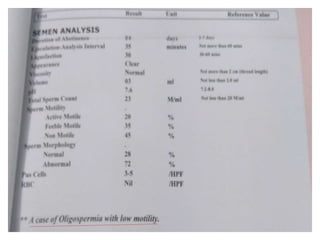
Difficult Cases in IUI
Moderator
• Dr Sujoy Dasgupta
Panelists
• Dr Sneha Tickoo
• Dr Dorothy Ghosh
• Dr Kakoli Pal
• Dr Nilanjan Paik
• Dr Siuli Chowdhury
• Dr Paromita Hazra
• Dr Sudakshina Panja
Dr Sujoy Dasgupta
MBBS (Gold Medalist, Hons)
MS (OBGY- Gold Medalist)
DNB (New Delhi)
MRCOG (London)
Advanced ART Course for Clinicians (NUHS, Singapore)
M Sc, Sexual and Reproductive Medicine (South Wales, UK)
Consultant: Reproductive Medicine, Genome Fertility
Centre, Kolkata
Managing Committee Member, BOGS, 2022-23
Executive Committee Member, ISAR Bengal, 2022-24
Clinical Examiner, MRCOG Part 3 Examination
Winner, Prof Geoffrey Chamberlain Award, RCOG World
Congress, London, 2019
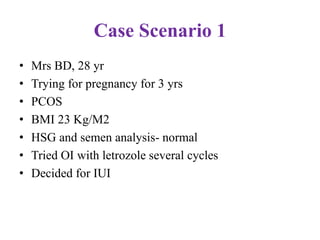
Case Scenario 1
• Mrs BD, 28 yr
• Trying for pregnancy for 3 yrs
• PCOS
• BMI 23 Kg/M2
• HSG and semen analysis- normal
• Tried OI with letrozole several cycles
• Decided for IUI
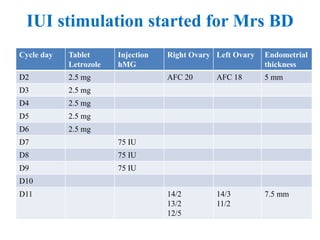
Cycle day Tablet
Letrozole
Injection
hMG
Right Ovary Left Ovary Endometrial
thickness
D2 2.5 mg AFC 20 AFC 18 5 mm
D3 2.5 mg
D4 2.5 mg
D5 2.5 mg
D6 2.5 mg
D7 75 IU
D8 75 IU
D9 75 IU
D10
D11 14/2
13/2
12/5
14/3
11/2
7.5 mm
IUI stimulation started for Mrs BD
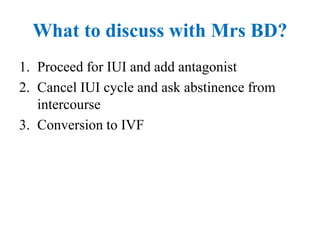
What to discuss with Mrs BD?
1. Proceed for IUI and add antagonist
2. Cancel IUI cycle and ask abstinence from
intercourse
3. Conversion to IVF
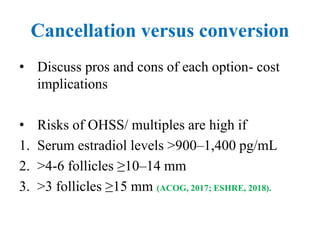
Cancellation versus conversion
• Discuss pros and cons of each option- cost
implications
• Risks of OHSS/ multiples are high if
1. Serum estradiol levels >900–1,400 pg/mL
2. >4-6 follicles ≥10–14 mm
3. >3 follicles ≥15 mm (ACOG, 2017; ESHRE, 2018).
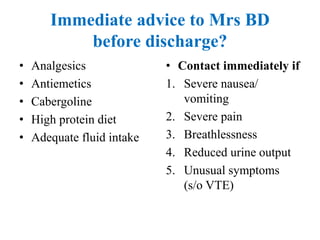
Immediate advice to Mrs BD
before discharge?
• Analgesics
• Antiemetics
• Cabergoline
• High protein diet
• Adequate fluid intake
• Contact immediately if
1. Severe nausea/
vomiting
2. Severe pain
3. Breathlessness
4. Reduced urine output
5. Unusual symptoms
(s/o VTE)
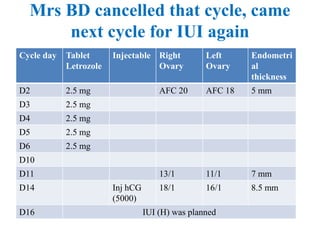
Cycle day Tablet
Letrozole
Injectable Right
Ovary
Left
Ovary
Endometri
al
thickness
D2 2.5 mg AFC 20 AFC 18 5 mm
D3 2.5 mg
D4 2.5 mg
D5 2.5 mg
D6 2.5 mg
D10
D11 13/1 11/1 7 mm
D14 Inj hCG
(5000)
18/1 16/1 8.5 mm
D16 IUI (H) was planned
Mrs BD cancelled that cycle, came
next cycle for IUI again
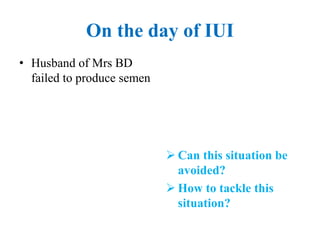
On the day of IUI
• Husband of Mrs BD
failed to produce semen
 Can this situation be
avoided?
 How to tackle this
situation?
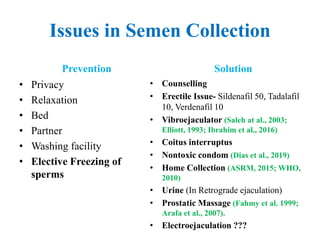
Issues in Semen Collection
Prevention
• Privacy
• Relaxation
• Bed
• Partner
• Washing facility
• Elective Freezing of
sperms
Solution
• Counselling
• Erectile Issue- Sildenafil 50, Tadalafil
10, Verdenafil 10
• Vibroejaculator (Saleh at al., 2003;
Elliott, 1993; Ibrahim et al., 2016)
• Coitus interruptus
• Nontoxic condom (Dias et al., 2019)
• Home Collection (ASRM, 2015; WHO,
2010)
• Urine (In Retrograde ejaculation)
• Prostatic Massage (Fahmy et al. 1999;
Arafa et al., 2007).
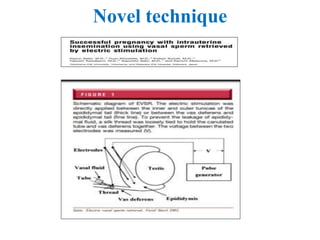
• Electroejaculation ???
Novel technique
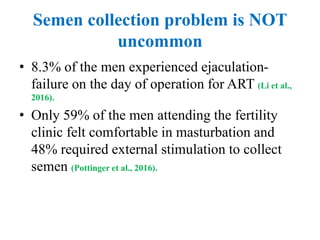
Semen collection problem is NOT
uncommon
• 8.3% of the men experienced ejaculation-
failure on the day of operation for ART (Li et al.,
2016).
• Only 59% of the men attending the fertility
clinic felt comfortable in masturbation and
48% required external stimulation to collect
semen (Pottinger et al., 2016).
Case Scenario 2
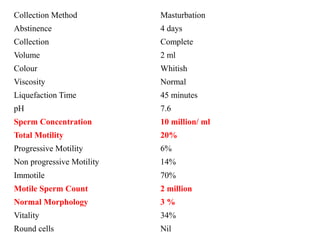
• Mr PS
• Medical H/O- nothing significant
Collection Method Masturbation
Abstinence 4 days
Collection Complete
Volume 2 ml
Colour Whitish
Viscosity Normal
Liquefaction Time 45 minutes
pH 7.6
Sperm Concentration 10 million/ ml
Total Motility 20%
Progressive Motility 6%
Non progressive Motility 14%
Immotile 70%
Motile Sperm Count 2 million
Normal Morphology 3 %
Vitality 34%
Round cells Nil
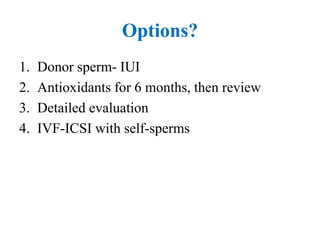
Options?
1. Donor sperm- IUI
2. Antioxidants for 6 months, then review
3. Detailed evaluation
4. IVF-ICSI with self-sperms
Severe Male Factor- if not left
untreated ???
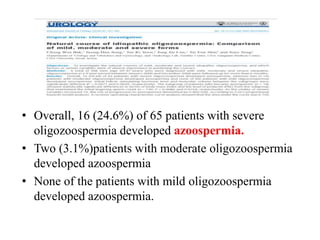
• Progressive decline in semen parameters
• Overall, 16 (24.6%) of 65 patients with severe
oligozoospermia developed azoospermia.
• Two (3.1%)patients with moderate oligozoospermia
developed azoospermia
• None of the patients with mild oligozoospermia
developed azoospermia.
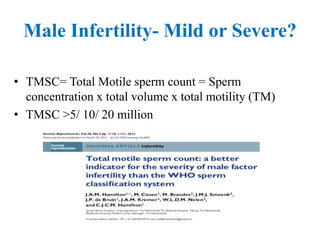
Male Infertility- Mild or Severe?
• TMSC= Total Motile sperm count = Sperm
concentration x total volume x total motility (TM)
• TMSC >5/ 10/ 20 million
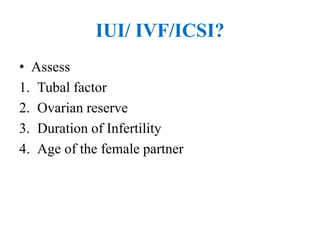
IUI/ IVF/ICSI?
• Assess
1. Tubal factor
2. Ovarian reserve
3. Duration of Infertility
4. Age of the female partner
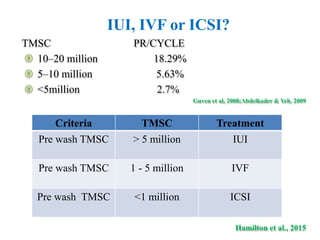
TMSC PR/CYCLE
 10–20 million 18.29%
 5–10 million 5.63%
 <5million 2.7%
Guven et al, 2008;Abdelkader & Yeh, 2009
Hamilton et al., 2015
Criteria TMSC Treatment
Pre wash TMSC > 5 million IUI
Pre wash TMSC 1 - 5 million IVF
Pre wash TMSC <1 million ICSI
IUI, IVF or ICSI?
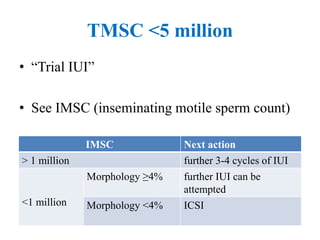
TMSC <5 million
• “Trial IUI”
• See IMSC (inseminating motile sperm count)
IMSC Next action
> 1 million further 3-4 cycles of IUI
<1 million
Morphology ≥4% further IUI can be
attempted
Morphology <4% ICSI
Any other thing?
• obtaining a second semen sample when the
motile sperm yield of the first semen sample is
1 million to 5 million significantly increases
the total motile sperm count in the final
inseminate.
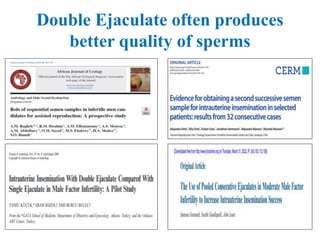
Double Ejaculate often produces
better quality of sperms
Oligospermia and IUI
TMSC 5-10 million
Do IUI 4-6 cycles
TMSC <5 mil
1. Counseling before IUI
2. Double Ejaculate
3. Post wash- IMSC
4. IMSC >1 mil → Further
IUI
5. IMSC <1 mil → see
Morphology
6. No role of double
insemination or any special
washing technique
(ESHRE., 2018)
Case Scenario 3
• Mrs AC, 30-yr
• Trying for pregnancy for 2 years
• c/o severe dysmenorrhoea
• AMH 3.5 ng/ml
• 5 cm endometrioma in Rt ovary
• Semen analysis normal
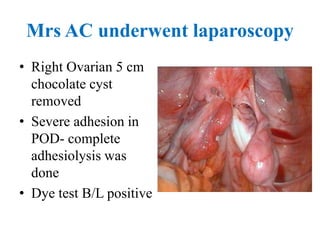
Mrs AC underwent laparoscopy
• Right Ovarian 5 cm
chocolate cyst
removed
• Severe adhesion in
POD- complete
adhesiolysis was
done
• Dye test B/L positive
Mrs AC is now pain-free
• Visited 4 doctors over the period of next 2
years.
• Received different brands of letrozole for
ovulation induction- total 12 cycles
• She wants to do IUI
• AMH now 2.2 ng/ml
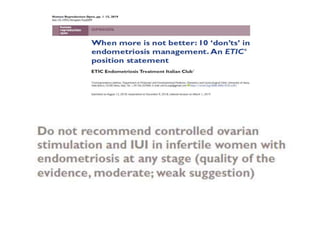
ESHRE, 2022
rASRM stage I/II
endometriosis
•May perform IUI with ovarian
stimulation, instead of expectant
management or IUI alone
•IUI+OS increases pregnancy rates.
rASRM stage III/IV
endometriosis
•The value of IUI in women with tubal
patency is uncertain
•IUI +OS could be considered
Can IUI be done in endometriosis?
Hughes, 1997 Meta-analysis- IUI success is halved in stage I/II
endometriosis
Gandhi et al., 2014 No difference between expectant management and IUI
Dmowski et al., 2002 First-cycle chance of pregnancy with IVF is
significantly higher than the cumulative pregnancy rate
after 6 IUI cycles
Van der Houwen et al., 2014;
D’Hooghe et al., 2006
The risk of endometriosis recurrence appears to be
increased by IUI (more than IVF)
IVF, but not IUI, can be expected to overcome the
detrimental effects of a pelvic inflammatory milieu.
Limitations of IUI in endometriosis
Mrs AC agreed for IUI
• On the day of IUI
• Husband- Mr AC collected semen
• Previous semen analysis- Normozoospermia
• Today- 4-5 motile sperms/hpf
 Explanation?
 Remedy?
Possible reasons of sudden abnormal
semen parameters
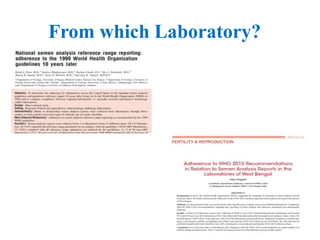
• Laboratories not adhering to WHO standards (Penn et al.,
2010; Keel et al., 2002)
• Significant intra-individual variability (10.3-26.8%
(Alvarez et al., 2003).
• Testicular heat exposure 3 months back (e.g., fever)
(WHO, 2010)
• New insults to spermatogenesis (mumps orchitis,
Covid-19 infection, TB, diabetes, drug exposure,
cancer treatment)
• Inadequate sexual stimulation can affect semen
quality (van Roijen et al., 1993)
From which Laboratory?
Solution for husband of Mr AC?
• Double ejaculate
Case Scenario 4
• Mrs TR, 28 yrs
• Trying for pregnancy for 5 yrs
• PCOS- not responded to letrozole and CC
• Underwent LOD, tubes patent
• Partner’s semen normal
• Requests for IUI
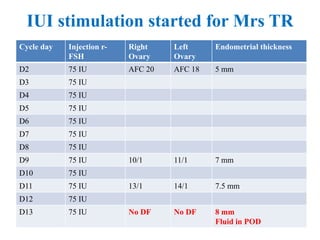
Cycle day Injection r-
FSH
Right
Ovary
Left
Ovary
Endometrial thickness
D2 75 IU AFC 20 AFC 18 5 mm
D3 75 IU
D4 75 IU
D5 75 IU
D6 75 IU
D7 75 IU
D8 75 IU
D9 75 IU 10/1 11/1 7 mm
D10 75 IU
D11 75 IU 13/1 14/1 7.5 mm
D12 75 IU
D13 75 IU No DF No DF 8 mm
Fluid in POD
IUI stimulation started for Mrs TR
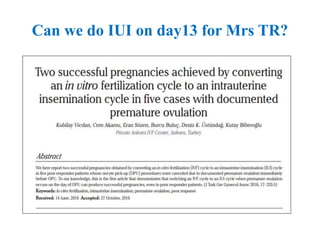
Can we do IUI on day13 for Mrs TR?
ESHRE, 2018
• If a HCG injection is used, single IUI can be
performed any time between 24 and 40 h after
HCG injection without compromising
pregnancy rates.
• IUI in a natural (not ovarian stimulated) cycle
should be performed 1 day after LH rise.
Prevention of premature ovulation
in IUI
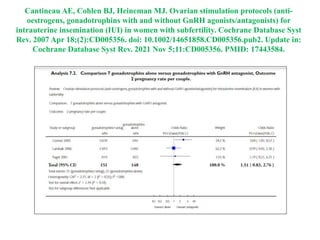
• GnRH Antagonist?
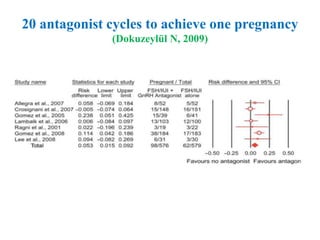
20 antagonist cycles to achieve one pregnancy
(Dokuzeylül N, 2009)
Cantineau AE, Cohlen BJ, Heineman MJ. Ovarian stimulation protocols (anti-
oestrogens, gonadotrophins with and without GnRH agonists/antagonists) for
intrauterine insemination (IUI) in women with subfertility. Cochrane Database Syst
Rev. 2007 Apr 18;(2):CD005356. doi: 10.1002/14651858.CD005356.pub2. Update in:
Cochrane Database Syst Rev. 2021 Nov 5;11:CD005356. PMID: 17443584.
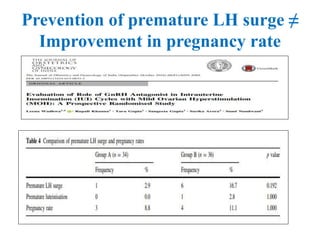
Prevention of premature LH surge ≠
Improvement in pregnancy rate
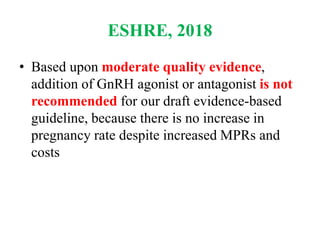
ESHRE, 2018
• Based upon moderate quality evidence,
addition of GnRH agonist or antagonist is not
recommended for our draft evidence-based
guideline, because there is no increase in
pregnancy rate despite increased MPRs and
costs
Case 5
• Mrs SN undergoing IUI for unexplained
subfertility
• Satisfactory stimulation response
• No significant medical/ surgical history
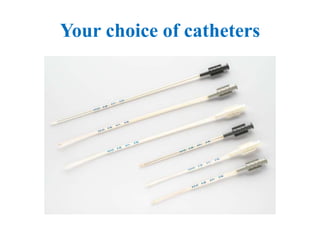
Your choice of catheters
During IUI
• Catheter could not be negotiated
• Is it “difficult insemination”?
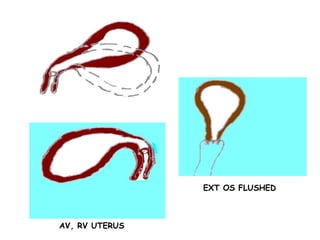
What is difficult insemination?
Insemination: easy in 80%,
difficult in 20%
Greater resistance during catheter negotiation
Harder catheter needed
Cervical dilatation needed
Blood in catheter
AV, RV UTERUS
EXT OS FLUSHED
What to do first?
• Full bladder • The pregnancy rate was higher in the full
bladder group than in the empty bladder
(control) group (P=0.03, 13.5% vs 7.4%; RR
1.95; 95% CI 1.048-3.637).
• The risk of undergoing difficult IUI was
higher in the empty bladder group than the
full bladder group (P<0.001; 10.0% vs 37.8%,
RR 0.18 for difficulty IUI; 95% CI 0.11-0.30).
• The clinical pregnancy rate was also higher
in the group of patients who had easy IUI
than in the group of patients who had difficult
IUI (P<0.05, 12.7% [42/331] vs 5.5% [6/110]);
RR 2.51 for pregnancy; 95% CI 1.04-6.09)
(Ayas et al., 2012)
Still difficult?
Keep Cx centrally in vagina by speculum manipulation
Slight traction on Cx with Allis’ tissue forceps:
straightens out utero-cervical angulations
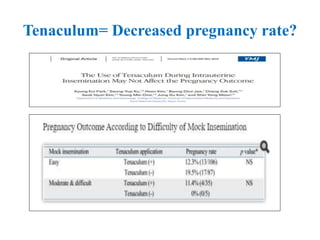
Tenaculum= Decreased pregnancy rate?
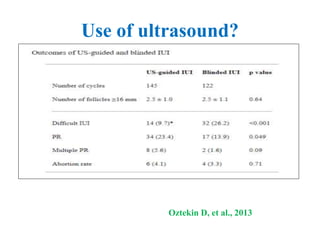
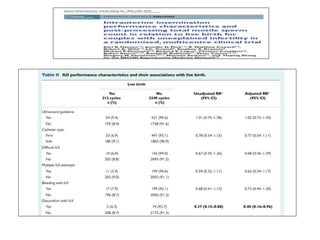
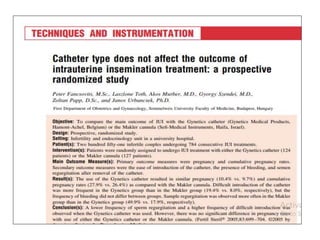
Use of ultrasound?
Oztekin D, et al., 2013
• Ultrasound-guided IUI significantly improved the
clinical pregnancy rate when compared to the classical
group (RR = 1.33, 95% CI [1.05, 1.68], p = 0.02).
• No significant differences between both groups in terms of
miscarriage and live birth rates.
• Ultrasound-guided IUI significantly reduced the
incidence of difficulty reported during the procedure (RR
= 0.42, 95% CI [0.21, 0.84], p = 0.01).
• The GRADEpro GDT tool showed high quality of
evidence for the evaluated outcomes.
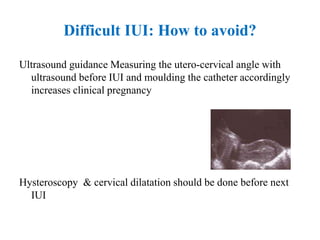
Difficult IUI: How to avoid?
Ultrasound guidance Measuring the utero-cervical angle with
ultrasound before IUI and moulding the catheter accordingly
increases clinical pregnancy
Hysteroscopy & cervical dilatation should be done before next
IUI
Mock IUI?
Enables the clinician to assess the degree of difficulty
• assessment of depth and shape of uterus
• selection of optimal catheter type
• mapping the easiest and least traumatic entry
into uterine cavity
• identify cervical stenosis
Difficult Cases in IUI

Difficult Cases in IUI

  • 1.
    Difficult Cases inIUI Moderator • Dr Sujoy Dasgupta Panelists • Dr Sneha Tickoo • Dr Dorothy Ghosh • Dr Kakoli Pal • Dr Nilanjan Paik • Dr Siuli Chowdhury • Dr Paromita Hazra • Dr Sudakshina Panja
  • 2.
    Dr Sujoy Dasgupta MBBS(Gold Medalist, Hons) MS (OBGY- Gold Medalist) DNB (New Delhi) MRCOG (London) Advanced ART Course for Clinicians (NUHS, Singapore) M Sc, Sexual and Reproductive Medicine (South Wales, UK) Consultant: Reproductive Medicine, Genome Fertility Centre, Kolkata Managing Committee Member, BOGS, 2022-23 Executive Committee Member, ISAR Bengal, 2022-24 Clinical Examiner, MRCOG Part 3 Examination Winner, Prof Geoffrey Chamberlain Award, RCOG World Congress, London, 2019
  • 3.
    Case Scenario 1 •Mrs BD, 28 yr • Trying for pregnancy for 3 yrs • PCOS • BMI 23 Kg/M2 • HSG and semen analysis- normal • Tried OI with letrozole several cycles • Decided for IUI
  • 4.
    Cycle day Tablet Letrozole Injection hMG RightOvary Left Ovary Endometrial thickness D2 2.5 mg AFC 20 AFC 18 5 mm D3 2.5 mg D4 2.5 mg D5 2.5 mg D6 2.5 mg D7 75 IU D8 75 IU D9 75 IU D10 D11 14/2 13/2 12/5 14/3 11/2 7.5 mm IUI stimulation started for Mrs BD
  • 5.
    What to discusswith Mrs BD? 1. Proceed for IUI and add antagonist 2. Cancel IUI cycle and ask abstinence from intercourse 3. Conversion to IVF
  • 6.
    Cancellation versus conversion •Discuss pros and cons of each option- cost implications • Risks of OHSS/ multiples are high if 1. Serum estradiol levels >900–1,400 pg/mL 2. >4-6 follicles ≥10–14 mm 3. >3 follicles ≥15 mm (ACOG, 2017; ESHRE, 2018).
  • 7.
    Immediate advice toMrs BD before discharge? • Analgesics • Antiemetics • Cabergoline • High protein diet • Adequate fluid intake • Contact immediately if 1. Severe nausea/ vomiting 2. Severe pain 3. Breathlessness 4. Reduced urine output 5. Unusual symptoms (s/o VTE)
  • 8.
    Cycle day Tablet Letrozole InjectableRight Ovary Left Ovary Endometri al thickness D2 2.5 mg AFC 20 AFC 18 5 mm D3 2.5 mg D4 2.5 mg D5 2.5 mg D6 2.5 mg D10 D11 13/1 11/1 7 mm D14 Inj hCG (5000) 18/1 16/1 8.5 mm D16 IUI (H) was planned Mrs BD cancelled that cycle, came next cycle for IUI again
  • 9.
    On the dayof IUI • Husband of Mrs BD failed to produce semen  Can this situation be avoided?  How to tackle this situation?
  • 10.
    Issues in SemenCollection Prevention • Privacy • Relaxation • Bed • Partner • Washing facility • Elective Freezing of sperms Solution • Counselling • Erectile Issue- Sildenafil 50, Tadalafil 10, Verdenafil 10 • Vibroejaculator (Saleh at al., 2003; Elliott, 1993; Ibrahim et al., 2016) • Coitus interruptus • Nontoxic condom (Dias et al., 2019) • Home Collection (ASRM, 2015; WHO, 2010) • Urine (In Retrograde ejaculation) • Prostatic Massage (Fahmy et al. 1999; Arafa et al., 2007). • Electroejaculation ???
  • 11.
  • 12.
    Semen collection problemis NOT uncommon • 8.3% of the men experienced ejaculation- failure on the day of operation for ART (Li et al., 2016). • Only 59% of the men attending the fertility clinic felt comfortable in masturbation and 48% required external stimulation to collect semen (Pottinger et al., 2016).
  • 13.
    Case Scenario 2 •Mr PS • Medical H/O- nothing significant
  • 14.
    Collection Method Masturbation Abstinence4 days Collection Complete Volume 2 ml Colour Whitish Viscosity Normal Liquefaction Time 45 minutes pH 7.6 Sperm Concentration 10 million/ ml Total Motility 20% Progressive Motility 6% Non progressive Motility 14% Immotile 70% Motile Sperm Count 2 million Normal Morphology 3 % Vitality 34% Round cells Nil
  • 15.
    Options? 1. Donor sperm-IUI 2. Antioxidants for 6 months, then review 3. Detailed evaluation 4. IVF-ICSI with self-sperms
  • 16.
    Severe Male Factor-if not left untreated ??? • Progressive decline in semen parameters
  • 17.
    • Overall, 16(24.6%) of 65 patients with severe oligozoospermia developed azoospermia. • Two (3.1%)patients with moderate oligozoospermia developed azoospermia • None of the patients with mild oligozoospermia developed azoospermia.
  • 18.
    Male Infertility- Mildor Severe? • TMSC= Total Motile sperm count = Sperm concentration x total volume x total motility (TM) • TMSC >5/ 10/ 20 million
  • 19.
    IUI/ IVF/ICSI? • Assess 1.Tubal factor 2. Ovarian reserve 3. Duration of Infertility 4. Age of the female partner
  • 20.
    TMSC PR/CYCLE  10–20million 18.29%  5–10 million 5.63%  <5million 2.7% Guven et al, 2008;Abdelkader & Yeh, 2009 Hamilton et al., 2015 Criteria TMSC Treatment Pre wash TMSC > 5 million IUI Pre wash TMSC 1 - 5 million IVF Pre wash TMSC <1 million ICSI IUI, IVF or ICSI?
  • 21.
    TMSC <5 million •“Trial IUI” • See IMSC (inseminating motile sperm count) IMSC Next action > 1 million further 3-4 cycles of IUI <1 million Morphology ≥4% further IUI can be attempted Morphology <4% ICSI
  • 22.
    Any other thing? •obtaining a second semen sample when the motile sperm yield of the first semen sample is 1 million to 5 million significantly increases the total motile sperm count in the final inseminate.
  • 23.
    Double Ejaculate oftenproduces better quality of sperms
  • 24.
    Oligospermia and IUI TMSC5-10 million Do IUI 4-6 cycles TMSC <5 mil 1. Counseling before IUI 2. Double Ejaculate 3. Post wash- IMSC 4. IMSC >1 mil → Further IUI 5. IMSC <1 mil → see Morphology 6. No role of double insemination or any special washing technique (ESHRE., 2018)
  • 25.
    Case Scenario 3 •Mrs AC, 30-yr • Trying for pregnancy for 2 years • c/o severe dysmenorrhoea • AMH 3.5 ng/ml • 5 cm endometrioma in Rt ovary • Semen analysis normal
  • 26.
    Mrs AC underwentlaparoscopy • Right Ovarian 5 cm chocolate cyst removed • Severe adhesion in POD- complete adhesiolysis was done • Dye test B/L positive
  • 27.
    Mrs AC isnow pain-free • Visited 4 doctors over the period of next 2 years. • Received different brands of letrozole for ovulation induction- total 12 cycles • She wants to do IUI • AMH now 2.2 ng/ml
  • 28.
    ESHRE, 2022 rASRM stageI/II endometriosis •May perform IUI with ovarian stimulation, instead of expectant management or IUI alone •IUI+OS increases pregnancy rates. rASRM stage III/IV endometriosis •The value of IUI in women with tubal patency is uncertain •IUI +OS could be considered Can IUI be done in endometriosis?
  • 29.
    Hughes, 1997 Meta-analysis-IUI success is halved in stage I/II endometriosis Gandhi et al., 2014 No difference between expectant management and IUI Dmowski et al., 2002 First-cycle chance of pregnancy with IVF is significantly higher than the cumulative pregnancy rate after 6 IUI cycles Van der Houwen et al., 2014; D’Hooghe et al., 2006 The risk of endometriosis recurrence appears to be increased by IUI (more than IVF) IVF, but not IUI, can be expected to overcome the detrimental effects of a pelvic inflammatory milieu. Limitations of IUI in endometriosis
  • 31.
    Mrs AC agreedfor IUI • On the day of IUI • Husband- Mr AC collected semen • Previous semen analysis- Normozoospermia • Today- 4-5 motile sperms/hpf  Explanation?  Remedy?
  • 32.
    Possible reasons ofsudden abnormal semen parameters • Laboratories not adhering to WHO standards (Penn et al., 2010; Keel et al., 2002) • Significant intra-individual variability (10.3-26.8% (Alvarez et al., 2003). • Testicular heat exposure 3 months back (e.g., fever) (WHO, 2010) • New insults to spermatogenesis (mumps orchitis, Covid-19 infection, TB, diabetes, drug exposure, cancer treatment) • Inadequate sexual stimulation can affect semen quality (van Roijen et al., 1993)
  • 33.
  • 35.
    Solution for husbandof Mr AC? • Double ejaculate
  • 36.
    Case Scenario 4 •Mrs TR, 28 yrs • Trying for pregnancy for 5 yrs • PCOS- not responded to letrozole and CC • Underwent LOD, tubes patent • Partner’s semen normal • Requests for IUI
  • 37.
    Cycle day Injectionr- FSH Right Ovary Left Ovary Endometrial thickness D2 75 IU AFC 20 AFC 18 5 mm D3 75 IU D4 75 IU D5 75 IU D6 75 IU D7 75 IU D8 75 IU D9 75 IU 10/1 11/1 7 mm D10 75 IU D11 75 IU 13/1 14/1 7.5 mm D12 75 IU D13 75 IU No DF No DF 8 mm Fluid in POD IUI stimulation started for Mrs TR
  • 38.
    Can we doIUI on day13 for Mrs TR?
  • 39.
    ESHRE, 2018 • Ifa HCG injection is used, single IUI can be performed any time between 24 and 40 h after HCG injection without compromising pregnancy rates. • IUI in a natural (not ovarian stimulated) cycle should be performed 1 day after LH rise.
  • 40.
    Prevention of prematureovulation in IUI • GnRH Antagonist?
  • 41.
    20 antagonist cyclesto achieve one pregnancy (Dokuzeylül N, 2009)
  • 42.
    Cantineau AE, CohlenBJ, Heineman MJ. Ovarian stimulation protocols (anti- oestrogens, gonadotrophins with and without GnRH agonists/antagonists) for intrauterine insemination (IUI) in women with subfertility. Cochrane Database Syst Rev. 2007 Apr 18;(2):CD005356. doi: 10.1002/14651858.CD005356.pub2. Update in: Cochrane Database Syst Rev. 2021 Nov 5;11:CD005356. PMID: 17443584.
  • 43.
    Prevention of prematureLH surge ≠ Improvement in pregnancy rate
  • 44.
    ESHRE, 2018 • Basedupon moderate quality evidence, addition of GnRH agonist or antagonist is not recommended for our draft evidence-based guideline, because there is no increase in pregnancy rate despite increased MPRs and costs
  • 45.
    Case 5 • MrsSN undergoing IUI for unexplained subfertility • Satisfactory stimulation response • No significant medical/ surgical history
  • 46.
    Your choice ofcatheters
  • 48.
    During IUI • Cathetercould not be negotiated • Is it “difficult insemination”?
  • 49.
    What is difficultinsemination? Insemination: easy in 80%, difficult in 20% Greater resistance during catheter negotiation Harder catheter needed Cervical dilatation needed Blood in catheter
  • 50.
  • 51.
    What to dofirst? • Full bladder • The pregnancy rate was higher in the full bladder group than in the empty bladder (control) group (P=0.03, 13.5% vs 7.4%; RR 1.95; 95% CI 1.048-3.637). • The risk of undergoing difficult IUI was higher in the empty bladder group than the full bladder group (P<0.001; 10.0% vs 37.8%, RR 0.18 for difficulty IUI; 95% CI 0.11-0.30). • The clinical pregnancy rate was also higher in the group of patients who had easy IUI than in the group of patients who had difficult IUI (P<0.05, 12.7% [42/331] vs 5.5% [6/110]); RR 2.51 for pregnancy; 95% CI 1.04-6.09) (Ayas et al., 2012)
  • 52.
    Still difficult? Keep Cxcentrally in vagina by speculum manipulation Slight traction on Cx with Allis’ tissue forceps: straightens out utero-cervical angulations
  • 53.
  • 54.
  • 55.
    • Ultrasound-guided IUIsignificantly improved the clinical pregnancy rate when compared to the classical group (RR = 1.33, 95% CI [1.05, 1.68], p = 0.02). • No significant differences between both groups in terms of miscarriage and live birth rates. • Ultrasound-guided IUI significantly reduced the incidence of difficulty reported during the procedure (RR = 0.42, 95% CI [0.21, 0.84], p = 0.01). • The GRADEpro GDT tool showed high quality of evidence for the evaluated outcomes.
  • 57.
    Difficult IUI: Howto avoid? Ultrasound guidance Measuring the utero-cervical angle with ultrasound before IUI and moulding the catheter accordingly increases clinical pregnancy Hysteroscopy & cervical dilatation should be done before next IUI
  • 58.
    Mock IUI? Enables theclinician to assess the degree of difficulty • assessment of depth and shape of uterus • selection of optimal catheter type • mapping the easiest and least traumatic entry into uterine cavity • identify cervical stenosis