Insight’12 – Lite, Coimbatore, India – May 2012
Lecture Overview
    Importance of LH suppression in COH
    LH suppresion using GnRH-antagonists
    Clinical Results
    Take-Home Messages

Esteves, 2
www.slideshare.net/sandroesteves
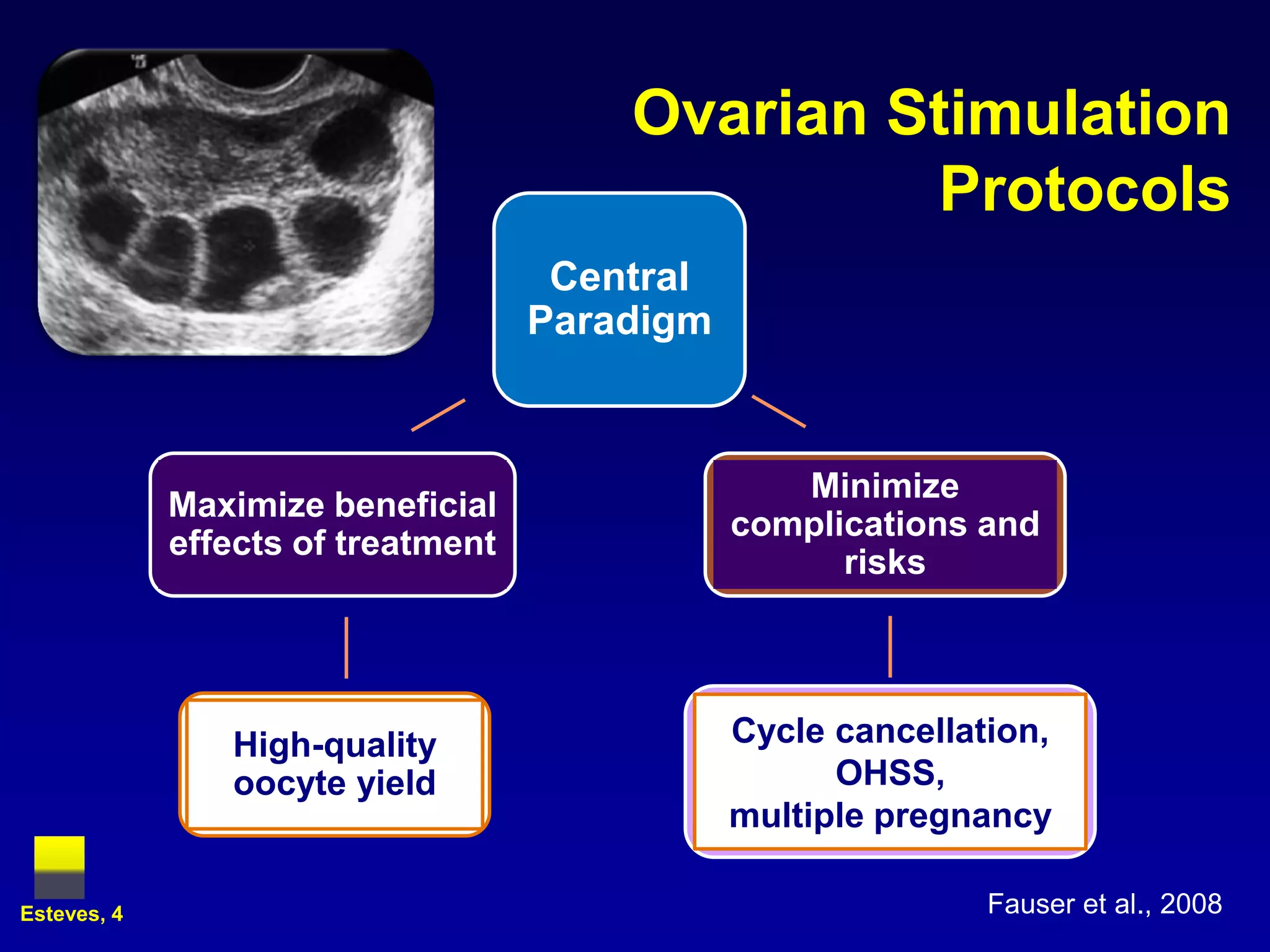
Ovarian Stimulation
                                                 Protocols
                                     Central
                                    Paradigm


                                                  Minimize
             Maximize beneficial
                                               complications and
             effects of treatment
                                                     risks


                High-quality                   Cycle cancellation,
                oocyte yield                         OHSS,
                                               multiple pregnancy

Esteves, 4                                                    Fauser et al., 2008
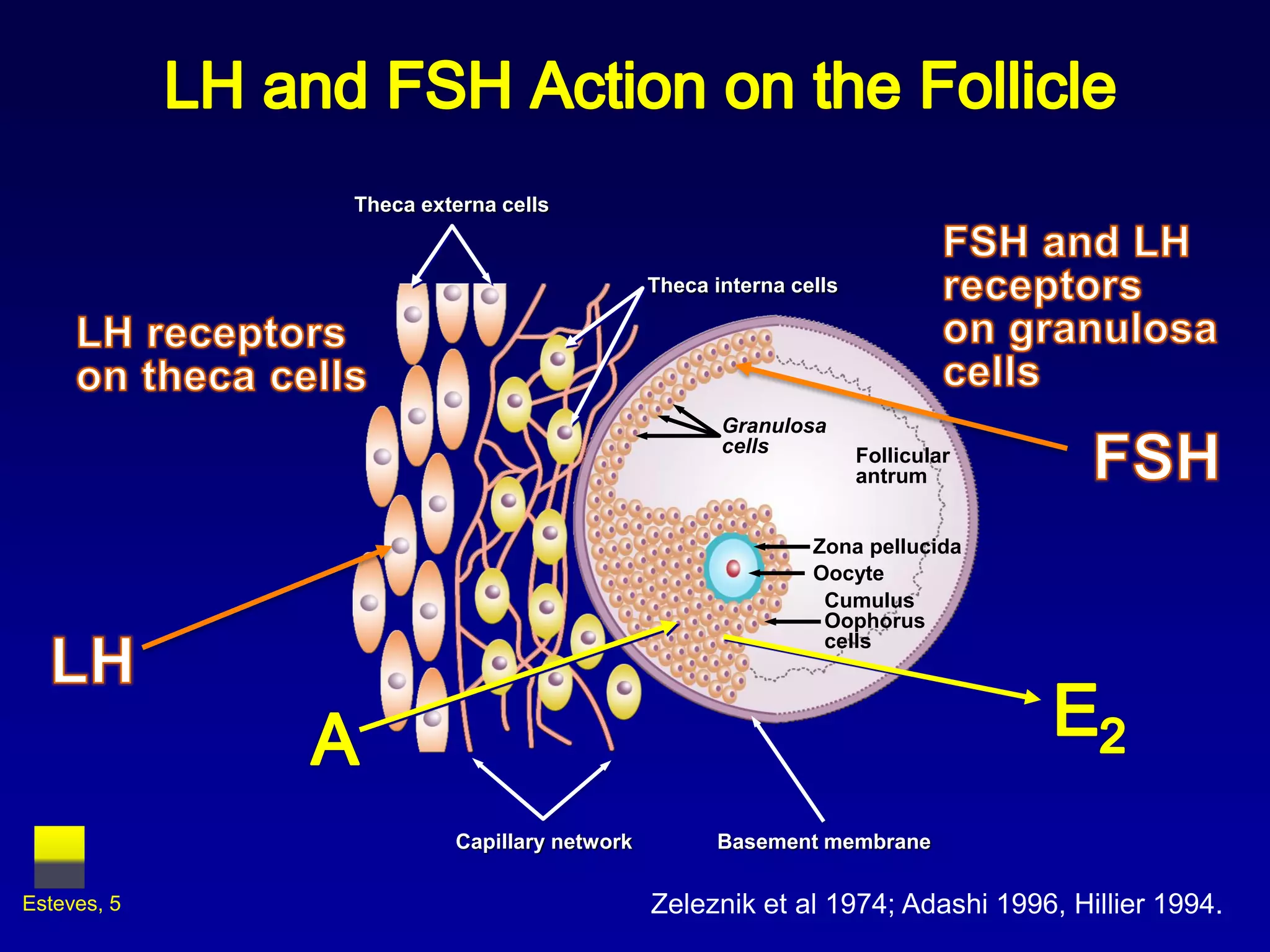
Theca externa cells


                                          Theca interna cells


                                                 Granulosa
                                                 cells          Follicular
                                                                antrum


                                                          Zona pellucida
                                                          Oocyte
                                                           Cumulus
                                                           Oophorus
                                                           cells


                      Capillary network         Basement membrane

Esteves, 5                                Zeleznik et al 1974; Adashi 1996, Hillier 1994.
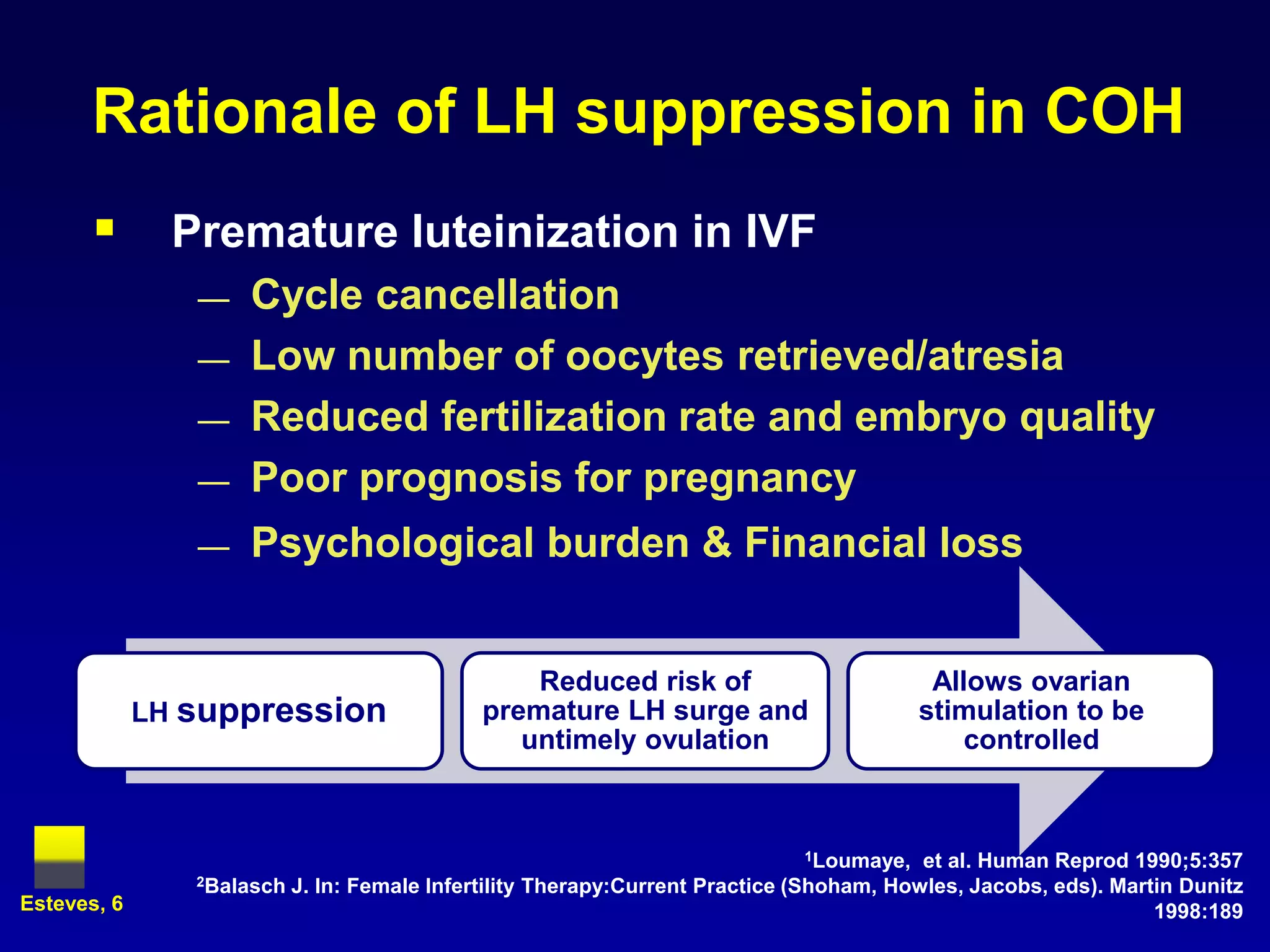
Rationale of LH suppression in COH
       Premature luteinization in IVF
                —   Cycle cancellation
                —   Low number of oocytes retrieved/atresia
                —   Reduced fertilization rate and embryo quality
                —   Poor prognosis for pregnancy
                —   Psychological burden & Financial loss


                                                  Reduced risk of                          Allows ovarian
             LH suppression                   premature LH surge and                      stimulation to be
                                                 untimely ovulation                           controlled


                                                                              1Loumaye,   et al. Human Reprod 1990;5:357
                2Balasch   J. In: Female Infertility Therapy:Current Practice (Shoham, Howles, Jacobs, eds). Martin Dunitz
Esteves, 6                                                                                                       1998:189
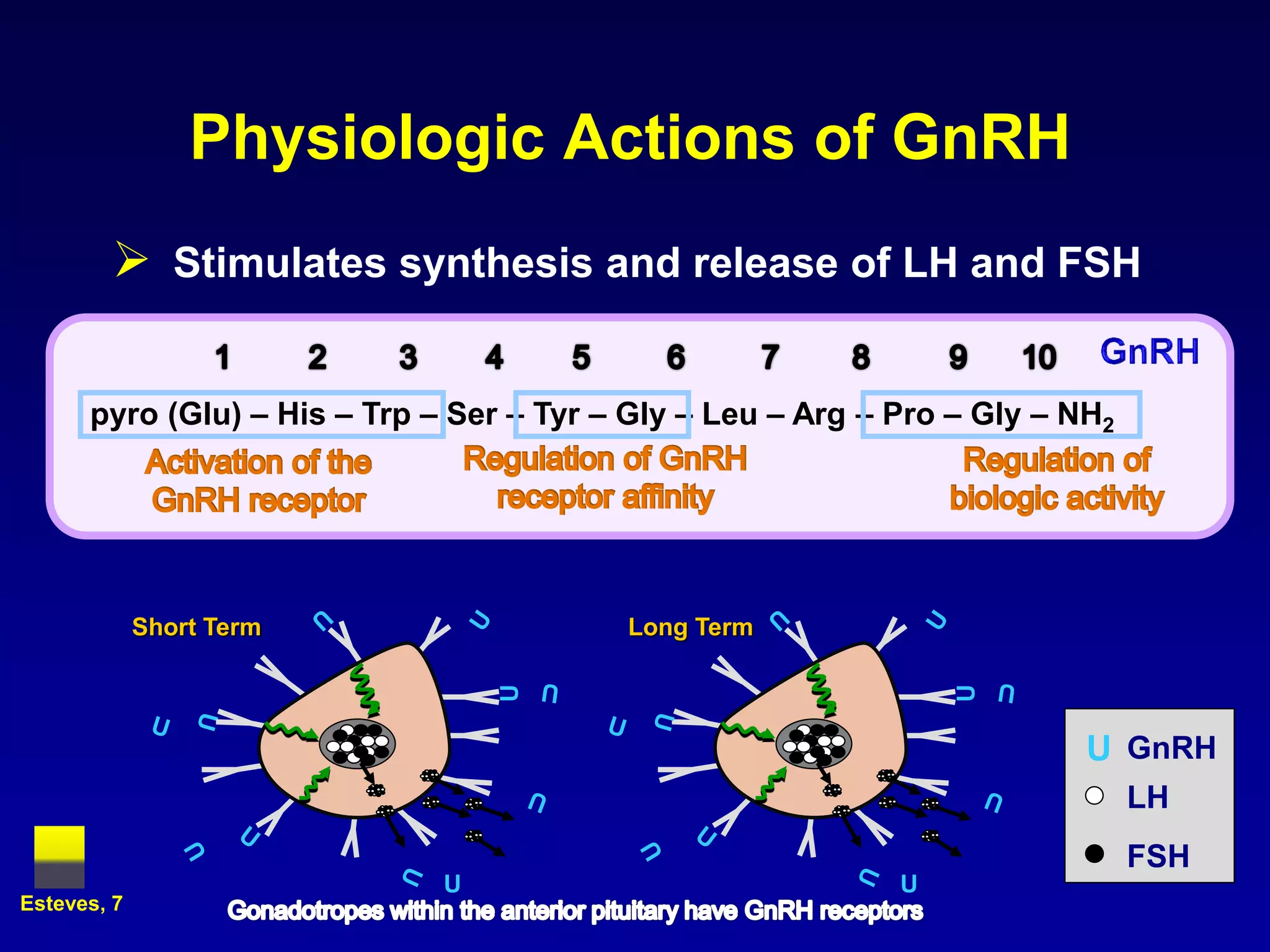
Physiologic Actions of GnRH
         Stimulates synthesis and release of LH and FSH

      pyro (Glu) – His – Trp – Ser – Tyr – Gly – Leu – Arg – Pro – Gly – NH2


             Short Term                   Long Term
                                  U


                                                                 U
                                                                          U GnRH
                                                                               LH
                                                                               FSH
                              U                              U
Esteves, 7
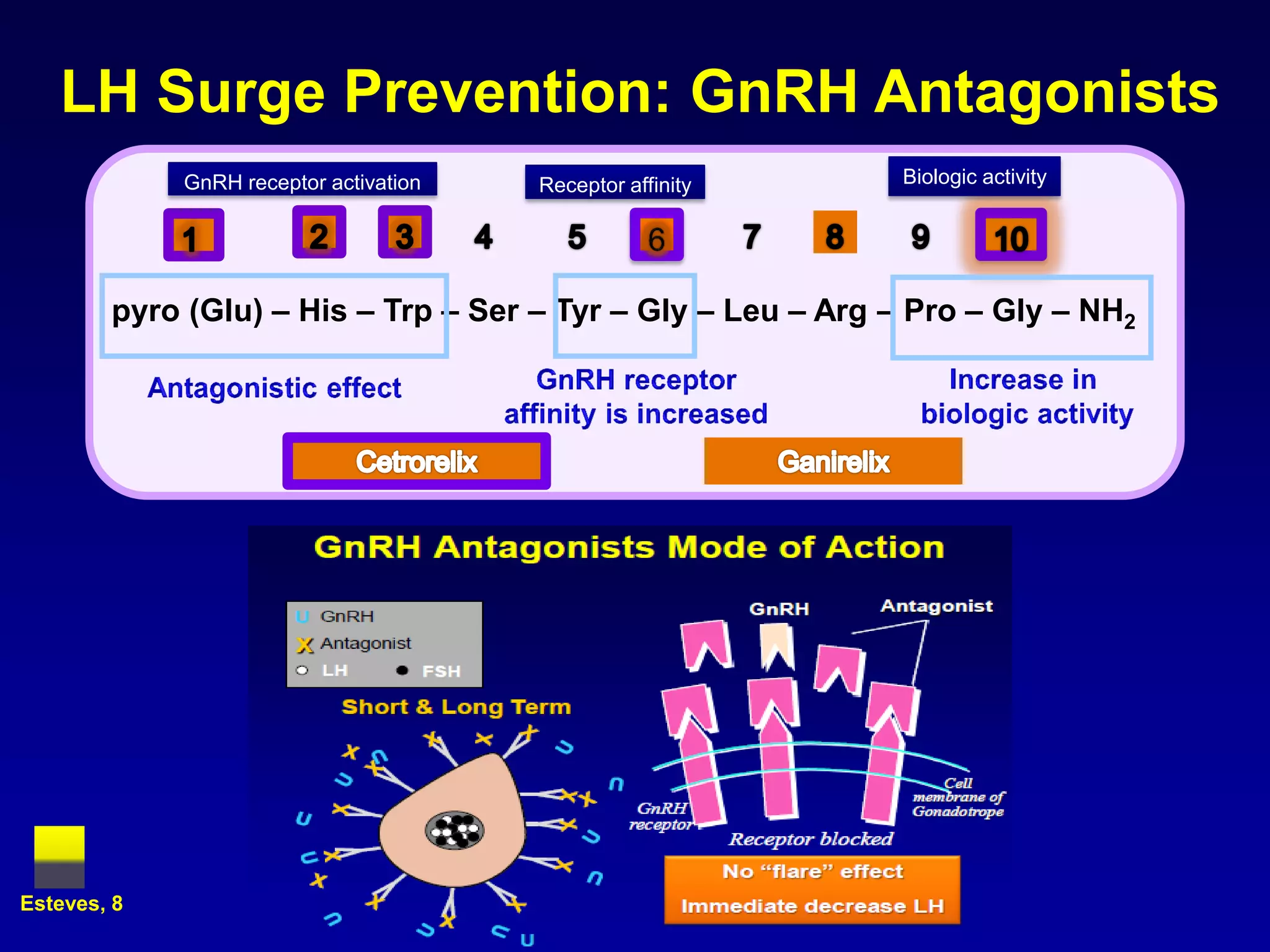
LH Surge Prevention: GnRH Antagonists
             GnRH receptor activation   Receptor affinity     Biologic activity


        pyro (Glu) – His – Trp – Ser – Tyr – Gly – Leu – Arg – Pro – Gly – NH2


Esteves, 8
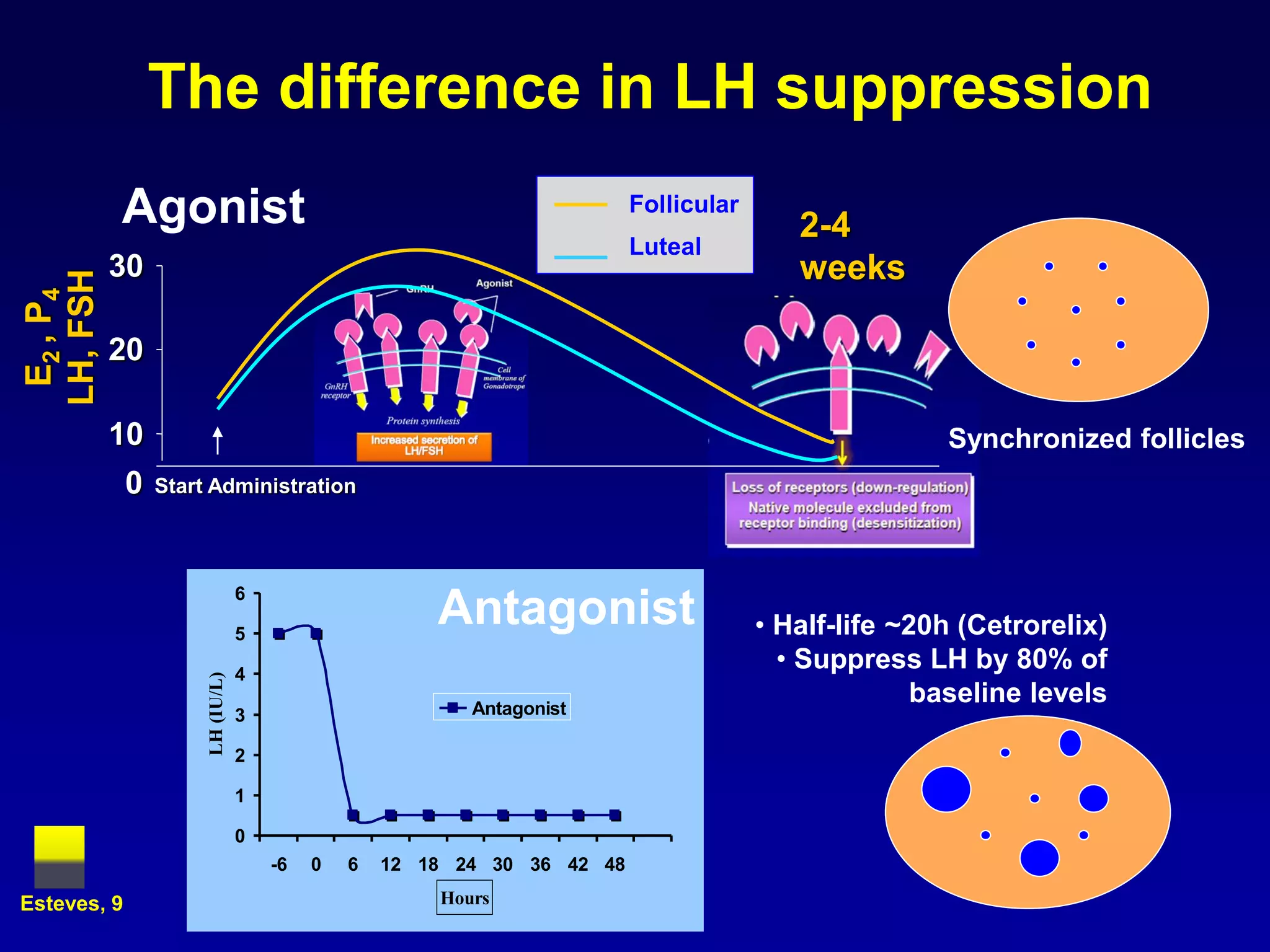
The difference in LH suppression
           Agonist                                                        Follicular
                                                                                          2-4
                                                                          Luteal
           30                                                                             weeks
LH, FSH
 E2 , P4


           20

           10                                                                                         Synchronized follicles
             0   Start Administration


                                  6

                                  5
                                                       Antagonist                      • Half-life ~20h (Cetrorelix)
                                  4
                                                                                         • Suppress LH by 80% of
                      LH (IU/L)


                                                          Antagonist
                                                                                                     baseline levels
                                  3

                                  2

                                  1

                                  0
                                      -6   0   6   12 18 24 30 36 42 48

Esteves, 9                                             Hours
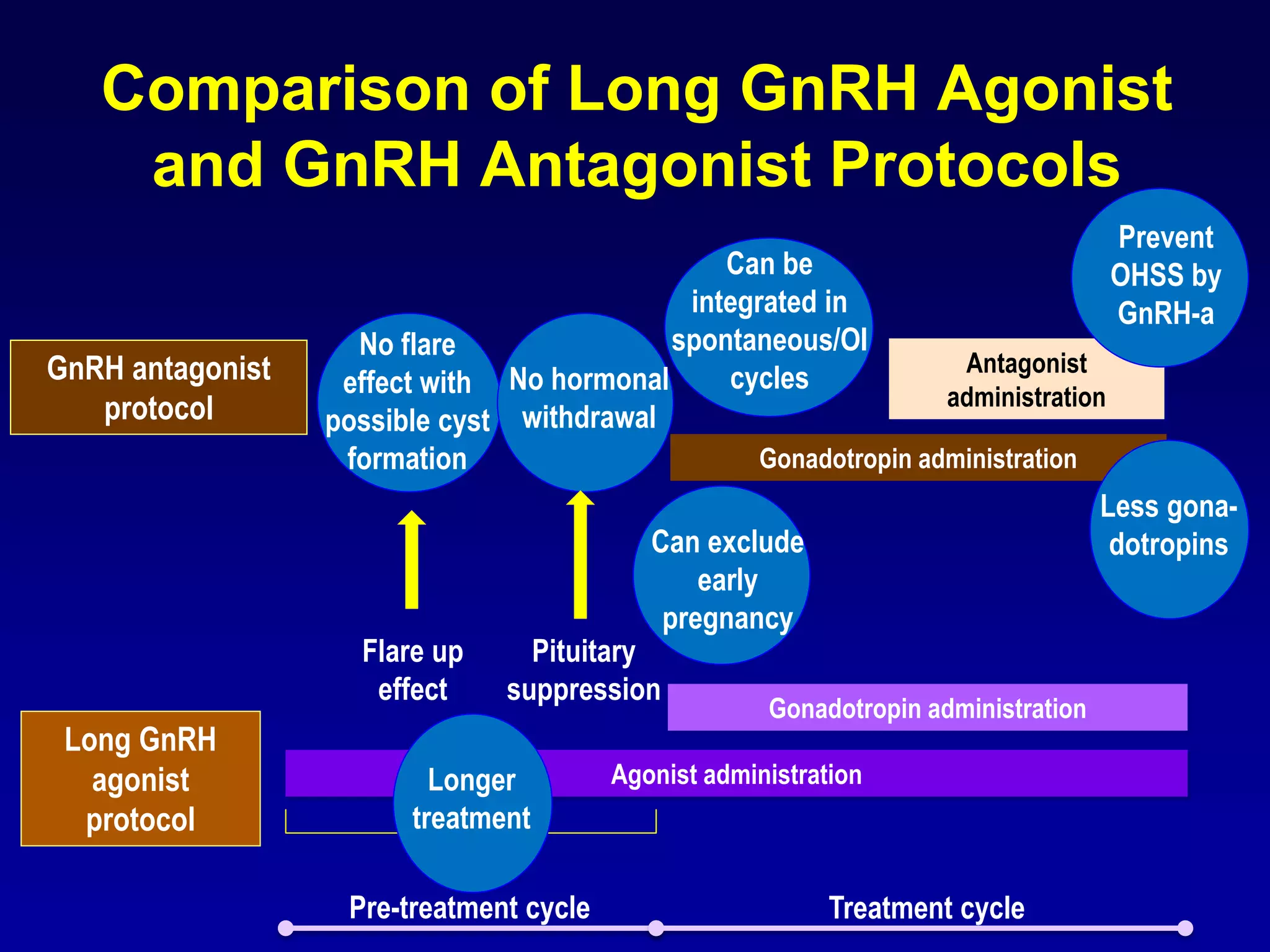
Comparison of Long GnRH Agonist
    and GnRH Antagonist Protocols
                                                                                     Prevent
                                                  Can be                            OHSS by
                                               integrated in                         GnRH-a
                    No flare                  spontaneous/OI
GnRH antagonist                                                       Antagonist
                   effect with No hormonal        cycles
   protocol                                                          administration
                  possible cyst  withdrawal
                   formation                          Gonadotropin administration
                                                                                   Less gona-
                                            Can exclude                             dotropins
                                                early
                                             pregnancy
                     Flare up     Pituitary
                      effect    suppression
                                                      Gonadotropin administration
 Long GnRH
   agonist                 Longer        Agonist administration
  protocol               treatment

                   Pre-treatment cycle                      Treatment cycle
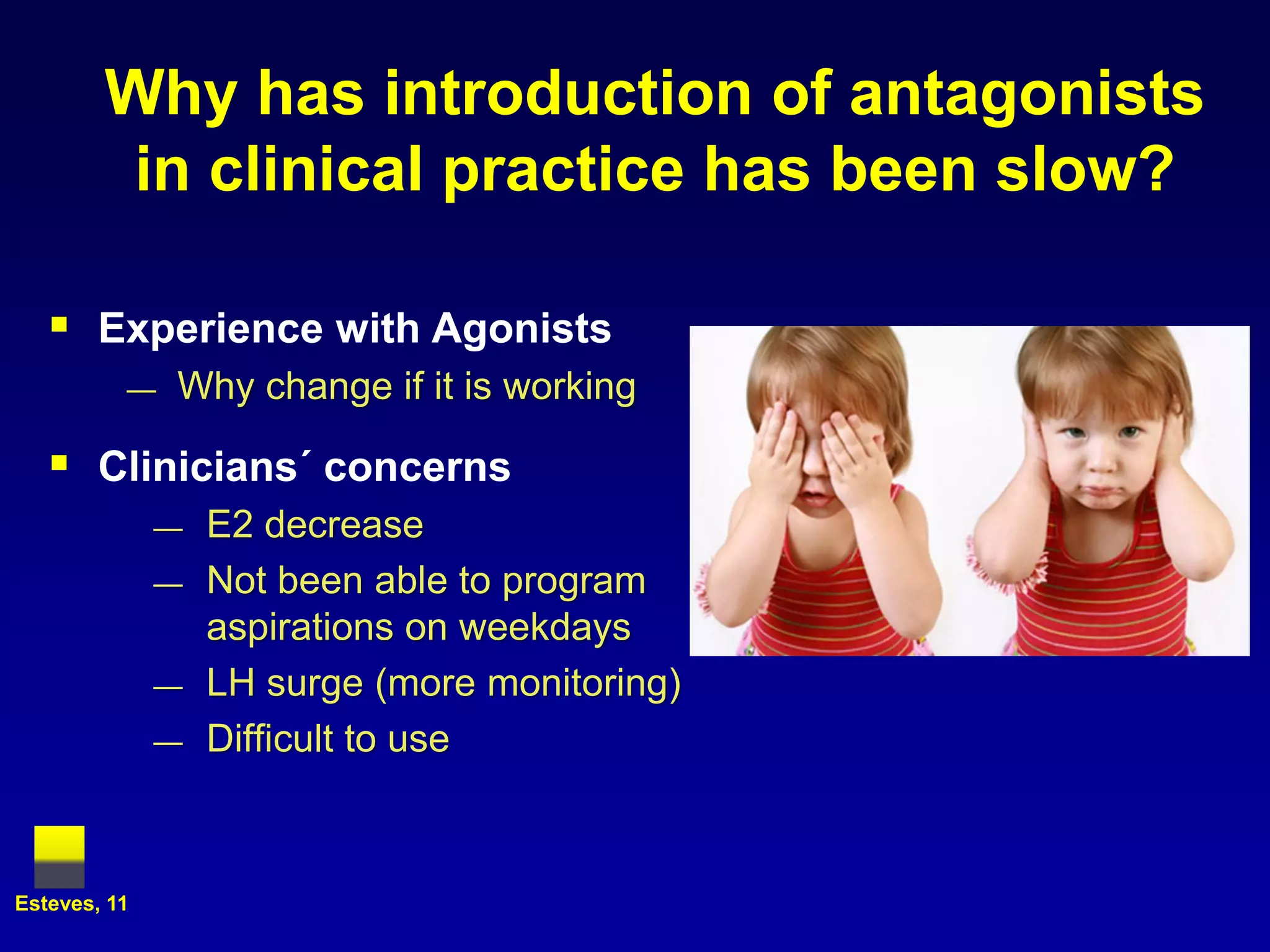
Why has introduction of antagonists
         in clinical practice has been slow?

    Experience with Agonists
          —   Why change if it is working

    Clinicians´ concerns
              —   E2 decrease
              —   Not been able to program
                  aspirations on weekdays
              —   LH surge (more monitoring)
              —   Difficult to use


Esteves, 11
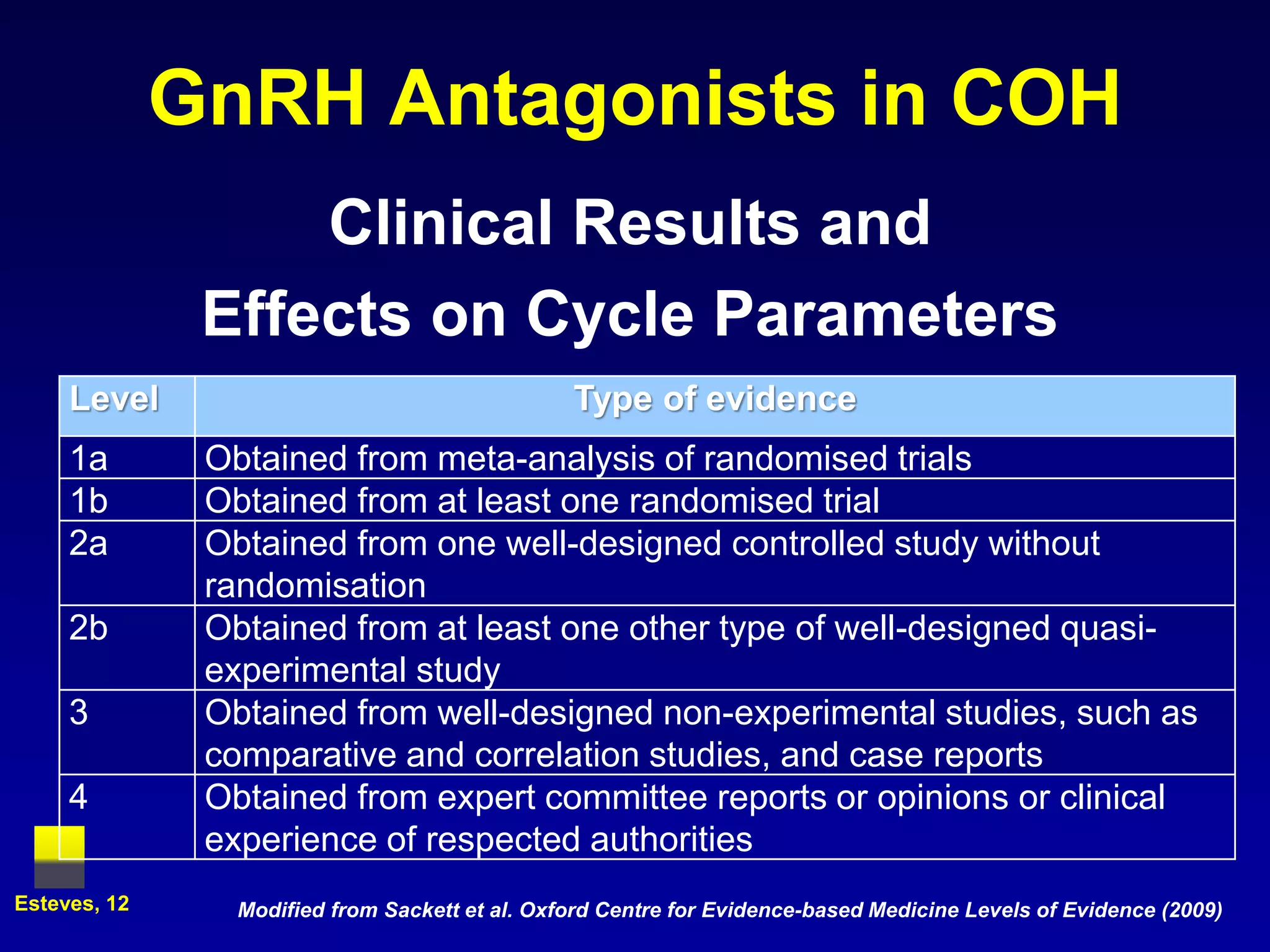
GnRH Antagonists in COH
                   Clinical Results and
               Effects on Cycle Parameters
     Level                                       Type of evidence
     1a        Obtained from meta-analysis of randomised trials
     1b        Obtained from at least one randomised trial
     2a        Obtained from one well-designed controlled study without
               randomisation
     2b        Obtained from at least one other type of well-designed quasi-
               experimental study
     3         Obtained from well-designed non-experimental studies, such as
               comparative and correlation studies, and case reports
     4         Obtained from expert committee reports or opinions or clinical
               experience of respected authorities
Esteves, 12      Modified from Sackett et al. Oxford Centre for Evidence-based Medicine Levels of Evidence (2009)
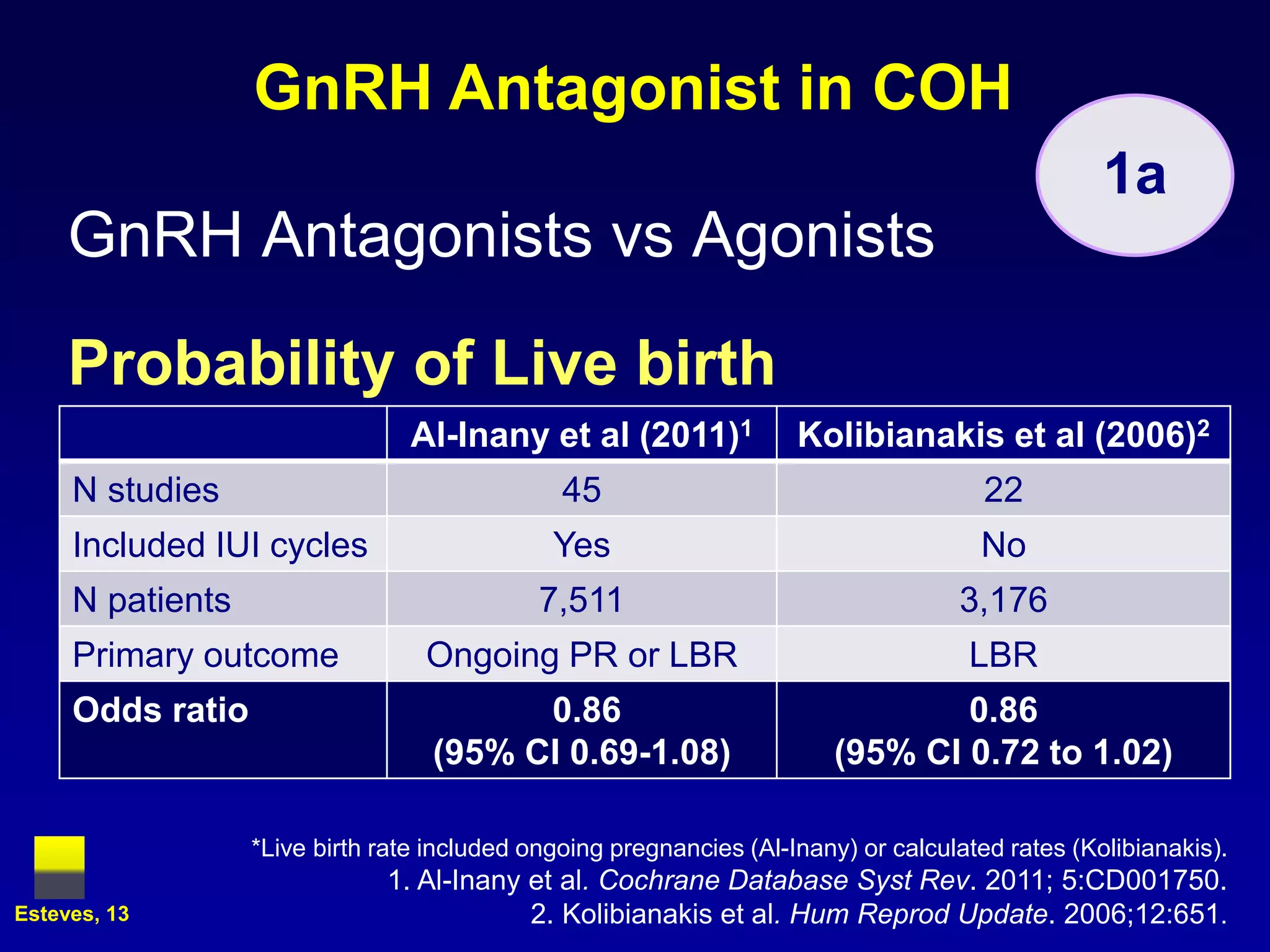
GnRH Antagonist in COH
                                                                                                  1a
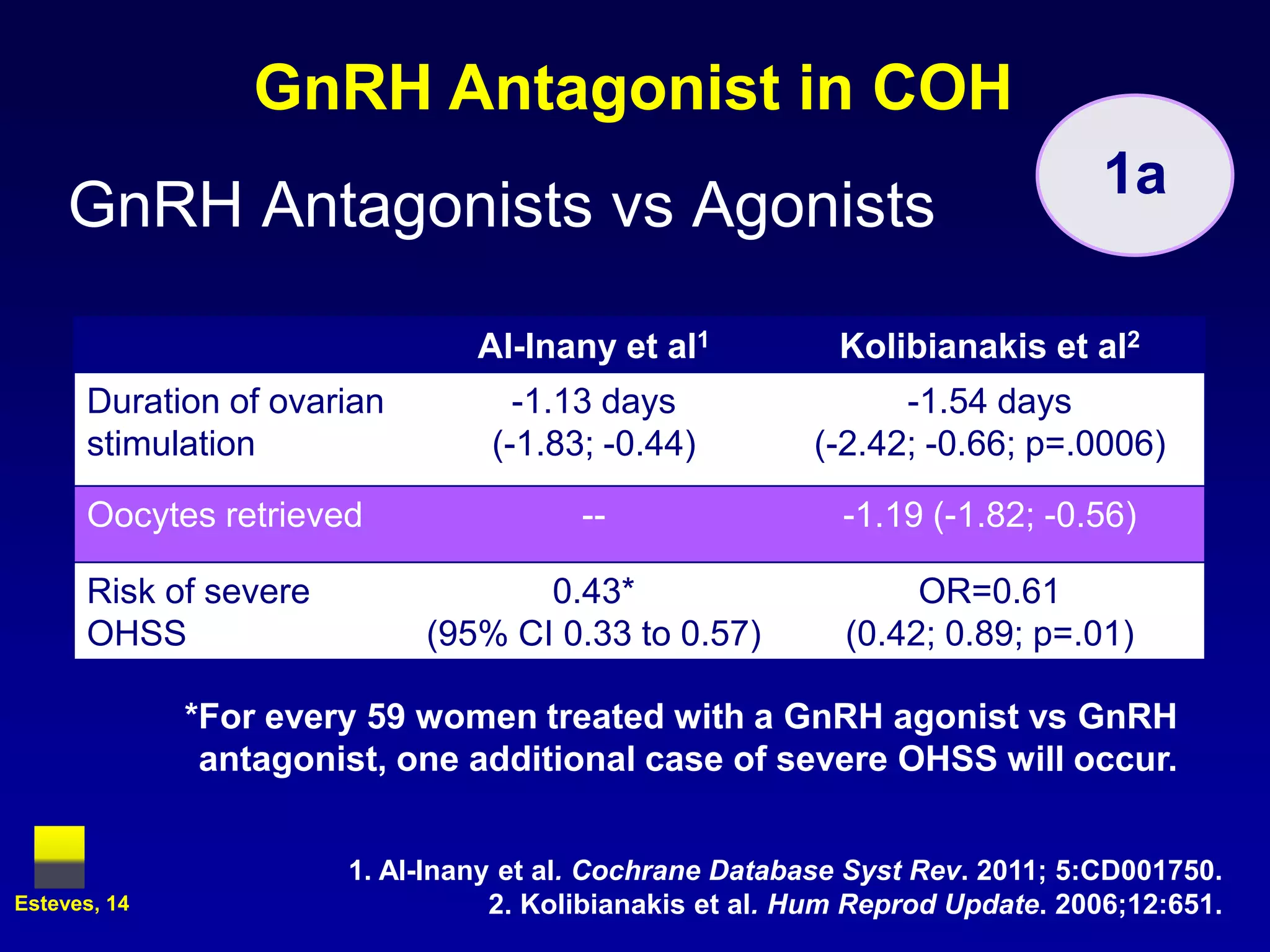
     GnRH Antagonists vs Agonists

     Probability of Live birth
                                 Al-Inany et al (2011)1              Kolibianakis et al (2006)2
     N studies                                 45                                      22
     Included IUI cycles                      Yes                                     No
     N patients                              7,511                                  3,176
     Primary outcome              Ongoing PR or LBR                                  LBR
     Odds ratio                          0.86                                   0.86
                                   (95% CI 0.69-1.08)                   (95% CI 0.72 to 1.02)

                  *Live birth rate included ongoing pregnancies (Al-Inany) or calculated rates (Kolibianakis).
                              1. Al-Inany et al. Cochrane Database Syst Rev. 2011; 5:CD001750.
Esteves, 13                               2. Kolibianakis et al. Hum Reprod Update. 2006;12:651.
GnRH Antagonist in COH
                                                                               1a
     GnRH Antagonists vs Agonists

                                Al-Inany et al1            Kolibianakis et al2
      Duration of ovarian          -1.13 days                  -1.54 days
      stimulation                (-1.83; -0.44)          (-2.42; -0.66; p=.0006)

      Oocytes retrieved                 --                 -1.19 (-1.82; -0.56)

      Risk of severe               0.43*                        OR=0.61
      OHSS                  (95% CI 0.33 to 0.57)          (0.42; 0.89; p=.01)

              *For every 59 women treated with a GnRH agonist vs GnRH
               antagonist, one additional case of severe OHSS will occur.


                       1. Al-Inany et al. Cochrane Database Syst Rev. 2011; 5:CD001750.
Esteves, 14                       2. Kolibianakis et al. Hum Reprod Update. 2006;12:651.
GnRH Antagonist in COH
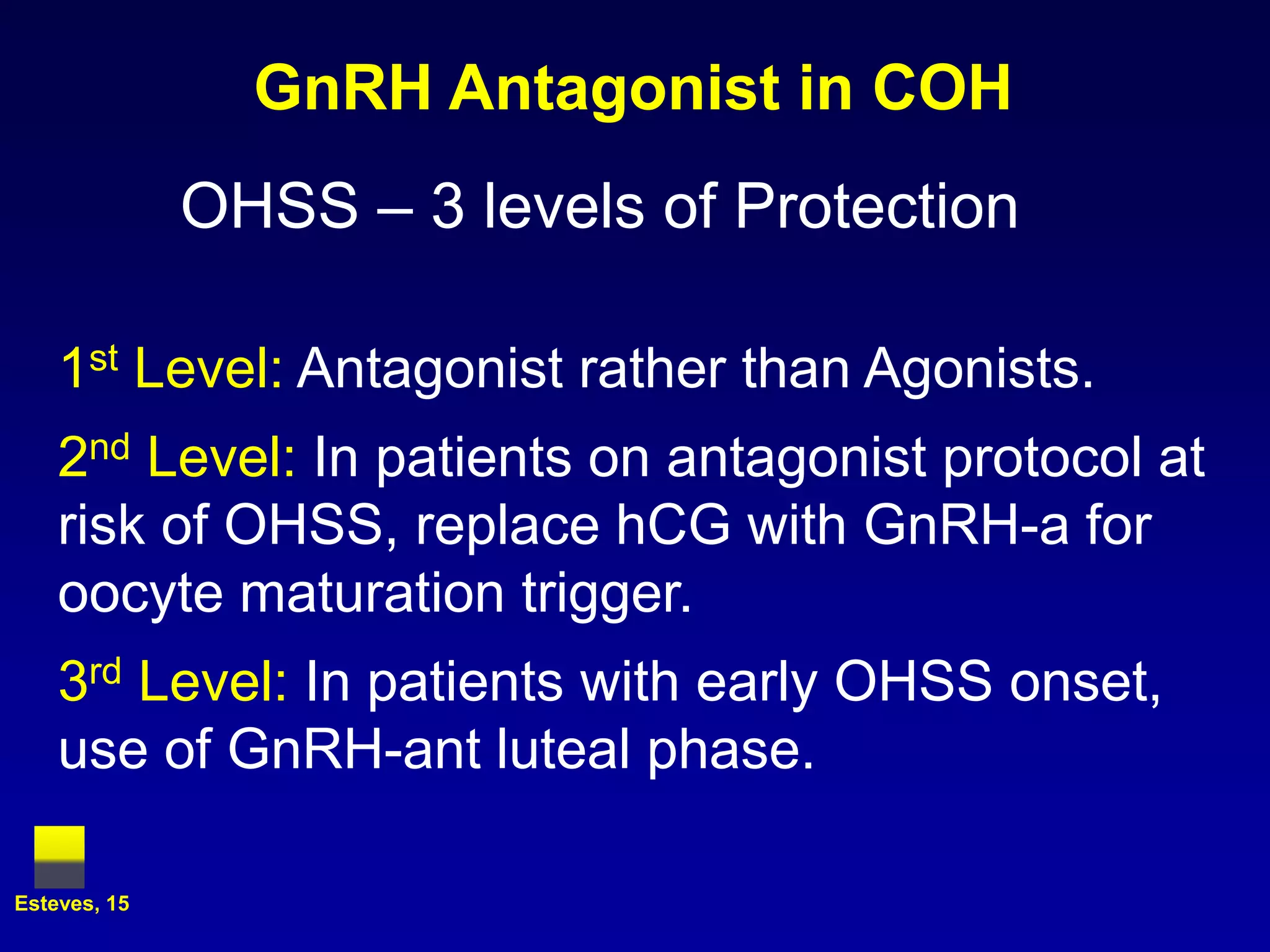
              OHSS – 3 levels of Protection

    1st Level: Antagonist rather than Agonists.
    2nd Level: In patients on antagonist protocol at
    risk of OHSS, replace hCG with GnRH-a for
    oocyte maturation trigger.
    3rd Level: In patients with early OHSS onset,
    use of GnRH-ant luteal phase.

Esteves, 15
GnRH Antagonist in COH

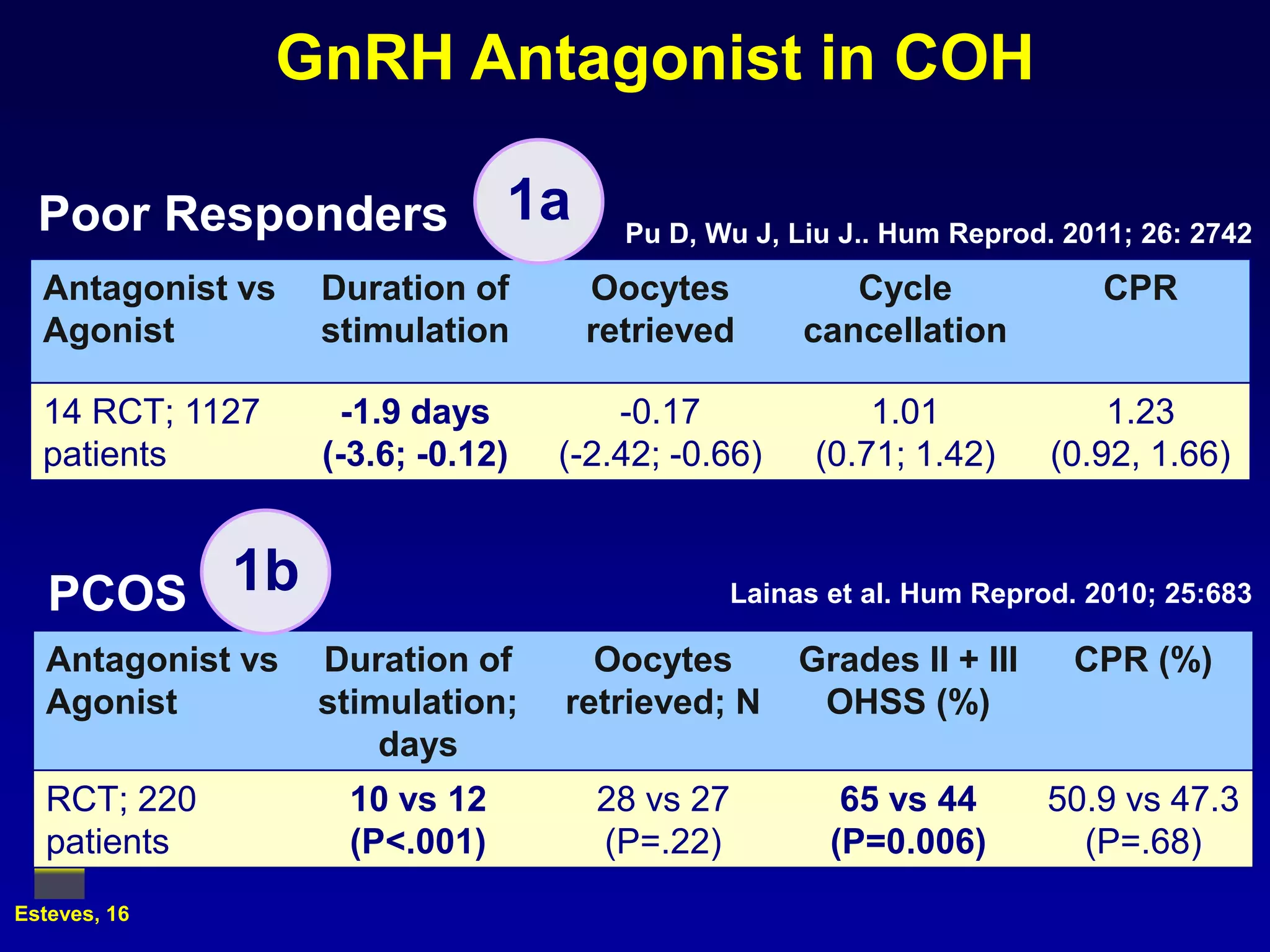
  Poor Responders              1a      Pu D, Wu J, Liu J.. Hum Reprod. 2011; 26: 2742

  Antagonist vs    Duration of      Oocytes            Cycle              CPR
  Agonist          stimulation      retrieved       cancellation

  14 RCT; 1127       -1.9 days         -0.17             1.01             1.23
  patients         (-3.6; -0.12)   (-2.42; -0.66)    (0.71; 1.42)     (0.92, 1.66)


   PCOS 1b                                    Lainas et al. Hum Reprod. 2010; 25:683

   Antagonist vs   Duration of       Oocytes        Grades II + III    CPR (%)
   Agonist         stimulation;    retrieved; N      OHSS (%)
                       days
   RCT; 220         10 vs 12         28 vs 27          65 vs 44       50.9 vs 47.3
   patients         (P<.001)         (P=.22)          (P=0.006)         (P=.68)
Esteves, 16
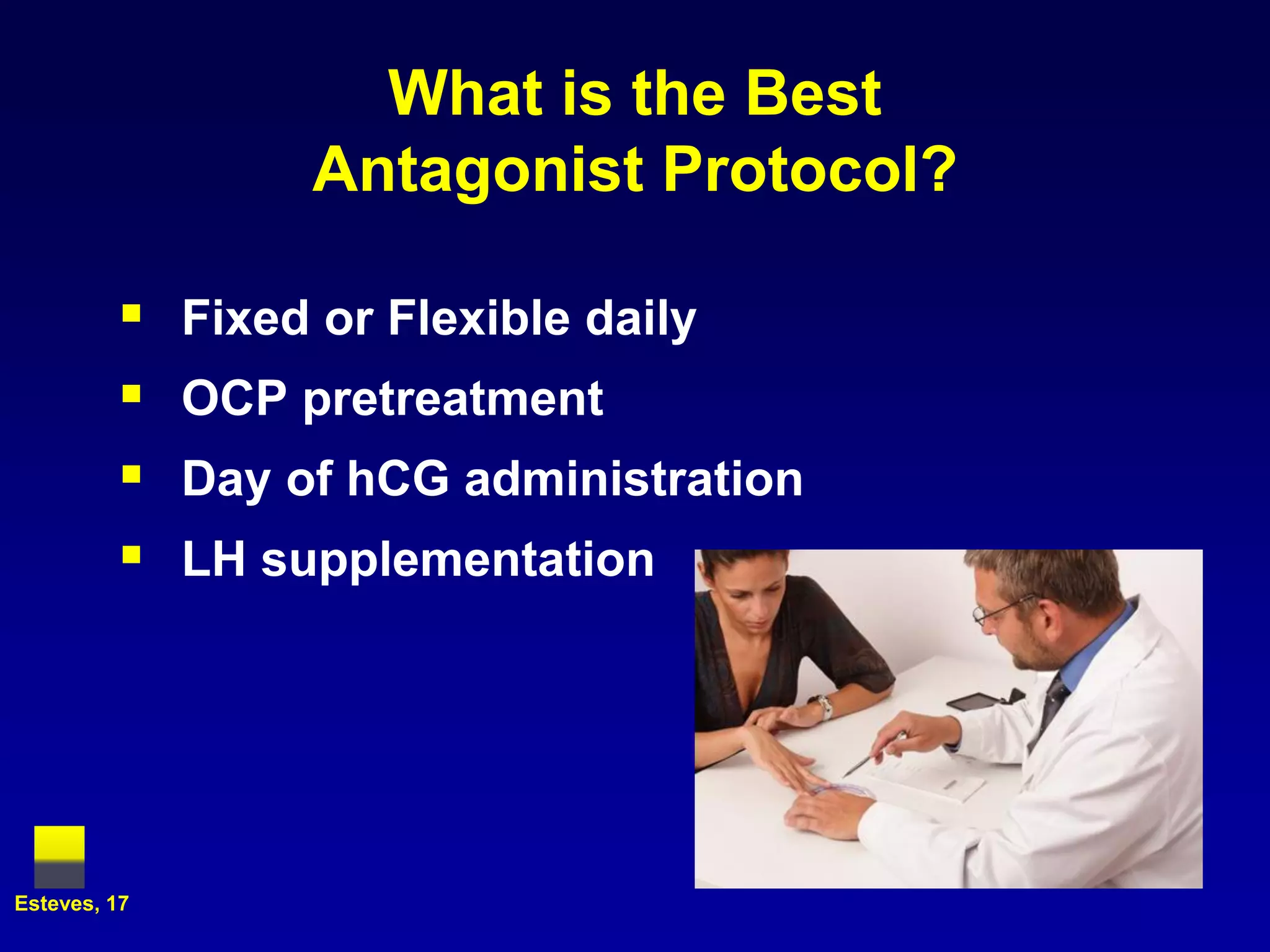
What is the Best
                   Antagonist Protocol?

             Fixed or Flexible daily
             OCP pretreatment
             Day of hCG administration
             LH supplementation


Esteves, 17
GnRH Antagonist in COH
                                                                               1b
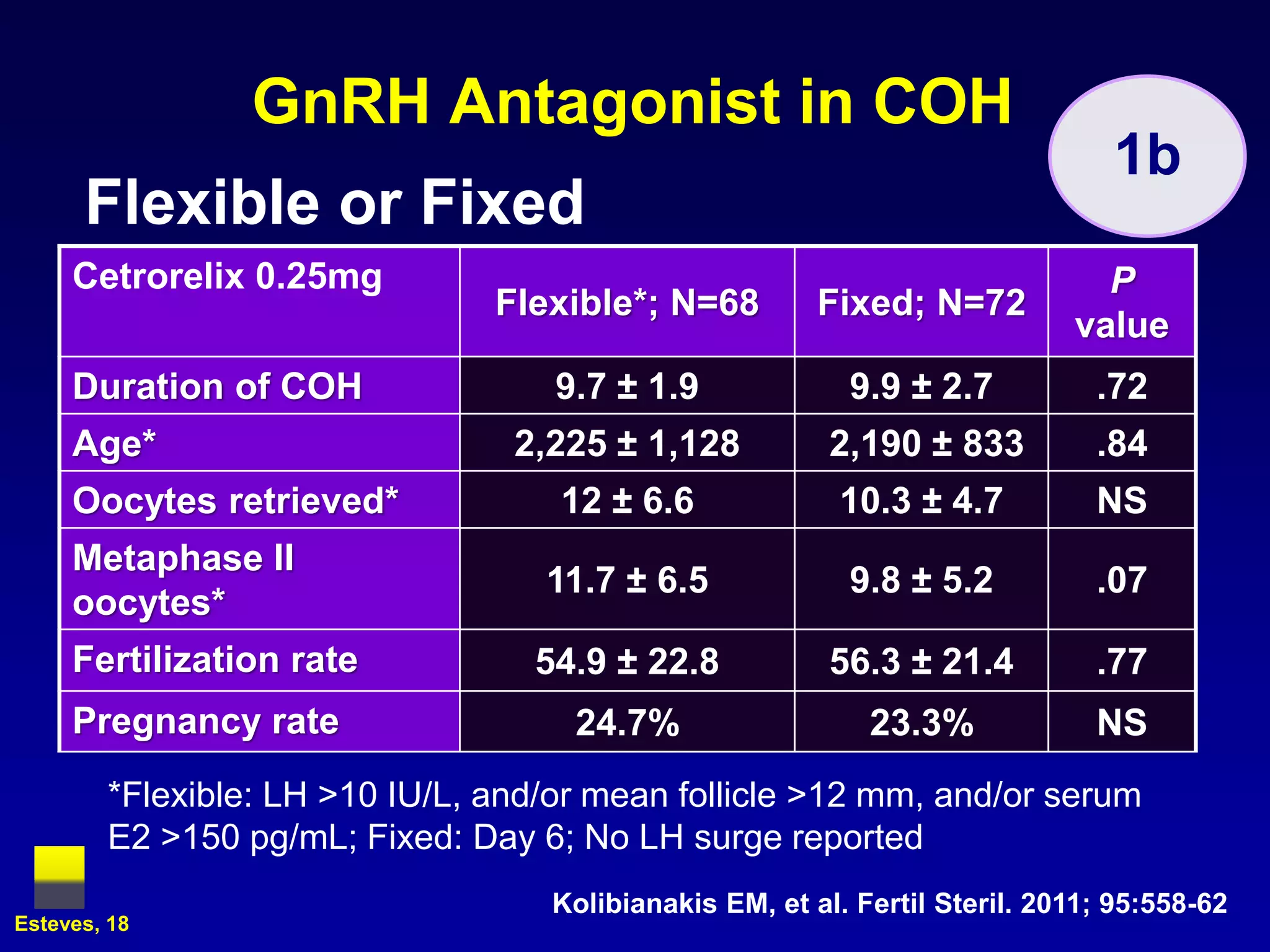
      Flexible or Fixed
     Cetrorelix 0.25mg                                                        P
                                Flexible*; N=68         Fixed; N=72
                                                                            value
     Duration of COH                9.7 ± 1.9             9.9 ± 2.7           .72
     Age*                        2,225 ± 1,128           2,190 ± 833          .84
     Oocytes retrieved*             12 ± 6.6             10.3 ± 4.7           NS
     Metaphase II
                                   11.7 ± 6.5             9.8 ± 5.2           .07
     oocytes*
     Fertilization rate           54.9 ± 22.8            56.3 ± 21.4          .77
     Pregnancy rate                  24.7%                  23.3%             NS
        *Flexible: LH >10 IU/L, and/or mean follicle >12 mm, and/or serum
        E2 >150 pg/mL; Fixed: Day 6; No LH surge reported
                                   Kolibianakis EM, et al. Fertil Steril. 2011; 95:558-62
Esteves, 18
GnRH Antagonist in COH
                                                                       1a
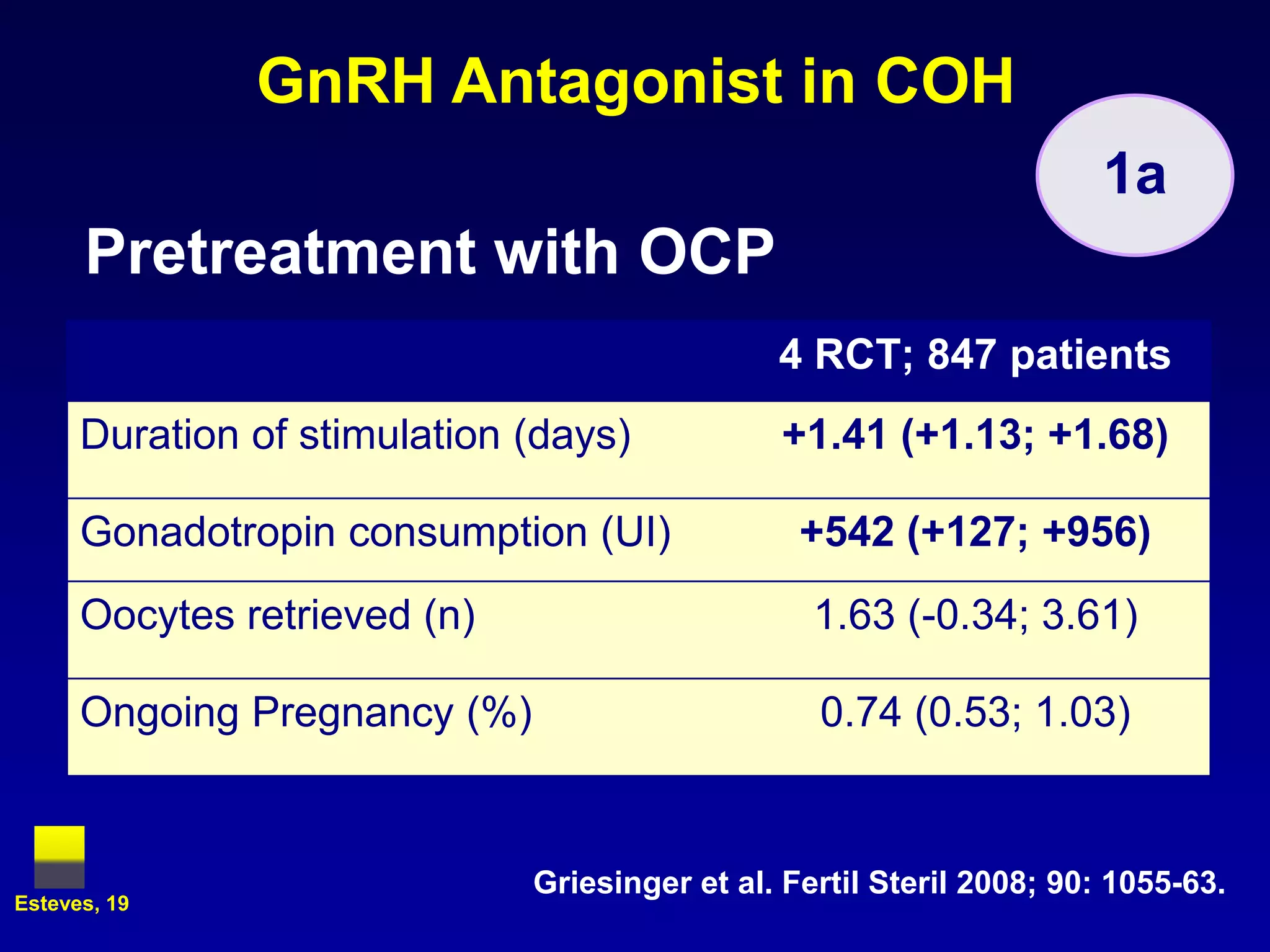
      Pretreatment with OCP
                                               4 RCT; 847 patients
      Duration of stimulation (days)           +1.41 (+1.13; +1.68)

      Gonadotropin consumption (UI)              +542 (+127; +956)
      Oocytes retrieved (n)                       1.63 (-0.34; 3.61)

      Ongoing Pregnancy (%)                       0.74 (0.53; 1.03)


                              Griesinger et al. Fertil Steril 2008; 90: 1055-63.
Esteves, 19
GnRH Antagonist in COH
                                                                        1b
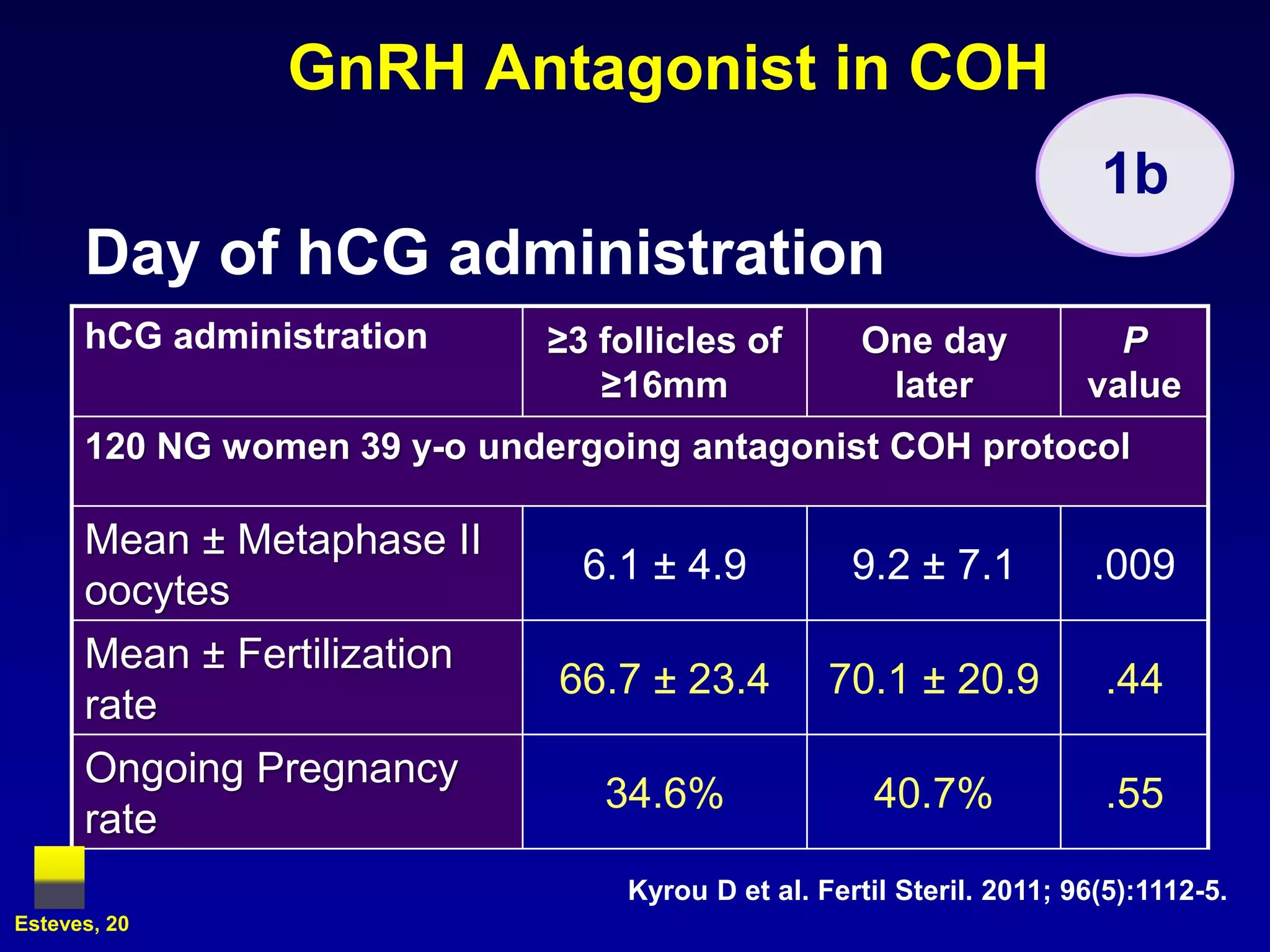
      Day of hCG administration
      hCG administration     ≥3 follicles of         One day             P
                                ≥16mm                 later            value
      120 NG women 39 y-o undergoing antagonist COH protocol

      Mean ± Metaphase II
                               6.1 ± 4.9            9.2 ± 7.1           .009
      oocytes
      Mean ± Fertilization
                              66.7 ± 23.4         70.1 ± 20.9           .44
      rate
      Ongoing Pregnancy
                                34.6%                 40.7%             .55
      rate
                                  Kyrou D et al. Fertil Steril. 2011; 96(5):1112-5.
Esteves, 20
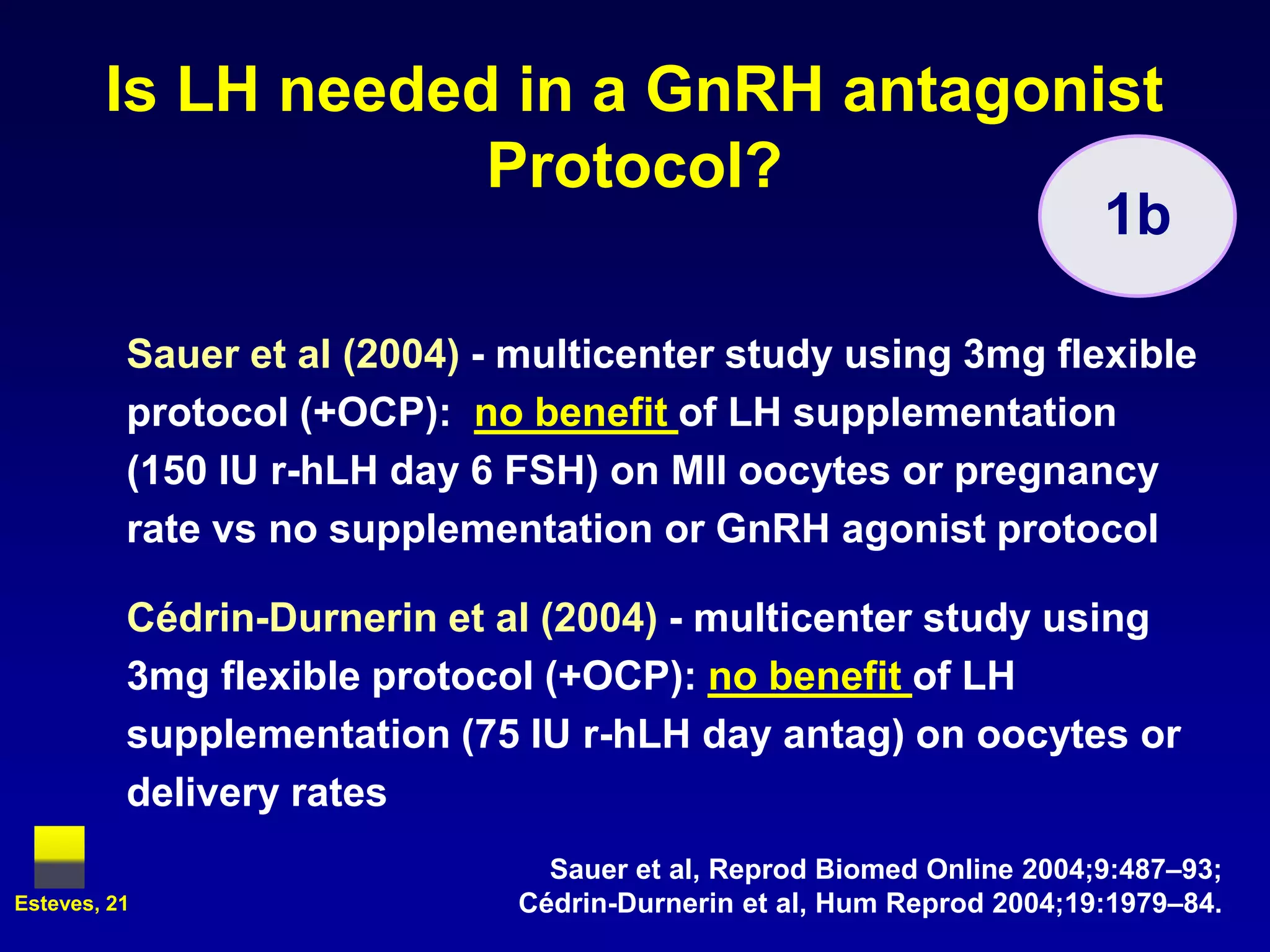
Is LH needed in a GnRH antagonist
                    Protocol?
                                                                       1b

          Sauer et al (2004) - multicenter study using 3mg flexible
          protocol (+OCP): no benefit of LH supplementation
          (150 IU r-hLH day 6 FSH) on MII oocytes or pregnancy
          rate vs no supplementation or GnRH agonist protocol

          Cédrin-Durnerin et al (2004) - multicenter study using
          3mg flexible protocol (+OCP): no benefit of LH
          supplementation (75 IU r-hLH day antag) on oocytes or
          delivery rates
                                Sauer et al, Reprod Biomed Online 2004;9:487–93;
Esteves, 21                   Cédrin-Durnerin et al, Hum Reprod 2004;19:1979–84.
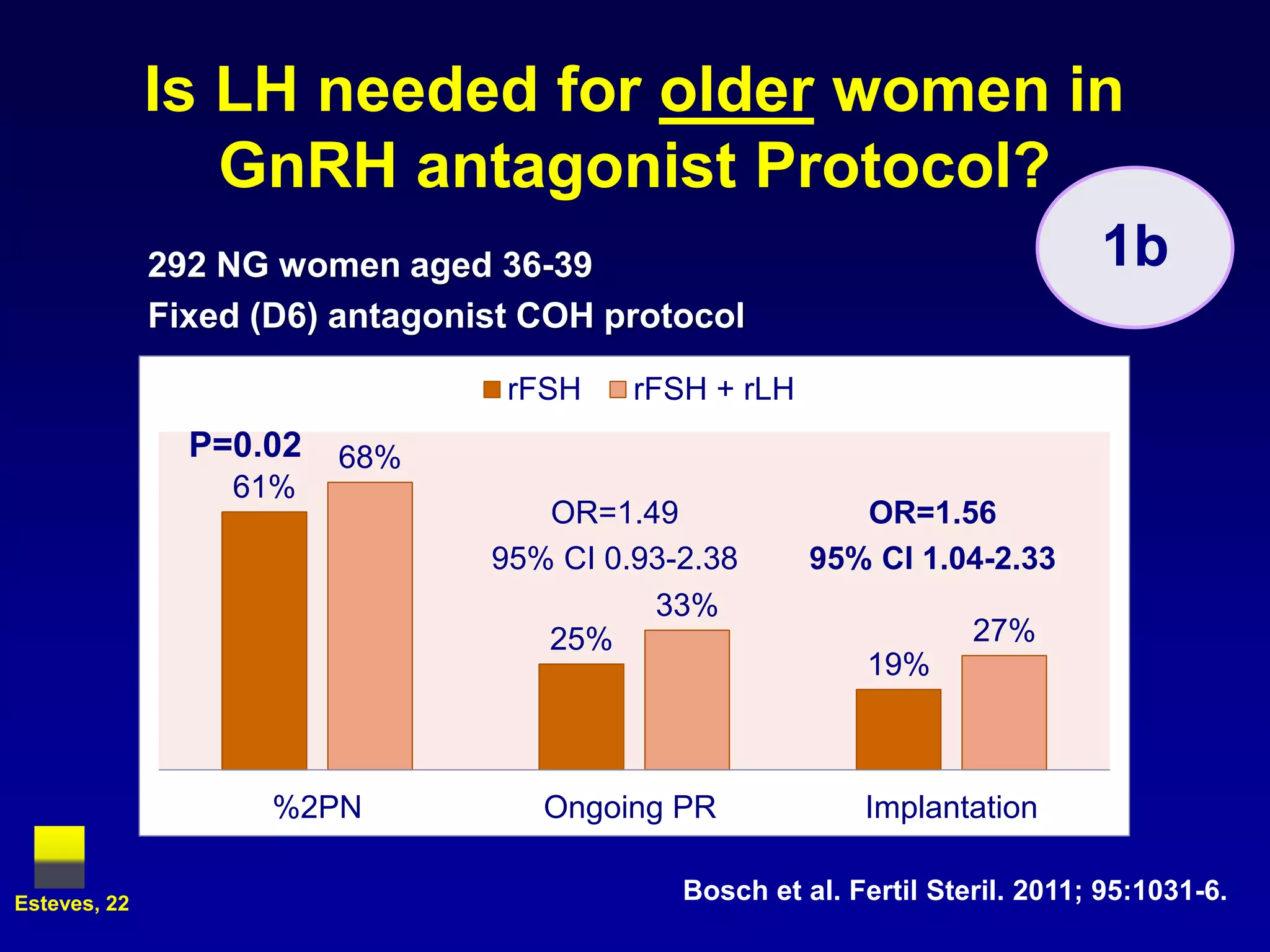
Is LH needed for older women in
                 GnRH antagonist Protocol?
              292 NG women aged 36-39                                         1b
              Fixed (D6) antagonist COH protocol

                                  rFSH    rFSH + rLH
                P=0.02   68%
                  61%
                                    OR=1.49               OR=1.56
                                 95% CI 0.93-2.38      95% CI 1.04-2.33
                                           33%
                                    25%                             27%
                                                           19%


                     %2PN           Ongoing PR             Implantation

Esteves, 22
                                             Bosch et al. Fertil Steril. 2011; 95:1031-6.
GnRH Antagonists in COH
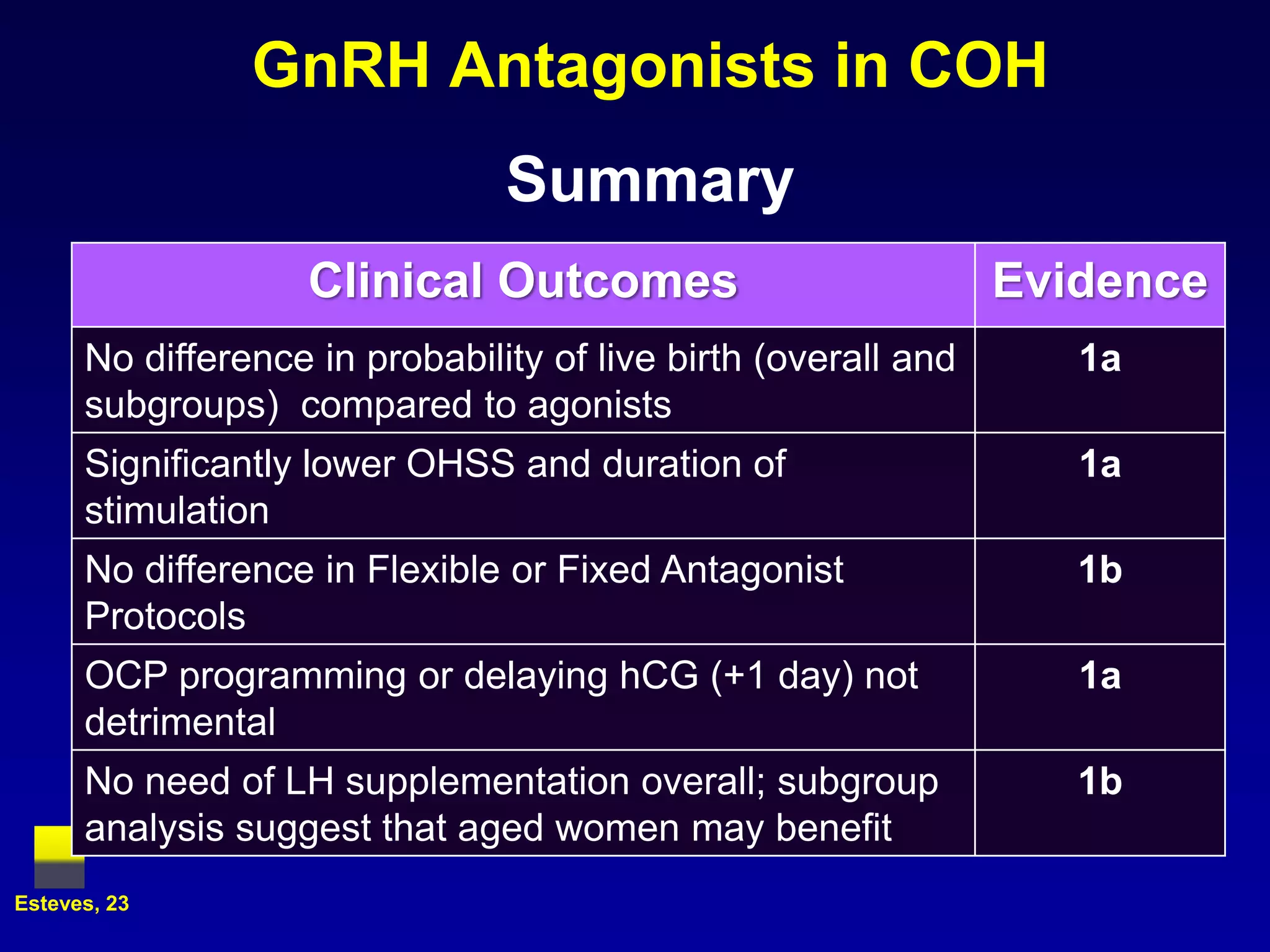
                                Summary
                    Clinical Outcomes                           Evidence
      No difference in probability of live birth (overall and      1a
      subgroups) compared to agonists
      Significantly lower OHSS and duration of                     1a
      stimulation
      No difference in Flexible or Fixed Antagonist                1b
      Protocols
      OCP programming or delaying hCG (+1 day) not                 1a
      detrimental
      No need of LH supplementation overall; subgroup              1b
      analysis suggest that aged women may benefit
Esteves, 23
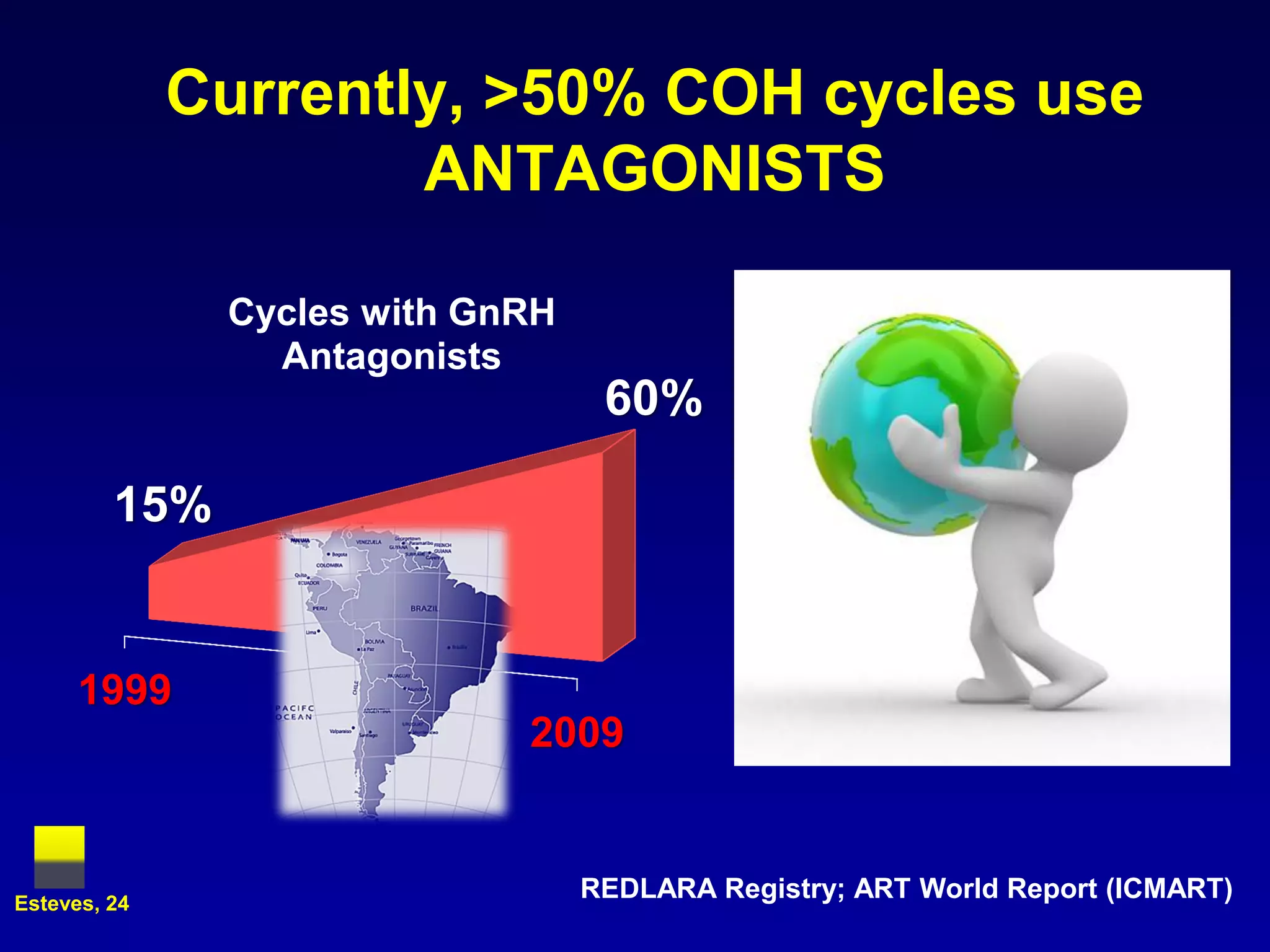
Currently, >50% COH cycles use
                      ANTAGONISTS

               Cycles with GnRH
                 Antagonists
                                   60%

         15%


      1999
                             2009


Esteves, 24
                                  REDLARA Registry; ART World Report (ICMART)
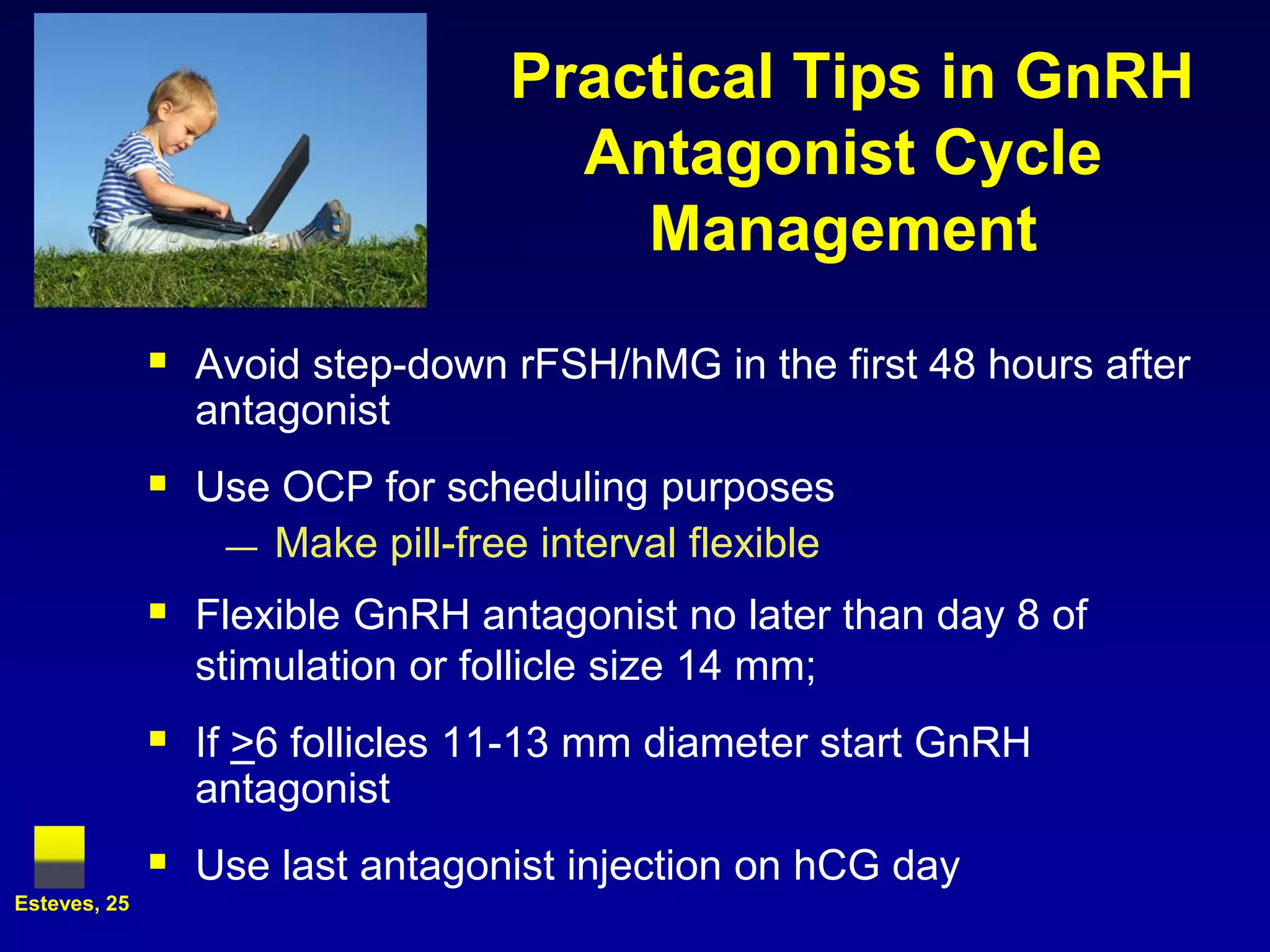
Practical Tips in GnRH
                                     Antagonist Cycle
                                       Management

               Avoid step-down rFSH/hMG in the first 48 hours after
                antagonist
               Use OCP for scheduling purposes
                  —   Make pill-free interval flexible
               Flexible GnRH antagonist no later than day 8 of
                stimulation or follicle size 14 mm;
               If >6 follicles 11-13 mm diameter start GnRH
                antagonist
               Use last antagonist injection on hCG day
Esteves, 25
Take-home Messages

         Agonists yield higher number of oocytes
         Antagonists are safer than agonists
               —   Decreased moderate and severe OHSS rates
         Antagonists more patient-friendly
               —   Shorter duration of COH
         Probability of live birth in COS is independent of
              the analog used for pituitary suppression
Esteves, 26

GnRH Antagonists in Controlled Ovarian Stimulation

  • 1.
    Insight’12 – Lite,Coimbatore, India – May 2012
  • 2.
    Lecture Overview  Importance of LH suppression in COH  LH suppresion using GnRH-antagonists  Clinical Results  Take-Home Messages Esteves, 2
  • 3.
  • 4.
    Ovarian Stimulation Protocols Central Paradigm Minimize Maximize beneficial complications and effects of treatment risks High-quality Cycle cancellation, oocyte yield OHSS, multiple pregnancy Esteves, 4 Fauser et al., 2008
  • 5.
    Theca externa cells Theca interna cells Granulosa cells Follicular antrum Zona pellucida Oocyte Cumulus Oophorus cells Capillary network Basement membrane Esteves, 5 Zeleznik et al 1974; Adashi 1996, Hillier 1994.
  • 6.
    Rationale of LHsuppression in COH  Premature luteinization in IVF — Cycle cancellation — Low number of oocytes retrieved/atresia — Reduced fertilization rate and embryo quality — Poor prognosis for pregnancy — Psychological burden & Financial loss Reduced risk of Allows ovarian LH suppression premature LH surge and stimulation to be untimely ovulation controlled 1Loumaye, et al. Human Reprod 1990;5:357 2Balasch J. In: Female Infertility Therapy:Current Practice (Shoham, Howles, Jacobs, eds). Martin Dunitz Esteves, 6 1998:189
  • 7.
    Physiologic Actions ofGnRH  Stimulates synthesis and release of LH and FSH pyro (Glu) – His – Trp – Ser – Tyr – Gly – Leu – Arg – Pro – Gly – NH2 Short Term Long Term U U U GnRH LH FSH U U Esteves, 7
  • 8.
    LH Surge Prevention:GnRH Antagonists GnRH receptor activation Receptor affinity Biologic activity pyro (Glu) – His – Trp – Ser – Tyr – Gly – Leu – Arg – Pro – Gly – NH2 Esteves, 8
  • 9.
    The difference inLH suppression Agonist Follicular 2-4 Luteal 30 weeks LH, FSH E2 , P4 20 10 Synchronized follicles 0 Start Administration 6 5 Antagonist • Half-life ~20h (Cetrorelix) 4 • Suppress LH by 80% of LH (IU/L) Antagonist baseline levels 3 2 1 0 -6 0 6 12 18 24 30 36 42 48 Esteves, 9 Hours
  • 10.
    Comparison of LongGnRH Agonist and GnRH Antagonist Protocols Prevent Can be OHSS by integrated in GnRH-a No flare spontaneous/OI GnRH antagonist Antagonist effect with No hormonal cycles protocol administration possible cyst withdrawal formation Gonadotropin administration Less gona- Can exclude dotropins early pregnancy Flare up Pituitary effect suppression Gonadotropin administration Long GnRH agonist Longer Agonist administration protocol treatment Pre-treatment cycle Treatment cycle
  • 11.
    Why has introductionof antagonists in clinical practice has been slow?  Experience with Agonists — Why change if it is working  Clinicians´ concerns — E2 decrease — Not been able to program aspirations on weekdays — LH surge (more monitoring) — Difficult to use Esteves, 11
  • 12.
    GnRH Antagonists inCOH Clinical Results and Effects on Cycle Parameters Level Type of evidence 1a Obtained from meta-analysis of randomised trials 1b Obtained from at least one randomised trial 2a Obtained from one well-designed controlled study without randomisation 2b Obtained from at least one other type of well-designed quasi- experimental study 3 Obtained from well-designed non-experimental studies, such as comparative and correlation studies, and case reports 4 Obtained from expert committee reports or opinions or clinical experience of respected authorities Esteves, 12 Modified from Sackett et al. Oxford Centre for Evidence-based Medicine Levels of Evidence (2009)
  • 13.
    GnRH Antagonist inCOH 1a GnRH Antagonists vs Agonists Probability of Live birth Al-Inany et al (2011)1 Kolibianakis et al (2006)2 N studies 45 22 Included IUI cycles Yes No N patients 7,511 3,176 Primary outcome Ongoing PR or LBR LBR Odds ratio 0.86 0.86 (95% CI 0.69-1.08) (95% CI 0.72 to 1.02) *Live birth rate included ongoing pregnancies (Al-Inany) or calculated rates (Kolibianakis). 1. Al-Inany et al. Cochrane Database Syst Rev. 2011; 5:CD001750. Esteves, 13 2. Kolibianakis et al. Hum Reprod Update. 2006;12:651.
  • 14.
    GnRH Antagonist inCOH 1a GnRH Antagonists vs Agonists Al-Inany et al1 Kolibianakis et al2 Duration of ovarian -1.13 days -1.54 days stimulation (-1.83; -0.44) (-2.42; -0.66; p=.0006) Oocytes retrieved -- -1.19 (-1.82; -0.56) Risk of severe 0.43* OR=0.61 OHSS (95% CI 0.33 to 0.57) (0.42; 0.89; p=.01) *For every 59 women treated with a GnRH agonist vs GnRH antagonist, one additional case of severe OHSS will occur. 1. Al-Inany et al. Cochrane Database Syst Rev. 2011; 5:CD001750. Esteves, 14 2. Kolibianakis et al. Hum Reprod Update. 2006;12:651.
  • 15.
    GnRH Antagonist inCOH OHSS – 3 levels of Protection 1st Level: Antagonist rather than Agonists. 2nd Level: In patients on antagonist protocol at risk of OHSS, replace hCG with GnRH-a for oocyte maturation trigger. 3rd Level: In patients with early OHSS onset, use of GnRH-ant luteal phase. Esteves, 15
  • 16.
    GnRH Antagonist inCOH Poor Responders 1a Pu D, Wu J, Liu J.. Hum Reprod. 2011; 26: 2742 Antagonist vs Duration of Oocytes Cycle CPR Agonist stimulation retrieved cancellation 14 RCT; 1127 -1.9 days -0.17 1.01 1.23 patients (-3.6; -0.12) (-2.42; -0.66) (0.71; 1.42) (0.92, 1.66) PCOS 1b Lainas et al. Hum Reprod. 2010; 25:683 Antagonist vs Duration of Oocytes Grades II + III CPR (%) Agonist stimulation; retrieved; N OHSS (%) days RCT; 220 10 vs 12 28 vs 27 65 vs 44 50.9 vs 47.3 patients (P<.001) (P=.22) (P=0.006) (P=.68) Esteves, 16
  • 17.
    What is theBest Antagonist Protocol?  Fixed or Flexible daily  OCP pretreatment  Day of hCG administration  LH supplementation Esteves, 17
  • 18.
    GnRH Antagonist inCOH 1b Flexible or Fixed Cetrorelix 0.25mg P Flexible*; N=68 Fixed; N=72 value Duration of COH 9.7 ± 1.9 9.9 ± 2.7 .72 Age* 2,225 ± 1,128 2,190 ± 833 .84 Oocytes retrieved* 12 ± 6.6 10.3 ± 4.7 NS Metaphase II 11.7 ± 6.5 9.8 ± 5.2 .07 oocytes* Fertilization rate 54.9 ± 22.8 56.3 ± 21.4 .77 Pregnancy rate 24.7% 23.3% NS *Flexible: LH >10 IU/L, and/or mean follicle >12 mm, and/or serum E2 >150 pg/mL; Fixed: Day 6; No LH surge reported Kolibianakis EM, et al. Fertil Steril. 2011; 95:558-62 Esteves, 18
  • 19.
    GnRH Antagonist inCOH 1a Pretreatment with OCP 4 RCT; 847 patients Duration of stimulation (days) +1.41 (+1.13; +1.68) Gonadotropin consumption (UI) +542 (+127; +956) Oocytes retrieved (n) 1.63 (-0.34; 3.61) Ongoing Pregnancy (%) 0.74 (0.53; 1.03) Griesinger et al. Fertil Steril 2008; 90: 1055-63. Esteves, 19
  • 20.
    GnRH Antagonist inCOH 1b Day of hCG administration hCG administration ≥3 follicles of One day P ≥16mm later value 120 NG women 39 y-o undergoing antagonist COH protocol Mean ± Metaphase II 6.1 ± 4.9 9.2 ± 7.1 .009 oocytes Mean ± Fertilization 66.7 ± 23.4 70.1 ± 20.9 .44 rate Ongoing Pregnancy 34.6% 40.7% .55 rate Kyrou D et al. Fertil Steril. 2011; 96(5):1112-5. Esteves, 20
  • 21.
    Is LH neededin a GnRH antagonist Protocol? 1b Sauer et al (2004) - multicenter study using 3mg flexible protocol (+OCP): no benefit of LH supplementation (150 IU r-hLH day 6 FSH) on MII oocytes or pregnancy rate vs no supplementation or GnRH agonist protocol Cédrin-Durnerin et al (2004) - multicenter study using 3mg flexible protocol (+OCP): no benefit of LH supplementation (75 IU r-hLH day antag) on oocytes or delivery rates Sauer et al, Reprod Biomed Online 2004;9:487–93; Esteves, 21 Cédrin-Durnerin et al, Hum Reprod 2004;19:1979–84.
  • 22.
    Is LH neededfor older women in GnRH antagonist Protocol? 292 NG women aged 36-39 1b Fixed (D6) antagonist COH protocol rFSH rFSH + rLH P=0.02 68% 61% OR=1.49 OR=1.56 95% CI 0.93-2.38 95% CI 1.04-2.33 33% 25% 27% 19% %2PN Ongoing PR Implantation Esteves, 22 Bosch et al. Fertil Steril. 2011; 95:1031-6.
  • 23.
    GnRH Antagonists inCOH Summary Clinical Outcomes Evidence No difference in probability of live birth (overall and 1a subgroups) compared to agonists Significantly lower OHSS and duration of 1a stimulation No difference in Flexible or Fixed Antagonist 1b Protocols OCP programming or delaying hCG (+1 day) not 1a detrimental No need of LH supplementation overall; subgroup 1b analysis suggest that aged women may benefit Esteves, 23
  • 24.
    Currently, >50% COHcycles use ANTAGONISTS Cycles with GnRH Antagonists 60% 15% 1999 2009 Esteves, 24 REDLARA Registry; ART World Report (ICMART)
  • 25.
    Practical Tips inGnRH Antagonist Cycle Management  Avoid step-down rFSH/hMG in the first 48 hours after antagonist  Use OCP for scheduling purposes — Make pill-free interval flexible  Flexible GnRH antagonist no later than day 8 of stimulation or follicle size 14 mm;  If >6 follicles 11-13 mm diameter start GnRH antagonist  Use last antagonist injection on hCG day Esteves, 25
  • 26.
    Take-home Messages  Agonists yield higher number of oocytes  Antagonists are safer than agonists — Decreased moderate and severe OHSS rates  Antagonists more patient-friendly — Shorter duration of COH  Probability of live birth in COS is independent of the analog used for pituitary suppression Esteves, 26