STATES OF MATTER
Matter and Types
PART-I
Nabeela Moosakutty
Lecturer
Dept. of Pharmaceutics
KTN College of Pharmacy
States of Matter
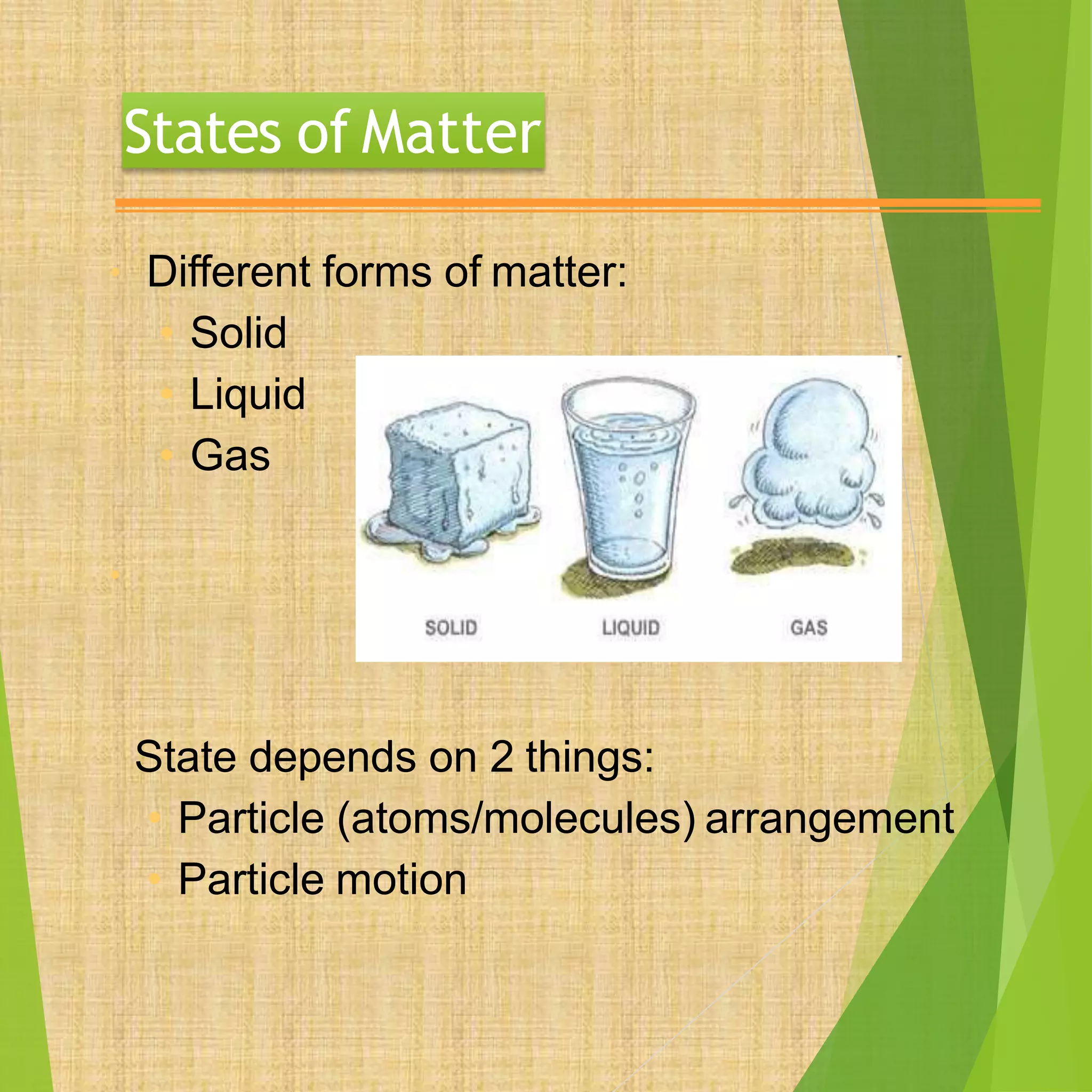
• Different forms of matter:
• Solid
• Liquid
• Gas
•
State depends on 2 things:
• Particle (atoms/molecules) arrangement
• Particle motion
Solid Matter
•
•
•
Fixed volume
Fixed shape
Particles packed
together tightly –
usually in a repeating
pattern
Examples: wood,
glass, salt, plastic
Solid Matter
•
•
Particles vibrate in place
• remember – matter is always in motion!
Want to separate the particles in a solid?
BREAK it!
Liquid Matter
•
•
•
•
•
Fixed volume, changing
shape
Particles can move
from place to place
Particles attracted to
each other, but more
easily separate
Take the shape of the
container its put in
Examples: milk, oil,
honey, water
Gas Matter
•
•
•
Volume changes, shape
changes
Examples: air, oxygen,
water vapor
Particles always push
outward on container
• Spread to fill
container if there is
more space
• Or pack closer
together when there
is less space =
PRESSURE from the
pushing!
• THREE STATES OF MATTER
Some Characteristics of Gases, L iquids and Sol ids and the
M icroscopic E xplanation for the B ehavior
Gas Liquids Solids
assumes the shape and
volume of its container
particles can move past one
another
assumes the shape of the
part of the containerwhich
it occupies
particles can move/slide
past one another
retains a fixed volume and
shape
rigid - particles locked into
place
compressible
lots of free space between
particles
not easily compressible
little free space between
particles
not easily compressible
little free space between
particles
flows easily
particles can move past one
another
flows easily
particles can move/slide
past one another
does not flow easily
rigid - particles cannot
move/slide past one
another
• TYPES OF I NTERMOLECULAR FORCES
Dispersion forces
or London forces
Itis theweakestintermolecularforce
It is a temporary at ractiveforcethat
results whentheelectronsin two
adjacent atoms occupy positions that
make theatoms form temporarydipoles
This forceis sometimescal edan
induceddipole- induceddipole at
raction
Theseatractiveforces that cause
nonpolar substances to condenseto
liquids and tofreezeinto solids when
thetemperatureis loweredsuf iciently
DIPOLE- DIPOLEFORCES
Dipole-dipole forces are at ractiveforces betweenthepositive end
of onepolar
molecule and the negative end of another polar molecule. Dipole-
dipole forces havestrengthsthatrange from5 kJ to20 kJ per
mole.They aremuchweaker
than ionic or covalent bonds and have a significant ef ect
only whenthe moleculesinvolvedareclose
together(touching oralmost touching).
INDUCED-DIPOLEFORCES
Ion–induceddipoleforces
An ion-induceddipole at ractionis
a weak at ractionthatresults
whentheapproach of an ion
induces a dipole in an atom or in
a nonpolar molecule by
disturbing the arrangement of
electrons in thenonpolar species.
• Dipole–InducedDipoleForces
A dipole-induced dipole at raction
is a weak at raction that results
when a polar moleculeinducesa
dipole inan atomorina nonpolar
molecule by disturbing the
arrangement of electrons in
thenonpolar species.
• HYDROGENBOND
The hydrogen bond is a special dipole-dipole interaction
betweenthe hydrogenatomina polar N-H, O-H orF- H
bondand an electronegative O, N or F atom.
A – H ----B
A and B
or
are O, N
A – H ----A
and F
Pressure: Gases andTemperature
 Particles speed up (more
energy)
 = Volume increases!
• Decreased temperature
• (remove heat)
 Particles slow down (less
energy)
 = Volume decreases!
Increased temperature
(add heat)

States of matter 1 matter and types converted

  • 1.
    STATES OF MATTER Matterand Types PART-I Nabeela Moosakutty Lecturer Dept. of Pharmaceutics KTN College of Pharmacy
  • 2.
    States of Matter •Different forms of matter: • Solid • Liquid • Gas • State depends on 2 things: • Particle (atoms/molecules) arrangement • Particle motion
  • 3.
    Solid Matter • • • Fixed volume Fixedshape Particles packed together tightly – usually in a repeating pattern Examples: wood, glass, salt, plastic
  • 4.
    Solid Matter • • Particles vibratein place • remember – matter is always in motion! Want to separate the particles in a solid? BREAK it!
  • 5.
    Liquid Matter • • • • • Fixed volume,changing shape Particles can move from place to place Particles attracted to each other, but more easily separate Take the shape of the container its put in Examples: milk, oil, honey, water
  • 6.
    Gas Matter • • • Volume changes,shape changes Examples: air, oxygen, water vapor Particles always push outward on container • Spread to fill container if there is more space • Or pack closer together when there is less space = PRESSURE from the pushing!
  • 8.
    • THREE STATESOF MATTER Some Characteristics of Gases, L iquids and Sol ids and the M icroscopic E xplanation for the B ehavior Gas Liquids Solids assumes the shape and volume of its container particles can move past one another assumes the shape of the part of the containerwhich it occupies particles can move/slide past one another retains a fixed volume and shape rigid - particles locked into place compressible lots of free space between particles not easily compressible little free space between particles not easily compressible little free space between particles flows easily particles can move past one another flows easily particles can move/slide past one another does not flow easily rigid - particles cannot move/slide past one another
  • 9.
    • TYPES OFI NTERMOLECULAR FORCES Dispersion forces or London forces Itis theweakestintermolecularforce It is a temporary at ractiveforcethat results whentheelectronsin two adjacent atoms occupy positions that make theatoms form temporarydipoles This forceis sometimescal edan induceddipole- induceddipole at raction Theseatractiveforces that cause nonpolar substances to condenseto liquids and tofreezeinto solids when thetemperatureis loweredsuf iciently
  • 10.
    DIPOLE- DIPOLEFORCES Dipole-dipole forcesare at ractiveforces betweenthepositive end of onepolar molecule and the negative end of another polar molecule. Dipole- dipole forces havestrengthsthatrange from5 kJ to20 kJ per mole.They aremuchweaker than ionic or covalent bonds and have a significant ef ect only whenthe moleculesinvolvedareclose together(touching oralmost touching).
  • 11.
    INDUCED-DIPOLEFORCES Ion–induceddipoleforces An ion-induceddipole atractionis a weak at ractionthatresults whentheapproach of an ion induces a dipole in an atom or in a nonpolar molecule by disturbing the arrangement of electrons in thenonpolar species. • Dipole–InducedDipoleForces A dipole-induced dipole at raction is a weak at raction that results when a polar moleculeinducesa dipole inan atomorina nonpolar molecule by disturbing the arrangement of electrons in thenonpolar species.
  • 12.
    • HYDROGENBOND The hydrogenbond is a special dipole-dipole interaction betweenthe hydrogenatomina polar N-H, O-H orF- H bondand an electronegative O, N or F atom. A – H ----B A and B or are O, N A – H ----A and F
  • 13.
    Pressure: Gases andTemperature Particles speed up (more energy)  = Volume increases! • Decreased temperature • (remove heat)  Particles slow down (less energy)  = Volume decreases! Increased temperature (add heat)