Global Distribution Strategies
Objectives
• To learn the variety of distribution channels and
how they affect cost and efficiency in marketing.
• To understand the Japanese distribution structure
and what it means to Japanese customers and to
competing importers of goods.
• To be aware of how distribution patterns affect
the various aspects of international marketing.
• To understand the functions, advantages, and
disadvantages of various kinds of middlemen.
• To learn the importance of selecting and
maintining middlemen.
• To know the growing importance of e-
commerce as a distribution alternative.
• To understand the interdependence of
physical distribution activitites.
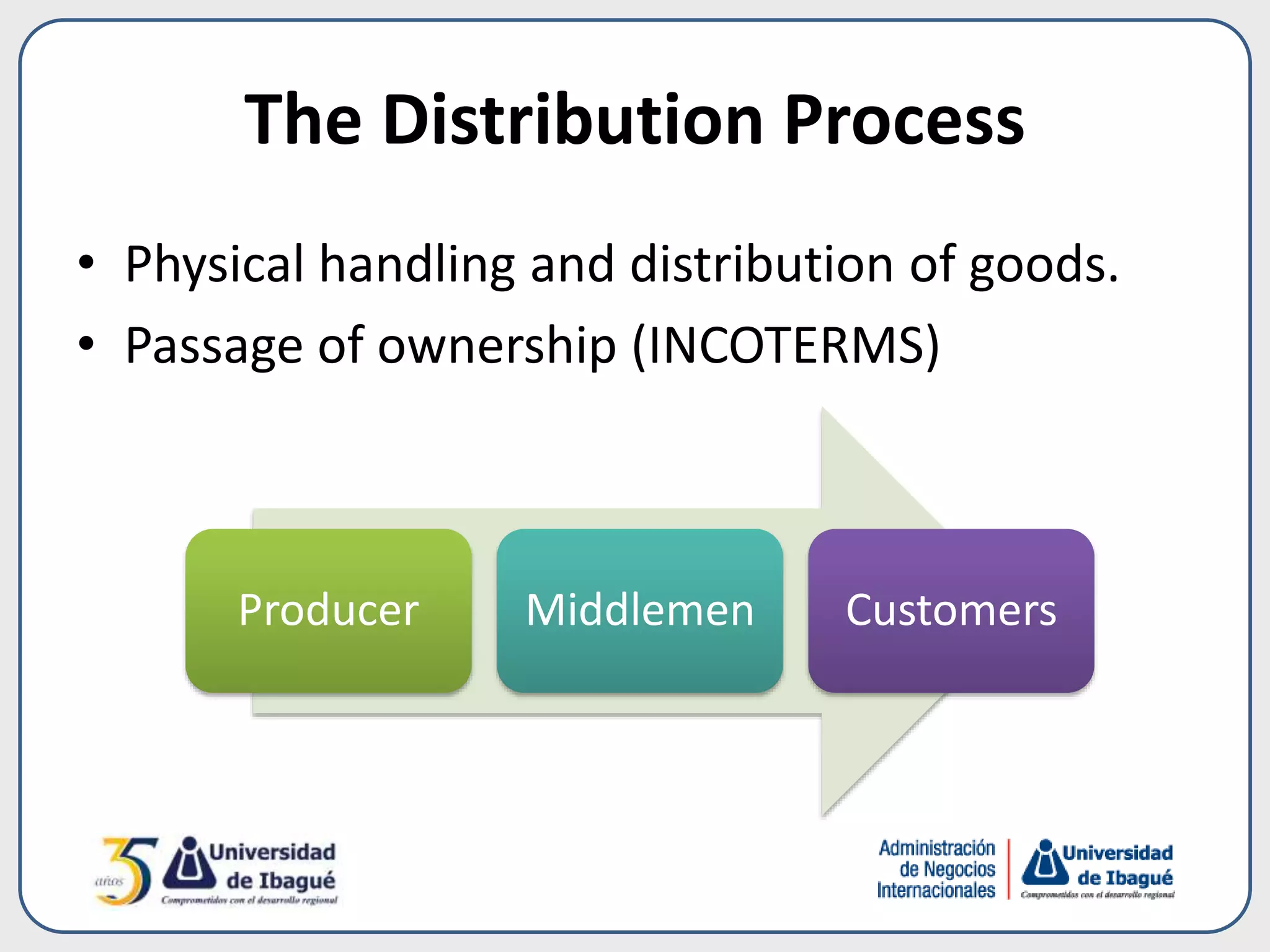
The Distribution Process
• Physical handling and distribution of goods.
• Passage of ownership (INCOTERMS)
Producer Middlemen Customers
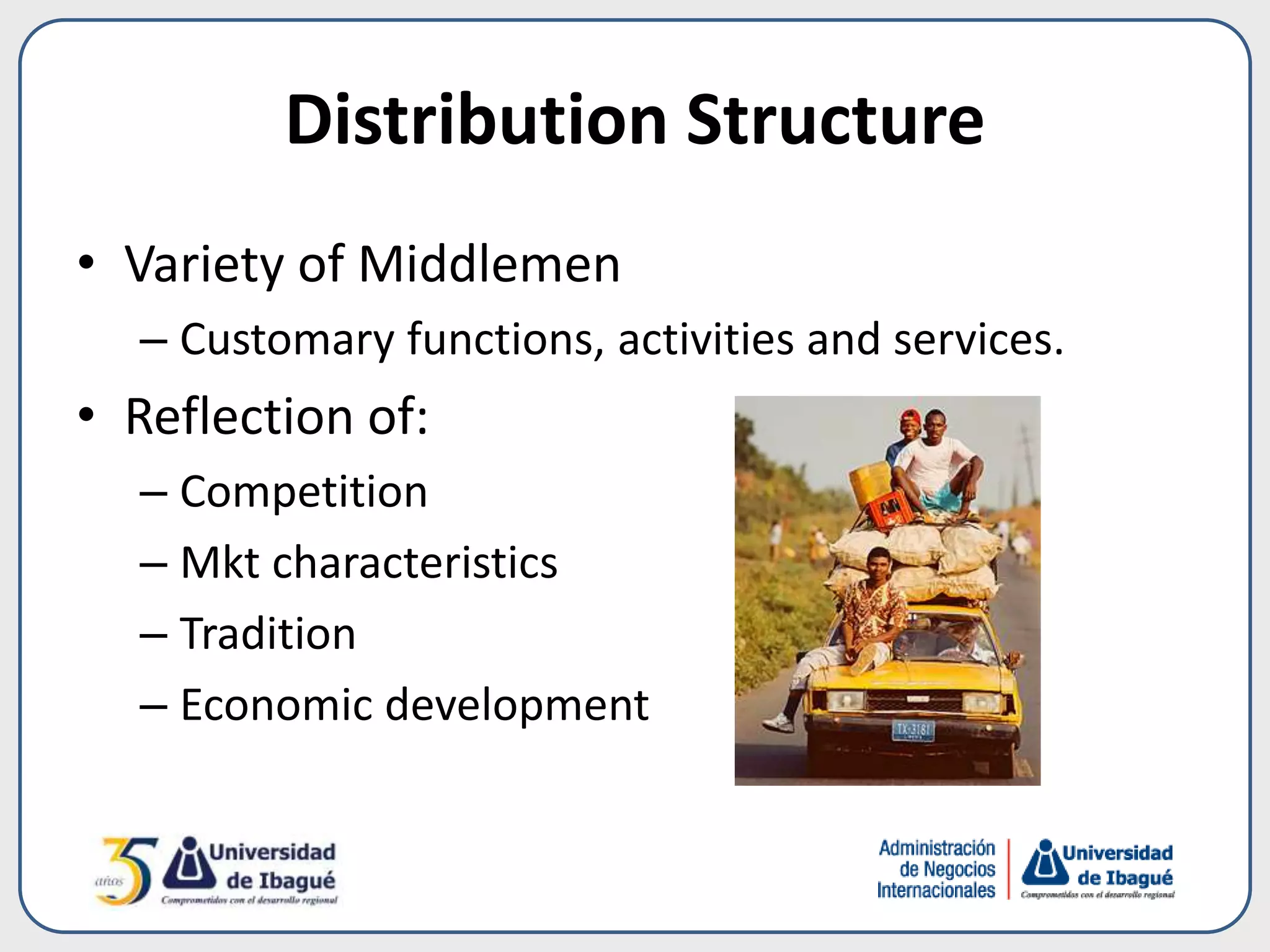
Distribution Structure
• Variety of Middlemen
– Customary functions, activities and services.
• Reflection of:
– Competition
– Mkt characteristics
– Tradition
– Economic development
Import-Oriented Distribution
Structure
• Developing countries
importing manufactured
goods.
• Limited supply at high
prices.
• Small number of
customers.
• No mass distribution.
Pasaje Comercial Hernandez in Bogota,
Destination of imported goods for
several decades in the 20th Century.
©CarlosLlamas
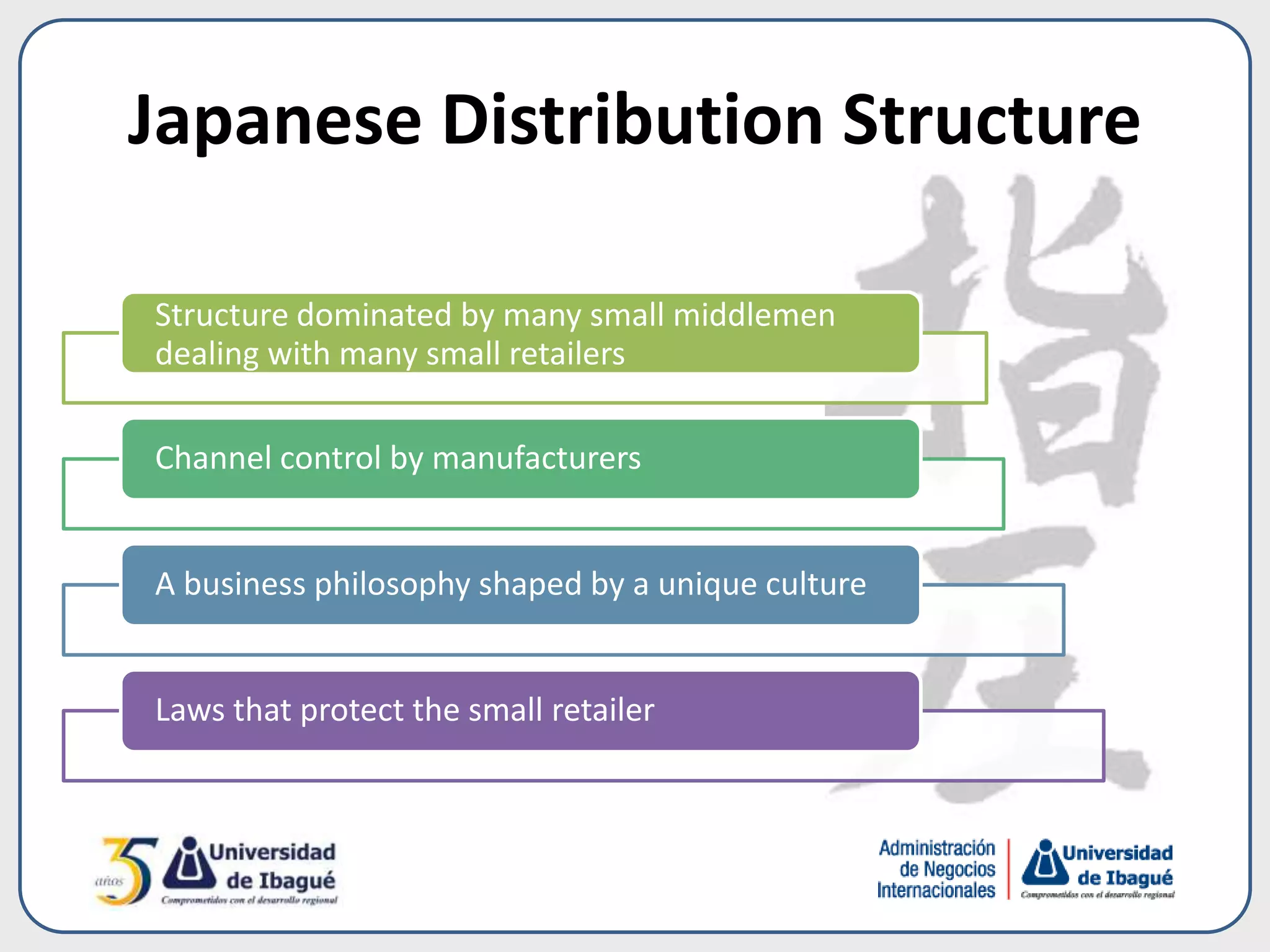
Japanese Distribution Structure
Structure dominated by many small middlemen
dealing with many small retailers
Channel control by manufacturers
A business philosophy shaped by a unique culture
Laws that protect the small retailer
Current Distribution Trends
• Web-based purchasing.
• Former competitors create Str. Alliances.
• Discount stores
• Diversification of activities
In Spain, El Corte Inglés is the biggest
Department store, in Colombia, Informática
El Corte Inglés takes care of the numeric
Portability process; also there is a travel
Agency named Viajes El Corte Inglés.
Dia is a discount chain owned by
Carrefour
Distribution Patterns
• The middlemen will not disappear.
• Patterns vary between markets.
• The “traditional” pattern will take longer to
disappear.
Branded Shops are examples of
Distribution Patterns
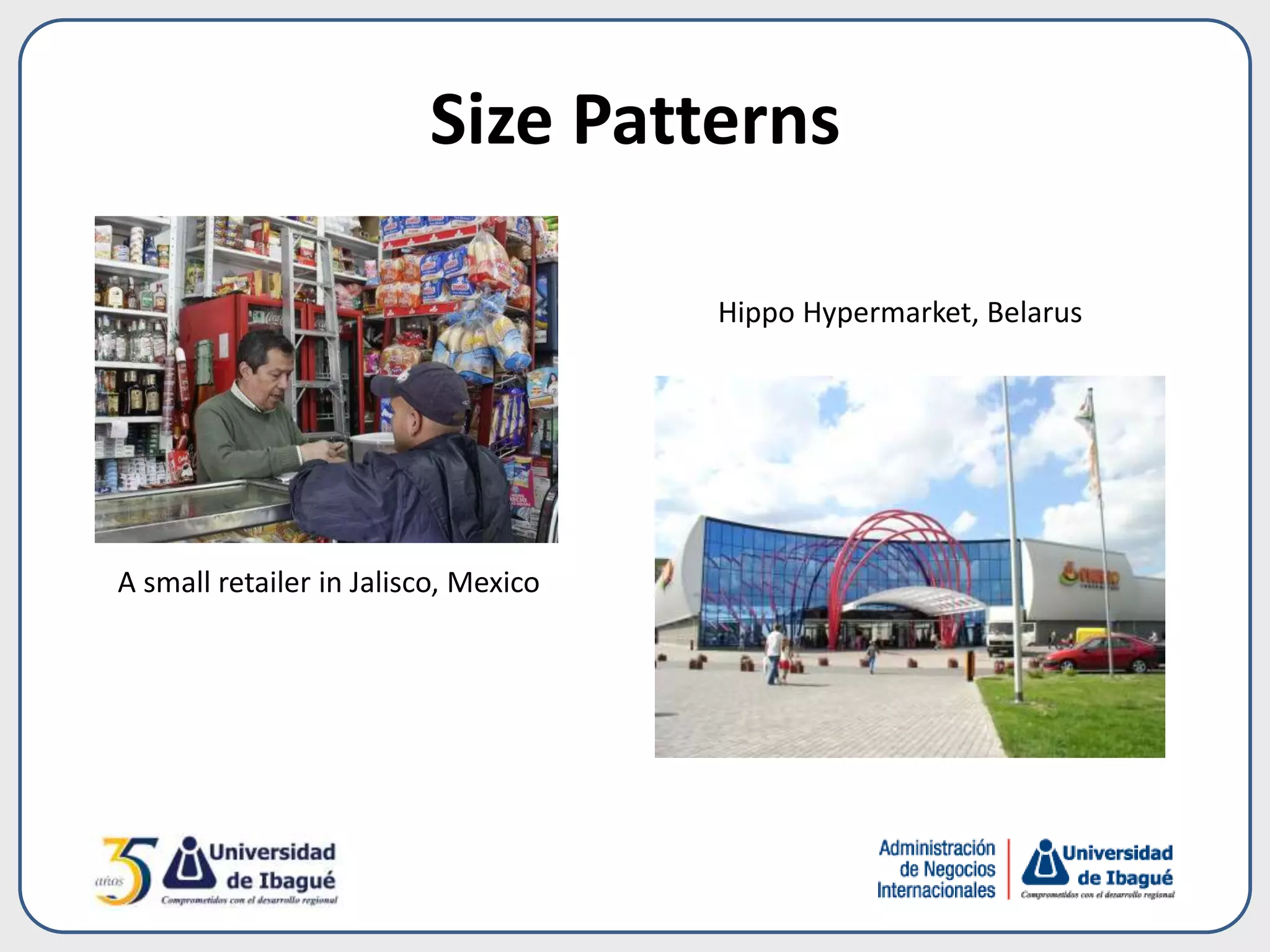
Size Patterns
A small retailer in Jalisco, Mexico
Hippo Hypermarket, Belarus
Direct Marketing
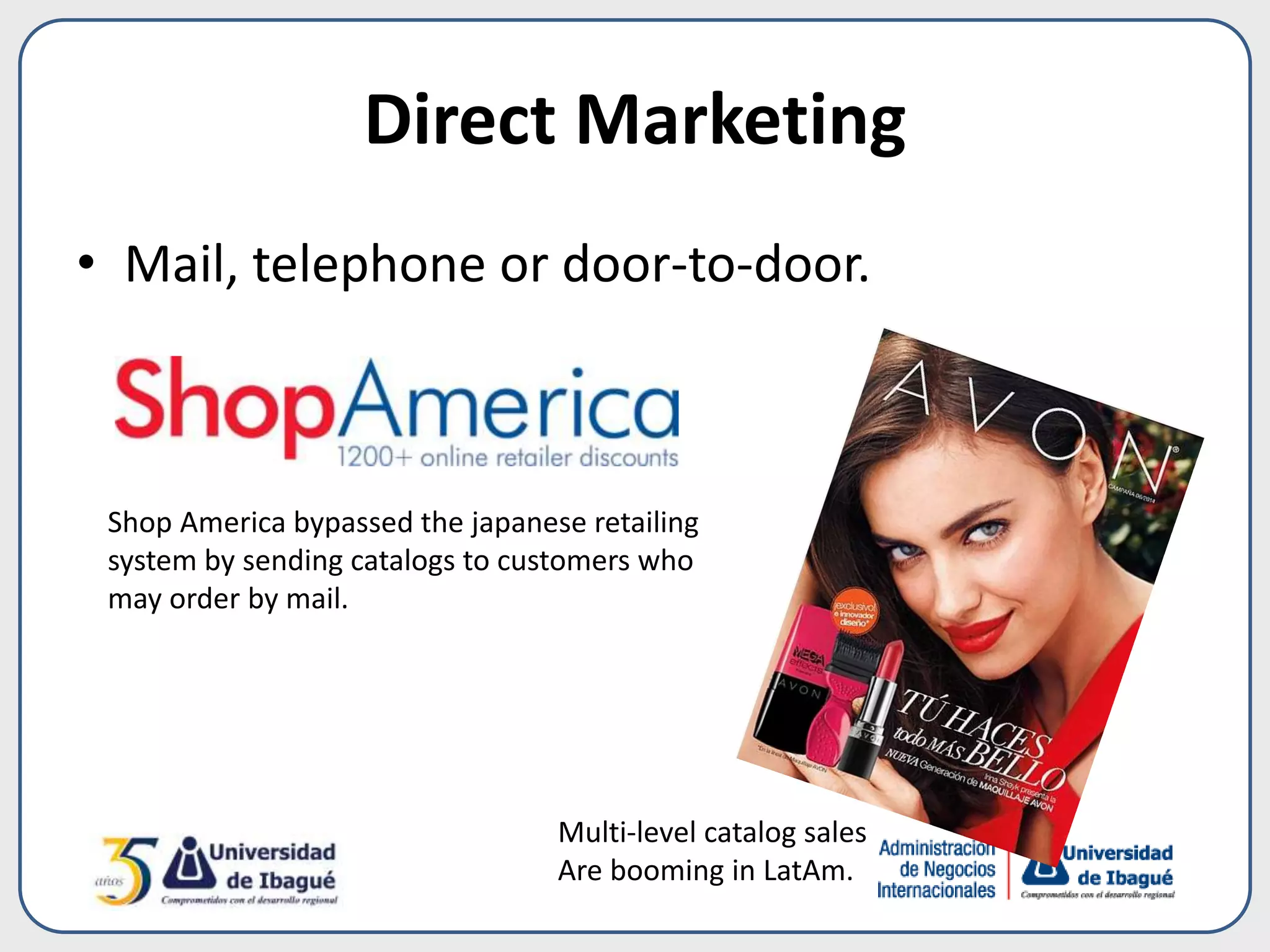
• Mail, telephone or door-to-door.
Multi-level catalog sales
Are booming in LatAm.
Shop America bypassed the japanese retailing
system by sending catalogs to customers who
may order by mail.
Resistance to Change
Prodiscos, the biggest colombian records retailer was slow in reaction facing the
threat of Online piracy and digital streaming and downloading. It tried to rebrand
itself as Entertainment Store during its last years but lost to the impeding change in
distribution trends.
Alternative Middleman Choices
Cateora,P.,&Gilly,M.(2011).Internationalmarketing(15thed.).NewYork,NY:
McGraw-Hill/Irwin.
Types of Middlemen
• Agent Middlemen
– Manufacturer’s Export Agent
– Acts on behalf of the manufacturer.
• Merchant Middlemen
– Combined Export Manager
– Acts on its own behalf
Domestic Middle-Men
Manufacturers’
Retail Store
• Disney
Global
Retailers
• Sears Roebuck
Export Management
Companies
• All things export
related
Trading
Companies
• Long tradition of
supplying goods to
developing countries.
Complementary
Marketers
• Piggybacking
Manufacturer’s
Exports Agent
• Act on behalf of the
producer
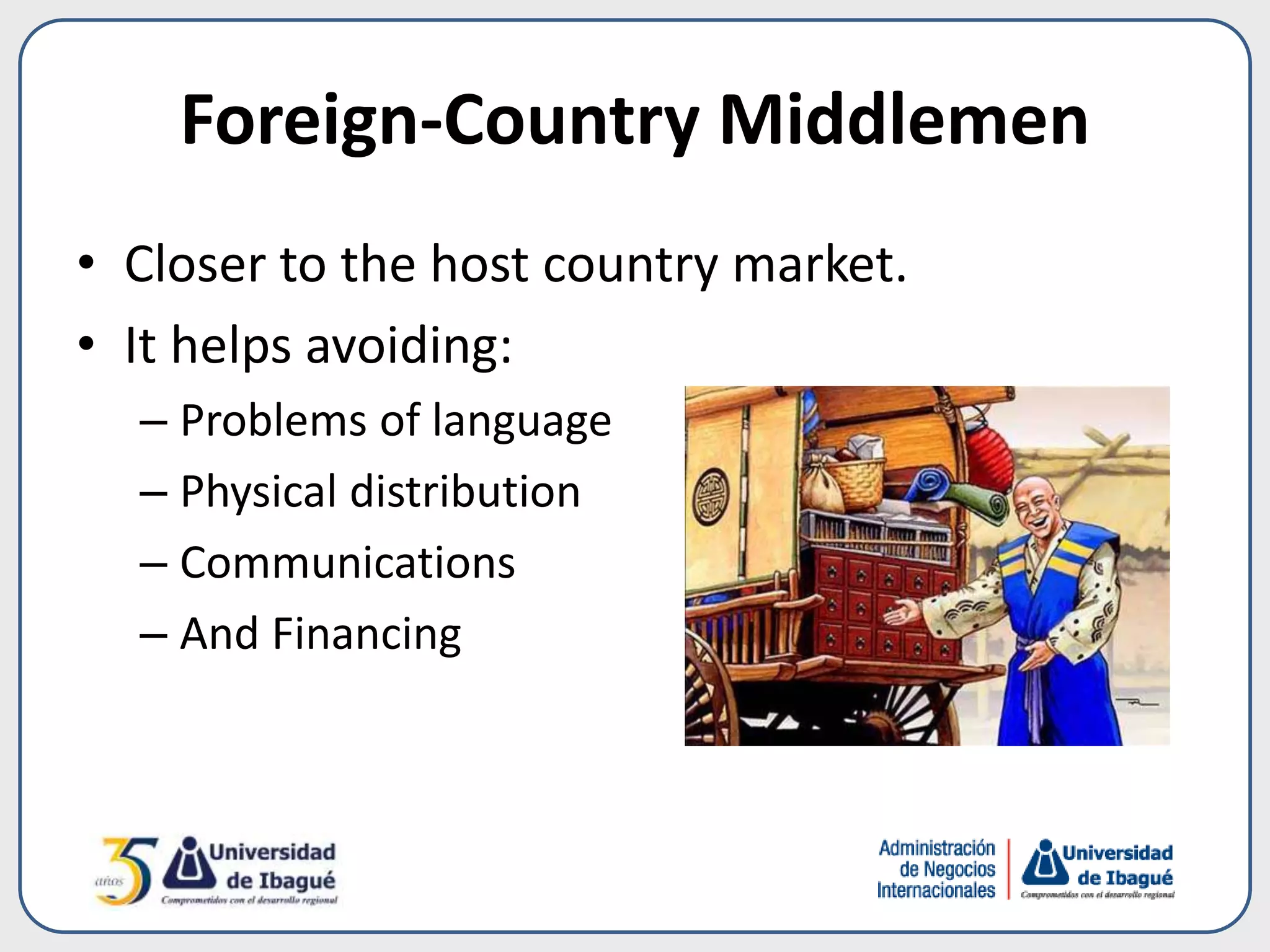
Foreign-Country Middlemen
• Closer to the host country market.
• It helps avoiding:
– Problems of language
– Physical distribution
– Communications
– And Financing
Government-Affiliated Middlemen
http://www.cbi.eu/
Before Selecting Channels
• It’s necessary to address these points:
1. Identify specific target markets within and
across countries.
2. Specify marketing goals in terms of volume,
market share, and profit margin requirements.
3. Specify financial and personnel commitments to
the development of international distribution.
4. Identify control, length of channels, terms of
sale, and channel ownership.
Selecting Middlemen
Cost
Availability
Control
The Six C of the Channel Strategy
Cost
Capital
Control
Coverage
Character
Continuity
Cost
Of
Developing
the channel
Of
Maintaining
the channel
Capital
• Internal channels
• Deals of distribution
– Loans
– Consignment
– More control = more
investment
Control
• The longest the channel, the least the control
the manufacturer has.
With several middlemen the power to decide over
• Price
• Volume
• Promotion
• And outlets
Diminishes.
Coverage
• Geographic segments
• Market segments
• No full market coverage, just major population
centers.
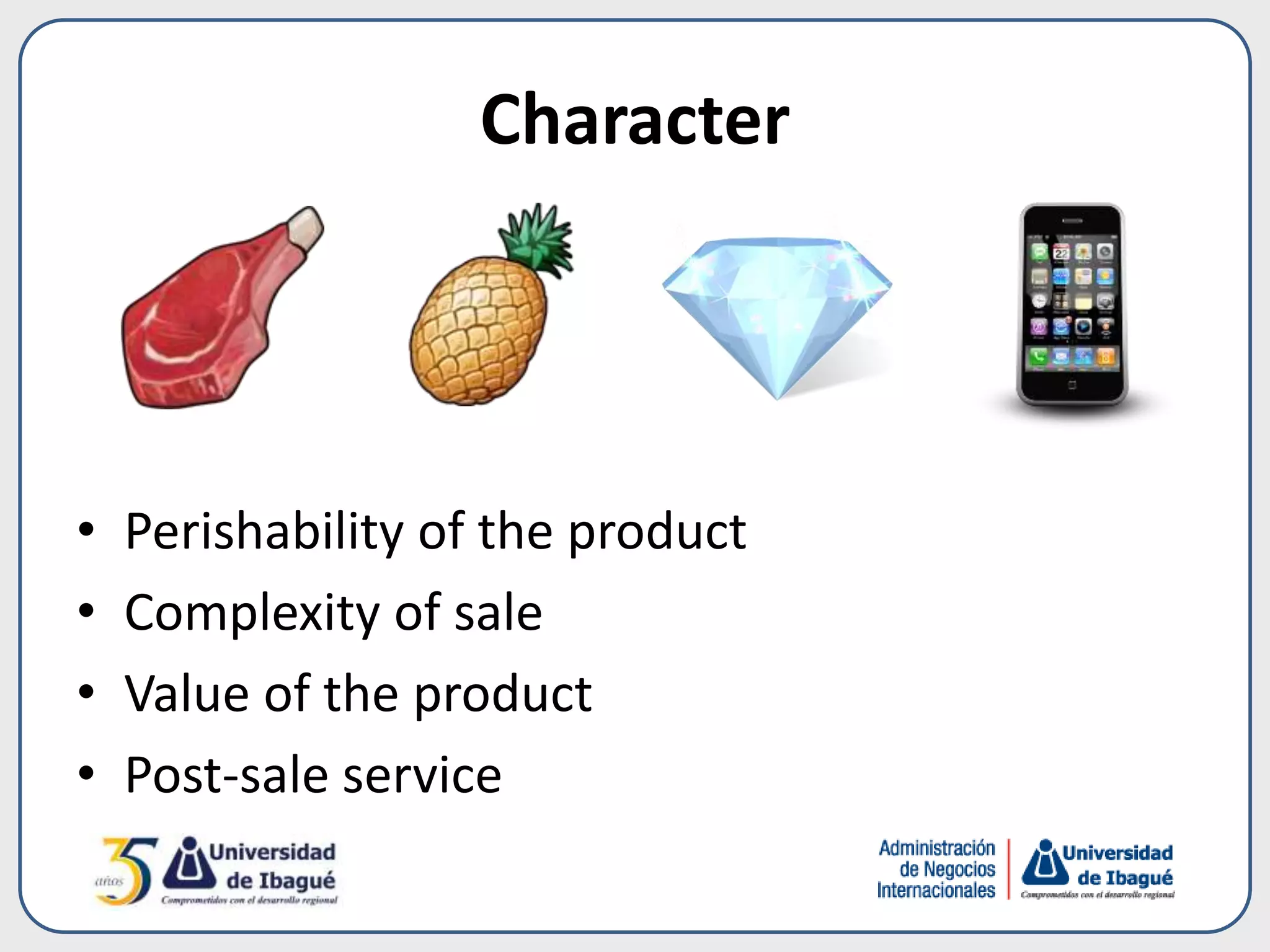
Character
• Perishability of the product
• Complexity of sale
• Value of the product
• Post-sale service
Continuity
• Middlemen loyalty is almos non-existent.
• Shift allegiance based on perks from
competitors.
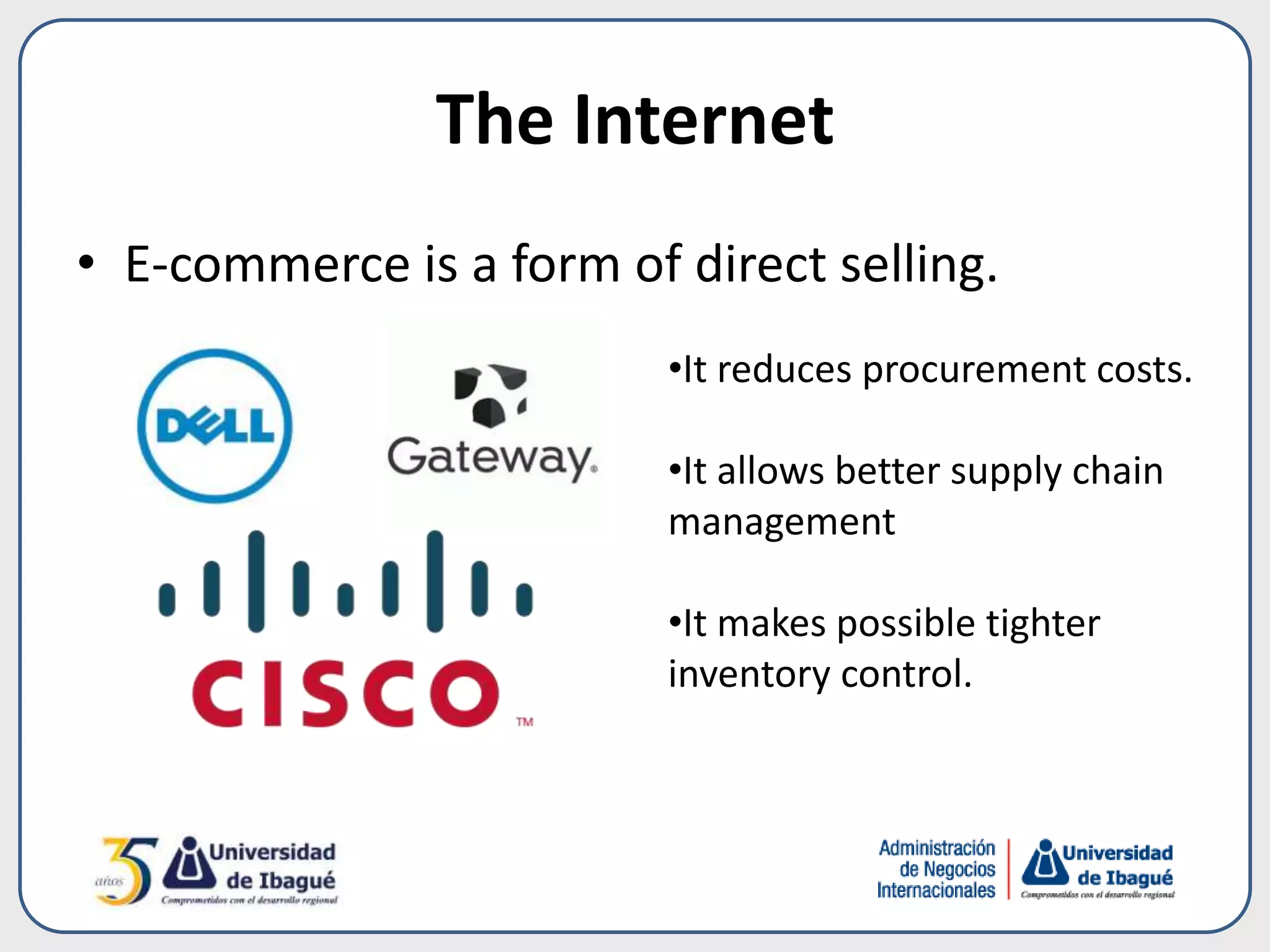
The Internet
• E-commerce is a form of direct selling.
•It reduces procurement costs.
•It allows better supply chain
management
•It makes possible tighter
inventory control.
Logistics
• Location of plants
• Warehousing
• Transportation mode
• Inventory quantities
• Packing.

Global distribution strategies

  • 1.
  • 2.
    Objectives • To learnthe variety of distribution channels and how they affect cost and efficiency in marketing. • To understand the Japanese distribution structure and what it means to Japanese customers and to competing importers of goods. • To be aware of how distribution patterns affect the various aspects of international marketing. • To understand the functions, advantages, and disadvantages of various kinds of middlemen.
  • 3.
    • To learnthe importance of selecting and maintining middlemen. • To know the growing importance of e- commerce as a distribution alternative. • To understand the interdependence of physical distribution activitites.
  • 4.
    The Distribution Process •Physical handling and distribution of goods. • Passage of ownership (INCOTERMS) Producer Middlemen Customers
  • 5.
    Distribution Structure • Varietyof Middlemen – Customary functions, activities and services. • Reflection of: – Competition – Mkt characteristics – Tradition – Economic development
  • 6.
    Import-Oriented Distribution Structure • Developingcountries importing manufactured goods. • Limited supply at high prices. • Small number of customers. • No mass distribution. Pasaje Comercial Hernandez in Bogota, Destination of imported goods for several decades in the 20th Century. ©CarlosLlamas
  • 7.
    Japanese Distribution Structure Structuredominated by many small middlemen dealing with many small retailers Channel control by manufacturers A business philosophy shaped by a unique culture Laws that protect the small retailer
  • 8.
    Current Distribution Trends •Web-based purchasing. • Former competitors create Str. Alliances. • Discount stores • Diversification of activities In Spain, El Corte Inglés is the biggest Department store, in Colombia, Informática El Corte Inglés takes care of the numeric Portability process; also there is a travel Agency named Viajes El Corte Inglés. Dia is a discount chain owned by Carrefour
  • 9.
    Distribution Patterns • Themiddlemen will not disappear. • Patterns vary between markets. • The “traditional” pattern will take longer to disappear. Branded Shops are examples of Distribution Patterns
  • 10.
    Size Patterns A smallretailer in Jalisco, Mexico Hippo Hypermarket, Belarus
  • 11.
    Direct Marketing • Mail,telephone or door-to-door. Multi-level catalog sales Are booming in LatAm. Shop America bypassed the japanese retailing system by sending catalogs to customers who may order by mail.
  • 12.
    Resistance to Change Prodiscos,the biggest colombian records retailer was slow in reaction facing the threat of Online piracy and digital streaming and downloading. It tried to rebrand itself as Entertainment Store during its last years but lost to the impeding change in distribution trends.
  • 13.
  • 14.
    Types of Middlemen •Agent Middlemen – Manufacturer’s Export Agent – Acts on behalf of the manufacturer. • Merchant Middlemen – Combined Export Manager – Acts on its own behalf
  • 15.
    Domestic Middle-Men Manufacturers’ Retail Store •Disney Global Retailers • Sears Roebuck Export Management Companies • All things export related Trading Companies • Long tradition of supplying goods to developing countries. Complementary Marketers • Piggybacking Manufacturer’s Exports Agent • Act on behalf of the producer
  • 16.
    Foreign-Country Middlemen • Closerto the host country market. • It helps avoiding: – Problems of language – Physical distribution – Communications – And Financing
  • 17.
  • 18.
    Before Selecting Channels •It’s necessary to address these points: 1. Identify specific target markets within and across countries. 2. Specify marketing goals in terms of volume, market share, and profit margin requirements. 3. Specify financial and personnel commitments to the development of international distribution. 4. Identify control, length of channels, terms of sale, and channel ownership.
  • 19.
  • 20.
    The Six Cof the Channel Strategy Cost Capital Control Coverage Character Continuity
  • 21.
  • 22.
    Capital • Internal channels •Deals of distribution – Loans – Consignment – More control = more investment
  • 23.
    Control • The longestthe channel, the least the control the manufacturer has. With several middlemen the power to decide over • Price • Volume • Promotion • And outlets Diminishes.
  • 24.
    Coverage • Geographic segments •Market segments • No full market coverage, just major population centers.
  • 25.
    Character • Perishability ofthe product • Complexity of sale • Value of the product • Post-sale service
  • 26.
    Continuity • Middlemen loyaltyis almos non-existent. • Shift allegiance based on perks from competitors.
  • 27.
    The Internet • E-commerceis a form of direct selling. •It reduces procurement costs. •It allows better supply chain management •It makes possible tighter inventory control.
  • 28.
    Logistics • Location ofplants • Warehousing • Transportation mode • Inventory quantities • Packing.