International Marketing Distribution
International Distribution   In intl mktg manufacturer doesn’t sell products directly Goes thro several parties before reaching consumer Involves various channels and variety of intermediaries Q: How do I get my product most profitably to a foreign country ? The answer lies in Firms method of entry in foreign market Selection & distribution channel within each of firms  foreign market
International Distribution   Decision criteria for entry method Firm must evaluate  Company goals - volume of business desired and geographical coverage Size of the company  in sales and assets Product line &nature of product (Industrial,consumer,  high or low price) Competitor abroad
International Distribution   Decision criteria for entry method Different entry method as per country need & regulatn In some wholly owned operations In others marketing subsidiaries In some others local distributors  or combine different entry methods Eg. Dupont 40 countries wholly owned 20 countries Mkt subsidiaries  > 60 countries distributors
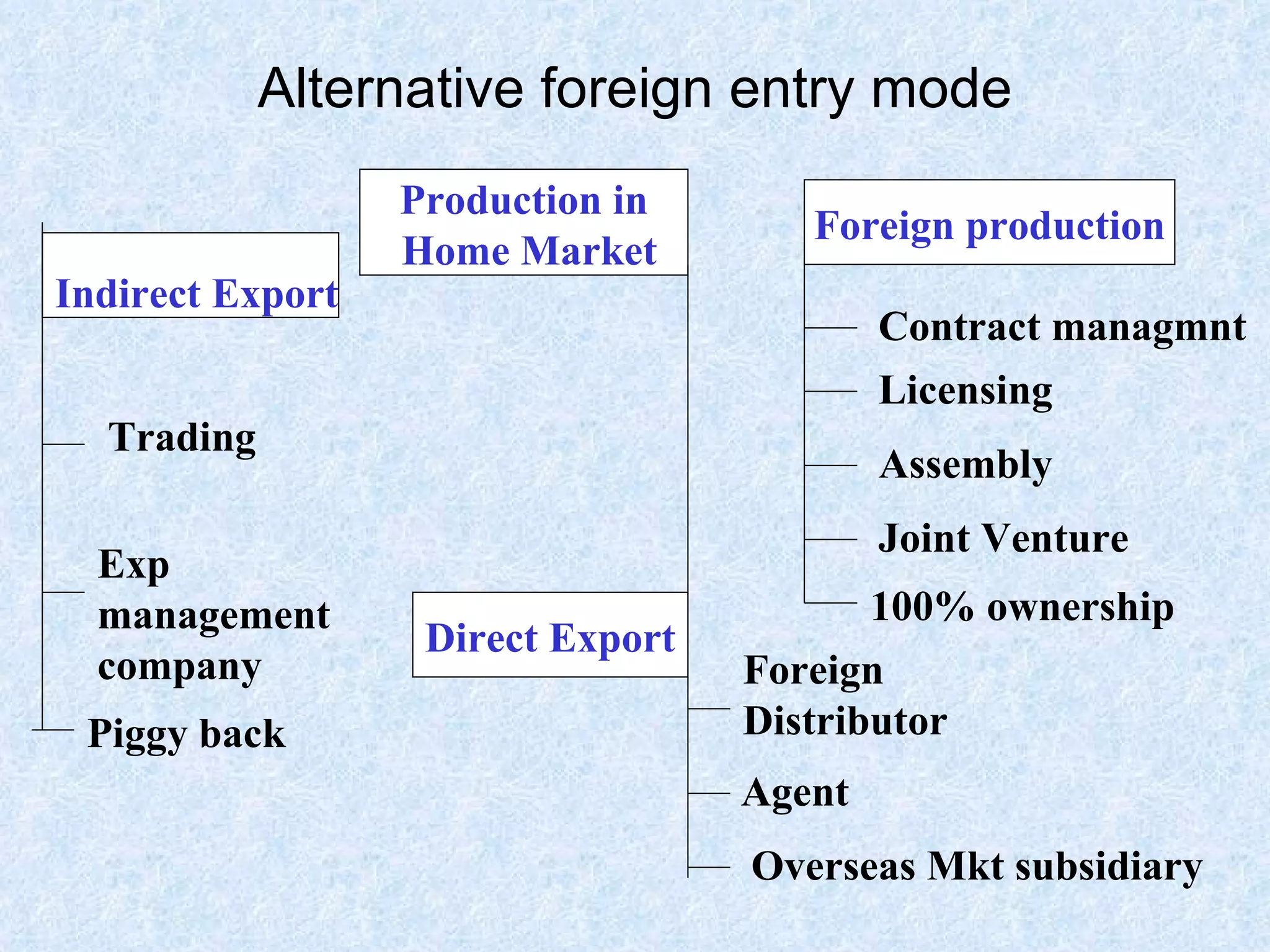
Alternative foreign entry mode Indirect Export   Trading Exp  management company Piggy back Production in Home Market Foreign production Direct Export Foreign Distributor Agent Overseas Mkt subsidiary Contract managmnt Licensing Assembly Joint Venture 100% ownership
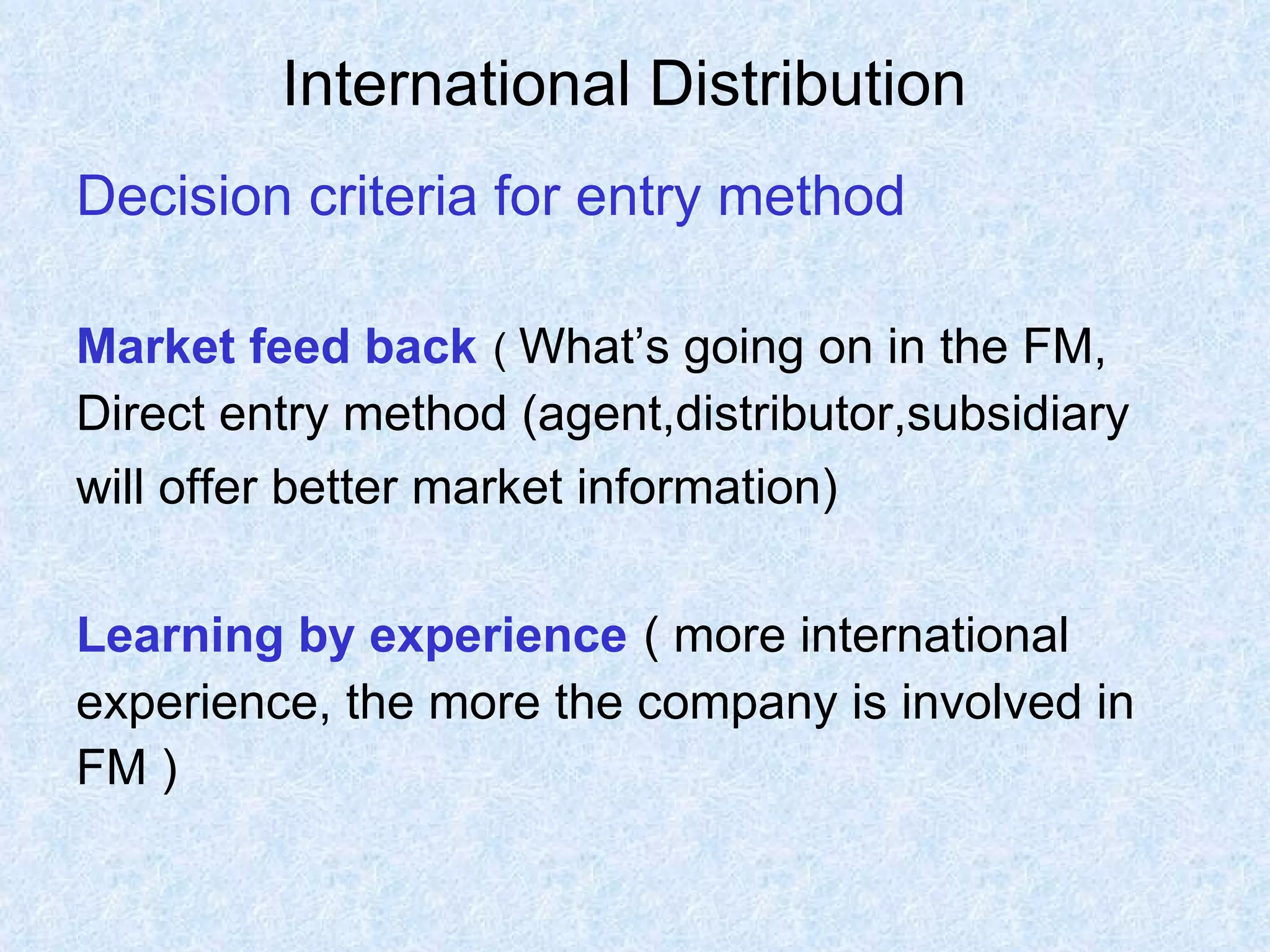
International Distribution   Decision criteria for entry method Market feed back   (  What’s going on in the FM,  Direct entry method (agent,distributor,subsidiary  will offer better market information)   Learning by experience   ( more international  experience, the more the company is involved in  FM )
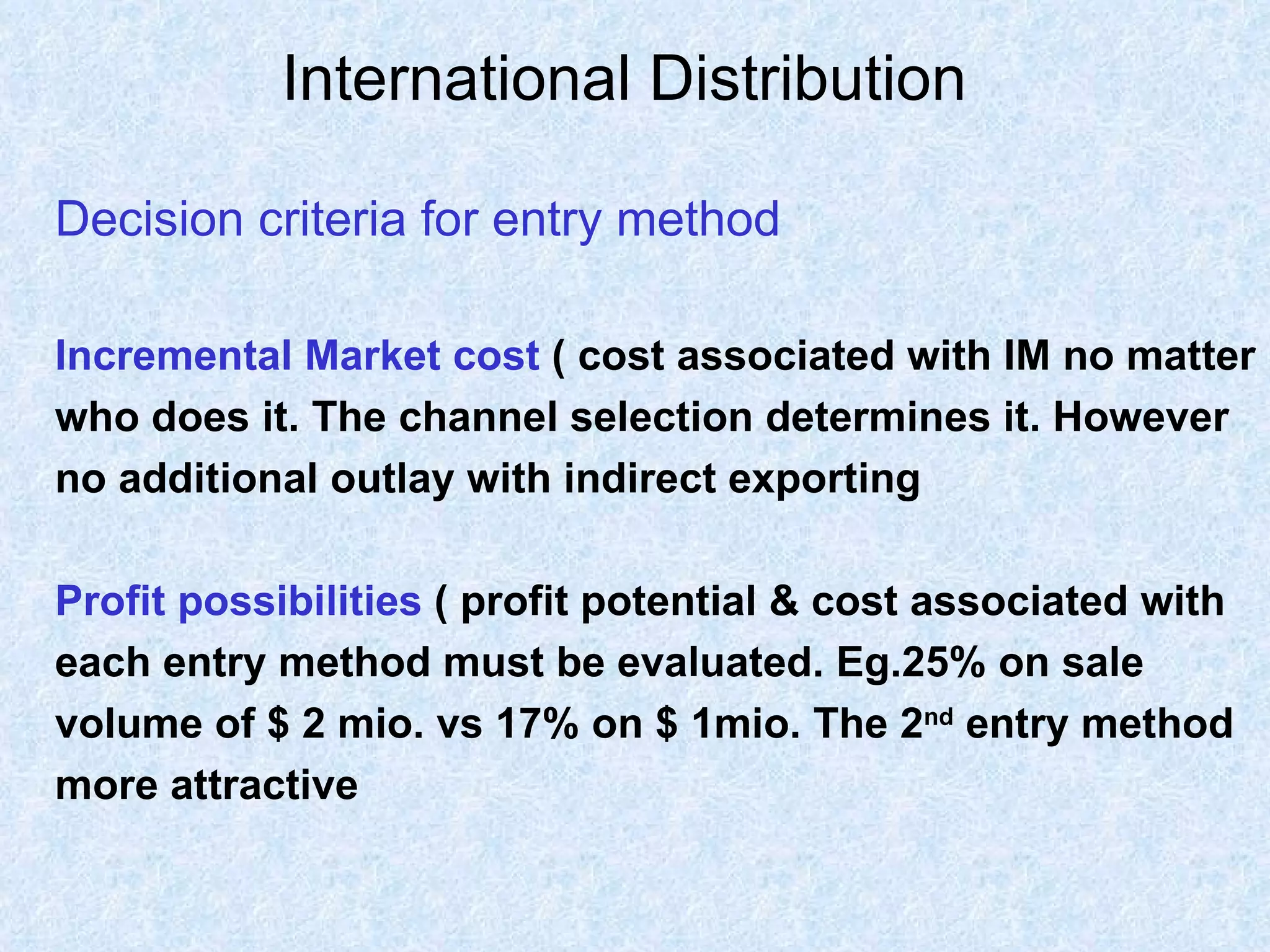
International Distribution   Decision criteria for entry method Incremental Market cost   ( cost associated with IM no matter who does it. The channel selection determines it. However no additional outlay with indirect exporting Profit possibilities   ( profit potential & cost associated with each entry method must be evaluated. Eg.25% on sale  volume of $ 2 mio. vs 17% on $ 1mio. The 2 nd  entry method  more attractive
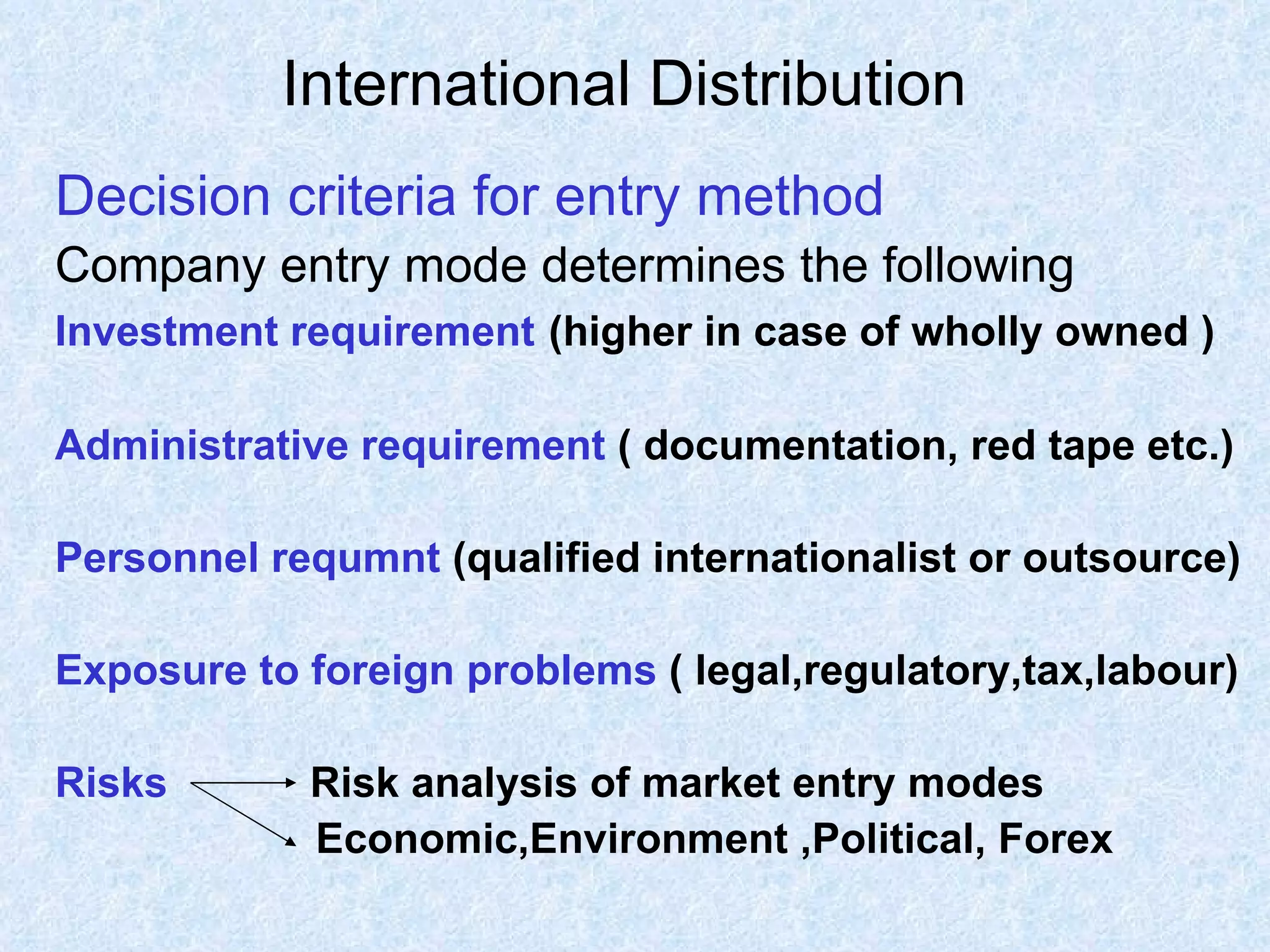
International Distribution   Decision criteria for entry method Company entry mode determines the following  Investment requirement   (higher in case of wholly owned ) Administrative requirement  ( documentation, red tape etc.) Personnel requmnt  (qualified internationalist or outsource) Exposure to foreign problems  ( legal,regulatory,tax,labour) Risks   Risk analysis of market entry modes Economic,Environment ,Political, Forex
International Distribution   Indirect Export  : Foreign sales through domestic  sales Organization Trading companies : Handle imports   ( Mitsubishi- Japan) Size and market  coverage of these companies make them attractive  distributors. Cover the Mkt well & service the  products Draw back  –  likely to carry competing lines & the new  product added might not receive the desired attention
International Distribution   Indirect Export  : Export Management company Act on behalf of the company with closer cooperation &  coordination.  Use company letterheads, negotiate on  behalf of the firm. Economical mode & the cost is shared Piggyback Manufacturer uses overseas distributor to sell another  company’s product along with its own,( carrier, rider  relationship) Advantage – Fill  the gap in its product line or  economy of scale. Economical and cost is shared.
International Distribution   Direct Export  : Foreign sales handled same way as domestic. All documentation, distribution fall under the firm Task of exp. Management staff: Choosing foreign mkt ( existing, new) Choosing representation ( own, or franchisee) Physical distribution & export documentation, logistic coordination Marketing task :   market intelligence, pricing & promotion
International Distribution   Foreign manufacturing & foreign entry  : Firm might find it undesirable to supply all foreign markets from domestic production Factors force/ encourage firm to produce in FM Heavy distribution cost,Tariff & Quotas Govt. policies encouraging local production Better interaction with local needs Saving on transportation, Tariff,& raw materials Better  customer & Govt. relations No interruption of supplies
International Distribution   Approaches to foreign manufacture: Assembly :   Produce components locally, ship them to FM  for assembly ( cars, electronics, Industrial goods) Contract manufacture:   Products produced in the FM by  another producer under contract with the firm . Covers only  mfg. Marketing is covered by the firm ( eg. P&G in Italy ) Drawback -  manufacturing profit goes to the producing  firm, Q.C is always a problem
International Distribution   Approaches to foreign manufacture: Licensing :   Firms establishes local production in FM  without capital investment usually for a longer period  Involves much greater responsibility for the national firm Licensor gives patent / Trademark rights,copyright and  product know how Joint Venture : Foreign operation where intln company has enough equity  to share a voice in the management ( 25  - 75 )  Many nations prefer JV – Nations gets more of the profit &  the technical  benefit
International Distribution   Approaches to foreign manufacture: Strategic Alliance:   Non equity contractual relationship between competition &  competitors in different countries eg. ( Phillips link with  Siemens ) The local firm gets a new product one that is  complimentary rather than  directly competing ( eg   Antidiarrhoel with ORS)
International Distribution   Approaches to foreign manufacture: Wholly owned foreign production : 100% ownership by international firm( 100% completeness  of control by the international firm ) Buy out a foreign producer through acquisition route Buy out a joint venture partner  Acquisition :   Quicker way to get into a market than building  Its own facilities. Package also includes qualified labour force,management,local knowledge,contact with local Mkt  and Govt.
International Distribution   Foreign Market channel & Global Logistics : How to distribute the products in FM once the goods are  Reached ? Management of foreign distributors Management international logistics Management of foreign distributor – depend on the entry  mode chosen.Firms have little to do when they choose trading / export management  & licensing companies Firms having own subsidiaries / complete mfg & mkt  operations in the FM have direct responsibility
International Distribution   Marketing through Trading company  Primary method of reaching foreign market Firm’s success depends on  performance of the distributor Selection:   Comp performce,past record,financial backing Agreement:  Spell out duties & responsibilities & interest of  each party Financial /price consideration :   Margins ,commission,credit  terms Marketing support:   Participation in promotion, trade  fairs,sampling etc. Communication:   availability of Tel,e.mail,personal visits Incentive and motivation: to induce him to sell
International Distribution   Marketing through Firms  own presence  Firm having own staff manage distribution locally Follow local distribution infrastructure (Wholesaler, retailer, transport system Wholesaler & service :   getting assortments, breaking bulk  & distribute to retailers Retailer & services:   stocking, displaying,selling products,  inventory carrying and repurchase A proper coordination, co operation and motivation is  necessary to manage business
International Distribution   Physical distribution vs Logistics: Physical distribution:   Financial & ownership flow of goods  a narrow view of the physical movement  Logistics:   Much more than physical movement &  Transportation. Involves number & location of production & storage facilities,production schedules inventory managmt Documentation involves more parties, more data, more  Credit checks on foreign buyers and involvement of new  intermediary in exp sales- international freight forwarder
International Distribution   Logistics within a foreign Market: Firms having own subsidiary must seek to optimize its  physical distribution Where represented by distributor & licensees – firm has  limited role in logistics Firms approach abroad can vary according to the size of  the market,way market is supplied,urbanization,  topography,& storage facilities ( Congo- Physical  distribution problems)
International Distribution   Multi market logistics: World – not one market but collection of individual national  mkts, each under the control  of sovereign Govt. Has various methods of separation their markets  from others, tariff barriers, quotas & licenses,local  laws,monitory system,tax system,transport policies Logistic management should adapt to overcome the  barriers to achieve integrated world mkt for physical  distribution ( eg. Coco cola built plant in India because of  trade restrictions  )
International Distribution   Management of international logistics: Facilities available are   Freight forwarders:   specialist in documentation &  transportation,insurance etc well  managed on their own Free Trade Zone & public warehouse:   50 nations over 500 FTS,free ports,bonded warehouse( a Govt owned & supervised by custom officials  Permit goods without tax as long as they are  in the FTZ May allow processing,Assembly, sorting, repacking within  the zone ( provides employment opportunities )

International Marketing Distribution-By Akshay Samant

  • 1.
  • 2.
    International Distribution In intl mktg manufacturer doesn’t sell products directly Goes thro several parties before reaching consumer Involves various channels and variety of intermediaries Q: How do I get my product most profitably to a foreign country ? The answer lies in Firms method of entry in foreign market Selection & distribution channel within each of firms foreign market
  • 3.
    International Distribution Decision criteria for entry method Firm must evaluate Company goals - volume of business desired and geographical coverage Size of the company in sales and assets Product line &nature of product (Industrial,consumer, high or low price) Competitor abroad
  • 4.
    International Distribution Decision criteria for entry method Different entry method as per country need & regulatn In some wholly owned operations In others marketing subsidiaries In some others local distributors or combine different entry methods Eg. Dupont 40 countries wholly owned 20 countries Mkt subsidiaries > 60 countries distributors
  • 5.
    Alternative foreign entrymode Indirect Export Trading Exp management company Piggy back Production in Home Market Foreign production Direct Export Foreign Distributor Agent Overseas Mkt subsidiary Contract managmnt Licensing Assembly Joint Venture 100% ownership
  • 6.
    International Distribution Decision criteria for entry method Market feed back ( What’s going on in the FM, Direct entry method (agent,distributor,subsidiary will offer better market information) Learning by experience ( more international experience, the more the company is involved in FM )
  • 7.
    International Distribution Decision criteria for entry method Incremental Market cost ( cost associated with IM no matter who does it. The channel selection determines it. However no additional outlay with indirect exporting Profit possibilities ( profit potential & cost associated with each entry method must be evaluated. Eg.25% on sale volume of $ 2 mio. vs 17% on $ 1mio. The 2 nd entry method more attractive
  • 8.
    International Distribution Decision criteria for entry method Company entry mode determines the following Investment requirement (higher in case of wholly owned ) Administrative requirement ( documentation, red tape etc.) Personnel requmnt (qualified internationalist or outsource) Exposure to foreign problems ( legal,regulatory,tax,labour) Risks Risk analysis of market entry modes Economic,Environment ,Political, Forex
  • 9.
    International Distribution Indirect Export : Foreign sales through domestic sales Organization Trading companies : Handle imports ( Mitsubishi- Japan) Size and market coverage of these companies make them attractive distributors. Cover the Mkt well & service the products Draw back – likely to carry competing lines & the new product added might not receive the desired attention
  • 10.
    International Distribution Indirect Export : Export Management company Act on behalf of the company with closer cooperation & coordination. Use company letterheads, negotiate on behalf of the firm. Economical mode & the cost is shared Piggyback Manufacturer uses overseas distributor to sell another company’s product along with its own,( carrier, rider relationship) Advantage – Fill the gap in its product line or economy of scale. Economical and cost is shared.
  • 11.
    International Distribution Direct Export : Foreign sales handled same way as domestic. All documentation, distribution fall under the firm Task of exp. Management staff: Choosing foreign mkt ( existing, new) Choosing representation ( own, or franchisee) Physical distribution & export documentation, logistic coordination Marketing task : market intelligence, pricing & promotion
  • 12.
    International Distribution Foreign manufacturing & foreign entry : Firm might find it undesirable to supply all foreign markets from domestic production Factors force/ encourage firm to produce in FM Heavy distribution cost,Tariff & Quotas Govt. policies encouraging local production Better interaction with local needs Saving on transportation, Tariff,& raw materials Better customer & Govt. relations No interruption of supplies
  • 13.
    International Distribution Approaches to foreign manufacture: Assembly : Produce components locally, ship them to FM for assembly ( cars, electronics, Industrial goods) Contract manufacture: Products produced in the FM by another producer under contract with the firm . Covers only mfg. Marketing is covered by the firm ( eg. P&G in Italy ) Drawback - manufacturing profit goes to the producing firm, Q.C is always a problem
  • 14.
    International Distribution Approaches to foreign manufacture: Licensing : Firms establishes local production in FM without capital investment usually for a longer period Involves much greater responsibility for the national firm Licensor gives patent / Trademark rights,copyright and product know how Joint Venture : Foreign operation where intln company has enough equity to share a voice in the management ( 25 - 75 ) Many nations prefer JV – Nations gets more of the profit & the technical benefit
  • 15.
    International Distribution Approaches to foreign manufacture: Strategic Alliance: Non equity contractual relationship between competition & competitors in different countries eg. ( Phillips link with Siemens ) The local firm gets a new product one that is complimentary rather than directly competing ( eg Antidiarrhoel with ORS)
  • 16.
    International Distribution Approaches to foreign manufacture: Wholly owned foreign production : 100% ownership by international firm( 100% completeness of control by the international firm ) Buy out a foreign producer through acquisition route Buy out a joint venture partner Acquisition : Quicker way to get into a market than building Its own facilities. Package also includes qualified labour force,management,local knowledge,contact with local Mkt and Govt.
  • 17.
    International Distribution Foreign Market channel & Global Logistics : How to distribute the products in FM once the goods are Reached ? Management of foreign distributors Management international logistics Management of foreign distributor – depend on the entry mode chosen.Firms have little to do when they choose trading / export management & licensing companies Firms having own subsidiaries / complete mfg & mkt operations in the FM have direct responsibility
  • 18.
    International Distribution Marketing through Trading company Primary method of reaching foreign market Firm’s success depends on performance of the distributor Selection: Comp performce,past record,financial backing Agreement: Spell out duties & responsibilities & interest of each party Financial /price consideration : Margins ,commission,credit terms Marketing support: Participation in promotion, trade fairs,sampling etc. Communication: availability of Tel,e.mail,personal visits Incentive and motivation: to induce him to sell
  • 19.
    International Distribution Marketing through Firms own presence Firm having own staff manage distribution locally Follow local distribution infrastructure (Wholesaler, retailer, transport system Wholesaler & service : getting assortments, breaking bulk & distribute to retailers Retailer & services: stocking, displaying,selling products, inventory carrying and repurchase A proper coordination, co operation and motivation is necessary to manage business
  • 20.
    International Distribution Physical distribution vs Logistics: Physical distribution: Financial & ownership flow of goods a narrow view of the physical movement Logistics: Much more than physical movement & Transportation. Involves number & location of production & storage facilities,production schedules inventory managmt Documentation involves more parties, more data, more Credit checks on foreign buyers and involvement of new intermediary in exp sales- international freight forwarder
  • 21.
    International Distribution Logistics within a foreign Market: Firms having own subsidiary must seek to optimize its physical distribution Where represented by distributor & licensees – firm has limited role in logistics Firms approach abroad can vary according to the size of the market,way market is supplied,urbanization, topography,& storage facilities ( Congo- Physical distribution problems)
  • 22.
    International Distribution Multi market logistics: World – not one market but collection of individual national mkts, each under the control of sovereign Govt. Has various methods of separation their markets from others, tariff barriers, quotas & licenses,local laws,monitory system,tax system,transport policies Logistic management should adapt to overcome the barriers to achieve integrated world mkt for physical distribution ( eg. Coco cola built plant in India because of trade restrictions )
  • 23.
    International Distribution Management of international logistics: Facilities available are Freight forwarders: specialist in documentation & transportation,insurance etc well managed on their own Free Trade Zone & public warehouse: 50 nations over 500 FTS,free ports,bonded warehouse( a Govt owned & supervised by custom officials Permit goods without tax as long as they are in the FTZ May allow processing,Assembly, sorting, repacking within the zone ( provides employment opportunities )