
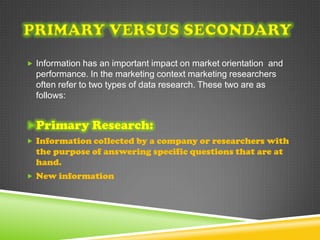


 Information has an important impact on market orientation and
  performance. In the marketing context marketing researchers
  often refer to two types of data research. These two are as
  follows:


Primary Research:
 Information collected by a company or researchers with
  the purpose of answering specific questions that are at
  hand.
 New information
 Export market research information (primary data)
 Strategic level:
 Entry Decision: political, financial, and legal risk assessment
 Mode of entry: focus on cost of production and marketing
 Opportunity: identify the macro market potential (GDP, population)
 Product market: sales volume of product, substitute products,
  number of competitors
 Tactical level: (4Ps)
 Product research: when to add, delete, or change product
 Promotion research: best way to communicate to target market
 Distribution research: availability and desirability of distribution
  channels
 Pricing research: ability of customers to pay, effect of pricing on
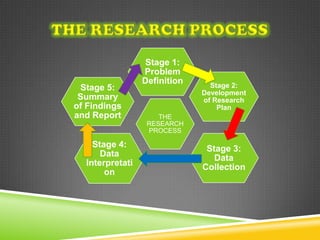
Stage 1:
                 Problem
                 Definition     Stage 2:
 Stage 5:
                              Development
 Summary                      of Research
of Findings                       Plan
and Report           THE
                  RESEARCH
                  PROCESS

    Stage 4:                   Stage 3:
      Data                       Data
  Interpretati                Collection
       on
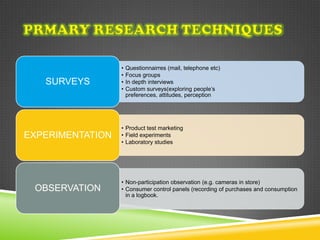
•   Questionnairres (mail, telephone etc)
                  •   Focus groups
   SURVEYS        •   In depth interviews
                  •   Custom surveys(exploring people’s
                      preferences, attitudes, perception


                  • Product test marketing
EXPERIMENTATION   • Field experiments
                  • Laboratory studies


                  • Non-participation observation (e.g. cameras in store)
 OBSERVATION      • Consumer control panels (recording of purchases and consumption
                    in a logbook.
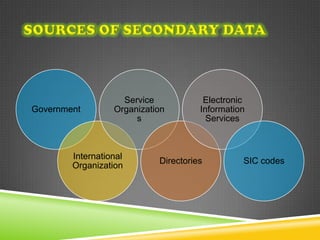
Service            Electronic
Government        Organization        Information
                       s                Services


        International
                            Directories         SIC codes
        Organization
 Availability
 Reliability
 Comparability of data
 Validity of secondary data
 When an outside agency is contracted to do the market
  research.


 Agency can be... located in the host-country, specialise in the
  industry, or be an international operating research agency.


 Considerations for selecting an agency:
 Cost, research expertise (have the capacity), product and
  industry knowledge, timeframe (speed of obtaining data),
  objectivity (unbiased), specialist equipment (better
  equipped), confidentiality
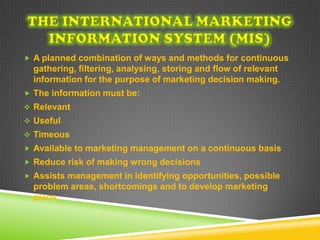
 A planned combination of ways and methods for continuous
  gathering, filtering, analysing, storing and flow of relevant
  information for the purpose of marketing decision making.
 The information must be:
 Relevant
 Useful
 Timeous
 Available to marketing management on a continuous basis
 Reduce risk of making wrong decisions
 Assists management in identifying opportunities, possible
  problem areas, shortcomings and to develop marketing
  plans.
1.   What use do you see for an international marketing
     intelligence system or do you think that it is irrelevant
     and should be eradicated?


2.   Which form of research is best suitable for
     international marketing? Primary or secondary?
     Motivate your answer.

International marketing research presentation

  • 3.
     Information hasan important impact on market orientation and performance. In the marketing context marketing researchers often refer to two types of data research. These two are as follows: Primary Research:  Information collected by a company or researchers with the purpose of answering specific questions that are at hand.  New information
  • 5.
     Export marketresearch information (primary data)  Strategic level:  Entry Decision: political, financial, and legal risk assessment  Mode of entry: focus on cost of production and marketing  Opportunity: identify the macro market potential (GDP, population)  Product market: sales volume of product, substitute products, number of competitors  Tactical level: (4Ps)  Product research: when to add, delete, or change product  Promotion research: best way to communicate to target market  Distribution research: availability and desirability of distribution channels  Pricing research: ability of customers to pay, effect of pricing on
  • 6.
    Stage 1: Problem Definition Stage 2: Stage 5: Development Summary of Research of Findings Plan and Report THE RESEARCH PROCESS Stage 4: Stage 3: Data Data Interpretati Collection on
  • 7.
    Questionnairres (mail, telephone etc) • Focus groups SURVEYS • In depth interviews • Custom surveys(exploring people’s preferences, attitudes, perception • Product test marketing EXPERIMENTATION • Field experiments • Laboratory studies • Non-participation observation (e.g. cameras in store) OBSERVATION • Consumer control panels (recording of purchases and consumption in a logbook.
  • 9.
    Service Electronic Government Organization Information s Services International Directories SIC codes Organization
  • 10.
     Availability  Reliability Comparability of data  Validity of secondary data
  • 11.
     When anoutside agency is contracted to do the market research.  Agency can be... located in the host-country, specialise in the industry, or be an international operating research agency.  Considerations for selecting an agency:  Cost, research expertise (have the capacity), product and industry knowledge, timeframe (speed of obtaining data), objectivity (unbiased), specialist equipment (better equipped), confidentiality
  • 12.
     A plannedcombination of ways and methods for continuous gathering, filtering, analysing, storing and flow of relevant information for the purpose of marketing decision making.  The information must be:  Relevant  Useful  Timeous  Available to marketing management on a continuous basis  Reduce risk of making wrong decisions  Assists management in identifying opportunities, possible problem areas, shortcomings and to develop marketing plans.
  • 14.
    1. What use do you see for an international marketing intelligence system or do you think that it is irrelevant and should be eradicated? 2. Which form of research is best suitable for international marketing? Primary or secondary? Motivate your answer.