© Luis Pachon
International
Business II
Introduction to the course
© Luis Pachon
Task
In pairs answer the following questions:
1. What is International Business?
2. Why should we study international business?
3. What does shape the profit-related activities
across national boundaries?
4. What are the differences between domestic and
international business?
5. Why do companies go international?
© Luis Pachon
The Importance of International
Business
What is International Business?
International business is all
commercial transactions—private and
governmental—between two or more
countries. Private companies
undertake such transactions for profit;
governments may or may not do the
same in their transactions.
© Luis Pachon
The Importance of International
Business
 Why should we study international business?
1. International business comprises a large and
growing portion of the world’s total
business. Today, global events and
competition affect almost all companies—
large or small—because most sell output to
and secure supplies from foreign countries.
Many companies also compete against
products and services that come from
abroad.
© Luis Pachon
The Importance of International
Business
Why should we study international
business?
2. A company operating in the
international business field will
engage in modes of business, such as
exporting and importing, that differ
from those it is accustomed to on a
domestic level.
© Luis Pachon
Growth of International Business
What does shape the profit-related activities
across national boundaries?
 .
 Globalization
 Regional Trading Blocs
EU
NAFTA
CIS
 Information Technology
 Workforce diversity
 Emerging Economies
 Political Instability
© Luis Pachon
Growth of International Business
The paradigm of the “Global
Village”
Countries differ
Culture
Political Systems
Economic Systems
Legal Systems
Economic Development
© Luis Pachon
International Business Vs Domestic
Business.
Systems are different.
Issues are more complex.
Conversion of Money into
different currencies.
Constraints and limitations from
foreign governments.
© Luis Pachon
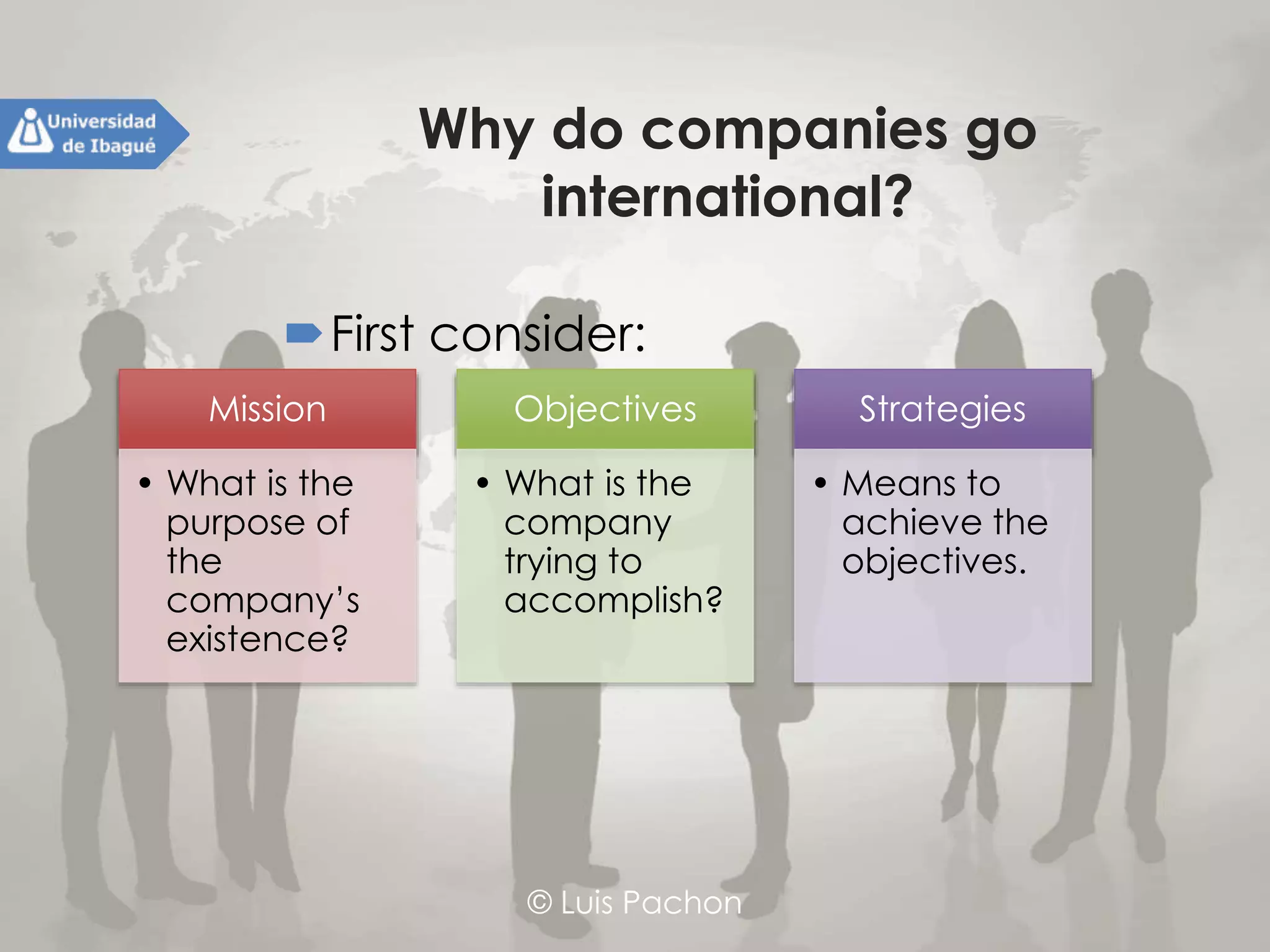
Why do companies go
international?
First consider:Mission
• What is the
purpose of
the
company’s
existence?
Objectives
• What is the
company
trying to
accomplish?
Strategies
• Means to
achieve the
objectives.
© Luis Pachon
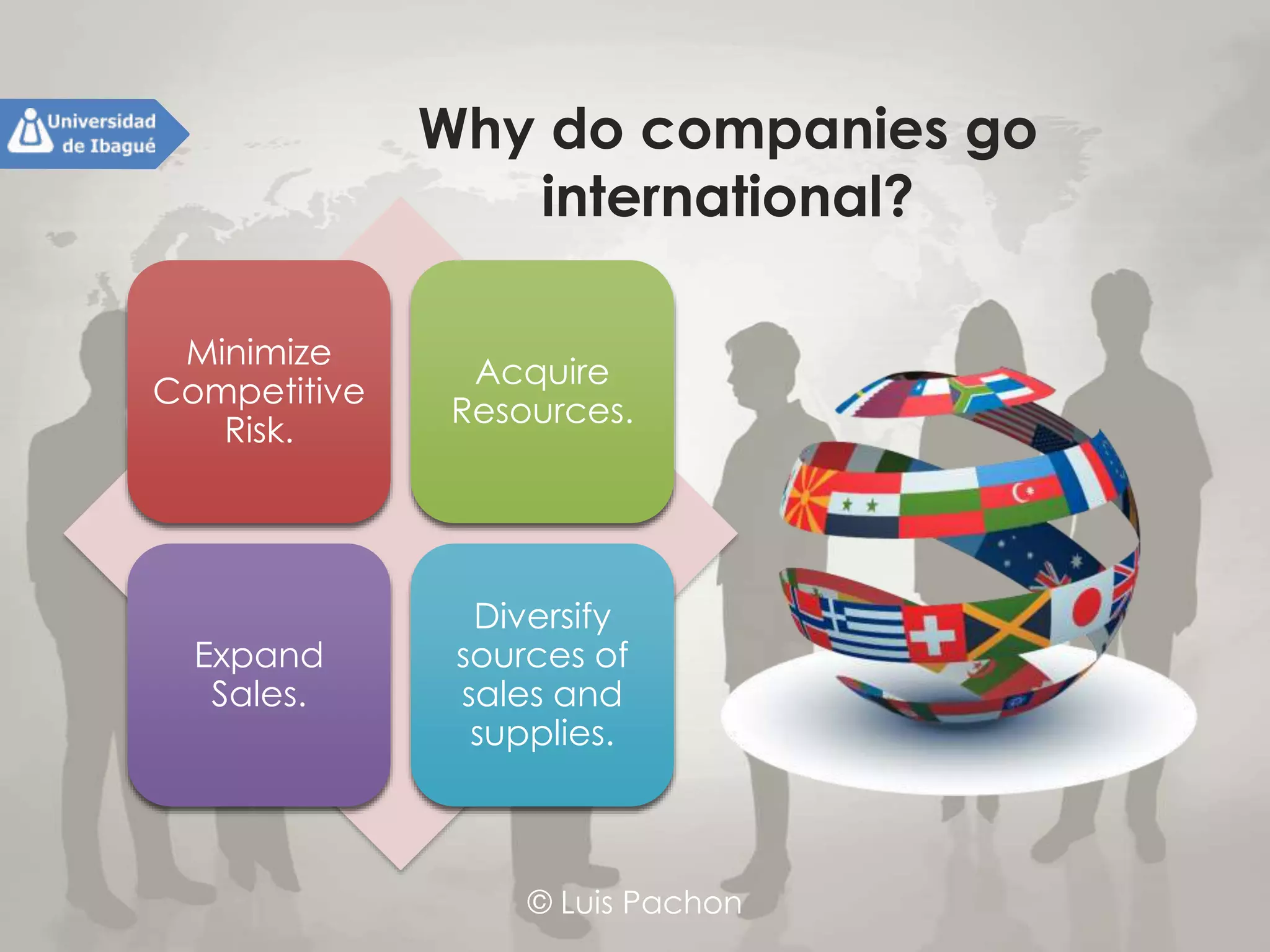
Why do companies go
international?
Minimize
Competitive
Risk.
Acquire
Resources.
Expand Sales.
Diversify
sources of
sales and
supplies.
© Luis Pachon
Minimize Competitive Risk
It’s a defensive reason.
Protection against domestic companies
that might gain advantages abroad.
That rival company could use those
advantages to improve the domestic
operations later.
Prevent a competitor to gain advantages.
© Luis Pachon
Acquire Resources
Products, services, and components
produced in foreign countries.
Foreign capital, technologies, and
information they can use at home.
Cost reduction  sweatshops.
© Luis Pachon
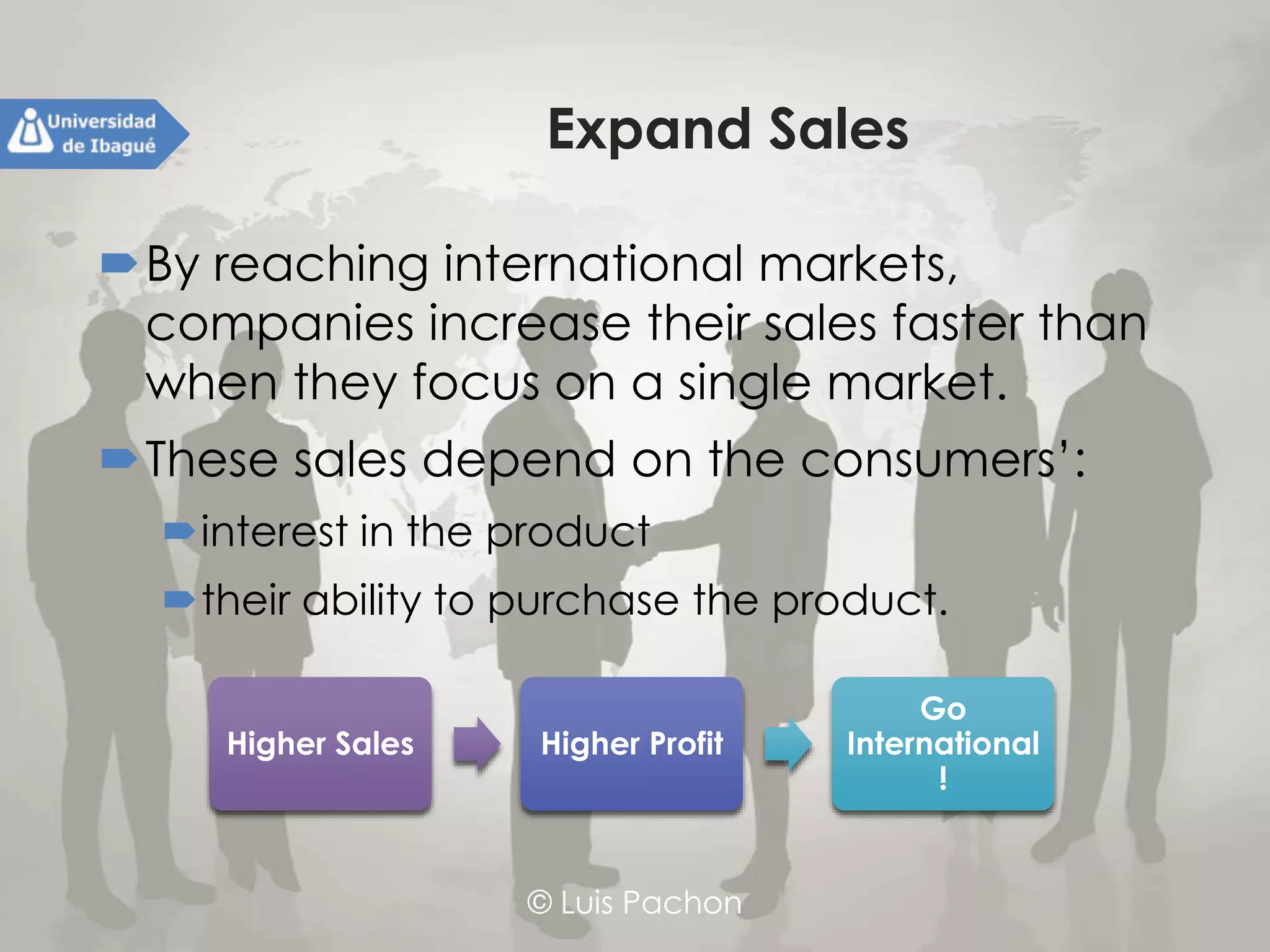
Expand Sales
By reaching international markets, companies
increase their sales faster than when they focus
on a single market.
These sales depend on the consumers’:
interest in the product
their ability to purchase the product.
Higher Sales Higher Profit
Go
International !
© Luis Pachon
Diversify Sources Of Sales And
Supplies
Minimize fluctuations in sales and profits
Sales increase in a country that is
expanding economically and decrease in
another that is in recession.
Avoid the full impact of price fluctuations
or shortages in any one country.
© Luis Pachon
Additional Factors
Increase in Global Competition.
Development and Expansion of
Technology.
Liberalization of Cross-Border
Movements.
Development of Supporting Services.
Consumer pressures.
© Luis Pachon
Increase in Global Competition
New products quickly become known
globally.
companies can produce in different
countries.
Suppliers
Competitors and
Customers of domestic companies have
become international as well.
© Luis Pachon
Development and Expansion of
Technology
 Internet
 Commercial transatlantic supersonic travel
 Faxing - E-mailing
 Teleconferencing
 Overseas direct-dial telephone service
 Sales over the Internet (electronic commerce; e-
commerce sales).
 Transportation and communication costs are more
conducive for international business operations.
© Luis Pachon
Liberalization of Cross-Border
Movements
The European Union, the NAFTA, and
other regional economic blocs
throughout the world provide fewer
restrictions on cross-border
movements.
© Luis Pachon
Development of Supporting
Services
Companies and governments of
various countries, alike, have
developed services that ease
international business.
Mail (Government monopoly)
Banking
© Luis Pachon
Consumer Pressures
Tastes have changed.
Consumers know about products and
services available in other countries.
More, new, better and differentiated
products.
Spend on R&D.
© Luis Pachon
Modes of International Business
Merchandise Exports and Imports
The most common international
economic transaction.
Tangible products.
© Luis Pachon
Modes of International Business
Service Exports and Imports.
Tourism and transportation  Movies 
Crew
Performance of Services  Fees (Turnkey
operations - Manufacturing Contracts)
Use of Assets  Royalties (Licensing –
franchising)
© Luis Pachon
Modes of International Business
Investments
FDI
Joint Venture (companies)
Mixed Venture (government + company)
Portfolio Investment
Non-controlling interest in a company.
Stocks
Loans
Financial Benefits.
© Luis Pachon
EXPORTING
Send a firm’s products or services to
international destinations.
Indirect: without the firm’s ultimate involvement
Cost  CEM (ads), MEA (no ads, own name)
Direct: Import without intermediaries  Export
department.
Export Sales Subsidiary
© Luis Pachon
COUNTERTRADE
Arrangements in which the flow
of goods and services in both
directions is the core of the
transaction.
© Luis Pachon
CONTRACT MANUFACTURING
Contractual agreement between a
company and a foreign producer
under which the foreign producer
manufactures the company’s product.
The company controls promotion and
distribution.
Pharmaceutical industry.
© Luis Pachon
LICENSING
In this agreement, the international
company, the licensor, agrees to make
available to another company abroad ,
the licensee, use of its:
Patents and trademarks
Manufacturing process
Know-how
Trade secrets
Managerial and technical services.
© Luis Pachon
FRANCHISING
Is a form of licensing.
Transfer of technology, business system,
brand name, trademark and other
property rights.
Franchisor: developed the business, lends
the names and brands.
Franchisee: buys the rights (fees or
royalties) to operate the business under
the name of the franchisor.
© Luis Pachon
MANAGEMENT SERVICE
CONTRACTS
It is a long term agreement, in which
the legal owners of the property and
real estate enter into a contract with
an outsider firm to run and operate
the business.
The Firm gets regular payments as well as
commissions.
© Luis Pachon
TURNKEY PROJECTS
The international company engages in
the design and construction of the
entire operation, once it is finished,
the management goes to local
personnel in exchange of a substantial
fee.
Airports, dams, electric power stations,
roads, factory complexes: steel mills,
refineries, chemical plants and
automobile plants.
© Luis Pachon
FOREIGN DIRECT INVESTMENT
Serve a local market better (HFDI)
Copy and paste from the HQ plant.
As it is “there” it substitutes trade.
Lower cost imputs (VFDI)
Splitting the value chain activities to low-
cost location.
© Luis Pachon
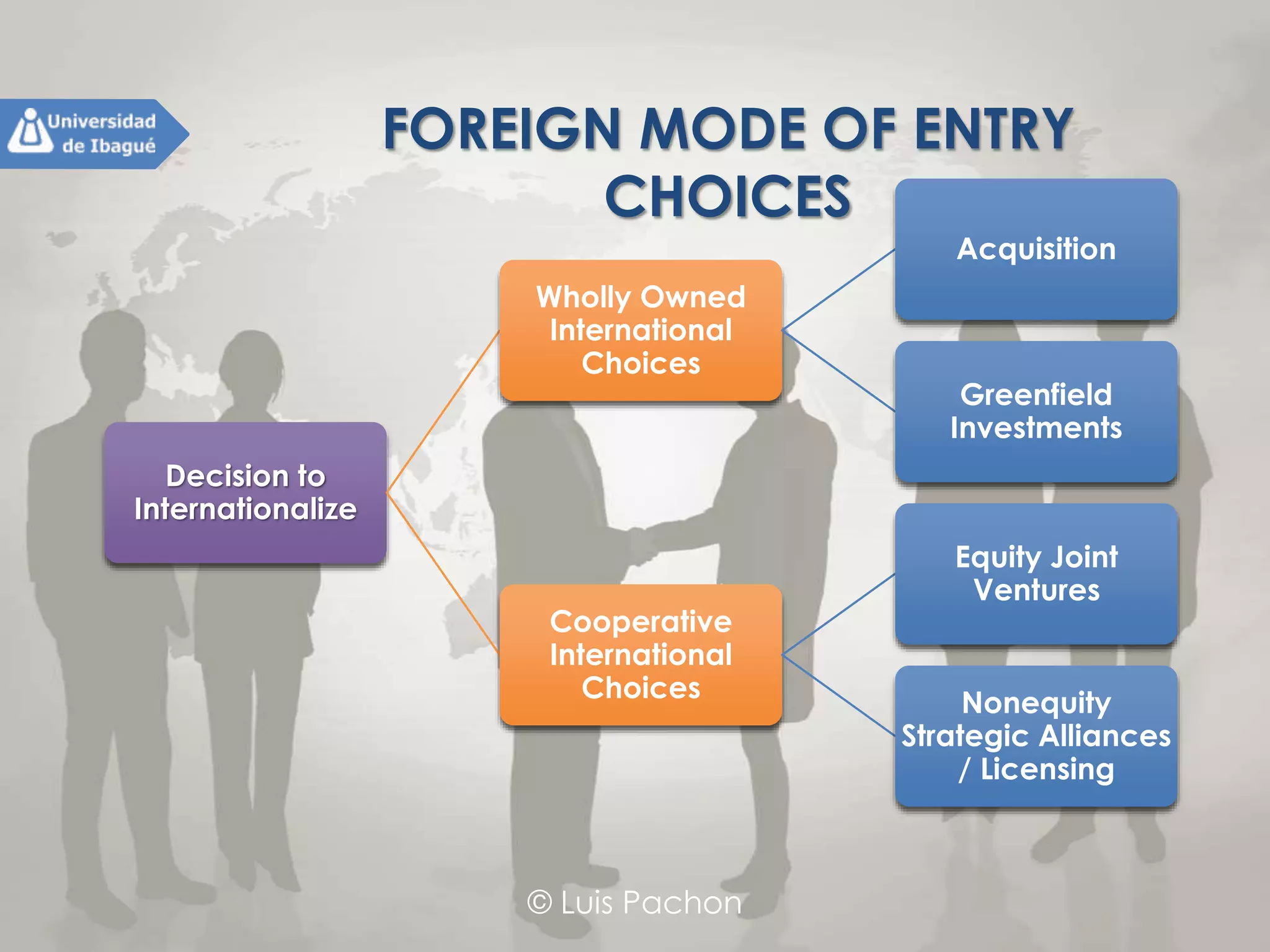
FOREIGN MODE OF ENTRY
CHOICES
Decision to
Internationalize
Wholly Owned
International Choices
Acquisition
Greenfield
Investments
Cooperative
International Choices
Equity Joint Ventures
Nonequity Strategic
Alliances / Licensing

Introduction to the course of International Business II

  • 1.
    © Luis Pachon International BusinessII Introduction to the course
  • 2.
    © Luis Pachon Task Inpairs answer the following questions: 1. What is International Business? 2. Why should we study international business? 3. What does shape the profit-related activities across national boundaries? 4. What are the differences between domestic and international business? 5. Why do companies go international?
  • 3.
    © Luis Pachon TheImportance of International Business What is International Business? International business is all commercial transactions—private and governmental—between two or more countries. Private companies undertake such transactions for profit; governments may or may not do the same in their transactions.
  • 4.
    © Luis Pachon TheImportance of International Business  Why should we study international business? 1. International business comprises a large and growing portion of the world’s total business. Today, global events and competition affect almost all companies— large or small—because most sell output to and secure supplies from foreign countries. Many companies also compete against products and services that come from abroad.
  • 5.
    © Luis Pachon TheImportance of International Business Why should we study international business? 2. A company operating in the international business field will engage in modes of business, such as exporting and importing, that differ from those it is accustomed to on a domestic level.
  • 6.
    © Luis Pachon Growthof International Business What does shape the profit-related activities across national boundaries?  .  Globalization  Regional Trading Blocs EU NAFTA CIS  Information Technology  Workforce diversity  Emerging Economies  Political Instability
  • 7.
    © Luis Pachon Growthof International Business The paradigm of the “Global Village” Countries differ Culture Political Systems Economic Systems Legal Systems Economic Development
  • 8.
    © Luis Pachon InternationalBusiness Vs Domestic Business. Systems are different. Issues are more complex. Conversion of Money into different currencies. Constraints and limitations from foreign governments.
  • 9.
    © Luis Pachon Whydo companies go international? First consider:Mission • What is the purpose of the company’s existence? Objectives • What is the company trying to accomplish? Strategies • Means to achieve the objectives.
  • 10.
    © Luis Pachon Whydo companies go international? Minimize Competitive Risk. Acquire Resources. Expand Sales. Diversify sources of sales and supplies.
  • 11.
    © Luis Pachon MinimizeCompetitive Risk It’s a defensive reason. Protection against domestic companies that might gain advantages abroad. That rival company could use those advantages to improve the domestic operations later. Prevent a competitor to gain advantages.
  • 12.
    © Luis Pachon AcquireResources Products, services, and components produced in foreign countries. Foreign capital, technologies, and information they can use at home. Cost reduction  sweatshops.
  • 13.
    © Luis Pachon ExpandSales By reaching international markets, companies increase their sales faster than when they focus on a single market. These sales depend on the consumers’: interest in the product their ability to purchase the product. Higher Sales Higher Profit Go International !
  • 14.
    © Luis Pachon DiversifySources Of Sales And Supplies Minimize fluctuations in sales and profits Sales increase in a country that is expanding economically and decrease in another that is in recession. Avoid the full impact of price fluctuations or shortages in any one country.
  • 15.
    © Luis Pachon AdditionalFactors Increase in Global Competition. Development and Expansion of Technology. Liberalization of Cross-Border Movements. Development of Supporting Services. Consumer pressures.
  • 16.
    © Luis Pachon Increasein Global Competition New products quickly become known globally. companies can produce in different countries. Suppliers Competitors and Customers of domestic companies have become international as well.
  • 17.
    © Luis Pachon Developmentand Expansion of Technology  Internet  Commercial transatlantic supersonic travel  Faxing - E-mailing  Teleconferencing  Overseas direct-dial telephone service  Sales over the Internet (electronic commerce; e- commerce sales).  Transportation and communication costs are more conducive for international business operations.
  • 18.
    © Luis Pachon Liberalizationof Cross-Border Movements The European Union, the NAFTA, and other regional economic blocs throughout the world provide fewer restrictions on cross-border movements.
  • 19.
    © Luis Pachon Developmentof Supporting Services Companies and governments of various countries, alike, have developed services that ease international business. Mail (Government monopoly) Banking
  • 20.
    © Luis Pachon ConsumerPressures Tastes have changed. Consumers know about products and services available in other countries. More, new, better and differentiated products. Spend on R&D.
  • 21.
    © Luis Pachon Modesof International Business Merchandise Exports and Imports The most common international economic transaction. Tangible products.
  • 22.
    © Luis Pachon Modesof International Business Service Exports and Imports. Tourism and transportation  Movies  Crew Performance of Services  Fees (Turnkey operations - Manufacturing Contracts) Use of Assets  Royalties (Licensing – franchising)
  • 23.
    © Luis Pachon Modesof International Business Investments FDI Joint Venture (companies) Mixed Venture (government + company) Portfolio Investment Non-controlling interest in a company. Stocks Loans Financial Benefits.
  • 24.
    © Luis Pachon EXPORTING Senda firm’s products or services to international destinations. Indirect: without the firm’s ultimate involvement Cost  CEM (ads), MEA (no ads, own name) Direct: Import without intermediaries  Export department. Export Sales Subsidiary
  • 25.
    © Luis Pachon COUNTERTRADE Arrangementsin which the flow of goods and services in both directions is the core of the transaction.
  • 26.
    © Luis Pachon CONTRACTMANUFACTURING Contractual agreement between a company and a foreign producer under which the foreign producer manufactures the company’s product. The company controls promotion and distribution. Pharmaceutical industry.
  • 27.
    © Luis Pachon LICENSING Inthis agreement, the international company, the licensor, agrees to make available to another company abroad , the licensee, use of its: Patents and trademarks Manufacturing process Know-how Trade secrets Managerial and technical services.
  • 28.
    © Luis Pachon FRANCHISING Isa form of licensing. Transfer of technology, business system, brand name, trademark and other property rights. Franchisor: developed the business, lends the names and brands. Franchisee: buys the rights (fees or royalties) to operate the business under the name of the franchisor.
  • 29.
    © Luis Pachon MANAGEMENTSERVICE CONTRACTS It is a long term agreement, in which the legal owners of the property and real estate enter into a contract with an outsider firm to run and operate the business. The Firm gets regular payments as well as commissions.
  • 30.
    © Luis Pachon TURNKEYPROJECTS The international company engages in the design and construction of the entire operation, once it is finished, the management goes to local personnel in exchange of a substantial fee. Airports, dams, electric power stations, roads, factory complexes: steel mills, refineries, chemical plants and automobile plants.
  • 31.
    © Luis Pachon FOREIGNDIRECT INVESTMENT Serve a local market better (HFDI) Copy and paste from the HQ plant. As it is “there” it substitutes trade. Lower cost imputs (VFDI) Splitting the value chain activities to low- cost location.
  • 32.
    © Luis Pachon FOREIGNMODE OF ENTRY CHOICES Decision to Internationalize Wholly Owned International Choices Acquisition Greenfield Investments Cooperative International Choices Equity Joint Ventures Nonequity Strategic Alliances / Licensing

Editor's Notes

  • #4 These transactions include sales, investments, and transportation.
  • #5 These transactions include sales, investments, and transportation.
  • #6 These transactions include sales, investments, and transportation.
  • #19 Lower governmental barriers to the movement of goods, services, and resources (financial, human, informational, physical) enable companies to take better advantage of international opportunities.
  • #25 Combined Export Manager – Manufacturer’s Export Agent
  • #32 Horizontal FDI + Vertical FDI