Carbon Emission
Scenarios
Carbon Emissions
 What are carbon emissions?
 Carbon emissions mainly refer to
carbon dioxide (CO₂) released into the
air due to human activities.
 Along with CO₂, other greenhouse
gases such as methane (CH₄) and
nitrous oxide (N₂O) are also included.
Main sources:
 Energy production:
 burning coal, oil, and gas for Electricity
 Transport: cars, buses, airplanes
 Industries: cement, steel, chemicals
 Deforestation: fewer trees to absorb
CO₂
 Agriculture: livestock and fertilizers
Why emissions matter:
 Greenhouse gases trap heat
 Increase Earth’s average temperature
 Cause climate change
 Example : More cars more fuel
→
burning more CO₂ higher
→ →
temperature
Carbon Emission Scenarios
 Simple explanation:
 A carbon emission scenario is a
scientific plan that describes how
greenhouse gas emissions might
change in the future, depending on
human choices.
 Important point:
 ❌ Not a prediction
 ✅ A possibility
Scientists ask:
 What if population grows fast?
 What if renewable energy replaces
fossil fuels?
 What if countries do nothing?
 Each answer creates a different
scenario.
Why Carbon Emission Scenarios Are Needed
 1. Understanding future climate
 Scenarios help scientists see how Earth’s climate
may look in 2050 or 2100.
 2. Policy making
 Governments use scenarios to:
 Make climate laws
 Decide emission targets
 3. Risk assessment
 Flood risk
 Heat waves
 Sea level rise
Why Carbon Emission Scenarios Are Needed
 4. Planning adaptation
 Flood defenses
 Heat-resistant crops
 Example : If emissions remain high →
coastal cities need stronger sea walls.
Factors That Shape Emission Scenarios
 (a) Population Growth
 More people more food, energy,
→
housing
 Leads to higher emissions
 (b) Economic Development
 Industrial growth increases emissions
Rich countries usually emit more
Factors That Shape Emission
Scenarios
 (c) Technology
 Clean technology lower emissions
→
 Old technology higher emissions
→
 (d) Energy
 Use Fossil fuels high CO₂
→
 Solar/wind low CO₂
→
 (e) Government Policies
 Carbon tax reduces emissions
 No rules emissions rise
→
What Are RCPs?
 Definition:
 RCPs are pathways that show how much
heat (radiative forcing) greenhouse gases
will trap in the atmosphere by 2100.
 Radiative forcing:
 Extra energy trapped in atmosphere
Measured in watts per square meter
(W/m²)
 Higher RCP number = more warming.
RCP4.5 – Stabilization Scenario Emission trend:
 Emission trend: Emissions increase until
mid-century
 Then decline
 Climate outcome:
 Moderate warming (2–3°C)
 Real-world picture:
 Partial climate policies
 Gradual clean energy adoption
 Example: Hybrid cars replace petrol cars
slowly.
RCP2.6 – Very Low Emission Pathway
 Emission trend:
 Emissions peak early
 Then rapidly decline
 Climate outcome:
 Warming limited to ~1.5–2°C
 Requirements:
 Strong global cooperation
 Renewable energy
 Energy efficiency
 Carbon capture
 Example: Countries ban coal plants and shift to solar.
RCP6.0 – Intermediate-High Scenario
 Emission trend:
 Emissions keep rising longer
 Decline late in century
 Climate outcome:
 High warming (3–4°C)
 Risk:
 Severe weather events
 Water stress
RCP8.5 – High Emission Scenario
 Emission trend:
 Emissions rise continuously
 Climate outcome:
 Extreme warming (>4°C)
 Consequences:
 Melting ice caps
 Strong storms
 Crop failures
 Often called “business as usual”
SHARED SOCIOECONOMIC
PATHWAYS (SSPs)
 What Are SSPs?
 SSPs describe how society develops, not just
emissions.
 They focus on:
 Population
 Economy
 Technology
 Education
 Inequality
 SSPs explain why emissions increase or decrease
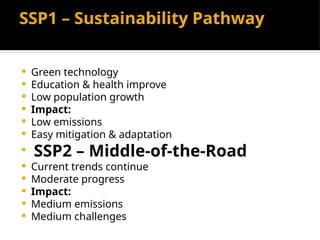
SSP1 – Sustainability Pathway
 Green technology
 Education & health improve
 Low population growth
 Impact:
 Low emissions
 Easy mitigation & adaptation
 SSP2 – Middle-of-the-Road
 Current trends continue
 Moderate progress
 Impact:
 Medium emissions
 Medium challenges
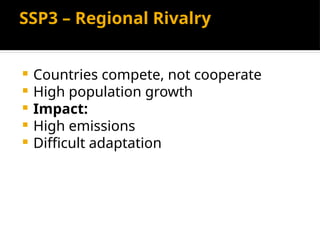
SSP3 – Regional Rivalry
 Countries compete, not cooperate
 High population growth
 Impact:
 High emissions
 Difficult adaptation
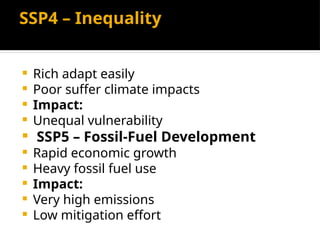
SSP4 – Inequality
 Rich adapt easily
 Poor suffer climate impacts
 Impact:
 Unequal vulnerability
 SSP5 – Fossil-Fuel Development
 Rapid economic growth
 Heavy fossil fuel use
 Impact:
 Very high emissions
 Low mitigation effort
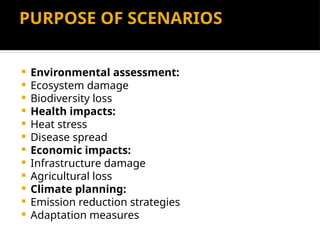
PURPOSE OF SCENARIOS
 Environmental assessment:
 Ecosystem damage
 Biodiversity loss
 Health impacts:
 Heat stress
 Disease spread
 Economic impacts:
 Infrastructure damage
 Agricultural loss
 Climate planning:
 Emission reduction strategies
 Adaptation measures
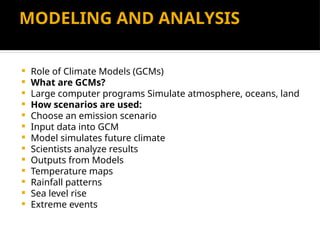
MODELING AND ANALYSIS
 Role of Climate Models (GCMs)
 What are GCMs?
 Large computer programs Simulate atmosphere, oceans, land
 How scenarios are used:
 Choose an emission scenario
 Input data into GCM
 Model simulates future climate
 Scientists analyze results
 Outputs from Models
 Temperature maps
 Rainfall patterns
 Sea level rise
 Extreme events
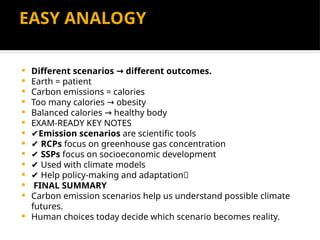
EASY ANALOGY
 Different scenarios different outcomes.
→
 Earth = patient
 Carbon emissions = calories
 Too many calories obesity
→
 Balanced calories healthy body
→
 EXAM-READY KEY NOTES
 ✔Emission scenarios are scientific tools
 ✔ RCPs focus on greenhouse gas concentration
 ✔ SSPs focus on socioeconomic development
 ✔ Used with climate models
 ✔ Help policy-making and adaptation🔚
 FINAL SUMMARY
 Carbon emission scenarios help us understand possible climate
futures.
 Human choices today decide which scenario becomes reality.
Thank you

carbon emission scenerioes.pptx PowerPoint

  • 1.
  • 2.
    Carbon Emissions  Whatare carbon emissions?  Carbon emissions mainly refer to carbon dioxide (CO₂) released into the air due to human activities.  Along with CO₂, other greenhouse gases such as methane (CH₄) and nitrous oxide (N₂O) are also included.
  • 3.
    Main sources:  Energyproduction:  burning coal, oil, and gas for Electricity  Transport: cars, buses, airplanes  Industries: cement, steel, chemicals  Deforestation: fewer trees to absorb CO₂  Agriculture: livestock and fertilizers
  • 4.
    Why emissions matter: Greenhouse gases trap heat  Increase Earth’s average temperature  Cause climate change  Example : More cars more fuel → burning more CO₂ higher → → temperature
  • 5.
    Carbon Emission Scenarios Simple explanation:  A carbon emission scenario is a scientific plan that describes how greenhouse gas emissions might change in the future, depending on human choices.  Important point:  ❌ Not a prediction  ✅ A possibility
  • 6.
    Scientists ask:  Whatif population grows fast?  What if renewable energy replaces fossil fuels?  What if countries do nothing?  Each answer creates a different scenario.
  • 7.
    Why Carbon EmissionScenarios Are Needed  1. Understanding future climate  Scenarios help scientists see how Earth’s climate may look in 2050 or 2100.  2. Policy making  Governments use scenarios to:  Make climate laws  Decide emission targets  3. Risk assessment  Flood risk  Heat waves  Sea level rise
  • 8.
    Why Carbon EmissionScenarios Are Needed  4. Planning adaptation  Flood defenses  Heat-resistant crops  Example : If emissions remain high → coastal cities need stronger sea walls.
  • 9.
    Factors That ShapeEmission Scenarios  (a) Population Growth  More people more food, energy, → housing  Leads to higher emissions  (b) Economic Development  Industrial growth increases emissions Rich countries usually emit more
  • 10.
    Factors That ShapeEmission Scenarios  (c) Technology  Clean technology lower emissions →  Old technology higher emissions →  (d) Energy  Use Fossil fuels high CO₂ →  Solar/wind low CO₂ →  (e) Government Policies  Carbon tax reduces emissions  No rules emissions rise →
  • 11.
    What Are RCPs? Definition:  RCPs are pathways that show how much heat (radiative forcing) greenhouse gases will trap in the atmosphere by 2100.  Radiative forcing:  Extra energy trapped in atmosphere Measured in watts per square meter (W/m²)  Higher RCP number = more warming.
  • 12.
    RCP4.5 – StabilizationScenario Emission trend:  Emission trend: Emissions increase until mid-century  Then decline  Climate outcome:  Moderate warming (2–3°C)  Real-world picture:  Partial climate policies  Gradual clean energy adoption  Example: Hybrid cars replace petrol cars slowly.
  • 13.
    RCP2.6 – VeryLow Emission Pathway  Emission trend:  Emissions peak early  Then rapidly decline  Climate outcome:  Warming limited to ~1.5–2°C  Requirements:  Strong global cooperation  Renewable energy  Energy efficiency  Carbon capture  Example: Countries ban coal plants and shift to solar.
  • 14.
    RCP6.0 – Intermediate-HighScenario  Emission trend:  Emissions keep rising longer  Decline late in century  Climate outcome:  High warming (3–4°C)  Risk:  Severe weather events  Water stress
  • 15.
    RCP8.5 – HighEmission Scenario  Emission trend:  Emissions rise continuously  Climate outcome:  Extreme warming (>4°C)  Consequences:  Melting ice caps  Strong storms  Crop failures  Often called “business as usual”
  • 16.
    SHARED SOCIOECONOMIC PATHWAYS (SSPs) What Are SSPs?  SSPs describe how society develops, not just emissions.  They focus on:  Population  Economy  Technology  Education  Inequality  SSPs explain why emissions increase or decrease
  • 17.
    SSP1 – SustainabilityPathway  Green technology  Education & health improve  Low population growth  Impact:  Low emissions  Easy mitigation & adaptation  SSP2 – Middle-of-the-Road  Current trends continue  Moderate progress  Impact:  Medium emissions  Medium challenges
  • 18.
    SSP3 – RegionalRivalry  Countries compete, not cooperate  High population growth  Impact:  High emissions  Difficult adaptation
  • 19.
    SSP4 – Inequality Rich adapt easily  Poor suffer climate impacts  Impact:  Unequal vulnerability  SSP5 – Fossil-Fuel Development  Rapid economic growth  Heavy fossil fuel use  Impact:  Very high emissions  Low mitigation effort
  • 20.
    PURPOSE OF SCENARIOS Environmental assessment:  Ecosystem damage  Biodiversity loss  Health impacts:  Heat stress  Disease spread  Economic impacts:  Infrastructure damage  Agricultural loss  Climate planning:  Emission reduction strategies  Adaptation measures
  • 21.
    MODELING AND ANALYSIS Role of Climate Models (GCMs)  What are GCMs?  Large computer programs Simulate atmosphere, oceans, land  How scenarios are used:  Choose an emission scenario  Input data into GCM  Model simulates future climate  Scientists analyze results  Outputs from Models  Temperature maps  Rainfall patterns  Sea level rise  Extreme events
  • 22.
    EASY ANALOGY  Differentscenarios different outcomes. →  Earth = patient  Carbon emissions = calories  Too many calories obesity →  Balanced calories healthy body →  EXAM-READY KEY NOTES  ✔Emission scenarios are scientific tools  ✔ RCPs focus on greenhouse gas concentration  ✔ SSPs focus on socioeconomic development  ✔ Used with climate models  ✔ Help policy-making and adaptation🔚  FINAL SUMMARY  Carbon emission scenarios help us understand possible climate futures.  Human choices today decide which scenario becomes reality.
  • 23.