The 21 st  Century climate challenge “ One generation plants a tree;  the next generation gets the shade.” Chinese Proverb “ You already know enough.  So do I. It is not knowledge we lack.  What is missing is the courage  to understand what we know  and to draw conclusions.” Sven Lindqvist
The world has  less than a decade  to avoid dangerous climate change that could bring unprecedented  human development reversals Climate change is a threat to humanity as a whole. But  it is the poor , a constituency with no responsibility for the ecological debt we are running up, who face the most immediate and most  severe human costs The Human Development Report 2007/2008 calls for a ‘twin track’ approach that combines stringent mitigation to limit 21st Century warming to  less than 2 degree centigrade , with strengthened international cooperation on adaptation The forthcoming conference of the parties in  Bali  is a unique opportunity to put the  interests  of the  world’s poor and future generations  at the heart of climate change negotiations
The  21st Century climate challenge Three distinctive characteristics: It is  cumulative The effects are  irreversible  Large time lags –  today’s emissions are tomorrow’s problems It is  global
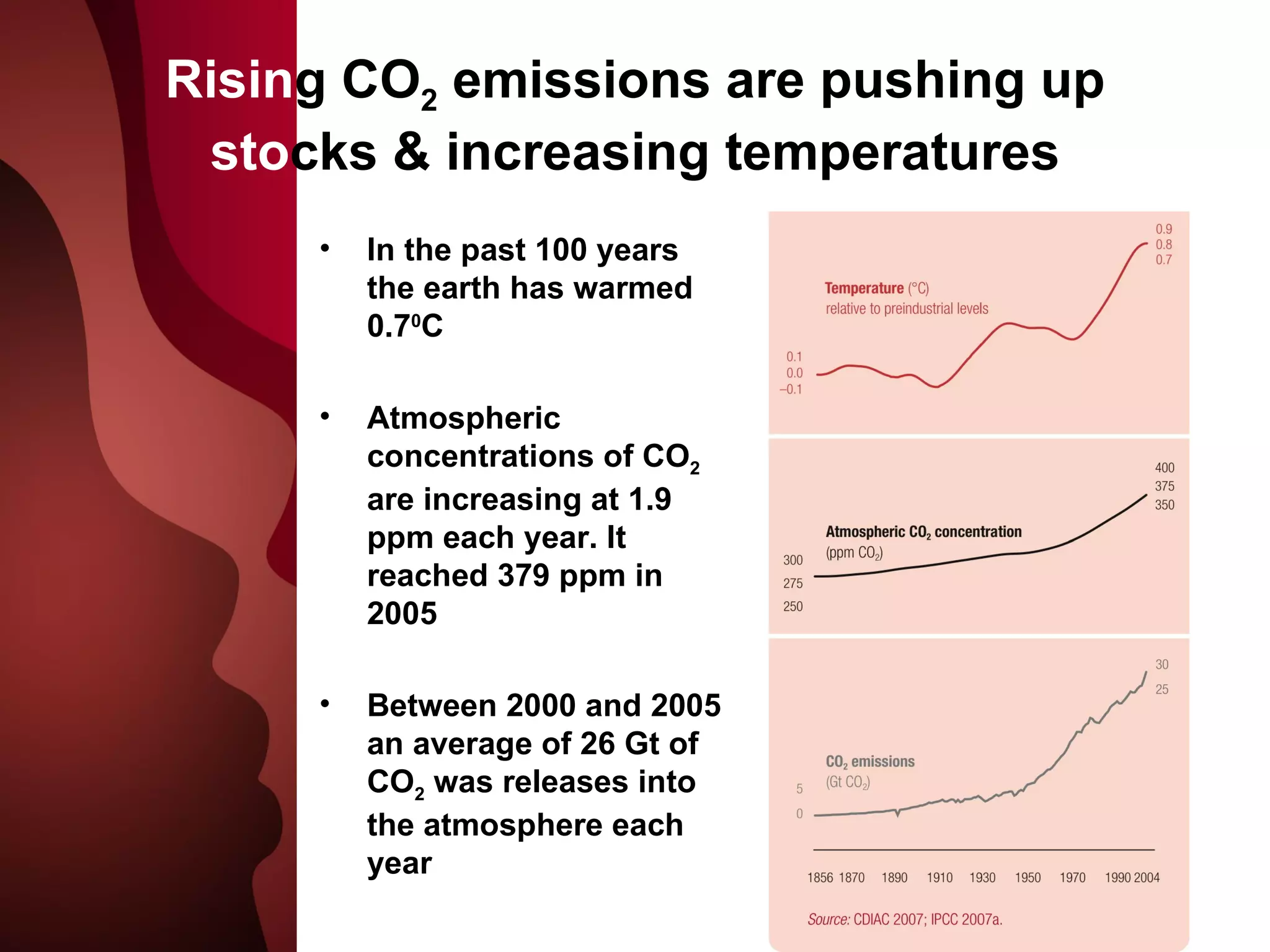
Risin g CO 2  emissions are pushing up  sto cks & increasing temperatures In the past 100 years the earth has warmed 0.7 0 C Atmospheric concentrations of CO 2  are increasing at 1.9 ppm each year. It reached 379 ppm in 2005 Between 2000 and 2005 an average of 26 Gt of CO 2  was releases into the atmosphere each year
The Globa l carbon account Defining dangerous – keeping within  2°C Establishing a 21 st  Century  carbon budget Defining a sustainable  emission’s pathway The problem of  inertia – the case for  adaptation
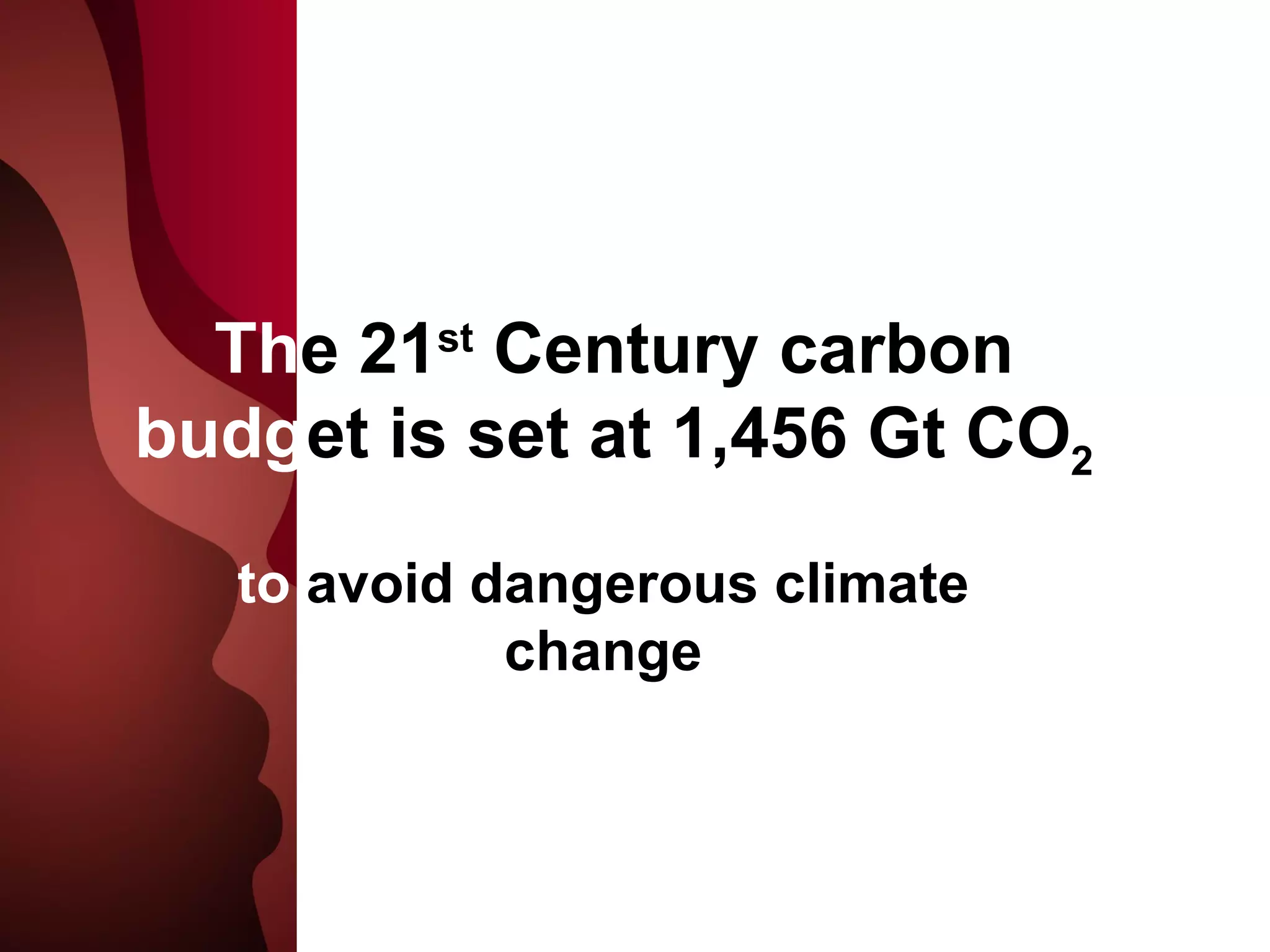
Th e 21 st  Century carbon budg et is set at 1,456 Gt CO 2 to  avoid dangerous climate change
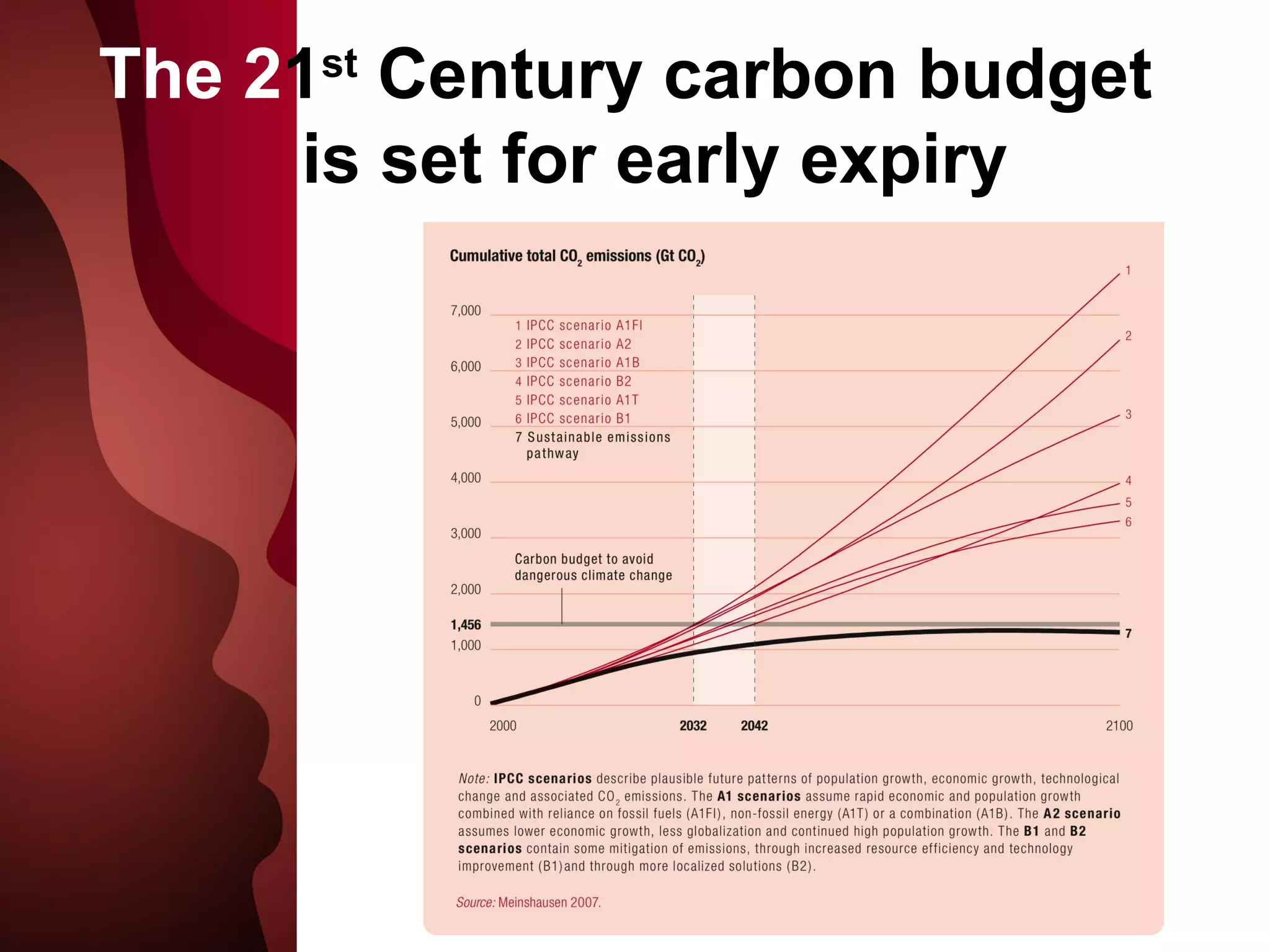
The 2 1 st  Century carbon budget    is  set for early expiry
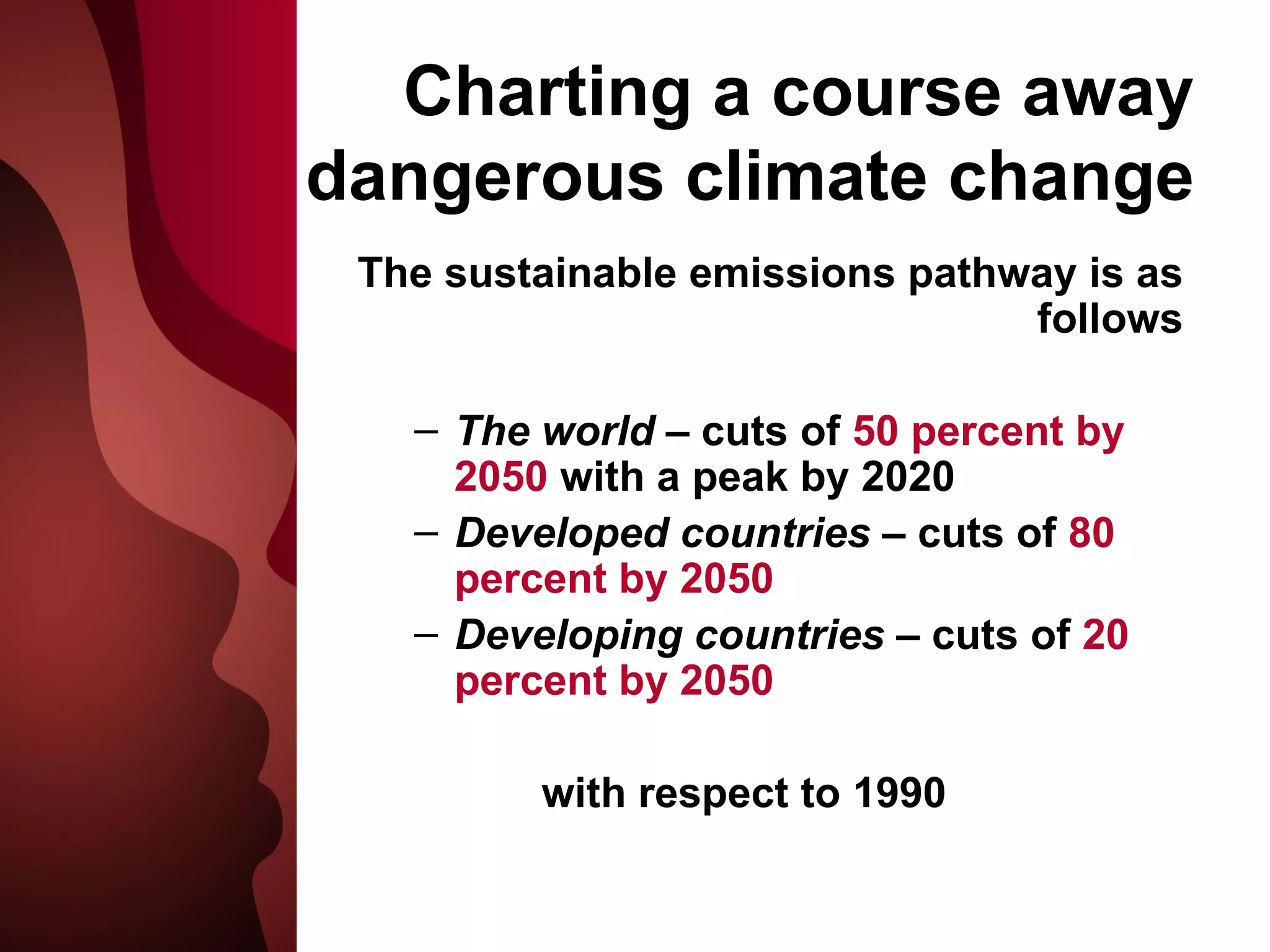
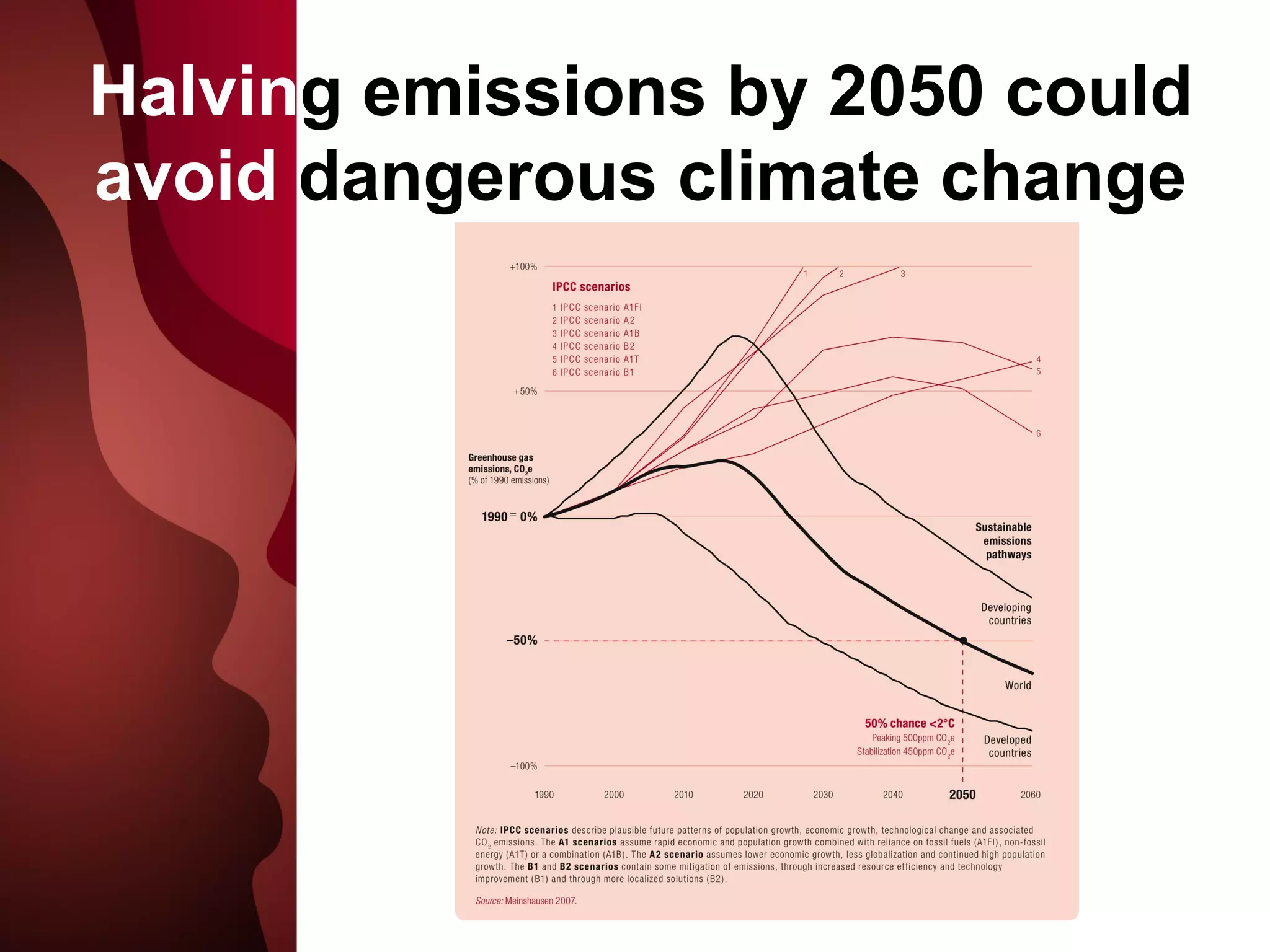
Charting a course away dangerous climate change The sustainable emissions pathway is as follows The world  – cuts of  50 percent by 2050  with a peak by 2020 Developed countries  – cuts of  80 percent by 2050 Developing countries  – cuts of  20 percent by 2050 with respect to 1990
Halvin g emissions by 2050 could  avoid  dangerous climate change
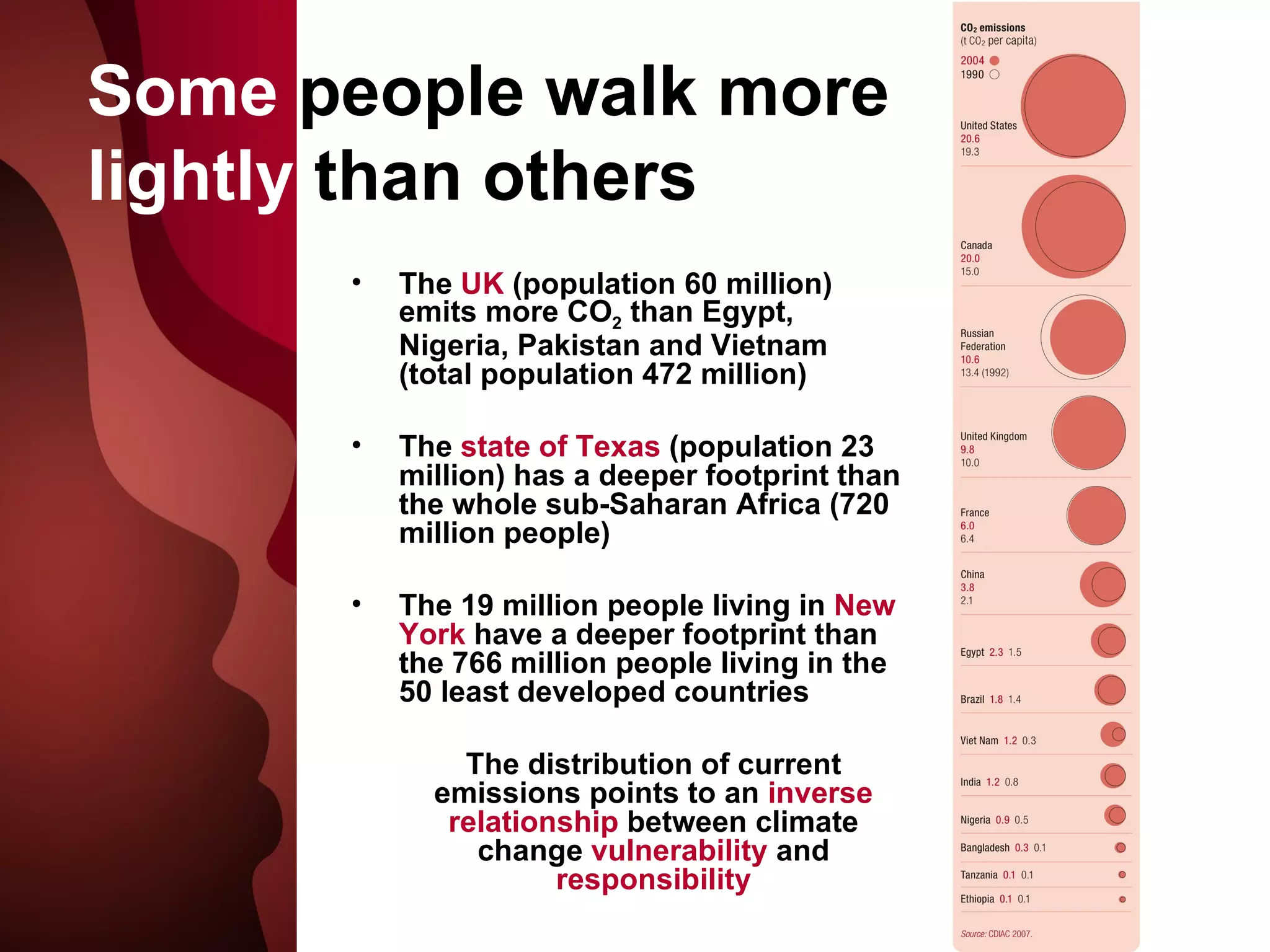
Some  people walk more  lightly  than others The  UK  (population 60 million) emits more CO 2  than Egypt, Nigeria, Pakistan and Vietnam (total population 472 million) The  state of Texas  (population 23 million) has a deeper footprint than the whole sub-Saharan Africa (720 million people) The 19 million people living in  New York  have a deeper footprint than the 766 million people living in the 50 least developed countries The distribution of current emissions points to an  inverse relationship  between climate change  vulnerability  and  responsibility
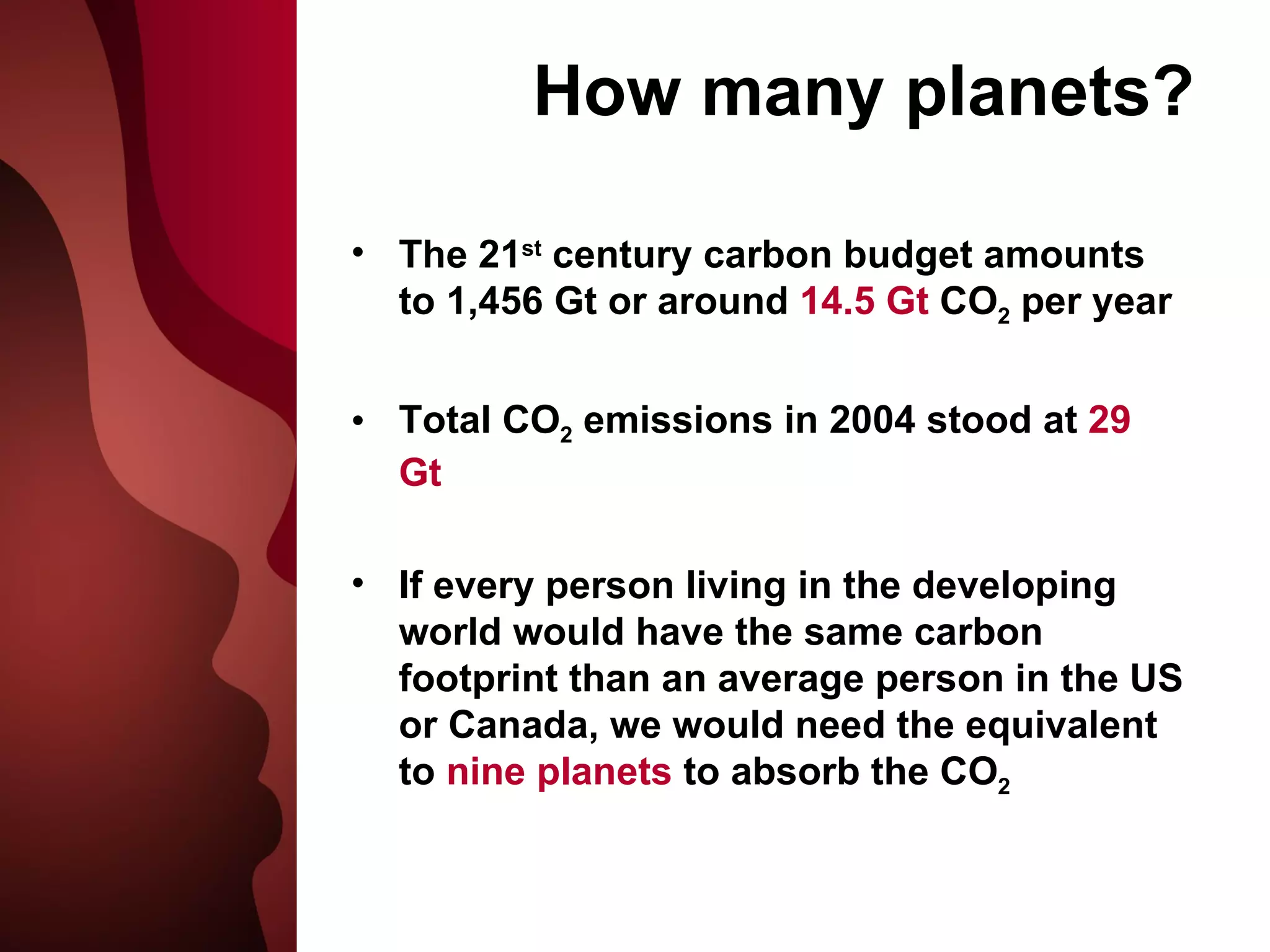
How many planets? The 21 st  century carbon budget amounts to 1,456 Gt or around  14.5 Gt  CO 2  per year Total CO 2  emissions in 2004 stood at  29 Gt If every person living in the developing world would have the same carbon footprint than an average person in the US or Canada, we would need the equivalent to  nine planets  to absorb the CO 2
Climate shocks: risk and vulnerability in an unequal world “ The countries most vulnerable are least able to protect themselves. They also contribute least to the global emissions of greenhouse gases. Without action they will pay a high price for the actions of others.” Kofi Annan “ Like slavery and apartheid, poverty is not natural. It is man-made and  it can be overcome and eradicated by the actions of human beings.” Nelson Mandela
Risk and vulnerability Climate risk is an external fact of life for the entire world Vulnerability is a measure of  capacity to manage  climate hazards without suffering a long-term potentially irreversible loss of well-being. The  state of human development  shapes the process by which risk is converted into vulnerability
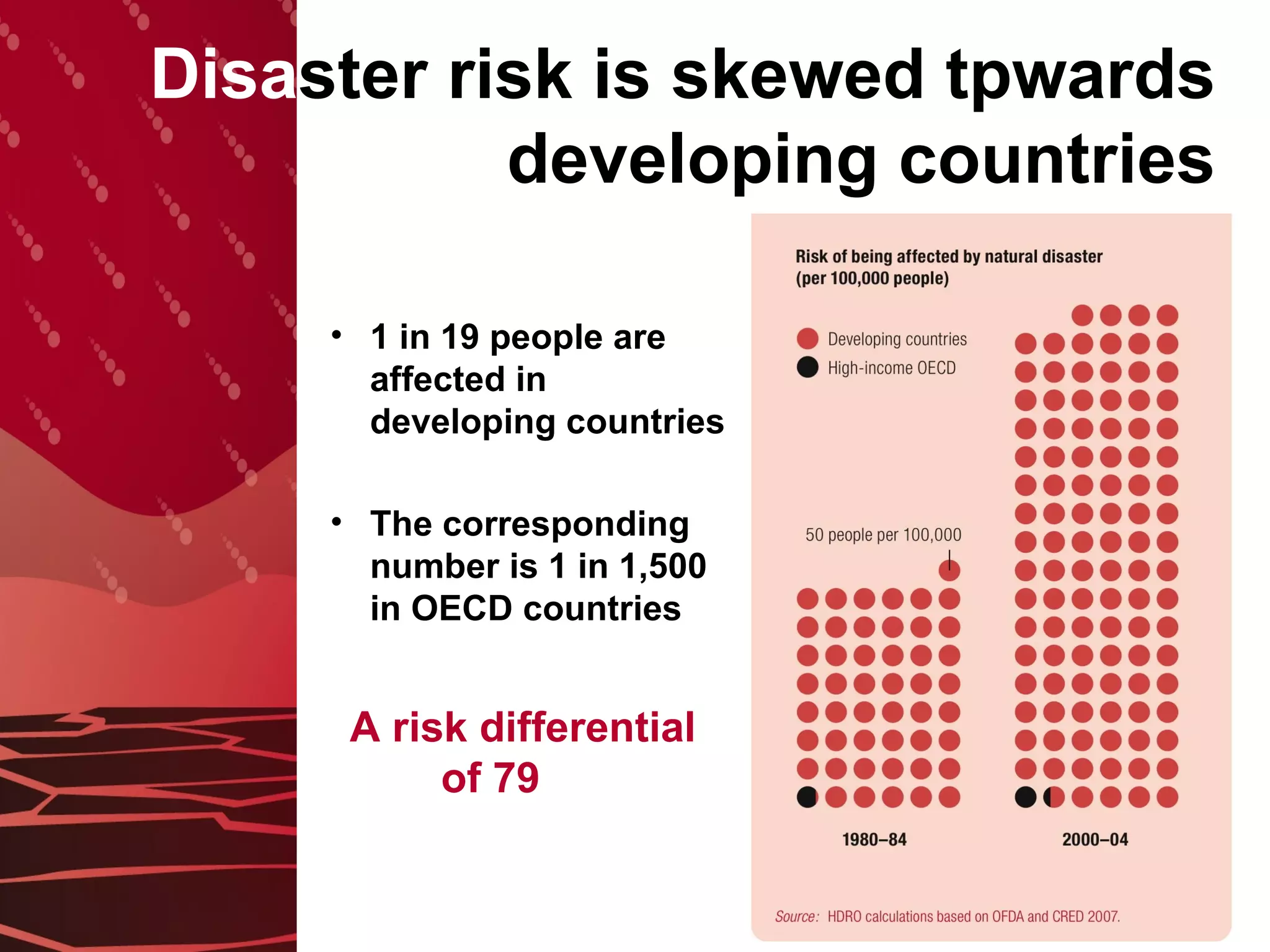
Disa ster risk is skewed tpwards developing countries 1 in 19 people are affected in developing countries The corresponding number is 1 in 1,500 in OECD countries   A risk differential    of 79
The human development backdrop Poverty, child mortality and malnutrition There are still around  1 billion  people living on less than a dollar a day.  Around  28 percent  of children in LDCs are underweight or stunted. Only  32 countries  (of 147) are on track to achieve the MDG on child mortality Inequality More than  80 percent  of the world’s population lives in countries where income differentials are widening Underlying  inequalities act as a barrier for early recovery  after shocks
Low  human development traps The potential human costs of climate change have been understated Climate related risks force people into downward spirals of disadvantage that undermine  future oppurtunities In Ethiopia, childre exposed to a drought in early childhood are  36 percent  more likely to be malnourished five years later – a figure that translates into  2 million additional  cases of child maknutrition Indian women born during a drought or a flood in the 1970s were  19 percent  less likely to ever attend primary school
Five h uman development tipping points Reduced  agricultural productivity Heightened  water insecurity Increased exposure to  extreme weather events Collapse of  ecosystems Increased  health risks
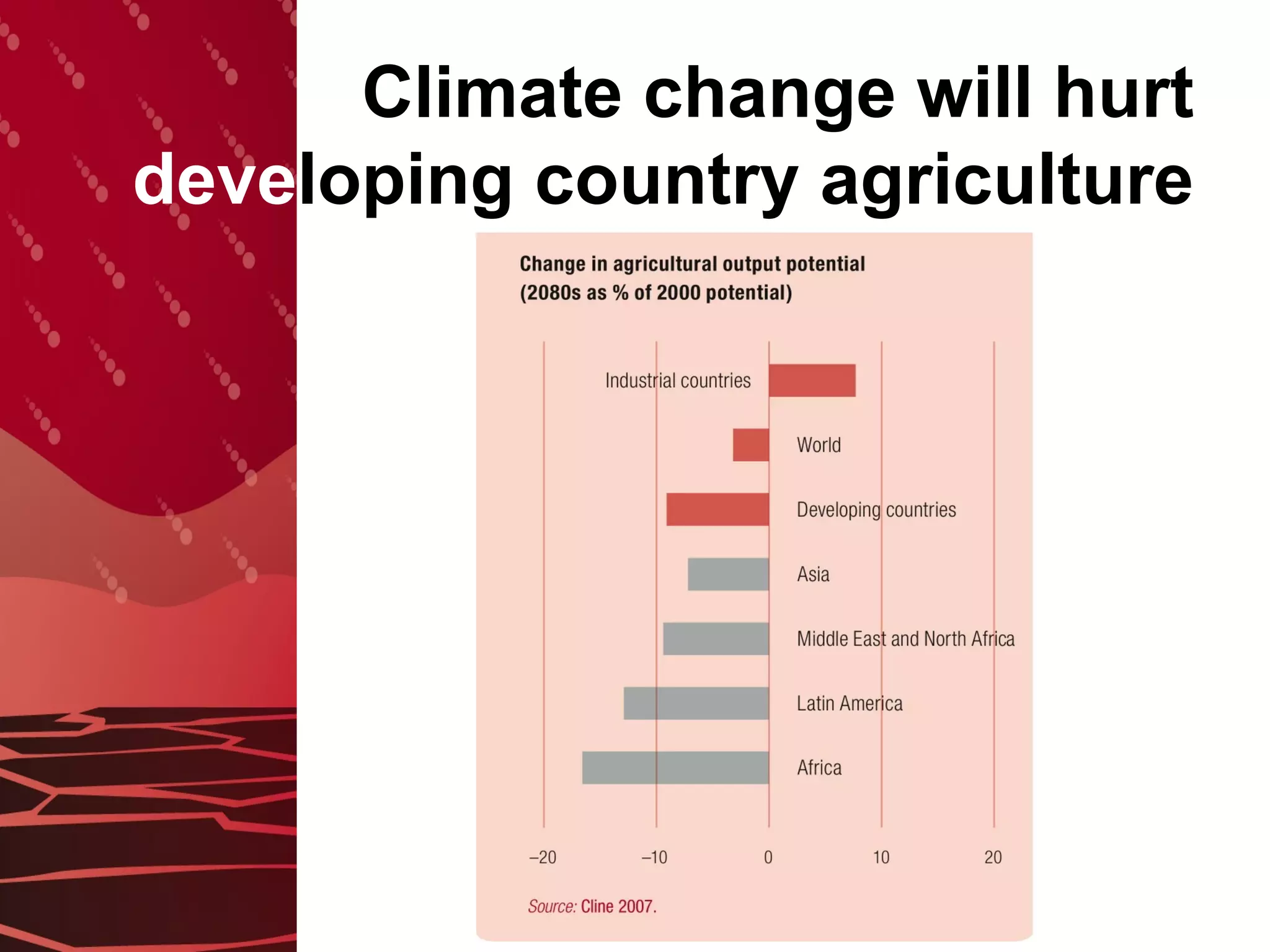
Climate change will hurt  deve loping country agriculture
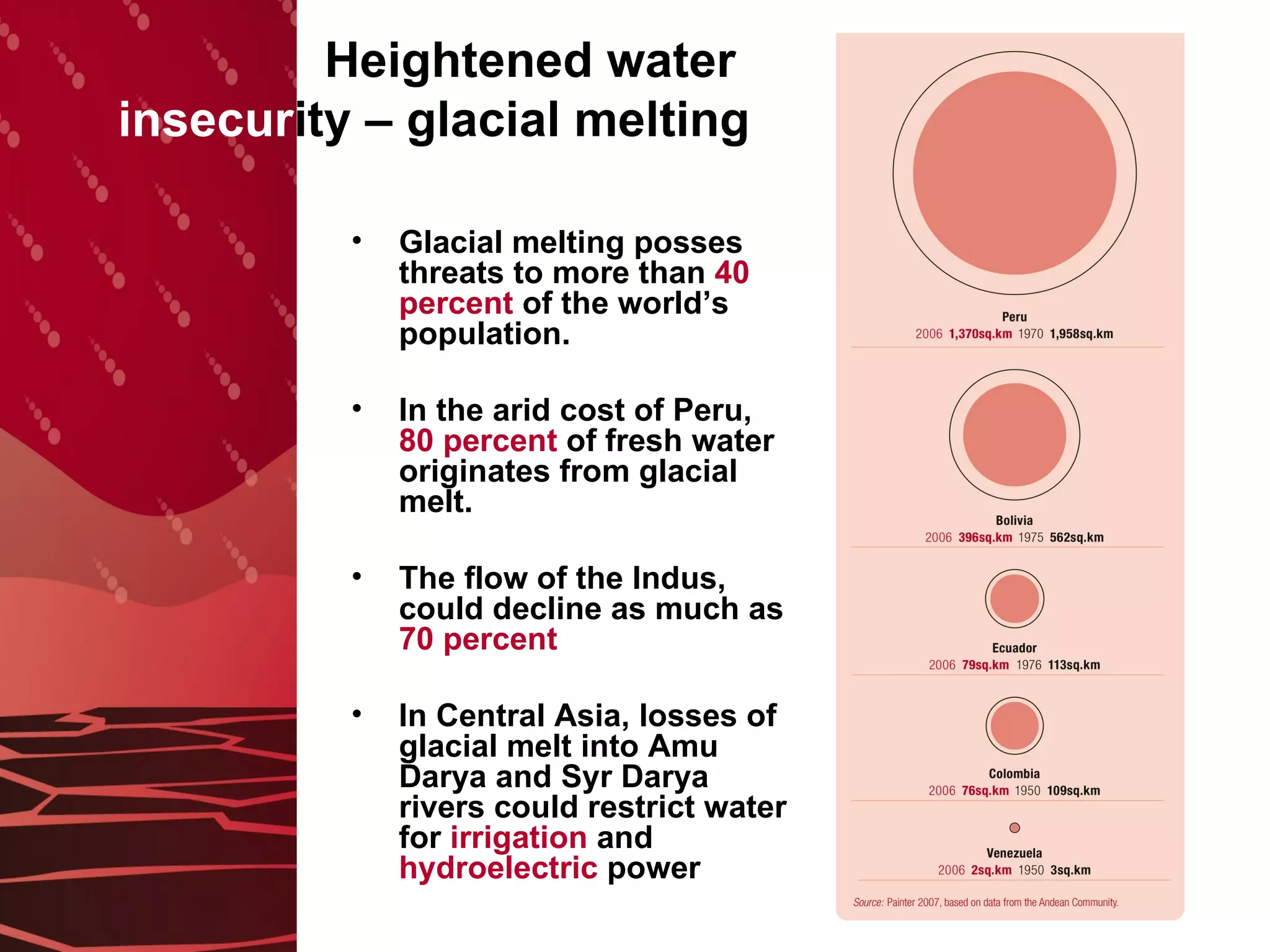
Heightened water  insecur ity – glacial melting Glacial melting posses threats to more than  40 percent  of the world’s population.  In the arid cost of Peru,  80 percent  of fresh water originates from glacial melt.  The flow of the Indus, could decline as much as  70 percent In Central Asia, losses of glacial melt into Amu Darya and Syr Darya rivers could restrict water for  irrigation  and  hydroelectric  power
Ext reme weather events The number of additional people experiencing coastal flooding could range from  134 to 332   million  for a 3 o - 4 o  increase in temperature.  Tropical storms could raise the figure to  371   million  by the end of the 21 st  century Possible consequences of one meter rise in sea level In Lower Egypt,  6 million  people displaced and 4,500 kms 2  of farmland flooded In Vietnam,  22 million  people displaced In Bangladesh, 18 percent of land area could be inundated affecting  11 percent  of the population   In the Maldives,  more than 80 percent  of land area is less than 1 meter above sea level
Avoiding dangerous climate change: strategies for mitigation “ We shall require a substantially new manner of thinking if mankind is to survive.” Albert Einstein “ Speed is irrelevant if you are going in the wrong direction.” Mahatma Gandhi “ Alone we can do so little;  together we can do so much.” Helen Keller
Avoidin g dangerous climate  change  –  strategies for mitigation Setting  mitigation targets:  current problems Pricing carbon:  the role of markets The role of  public policy:  regulation and research & development
Prob lems setting emission  reduction targets Insufficient  ambition Insufficient  urgency   Inaccurate  indicators Inadequate  sectoral  coverage Inconsistent  base years Targets are de-linked from policies
Pric ing  carbon emissions Market failure:  Polluters do not suffer the worse consequences of their own pollution Immediate challenge:  to push the price of carbon to a level consistent with the sustainable emissions pathway Ways to do it:  taxation and cap-and-trade and trade
Where  should the price of carbon be set?  How  should the price be generated? Under carbon taxation emitters are required to pay for each tone of CO 2  they produce Under cap-and-trade, the government sets an overall emissions cap and issues tradable allowances to allow business the “right to emit” Taxat ion versus cap-and-trade
The r e lative merits of taxation and cap-and-trade Administration Price predictability Revenue mobilization   The differences can be exaggerated
The  critical role of regulation  and government action  The energy mix The  residential  sector Vehicle emission  standards R&D and deployment of low carbon technologies
The Energy Mix Currently energy mix is dominated by fossil fuels Renewable energy is not competitive with coal-fired power – price of carbon and incentives for predicable markets can play a role Germany’ Renewable Sources Act – fix price for 20 years Spain – wind power satisfies around 8 percent of total electricity demand. In 2005 saved 19 million t CO 2  emissions Denmark – tax breaks on capital investments. In two decades wind has increased the share in electricity generation to 20 percent
Residential Sector Low cost  mitigation In OECD residential accounts for 35-40 percent of national CO2 emissions Appliances alone produce roughly  12 percent Policies on building and appliances could save up to 29 percent emissions (3.9 Gt CO 2 ) by 2020 equivalent to  three times  current emissions of India Average European household could save 200 to 1000 Euros annually through energy efficiency The best efficiency standards of electrical appliances could save 322 million t CO 2  by 2010 equivalent to  100 million cars off the road  (all cars from Canada, France and Germany)
Vehic le  Emission Standards Personal transportation is the largest consumer of oil In OECD the automobile sector accounts for about  30 percent  of total greenhouse gas emissions Improvements in the United States regulatory standards would represent cuttings equivalent to  France’s total   emissions
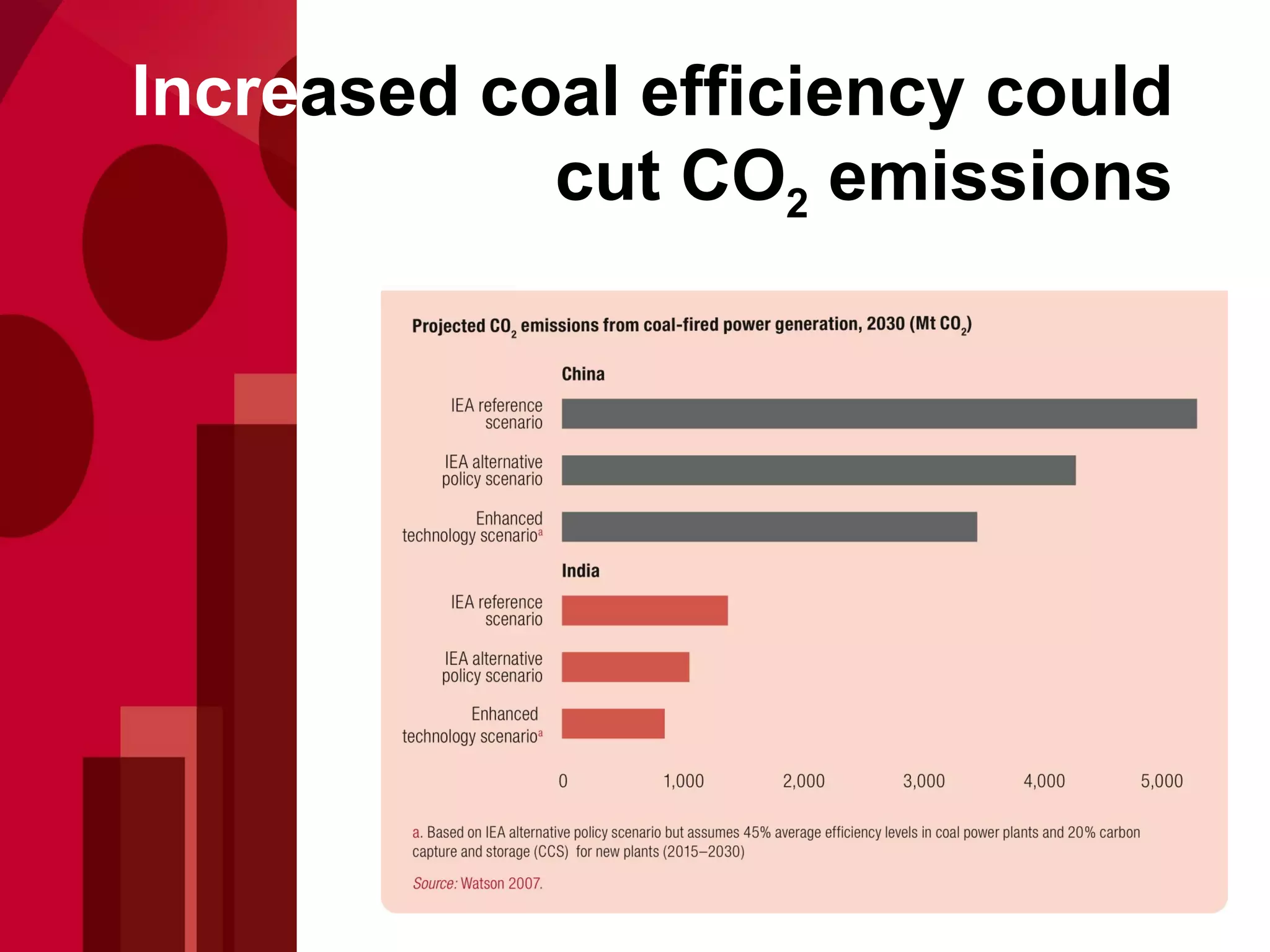
Incre a sed coal efficiency could cut CO 2  emissions
Adapting to the inevitable: national action and international cooperation “ If you are neutral in a situation of injustice, you have chosen the side of the oppressor.” Archbishop Desmond Tutu “ An injustice committed against anyone is a threat to everyone.” Montesquieu
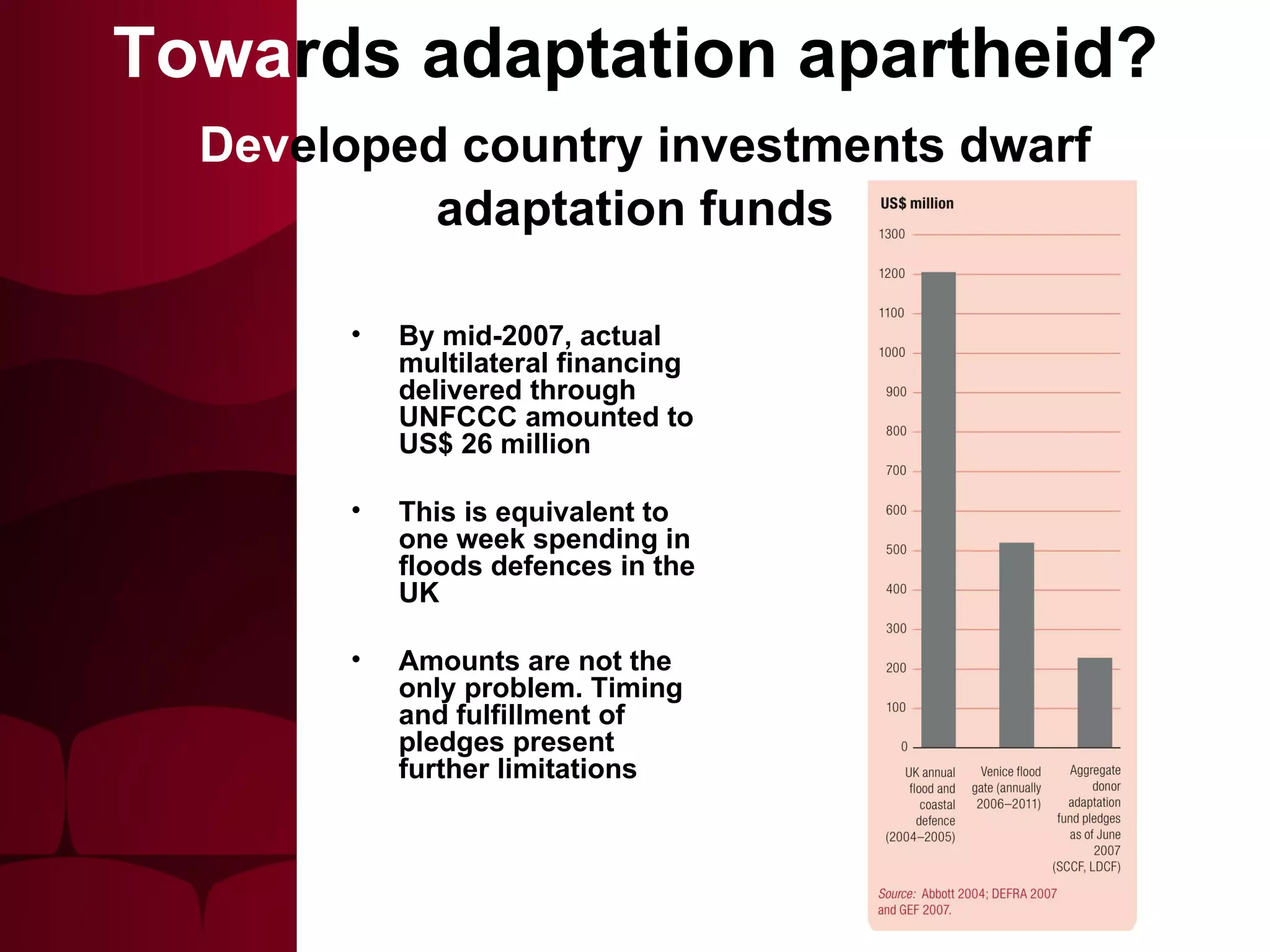
By mid-2007, actual multilateral financing delivered through UNFCCC amounted to US$ 26 million This is equivalent to one week spending in floods defences in the UK Amounts are not the only problem. Timing and fulfillment of pledges present further limitations Towa rds adaptation apartheid?   Dev eloped country investments dwarf adaptation funds
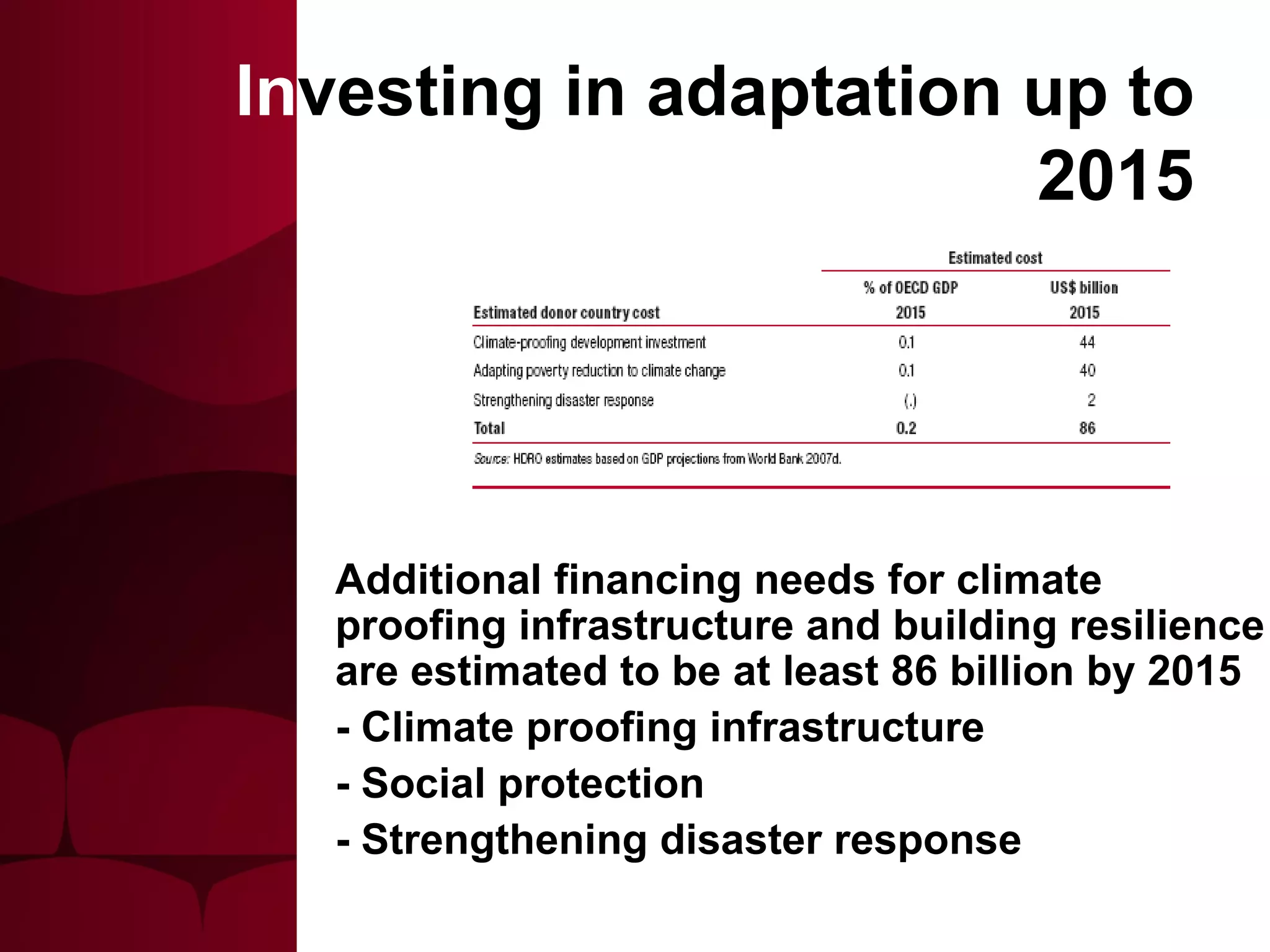
In v esting in adaptation up to 2015 Additional financing needs for climate proofing infrastructure and building resilience are estimated to be at least 86 billion by 2015 - Climate proofing infrastructure - Social protection - Strengthening disaster response
The H uman Development Report underscores that: The poo r are suffering and will suffer more with climate change. They  are at gr eatest risk to face human development reversals leading to  low hum an development traps. Climate  change is an urgent matter. We need to act now.  Both mit igation and adaptation are needed to truly fight climate  change  and the threats it poses to humanity. Rich co untries must cut emissions by 30% by 2020 and 80% by 2050.  Internati onal cooperation on finance and technology transfer is  needed.  The report argues for the creation of a Climate Change  Mitigatio n Facility. Extreme  inequalities in adaptation capacity exist. International  coopera tion has been slow to materialize. Adaptation plans  needs need to  be part of wider strategies of poverty alleviation.
The HDR 2007/2008 will be launched 27 November 2007 http://hdr.undp.org

Hdr 20072008 Presentation[1]

  • 1.
  • 2.
    The 21 st Century climate challenge “ One generation plants a tree; the next generation gets the shade.” Chinese Proverb “ You already know enough. So do I. It is not knowledge we lack. What is missing is the courage to understand what we know and to draw conclusions.” Sven Lindqvist
  • 3.
    The world has less than a decade to avoid dangerous climate change that could bring unprecedented human development reversals Climate change is a threat to humanity as a whole. But it is the poor , a constituency with no responsibility for the ecological debt we are running up, who face the most immediate and most severe human costs The Human Development Report 2007/2008 calls for a ‘twin track’ approach that combines stringent mitigation to limit 21st Century warming to less than 2 degree centigrade , with strengthened international cooperation on adaptation The forthcoming conference of the parties in Bali is a unique opportunity to put the interests of the world’s poor and future generations at the heart of climate change negotiations
  • 4.
    The 21stCentury climate challenge Three distinctive characteristics: It is cumulative The effects are irreversible Large time lags – today’s emissions are tomorrow’s problems It is global
  • 5.
    Risin g CO2 emissions are pushing up sto cks & increasing temperatures In the past 100 years the earth has warmed 0.7 0 C Atmospheric concentrations of CO 2 are increasing at 1.9 ppm each year. It reached 379 ppm in 2005 Between 2000 and 2005 an average of 26 Gt of CO 2 was releases into the atmosphere each year
  • 6.
    The Globa lcarbon account Defining dangerous – keeping within 2°C Establishing a 21 st Century carbon budget Defining a sustainable emission’s pathway The problem of inertia – the case for adaptation
  • 7.
    Th e 21st Century carbon budg et is set at 1,456 Gt CO 2 to avoid dangerous climate change
  • 8.
    The 2 1st Century carbon budget is set for early expiry
  • 9.
    Charting a courseaway dangerous climate change The sustainable emissions pathway is as follows The world – cuts of 50 percent by 2050 with a peak by 2020 Developed countries – cuts of 80 percent by 2050 Developing countries – cuts of 20 percent by 2050 with respect to 1990
  • 10.
    Halvin g emissionsby 2050 could avoid dangerous climate change
  • 11.
    Some peoplewalk more lightly than others The UK (population 60 million) emits more CO 2 than Egypt, Nigeria, Pakistan and Vietnam (total population 472 million) The state of Texas (population 23 million) has a deeper footprint than the whole sub-Saharan Africa (720 million people) The 19 million people living in New York have a deeper footprint than the 766 million people living in the 50 least developed countries The distribution of current emissions points to an inverse relationship between climate change vulnerability and responsibility
  • 12.
    How many planets?The 21 st century carbon budget amounts to 1,456 Gt or around 14.5 Gt CO 2 per year Total CO 2 emissions in 2004 stood at 29 Gt If every person living in the developing world would have the same carbon footprint than an average person in the US or Canada, we would need the equivalent to nine planets to absorb the CO 2
  • 13.
    Climate shocks: riskand vulnerability in an unequal world “ The countries most vulnerable are least able to protect themselves. They also contribute least to the global emissions of greenhouse gases. Without action they will pay a high price for the actions of others.” Kofi Annan “ Like slavery and apartheid, poverty is not natural. It is man-made and it can be overcome and eradicated by the actions of human beings.” Nelson Mandela
  • 14.
    Risk and vulnerabilityClimate risk is an external fact of life for the entire world Vulnerability is a measure of capacity to manage climate hazards without suffering a long-term potentially irreversible loss of well-being. The state of human development shapes the process by which risk is converted into vulnerability
  • 15.
    Disa ster riskis skewed tpwards developing countries 1 in 19 people are affected in developing countries The corresponding number is 1 in 1,500 in OECD countries A risk differential of 79
  • 16.
    The human developmentbackdrop Poverty, child mortality and malnutrition There are still around 1 billion people living on less than a dollar a day. Around 28 percent of children in LDCs are underweight or stunted. Only 32 countries (of 147) are on track to achieve the MDG on child mortality Inequality More than 80 percent of the world’s population lives in countries where income differentials are widening Underlying inequalities act as a barrier for early recovery after shocks
  • 17.
    Low humandevelopment traps The potential human costs of climate change have been understated Climate related risks force people into downward spirals of disadvantage that undermine future oppurtunities In Ethiopia, childre exposed to a drought in early childhood are 36 percent more likely to be malnourished five years later – a figure that translates into 2 million additional cases of child maknutrition Indian women born during a drought or a flood in the 1970s were 19 percent less likely to ever attend primary school
  • 18.
    Five h umandevelopment tipping points Reduced agricultural productivity Heightened water insecurity Increased exposure to extreme weather events Collapse of ecosystems Increased health risks
  • 19.
    Climate change willhurt deve loping country agriculture
  • 20.
    Heightened water insecur ity – glacial melting Glacial melting posses threats to more than 40 percent of the world’s population. In the arid cost of Peru, 80 percent of fresh water originates from glacial melt. The flow of the Indus, could decline as much as 70 percent In Central Asia, losses of glacial melt into Amu Darya and Syr Darya rivers could restrict water for irrigation and hydroelectric power
  • 21.
    Ext reme weatherevents The number of additional people experiencing coastal flooding could range from 134 to 332 million for a 3 o - 4 o increase in temperature. Tropical storms could raise the figure to 371 million by the end of the 21 st century Possible consequences of one meter rise in sea level In Lower Egypt, 6 million people displaced and 4,500 kms 2 of farmland flooded In Vietnam, 22 million people displaced In Bangladesh, 18 percent of land area could be inundated affecting 11 percent of the population In the Maldives, more than 80 percent of land area is less than 1 meter above sea level
  • 22.
    Avoiding dangerous climatechange: strategies for mitigation “ We shall require a substantially new manner of thinking if mankind is to survive.” Albert Einstein “ Speed is irrelevant if you are going in the wrong direction.” Mahatma Gandhi “ Alone we can do so little; together we can do so much.” Helen Keller
  • 23.
    Avoidin g dangerousclimate change – strategies for mitigation Setting mitigation targets: current problems Pricing carbon: the role of markets The role of public policy: regulation and research & development
  • 24.
    Prob lems settingemission reduction targets Insufficient ambition Insufficient urgency Inaccurate indicators Inadequate sectoral coverage Inconsistent base years Targets are de-linked from policies
  • 25.
    Pric ing carbon emissions Market failure: Polluters do not suffer the worse consequences of their own pollution Immediate challenge: to push the price of carbon to a level consistent with the sustainable emissions pathway Ways to do it: taxation and cap-and-trade and trade
  • 26.
    Where shouldthe price of carbon be set? How should the price be generated? Under carbon taxation emitters are required to pay for each tone of CO 2 they produce Under cap-and-trade, the government sets an overall emissions cap and issues tradable allowances to allow business the “right to emit” Taxat ion versus cap-and-trade
  • 27.
    The r elative merits of taxation and cap-and-trade Administration Price predictability Revenue mobilization The differences can be exaggerated
  • 28.
    The criticalrole of regulation and government action The energy mix The residential sector Vehicle emission standards R&D and deployment of low carbon technologies
  • 29.
    The Energy MixCurrently energy mix is dominated by fossil fuels Renewable energy is not competitive with coal-fired power – price of carbon and incentives for predicable markets can play a role Germany’ Renewable Sources Act – fix price for 20 years Spain – wind power satisfies around 8 percent of total electricity demand. In 2005 saved 19 million t CO 2 emissions Denmark – tax breaks on capital investments. In two decades wind has increased the share in electricity generation to 20 percent
  • 30.
    Residential Sector Lowcost mitigation In OECD residential accounts for 35-40 percent of national CO2 emissions Appliances alone produce roughly 12 percent Policies on building and appliances could save up to 29 percent emissions (3.9 Gt CO 2 ) by 2020 equivalent to three times current emissions of India Average European household could save 200 to 1000 Euros annually through energy efficiency The best efficiency standards of electrical appliances could save 322 million t CO 2 by 2010 equivalent to 100 million cars off the road (all cars from Canada, France and Germany)
  • 31.
    Vehic le Emission Standards Personal transportation is the largest consumer of oil In OECD the automobile sector accounts for about 30 percent of total greenhouse gas emissions Improvements in the United States regulatory standards would represent cuttings equivalent to France’s total emissions
  • 32.
    Incre a sedcoal efficiency could cut CO 2 emissions
  • 33.
    Adapting to theinevitable: national action and international cooperation “ If you are neutral in a situation of injustice, you have chosen the side of the oppressor.” Archbishop Desmond Tutu “ An injustice committed against anyone is a threat to everyone.” Montesquieu
  • 34.
    By mid-2007, actualmultilateral financing delivered through UNFCCC amounted to US$ 26 million This is equivalent to one week spending in floods defences in the UK Amounts are not the only problem. Timing and fulfillment of pledges present further limitations Towa rds adaptation apartheid? Dev eloped country investments dwarf adaptation funds
  • 35.
    In v estingin adaptation up to 2015 Additional financing needs for climate proofing infrastructure and building resilience are estimated to be at least 86 billion by 2015 - Climate proofing infrastructure - Social protection - Strengthening disaster response
  • 36.
    The H umanDevelopment Report underscores that: The poo r are suffering and will suffer more with climate change. They are at gr eatest risk to face human development reversals leading to low hum an development traps. Climate change is an urgent matter. We need to act now. Both mit igation and adaptation are needed to truly fight climate change and the threats it poses to humanity. Rich co untries must cut emissions by 30% by 2020 and 80% by 2050. Internati onal cooperation on finance and technology transfer is needed. The report argues for the creation of a Climate Change Mitigatio n Facility. Extreme inequalities in adaptation capacity exist. International coopera tion has been slow to materialize. Adaptation plans needs need to be part of wider strategies of poverty alleviation.
  • 37.
    The HDR 2007/2008will be launched 27 November 2007 http://hdr.undp.org