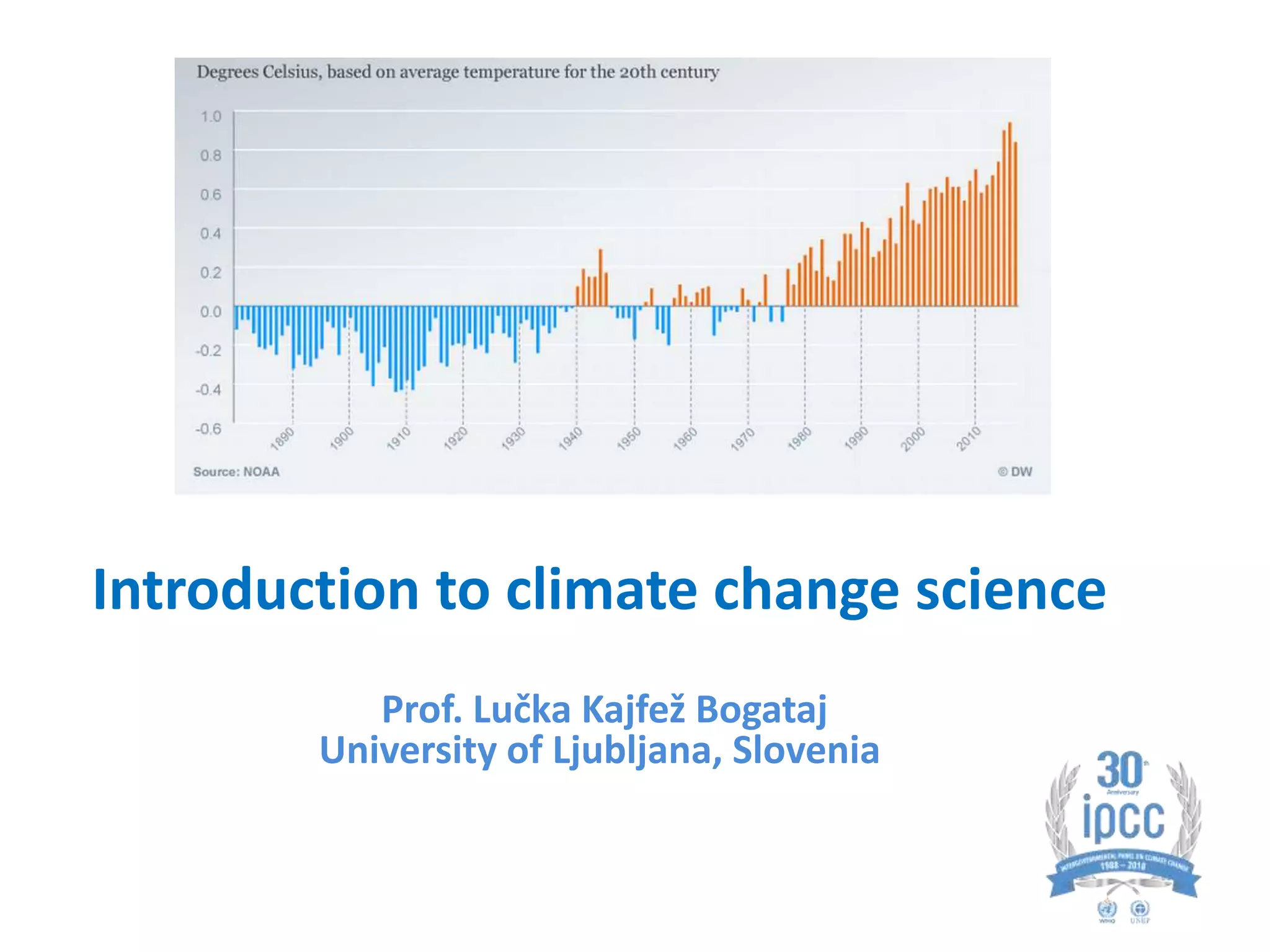
Introduction to climate change science
Prof. Lučka Kajfež Bogataj
University of Ljubljana, Slovenia
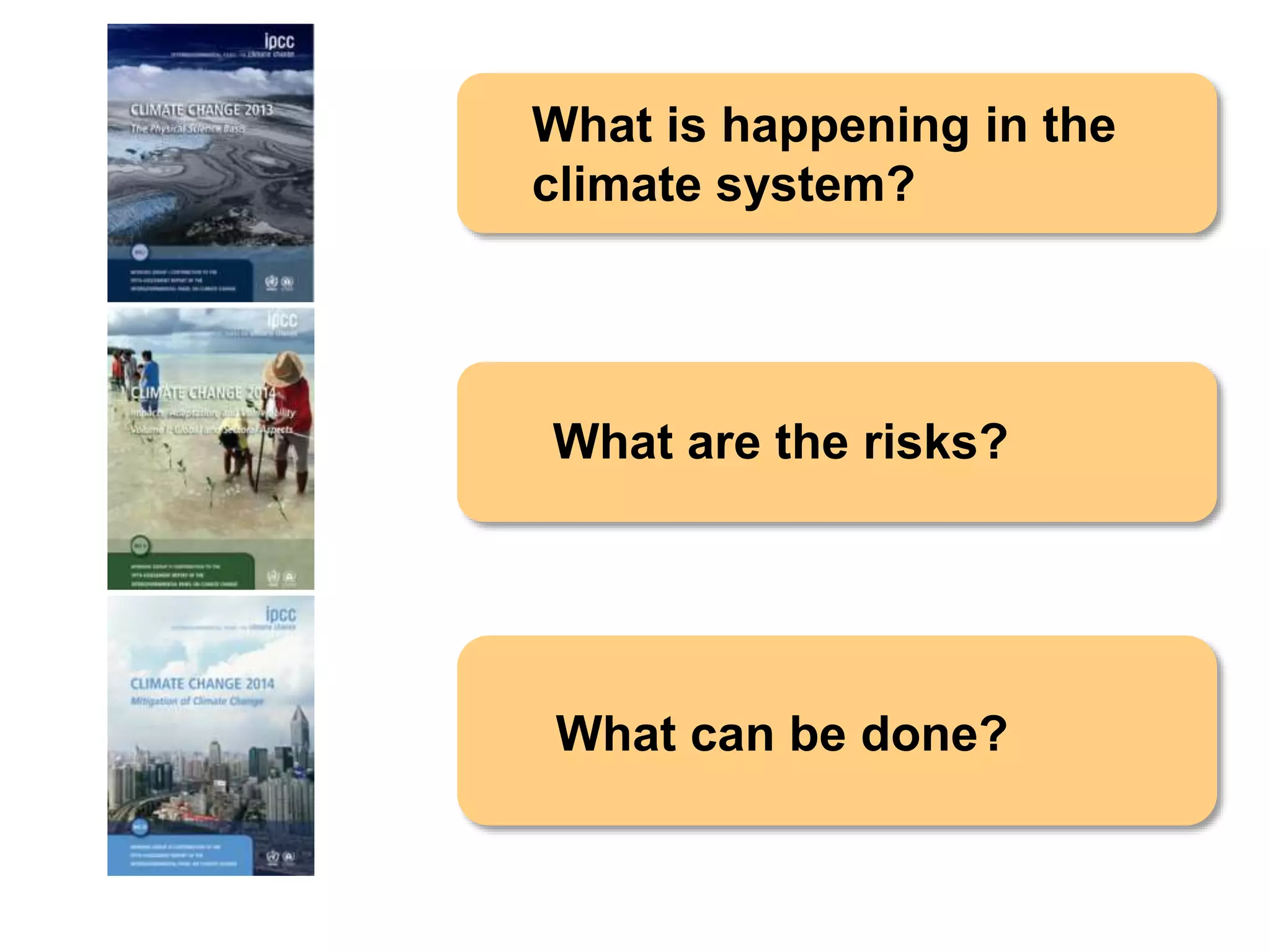
What is happening in the
climate system?
What are the risks?
What can be done?
Climate system
Main components: the atmosphere, hydrosphere [liquid water
components], cryosphere [frozen water components], lithosphere [land
surface] and biosphere [living things]) and the interactions between them
THE COMPOSITION OF AIR IS
CHANGING RAPIDLY due to human
activities:
→ more GHG (CO2, CH4, NOx...)
→ more aerosol (air pollution)
Human activities induced LAND USE
CHANGES
→ deforestation changed CO2 balance, more
GHG (CO2)
→ changes in albedo, water balance etc.
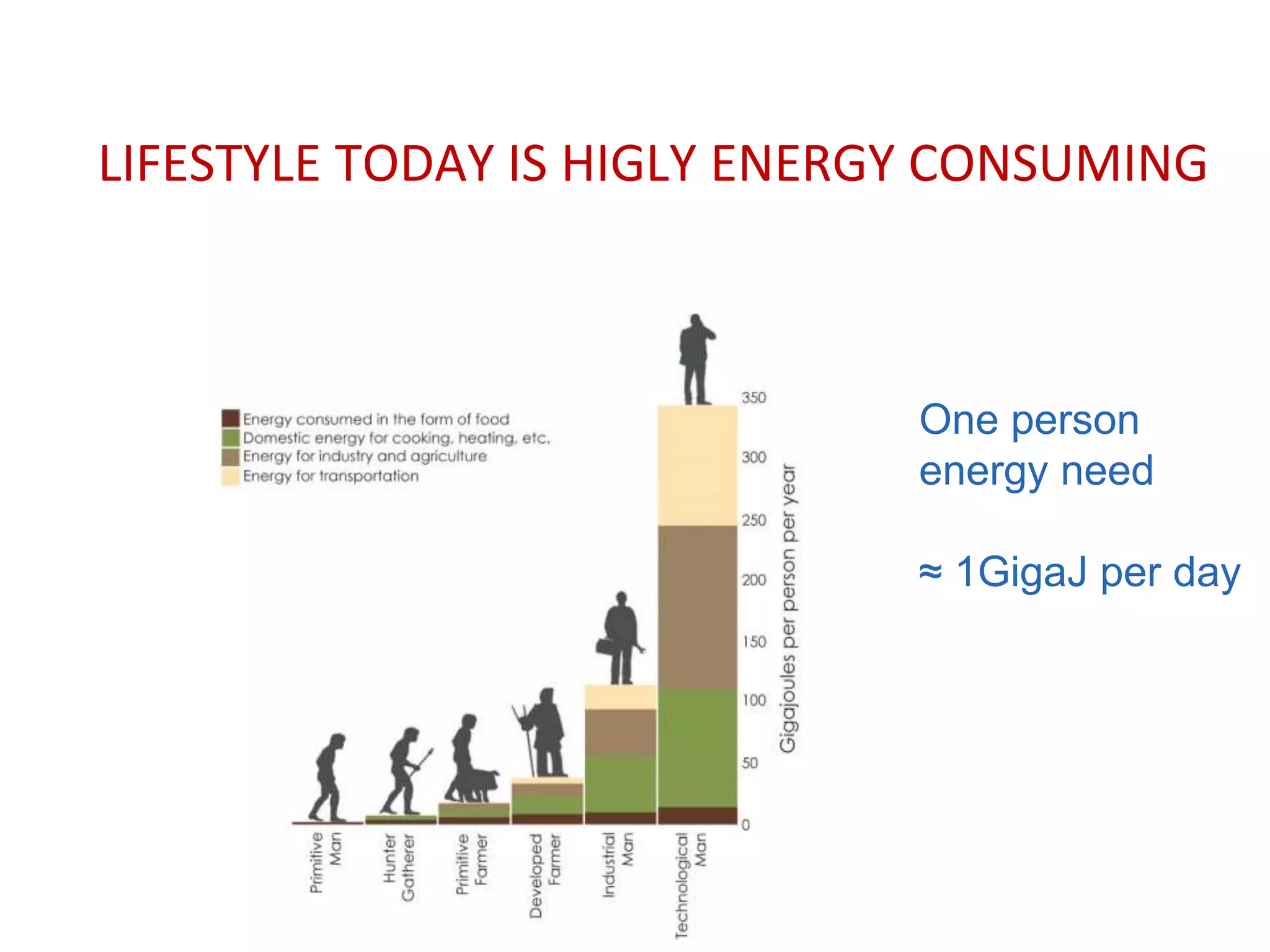
LIFESTYLE TODAY IS HIGLY ENERGY CONSUMING
One person
energy need
≈ 1GigaJ per day
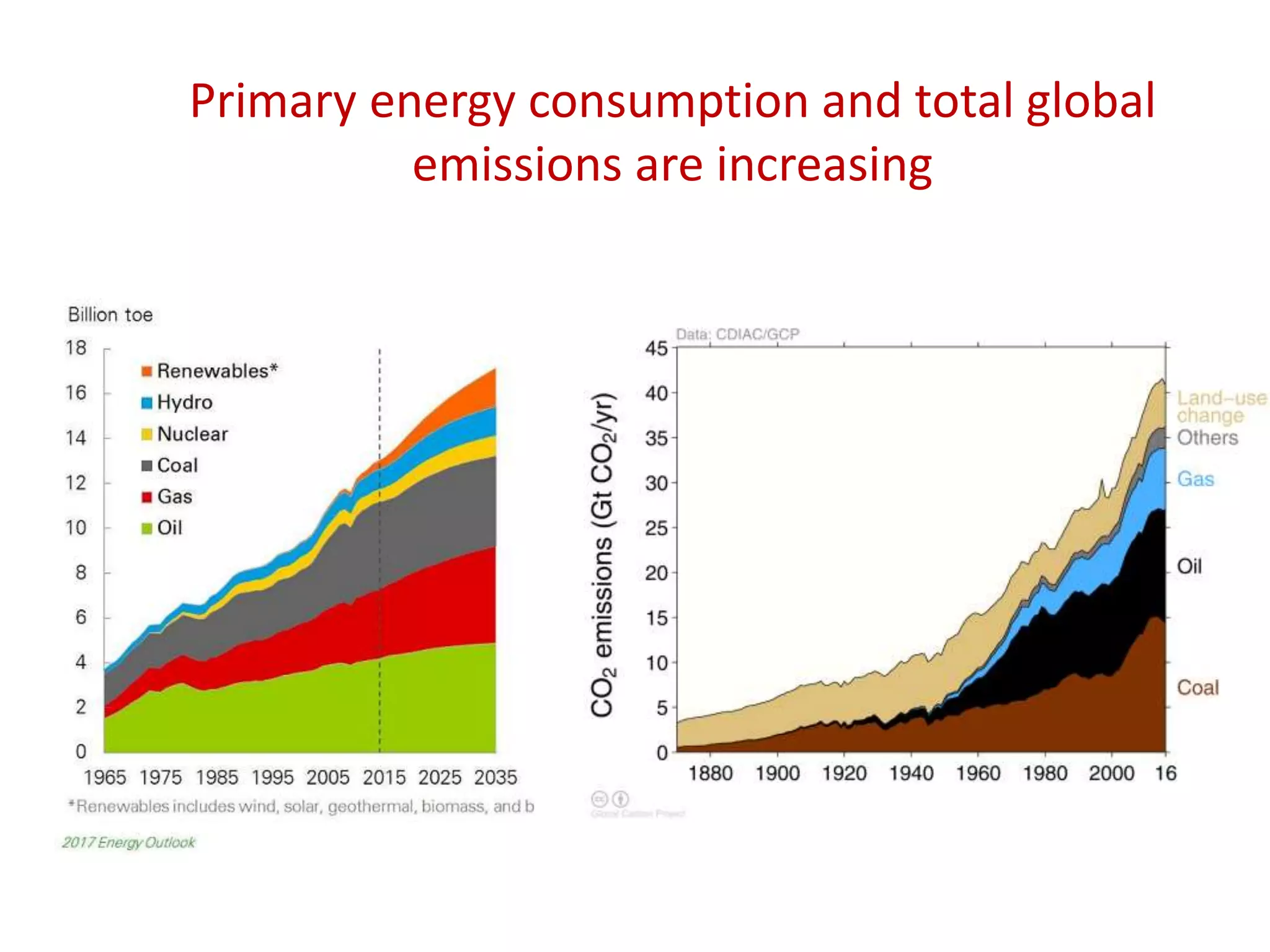
Primary energy consumption and total global
emissions are increasing
30%
11.0
GtCO2/yr
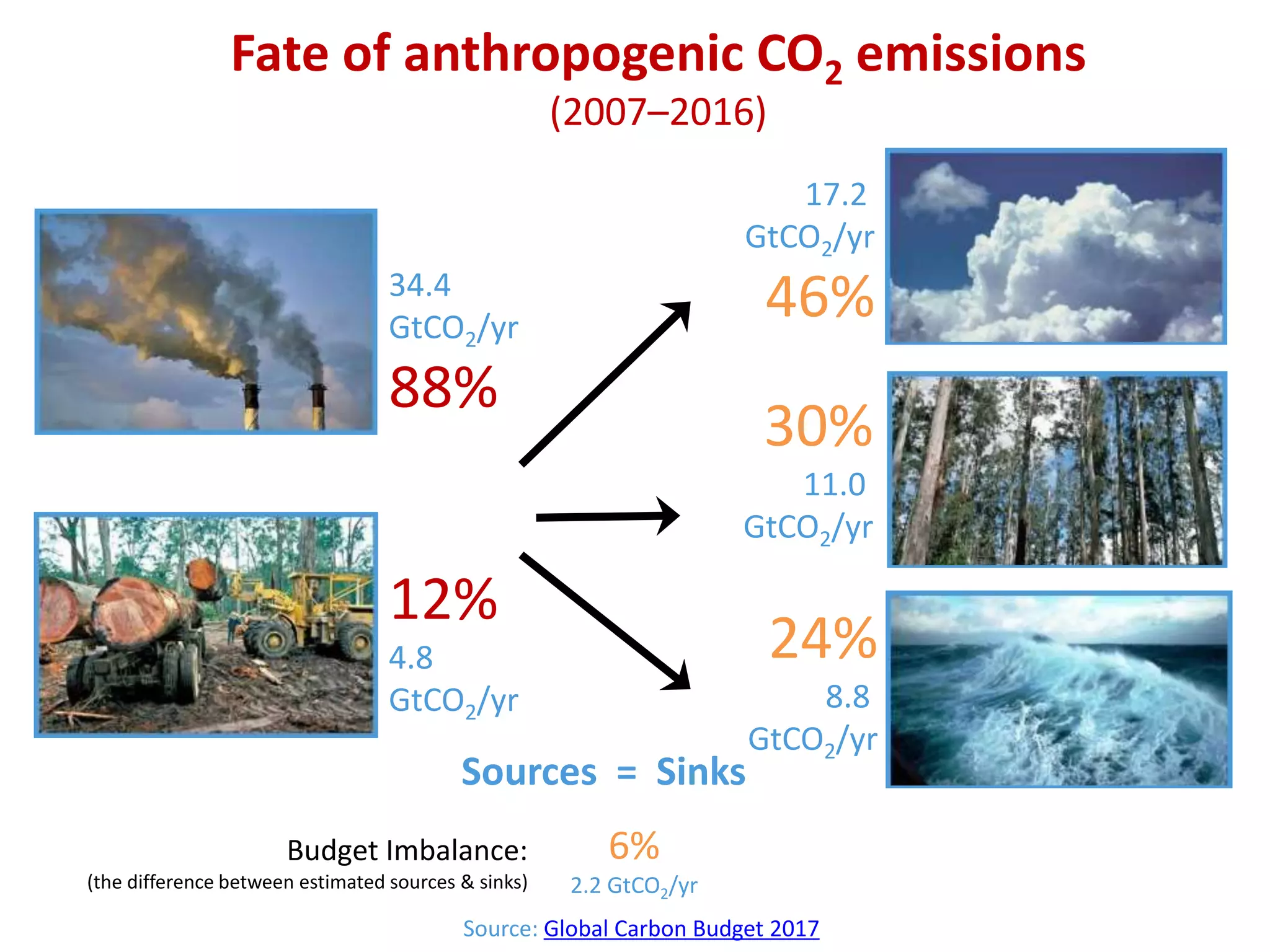
Fate of anthropogenic CO2 emissions
(2007–2016)
Source: Global Carbon Budget 2017
24%
8.8
GtCO2/yr
34.4
GtCO2/yr
88%
12%
4.8
GtCO2/yr
17.2
GtCO2/yr
46%
Sources = Sinks
6%
2.2 GtCO2/yr
Budget Imbalance:
(the difference between estimated sources & sinks)
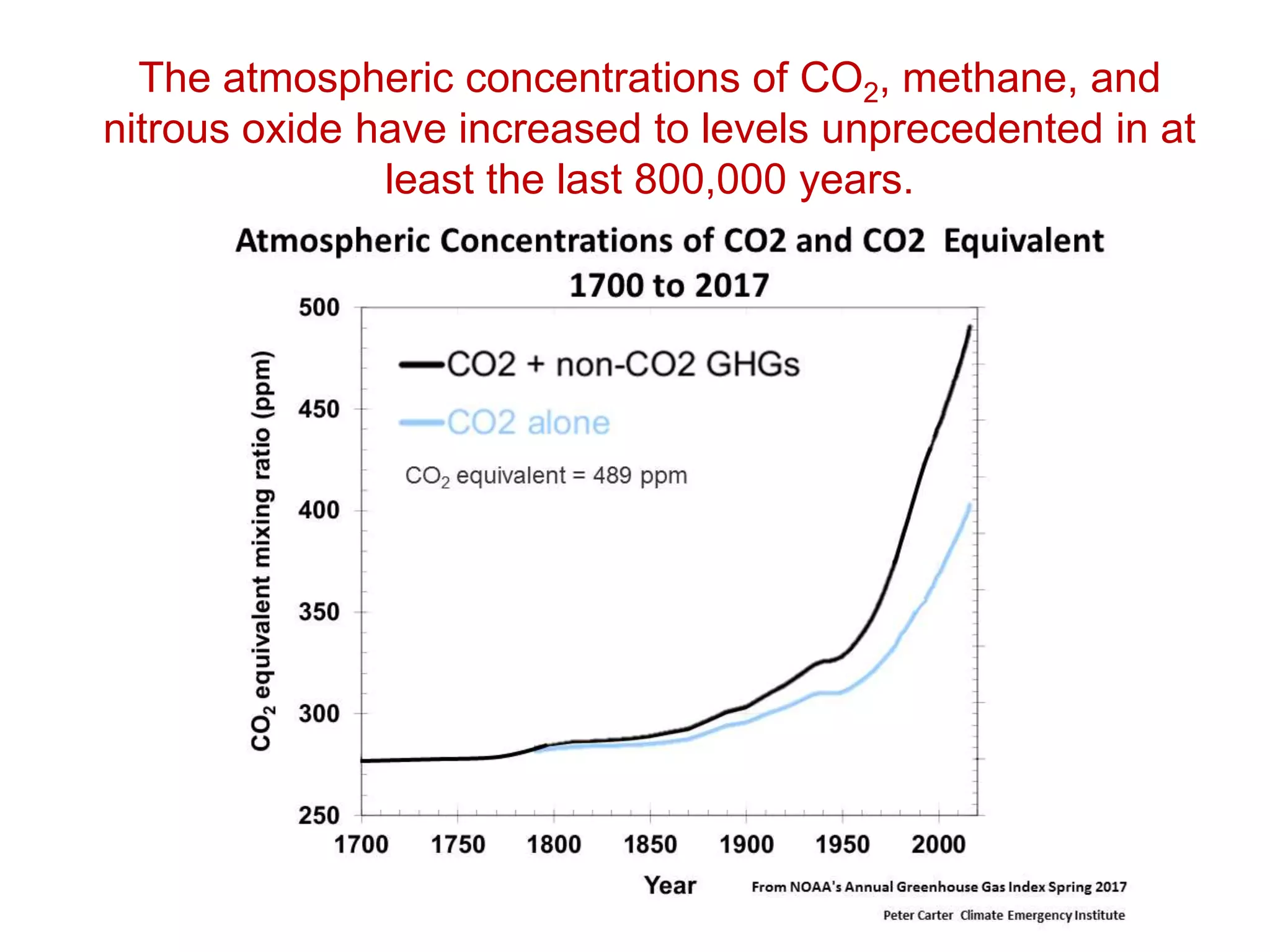
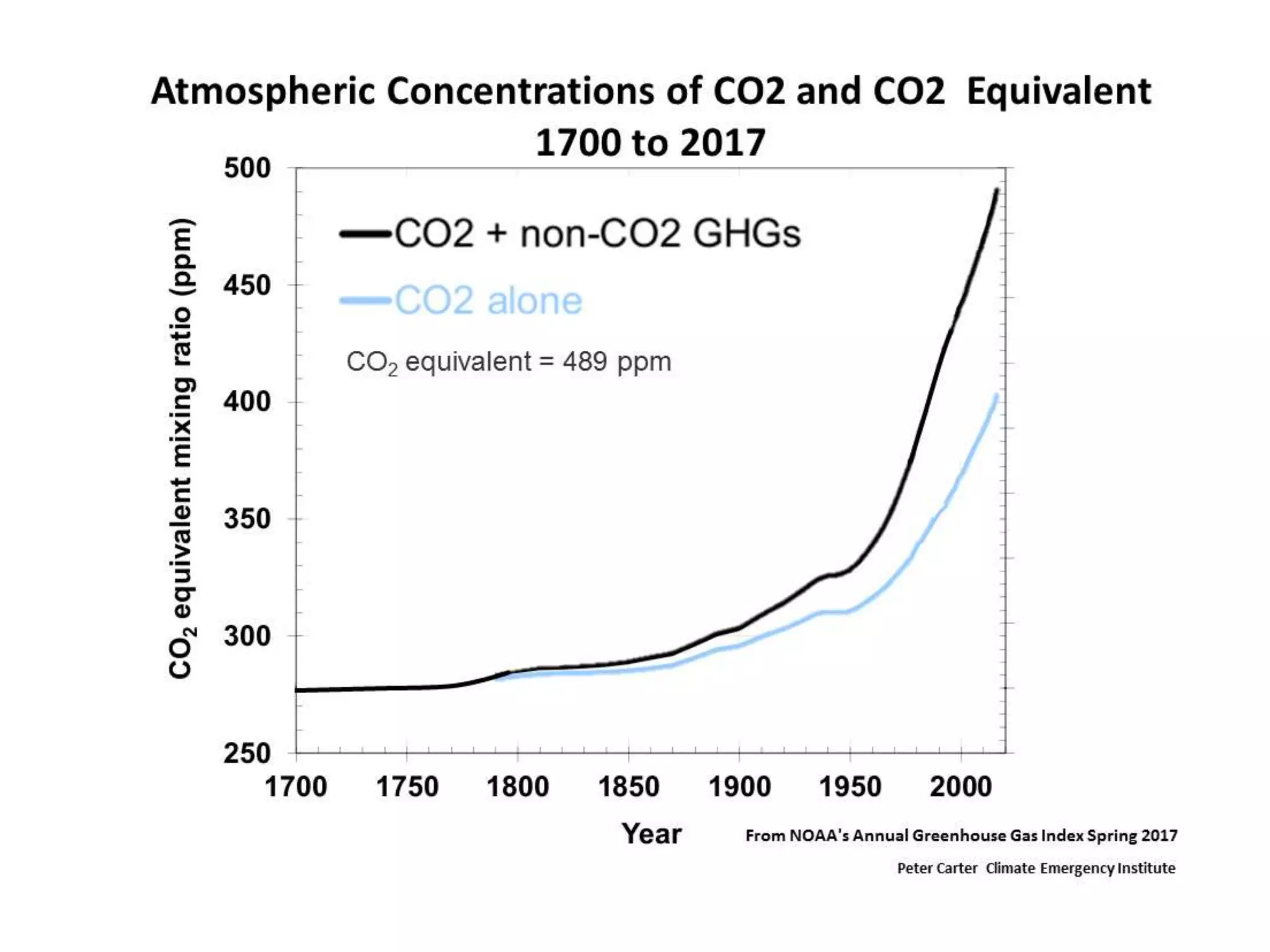
The atmospheric concentrations of CO2, methane, and
nitrous oxide have increased to levels unprecedented in at
least the last 800,000 years.
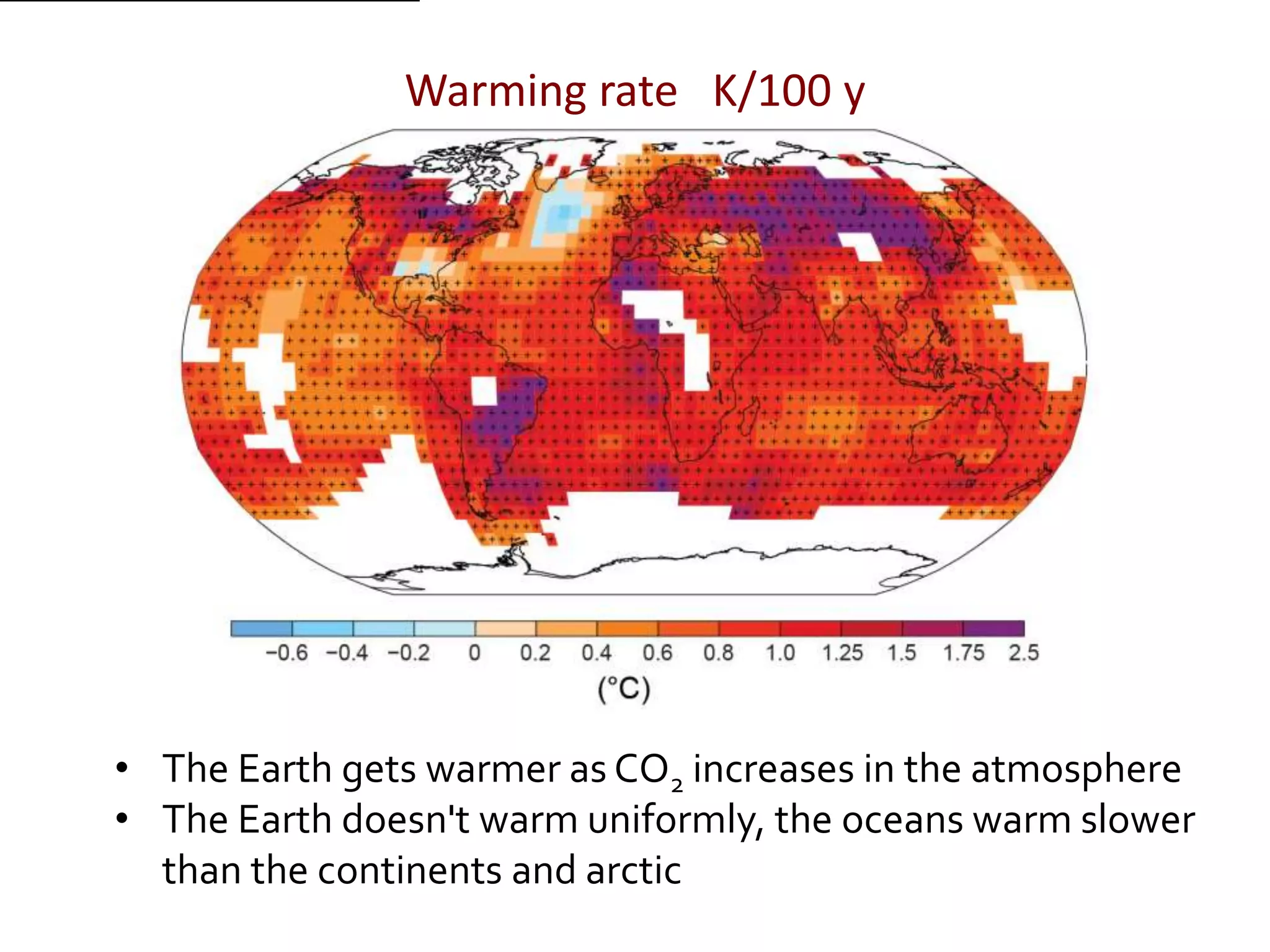
Warming rate K/100 y
• The Earth gets warmer as CO2 increases in the atmosphere
• The Earth doesn't warm uniformly, the oceans warm slower
than the continents and arctic
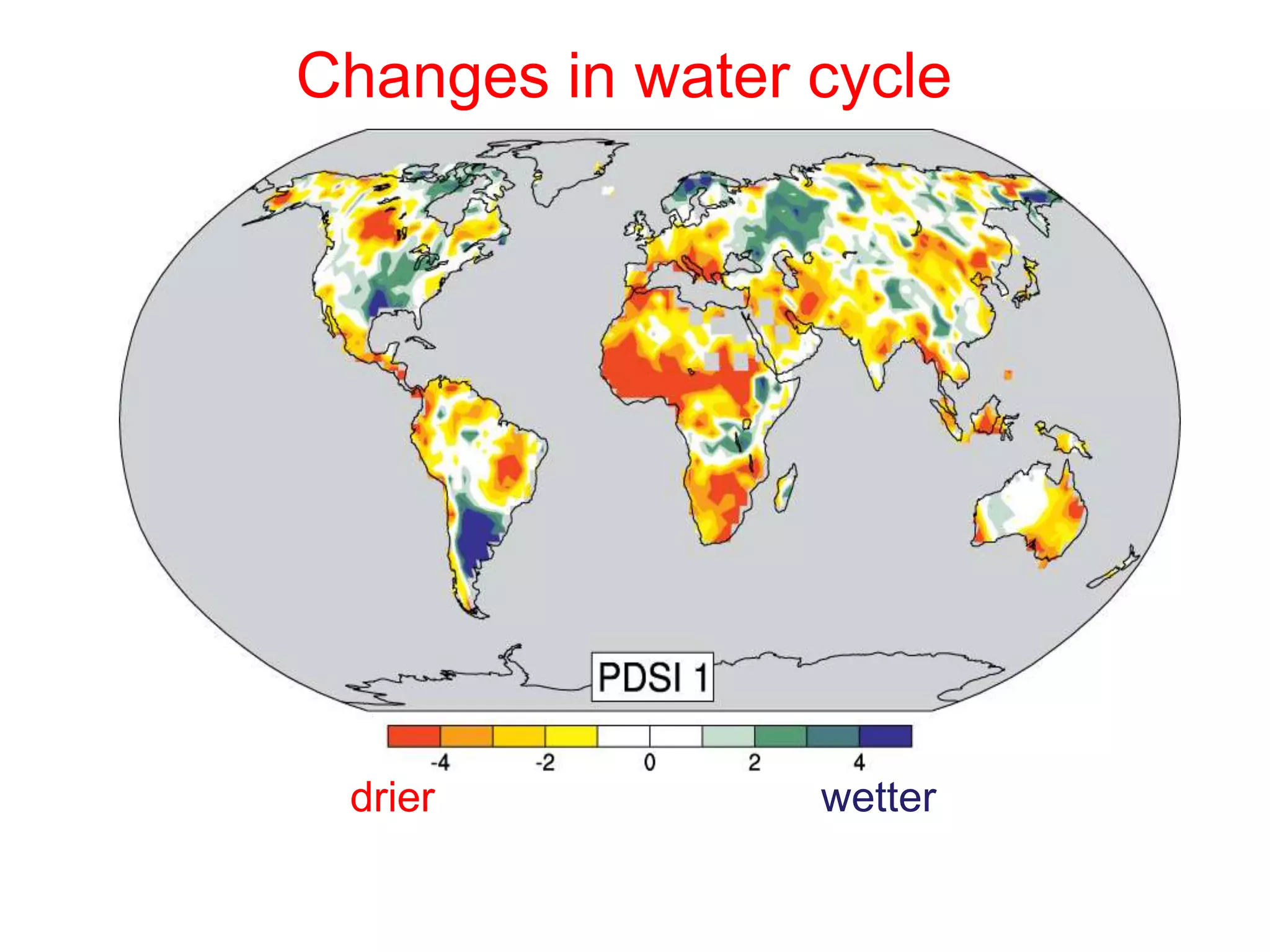
Changes in water cycle
drier wetter
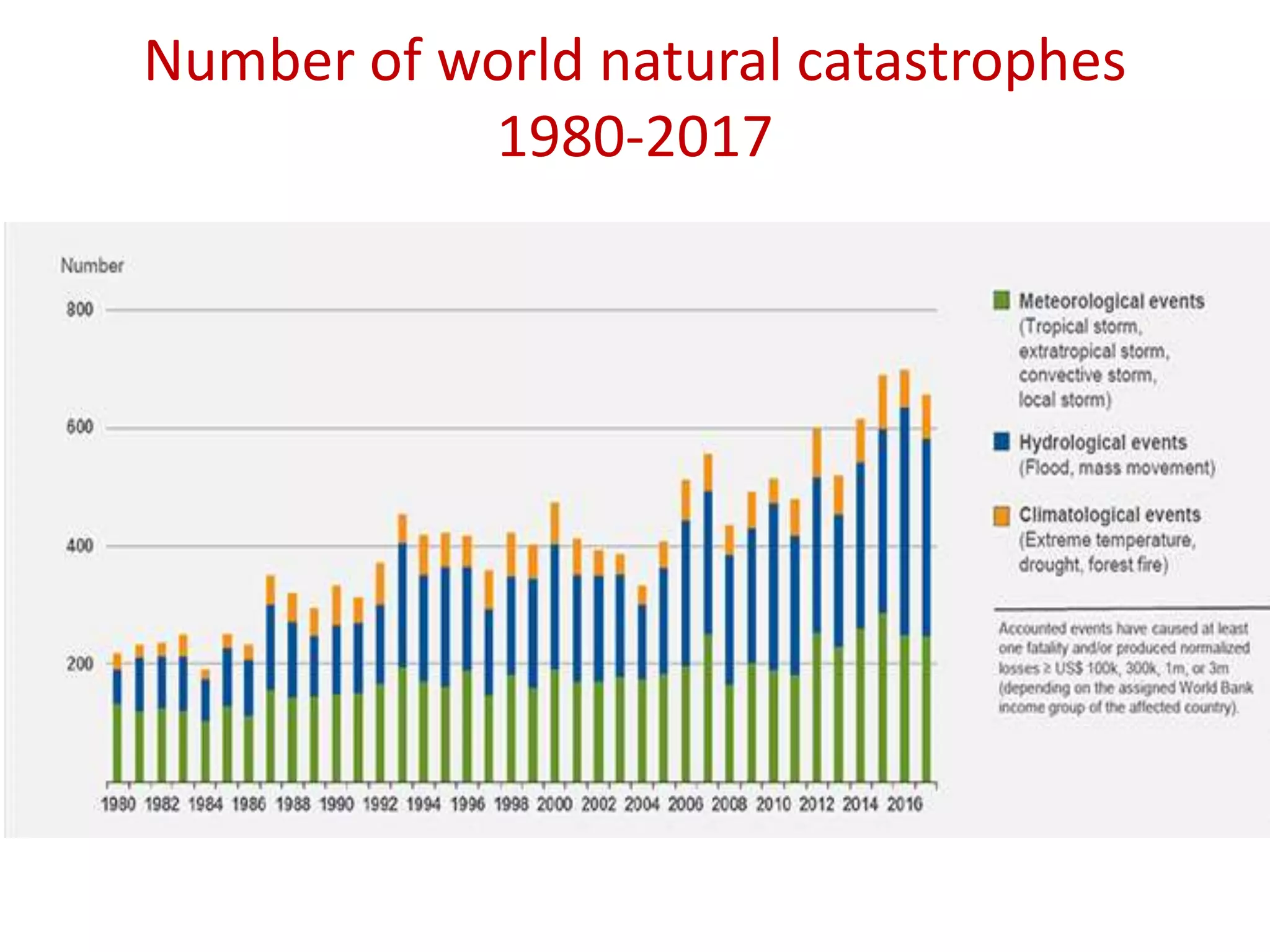
Number of world natural catastrophes
1980-2017
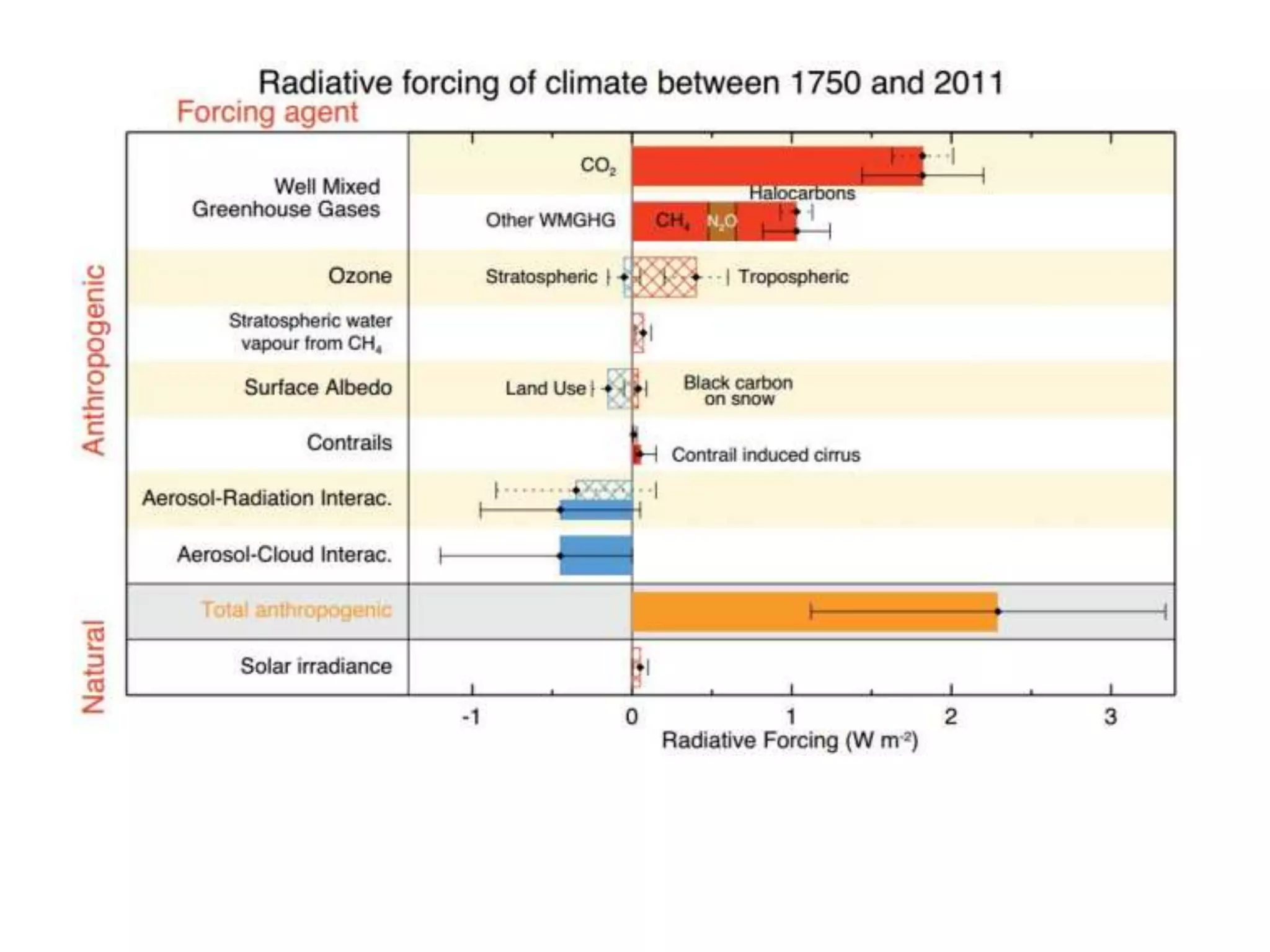
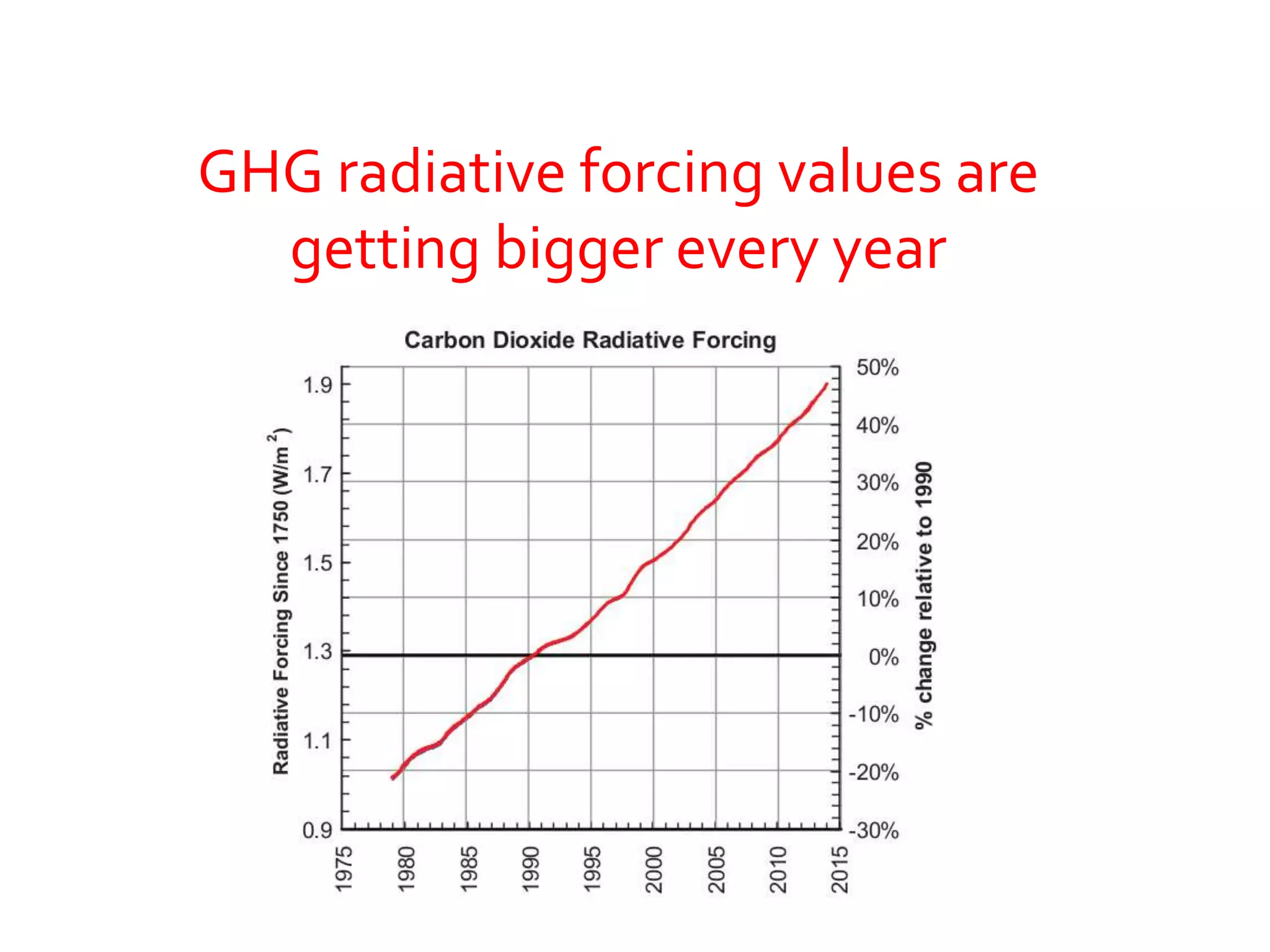
GHG radiative forcing values are
getting bigger every year
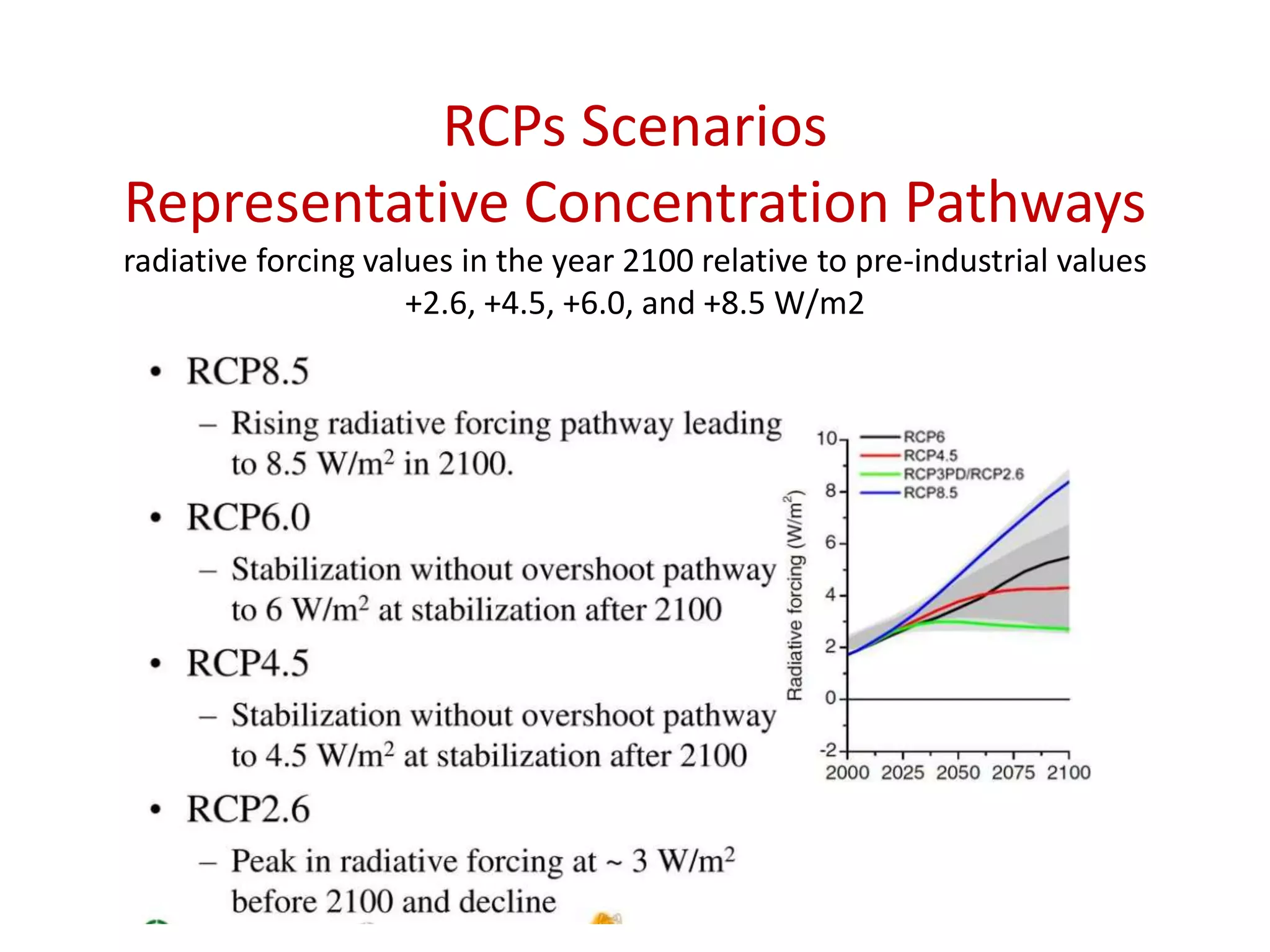
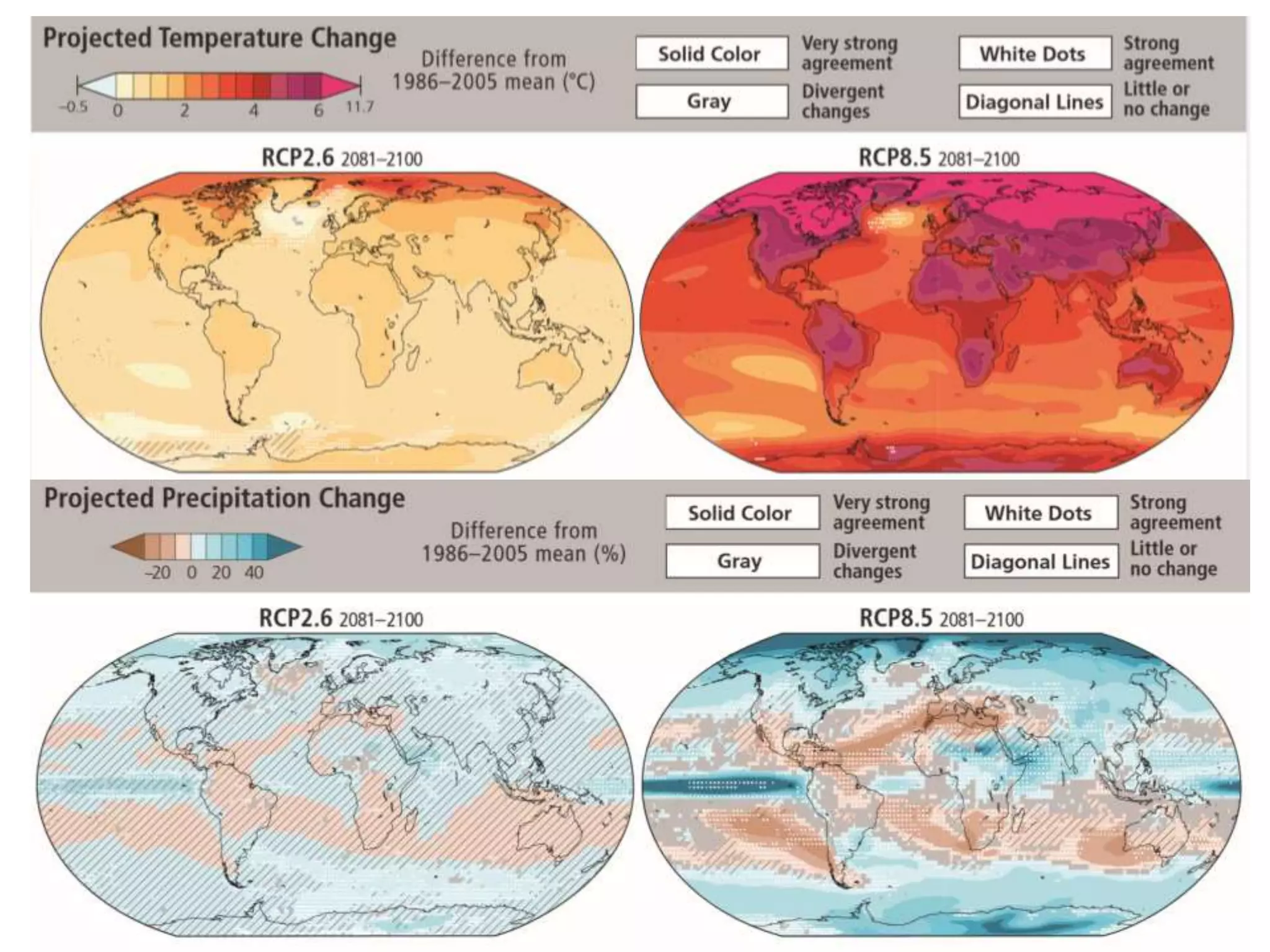
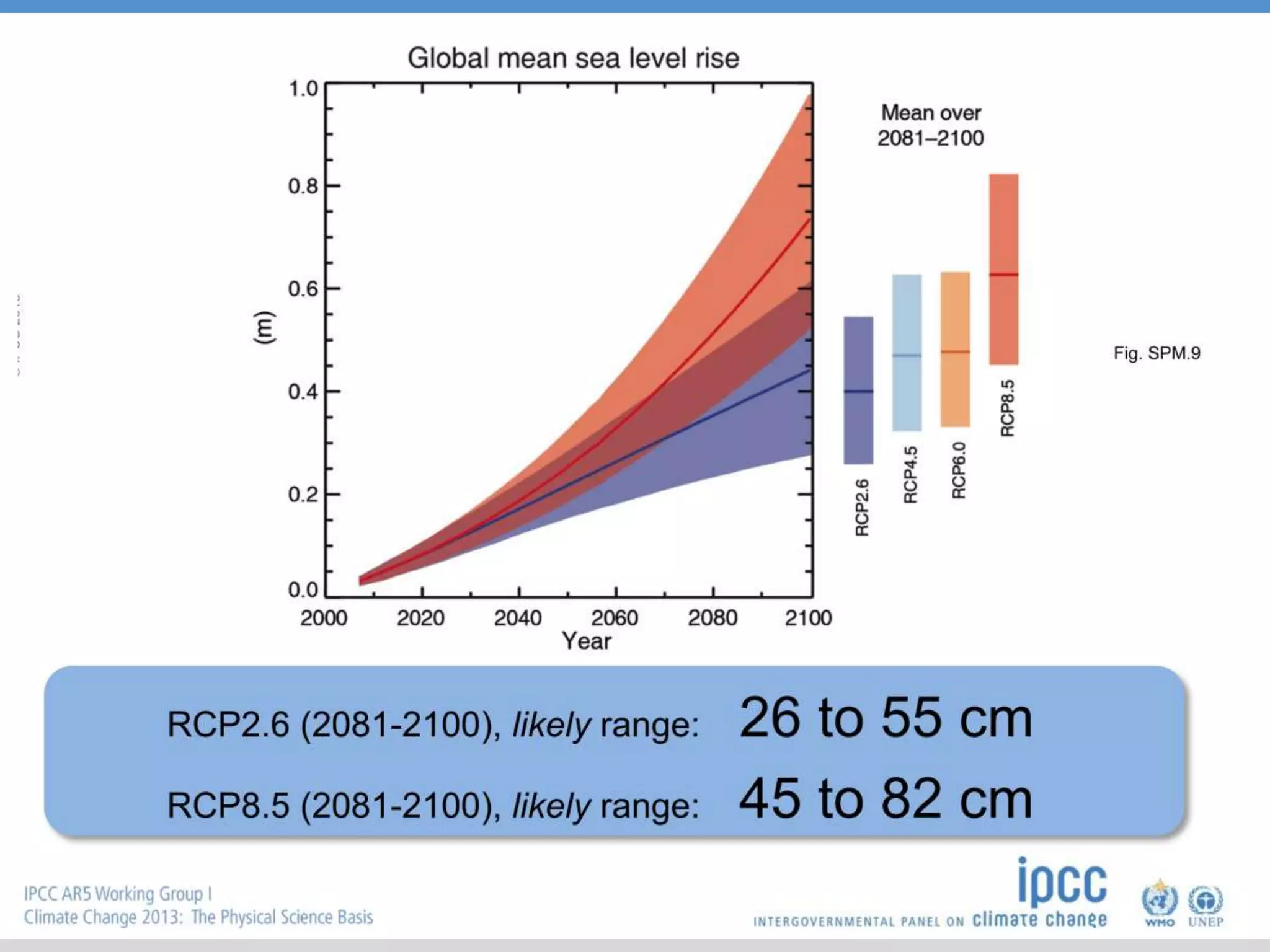
RCPs Scenarios
Representative Concentration Pathways
radiative forcing values in the year 2100 relative to pre-industrial values
+2.6, +4.5, +6.0, and +8.5 W/m2
Climate models
• Climate models are systems of differential
equations based on the basic laws of physics,
fluid motion, and chemistry.
• GCMs divide earth into many layers of grids.
GCMs provide forecasts for each grid point,
which represent average values for a grid.
• Using more than one GCM is recommended to
avoid the effects of model bias.
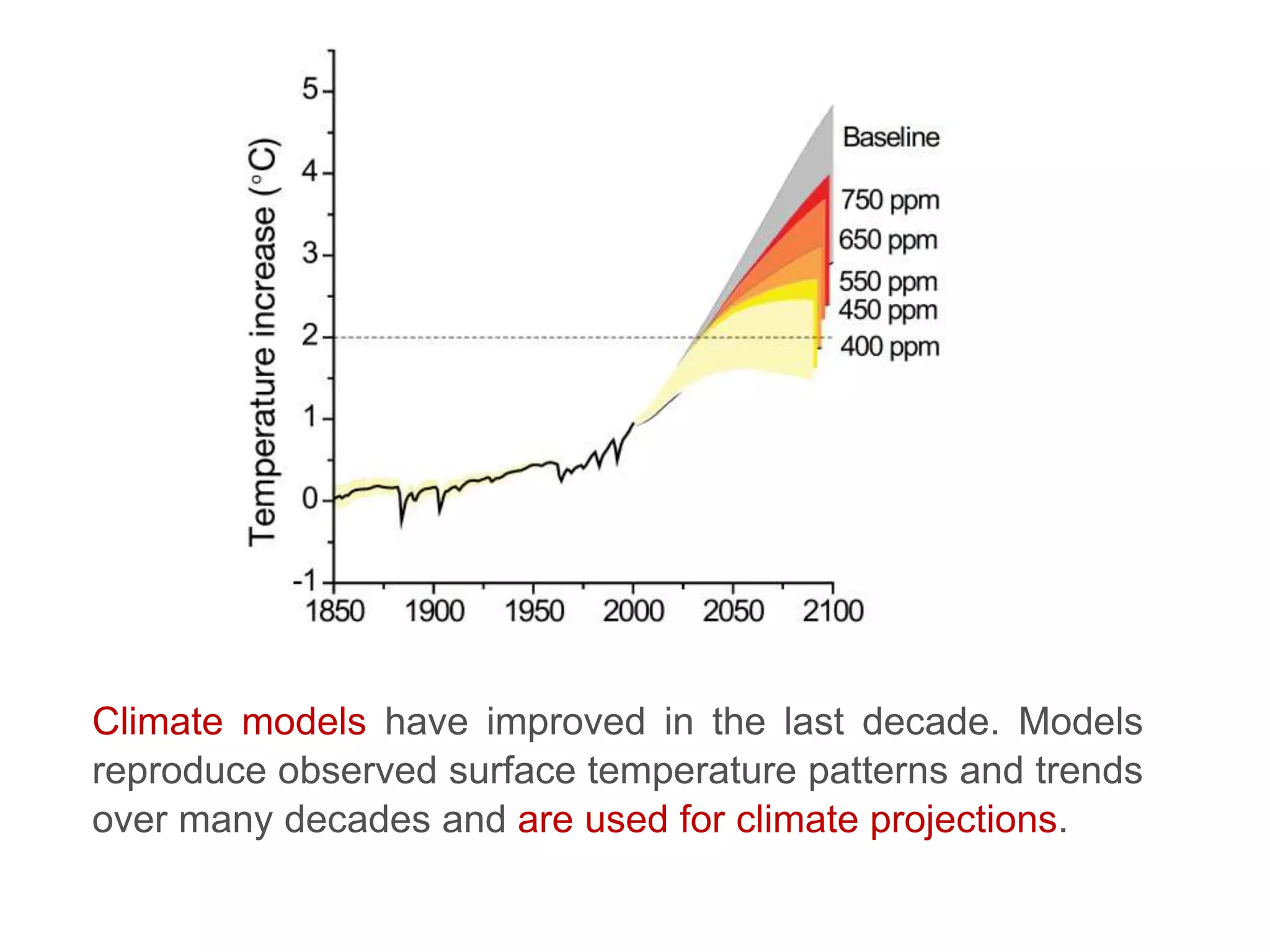
Climate models have improved in the last decade. Models
reproduce observed surface temperature patterns and trends
over many decades and are used for climate projections.
Downscaling is a technique to obtain information for a
finer scale from information for a larger scale.
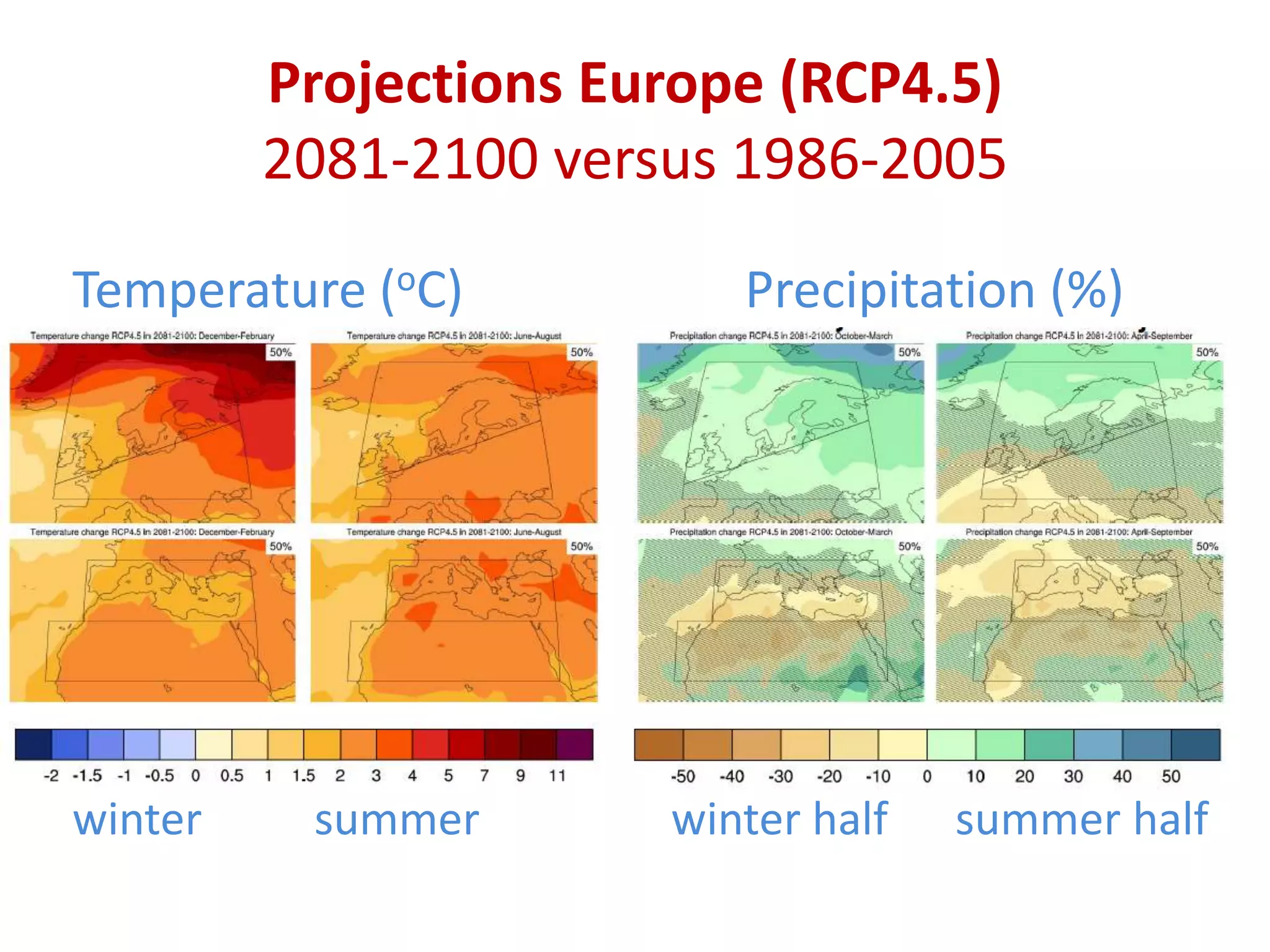
Projections Europe (RCP4.5)
2081-2100 versus 1986-2005
Temperature (oC) Precipitation (%)
winter summer winter half summer half
Feedbacks are important to climate change
• They have the potential to radically affect climate change.
• There are both negative and positive feedbacks, the big
question is how these will balance out
• Some types of feedback are well understood by climate
scientists and their effects are included in climate models
(water vapour - positive feedback, albedo -positive
feedback)
• Some are less understood (land and ocean carbon cycle,
clouds)
• Some are not at all included in the models (permafrost
methane -positive feedback, methane hydrates - positive
feedback)
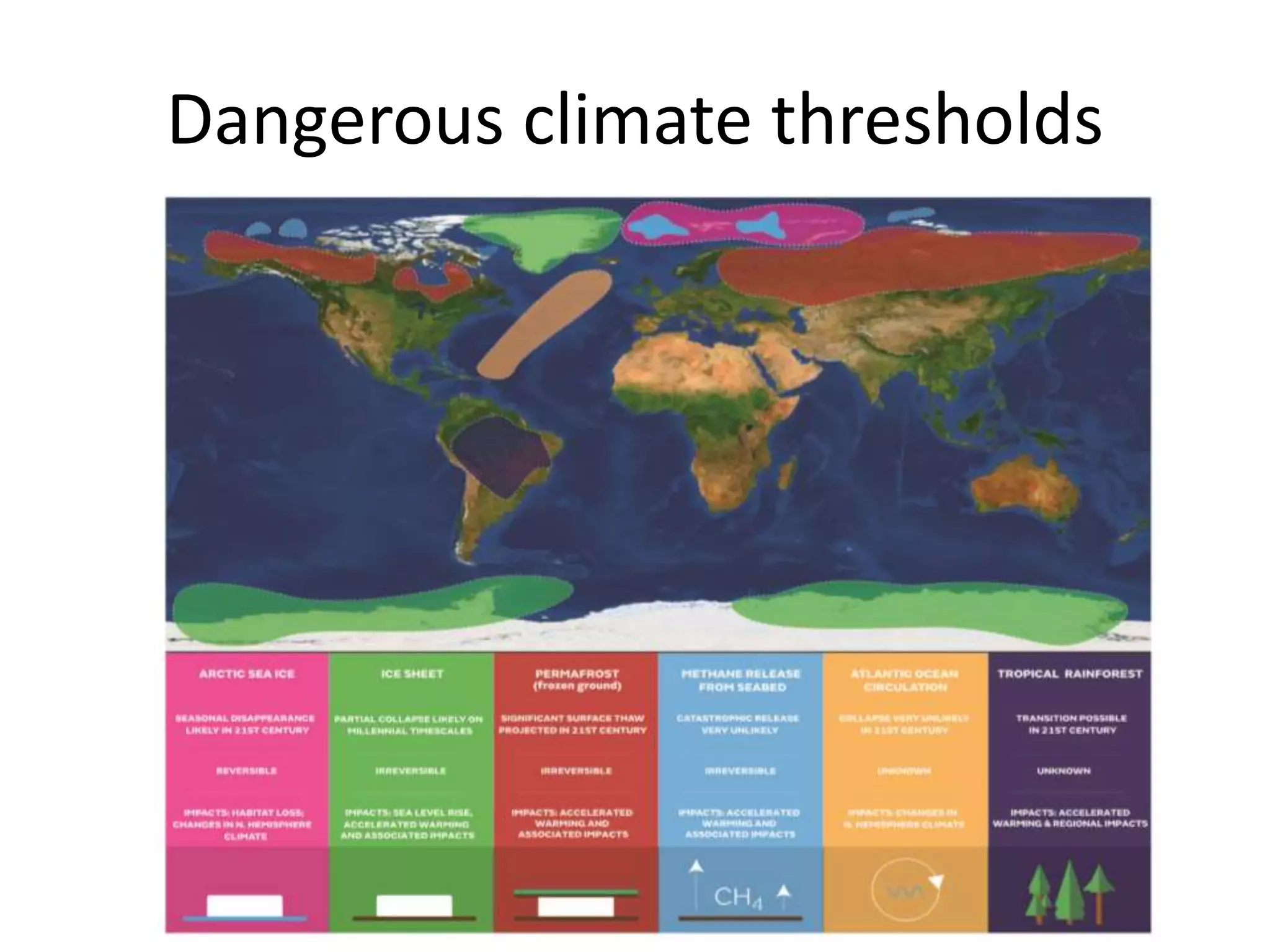
Dangerous climate thresholds
Evidence suggests the Earth’s climate has reached critical
thresholds in the past, triggering abrupt change. Climate
models suggest such thresholds could be reached again
as the Earth warms from increasing GHG emissions
• Arctic sea ice
• Changes in ocean circulation
• Permafrost
• Tropical and boreal forests
• Ice sheets
• Methane release from the seabed
Dangerous climate thresholds
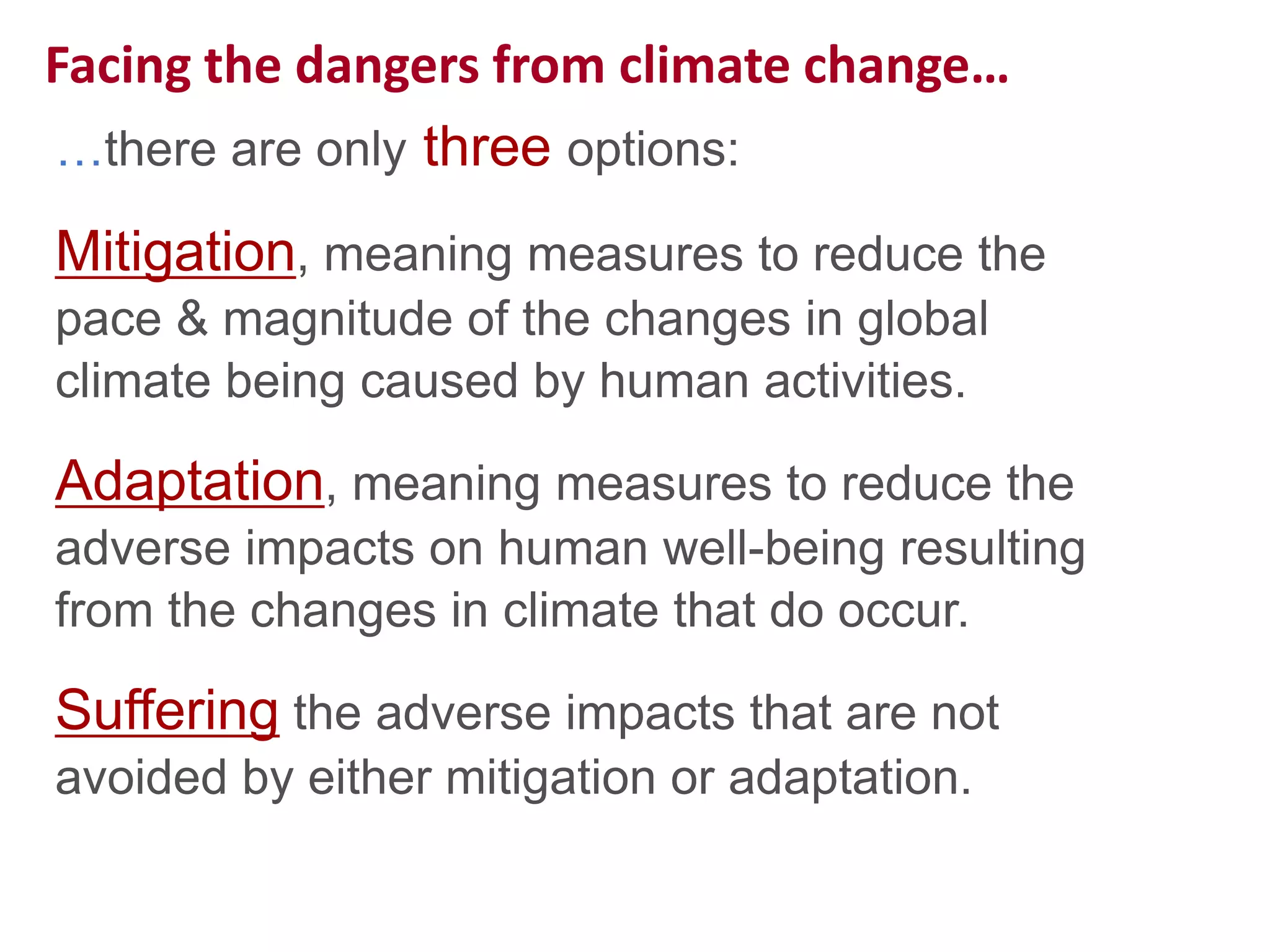
Facing the dangers from climate change…
…there are only three options:
Mitigation, meaning measures to reduce the
pace & magnitude of the changes in global
climate being caused by human activities.
Adaptation, meaning measures to reduce the
adverse impacts on human well-being resulting
from the changes in climate that do occur.
Suffering the adverse impacts that are not
avoided by either mitigation or adaptation.
Concluding thoughts
• Human influence on the climate system is clear.
This is evident from the increasing GHG
concentrations, observed warming, and
understanding of the climate system.
• Continued emissions of GHG will cause further
warming and changes in all components of the
climate system.
• We can still limit climate change by substantial
and sustained reductions of greenhouse gas
emissions.

Scientists - Introduction to climate change science

  • 1.
    Introduction to climatechange science Prof. Lučka Kajfež Bogataj University of Ljubljana, Slovenia
  • 2.
    What is happeningin the climate system? What are the risks? What can be done?
  • 3.
    Climate system Main components:the atmosphere, hydrosphere [liquid water components], cryosphere [frozen water components], lithosphere [land surface] and biosphere [living things]) and the interactions between them
  • 4.
    THE COMPOSITION OFAIR IS CHANGING RAPIDLY due to human activities: → more GHG (CO2, CH4, NOx...) → more aerosol (air pollution) Human activities induced LAND USE CHANGES → deforestation changed CO2 balance, more GHG (CO2) → changes in albedo, water balance etc.
  • 5.
    LIFESTYLE TODAY ISHIGLY ENERGY CONSUMING One person energy need ≈ 1GigaJ per day
  • 6.
    Primary energy consumptionand total global emissions are increasing
  • 7.
    30% 11.0 GtCO2/yr Fate of anthropogenicCO2 emissions (2007–2016) Source: Global Carbon Budget 2017 24% 8.8 GtCO2/yr 34.4 GtCO2/yr 88% 12% 4.8 GtCO2/yr 17.2 GtCO2/yr 46% Sources = Sinks 6% 2.2 GtCO2/yr Budget Imbalance: (the difference between estimated sources & sinks)
  • 8.
    The atmospheric concentrationsof CO2, methane, and nitrous oxide have increased to levels unprecedented in at least the last 800,000 years.
  • 11.
    Warming rate K/100y • The Earth gets warmer as CO2 increases in the atmosphere • The Earth doesn't warm uniformly, the oceans warm slower than the continents and arctic
  • 12.
    Changes in watercycle drier wetter
  • 14.
    Number of worldnatural catastrophes 1980-2017
  • 16.
    GHG radiative forcingvalues are getting bigger every year
  • 17.
    RCPs Scenarios Representative ConcentrationPathways radiative forcing values in the year 2100 relative to pre-industrial values +2.6, +4.5, +6.0, and +8.5 W/m2
  • 18.
    Climate models • Climatemodels are systems of differential equations based on the basic laws of physics, fluid motion, and chemistry. • GCMs divide earth into many layers of grids. GCMs provide forecasts for each grid point, which represent average values for a grid. • Using more than one GCM is recommended to avoid the effects of model bias.
  • 19.
    Climate models haveimproved in the last decade. Models reproduce observed surface temperature patterns and trends over many decades and are used for climate projections.
  • 22.
    Downscaling is atechnique to obtain information for a finer scale from information for a larger scale.
  • 23.
    Projections Europe (RCP4.5) 2081-2100versus 1986-2005 Temperature (oC) Precipitation (%) winter summer winter half summer half
  • 24.
    Feedbacks are importantto climate change • They have the potential to radically affect climate change. • There are both negative and positive feedbacks, the big question is how these will balance out • Some types of feedback are well understood by climate scientists and their effects are included in climate models (water vapour - positive feedback, albedo -positive feedback) • Some are less understood (land and ocean carbon cycle, clouds) • Some are not at all included in the models (permafrost methane -positive feedback, methane hydrates - positive feedback)
  • 25.
    Dangerous climate thresholds Evidencesuggests the Earth’s climate has reached critical thresholds in the past, triggering abrupt change. Climate models suggest such thresholds could be reached again as the Earth warms from increasing GHG emissions • Arctic sea ice • Changes in ocean circulation • Permafrost • Tropical and boreal forests • Ice sheets • Methane release from the seabed
  • 26.
  • 27.
    Facing the dangersfrom climate change… …there are only three options: Mitigation, meaning measures to reduce the pace & magnitude of the changes in global climate being caused by human activities. Adaptation, meaning measures to reduce the adverse impacts on human well-being resulting from the changes in climate that do occur. Suffering the adverse impacts that are not avoided by either mitigation or adaptation.
  • 28.
    Concluding thoughts • Humaninfluence on the climate system is clear. This is evident from the increasing GHG concentrations, observed warming, and understanding of the climate system. • Continued emissions of GHG will cause further warming and changes in all components of the climate system. • We can still limit climate change by substantial and sustained reductions of greenhouse gas emissions.