Sample Scenario
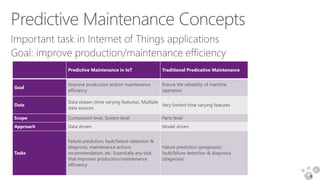
Predictive maintenance in IoT applications vs. traditional predictive maintenance concepts
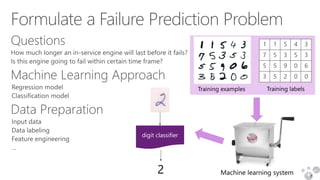
Predictive problem: “When an in-service machine will fail?”
Machine learning approach
Problem formulation
Use case
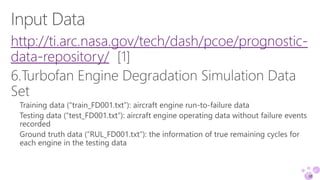
Input data – publicly available aircraft engine run-to-failure data
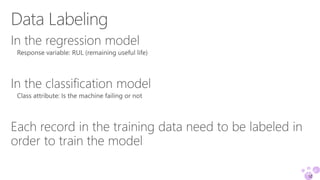
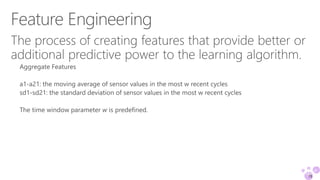
Data labeling and feature engineering
Tools to build end-to-end solution from data to web service
Azure ML
Predictive Maintenance Template in Azure ML
Demo: desktop app to predict machine’s remaining useful life
2
3
DATA
Business
apps
Custom
apps
Sensors
and
devices
ACTION
People
Automated
Systems
Data Science Process
DATA
4
DATA
Desktop app
5
6
Predictive Maintenance in IoT Traditional Predicative Maintenance
Goal
Improve production and/or maintenance
efficiency
Ensure the reliability of machine
operation
Data
Data stream (time varying features), Multiple
data sources
Very limited time varying features
Scope Component level, System level Parts level
Approach Data driven Model driven
Tasks
Failure prediction, fault/failure detection &
diagnosis, maintenance actions
recommendation, etc. Essentially any task
that improves production/maintenance
efficiency
Failure prediction (prognosis),
fault/failure detection & diagnosis
(diagnosis)
7
1 1 5 4 3
7 5 3 5 3
5 5 9 0 6
3 5 2 0 0
8
9
http://ti.arc.nasa.gov/tech/dash/pcoe/prognostic-
data-repository/
10
Sample training data
~20k rows,
100 unique engine id
Sample testing data
~13k rows,
100 unique engine id
Sample ground truth data
100 rows
11
12
Sample training data
~20k rows,
100 unique engine id
Sample testing data
~13k rows,
100 unique engine id
Sample ground truth data
100 rows
13
RUL label1 label2
?
14
id cycle … RUL label1 label2
1 1 191 0 0
1 2 190 0 0
1 3 189 0 0
1 4 188 0 0
… … … …
1 160 32 0 0
1 161 31 0 0
1 162 30 1 1
1 163 29 1 1
1 164 28 1 1
1 165 27 1 1
1 166 26 1 1
1 167 25 1 1
1 168 24 1 1
1 169 23 1 1
1 170 22 1 1
1 171 21 1 1
1 172 20 1 1
1 173 19 1 1
1 174 18 1 1
1 175 17 1 1
1 176 16 1 1
1 177 15 1 2
1 178 14 1 2
1 179 13 1 2
1 180 12 1 2
1 181 11 1 2
1 182 10 1 2
1 183 9 1 2
1 184 8 1 2
1 185 7 1 2
1 186 6 1 2
1 187 5 1 2
1 188 4 1 2
1 189 3 1 2
1 190 2 1 2
1 191 1 1 2
1 192 0 1 2
Predefined window size
for classification models
w1 = 30
w0 = 15
w1
w0
15
16
a1 a2 … a21 sd1 sd2 … sd21 RUL label1 label2
Other potential features: change from initial value, velocity of change, frequency count over a
predefined threshold
http://gallery.azureml.net (search “predictive maintenance”)
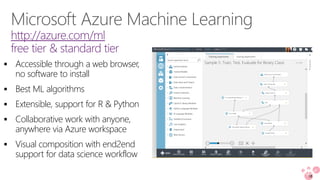
http://azure.com/ml
free tier & standard tier
18
 Accessible through a web browser,
no software to install
 Best ML algorithms
 Extensible, support for R & Python
 Collaborative work with anyone,
anywhere via Azure workspace
 Visual composition with end2end
support for data science workflow
19
Step #2B
Train and evaluate binary
classification models
Step #1 Data preparation and
feature engineering
Step #2A
Train and evaluate regression
models
Step #3A
Deploy web service with a
regression model
Step #3B
Deploy web service with a
binary classification model
Step #3C
Deploy web service with a
multi-class classification
model
Step #2C
Train and evaluate multi-class
classification models
Step 1 Step 2 Step 3
20
21
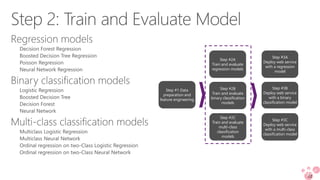
22
Step #2B
Train and evaluate
binary classification
models
Step #1 Data
preparation and
feature engineering
Step #2A
Train and evaluate
regression models
Step #3A
Deploy web service
with a regression
model
Step #3B
Deploy web service
with a binary
classification model
Step #3C
Deploy web service
with a multi-class
classification model
Step #2C
Train and evaluate
multi-class
classification
models
23
Decision Forest Regression
Boosted Decision Tree Regression
Poisson Regression
Neural Network Regression
24
Saved Transform
Web service input/output
25
Desktop app
Azure ML Model
(Deployed Web
Service)
ML predictions
consumed
through the
RRS web service
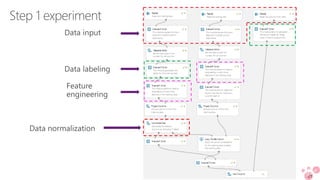
interfaceData input
27
DATA INTELLIGENCE ACTION
28
using three machine learning models: regression, binary classification,
multi-class classification
Introduced how to build end-to-end
data pipeline with Azure ML
29
 Microsoft Azure Machine Learning
http://azure.com/ml
 http://gallery.azureml.net (search “predictive
maintenance”)
 Register for the Cortana Analytics Workshop
hosted in Redmond on September 10-11, 2015.
https://analyticsworkshop.azurewebsites.net

[Tutorial] building machine learning models for predictive maintenance applications - Yan Zhang

  • 2.
    Sample Scenario Predictive maintenancein IoT applications vs. traditional predictive maintenance concepts Predictive problem: “When an in-service machine will fail?” Machine learning approach Problem formulation Use case Input data – publicly available aircraft engine run-to-failure data Data labeling and feature engineering Tools to build end-to-end solution from data to web service Azure ML Predictive Maintenance Template in Azure ML Demo: desktop app to predict machine’s remaining useful life 2
  • 3.
  • 4.
  • 5.
  • 6.
    6 Predictive Maintenance inIoT Traditional Predicative Maintenance Goal Improve production and/or maintenance efficiency Ensure the reliability of machine operation Data Data stream (time varying features), Multiple data sources Very limited time varying features Scope Component level, System level Parts level Approach Data driven Model driven Tasks Failure prediction, fault/failure detection & diagnosis, maintenance actions recommendation, etc. Essentially any task that improves production/maintenance efficiency Failure prediction (prognosis), fault/failure detection & diagnosis (diagnosis)
  • 7.
    7 1 1 54 3 7 5 3 5 3 5 5 9 0 6 3 5 2 0 0
  • 8.
  • 9.
  • 10.
  • 11.
    Sample training data ~20krows, 100 unique engine id Sample testing data ~13k rows, 100 unique engine id Sample ground truth data 100 rows 11
  • 12.
  • 13.
    Sample training data ~20krows, 100 unique engine id Sample testing data ~13k rows, 100 unique engine id Sample ground truth data 100 rows 13 RUL label1 label2 ?
  • 14.
    14 id cycle …RUL label1 label2 1 1 191 0 0 1 2 190 0 0 1 3 189 0 0 1 4 188 0 0 … … … … 1 160 32 0 0 1 161 31 0 0 1 162 30 1 1 1 163 29 1 1 1 164 28 1 1 1 165 27 1 1 1 166 26 1 1 1 167 25 1 1 1 168 24 1 1 1 169 23 1 1 1 170 22 1 1 1 171 21 1 1 1 172 20 1 1 1 173 19 1 1 1 174 18 1 1 1 175 17 1 1 1 176 16 1 1 1 177 15 1 2 1 178 14 1 2 1 179 13 1 2 1 180 12 1 2 1 181 11 1 2 1 182 10 1 2 1 183 9 1 2 1 184 8 1 2 1 185 7 1 2 1 186 6 1 2 1 187 5 1 2 1 188 4 1 2 1 189 3 1 2 1 190 2 1 2 1 191 1 1 2 1 192 0 1 2 Predefined window size for classification models w1 = 30 w0 = 15 w1 w0
  • 15.
  • 16.
    16 a1 a2 …a21 sd1 sd2 … sd21 RUL label1 label2 Other potential features: change from initial value, velocity of change, frequency count over a predefined threshold
  • 17.
  • 18.
    http://azure.com/ml free tier &standard tier 18  Accessible through a web browser, no software to install  Best ML algorithms  Extensible, support for R & Python  Collaborative work with anyone, anywhere via Azure workspace  Visual composition with end2end support for data science workflow
  • 19.
    19 Step #2B Train andevaluate binary classification models Step #1 Data preparation and feature engineering Step #2A Train and evaluate regression models Step #3A Deploy web service with a regression model Step #3B Deploy web service with a binary classification model Step #3C Deploy web service with a multi-class classification model Step #2C Train and evaluate multi-class classification models Step 1 Step 2 Step 3
  • 20.
  • 21.
  • 22.
    22 Step #2B Train andevaluate binary classification models Step #1 Data preparation and feature engineering Step #2A Train and evaluate regression models Step #3A Deploy web service with a regression model Step #3B Deploy web service with a binary classification model Step #3C Deploy web service with a multi-class classification model Step #2C Train and evaluate multi-class classification models
  • 23.
    23 Decision Forest Regression BoostedDecision Tree Regression Poisson Regression Neural Network Regression
  • 24.
  • 25.
  • 27.
    Desktop app Azure MLModel (Deployed Web Service) ML predictions consumed through the RRS web service interfaceData input 27
  • 28.
  • 29.
    using three machinelearning models: regression, binary classification, multi-class classification Introduced how to build end-to-end data pipeline with Azure ML 29
  • 30.
     Microsoft AzureMachine Learning http://azure.com/ml  http://gallery.azureml.net (search “predictive maintenance”)  Register for the Cortana Analytics Workshop hosted in Redmond on September 10-11, 2015. https://analyticsworkshop.azurewebsites.net