Pariveda Solutions 
APIs or Bust: 
Remaining Relevant for IoT 
Finfest October 2014 
Brian Edwards and Robert Greiner 
© Pariveda Solutions. Confidential 1 & Proprietary. 
“A solution approach for the rapidly expanding 
universe of connected end point devices”
What is the “Internet of Things”? 
How to Serve the “Internet of Things” – Observations and Challenges 
Where is this heading? – Opportunities for Pariveda 
Concluding Thoughts 
Appendix
Why should an organization be concerned 
about the Internet of Things? 
© Pariveda Solutions. Confidential 3 & Proprietary. 
‘2008: total # of “things” 
connected to the internet 
exceeded people on earth’ 
[2] – Cisco 2013 
‘By 2020 there will be 
50 billion things’ 
[2] – Cisco 2013 
In 2010, 14 million people 
only used mobile; by 2015 
there will be 788 million. 
[5] – Cisco 2011 
‘Square unlocked the small 
business credit card market, in 
2 years TXN volume increase 
10x and 60% of it’s clients 
never accepted credit cards’ 
[3] McKinsey 2013 
“Leaders should be thinking about 
creative ways to monetize their assets. … 
companies need to evolve their business 
model to prepare for more customers 
turning from buyers into renters.” 
[3] McKinsey 2013
What should you take away from today? 
 APIs are an essential enabler to the Internet of Things 
 We should be identifying opportunities at our clients to 
build reusable APIs 
4
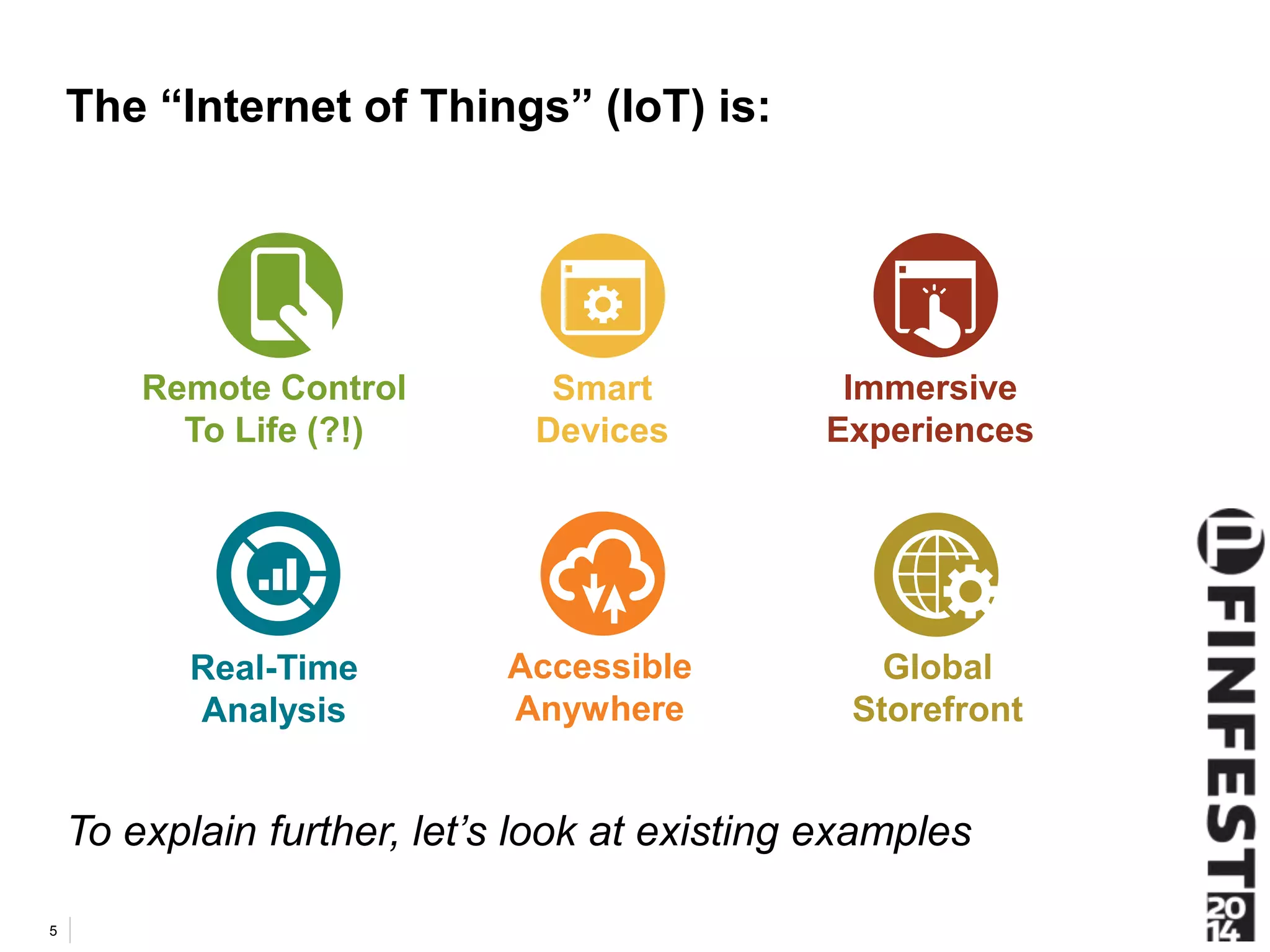
The “Internet of Things” (IoT) is: 
To explain further, let’s look at existing examples 
5 
Global 
Storefront 
Remote Control 
To Life (?!) 
Accessible 
Anywhere 
Immersive 
Experiences 
Real-Time 
Analysis 
Smart 
Devices
Nest provides customers a unique thermostat 
which ultimately reduces energy consumption 
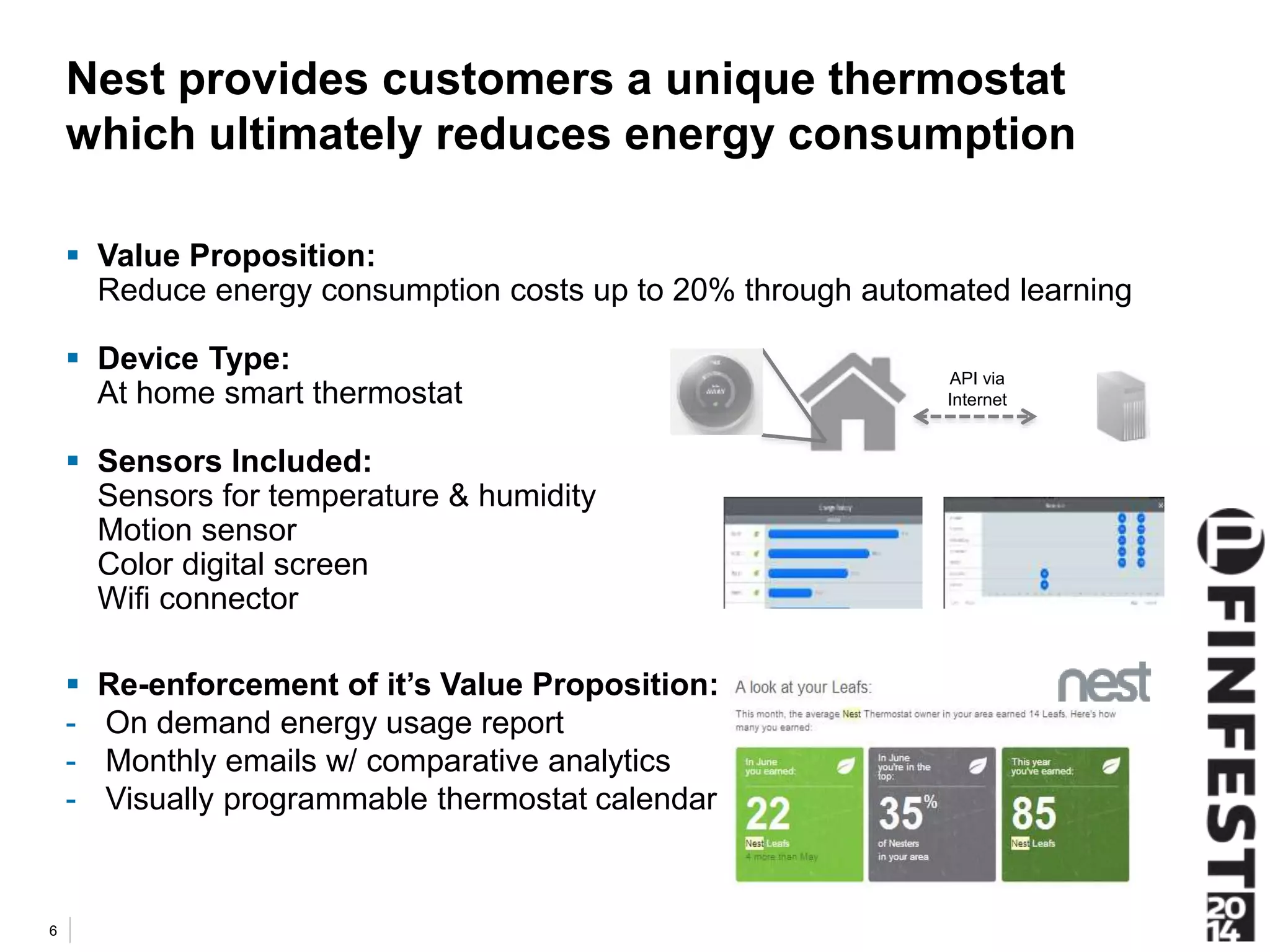
 Value Proposition: 
Reduce energy consumption costs up to 20% through automated learning 
 Device Type: 
At home smart thermostat 
 Sensors Included: 
Sensors for temperature & humidity 
Motion sensor 
Color digital screen 
Wifi connector 
 Re-enforcement of it’s Value Proposition: 
- On demand energy usage report 
- Monthly emails w/ comparative analytics 
- Visually programmable thermostat calendar 
6 
API via 
Internet
Disney’s investment into automated park touch points 
delivers a more immersive experience to visitors 
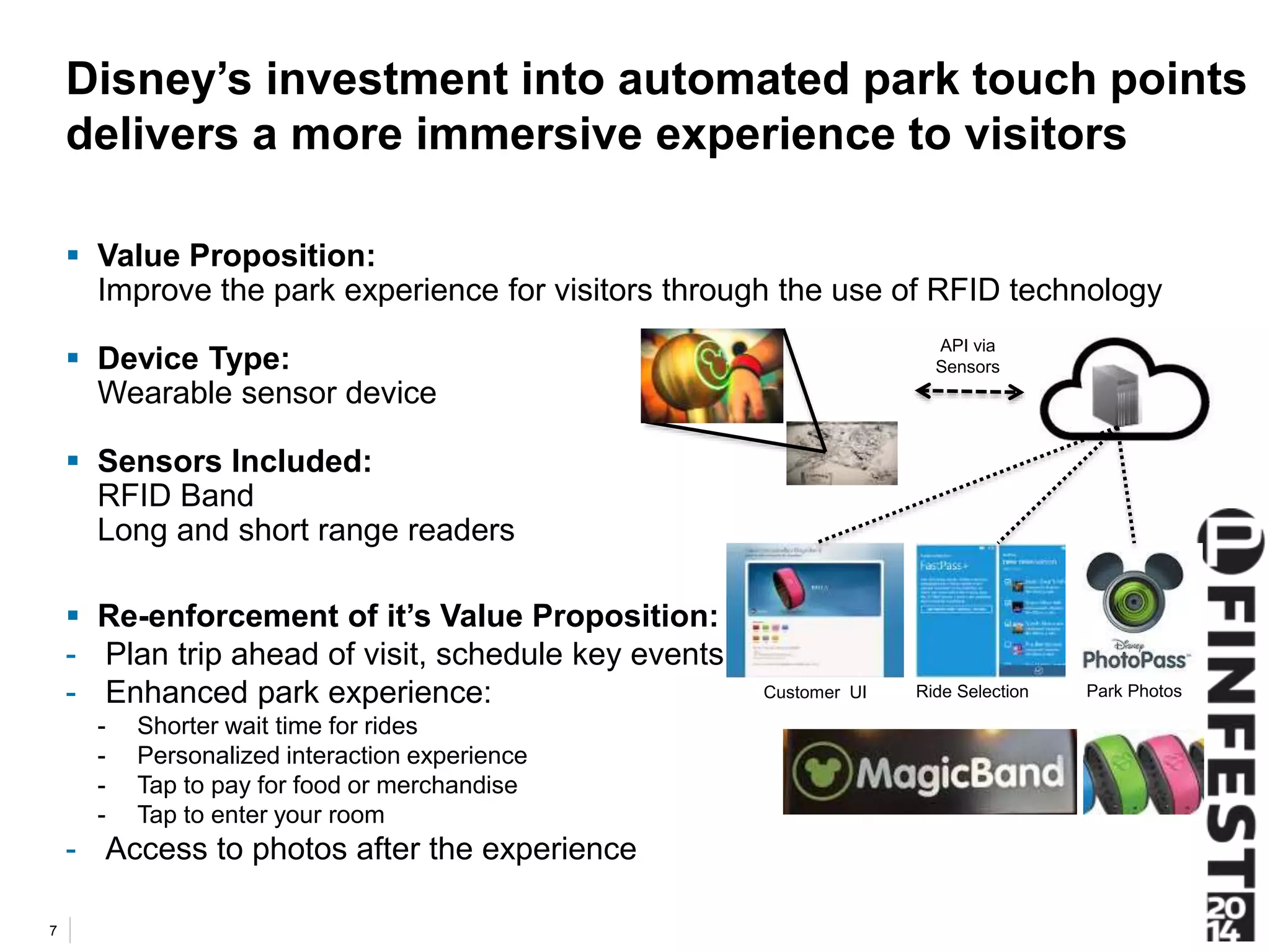
 Value Proposition: 
Improve the park experience for visitors through the use of RFID technology 
 Device Type: 
Wearable sensor device 
 Sensors Included: 
RFID Band 
Long and short range readers 
 Re-enforcement of it’s Value Proposition: 
- Plan trip ahead of visit, schedule key events 
- Enhanced park experience: 
- Shorter wait time for rides 
- Personalized interaction experience 
- Tap to pay for food or merchandise 
- Tap to enter your room 
- Access to photos after the experience 
7 
API via 
Sensors 
Customer UI Ride Selection Park Photos
Based on extending its concept of digital life, AT&T 
made a big bet by building best in class car platform 
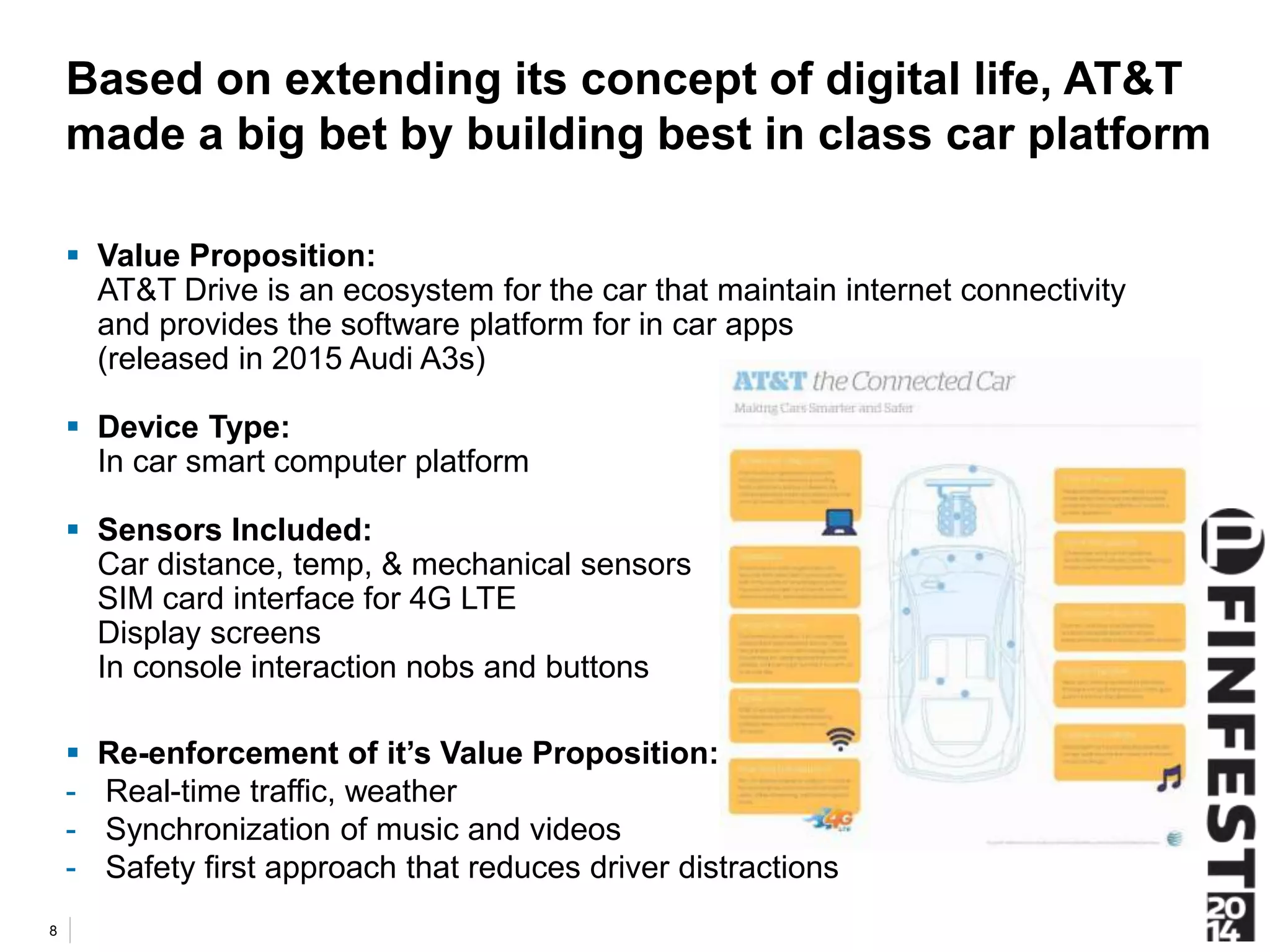
 Value Proposition: 
AT&T Drive is an ecosystem for the car that maintain internet connectivity 
and provides the software platform for in car apps 
(released in 2015 Audi A3s) 
 Device Type: 
In car smart computer platform 
 Sensors Included: 
Car distance, temp, & mechanical sensors 
SIM card interface for 4G LTE 
Display screens 
In console interaction nobs and buttons 
 Re-enforcement of it’s Value Proposition: 
- Real-time traffic, weather 
- Synchronization of music and videos 
- Safety first approach that reduces driver distractions 
8
IoT is a significant disrupter for business and 
its potential is still untapped 
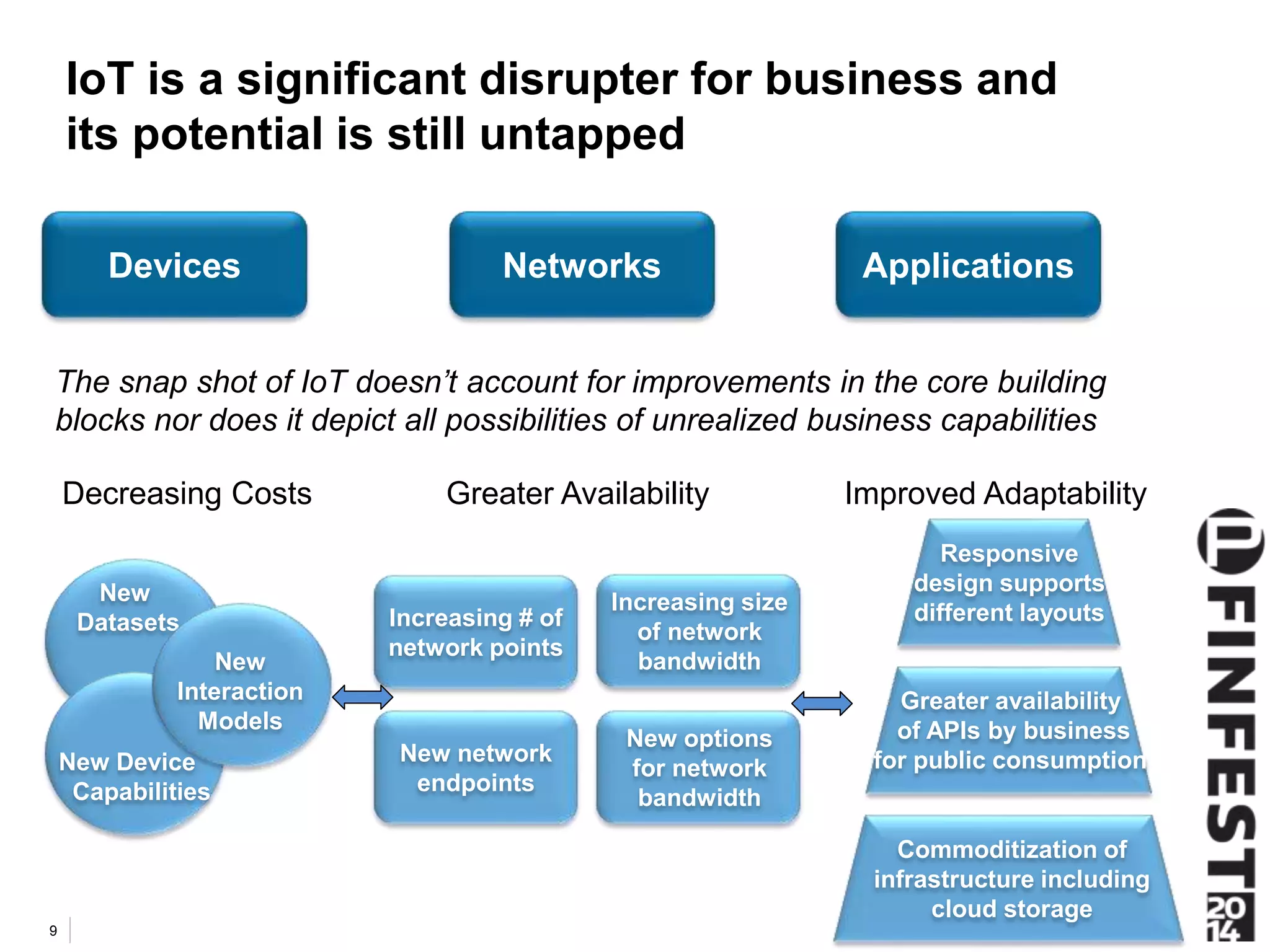
The snap shot of IoT doesn’t account for improvements in the core building 
blocks nor does it depict all possibilities of unrealized business capabilities 
9 
Devices Networks Applications 
Decreasing Costs 
New 
Datasets 
New Device 
Capabilities 
New 
Interaction 
Models 
Greater Availability Improved Adaptability 
Increasing # of 
network points 
Increasing size 
of network 
bandwidth 
New network 
endpoints 
New options 
for network 
bandwidth 
Responsive 
design supports 
different layouts 
Greater availability 
of APIs by business 
for public consumption 
Commoditization of 
infrastructure including 
cloud storage
What is the “Internet of Things”? 
How to Serve the “Internet of Things” – Observations and Challenges 
Where is this heading? – Opportunities for Pariveda 
Concluding Thoughts 
Appendix
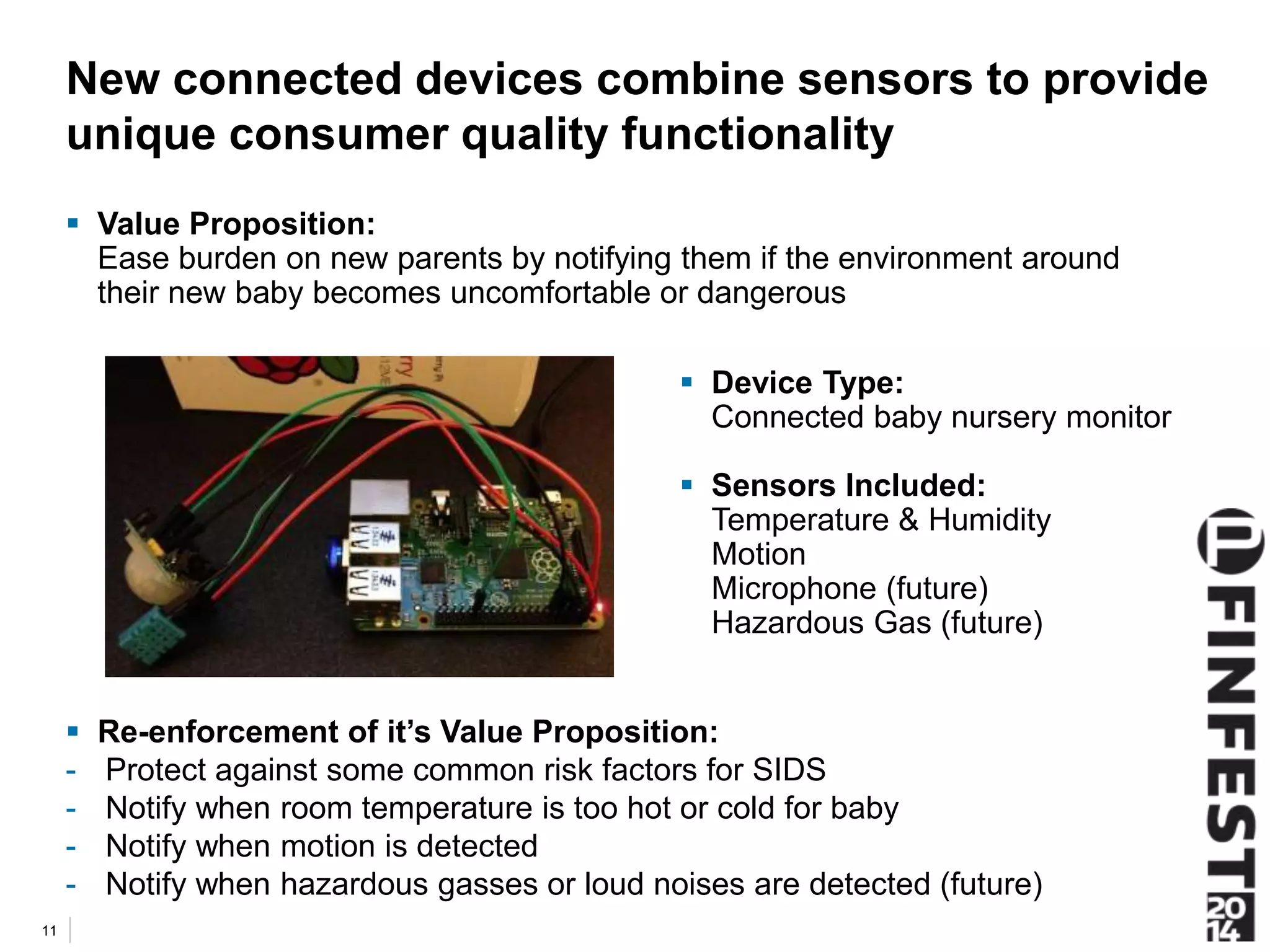
New connected devices combine sensors to provide 
unique consumer quality functionality 
 Re-enforcement of it’s Value Proposition: 
- Protect against some common risk factors for SIDS 
- Notify when room temperature is too hot or cold for baby 
- Notify when motion is detected 
- Notify when hazardous gasses or loud noises are detected (future) 
11 
 Device Type: 
Connected baby nursery monitor 
 Sensors Included: 
Temperature & Humidity 
Motion 
Microphone (future) 
Hazardous Gas (future) 
 Value Proposition: 
Ease burden on new parents by notifying them if the environment around 
their new baby becomes uncomfortable or dangerous
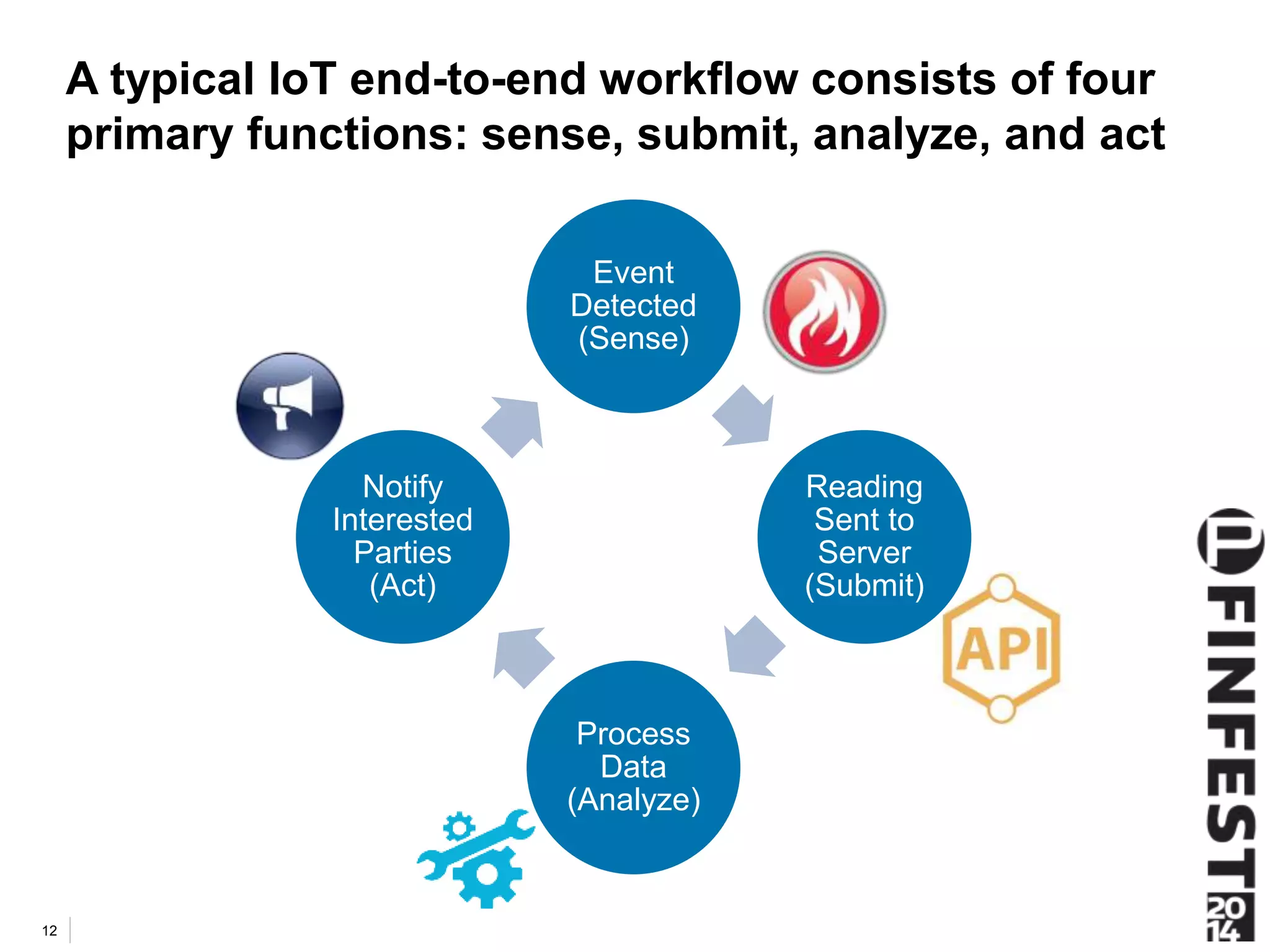
A typical IoT end-to-end workflow consists of four 
primary functions: sense, submit, analyze, and act 
12 
Event 
Detected 
(Sense) 
Reading 
Sent to 
Server 
(Submit) 
Process 
Data 
(Analyze) 
Notify 
Interested 
Parties 
(Act)
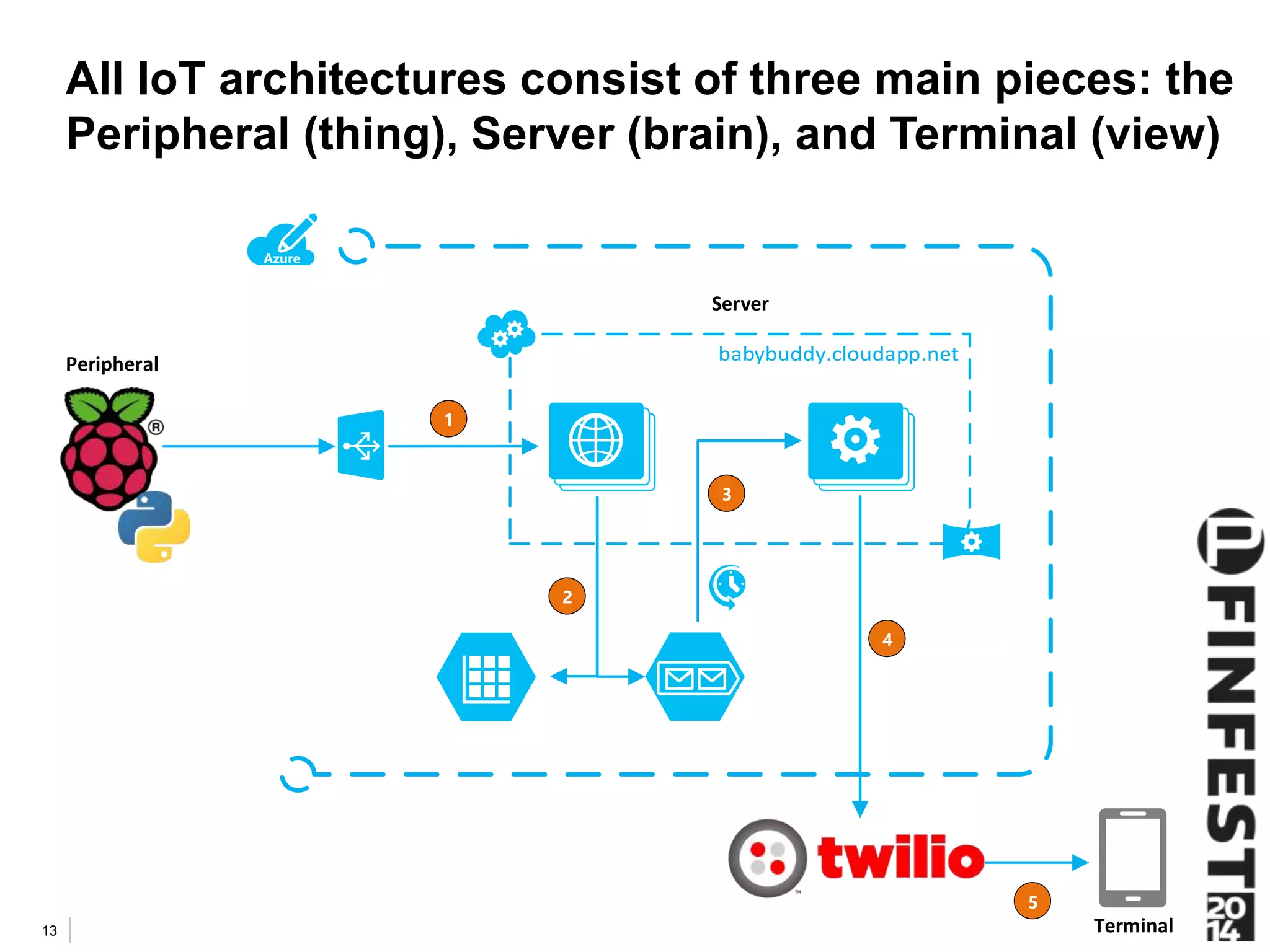
All IoT architectures consist of three main pieces: the 
Peripheral (thing), Server (brain), and Terminal (view) 
13 
1 
2 
3 
4 
5 
Peripheral 
Server 
Terminal
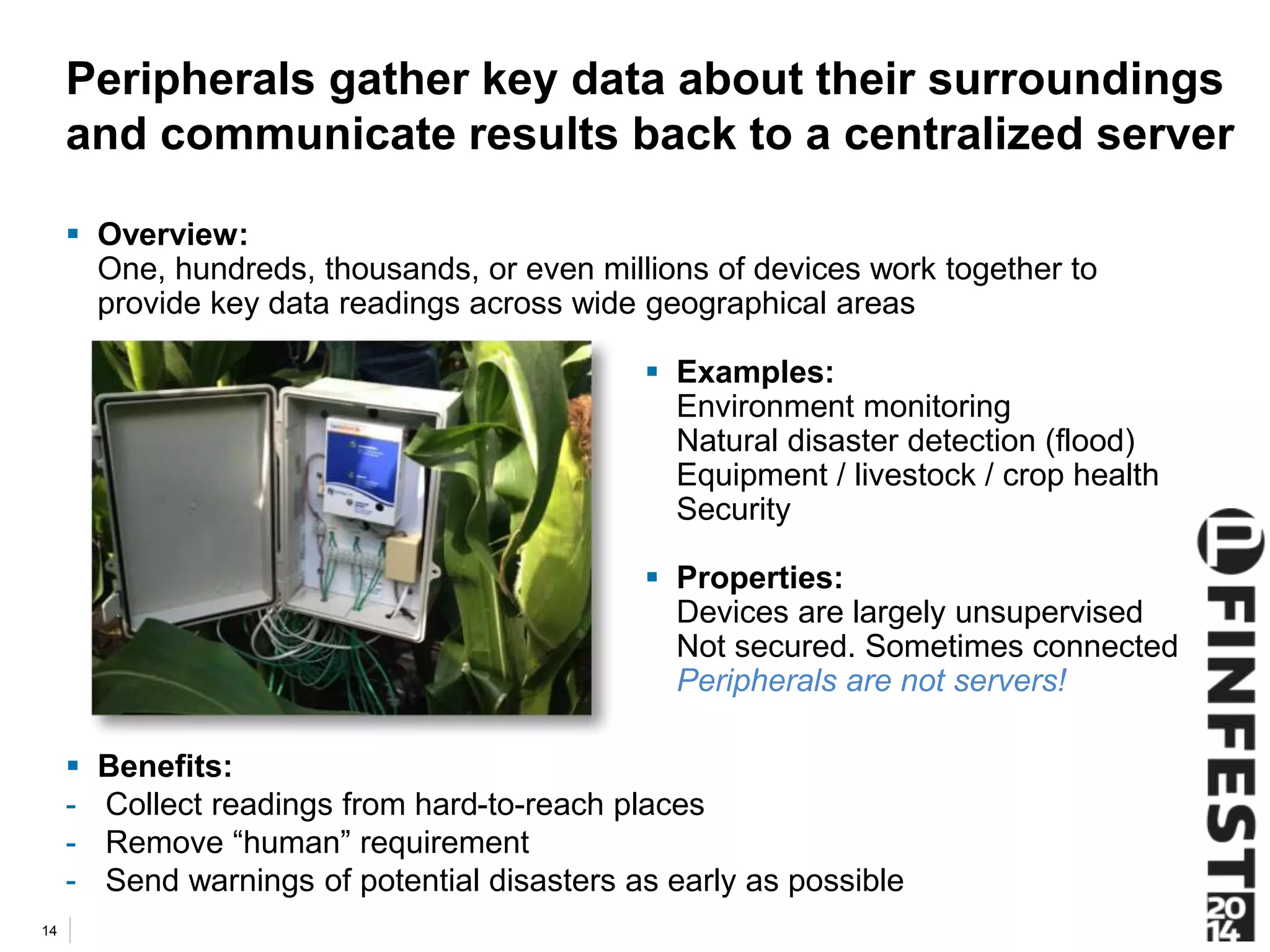
Peripherals gather key data about their surroundings 
and communicate results back to a centralized server 
 Overview: 
One, hundreds, thousands, or even millions of devices work together to 
provide key data readings across wide geographical areas 
 Benefits: 
- Collect readings from hard-to-reach places 
- Remove “human” requirement 
- Send warnings of potential disasters as early as possible 
14 
 Examples: 
Environment monitoring 
Natural disaster detection (flood) 
Equipment / livestock / crop health 
Security 
 Properties: 
Devices are largely unsupervised 
Not secured. Sometimes connected 
Peripherals are not servers!
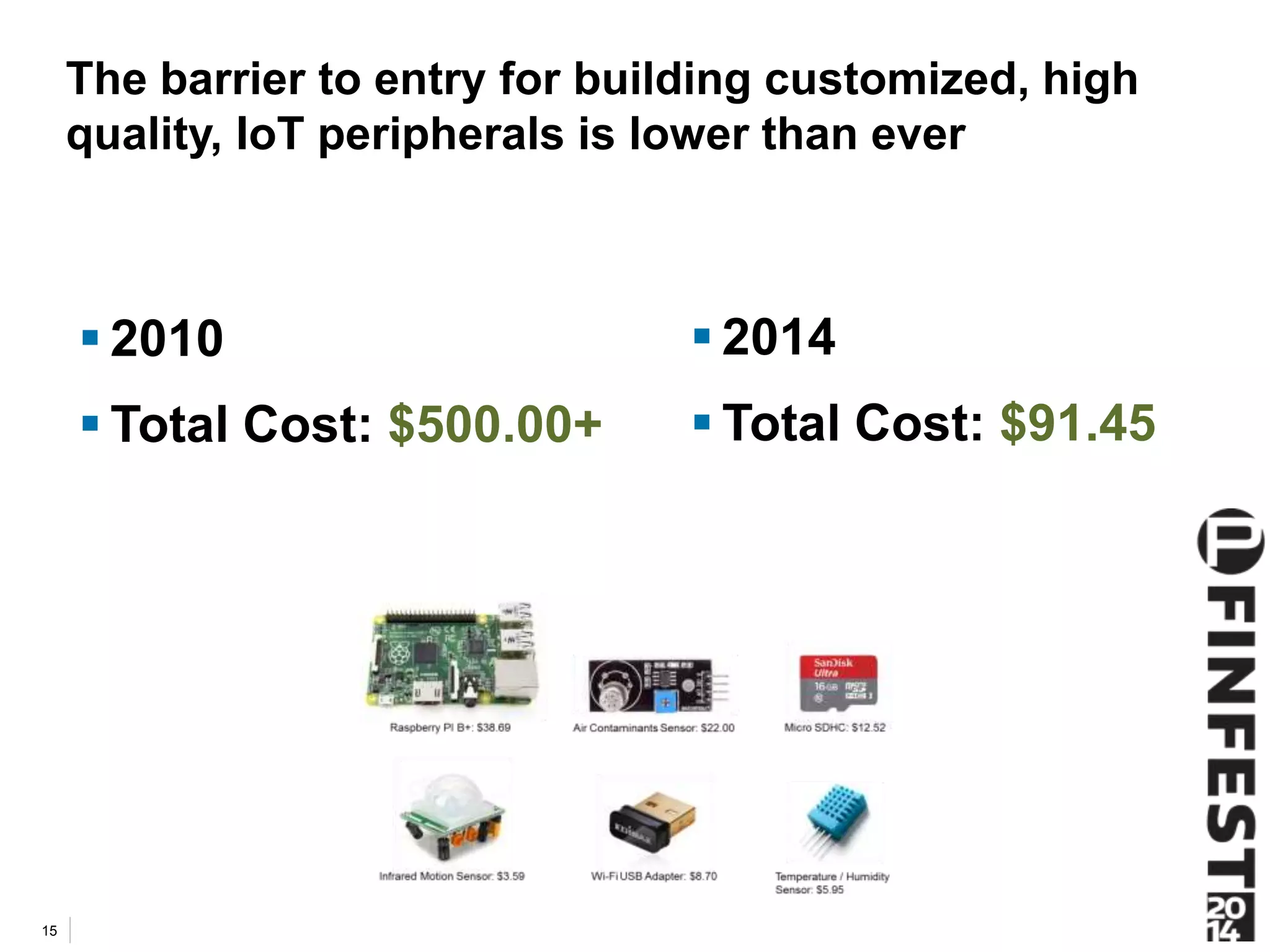
The barrier to entry for building customized, high 
quality, IoT peripherals is lower than ever 
 2014 
 Total Cost: $91.45 
15 
 2010 
 Total Cost: $500.00+
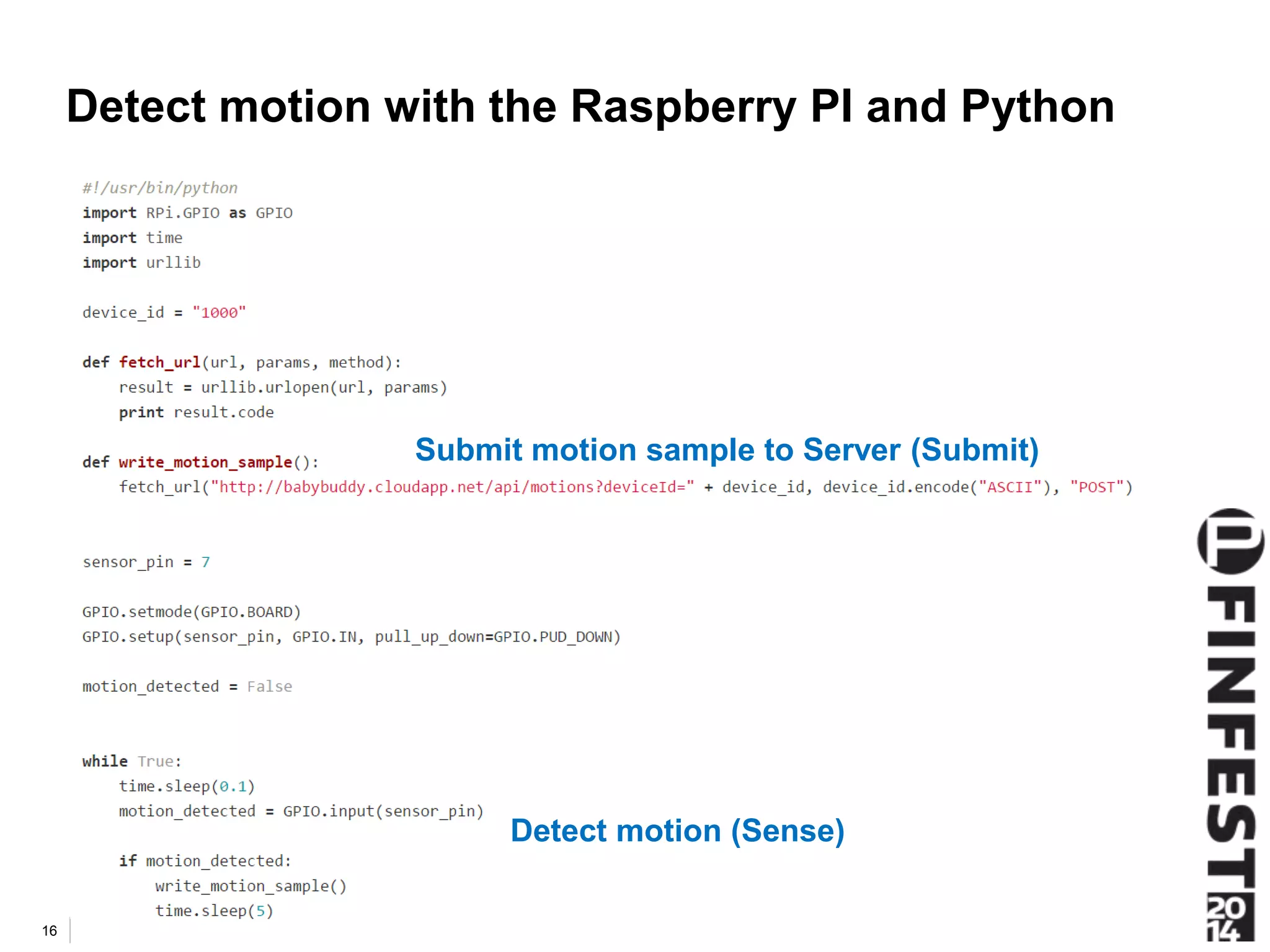
Detect motion with the Raspberry PI and Python 
16 
Submit motion sample to Server (Submit) 
Detect motion (Sense)
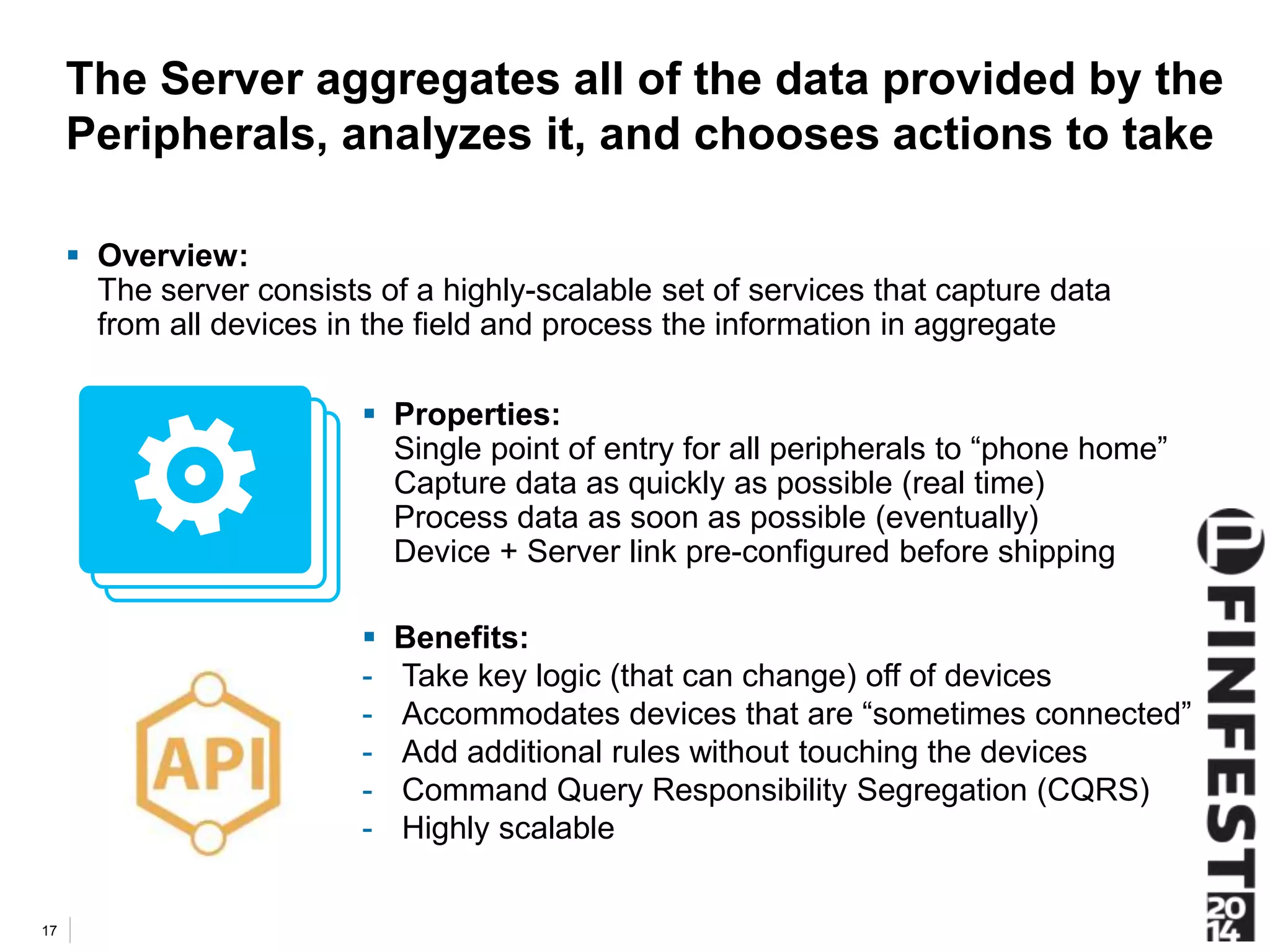
The Server aggregates all of the data provided by the 
Peripherals, analyzes it, and chooses actions to take 
 Overview: 
The server consists of a highly-scalable set of services that capture data 
from all devices in the field and process the information in aggregate 
17 
 Properties: 
Single point of entry for all peripherals to “phone home” 
Capture data as quickly as possible (real time) 
Process data as soon as possible (eventually) 
Device + Server link pre-configured before shipping 
 Benefits: 
- Take key logic (that can change) off of devices 
- Accommodates devices that are “sometimes connected” 
- Add additional rules without touching the devices 
- Command Query Responsibility Segregation (CQRS) 
- Highly scalable
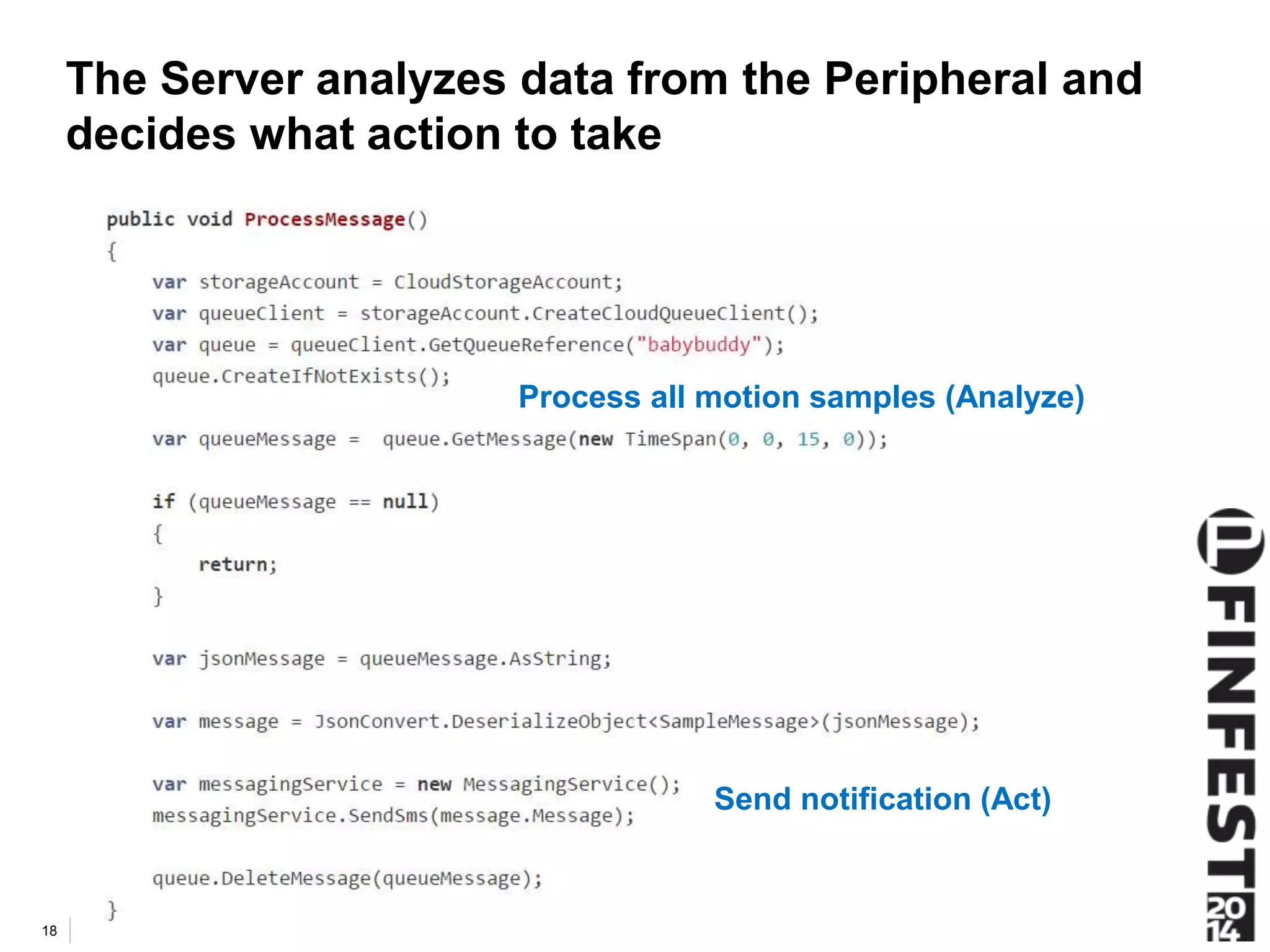
The Server analyzes data from the Peripheral and 
decides what action to take 
18 
Process all motion samples (Analyze) 
Send notification (Act)
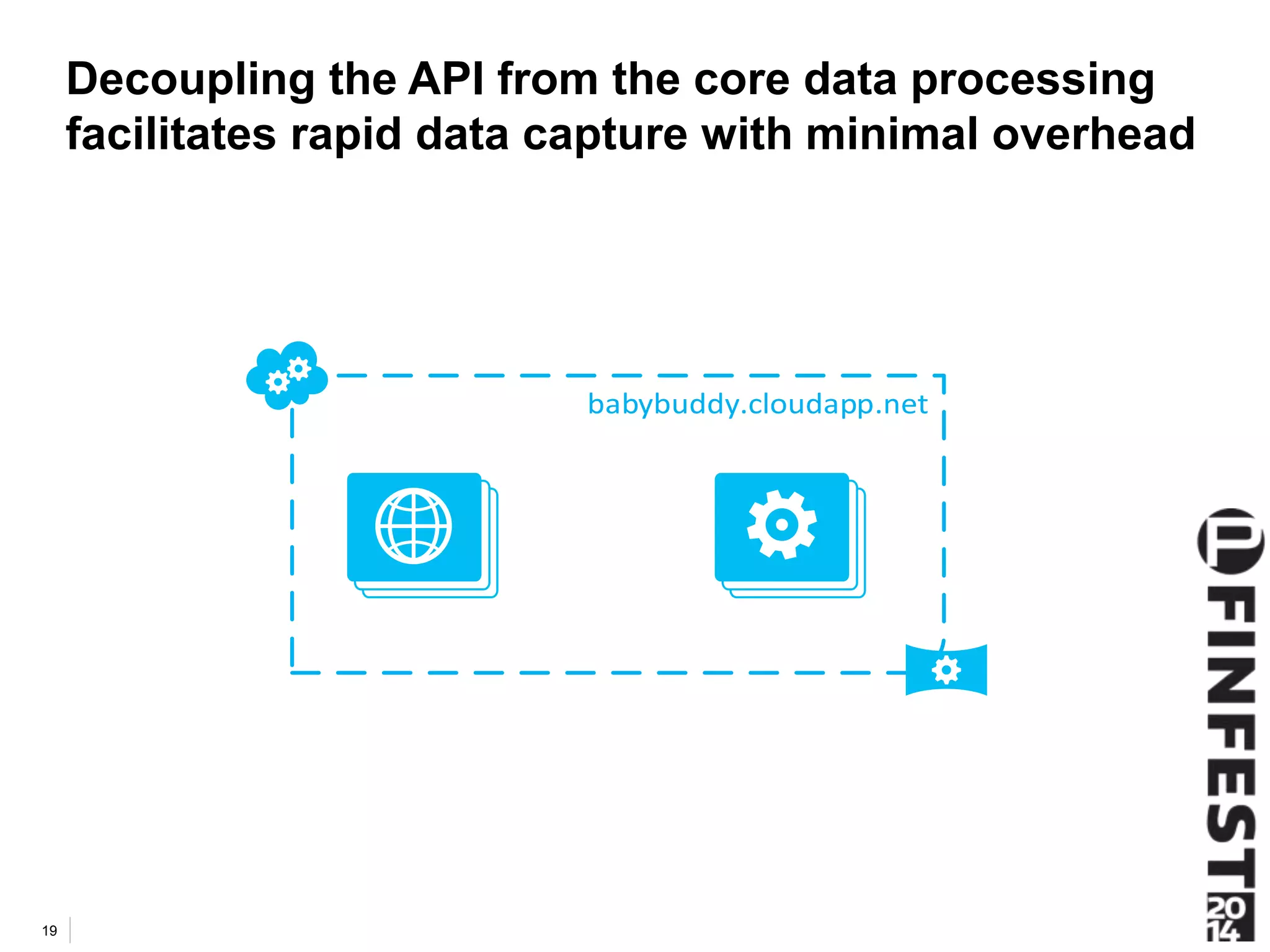
Decoupling the API from the core data processing 
facilitates rapid data capture with minimal overhead 
19
Cloud platforms enable IoT applications to reach the 
level of scale needed to be useful to society 
 Overview: 
A massive amount of peripherals are being deployed to the “wild” every 
day. Enterprises need additional compute and storage resources to keep 
up with demand. 
 Examples: 
Auto manufacturers want to put connected devices in millions of cars 
A car you rented unlocks as you approach it (Zipcar) 
Crop / irrigation sensors on farms 
Flood sensors across the globe 
 Properties: 
Compute and storage resources can grow with customer demand 
Scale resources up/down depending on need 
 Benefits: 
- Cloud providers help create a virtuous cycle between adding additional 
compute/storage capability and enterprises adding connected devices 
20
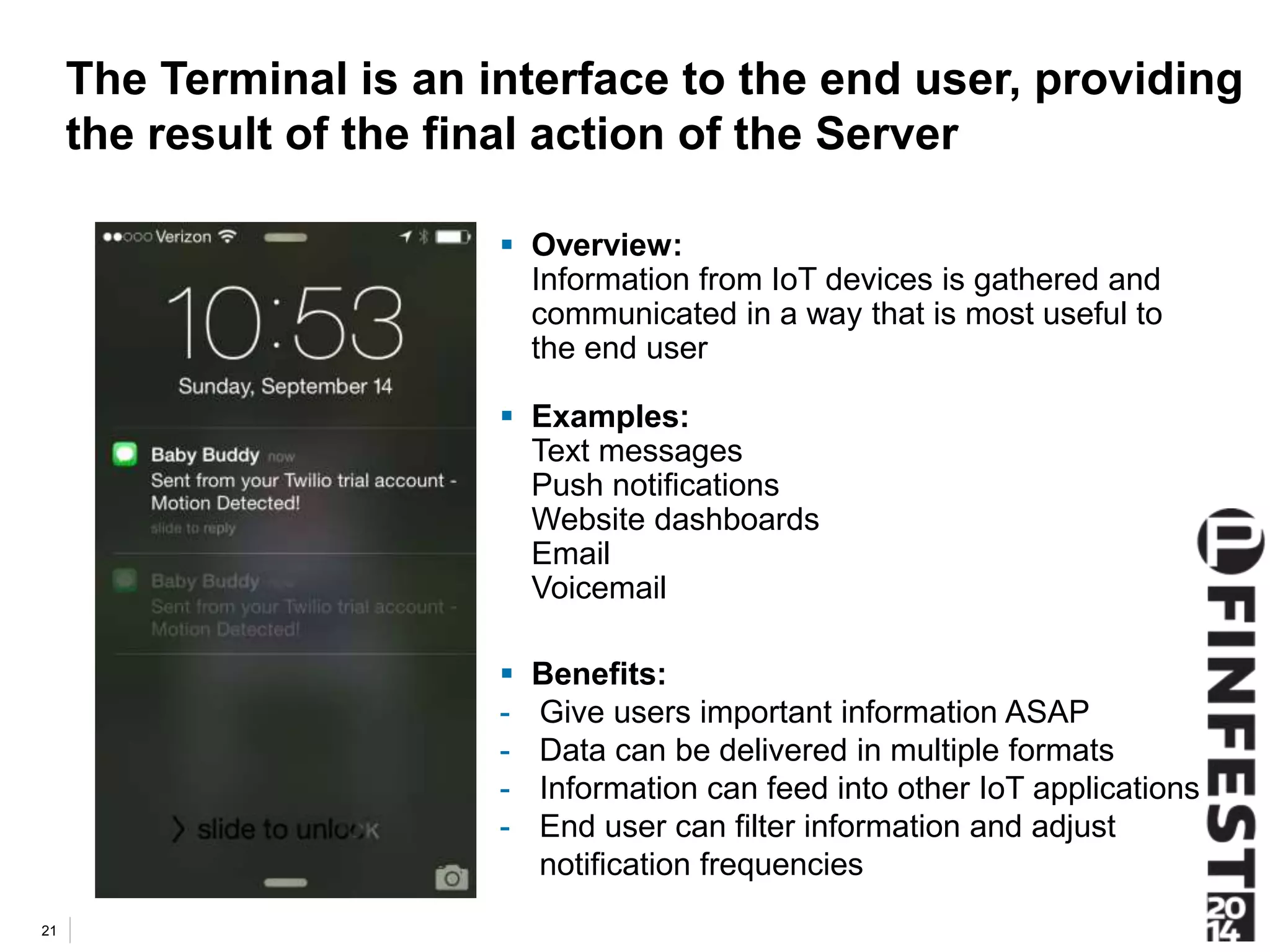
The Terminal is an interface to the end user, providing 
the result of the final action of the Server 
 Overview: 
Information from IoT devices is gathered and 
communicated in a way that is most useful to 
the end user 
 Examples: 
Text messages 
Push notifications 
Website dashboards 
Email 
Voicemail 
 Benefits: 
- Give users important information ASAP 
- Data can be delivered in multiple formats 
- Information can feed into other IoT applications 
- End user can filter information and adjust 
notification frequencies 
21
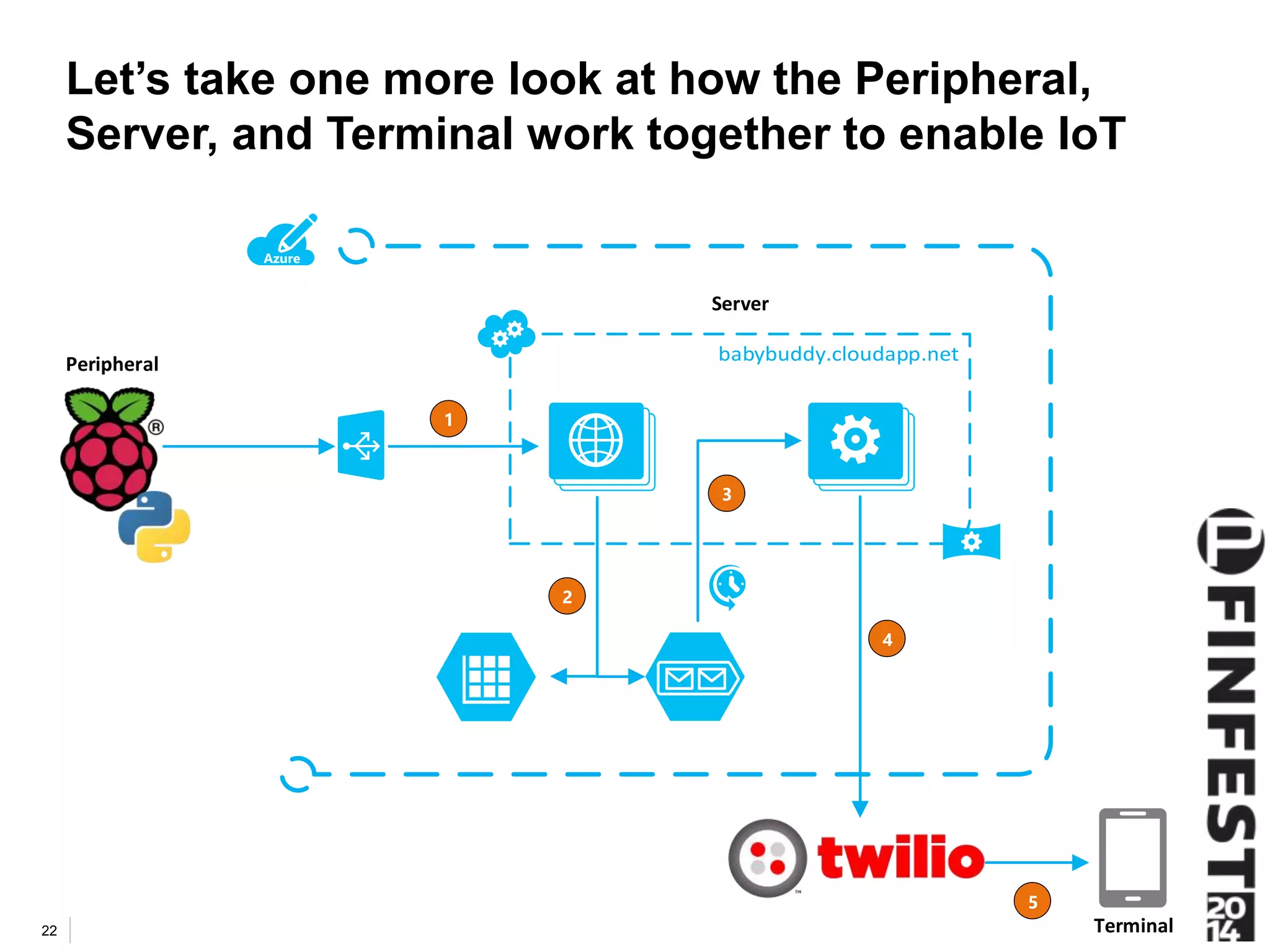
Let’s take one more look at how the Peripheral, 
Server, and Terminal work together to enable IoT 
22 
1 
2 
3 
4 
5 
Peripheral 
Server 
Terminal
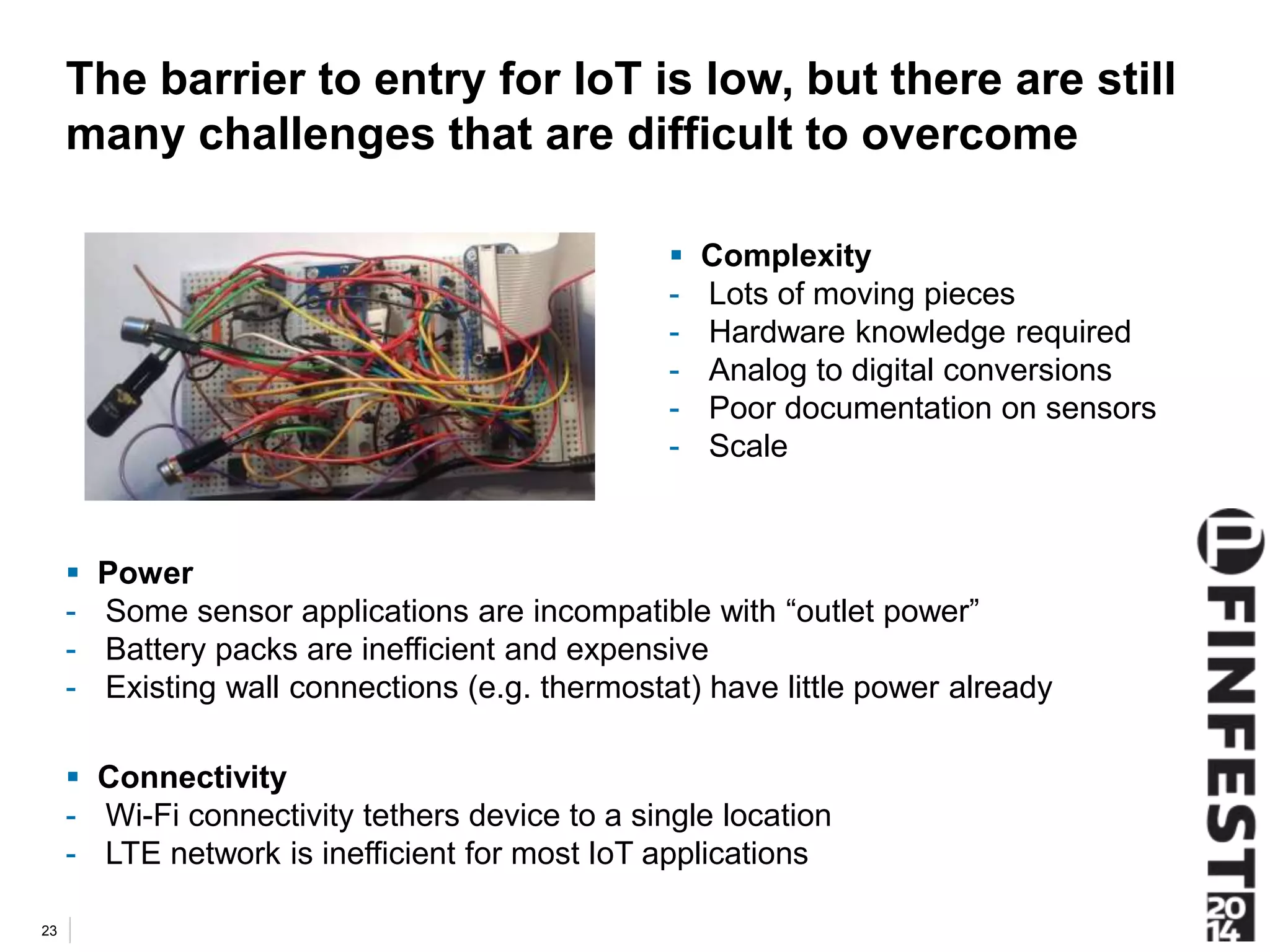
The barrier to entry for IoT is low, but there are still 
many challenges that are difficult to overcome 
 Power 
- Some sensor applications are incompatible with “outlet power” 
- Battery packs are inefficient and expensive 
- Existing wall connections (e.g. thermostat) have little power already 
 Connectivity 
- Wi-Fi connectivity tethers device to a single location 
- LTE network is inefficient for most IoT applications 
23 
 Complexity 
- Lots of moving pieces 
- Hardware knowledge required 
- Analog to digital conversions 
- Poor documentation on sensors 
- Scale
What is the “Internet of Things”? 
How to Serve the “Internet of Things” – Observations and Challenges 
Where is this heading? – Opportunities for Pariveda 
Concluding Thoughts 
Appendix
What is the “Internet of Things? 
How to Serve the “Internet of Things” – Observations and Challenges 
Where is this heading? – Opportunities for Pariveda 
Concluding Thoughts 
Appendix
Questions 
© Pariveda Solutions. Confidential 26 & Proprietary.
APPENDIX 
27
About the speakers 
Brian Edwards 
 Atlanta, GA 
 Principal 
 Contact at: 
brian.edwards@parivedasolutions.com 
Robert Griener 
 Dallas, TX 
 Manager 
 Contact at: 
robert.griener@parivedasolutions.com 
http://robertgreiner.com 
@robert_greiner 
28
Additional Market Drivers 
Additional resources on the Internet of Things 
Product Examples: 
 JIBO: Promotional Video (Home) 
 Viv: Wired Article (Mobile) 
 AT&T: Connect Car (Car) 
 FitBit: Home Site (Personal) 
Industry News: 
 Mark Lowenstein (Mobile Analyst): 
And the next big thing is…? 
Further Reading on the Topic: 
 McKinsey: 
Reinventing IT to support 
digitization 
 Texas CEO Magazine: 
- The Internet of Things 
- M2M The Internet of Things 
© Pariveda Solutions. Confidential 29 & Proprietary.
Additional Market Drivers 
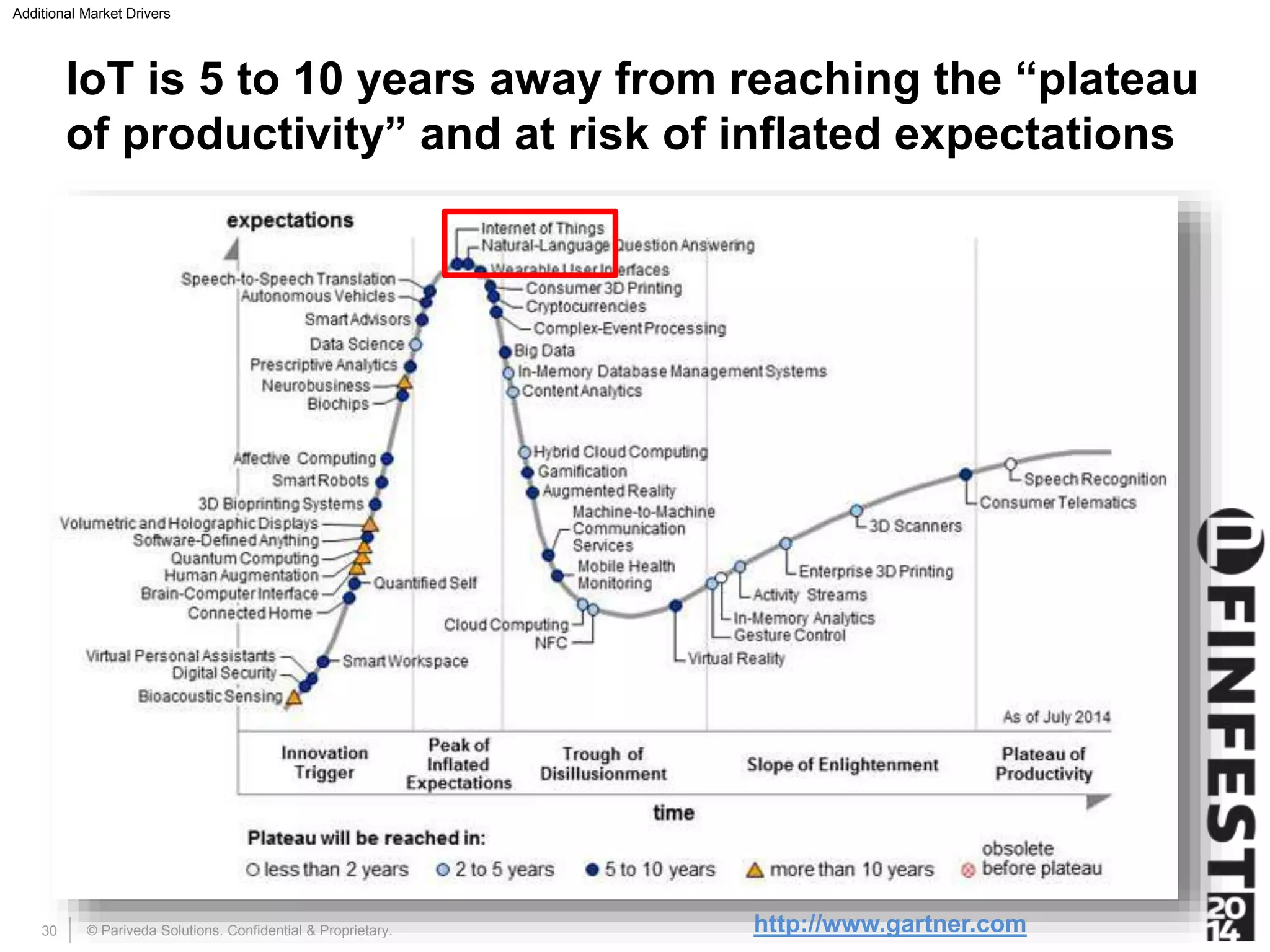
IoT is 5 to 10 years away from reaching the “plateau 
of productivity” and at risk of inflated expectations 
© Pariveda Solutions. Confidential 30 & Proprietary. http://www.gartner.com
Additional Market Drivers 
Financial accounting practices recognize capitalization 
for digital assets & intangible innovation 
 “On July 31, 2013, the US bureau of Economic Analysis released, for the first time, GDP figures 
categorizing research and development as fixed investment. It will join software in a new category 
called intellectual-property products.” – (McKinsey & Company [1]) 
 “Assume digital leaders in your competitive zone are relentlessly expanding their intangible assets 
both to attack existing markets and to create new ones”; here are a few examples: 
– “Amzaon.com, for instance, won share from brick-and-mortar with it’s ease-of-purchase model and it’s ability to 
long-tail customers” 
– [Amazon.com] “It’s also using tangible assets to offer cloud-based labor services… that match freelance workers 
demand for their labor” – (McKinsey & Company [1]) 
31
References in the presentation are listed below: 
 [1] Measuring the full impact of digital capital by Jacques Bughin and James Manyika, July 
32 
2013 – McKinsey & Company 
 [2] http://share.cisco.com/internet-of-things.html - Cisco Visualizations 
 [3] Ten IT-enabled business trends for the decade ahead, May 2013 – McKinsey Global 
Institute 
 [4] The coming era of ‘on-demand’ marketing by Peter Dahlstrom and Edelman, April 2013 – 
McKinsey Quarterly 
 [5] Cisco Visual Networking Index: Global Mobile Data Traffic Forecast Update, 2010 – 2015, 
February 2011 – Cisco 
 [6] http://www.brafton.com/news/study-90-percent-of-websites-not-ready-for-mobile-use - Feb 
22, 2012 - Brafton Editorial

Fin fest 2014 - Internet of Things and APIs

  • 1.
    Pariveda Solutions APIsor Bust: Remaining Relevant for IoT Finfest October 2014 Brian Edwards and Robert Greiner © Pariveda Solutions. Confidential 1 & Proprietary. “A solution approach for the rapidly expanding universe of connected end point devices”
  • 2.
    What is the“Internet of Things”? How to Serve the “Internet of Things” – Observations and Challenges Where is this heading? – Opportunities for Pariveda Concluding Thoughts Appendix
  • 3.
    Why should anorganization be concerned about the Internet of Things? © Pariveda Solutions. Confidential 3 & Proprietary. ‘2008: total # of “things” connected to the internet exceeded people on earth’ [2] – Cisco 2013 ‘By 2020 there will be 50 billion things’ [2] – Cisco 2013 In 2010, 14 million people only used mobile; by 2015 there will be 788 million. [5] – Cisco 2011 ‘Square unlocked the small business credit card market, in 2 years TXN volume increase 10x and 60% of it’s clients never accepted credit cards’ [3] McKinsey 2013 “Leaders should be thinking about creative ways to monetize their assets. … companies need to evolve their business model to prepare for more customers turning from buyers into renters.” [3] McKinsey 2013
  • 4.
    What should youtake away from today?  APIs are an essential enabler to the Internet of Things  We should be identifying opportunities at our clients to build reusable APIs 4
  • 5.
    The “Internet ofThings” (IoT) is: To explain further, let’s look at existing examples 5 Global Storefront Remote Control To Life (?!) Accessible Anywhere Immersive Experiences Real-Time Analysis Smart Devices
  • 6.
    Nest provides customersa unique thermostat which ultimately reduces energy consumption  Value Proposition: Reduce energy consumption costs up to 20% through automated learning  Device Type: At home smart thermostat  Sensors Included: Sensors for temperature & humidity Motion sensor Color digital screen Wifi connector  Re-enforcement of it’s Value Proposition: - On demand energy usage report - Monthly emails w/ comparative analytics - Visually programmable thermostat calendar 6 API via Internet
  • 7.
    Disney’s investment intoautomated park touch points delivers a more immersive experience to visitors  Value Proposition: Improve the park experience for visitors through the use of RFID technology  Device Type: Wearable sensor device  Sensors Included: RFID Band Long and short range readers  Re-enforcement of it’s Value Proposition: - Plan trip ahead of visit, schedule key events - Enhanced park experience: - Shorter wait time for rides - Personalized interaction experience - Tap to pay for food or merchandise - Tap to enter your room - Access to photos after the experience 7 API via Sensors Customer UI Ride Selection Park Photos
  • 8.
    Based on extendingits concept of digital life, AT&T made a big bet by building best in class car platform  Value Proposition: AT&T Drive is an ecosystem for the car that maintain internet connectivity and provides the software platform for in car apps (released in 2015 Audi A3s)  Device Type: In car smart computer platform  Sensors Included: Car distance, temp, & mechanical sensors SIM card interface for 4G LTE Display screens In console interaction nobs and buttons  Re-enforcement of it’s Value Proposition: - Real-time traffic, weather - Synchronization of music and videos - Safety first approach that reduces driver distractions 8
  • 9.
    IoT is asignificant disrupter for business and its potential is still untapped The snap shot of IoT doesn’t account for improvements in the core building blocks nor does it depict all possibilities of unrealized business capabilities 9 Devices Networks Applications Decreasing Costs New Datasets New Device Capabilities New Interaction Models Greater Availability Improved Adaptability Increasing # of network points Increasing size of network bandwidth New network endpoints New options for network bandwidth Responsive design supports different layouts Greater availability of APIs by business for public consumption Commoditization of infrastructure including cloud storage
  • 10.
    What is the“Internet of Things”? How to Serve the “Internet of Things” – Observations and Challenges Where is this heading? – Opportunities for Pariveda Concluding Thoughts Appendix
  • 11.
    New connected devicescombine sensors to provide unique consumer quality functionality  Re-enforcement of it’s Value Proposition: - Protect against some common risk factors for SIDS - Notify when room temperature is too hot or cold for baby - Notify when motion is detected - Notify when hazardous gasses or loud noises are detected (future) 11  Device Type: Connected baby nursery monitor  Sensors Included: Temperature & Humidity Motion Microphone (future) Hazardous Gas (future)  Value Proposition: Ease burden on new parents by notifying them if the environment around their new baby becomes uncomfortable or dangerous
  • 12.
    A typical IoTend-to-end workflow consists of four primary functions: sense, submit, analyze, and act 12 Event Detected (Sense) Reading Sent to Server (Submit) Process Data (Analyze) Notify Interested Parties (Act)
  • 13.
    All IoT architecturesconsist of three main pieces: the Peripheral (thing), Server (brain), and Terminal (view) 13 1 2 3 4 5 Peripheral Server Terminal
  • 14.
    Peripherals gather keydata about their surroundings and communicate results back to a centralized server  Overview: One, hundreds, thousands, or even millions of devices work together to provide key data readings across wide geographical areas  Benefits: - Collect readings from hard-to-reach places - Remove “human” requirement - Send warnings of potential disasters as early as possible 14  Examples: Environment monitoring Natural disaster detection (flood) Equipment / livestock / crop health Security  Properties: Devices are largely unsupervised Not secured. Sometimes connected Peripherals are not servers!
  • 15.
    The barrier toentry for building customized, high quality, IoT peripherals is lower than ever  2014  Total Cost: $91.45 15  2010  Total Cost: $500.00+
  • 16.
    Detect motion withthe Raspberry PI and Python 16 Submit motion sample to Server (Submit) Detect motion (Sense)
  • 17.
    The Server aggregatesall of the data provided by the Peripherals, analyzes it, and chooses actions to take  Overview: The server consists of a highly-scalable set of services that capture data from all devices in the field and process the information in aggregate 17  Properties: Single point of entry for all peripherals to “phone home” Capture data as quickly as possible (real time) Process data as soon as possible (eventually) Device + Server link pre-configured before shipping  Benefits: - Take key logic (that can change) off of devices - Accommodates devices that are “sometimes connected” - Add additional rules without touching the devices - Command Query Responsibility Segregation (CQRS) - Highly scalable
  • 18.
    The Server analyzesdata from the Peripheral and decides what action to take 18 Process all motion samples (Analyze) Send notification (Act)
  • 19.
    Decoupling the APIfrom the core data processing facilitates rapid data capture with minimal overhead 19
  • 20.
    Cloud platforms enableIoT applications to reach the level of scale needed to be useful to society  Overview: A massive amount of peripherals are being deployed to the “wild” every day. Enterprises need additional compute and storage resources to keep up with demand.  Examples: Auto manufacturers want to put connected devices in millions of cars A car you rented unlocks as you approach it (Zipcar) Crop / irrigation sensors on farms Flood sensors across the globe  Properties: Compute and storage resources can grow with customer demand Scale resources up/down depending on need  Benefits: - Cloud providers help create a virtuous cycle between adding additional compute/storage capability and enterprises adding connected devices 20
  • 21.
    The Terminal isan interface to the end user, providing the result of the final action of the Server  Overview: Information from IoT devices is gathered and communicated in a way that is most useful to the end user  Examples: Text messages Push notifications Website dashboards Email Voicemail  Benefits: - Give users important information ASAP - Data can be delivered in multiple formats - Information can feed into other IoT applications - End user can filter information and adjust notification frequencies 21
  • 22.
    Let’s take onemore look at how the Peripheral, Server, and Terminal work together to enable IoT 22 1 2 3 4 5 Peripheral Server Terminal
  • 23.
    The barrier toentry for IoT is low, but there are still many challenges that are difficult to overcome  Power - Some sensor applications are incompatible with “outlet power” - Battery packs are inefficient and expensive - Existing wall connections (e.g. thermostat) have little power already  Connectivity - Wi-Fi connectivity tethers device to a single location - LTE network is inefficient for most IoT applications 23  Complexity - Lots of moving pieces - Hardware knowledge required - Analog to digital conversions - Poor documentation on sensors - Scale
  • 24.
    What is the“Internet of Things”? How to Serve the “Internet of Things” – Observations and Challenges Where is this heading? – Opportunities for Pariveda Concluding Thoughts Appendix
  • 25.
    What is the“Internet of Things? How to Serve the “Internet of Things” – Observations and Challenges Where is this heading? – Opportunities for Pariveda Concluding Thoughts Appendix
  • 26.
    Questions © ParivedaSolutions. Confidential 26 & Proprietary.
  • 27.
  • 28.
    About the speakers Brian Edwards  Atlanta, GA  Principal  Contact at: brian.edwards@parivedasolutions.com Robert Griener  Dallas, TX  Manager  Contact at: robert.griener@parivedasolutions.com http://robertgreiner.com @robert_greiner 28
  • 29.
    Additional Market Drivers Additional resources on the Internet of Things Product Examples:  JIBO: Promotional Video (Home)  Viv: Wired Article (Mobile)  AT&T: Connect Car (Car)  FitBit: Home Site (Personal) Industry News:  Mark Lowenstein (Mobile Analyst): And the next big thing is…? Further Reading on the Topic:  McKinsey: Reinventing IT to support digitization  Texas CEO Magazine: - The Internet of Things - M2M The Internet of Things © Pariveda Solutions. Confidential 29 & Proprietary.
  • 30.
    Additional Market Drivers IoT is 5 to 10 years away from reaching the “plateau of productivity” and at risk of inflated expectations © Pariveda Solutions. Confidential 30 & Proprietary. http://www.gartner.com
  • 31.
    Additional Market Drivers Financial accounting practices recognize capitalization for digital assets & intangible innovation  “On July 31, 2013, the US bureau of Economic Analysis released, for the first time, GDP figures categorizing research and development as fixed investment. It will join software in a new category called intellectual-property products.” – (McKinsey & Company [1])  “Assume digital leaders in your competitive zone are relentlessly expanding their intangible assets both to attack existing markets and to create new ones”; here are a few examples: – “Amzaon.com, for instance, won share from brick-and-mortar with it’s ease-of-purchase model and it’s ability to long-tail customers” – [Amazon.com] “It’s also using tangible assets to offer cloud-based labor services… that match freelance workers demand for their labor” – (McKinsey & Company [1]) 31
  • 32.
    References in thepresentation are listed below:  [1] Measuring the full impact of digital capital by Jacques Bughin and James Manyika, July 32 2013 – McKinsey & Company  [2] http://share.cisco.com/internet-of-things.html - Cisco Visualizations  [3] Ten IT-enabled business trends for the decade ahead, May 2013 – McKinsey Global Institute  [4] The coming era of ‘on-demand’ marketing by Peter Dahlstrom and Edelman, April 2013 – McKinsey Quarterly  [5] Cisco Visual Networking Index: Global Mobile Data Traffic Forecast Update, 2010 – 2015, February 2011 – Cisco  [6] http://www.brafton.com/news/study-90-percent-of-websites-not-ready-for-mobile-use - Feb 22, 2012 - Brafton Editorial

Editor's Notes

  • #6 The Internet of Things (IoT) is the interconnection of uniquely identifiable embedded computing devices within the existing Internet infrastructure. Typically, IoT is expected to offer advanced connectivity of devices, systems, and services that goes beyond machine-to-machine communications (M2M) and covers a variety of protocols, domains, and applications.[1] The interconnection of these embedded devices (including smart objects), is expected to usher in automation in nearly all fields, while also enabling advanced applications like a Smart Grid.[2] ( http://en.wikipedia.org/wiki/Internet_of_Things)
  • #9  http://about.att.com/newsroom/connected_car.html
  • #10 At Home, On Location, In Car Challenges for IT brought by endpoints leading to modifications of applications: Large data sets or media (“VIDEO”) that fail to transfer rapidly over limited bandwidth or be stored locally due to limited storage Variance in the order of processing steps or completing the same process with different field sets New information sets need to be coupled together to deliver relevant functionality Access to information needs to be made available agnostic of device forcing information sharing across the enterprise Securing access to information across multiple business platforms and systems needs to be via a single requests for auth.
  • #15 https://www.nimbelink.com/