Glial cells and astrocytes:
neural network modulators?
Hugo Trad & Stephen Larroque
2 Nov 2015
Glia/Neuron ratio
• Glia not just a « glue », lots of different
functions
• Friede (1954) : Glial index, or glia/neurons
(G/N) ratio
• How does this ratio vary across species, and
to what extent this variation can be
informative of glia’s function ?
2
(Herculano-Houzel, 2014)
G/N varies with brain size?
3
(Herculano-Houzel, 2014)
G/N varies with brain size?
4
(Herculano-Houzel, 2014)
G/N varies with brain size?
5
(Herculano-Houzel, 2014)
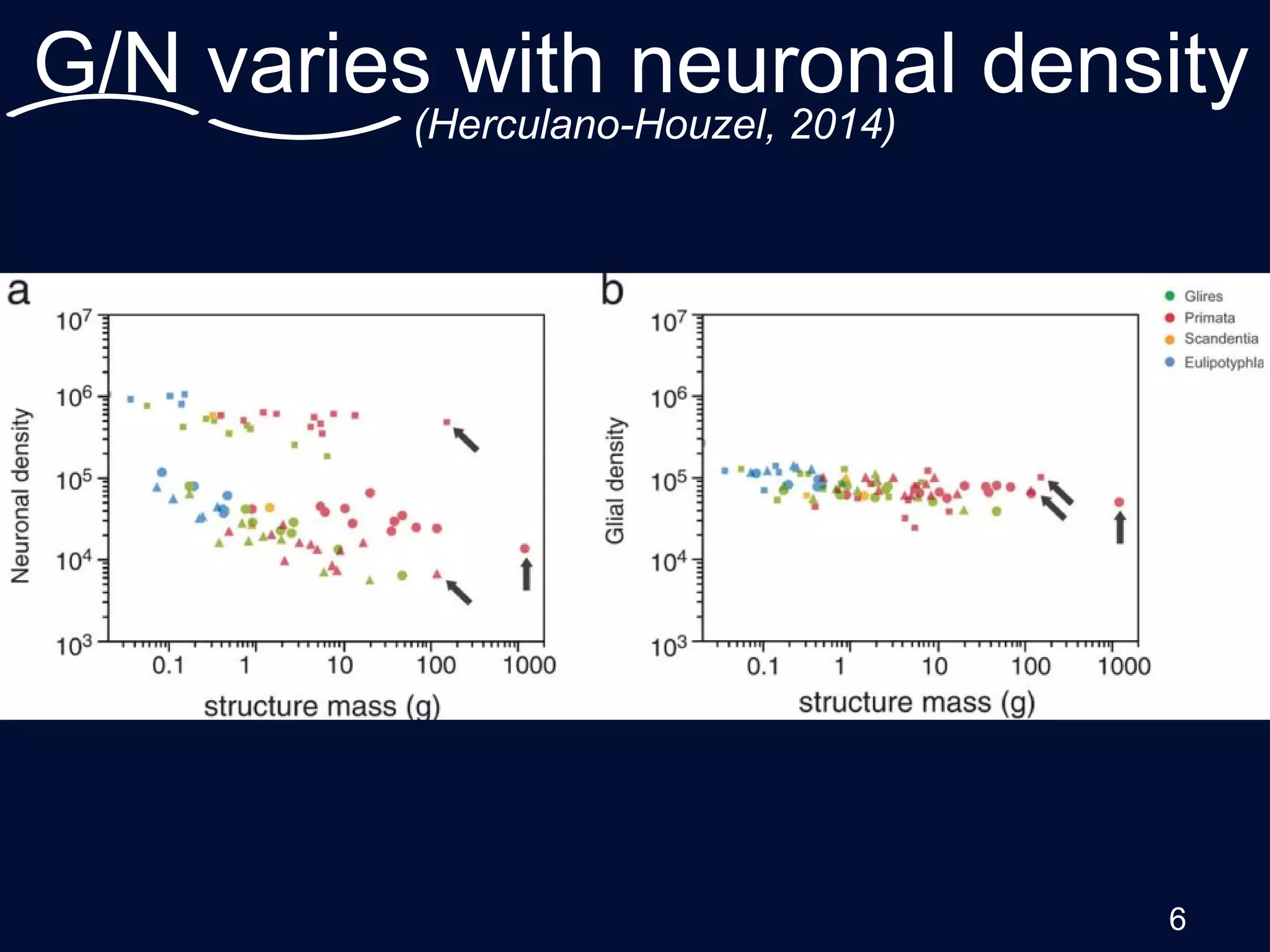
G/N varies with neuronal density
6
(Herculano-Houzel, 2014)
G/N varies with neuronal density
7
(Herculano-Houzel, 2014)
Varies with neuronal density?
• Why ?
– Metabolic argument : larger neurons because of
smaller neuronal density (= metabolic cost?)
8
(Herculano-Houzel, 2014)
Varies with neuronal density?
• Why ?
– Metabolic argument : larger neurons because of
smaller neuronal density (= metabolic cost?)
9
(Herculano-Houzel, 2014)
Varies with neuronal density?
• Why ?
– Developmental argument : glia can proliferate
during postnatal development
– Glia : small size variations
and uniformly distributed
(contrary to neurons)
→ G/N vary with neuronal
density (not glial density)
– Consistent with data !
10
(Herculano-Houzel, 2014)
Implications of G/N ratio
• Uniform variation → highly conservated
throughout evolution
• Suggests glial cells perform fundamental role,
since they can hardly be altered
• May favor sparse coding
• Human exception : larger and more complex
astrocytes. Why ?
– Brain size vs intrinsic properties of human astrocytes ?
– Core to human cognition ?
11
(Herculano-Houzel, 2014)
Why is sleep important?
• Essential for memory and cognitive functions
• Universal for all animals with a brain (mammals, birds,
insects?, etc.)
• Necessary, else death is guaranteed
• Precise physiological (REM/NREM, slow waves) or
behavioral (no response to stimuli) definitions
• Compensation after deprivation (more frequent slow waves)
• Questions :
– What functionality ?
– How it works ? 12
Sleep functionality: theories
• Synaptic homeostasis (SHY) (Tononi & Cirelli,
2003) : wake LTP-potentiated synapses weights
are normalized during sleep for efficiency
• Memory trace replay (Lee & Wilson,2002) :
memories are consolidated by offline
reactivation during sleep
=> Sleep = regulation of plasticity ?
=> Contradictory or complementary theories?
13
Local synaptic modulation
14
• 2 pathways for local synaptic modulation by astrocytes :
(2B) A1 pathway is tonically activated to clean neurotransmitters,
While phasic A1 activation can regulate depending on synaptic activity
(Fellin et al, 2014)
Up-down states modulation
15
• Slow waves reduction in sleep-deprived dnSNARE mice can be
explained by the modulation of up-down states probabilities :
Deprived dnSNARE mice cannot compensate !
(Fellin et al, 2009)
Take home message
• Astrocytes :
– Active synaptic modulators (not just passive regulators)
similar to neurons gatekeepers (synaptic gating)
– Highly conservated throughout evolution = essential role
– Essential (core?) for sleep (and thus memory) functions
• Questions :
– Characteristics intrinsic or due to neural environment ?
– Astrocytes participate in the formation of complex neural
networks ? Do evolved astrocytes allow to better learn ?
16
– The Glia/Neuron Ratio, Herculano-Houzel, 2014, Glia, 62(9), 1377-1391.
– Astrocyte regulation of sleep circuits: experimental and modeling
perspectives, Fellin et al, Frontiers in Computational Neuroscience, 2014
– Time to be SHY? Some comments on sleep and synaptic homeostasis,
Tononi & Cirelli, 2012, Neural plasticity.
– Astrocytes drive neural network synchrony, Levine-Small & Guebeli &
Goddard & Yang & Chuong & Chow & Egert, 2012, In MEA Meeting 2012(p.
30).
– Memory of sequential experience in the hippocampus during slow wave
sleep, Lee & Wilson, 2002, Neuron, 36(6), 1183-1194.
– Reverse replay of behavioural sequences in hippocampal place cells
during the awake state, Foster & Wilson, 2006, Nature, 440(7084), 680-
683.
References
slideshare.net/LRQ3000
Thank you!
slideshare.net/LRQ3000
Bonus Slides
Network synchrony modulation
23
Local phasic ATP/Adn modulation may promote global synchrony :
(Fellin et al, 2014)
Sleep-deprived dnSNARE mice
24
• Sleep-deprived dnSNARE mice have difficulties to compensate
when under high homeostatic sleep pressure :
Deprived dnSNARE mice have reduced compensation !
(Fellin et al, 2009)
Bistable neurons, synaptic gating
25
• Bistable neurons can switch between two states : Up and Down
• Allow to create selective inhibition (aka : synaptic gating)
• A third neuron (or astrocyte?) can modulate this gating : the
gatekeeper
Up and down state in one neuron
26
• Up-state = depolarized ; Down-state = hyperpolarized (close to
membrane potential).
• Change neuron’s dynamics ; Up needs balanced excitation and
inhibition ? (Wilson & Cowan 1972)
• Can switch state without triggering a spike
DownDownUpUp
Up and down states
27
• Up and down states in dnSNARE mice (in-vivo patch-clamp
recordings from pyramidal neurons in somato-sensory cortex) :
(Fellin et al, 2009)
Neural oscillations
28
• Oscillation = rythmic pattern of activation of a
single neuron or a network
THE END

Glial cells and astrocytes: neural networks modulators?

  • 1.
    Glial cells andastrocytes: neural network modulators? Hugo Trad & Stephen Larroque 2 Nov 2015
  • 2.
    Glia/Neuron ratio • Glianot just a « glue », lots of different functions • Friede (1954) : Glial index, or glia/neurons (G/N) ratio • How does this ratio vary across species, and to what extent this variation can be informative of glia’s function ? 2 (Herculano-Houzel, 2014)
  • 3.
    G/N varies withbrain size? 3 (Herculano-Houzel, 2014)
  • 4.
    G/N varies withbrain size? 4 (Herculano-Houzel, 2014)
  • 5.
    G/N varies withbrain size? 5 (Herculano-Houzel, 2014)
  • 6.
    G/N varies withneuronal density 6 (Herculano-Houzel, 2014)
  • 7.
    G/N varies withneuronal density 7 (Herculano-Houzel, 2014)
  • 8.
    Varies with neuronaldensity? • Why ? – Metabolic argument : larger neurons because of smaller neuronal density (= metabolic cost?) 8 (Herculano-Houzel, 2014)
  • 9.
    Varies with neuronaldensity? • Why ? – Metabolic argument : larger neurons because of smaller neuronal density (= metabolic cost?) 9 (Herculano-Houzel, 2014)
  • 10.
    Varies with neuronaldensity? • Why ? – Developmental argument : glia can proliferate during postnatal development – Glia : small size variations and uniformly distributed (contrary to neurons) → G/N vary with neuronal density (not glial density) – Consistent with data ! 10 (Herculano-Houzel, 2014)
  • 11.
    Implications of G/Nratio • Uniform variation → highly conservated throughout evolution • Suggests glial cells perform fundamental role, since they can hardly be altered • May favor sparse coding • Human exception : larger and more complex astrocytes. Why ? – Brain size vs intrinsic properties of human astrocytes ? – Core to human cognition ? 11 (Herculano-Houzel, 2014)
  • 12.
    Why is sleepimportant? • Essential for memory and cognitive functions • Universal for all animals with a brain (mammals, birds, insects?, etc.) • Necessary, else death is guaranteed • Precise physiological (REM/NREM, slow waves) or behavioral (no response to stimuli) definitions • Compensation after deprivation (more frequent slow waves) • Questions : – What functionality ? – How it works ? 12
  • 13.
    Sleep functionality: theories •Synaptic homeostasis (SHY) (Tononi & Cirelli, 2003) : wake LTP-potentiated synapses weights are normalized during sleep for efficiency • Memory trace replay (Lee & Wilson,2002) : memories are consolidated by offline reactivation during sleep => Sleep = regulation of plasticity ? => Contradictory or complementary theories? 13
  • 14.
    Local synaptic modulation 14 •2 pathways for local synaptic modulation by astrocytes : (2B) A1 pathway is tonically activated to clean neurotransmitters, While phasic A1 activation can regulate depending on synaptic activity (Fellin et al, 2014)
  • 15.
    Up-down states modulation 15 •Slow waves reduction in sleep-deprived dnSNARE mice can be explained by the modulation of up-down states probabilities : Deprived dnSNARE mice cannot compensate ! (Fellin et al, 2009)
  • 16.
    Take home message •Astrocytes : – Active synaptic modulators (not just passive regulators) similar to neurons gatekeepers (synaptic gating) – Highly conservated throughout evolution = essential role – Essential (core?) for sleep (and thus memory) functions • Questions : – Characteristics intrinsic or due to neural environment ? – Astrocytes participate in the formation of complex neural networks ? Do evolved astrocytes allow to better learn ? 16
  • 17.
    – The Glia/NeuronRatio, Herculano-Houzel, 2014, Glia, 62(9), 1377-1391. – Astrocyte regulation of sleep circuits: experimental and modeling perspectives, Fellin et al, Frontiers in Computational Neuroscience, 2014 – Time to be SHY? Some comments on sleep and synaptic homeostasis, Tononi & Cirelli, 2012, Neural plasticity. – Astrocytes drive neural network synchrony, Levine-Small & Guebeli & Goddard & Yang & Chuong & Chow & Egert, 2012, In MEA Meeting 2012(p. 30). – Memory of sequential experience in the hippocampus during slow wave sleep, Lee & Wilson, 2002, Neuron, 36(6), 1183-1194. – Reverse replay of behavioural sequences in hippocampal place cells during the awake state, Foster & Wilson, 2006, Nature, 440(7084), 680- 683. References slideshare.net/LRQ3000
  • 18.
  • 19.
  • 20.
    Network synchrony modulation 23 Localphasic ATP/Adn modulation may promote global synchrony : (Fellin et al, 2014)
  • 21.
    Sleep-deprived dnSNARE mice 24 •Sleep-deprived dnSNARE mice have difficulties to compensate when under high homeostatic sleep pressure : Deprived dnSNARE mice have reduced compensation ! (Fellin et al, 2009)
  • 22.
    Bistable neurons, synapticgating 25 • Bistable neurons can switch between two states : Up and Down • Allow to create selective inhibition (aka : synaptic gating) • A third neuron (or astrocyte?) can modulate this gating : the gatekeeper
  • 23.
    Up and downstate in one neuron 26 • Up-state = depolarized ; Down-state = hyperpolarized (close to membrane potential). • Change neuron’s dynamics ; Up needs balanced excitation and inhibition ? (Wilson & Cowan 1972) • Can switch state without triggering a spike DownDownUpUp
  • 24.
    Up and downstates 27 • Up and down states in dnSNARE mice (in-vivo patch-clamp recordings from pyramidal neurons in somato-sensory cortex) : (Fellin et al, 2009)
  • 25.
    Neural oscillations 28 • Oscillation= rythmic pattern of activation of a single neuron or a network
  • 26.