Coma Science Group - GIGA
University of Liège, Belgium
Brain-Computer Interface
and States of Vigilance
03/01/2017
Stephen Larroque
stephen.larroque@ulg.ac.be
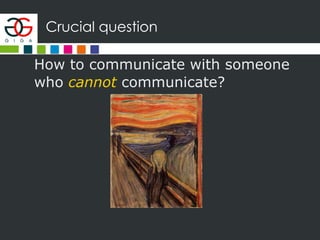
Crucial question
How to communicate with someone
who cannot communicate?
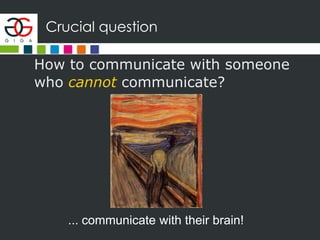
Crucial question
How to communicate with someone
who cannot communicate?
... communicate with their brain!
BCI Outline
1. Identifying the (sub)population
2. Identifying biomarkers
3. Modelling (= decoder)
4. Applications: detection, communication &
rehabilitation
Overview
1. Identifying the population
• Disorders of consciousness
• Clinical diagnoses
2. Identifying biomarkers
• Functional neuroimagery and EEG
3. Modelling
• Brain-computer interfaces (BCI)
4. Applications: communication & rehabilitation
• Conclusions
Coma Science Group - GIGA
University of Liège, Belgium
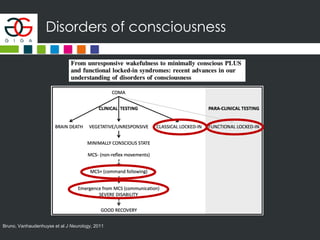
Disorders of consciousness
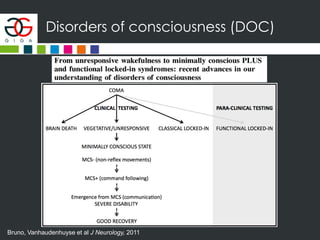
Disorders of consciousness (DOC)
Bruno, Vanhaudenhuyse et al J Neurology, 2011
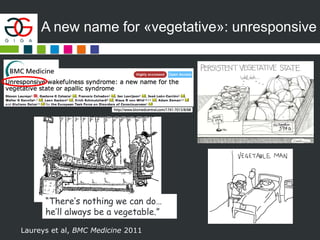
A new name for «vegetative»: unresponsive
“There’s nothing we can do…
he’ll always be a vegetable.”
Laureys et al, BMC Medicine 2011
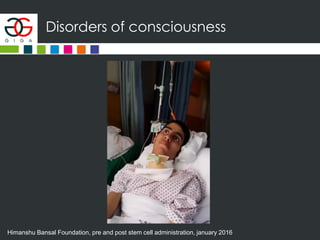
Disorders of consciousness
Himanshu Bansal Foundation, pre and post stem cell administration, january 2016
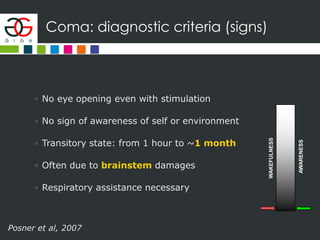
Coma: diagnostic criteria (signs)
• No eye opening even with stimulation
• No sign of awareness of self or environment
• Transitory state: from 1 hour to ~1 month
• Often due to brainstem damages
• Respiratory assistance necessary
AWARENESS
WAKEFULNESS
Posner et al, 2007
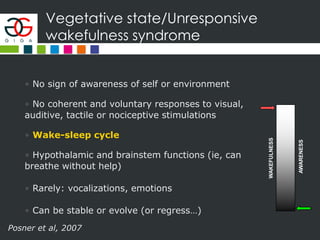
Vegetative state/Unresponsive
wakefulness syndrome
• No sign of awareness of self or environment
• No coherent and voluntary responses to visual,
auditive, tactile or nociceptive stimulations
• Wake-sleep cycle
• Hypothalamic and brainstem functions (ie, can
breathe without help)
• Rarely: vocalizations, emotions
• Can be stable or evolve (or regress…)
AWARENESS
WAKEFULNESS
Posner et al, 2007
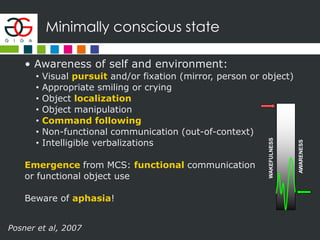
Minimally conscious state
• Awareness of self and environment:
• Visual pursuit and/or fixation (mirror, person or object)
• Appropriate smiling or crying
• Object localization
• Object manipulation
• Command following
• Non-functional communication (out-of-context)
• Intelligible verbalizations
Emergence from MCS: functional communication
or functional object use
Beware of aphasia!
AWARENESS
WAKEFULNESS
Posner et al, 2007
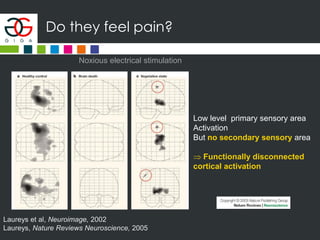
Do they feel pain?
Low level primary sensory area
Activation
But no secondary sensory area
 Functionally disconnected
cortical activation
Noxious electrical stimulation
Laureys et al, Neuroimage, 2002
Laureys, Nature Reviews Neuroscience, 2005
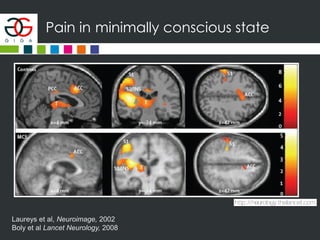
Pain in minimally conscious state
Laureys et al, Neuroimage, 2002
Boly et al Lancet Neurology, 2008
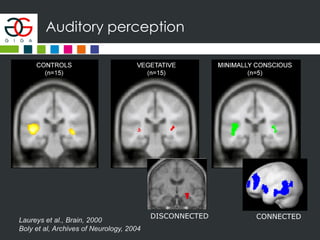
Auditory perception
Laureys et al., Brain, 2000
Boly et al, Archives of Neurology, 2004
DISCONNECTED CONNECTED
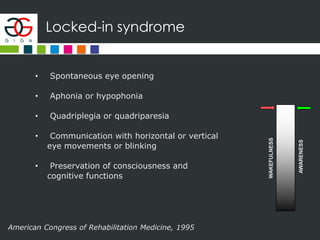
Locked-in syndrome
American Congress of Rehabilitation Medicine, 1995
WAKEFULNESS
AWARENESS
• Spontaneous eye opening
• Aphonia or hypophonia
• Quadriplegia or quadriparesia
• Communication with horizontal or vertical
eye movements or blinking
• Preservation of consciousness and
cognitive functions
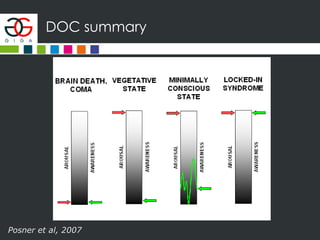
DOC summary
Posner et al, 2007
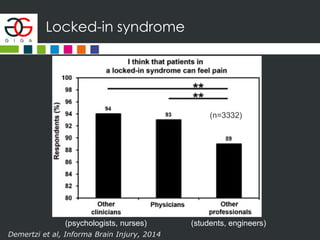
Locked-in syndrome
Demertzi et al, Informa Brain Injury, 2014
(psychologists, nurses) (students, engineers)
(n=3332)
Coma Science Group - GIGA
University of Liège, Belgium
Clinical Diagnosis
05/01/2015
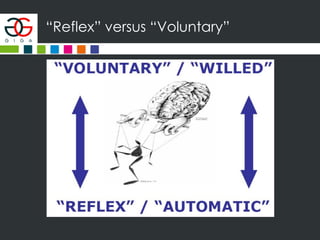
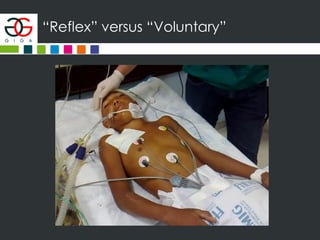
“Reflex” versus “Voluntary”
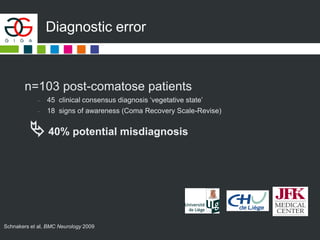
Diagnostic error
n=103 post-comatose patients
– 45 clinical consensus diagnosis ‘vegetative state’
– 18 signs of awareness (Coma Recovery Scale-Revise)
 40% potential misdiagnosis
Schnakers et al, BMC Neurology 2009
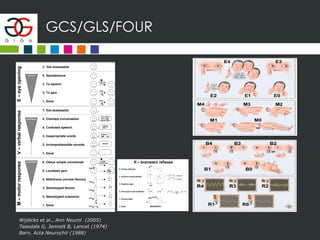
GCS/GLS/FOUR
Wijdicks et al., Ann Neurol (2005)
Teasdale G, Jennett B, Lancet (1974)
Born, Acta Neurochir (1988)
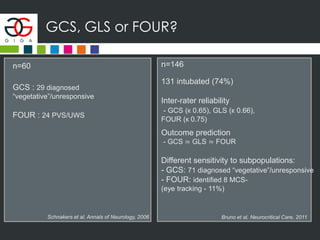
GCS, GLS or FOUR?
Bruno et al, Neurocritical Care, 2011
n=146
131 intubated (74%)
Inter-rater reliability
- GCS (к 0.65), GLS (к 0.66),
FOUR (к 0.75)
Outcome prediction
- GCS ≃ GLS ≃ FOUR
Different sensitivity to subpopulations:
- GCS: 71 diagnosed “vegetative”/unresponsive
- FOUR: identified 8 MCS-
(eye tracking - 11%)
n=60
GCS : 29 diagnosed
“vegetative”/unresponsive
FOUR : 24 PVS/UWS
Schnakers et al, Annals of Neurology, 2006
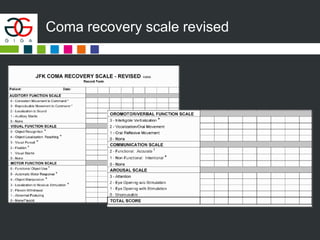
Coma recovery scale revised
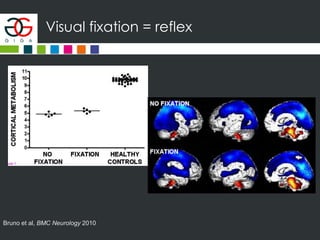
Visual fixation = reflex
Bruno et al, BMC Neurology 2010
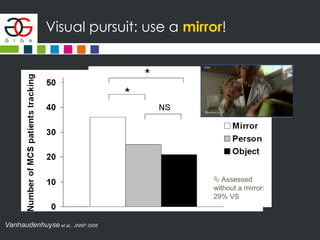
Visual pursuit: use a mirror!
Vanhaudenhuyse et al., JNNP 2008
 Assessed
without a mirror:
29% VS
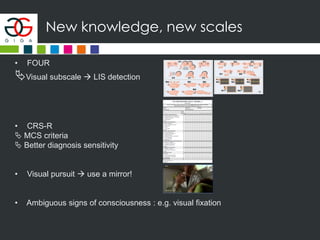
New knowledge, new scales
• FOUR
Visual subscale  LIS detection
• CRS-R
 MCS criteria
 Better diagnosis sensitivity
• Visual pursuit  use a mirror!
• Ambiguous signs of consciousness : e.g. visual fixation
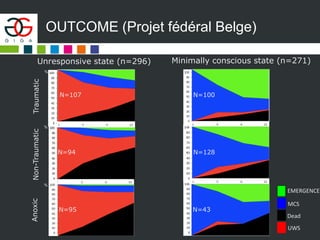
OUTCOME (Projet fédéral Belge)
Unresponsive state (n=296)
TraumaticNon-TraumaticAnoxic
%
%
%
Minimally conscious state (n=271)
N=107
N=94
N=95
N=100
N=128
N=43
EMERGENCE
MCS
Dead
UWS
Coma Science Group - GIGA
University of Liège, Belgium
Neuroimagery and biomarkers
05/01/2015
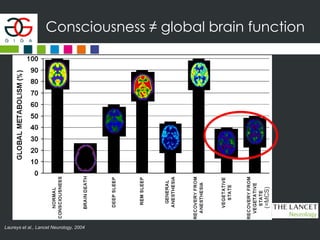
Consciousness ≠ global brain function
Laureys et al., Lancet Neurology, 2004
(=MCS)
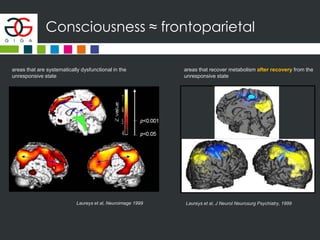
Consciousness ≈ frontoparietal
Laureys et al, Neuroimage 1999
areas that are systematically dysfunctional in the
unresponsive state
areas that recover metabolism after recovery from the
unresponsive state
Laureys et al, J Neurol Neurosurg Psychiatry, 1999
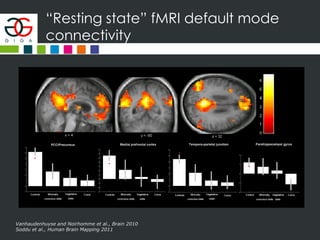
“Resting state” fMRI default mode
connectivity
Vanhaudenhuyse and Noirhomme et al., Brain 2010
Soddu et al., Human Brain Mapping 2011
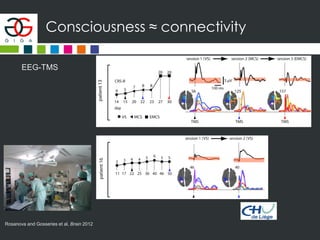
Consciousness ≈ connectivity
EEG-TMS
Rosanova and Gosseries et al, Brain 2012
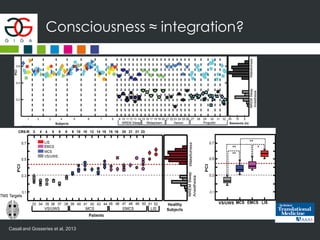
Consciousness ≈ integration?
Casali and Gosseries et al, 2013
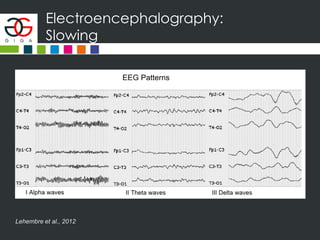
Electroencephalography:
Slowing
Lehembre et al., 2012
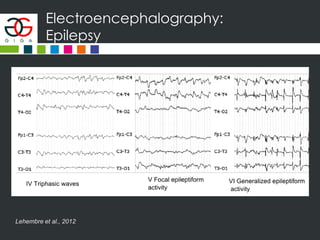
Electroencephalography:
Epilepsy
Lehembre et al., 2012
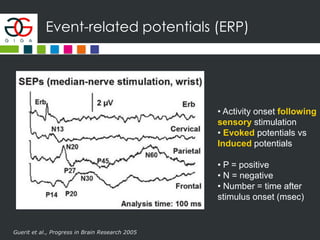
Event-related potentials (ERP)
Guerit et al., Progress in Brain Research 2005
• Activity onset following
sensory stimulation
• Evoked potentials vs
Induced potentials
• P = positive
• N = negative
• Number = time after
stimulus onset (msec)
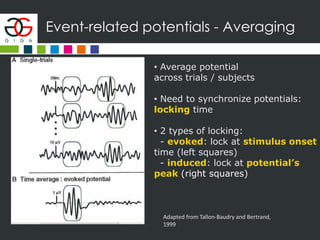
Event-related potentials - Averaging
Adapted from Tallon-Baudry and Bertrand,
1999
• Average potential
across trials / subjects
• Need to synchronize potentials:
locking time
• 2 types of locking:
- evoked: lock at stimulus onset
time (left squares)
- induced: lock at potential’s
peak (right squares)
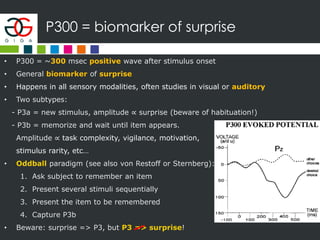
P300 = biomarker of surprise
• P300 = ~300 msec positive wave after stimulus onset
• General biomarker of surprise
• Happens in all sensory modalities, often studies in visual or auditory
• Two subtypes:
- P3a = new stimulus, amplitude ∝ surprise (beware of habituation!)
- P3b = memorize and wait until item appears.
Amplitude ∝ task complexity, vigilance, motivation,
stimulus rarity, etc…
• Oddball paradigm (see also von Restoff or Sternberg):
1. Ask subject to remember an item
2. Present several stimuli sequentially
3. Present the item to be remembered
4. Capture P3b
• Beware: surprise => P3, but P3 => surprise!
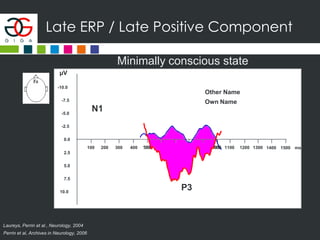
Late ERP / Late Positive Component
Minimally conscious state
µV
0.0
-2.5
-5.0
-7.5
-10.0
2.5
5.0
7.5
10.0
Other Name
N1
ms100 300 500 800 1000 1300200 400 600 700 900 1100 1200 15001400
P3
Own Name
Laureys, Perrin et al., Neurology, 2004
Perrin et al, Archives in Neurology, 2006
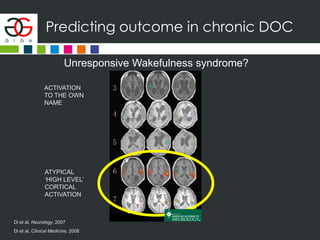
Predicting outcome in chronic DOC
Unresponsive Wakefulness syndrome?
ATYPICAL
‘HIGH LEVEL’
CORTICAL
ACTIVATION
Di et al, Neurology, 2007
ACTIVATION
TO THE OWN
NAME
Di et al, Clinical Medicine, 2008
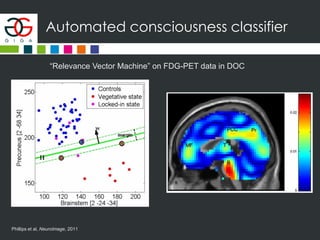
Automated consciousness classifier
Phillips et al, NeuroImage, 2011
“Relevance Vector Machine” on FDG-PET data in DOC
Overview
1. Identifying the population
• Disorders of consciousness
• Clinical diagnoses
2. Identifying biomarkers
• Functional neuroimagery and EEG
3. Modelling
• Brain-computer interfaces (BCI)
4. Applications: communication & rehabilitation
• Conclusions
Coma Science Group - GIGA
University of Liège, Belgium
Brain-Computer Interface
05/01/2015
Disorders of consciousness
Bruno, Vanhaudenhuyse et al J Neurology, 2011
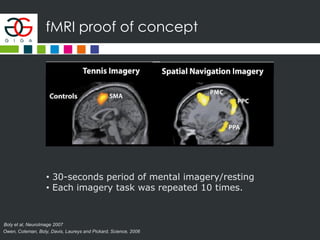
fMRI proof of concept
• 30-seconds period of mental imagery/resting
• Each imagery task was repeated 10 times.
Owen, Coleman, Boly, Davis, Laureys and Pickard, Science, 2006
Boly et al, NeuroImage 2007
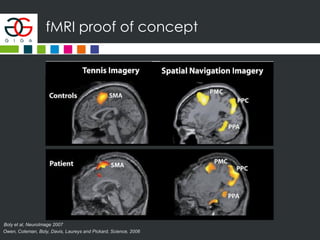
fMRI proof of concept
• 30-seconds period of mental imagery/resting
• Each imagery task was repeated 10 times.
Owen, Coleman, Boly, Davis, Laureys and Pickard, Science, 2006
Boly et al, NeuroImage 2007
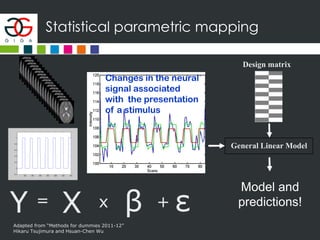
Statistical parametric mapping
Changes in the neural
signal associated
with the presentation
of a stimulus
General Linear Model
Design matrix
Y = X x β + ε
Adapted from “Methods for dummies 2011-12”
Hikaru Tsujimura and Hsuan-Chen Wu
Model and
predictions!
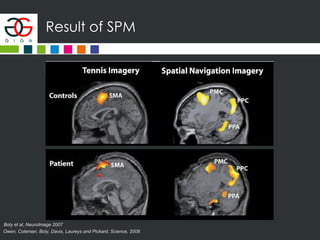
Result of SPM
• 30-seconds period of mental imagery/resting
• Each imagery task was repeated 10 times.
Owen, Coleman, Boly, Davis, Laureys and Pickard, Science, 2006
Boly et al, NeuroImage 2007
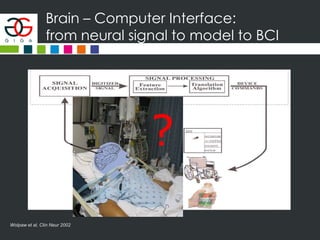
Brain – Computer Interface:
from neural signal to model to BCI
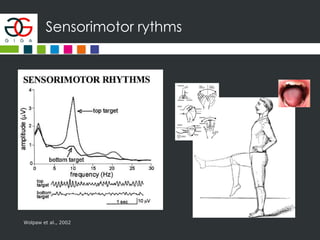
Wolpaw et al, Clin Neur 2002
?
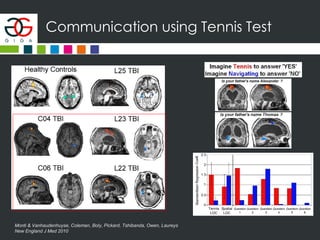
Communication using Tennis Test
Monti & Vanhaudenhuyse, Coleman, Boly, Pickard, Tshibanda, Owen, Laureys
New England J Med 2010
Coma Science Group - GIGA
University of Liège, Belgium
Communication
05/01/2015
Sensorimotor rythms
Wolpaw et al., 2002
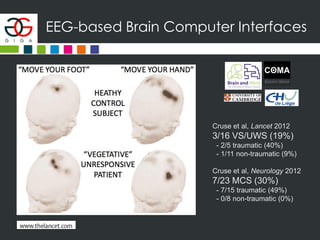
EEG-based Brain Computer Interfaces
SCIENCE GROUP
COMA
Cruse et al, Lancet 2012
3/16 VS/UWS (19%)
- 2/5 traumatic (40%)
- 1/11 non-traumatic (9%)
Cruse et al, Neurology 2012
7/23 MCS (30%)
- 7/15 traumatic (49%)
- 0/8 non-traumatic (0%)
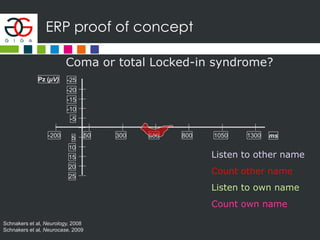
ERP proof of concept
ms-200 50 300 550 800 1050 1300
-5
-10
-15
-20
-25
5
10
15
20
25
Pz (µV)
Count own name
Coma or total Locked-in syndrome?
Listen to other name
Count other name
Listen to own name
Schnakers et al, Neurology, 2008
Schnakers et al, Neurocase, 2009
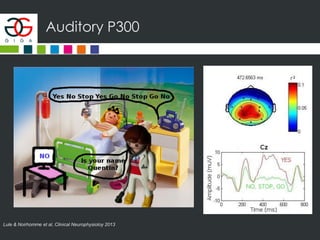
Auditory P300
Lule & Noirhomme et al, Clinical Neurophysioloy 2013
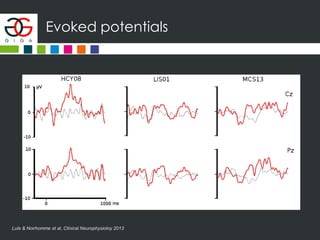
Evoked potentials
Lule & Noirhomme et al, Clinical Neurophysioloy 2013
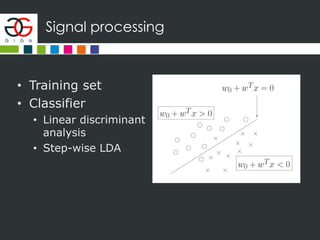
Signal processing
• Training set
• Classifier
• Linear discriminant
analysis
• Step-wise LDA
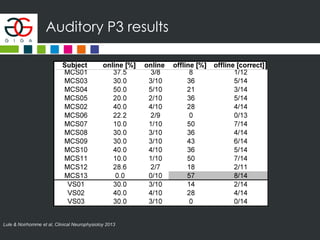
Auditory P3 results
Lule & Noirhomme et al, Clinical Neurophysioloy 2013
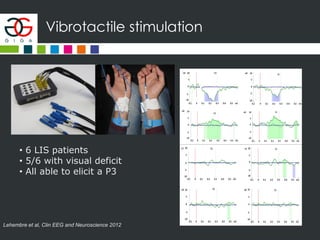
Vibrotactile stimulation
Lehembre et al, Clin EEG and Neuroscience 2012
• 6 LIS patients
• 5/6 with visual deficit
• All able to elicit a P3
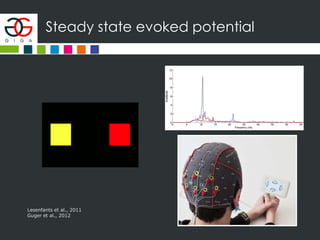
Steady state evoked potential
Lesenfants et al., 2011
Guger et al., 2012
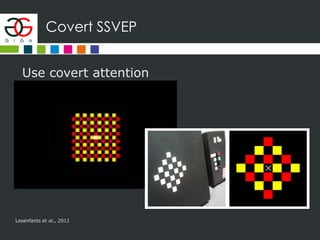
Covert SSVEP
Use covert attention
Lesenfants et al., 2011
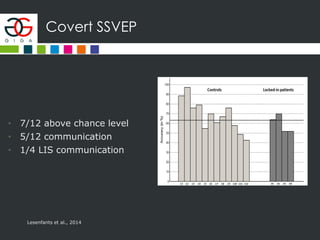
Covert SSVEP
• 7/12 above chance level
• 5/12 communication
• 1/4 LIS communication
Lesenfants et al., 2014
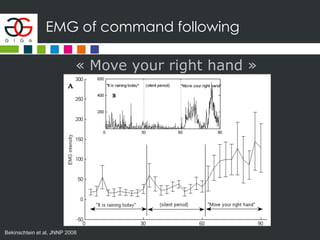
EMG of command following
« Move your right hand »
Bekinschtein et al, JNNP 2008
Coma Science Group - GIGA
University of Liège, Belgium
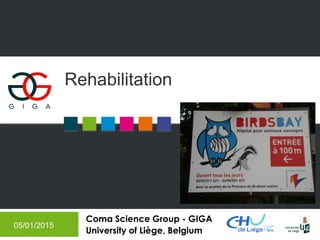
Rehabilitation
05/01/2015
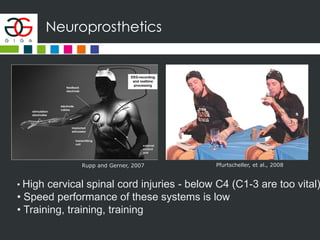
Neuroprosthetics
Rupp and Gerner, 2007 Pfurtscheller, et al., 2008
• High cervical spinal cord injuries - below C4 (C1-3 are too vital)
• Speed performance of these systems is low
• Training, training, training
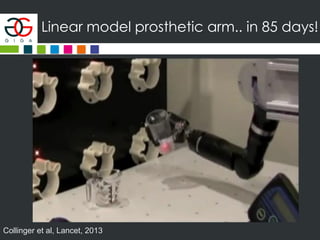
Linear model prosthetic arm.. in 85 days!
Collinger et al, Lancet, 2013
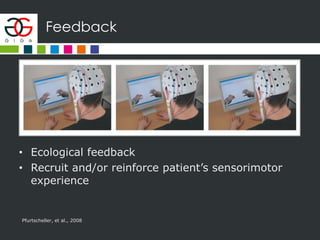
Feedback
• Ecological feedback
• Recruit and/or reinforce patient’s sensorimotor
experience
Pfurtscheller, et al., 2008
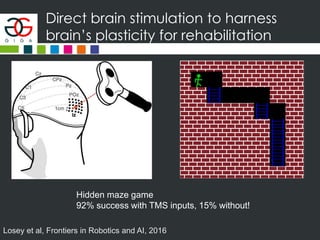
Direct brain stimulation to harness
brain’s plasticity for rehabilitation
Losey et al, Frontiers in Robotics and AI, 2016
Hidden maze game
92% success with TMS inputs, 15% without!
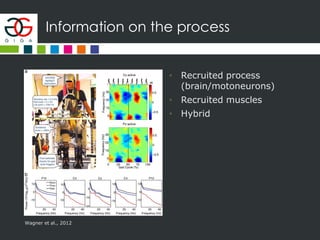
Information on the process
• Recruited process
(brain/motoneurons)
• Recruited muscles
• Hybrid
Wagner et al., 2012
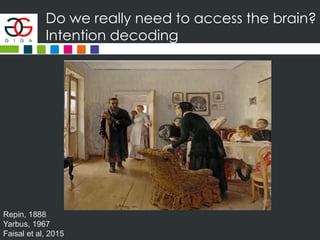
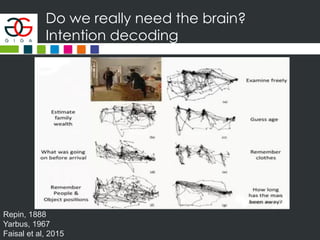
Do we really need to access the brain?
Intention decoding
Repin, 1888
Yarbus, 1967
Faisal et al, 2015
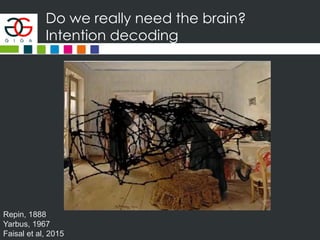
Do we really need the brain?
Intention decoding
Repin, 1888
Yarbus, 1967
Faisal et al, 2015
Do we really need the brain?
Intention decoding
Repin, 1888
Yarbus, 1967
Faisal et al, 2015
Do we really need the brain?
Intention decoding
Repin, 1888
Yarbus, 1967
Faisal et al, 2015
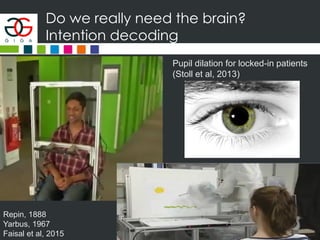
Pupil dilation for locked-in patients
(Stoll et al, 2013)
Coma Science Group - GIGA
University of Liège, Belgium
Conclusion
05/01/2015
BCI for DOC and other pathologies
• BCIs may enable the detection of response to command
and communication
• Results need to be interpreted with great caution
• Statistical validation
• Be aware of false negative
• Numerous challenges: subpopulation identification,
feature extraction, hardware restrictions, physical
restrictions (lots of noise!), expensive, etc.
• Results could have a high impact on rehabilitation
strategies, quality of life and prognosis
• Exciting era for BCI, lots of AI models and
wonderful technological advances!
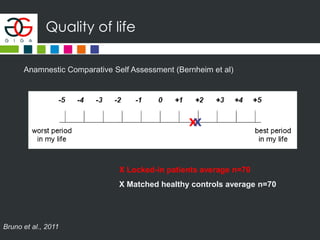
Quality of life
Bruno et al., 2011
Anamnestic Comparative Self Assessment (Bernheim et al)
X
X Locked-in patients average n=70
X
X Matched healthy controls average n=70
Further information
• See previous slides for references
• Books:
• The neurology of consciousness: cognitive
neuroscience and neuropathology , Laureys, Steven,
Olivia Gosseries, and Giulio Tononi, Academic Press, 2015.
• Videos, documentaries:
• Charlie Ford Coma 1 to 7
• Holly’s Road To Recovery - A TBI Survivor
• Human Neuroscience in the wild – Aldo Faisal – FSC 2016
Coma Science Group - GIGA
University of Liège, Belgium
Thank you!
05/01/2015
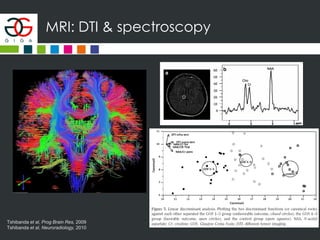
MRI: DTI & spectroscopy
Tshibanda et al, Prog Brain Res, 2009
Tshibanda et al, Neuroradiology, 2010
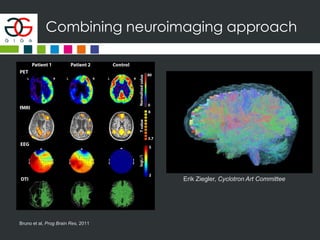
Combining neuroimaging approach
Bruno et al, Prog Brain Res, 2011
Erik Ziegler, Cyclotron Art Committee
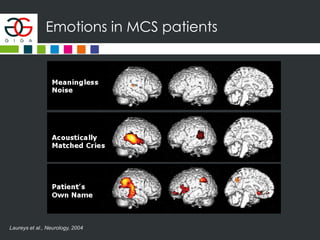
Emotions in MCS patients
Laureys et al., Neurology, 2004
Statistical analysis
•Statistical analysis of latency, amplitude
•For all derivations and potentials
•ANOVA, t-test
•Group level
BCI features
• Synchronous/asynchronous
• Dependent/independent
• Robust to artifacts
Coma Science Group - GIGA
University of Liège, Belgium
Challenges
05/01/2015
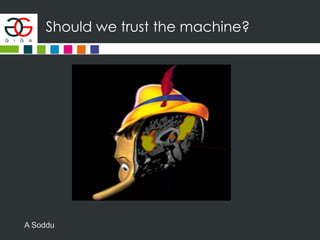
Should we trust the machine?
A Soddu
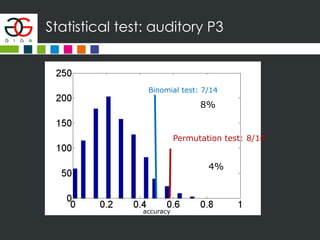
Statistical test: auditory P3
Permutation test: 8/14
Binomial test: 7/14
8%
4%
accuracy
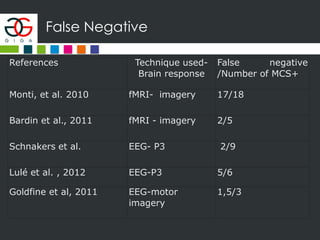
False Negative
References Technique used-
Brain response
False negative
/Number of MCS+
Monti, et al. 2010 fMRI- imagery 17/18
Bardin et al., 2011 fMRI - imagery 2/5
Schnakers et al. EEG- P3 2/9
Lulé et al. , 2012 EEG-P3 5/6
Goldfine et al, 2011 EEG-motor
imagery
1,5/3
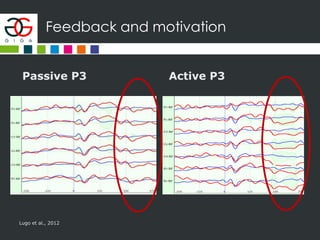
Feedback and motivation
Passive P3 Active P3
Lugo et al., 2012
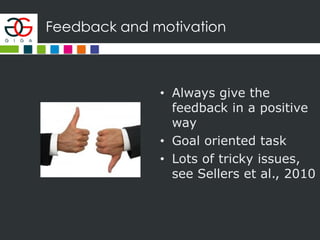
Feedback and motivation
• Always give the
feedback in a positive
way
• Goal oriented task
• Lots of tricky issues,
see Sellers et al., 2010
BCI Limits for home use
• Not usable by non-technical personal
• Do not provide basic communication
capacities (just binary: yes/no)
• Not easily configured for the needs of each
user
• Not suited to periodic long-distance technical
oversights

Brain-Computer Interface and States of Vigilance

  • 1.
    Coma Science Group- GIGA University of Liège, Belgium Brain-Computer Interface and States of Vigilance 03/01/2017 Stephen Larroque stephen.larroque@ulg.ac.be
  • 2.
    Crucial question How tocommunicate with someone who cannot communicate?
  • 3.
    Crucial question How tocommunicate with someone who cannot communicate? ... communicate with their brain!
  • 4.
    BCI Outline 1. Identifyingthe (sub)population 2. Identifying biomarkers 3. Modelling (= decoder) 4. Applications: detection, communication & rehabilitation
  • 5.
    Overview 1. Identifying thepopulation • Disorders of consciousness • Clinical diagnoses 2. Identifying biomarkers • Functional neuroimagery and EEG 3. Modelling • Brain-computer interfaces (BCI) 4. Applications: communication & rehabilitation • Conclusions
  • 6.
    Coma Science Group- GIGA University of Liège, Belgium Disorders of consciousness
  • 7.
    Disorders of consciousness(DOC) Bruno, Vanhaudenhuyse et al J Neurology, 2011
  • 8.
    A new namefor «vegetative»: unresponsive “There’s nothing we can do… he’ll always be a vegetable.” Laureys et al, BMC Medicine 2011
  • 9.
    Disorders of consciousness HimanshuBansal Foundation, pre and post stem cell administration, january 2016
  • 10.
    Coma: diagnostic criteria(signs) • No eye opening even with stimulation • No sign of awareness of self or environment • Transitory state: from 1 hour to ~1 month • Often due to brainstem damages • Respiratory assistance necessary AWARENESS WAKEFULNESS Posner et al, 2007
  • 11.
    Vegetative state/Unresponsive wakefulness syndrome •No sign of awareness of self or environment • No coherent and voluntary responses to visual, auditive, tactile or nociceptive stimulations • Wake-sleep cycle • Hypothalamic and brainstem functions (ie, can breathe without help) • Rarely: vocalizations, emotions • Can be stable or evolve (or regress…) AWARENESS WAKEFULNESS Posner et al, 2007
  • 12.
    Minimally conscious state •Awareness of self and environment: • Visual pursuit and/or fixation (mirror, person or object) • Appropriate smiling or crying • Object localization • Object manipulation • Command following • Non-functional communication (out-of-context) • Intelligible verbalizations Emergence from MCS: functional communication or functional object use Beware of aphasia! AWARENESS WAKEFULNESS Posner et al, 2007
  • 13.
    Do they feelpain? Low level primary sensory area Activation But no secondary sensory area  Functionally disconnected cortical activation Noxious electrical stimulation Laureys et al, Neuroimage, 2002 Laureys, Nature Reviews Neuroscience, 2005
  • 14.
    Pain in minimallyconscious state Laureys et al, Neuroimage, 2002 Boly et al Lancet Neurology, 2008
  • 15.
    Auditory perception Laureys etal., Brain, 2000 Boly et al, Archives of Neurology, 2004 DISCONNECTED CONNECTED
  • 16.
    Locked-in syndrome American Congressof Rehabilitation Medicine, 1995 WAKEFULNESS AWARENESS • Spontaneous eye opening • Aphonia or hypophonia • Quadriplegia or quadriparesia • Communication with horizontal or vertical eye movements or blinking • Preservation of consciousness and cognitive functions
  • 17.
  • 18.
    Locked-in syndrome Demertzi etal, Informa Brain Injury, 2014 (psychologists, nurses) (students, engineers) (n=3332)
  • 19.
    Coma Science Group- GIGA University of Liège, Belgium Clinical Diagnosis 05/01/2015
  • 20.
  • 21.
  • 22.
    Diagnostic error n=103 post-comatosepatients – 45 clinical consensus diagnosis ‘vegetative state’ – 18 signs of awareness (Coma Recovery Scale-Revise)  40% potential misdiagnosis Schnakers et al, BMC Neurology 2009
  • 23.
    GCS/GLS/FOUR Wijdicks et al.,Ann Neurol (2005) Teasdale G, Jennett B, Lancet (1974) Born, Acta Neurochir (1988)
  • 24.
    GCS, GLS orFOUR? Bruno et al, Neurocritical Care, 2011 n=146 131 intubated (74%) Inter-rater reliability - GCS (к 0.65), GLS (к 0.66), FOUR (к 0.75) Outcome prediction - GCS ≃ GLS ≃ FOUR Different sensitivity to subpopulations: - GCS: 71 diagnosed “vegetative”/unresponsive - FOUR: identified 8 MCS- (eye tracking - 11%) n=60 GCS : 29 diagnosed “vegetative”/unresponsive FOUR : 24 PVS/UWS Schnakers et al, Annals of Neurology, 2006
  • 25.
  • 26.
    Visual fixation =reflex Bruno et al, BMC Neurology 2010
  • 27.
    Visual pursuit: usea mirror! Vanhaudenhuyse et al., JNNP 2008  Assessed without a mirror: 29% VS
  • 28.
    New knowledge, newscales • FOUR Visual subscale  LIS detection • CRS-R  MCS criteria  Better diagnosis sensitivity • Visual pursuit  use a mirror! • Ambiguous signs of consciousness : e.g. visual fixation
  • 29.
    OUTCOME (Projet fédéralBelge) Unresponsive state (n=296) TraumaticNon-TraumaticAnoxic % % % Minimally conscious state (n=271) N=107 N=94 N=95 N=100 N=128 N=43 EMERGENCE MCS Dead UWS
  • 30.
    Coma Science Group- GIGA University of Liège, Belgium Neuroimagery and biomarkers 05/01/2015
  • 31.
    Consciousness ≠ globalbrain function Laureys et al., Lancet Neurology, 2004 (=MCS)
  • 32.
    Consciousness ≈ frontoparietal Laureyset al, Neuroimage 1999 areas that are systematically dysfunctional in the unresponsive state areas that recover metabolism after recovery from the unresponsive state Laureys et al, J Neurol Neurosurg Psychiatry, 1999
  • 33.
    “Resting state” fMRIdefault mode connectivity Vanhaudenhuyse and Noirhomme et al., Brain 2010 Soddu et al., Human Brain Mapping 2011
  • 34.
    Consciousness ≈ connectivity EEG-TMS Rosanovaand Gosseries et al, Brain 2012
  • 35.
    Consciousness ≈ integration? Casaliand Gosseries et al, 2013
  • 36.
  • 37.
  • 38.
    Event-related potentials (ERP) Gueritet al., Progress in Brain Research 2005 • Activity onset following sensory stimulation • Evoked potentials vs Induced potentials • P = positive • N = negative • Number = time after stimulus onset (msec)
  • 39.
    Event-related potentials -Averaging Adapted from Tallon-Baudry and Bertrand, 1999 • Average potential across trials / subjects • Need to synchronize potentials: locking time • 2 types of locking: - evoked: lock at stimulus onset time (left squares) - induced: lock at potential’s peak (right squares)
  • 40.
    P300 = biomarkerof surprise • P300 = ~300 msec positive wave after stimulus onset • General biomarker of surprise • Happens in all sensory modalities, often studies in visual or auditory • Two subtypes: - P3a = new stimulus, amplitude ∝ surprise (beware of habituation!) - P3b = memorize and wait until item appears. Amplitude ∝ task complexity, vigilance, motivation, stimulus rarity, etc… • Oddball paradigm (see also von Restoff or Sternberg): 1. Ask subject to remember an item 2. Present several stimuli sequentially 3. Present the item to be remembered 4. Capture P3b • Beware: surprise => P3, but P3 => surprise!
  • 41.
    Late ERP /Late Positive Component Minimally conscious state µV 0.0 -2.5 -5.0 -7.5 -10.0 2.5 5.0 7.5 10.0 Other Name N1 ms100 300 500 800 1000 1300200 400 600 700 900 1100 1200 15001400 P3 Own Name Laureys, Perrin et al., Neurology, 2004 Perrin et al, Archives in Neurology, 2006
  • 42.
    Predicting outcome inchronic DOC Unresponsive Wakefulness syndrome? ATYPICAL ‘HIGH LEVEL’ CORTICAL ACTIVATION Di et al, Neurology, 2007 ACTIVATION TO THE OWN NAME Di et al, Clinical Medicine, 2008
  • 43.
    Automated consciousness classifier Phillipset al, NeuroImage, 2011 “Relevance Vector Machine” on FDG-PET data in DOC
  • 44.
    Overview 1. Identifying thepopulation • Disorders of consciousness • Clinical diagnoses 2. Identifying biomarkers • Functional neuroimagery and EEG 3. Modelling • Brain-computer interfaces (BCI) 4. Applications: communication & rehabilitation • Conclusions
  • 45.
    Coma Science Group- GIGA University of Liège, Belgium Brain-Computer Interface 05/01/2015
  • 46.
    Disorders of consciousness Bruno,Vanhaudenhuyse et al J Neurology, 2011
  • 47.
    fMRI proof ofconcept • 30-seconds period of mental imagery/resting • Each imagery task was repeated 10 times. Owen, Coleman, Boly, Davis, Laureys and Pickard, Science, 2006 Boly et al, NeuroImage 2007
  • 48.
    fMRI proof ofconcept • 30-seconds period of mental imagery/resting • Each imagery task was repeated 10 times. Owen, Coleman, Boly, Davis, Laureys and Pickard, Science, 2006 Boly et al, NeuroImage 2007
  • 49.
    Statistical parametric mapping Changesin the neural signal associated with the presentation of a stimulus General Linear Model Design matrix Y = X x β + ε Adapted from “Methods for dummies 2011-12” Hikaru Tsujimura and Hsuan-Chen Wu Model and predictions!
  • 50.
    Result of SPM •30-seconds period of mental imagery/resting • Each imagery task was repeated 10 times. Owen, Coleman, Boly, Davis, Laureys and Pickard, Science, 2006 Boly et al, NeuroImage 2007
  • 51.
    Brain – ComputerInterface: from neural signal to model to BCI Wolpaw et al, Clin Neur 2002 ?
  • 52.
    Communication using TennisTest Monti & Vanhaudenhuyse, Coleman, Boly, Pickard, Tshibanda, Owen, Laureys New England J Med 2010
  • 53.
    Coma Science Group- GIGA University of Liège, Belgium Communication 05/01/2015
  • 54.
  • 55.
    EEG-based Brain ComputerInterfaces SCIENCE GROUP COMA Cruse et al, Lancet 2012 3/16 VS/UWS (19%) - 2/5 traumatic (40%) - 1/11 non-traumatic (9%) Cruse et al, Neurology 2012 7/23 MCS (30%) - 7/15 traumatic (49%) - 0/8 non-traumatic (0%)
  • 56.
    ERP proof ofconcept ms-200 50 300 550 800 1050 1300 -5 -10 -15 -20 -25 5 10 15 20 25 Pz (µV) Count own name Coma or total Locked-in syndrome? Listen to other name Count other name Listen to own name Schnakers et al, Neurology, 2008 Schnakers et al, Neurocase, 2009
  • 57.
    Auditory P300 Lule &Noirhomme et al, Clinical Neurophysioloy 2013
  • 58.
    Evoked potentials Lule &Noirhomme et al, Clinical Neurophysioloy 2013
  • 59.
    Signal processing • Trainingset • Classifier • Linear discriminant analysis • Step-wise LDA
  • 60.
    Auditory P3 results Lule& Noirhomme et al, Clinical Neurophysioloy 2013
  • 61.
    Vibrotactile stimulation Lehembre etal, Clin EEG and Neuroscience 2012 • 6 LIS patients • 5/6 with visual deficit • All able to elicit a P3
  • 62.
    Steady state evokedpotential Lesenfants et al., 2011 Guger et al., 2012
  • 63.
    Covert SSVEP Use covertattention Lesenfants et al., 2011
  • 64.
    Covert SSVEP • 7/12above chance level • 5/12 communication • 1/4 LIS communication Lesenfants et al., 2014
  • 65.
    EMG of commandfollowing « Move your right hand » Bekinschtein et al, JNNP 2008
  • 66.
    Coma Science Group- GIGA University of Liège, Belgium Rehabilitation 05/01/2015
  • 67.
    Neuroprosthetics Rupp and Gerner,2007 Pfurtscheller, et al., 2008 • High cervical spinal cord injuries - below C4 (C1-3 are too vital) • Speed performance of these systems is low • Training, training, training
  • 68.
    Linear model prostheticarm.. in 85 days! Collinger et al, Lancet, 2013
  • 69.
    Feedback • Ecological feedback •Recruit and/or reinforce patient’s sensorimotor experience Pfurtscheller, et al., 2008
  • 70.
    Direct brain stimulationto harness brain’s plasticity for rehabilitation Losey et al, Frontiers in Robotics and AI, 2016 Hidden maze game 92% success with TMS inputs, 15% without!
  • 71.
    Information on theprocess • Recruited process (brain/motoneurons) • Recruited muscles • Hybrid Wagner et al., 2012
  • 72.
    Do we reallyneed to access the brain? Intention decoding Repin, 1888 Yarbus, 1967 Faisal et al, 2015
  • 73.
    Do we reallyneed the brain? Intention decoding Repin, 1888 Yarbus, 1967 Faisal et al, 2015
  • 74.
    Do we reallyneed the brain? Intention decoding Repin, 1888 Yarbus, 1967 Faisal et al, 2015
  • 75.
    Do we reallyneed the brain? Intention decoding Repin, 1888 Yarbus, 1967 Faisal et al, 2015 Pupil dilation for locked-in patients (Stoll et al, 2013)
  • 76.
    Coma Science Group- GIGA University of Liège, Belgium Conclusion 05/01/2015
  • 77.
    BCI for DOCand other pathologies • BCIs may enable the detection of response to command and communication • Results need to be interpreted with great caution • Statistical validation • Be aware of false negative • Numerous challenges: subpopulation identification, feature extraction, hardware restrictions, physical restrictions (lots of noise!), expensive, etc. • Results could have a high impact on rehabilitation strategies, quality of life and prognosis • Exciting era for BCI, lots of AI models and wonderful technological advances!
  • 78.
    Quality of life Brunoet al., 2011 Anamnestic Comparative Self Assessment (Bernheim et al) X X Locked-in patients average n=70 X X Matched healthy controls average n=70
  • 79.
    Further information • Seeprevious slides for references • Books: • The neurology of consciousness: cognitive neuroscience and neuropathology , Laureys, Steven, Olivia Gosseries, and Giulio Tononi, Academic Press, 2015. • Videos, documentaries: • Charlie Ford Coma 1 to 7 • Holly’s Road To Recovery - A TBI Survivor • Human Neuroscience in the wild – Aldo Faisal – FSC 2016
  • 80.
    Coma Science Group- GIGA University of Liège, Belgium Thank you! 05/01/2015
  • 81.
    MRI: DTI &spectroscopy Tshibanda et al, Prog Brain Res, 2009 Tshibanda et al, Neuroradiology, 2010
  • 82.
    Combining neuroimaging approach Brunoet al, Prog Brain Res, 2011 Erik Ziegler, Cyclotron Art Committee
  • 83.
    Emotions in MCSpatients Laureys et al., Neurology, 2004
  • 84.
    Statistical analysis •Statistical analysisof latency, amplitude •For all derivations and potentials •ANOVA, t-test •Group level
  • 85.
    BCI features • Synchronous/asynchronous •Dependent/independent • Robust to artifacts
  • 86.
    Coma Science Group- GIGA University of Liège, Belgium Challenges 05/01/2015
  • 87.
    Should we trustthe machine? A Soddu
  • 88.
    Statistical test: auditoryP3 Permutation test: 8/14 Binomial test: 7/14 8% 4% accuracy
  • 89.
    False Negative References Techniqueused- Brain response False negative /Number of MCS+ Monti, et al. 2010 fMRI- imagery 17/18 Bardin et al., 2011 fMRI - imagery 2/5 Schnakers et al. EEG- P3 2/9 Lulé et al. , 2012 EEG-P3 5/6 Goldfine et al, 2011 EEG-motor imagery 1,5/3
  • 90.
    Feedback and motivation PassiveP3 Active P3 Lugo et al., 2012
  • 91.
    Feedback and motivation •Always give the feedback in a positive way • Goal oriented task • Lots of tricky issues, see Sellers et al., 2010
  • 92.
    BCI Limits forhome use • Not usable by non-technical personal • Do not provide basic communication capacities (just binary: yes/no) • Not easily configured for the needs of each user • Not suited to periodic long-distance technical oversights