Kurdistan Board GEH/GIT Surgery J Club 2021
Supervised by Professor Dr. Mohamed Alshekhani.
Biliary colic:
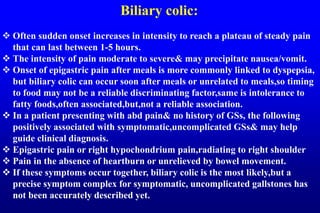
 Often sudden onset increases in intensity to reach a plateau of steady pain
that can last between 1-5 hours.
 The intensity of pain moderate to severe& may precipitate nausea/vomit.
 Onset of epigastric pain after meals is more commonly linked to dyspepsia,
but biliary colic can occur soon after meals or unrelated to meals,so timing
to food may not be a reliable discriminating factor,same is intolerance to
fatty foods,often associated,but,not a reliable association.
 In a patient presenting with abd pain& no history of GSs, the following
positively associated with symptomatic,uncomplicated GSs& may help
guide clinical diagnosis.
 Epigastric pain or right hypochondrium pain,radiating to right shoulder
 Pain in the absence of heartburn or unrelieved by bowel movement.
 If these symptoms occur together, biliary colic is the most likely,but a
precise symptom complex for symptomatic, uncomplicated gallstones has
not been accurately described yet.
Biliary colic:
 Features that have been associated with increased risk of GSs, include:
 Incr age, female, pregnancy, multiparity, obesity&family H/O GSs.
 Insulin resistance, particularly undiagnosed diabetes in women.
 Haemolytic diseases
 Rapid weight loss (>1.5 kg/week) from dieting or bariatric surgery.
 Examination is important to:
 Whether the patient is systemically unwell to warrant urgent hosp admit.
 Whether the abd pain is GB related or is secondary to other causes:
 Check respiratory rate, heart rate, blood pressure,temperature.
 Systemic features;hypotension may indicate complicated GSs or dehydrat.
 Tachycardia alone may be driven by pain.
 Inspect the skin and eyes for jaundice, which may indicate complicated
gallstones or an alternate diagnosis (acute hepatitis, pancreatic or CC).
 Examine the abdomen to localise tenderness, which, if caused by
gallstones, is most likely in the RUQ or epigastrium.
Biliary colic:
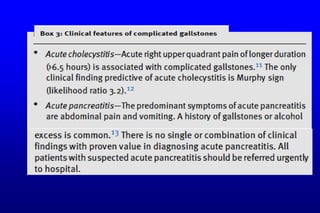
 A painful, palpable gallbladder, whereby inspiration is arrested on deep
palpation of the right upper quadrant, is known as Murphy sign and is
suggestive of peritoneal irritation as a result of acute inflammation, a
clinical sign predictive of acute cholecystitis (likelihood ratio 3.2).
 ‐A painless, palpable gallbladder, known as Courvoisier sign, is suggestive
of extra-hepatic biliary obstruction (likelihood ratio 26), though poor at
differentiating malignant from benign causes.
 Examine the lungs to exclude basal lung pathology.
 Urine analysis, to exclude renal& urological causes.
 Urinary pregnancy test in all females of childbearing age to exclude
pregnancy.
Urgent hosp admission:
 Patients should be urgently referred to hospital if:
 Systemic observations are abnormal& there is a suspicion of complicated
gallstones.
 Pain is not controlled with analgesia in the community.
 Subsequent, elective referral to a surgical service may be indicated if the
patient has radiologically confirmed, symptomatic, uncomplicated
gallstones&wishes to consider surgical management.5
Investigation in PC:
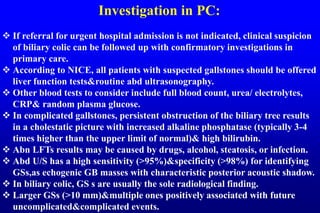
 If referral for urgent hospital admission is not indicated, clinical suspicion
of biliary colic can be followed up with confirmatory investigations in
primary care.
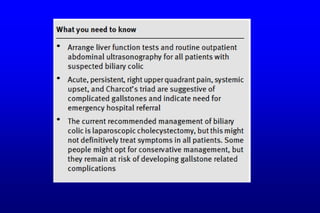
 According to NICE, all patients with suspected gallstones should be offered
liver function tests&routine abd ultrasonography.
 Other blood tests to consider include full blood count, urea/ electrolytes,
CRP& random plasma glucose.
 In complicated gallstones, persistent obstruction of the biliary tree results
in a cholestatic picture with increased alkaline phosphatase (typically 3-4
times higher than the upper limit of normal)& high bilirubin.
 Abn LFTs results may be caused by drugs, alcohol, steatosis, or infection.
 Abd U/S has a high sensitivity (>95%)&specificity (>98%) for identifying
GSs,as echogenic GB masses with characteristic posterior acoustic shadow.
 In biliary colic, GS s are usually the sole radiological finding.
 Larger GSs (>10 mm)&multiple ones positively associated with future
uncomplicated&complicated events.
Management options:
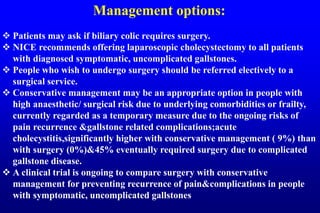
 Patients may ask if biliary colic requires surgery.
 NICE recommends offering laparoscopic cholecystectomy to all patients
with diagnosed symptomatic, uncomplicated gallstones.
 People who wish to undergo surgery should be referred electively to a
surgical service.
 Conservative management may be an appropriate option in people with
high anaesthetic/ surgical risk due to underlying comorbidities or frailty,
currently regarded as a temporary measure due to the ongoing risks of
pain recurrence &gallstone related complications;acute
cholecystitis,significantly higher with conservative management ( 9%) than
with surgery (0%)&45% eventually required surgery due to complicated
gallstone disease.
 A clinical trial is ongoing to compare surgery with conservative
management for preventing recurrence of pain&complications in people
with symptomatic, uncomplicated gallstones
Management options:
 Lifestyle modification with exercise and a low fat diet traditionally advised
to prevent recurrence of biliary colic, but evidence remains insufficient.
 The recommended initial analgesics for biliary colic are paracetamol&
diclofenac, it is as effective as opiates&superior to antispasmodics in
relieving gallstone related pain.
 Antibiotic is not indicated in biliary colic.
 There is insufficient evidence to support the use of proton pump inhibitors,
hyoscine, or gallstone dissolution therapies (ursodeoxycholic acid,
extracorporeal lithotripsy) in the management of symptomatic,
uncomplicated gallstones.
Git j club biliary colic21

Git j club biliary colic21

  • 1.
    Kurdistan Board GEH/GITSurgery J Club 2021 Supervised by Professor Dr. Mohamed Alshekhani.
  • 2.
    Biliary colic:  Oftensudden onset increases in intensity to reach a plateau of steady pain that can last between 1-5 hours.  The intensity of pain moderate to severe& may precipitate nausea/vomit.  Onset of epigastric pain after meals is more commonly linked to dyspepsia, but biliary colic can occur soon after meals or unrelated to meals,so timing to food may not be a reliable discriminating factor,same is intolerance to fatty foods,often associated,but,not a reliable association.  In a patient presenting with abd pain& no history of GSs, the following positively associated with symptomatic,uncomplicated GSs& may help guide clinical diagnosis.  Epigastric pain or right hypochondrium pain,radiating to right shoulder  Pain in the absence of heartburn or unrelieved by bowel movement.  If these symptoms occur together, biliary colic is the most likely,but a precise symptom complex for symptomatic, uncomplicated gallstones has not been accurately described yet.
  • 3.
    Biliary colic:  Featuresthat have been associated with increased risk of GSs, include:  Incr age, female, pregnancy, multiparity, obesity&family H/O GSs.  Insulin resistance, particularly undiagnosed diabetes in women.  Haemolytic diseases  Rapid weight loss (>1.5 kg/week) from dieting or bariatric surgery.  Examination is important to:  Whether the patient is systemically unwell to warrant urgent hosp admit.  Whether the abd pain is GB related or is secondary to other causes:  Check respiratory rate, heart rate, blood pressure,temperature.  Systemic features;hypotension may indicate complicated GSs or dehydrat.  Tachycardia alone may be driven by pain.  Inspect the skin and eyes for jaundice, which may indicate complicated gallstones or an alternate diagnosis (acute hepatitis, pancreatic or CC).  Examine the abdomen to localise tenderness, which, if caused by gallstones, is most likely in the RUQ or epigastrium.
  • 4.
    Biliary colic:  Apainful, palpable gallbladder, whereby inspiration is arrested on deep palpation of the right upper quadrant, is known as Murphy sign and is suggestive of peritoneal irritation as a result of acute inflammation, a clinical sign predictive of acute cholecystitis (likelihood ratio 3.2).  ‐A painless, palpable gallbladder, known as Courvoisier sign, is suggestive of extra-hepatic biliary obstruction (likelihood ratio 26), though poor at differentiating malignant from benign causes.  Examine the lungs to exclude basal lung pathology.  Urine analysis, to exclude renal& urological causes.  Urinary pregnancy test in all females of childbearing age to exclude pregnancy.
  • 5.
    Urgent hosp admission: Patients should be urgently referred to hospital if:  Systemic observations are abnormal& there is a suspicion of complicated gallstones.  Pain is not controlled with analgesia in the community.  Subsequent, elective referral to a surgical service may be indicated if the patient has radiologically confirmed, symptomatic, uncomplicated gallstones&wishes to consider surgical management.5
  • 6.
    Investigation in PC: If referral for urgent hospital admission is not indicated, clinical suspicion of biliary colic can be followed up with confirmatory investigations in primary care.  According to NICE, all patients with suspected gallstones should be offered liver function tests&routine abd ultrasonography.  Other blood tests to consider include full blood count, urea/ electrolytes, CRP& random plasma glucose.  In complicated gallstones, persistent obstruction of the biliary tree results in a cholestatic picture with increased alkaline phosphatase (typically 3-4 times higher than the upper limit of normal)& high bilirubin.  Abn LFTs results may be caused by drugs, alcohol, steatosis, or infection.  Abd U/S has a high sensitivity (>95%)&specificity (>98%) for identifying GSs,as echogenic GB masses with characteristic posterior acoustic shadow.  In biliary colic, GS s are usually the sole radiological finding.  Larger GSs (>10 mm)&multiple ones positively associated with future uncomplicated&complicated events.
  • 7.
    Management options:  Patientsmay ask if biliary colic requires surgery.  NICE recommends offering laparoscopic cholecystectomy to all patients with diagnosed symptomatic, uncomplicated gallstones.  People who wish to undergo surgery should be referred electively to a surgical service.  Conservative management may be an appropriate option in people with high anaesthetic/ surgical risk due to underlying comorbidities or frailty, currently regarded as a temporary measure due to the ongoing risks of pain recurrence &gallstone related complications;acute cholecystitis,significantly higher with conservative management ( 9%) than with surgery (0%)&45% eventually required surgery due to complicated gallstone disease.  A clinical trial is ongoing to compare surgery with conservative management for preventing recurrence of pain&complications in people with symptomatic, uncomplicated gallstones
  • 8.
    Management options:  Lifestylemodification with exercise and a low fat diet traditionally advised to prevent recurrence of biliary colic, but evidence remains insufficient.  The recommended initial analgesics for biliary colic are paracetamol& diclofenac, it is as effective as opiates&superior to antispasmodics in relieving gallstone related pain.  Antibiotic is not indicated in biliary colic.  There is insufficient evidence to support the use of proton pump inhibitors, hyoscine, or gallstone dissolution therapies (ursodeoxycholic acid, extracorporeal lithotripsy) in the management of symptomatic, uncomplicated gallstones.