Pancreatic disorders
Acute pancreatitis:
 3% of all cases of abd pain admitted to hospital.
 Affects 2–28/100 000,increasing in incidence.
 A potentially serious condition with an overall mortality of 10%.
 About 80% of all cases are mild with favourable outcome.
 Approximately 98% of deaths occur in the 20% of patients with severe
disease& about 1/3 within the first week, usually from multi-organ failure.
 After this time, the majority of deaths result from sepsis, especially that
complicating infected necrosis.
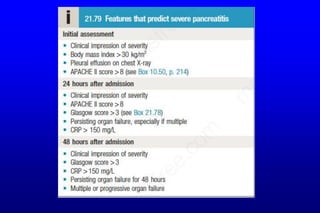
 At admission, it is possible to predict patients at risk of complications.
 Individuals who are predicted to have severe pancreatitis&those with
necrosis or other complications should be managed in a specialist centre
with an intensive care unit& multidisciplinary hepatobiliary specialists.
Acute pancreatitis:Pathophysiology
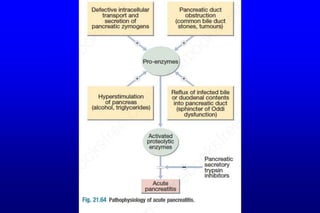
 AP occurs from premature intracellular trypsinogen activation, releasing
proteases that digest the pancreas& surrounding tissue.
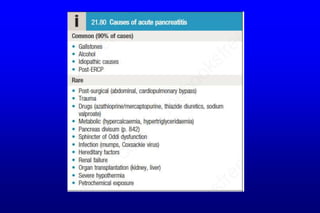
 Triggers :alcohol, gallstone &PD obstruction .
 There is simultaneous activation of nuclear factor kappaB (NFκB), leading
to mitochondrial dysfunction, autophagy& vigorous inflamma response.
 The normal pancreas has only a poorly developed capsule& adjacent
structures, including the common bile duct, duodenum, splenic vein&
transverse colon, are commonly involved in the inflammatory process.
 The severity is dependent on the balance between the released proteolytic
enzymes& antiproteolytic factors; intracellular panc trypsin inhibitor
protein& circulating β2-macroglobulin, α1-antitrypsin& C1-esterase inhib.
 AP is often self-limiting, in some with severe disease, local complications;
necrosis, pseudocyst or abscess&systemic complications lead to MOF.
Acute pancreatitis : Clinical features
 The typical presentation is with severe, constant upper abd pain, of
increasing intensity over 15–60 minutes, which radiates to the back.
 Nausea/vomiting are common.
 There is marked epigastric tenderness, but in the early stages ( in contrast
to a perforated peptic ulcer), guarding/ rebound tenderness are absent
because the inflammation is principally retroperitoneal.
 Bowel sounds become quiet or absent as paralytic ileus develops.
 In severe cases, hypoxia, hypovolaemic shock develop with oliguria.
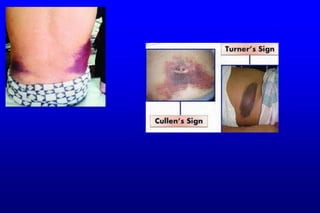
 Discoloration of the flanks(Grey Turner’s sign) or the periumbilical region
(Cullen’s sign) is a feature of severe pancreatitis with haemorrhage.
 DD:perforated viscus,acute cholecystitis&myocardial infarction.
Acute pancreatitis : Clinical features
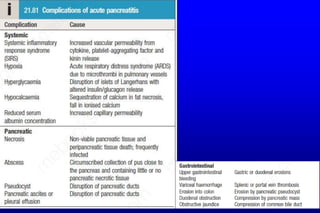
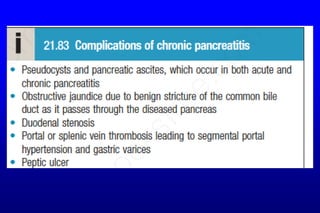
 Various complications may occur.
 A collection of fluid& debris develop in the lesser sac, following inflamma
rupture of the pancreatic duct; initially contained within a poorly defined,
fragile wall of granulation tissue, which matures over a 6-week period to
form a fibrous capsule (pseudocysts) common, usually asymptomatic,
resolving as the pancreatitis recovers.
 Pseudocysts> 6 cm in diameter seldom disappear spontaneously, can cause
constant abd pain&compress or erode surrounding structures, including
blood vessels, to form pseudoaneurysms.
 Large pseudocysts can be detected clinically as a palpable abdominal mass.
 Pancreatic ascites occurs when fluid leaks from a disrupted pancreatic
duct into the peritoneal cavity.
 Leakage into the thoracic cavity can result in a pleural effusion or a
pleuro-pancreatic fistula.
Acute pancreatitis : Lab
 Diagnostic traid: 2 of the 3: pain/enzyme elevation,imaging.
 Diagnosis:raised serum amylase or lipas& U/S or CT evidence of
pancreatic swelling.
 Plain X-rays should be taken to exclude other diagnoses, as perforation or
obstruction& identify pulmonary complications.
 Amylase is efficiently excreted by the kidneys&concentrations may have
returned to normal if measured 24–48 hours after the onset of pancreatitis.
 A persistently elevated serum amylase concentration suggests pseudocyst.
 Peritoneal amylase are massively elevated in pancreatic ascites.
 Serum amylase concentrations are also elevated (but less so) in intestinal
ischaemia, perforated peptic ulcer&ruptured ovarian cyst, while the
salivary isoenzyme of amylase is elevated in parotitis.
Acute pancreatitis : Lab
 If available, s lipase preferable to amylase, have greater diagn accuracy.
 Certain invs stratify the severity of AP&have important prognostic value
at the time of presentation,as serial assessment of CRP.
 A peak CRP of > 210 mg/L in the first 4 days predicts severe AP with 80%
accuracy.
 amylase concentration has no prognostic value.
Acute pancreatitis : imagings
 U/S can confirm the diagnosis, although in the earlier stages the gland may
not be grossly swollen,also useful because it may show gallstones, biliary
obstruction or pseudocyst formation.
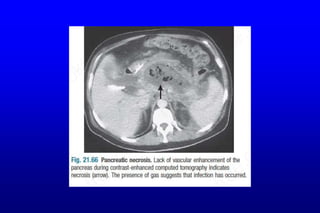
 CE CT, 6–10 days after admission useful in assessing viability, if persisting
organ failure, sepsis or clinical deterioration; features of pan necrosis.
 Necrotising pancreatitis is associated with decreased pancreatic
enhancement on CT, following IV contrast inj.
 The presence of gas within necrotic material suggests infection&impending
abscess formation, in which case percutaneous aspiration of material for
bacterial culture, for appropriate antibiotics.
 Involvement of the colon, blood vessels&other adjacent structures by the
inflammatory process is best seen by CT.
Acute pancreatitis : Management
 Establishing the diagnosis& disease severity
 Early resuscitation, according to whether the disease is mild or severe
 Detection& treatment of complications
 Treatment of the underlying cause.
 Opiate analgesics should be given to treat pain&hypovolaemia should be
corrected using normal saline or other crystalloids.
 All severe cases should be managed in a high-dependency ward or ICU.
 A CV line&urinary cath should be inserted to monitor patients with shock.
 Oxygen should be given to hypoxic patients&those who develop systemic
inflammatory response syndrome (SIRS) may require ventilatory support.
 Hyperglycaemia corrected using insulin& hypocalcaemia by IV calcium.
 NG aspiration is required only if paralytic ileus is present.
 Enteral feeding, if tolerated, should be started early in severe AP because
they are in a severely catabolic state& need nutritional support.
Acute pancreatitis : Management
 Enteral feeding decreases endotoxaemia&reduce systemic complications.
 Nasogastric feeding is just as effective as nasojejunal route.
 Prophylaxis of thromboembolism with SC LMWH is also advisable.
 Use of prophylactic, broad-spectrum IV antibiotics to prevent inf of panc
necrosis is not indicated, but infected necrosis treated with antibiotics
penetrating necrotic tissue;carbapenems or quinolones, &metronidazole.
 Patients who present with cholangitis or jaundice in association with severe
AP should undergo urgent ERCP to diagnose&treat choledocholithiasis.
 In less severe cases of gallstone pancreatitis, biliary imaging (using MRCP
or EUS) can be carried out after the acute phase has resolved.
 If the liver function tests return to normal&U/S has not demonstrated a
dilated biliary tree, lapchole with an on-table cholangiogram is
appropriate because any CBD stones have probably passed.
Acute pancreatitis : Management
 When the operative cholangiogram detects residual CBD stones, should be
removed by laparoscopic exploration or by post-operative ERCP.
 Cholecystectomy should be undertaken within 2 weeks of resolution of
pancreatitis – preferably during the same admission – to prevent further
potentially fatal attacks of pancreatitis.
 Patients with infected pancreatic necrosis or pancreatic abscess require
urgent endoscopic drainage or minimally invasive retroperitoneal
pancreatic (MIRP) necrosectomy to debride all necrotic material.
 Pancreatic pseudocysts can be treated by drainage into the stomach or
duodenum,usually performed after an interval of at least 6 weeks,once a
pseudocapsule has matured, by surgical or endoscopic cystogastrostomy.
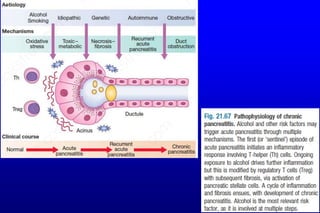
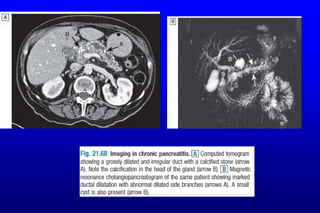
Chronic pancreatitis :
 A chronic inflammatory disease characterized by fibrosis& destruction of
exocrine pancreatic tissue.
 Diabetes mellitus occurs in advanced cases because islets of Langerhans
are involved.
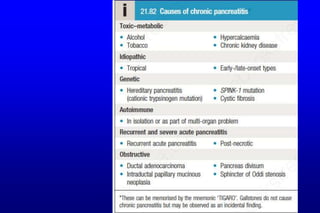
Chronic pancreatitis:causes
 Around 80% result from alcohol misuse.
 In poor countries, severe chronic calcific pancreatitis occurs in non-
alcoholics, possibly as a result of malnutrition, deficiency of trace elements
/ micronutrients& cassava consumption.
Chronic pancreatitis: clinical features
 Predominantly affects middle-aged alcoholic men.
 Almost all present with abdominal pain.
 In 50%, this occurs as episodes of ‘acute pancreatitis’, although each
attack results in a degree of permanent pancreatic damage.
 Relentless slowly progressive chronic pain without acute exacerbations
affects 35%, while the remainder have no pain but present with diarrhoea.
 Pain is due to a combination of increased pressure within the pancreatic
ducts&direct involvement of peripancreatic nerves by the inflam process.
 Pain may be relieved by leaning forwards or by drinking alcohol.
 Approximately one-fifth of patients chronically consume opiate analgesics.
 Weight loss is common results from a combination of anorexia, avoidance
of food because of post-prandial pain, malabsorption&/or diabetes.
 Steatorrhoea occurs when> 90% of the exocrine tissue has been destroyed;
protein malabsorption develops only in the most advanced cases.
Chronic pancreatitis: clinical features
 Overall, 30% have (secondary) diabetes but rises to 70% in those with
chronic calcific pancreatitis.
 Physical examination reveals a thin, malnourished patient with epigastric
tenderness. Skin pigmentation over the abdomen& back is common results
from chronic use of a hot water bottle (erythema ab igne).
 Many patients have features of other alcohol&smoking-related diseases.
Chronic pancreatitis: Investigations
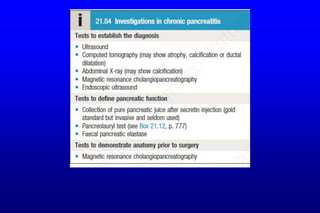
 Aims:
 Make a diagnosis of chronic pancreatitis
 Define pancreatic function
 Demonstrate anatomical abnormalities prior to surgical intervention.
Chronic pancreatitis: Management
 1.Alcohol misuse:
 Alcohol avoidance is crucial in halting progression of the disease&reducing
pain.
Chronic pancreatitis: Management
 2.Pain relief:
 Analgesic drugs,sp NSAIDs, are valuable but the severe/ unremitting
nature of the pain often leads to opiate use with the risk of addiction.
 Analgesics, as pregabalin/TADs at a low dose, may be effective.
 Oral pancreatic enzyme supplements suppress pancreatic secretion& their
regular use reduces analgesic consumption in some patients.
Chronic pancreatitis: Management
 2.Pain relief:
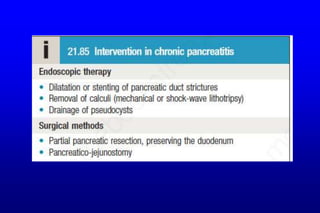
 Patients who are abstinent from alcohol&who have severe chronic pain
resistant to conservative measures should be considered for surgical or
endoscopic pancreatic therapy.
 Coeliac plexus neurolysis sometimes produces long-lasting pain relief,
although relapse occurs in the majority of cases.
 In some, MRCP does not show a surgically or endoscopically correctable
abn, in these individuals, the only approach is total pancreatectomy.
 Even after this operation, some continue to experience pain&the procedure
causes DM,difficult to control, with high risk of hypoglycaemia (since both
insulin& glucagon are absent)&significant morbidity&mortality.
Chronic pancreatitis: Management
 3.Malabsorption
 Treated by dietary fat restriction (with supplementary medium-chain
triglyceride therapy in malnourished patients)&oral pancreatic enzyme
supplements.
 A PPI is added to optimize duodenal pH for pancreatic enzyme activity.
Chronic pancreatitis: Management
 4.Complications management:
 Surgical or endoscopic therapy may be necessary for the management of
pseudocysts, pancreatic ascites, common bile duct or duodenal stricture&
the consequences of portal hypertension.
 Many patients with chronic pancreatitis also require treatment for other
alcohol/ smoking-related diseases& for the consequences of self-neglect
&malnutrition.
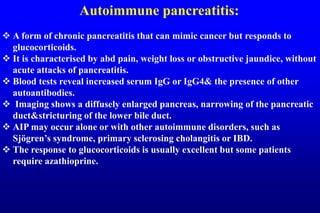
Autoimmune pancreatitis:
 A form of chronic pancreatitis that can mimic cancer but responds to
glucocorticoids.
 It is characterised by abd pain, weight loss or obstructive jaundice, without
acute attacks of pancreatitis.
 Blood tests reveal increased serum IgG or IgG4& the presence of other
autoantibodies.
 Imaging shows a diffusely enlarged pancreas, narrowing of the pancreatic
duct&stricturing of the lower bile duct.
 AIP may occur alone or with other autoimmune disorders, such as
Sjögren’s syndrome, primary sclerosing cholangitis or IBD.
 The response to glucocorticoids is usually excellent but some patients
require azathioprine.
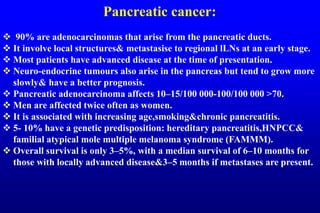
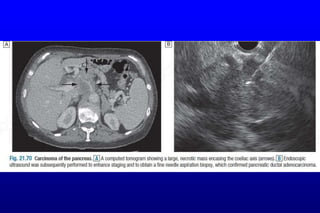
Pancreatic cancer:
 90% are adenocarcinomas that arise from the pancreatic ducts.
 It involve local structures& metastasise to regional lLNs at an early stage.
 Most patients have advanced disease at the time of presentation.
 Neuro-endocrine tumours also arise in the pancreas but tend to grow more
slowly& have a better prognosis.
 Pancreatic adenocarcinoma affects 10–15/100 000-100/100 000 >70.
 Men are affected twice often as women.
 It is associated with increasing age,smoking&chronic pancreatitis.
 5- 10% have a genetic predisposition: hereditary pancreatitis,HNPCC&
familial atypical mole multiple melanoma syndrome (FAMMM).
 Overall survival is only 3–5%, with a median survival of 6–10 months for
those with locally advanced disease&3–5 months if metastases are present.
Pancreatic cancer: Clin features
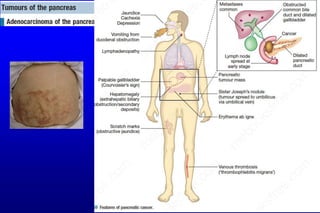
 Many patients are asymptomatic until an advanced stage, when they
present with central abdominal pain, weight loss&obstructive jaundice.
 The pain results from invasion of the coeliac plexus, characteristically
incessant&gnawing,often radiates from the upper abdomen through to the
back&may be eased a little by bending forwards.
 Almost all patients lose weight& many are cachectic.
 60% arise from the head &involvement of CBD results in the development
of obstructive jaundice, often with severe pruritus.
 A few patients present with diarrhoea, vomiting from duodenal
obstruction, DM, recurrent venous thrombosis, AP or depression.
 Physical exam: evidence of wt loss,abd mass due to the tumour itself, a
palpable gallbladder or hepatic metastasis is commonly found.
 A palpable GB in a jaundiced patient is usually the consequence of distal
biliary obstruction by a pancreatic cancer (Courvoisier’s sign).
Pancreatic cancer: Investigations
 The diagnosis is usually made by ultrasound and contrast-enhanced CT
 Diagnosis in non-jaundiced patients is often delayed because presenting
symptoms are relatively non-specific.
 Fit patients with small, localised tumours should undergo staging to define
operability.
 EUS or laparoscopy with laparoscopic ultrasound will define tumour size,
involvement of blood vessels& metastatic spread.
 In patients unsuitable for surgery because of advanced disease, frailty or
comorbidity, EUS- or CT-guided cytology or biopsy can be used to confirm
the diagnosis.
 MRCP& ERCP are sensitive methods of diagnosing pancreatic cancer&
valuable when the diagnosis is in doubt, although differentiation between
cancer& localised chronic/AI pancreatitis can be difficult.
 The main role of ERCP is to insert a stent into the common bile duct to
relieve obstructive jaundice in inoperable patients.
Pancreatic cancer: Management
 Surgical resection is the only method of effecting cure& 5-year survival in
patients undergoing a complete resection is around 12%.
 Improved survival (21–29%) with adj chemotherapy using gemcitabine.
 Unfortunately, only 10–15% of tumours are resectable for cure, since most
are locally advanced at the time of diagnosis.
Pancreatic cancer: Management
 For the great majority of patients, treatment is palliative.
 Chemotherapy with FOLFIRINOX (5-fluorouracil, leucovorin, irinotecan ,
oxaliplatin) improves median survival to 11 months.
 Pain relief can be achieved using analgesics but, in some patients, coeliac
plexus neurolysis may be required.
 Jaundice relieved by choledochojejunostomy in fit patients& percutaneous
or endoscopic stenting is preferable in the elderly &very advanced disease.
 Ampullary or periampullary ACs are rare,often polypoid, may ulcerate;
frequently infiltrate the duodenum but behave less aggressively than
pancreatic AC&25%undergoing resection survive 5 Ys.
Git 4th pancreatic disorders21

Git 4th pancreatic disorders21

  • 1.
  • 2.
    Acute pancreatitis:  3%of all cases of abd pain admitted to hospital.  Affects 2–28/100 000,increasing in incidence.  A potentially serious condition with an overall mortality of 10%.  About 80% of all cases are mild with favourable outcome.  Approximately 98% of deaths occur in the 20% of patients with severe disease& about 1/3 within the first week, usually from multi-organ failure.  After this time, the majority of deaths result from sepsis, especially that complicating infected necrosis.  At admission, it is possible to predict patients at risk of complications.  Individuals who are predicted to have severe pancreatitis&those with necrosis or other complications should be managed in a specialist centre with an intensive care unit& multidisciplinary hepatobiliary specialists.
  • 5.
    Acute pancreatitis:Pathophysiology  APoccurs from premature intracellular trypsinogen activation, releasing proteases that digest the pancreas& surrounding tissue.  Triggers :alcohol, gallstone &PD obstruction .  There is simultaneous activation of nuclear factor kappaB (NFκB), leading to mitochondrial dysfunction, autophagy& vigorous inflamma response.  The normal pancreas has only a poorly developed capsule& adjacent structures, including the common bile duct, duodenum, splenic vein& transverse colon, are commonly involved in the inflammatory process.  The severity is dependent on the balance between the released proteolytic enzymes& antiproteolytic factors; intracellular panc trypsin inhibitor protein& circulating β2-macroglobulin, α1-antitrypsin& C1-esterase inhib.  AP is often self-limiting, in some with severe disease, local complications; necrosis, pseudocyst or abscess&systemic complications lead to MOF.
  • 7.
    Acute pancreatitis :Clinical features  The typical presentation is with severe, constant upper abd pain, of increasing intensity over 15–60 minutes, which radiates to the back.  Nausea/vomiting are common.  There is marked epigastric tenderness, but in the early stages ( in contrast to a perforated peptic ulcer), guarding/ rebound tenderness are absent because the inflammation is principally retroperitoneal.  Bowel sounds become quiet or absent as paralytic ileus develops.  In severe cases, hypoxia, hypovolaemic shock develop with oliguria.  Discoloration of the flanks(Grey Turner’s sign) or the periumbilical region (Cullen’s sign) is a feature of severe pancreatitis with haemorrhage.  DD:perforated viscus,acute cholecystitis&myocardial infarction.
  • 9.
    Acute pancreatitis :Clinical features  Various complications may occur.  A collection of fluid& debris develop in the lesser sac, following inflamma rupture of the pancreatic duct; initially contained within a poorly defined, fragile wall of granulation tissue, which matures over a 6-week period to form a fibrous capsule (pseudocysts) common, usually asymptomatic, resolving as the pancreatitis recovers.  Pseudocysts> 6 cm in diameter seldom disappear spontaneously, can cause constant abd pain&compress or erode surrounding structures, including blood vessels, to form pseudoaneurysms.  Large pseudocysts can be detected clinically as a palpable abdominal mass.  Pancreatic ascites occurs when fluid leaks from a disrupted pancreatic duct into the peritoneal cavity.  Leakage into the thoracic cavity can result in a pleural effusion or a pleuro-pancreatic fistula.
  • 11.
    Acute pancreatitis :Lab  Diagnostic traid: 2 of the 3: pain/enzyme elevation,imaging.  Diagnosis:raised serum amylase or lipas& U/S or CT evidence of pancreatic swelling.  Plain X-rays should be taken to exclude other diagnoses, as perforation or obstruction& identify pulmonary complications.  Amylase is efficiently excreted by the kidneys&concentrations may have returned to normal if measured 24–48 hours after the onset of pancreatitis.  A persistently elevated serum amylase concentration suggests pseudocyst.  Peritoneal amylase are massively elevated in pancreatic ascites.  Serum amylase concentrations are also elevated (but less so) in intestinal ischaemia, perforated peptic ulcer&ruptured ovarian cyst, while the salivary isoenzyme of amylase is elevated in parotitis.
  • 12.
    Acute pancreatitis :Lab  If available, s lipase preferable to amylase, have greater diagn accuracy.  Certain invs stratify the severity of AP&have important prognostic value at the time of presentation,as serial assessment of CRP.  A peak CRP of > 210 mg/L in the first 4 days predicts severe AP with 80% accuracy.  amylase concentration has no prognostic value.
  • 13.
    Acute pancreatitis :imagings  U/S can confirm the diagnosis, although in the earlier stages the gland may not be grossly swollen,also useful because it may show gallstones, biliary obstruction or pseudocyst formation.  CE CT, 6–10 days after admission useful in assessing viability, if persisting organ failure, sepsis or clinical deterioration; features of pan necrosis.  Necrotising pancreatitis is associated with decreased pancreatic enhancement on CT, following IV contrast inj.  The presence of gas within necrotic material suggests infection&impending abscess formation, in which case percutaneous aspiration of material for bacterial culture, for appropriate antibiotics.  Involvement of the colon, blood vessels&other adjacent structures by the inflammatory process is best seen by CT.
  • 14.
    Acute pancreatitis :Management  Establishing the diagnosis& disease severity  Early resuscitation, according to whether the disease is mild or severe  Detection& treatment of complications  Treatment of the underlying cause.  Opiate analgesics should be given to treat pain&hypovolaemia should be corrected using normal saline or other crystalloids.  All severe cases should be managed in a high-dependency ward or ICU.  A CV line&urinary cath should be inserted to monitor patients with shock.  Oxygen should be given to hypoxic patients&those who develop systemic inflammatory response syndrome (SIRS) may require ventilatory support.  Hyperglycaemia corrected using insulin& hypocalcaemia by IV calcium.  NG aspiration is required only if paralytic ileus is present.  Enteral feeding, if tolerated, should be started early in severe AP because they are in a severely catabolic state& need nutritional support.
  • 15.
    Acute pancreatitis :Management  Enteral feeding decreases endotoxaemia&reduce systemic complications.  Nasogastric feeding is just as effective as nasojejunal route.  Prophylaxis of thromboembolism with SC LMWH is also advisable.  Use of prophylactic, broad-spectrum IV antibiotics to prevent inf of panc necrosis is not indicated, but infected necrosis treated with antibiotics penetrating necrotic tissue;carbapenems or quinolones, &metronidazole.  Patients who present with cholangitis or jaundice in association with severe AP should undergo urgent ERCP to diagnose&treat choledocholithiasis.  In less severe cases of gallstone pancreatitis, biliary imaging (using MRCP or EUS) can be carried out after the acute phase has resolved.  If the liver function tests return to normal&U/S has not demonstrated a dilated biliary tree, lapchole with an on-table cholangiogram is appropriate because any CBD stones have probably passed.
  • 16.
    Acute pancreatitis :Management  When the operative cholangiogram detects residual CBD stones, should be removed by laparoscopic exploration or by post-operative ERCP.  Cholecystectomy should be undertaken within 2 weeks of resolution of pancreatitis – preferably during the same admission – to prevent further potentially fatal attacks of pancreatitis.  Patients with infected pancreatic necrosis or pancreatic abscess require urgent endoscopic drainage or minimally invasive retroperitoneal pancreatic (MIRP) necrosectomy to debride all necrotic material.  Pancreatic pseudocysts can be treated by drainage into the stomach or duodenum,usually performed after an interval of at least 6 weeks,once a pseudocapsule has matured, by surgical or endoscopic cystogastrostomy.
  • 18.
    Chronic pancreatitis : A chronic inflammatory disease characterized by fibrosis& destruction of exocrine pancreatic tissue.  Diabetes mellitus occurs in advanced cases because islets of Langerhans are involved.
  • 19.
    Chronic pancreatitis:causes  Around80% result from alcohol misuse.  In poor countries, severe chronic calcific pancreatitis occurs in non- alcoholics, possibly as a result of malnutrition, deficiency of trace elements / micronutrients& cassava consumption.
  • 22.
    Chronic pancreatitis: clinicalfeatures  Predominantly affects middle-aged alcoholic men.  Almost all present with abdominal pain.  In 50%, this occurs as episodes of ‘acute pancreatitis’, although each attack results in a degree of permanent pancreatic damage.  Relentless slowly progressive chronic pain without acute exacerbations affects 35%, while the remainder have no pain but present with diarrhoea.  Pain is due to a combination of increased pressure within the pancreatic ducts&direct involvement of peripancreatic nerves by the inflam process.  Pain may be relieved by leaning forwards or by drinking alcohol.  Approximately one-fifth of patients chronically consume opiate analgesics.  Weight loss is common results from a combination of anorexia, avoidance of food because of post-prandial pain, malabsorption&/or diabetes.  Steatorrhoea occurs when> 90% of the exocrine tissue has been destroyed; protein malabsorption develops only in the most advanced cases.
  • 23.
    Chronic pancreatitis: clinicalfeatures  Overall, 30% have (secondary) diabetes but rises to 70% in those with chronic calcific pancreatitis.  Physical examination reveals a thin, malnourished patient with epigastric tenderness. Skin pigmentation over the abdomen& back is common results from chronic use of a hot water bottle (erythema ab igne).  Many patients have features of other alcohol&smoking-related diseases.
  • 25.
    Chronic pancreatitis: Investigations Aims:  Make a diagnosis of chronic pancreatitis  Define pancreatic function  Demonstrate anatomical abnormalities prior to surgical intervention.
  • 27.
    Chronic pancreatitis: Management 1.Alcohol misuse:  Alcohol avoidance is crucial in halting progression of the disease&reducing pain.
  • 28.
    Chronic pancreatitis: Management 2.Pain relief:  Analgesic drugs,sp NSAIDs, are valuable but the severe/ unremitting nature of the pain often leads to opiate use with the risk of addiction.  Analgesics, as pregabalin/TADs at a low dose, may be effective.  Oral pancreatic enzyme supplements suppress pancreatic secretion& their regular use reduces analgesic consumption in some patients.
  • 29.
    Chronic pancreatitis: Management 2.Pain relief:  Patients who are abstinent from alcohol&who have severe chronic pain resistant to conservative measures should be considered for surgical or endoscopic pancreatic therapy.  Coeliac plexus neurolysis sometimes produces long-lasting pain relief, although relapse occurs in the majority of cases.  In some, MRCP does not show a surgically or endoscopically correctable abn, in these individuals, the only approach is total pancreatectomy.  Even after this operation, some continue to experience pain&the procedure causes DM,difficult to control, with high risk of hypoglycaemia (since both insulin& glucagon are absent)&significant morbidity&mortality.
  • 30.
    Chronic pancreatitis: Management 3.Malabsorption  Treated by dietary fat restriction (with supplementary medium-chain triglyceride therapy in malnourished patients)&oral pancreatic enzyme supplements.  A PPI is added to optimize duodenal pH for pancreatic enzyme activity.
  • 31.
    Chronic pancreatitis: Management 4.Complications management:  Surgical or endoscopic therapy may be necessary for the management of pseudocysts, pancreatic ascites, common bile duct or duodenal stricture& the consequences of portal hypertension.  Many patients with chronic pancreatitis also require treatment for other alcohol/ smoking-related diseases& for the consequences of self-neglect &malnutrition.
  • 34.
    Autoimmune pancreatitis:  Aform of chronic pancreatitis that can mimic cancer but responds to glucocorticoids.  It is characterised by abd pain, weight loss or obstructive jaundice, without acute attacks of pancreatitis.  Blood tests reveal increased serum IgG or IgG4& the presence of other autoantibodies.  Imaging shows a diffusely enlarged pancreas, narrowing of the pancreatic duct&stricturing of the lower bile duct.  AIP may occur alone or with other autoimmune disorders, such as Sjögren’s syndrome, primary sclerosing cholangitis or IBD.  The response to glucocorticoids is usually excellent but some patients require azathioprine.
  • 35.
    Pancreatic cancer:  90%are adenocarcinomas that arise from the pancreatic ducts.  It involve local structures& metastasise to regional lLNs at an early stage.  Most patients have advanced disease at the time of presentation.  Neuro-endocrine tumours also arise in the pancreas but tend to grow more slowly& have a better prognosis.  Pancreatic adenocarcinoma affects 10–15/100 000-100/100 000 >70.  Men are affected twice often as women.  It is associated with increasing age,smoking&chronic pancreatitis.  5- 10% have a genetic predisposition: hereditary pancreatitis,HNPCC& familial atypical mole multiple melanoma syndrome (FAMMM).  Overall survival is only 3–5%, with a median survival of 6–10 months for those with locally advanced disease&3–5 months if metastases are present.
  • 36.
    Pancreatic cancer: Clinfeatures  Many patients are asymptomatic until an advanced stage, when they present with central abdominal pain, weight loss&obstructive jaundice.  The pain results from invasion of the coeliac plexus, characteristically incessant&gnawing,often radiates from the upper abdomen through to the back&may be eased a little by bending forwards.  Almost all patients lose weight& many are cachectic.  60% arise from the head &involvement of CBD results in the development of obstructive jaundice, often with severe pruritus.  A few patients present with diarrhoea, vomiting from duodenal obstruction, DM, recurrent venous thrombosis, AP or depression.  Physical exam: evidence of wt loss,abd mass due to the tumour itself, a palpable gallbladder or hepatic metastasis is commonly found.  A palpable GB in a jaundiced patient is usually the consequence of distal biliary obstruction by a pancreatic cancer (Courvoisier’s sign).
  • 37.
    Pancreatic cancer: Investigations The diagnosis is usually made by ultrasound and contrast-enhanced CT  Diagnosis in non-jaundiced patients is often delayed because presenting symptoms are relatively non-specific.  Fit patients with small, localised tumours should undergo staging to define operability.  EUS or laparoscopy with laparoscopic ultrasound will define tumour size, involvement of blood vessels& metastatic spread.  In patients unsuitable for surgery because of advanced disease, frailty or comorbidity, EUS- or CT-guided cytology or biopsy can be used to confirm the diagnosis.  MRCP& ERCP are sensitive methods of diagnosing pancreatic cancer& valuable when the diagnosis is in doubt, although differentiation between cancer& localised chronic/AI pancreatitis can be difficult.  The main role of ERCP is to insert a stent into the common bile duct to relieve obstructive jaundice in inoperable patients.
  • 38.
    Pancreatic cancer: Management Surgical resection is the only method of effecting cure& 5-year survival in patients undergoing a complete resection is around 12%.  Improved survival (21–29%) with adj chemotherapy using gemcitabine.  Unfortunately, only 10–15% of tumours are resectable for cure, since most are locally advanced at the time of diagnosis.
  • 39.
    Pancreatic cancer: Management For the great majority of patients, treatment is palliative.  Chemotherapy with FOLFIRINOX (5-fluorouracil, leucovorin, irinotecan , oxaliplatin) improves median survival to 11 months.  Pain relief can be achieved using analgesics but, in some patients, coeliac plexus neurolysis may be required.  Jaundice relieved by choledochojejunostomy in fit patients& percutaneous or endoscopic stenting is preferable in the elderly &very advanced disease.  Ampullary or periampullary ACs are rare,often polypoid, may ulcerate; frequently infiltrate the duodenum but behave less aggressively than pancreatic AC&25%undergoing resection survive 5 Ys.