Kurdistan Board GEH/GIT Surgery J Club 2022
Supervised by Professor Dr. Mohamed Alshekhani.
Introduction:
 The clinical&endoscopic features of CI are non-specific.
 CI is correctly identified at the time of presentation in only 9%.
 The true incidence is likely underestimated because many mild cases
resolve spontaneously without medical treatment.
 Most CI are transient&no specific cause detected,so often labled idiopathic
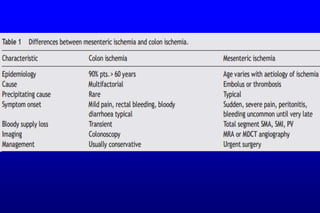
 In severe CI correct diagnosis, prompt recognition, therapy &
identification of underlying causes are crucial for a favorable outcome.
 Less severe&mild cases may present with similar symptoms,but prognosis/
management are completely different&managed conservatively.
 Endoscopic follow-up to detect chronic, recurrent/or strictures may be
considered.
 The SMA&IMA are both responsible for blood supply to the colon.
 The high density of the collateral vascular pathway (the marginal artery of
Drummond& the arc of Riolan) protects the entire colon from ischemic
injury,but the vasa recta (end-vessels providing blood to colon) are less
dense in the right colon, splenic flexure, rectosigmoid& hepatic flexure.
Introduction:
 Diagnosed in 9—24% of patients hospitalized for LGIB.
 CI most commonly occurs in elderly 80%& women 76%,but also youngs.
 The true incidence is difficult to estimate due to broad clin spectrum.
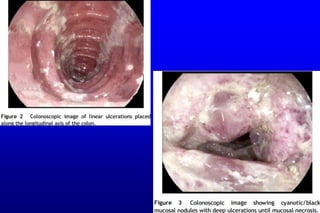
 CI findings can encompass inflammation, mucosal ulceration,
haemorrhage, pseudo-tumoral appearance&transmural necrosis.
 In most cases, ischemic damage is transient&reversible.
 In some cases, ulcerations/strictures, even asymptomatically, may persist
for several months before resolution.
 Irreversible consequences aused by transmural colonic damage that lead to
gangrene,fulminant colitis& multi-organ failure.
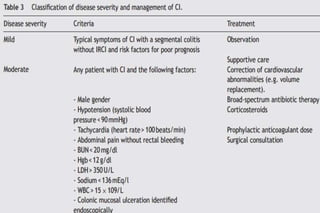
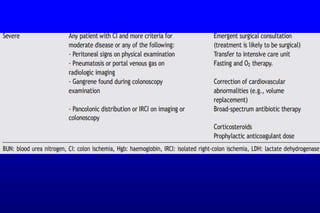
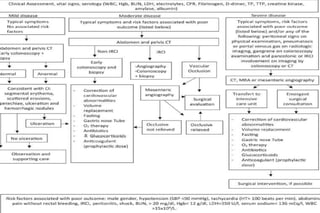
 Treatment options are determined by the severity.
 Rising with increased life expectancy with underlying comorbiditie&
increased recognition with CT/ endoscopy.
 Male gender is a predictor of poor prognosis,
 The overall mortality rate is 12%.
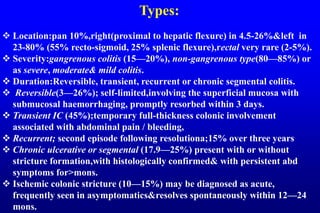
Types:
 Location:pan 10%,right(proximal to hepatic flexure) in 4.5-26%&left in
23-80% (55% recto-sigmoid, 25% splenic flexure),rectal very rare (2-5%).
 Severity:gangrenous colitis (15—20%), non-gangrenous type(80—85%) or
as severe, moderate& mild colitis.
 Duration:Reversible, transient, recurrent or chronic segmental colitis.
 Reversible(3—26%); self-limited,involving the superficial mucosa with
submucosal haemorrhaging, promptly resorbed within 3 days.
 Transient IC (45%);temporary full-thickness colonic involvement
associated with abdominal pain / bleeding,
 Recurrent; second episode following resolutiona;15% over three years
 Chronic ulcerative or segmental (17.9—25%) present with or without
stricture formation,with histologically confirmed& with persistent abd
symptoms for>mons.
 Ischemic colonic stricture (10—15%) may be diagnosed as acute,
frequently seen in asymptomatics&resolves spontaneously within 12—24
mons.
RFs:
 Hypertension the most common comorbidity (58%).
 DM(24%)
 Cardiovascular disease (23.8%)
 Nephropathy (15%)
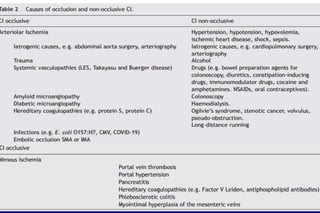
 AF (14.3%) [13,54], particularly in IRCI cases.
 A history of previous surgery (i.e.GI surgery, abdominal aortic aneurysm
surgery, or major CV surgery) in 3.9—79.1%
 Predictors of a poor prognosis are male gender, tachycardia, absence of
rectal bleeding, peritonitis, shock, hypotension (<90 mmHg) &IRCI.
Key points:
 CI is often clinically under appreciated,but common, acute& chronic dis.
 CI can affect young people with or without predisposing factors.
 Underlying hypercoagulable states may induce CI,including those
associated with COVID-19 infection.
 Accurate diagnosis will decrease the number of CI cases that are
incorrectly diagnosed as idiopathic.
 Treatment management differs according to the type of CI.
 Anticoagulant/ corticosteroids show promise for the treatment of severe &
moderate disease.
 Endoscopic surveillance at regular intervals following onset of disease can
be considered for early detection& treatment of subsequent strictures.
 Endoscopic dilation could be an alternative to surgery for symptomatic
strictures.
Conclusion:
 CI is a common & usually benign disease.
 The prognosis epends on the length of colon involved & the severity f
damage.
 Correct identification, prompt recognition of any underlying cause &
selection of treatment based ons everity are crucial.
 Ideally, A MD approach is necessary.
 Prompt diagnosis is essential because mortality rates significantly increase
when treatment is delayed.

Git j club colon ischemia22

  • 1.
    Kurdistan Board GEH/GITSurgery J Club 2022 Supervised by Professor Dr. Mohamed Alshekhani.
  • 2.
    Introduction:  The clinical&endoscopicfeatures of CI are non-specific.  CI is correctly identified at the time of presentation in only 9%.  The true incidence is likely underestimated because many mild cases resolve spontaneously without medical treatment.  Most CI are transient&no specific cause detected,so often labled idiopathic  In severe CI correct diagnosis, prompt recognition, therapy & identification of underlying causes are crucial for a favorable outcome.  Less severe&mild cases may present with similar symptoms,but prognosis/ management are completely different&managed conservatively.  Endoscopic follow-up to detect chronic, recurrent/or strictures may be considered.  The SMA&IMA are both responsible for blood supply to the colon.  The high density of the collateral vascular pathway (the marginal artery of Drummond& the arc of Riolan) protects the entire colon from ischemic injury,but the vasa recta (end-vessels providing blood to colon) are less dense in the right colon, splenic flexure, rectosigmoid& hepatic flexure.
  • 3.
    Introduction:  Diagnosed in9—24% of patients hospitalized for LGIB.  CI most commonly occurs in elderly 80%& women 76%,but also youngs.  The true incidence is difficult to estimate due to broad clin spectrum.  CI findings can encompass inflammation, mucosal ulceration, haemorrhage, pseudo-tumoral appearance&transmural necrosis.  In most cases, ischemic damage is transient&reversible.  In some cases, ulcerations/strictures, even asymptomatically, may persist for several months before resolution.  Irreversible consequences aused by transmural colonic damage that lead to gangrene,fulminant colitis& multi-organ failure.  Treatment options are determined by the severity.  Rising with increased life expectancy with underlying comorbiditie& increased recognition with CT/ endoscopy.  Male gender is a predictor of poor prognosis,  The overall mortality rate is 12%.
  • 4.
    Types:  Location:pan 10%,right(proximalto hepatic flexure) in 4.5-26%&left in 23-80% (55% recto-sigmoid, 25% splenic flexure),rectal very rare (2-5%).  Severity:gangrenous colitis (15—20%), non-gangrenous type(80—85%) or as severe, moderate& mild colitis.  Duration:Reversible, transient, recurrent or chronic segmental colitis.  Reversible(3—26%); self-limited,involving the superficial mucosa with submucosal haemorrhaging, promptly resorbed within 3 days.  Transient IC (45%);temporary full-thickness colonic involvement associated with abdominal pain / bleeding,  Recurrent; second episode following resolutiona;15% over three years  Chronic ulcerative or segmental (17.9—25%) present with or without stricture formation,with histologically confirmed& with persistent abd symptoms for>mons.  Ischemic colonic stricture (10—15%) may be diagnosed as acute, frequently seen in asymptomatics&resolves spontaneously within 12—24 mons.
  • 5.
    RFs:  Hypertension themost common comorbidity (58%).  DM(24%)  Cardiovascular disease (23.8%)  Nephropathy (15%)  AF (14.3%) [13,54], particularly in IRCI cases.  A history of previous surgery (i.e.GI surgery, abdominal aortic aneurysm surgery, or major CV surgery) in 3.9—79.1%  Predictors of a poor prognosis are male gender, tachycardia, absence of rectal bleeding, peritonitis, shock, hypotension (<90 mmHg) &IRCI.
  • 13.
    Key points:  CIis often clinically under appreciated,but common, acute& chronic dis.  CI can affect young people with or without predisposing factors.  Underlying hypercoagulable states may induce CI,including those associated with COVID-19 infection.  Accurate diagnosis will decrease the number of CI cases that are incorrectly diagnosed as idiopathic.  Treatment management differs according to the type of CI.  Anticoagulant/ corticosteroids show promise for the treatment of severe & moderate disease.  Endoscopic surveillance at regular intervals following onset of disease can be considered for early detection& treatment of subsequent strictures.  Endoscopic dilation could be an alternative to surgery for symptomatic strictures.
  • 14.
    Conclusion:  CI isa common & usually benign disease.  The prognosis epends on the length of colon involved & the severity f damage.  Correct identification, prompt recognition of any underlying cause & selection of treatment based ons everity are crucial.  Ideally, A MD approach is necessary.  Prompt diagnosis is essential because mortality rates significantly increase when treatment is delayed.