Kurdistan Board GEH/GIT Surgery J Club 2022
Supervised by Professor Dr. Mohamed Alshekhani.
Introduction:
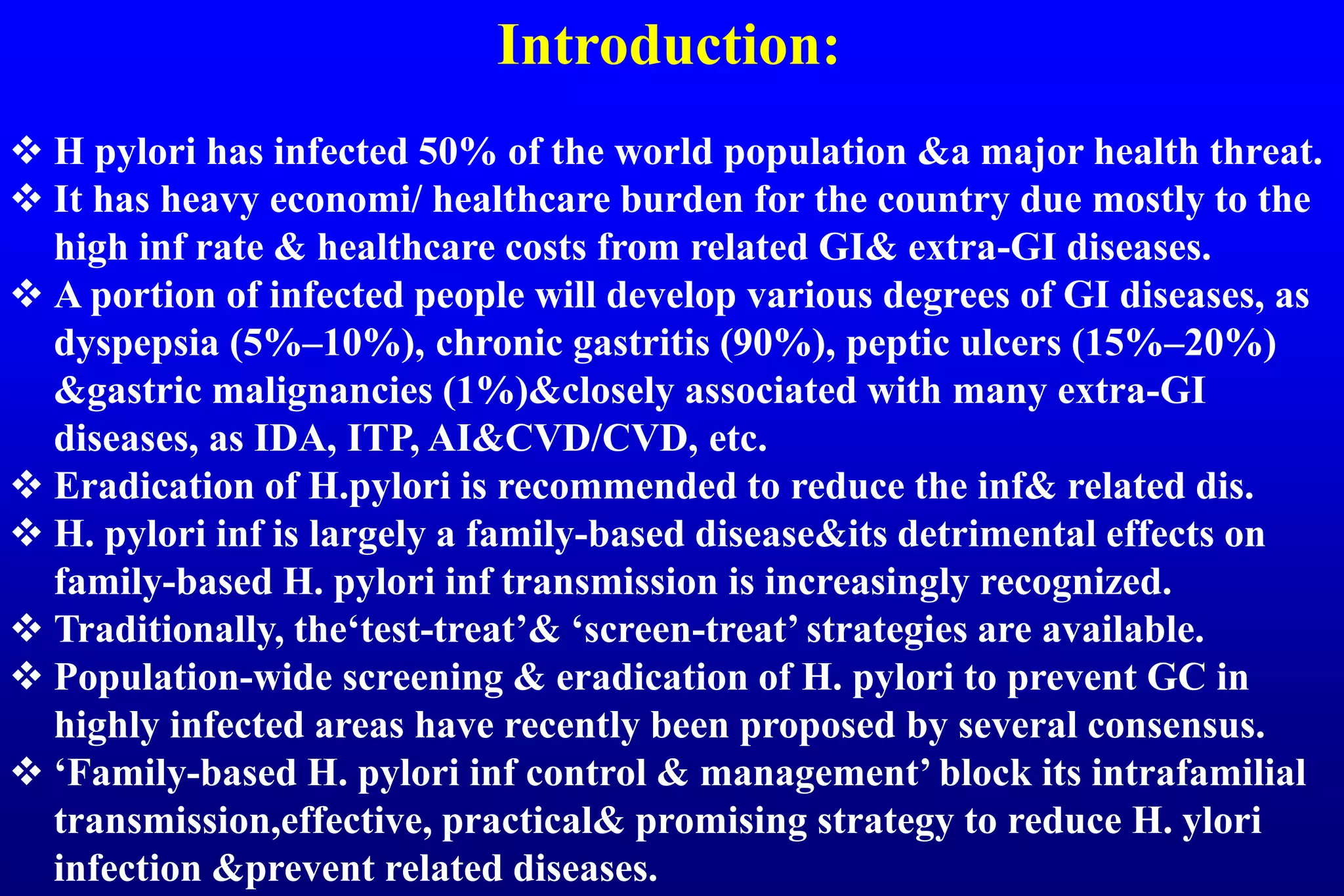
 H pylori has infected 50% of the world population &a major health threat.
 It has heavy economi/ healthcare burden for the country due mostly to the
high inf rate & healthcare costs from related GI& extra-GI diseases.
 A portion of infected people will develop various degrees of GI diseases, as
dyspepsia (5%–10%), chronic gastritis (90%), peptic ulcers (15%–20%)
&gastric malignancies (1%)&closely associated with many extra-GI
diseases, as IDA, ITP, AI&CVD/CVD, etc.
 Eradication of H.pylori is recommended to reduce the inf& related dis.
 H. pylori inf is largely a family-based disease&its detrimental effects on
family-based H. pylori inf transmission is increasingly recognized.
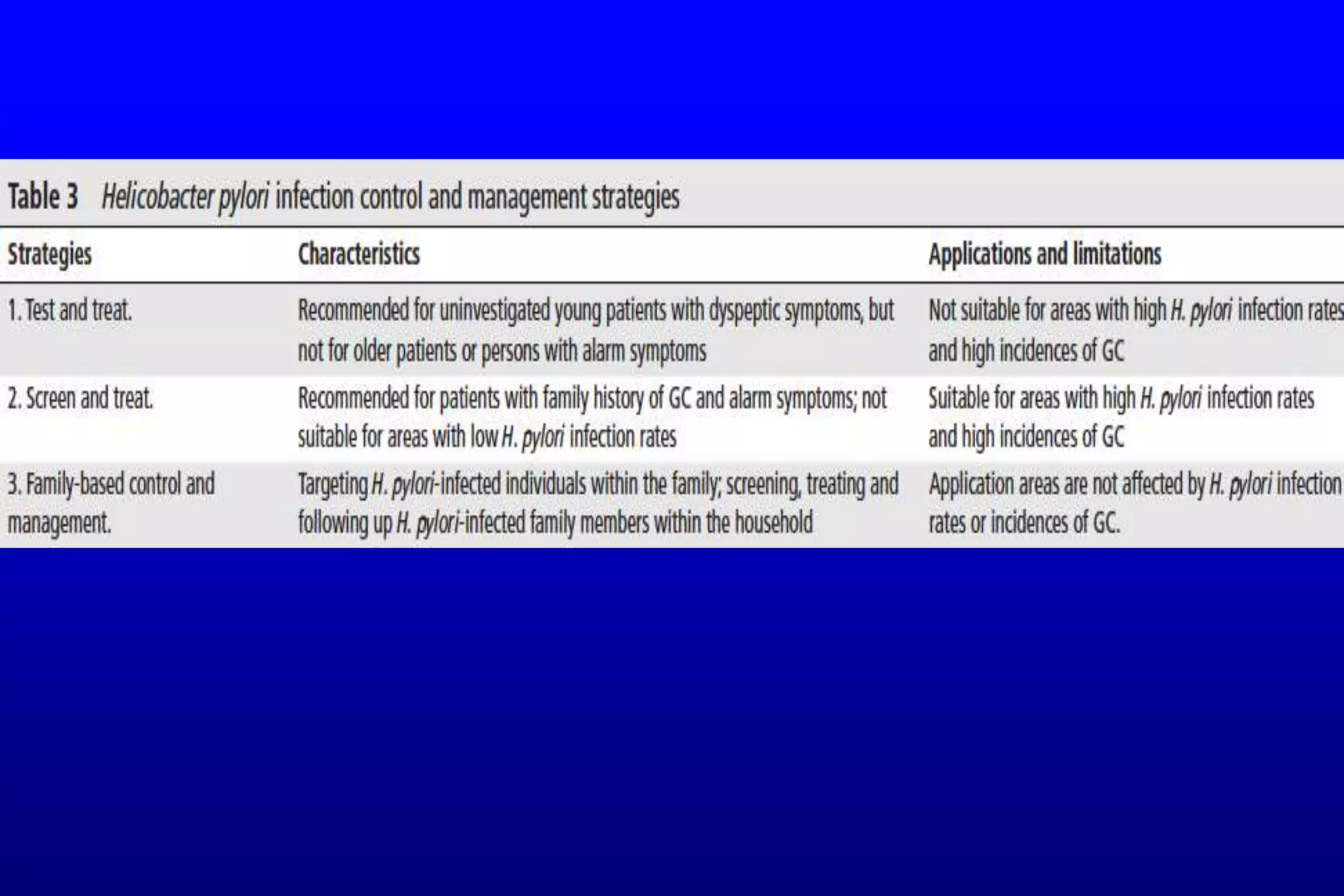
 Traditionally, the‘test-treat’& ‘screen-treat’ strategies are available.
 Population-wide screening & eradication of H. pylori to prevent GC in
highly infected areas have recently been proposed by several consensus.
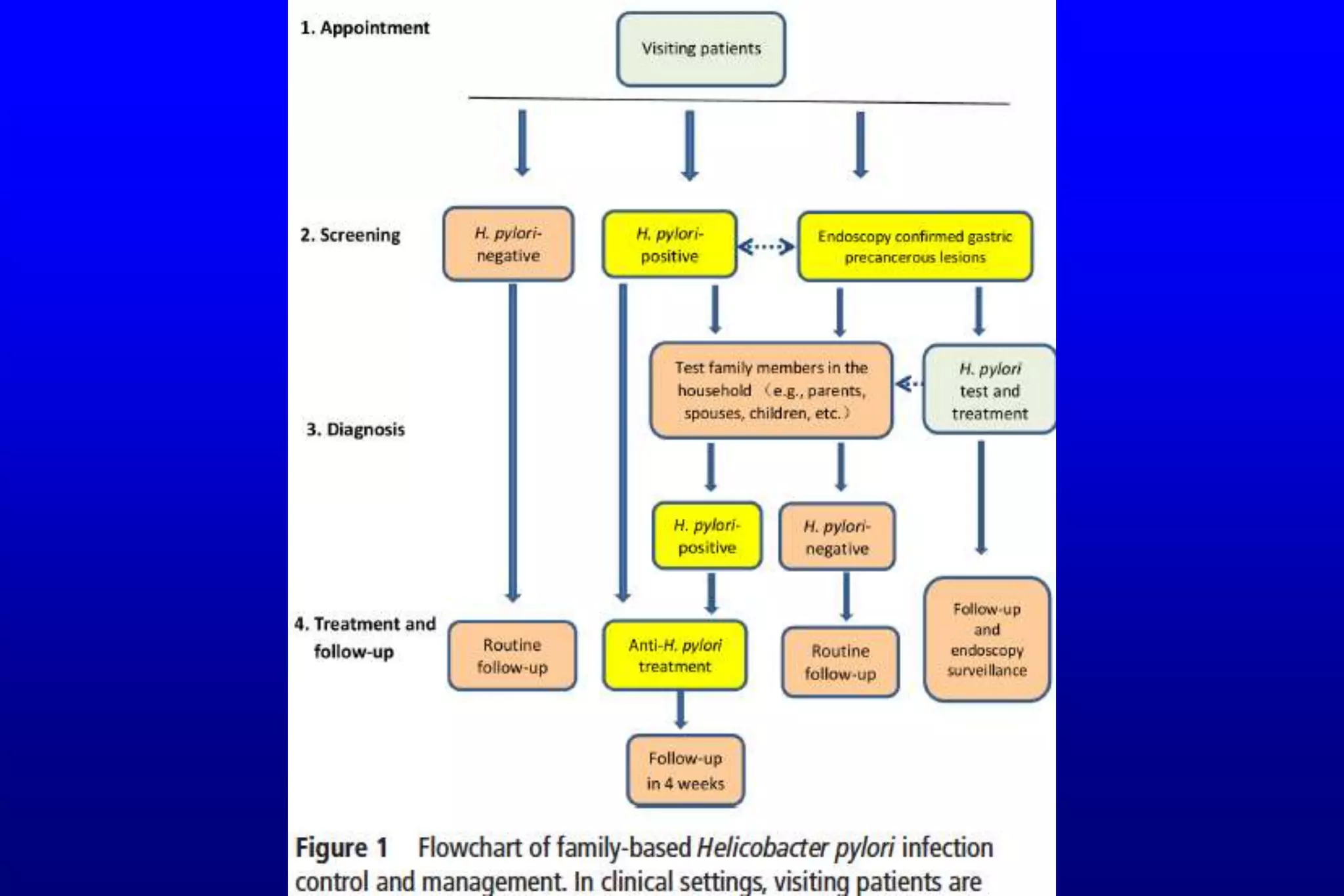
 ‘Family-based H. pylori inf control & management’ block its intrafamilial
transmission,effective, practical& promising strategy to reduce H. ylori
infection &prevent related diseases.
Conclusion:
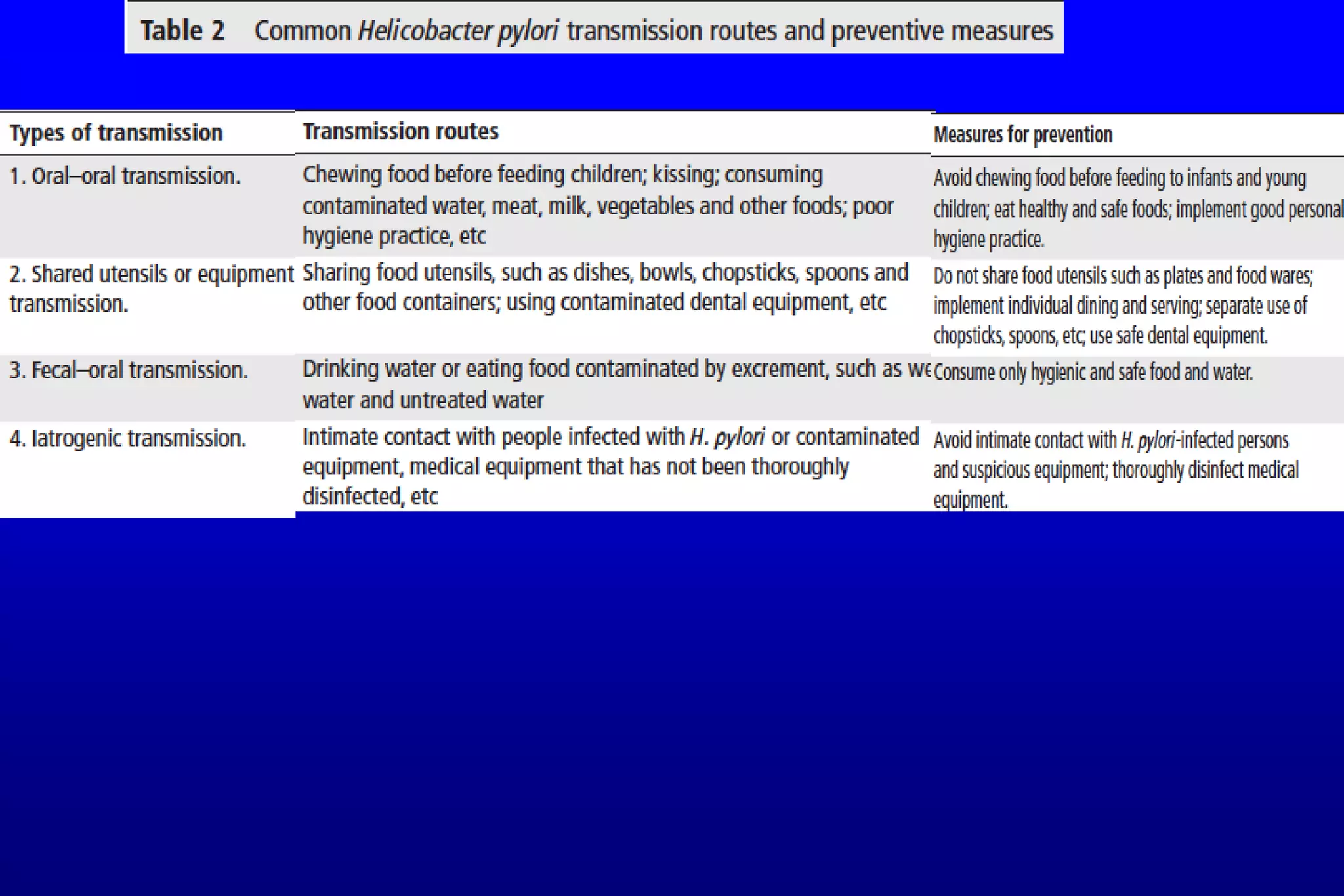
 H. pylori is transmissible from person to person& among family members.
 A family-based H. pylori prevention& eradication strategy would be a
suitable approach to prevent its intra-familial transmission& related
diseases.
 The notion & practice would be beneficial for all highly infected areas.

Git j club h pylori family based eradication22

  • 1.
    Kurdistan Board GEH/GITSurgery J Club 2022 Supervised by Professor Dr. Mohamed Alshekhani.
  • 2.
    Introduction:  H pylorihas infected 50% of the world population &a major health threat.  It has heavy economi/ healthcare burden for the country due mostly to the high inf rate & healthcare costs from related GI& extra-GI diseases.  A portion of infected people will develop various degrees of GI diseases, as dyspepsia (5%–10%), chronic gastritis (90%), peptic ulcers (15%–20%) &gastric malignancies (1%)&closely associated with many extra-GI diseases, as IDA, ITP, AI&CVD/CVD, etc.  Eradication of H.pylori is recommended to reduce the inf& related dis.  H. pylori inf is largely a family-based disease&its detrimental effects on family-based H. pylori inf transmission is increasingly recognized.  Traditionally, the‘test-treat’& ‘screen-treat’ strategies are available.  Population-wide screening & eradication of H. pylori to prevent GC in highly infected areas have recently been proposed by several consensus.  ‘Family-based H. pylori inf control & management’ block its intrafamilial transmission,effective, practical& promising strategy to reduce H. ylori infection &prevent related diseases.
  • 10.
    Conclusion:  H. pyloriis transmissible from person to person& among family members.  A family-based H. pylori prevention& eradication strategy would be a suitable approach to prevent its intra-familial transmission& related diseases.  The notion & practice would be beneficial for all highly infected areas.