Kurdistan Board GEH/GIT Surgery J Club 2022
Supervised by Professor Dr. Mohamed Alshekhani.
Introduction:
 GIB is a common clinical problem encountered in inpatient&OP settings.
 Although the evaluation of upper & lower GIB is often straightforward,
bleeding from the SB may pose a clinical challenge.
 The indications, modalities&differential diagnoses of SB bleeding is shown.
 Clinicians should be able to identify common causes of SB bleeding,
understand the advantages & disadvantages of the modalities used to
evaluate SB bleeding& enact a stepwise management approach to the
patient with presumed SB bleeding.
Introduction:
 GIB is a common clinical problem encountered in inpatient&OP settings.
 Although the evaluation of upper & lower GIB is often straightforward,
bleeding from the SB may pose a clinical challenge.
 The indications, modalities&differential diagnoses of SB bleeding is shown.
 Clinicians should be able to identify common causes of SB bleeding,
understand the advantages & disadvantages of the modalities used to
evaluate SB bleeding& enact a stepwise management approach to the
patient with presumed SB bleeding.
 GIB; include upper, lower&SBB.
 Upper:bleeding that occurs proximal to the ligament of Treitz classically
presents with melena, hematemesis, or, if brisk bleeding, hematochezia.
 Lower: a colonic source of bleeding typically presents with hematochezia.
 Small: 5-10% of GI bleeding.
Classification:
 Overt GI bleeding: visible either through bright red blood or through by-
products of blood breakdown in the emesis or feces.
 Occult:+ve FOB test &/or IDA without visual evidence of blood or blood
breakdown products.
 In occult GIB (no visible blood), it is recommended to first pursue EGD&
colonoscopy to determine a potential source of bleeding.
 If no source is identified on EGD& colonoscopy&evidence of GI persists
through continued ID, +FOB, &/or visible blood loss, it is referred to as
obscure GI bleeding.
 Obscure GI bleeding has largely been replaced by SBB because advances
in endoscopy, VCE&radiographic imaging have allowed for improved
identification of SBB that was previously difficult to detect.
 Overt (visible) GI bleeding, occult (not visible) GI bleeding& SBB
(evidence of ongoing GIB without sourc on after EGD &colonoscopy).
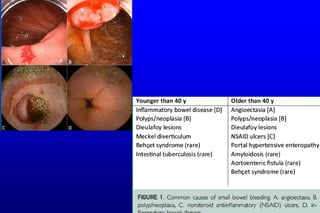
SBB DD:
 Diagnoses to consider in those <40 years include IBD, polyposis
syndromes& Meckel diverticulum.
 In those>40 years, vascular lesions as angioectasias&NSAIDs-induced
ulcers&enteropathy are more common.
 Etiologies present in both age groups include Dieulafoy lesions (small
submucosal arterial bleeds)& neoplastic lesions.
Evaluation of presumed SBB:
 Begins with the assessment of the hemodynamic stability of the patient.
 SBB most often presents as stable overt or occult bleeding, with an
unstable presentation being relatively rare.
 If brisk SBB is suspected, the patient should be admitted to the hospital
with consideration of admission to theICU if HD instability is present.
 Anticoagulation, antiplatelet agents& nonsteroidal anti-inflammatory
drugs should be held if clinically permitted.
 In general, the goal hemoglobin transfusion threshold should be 7 g/dL for
most patients& 8 g/dL for those with coronary artery disease (to convert to
mmol/L, multiply by 0.6206).
Occult or stable overt SBB:
 With negative EGD and colonoscopy, it is important to first consider
repeating EGD or colonoscopy in select cases.
 Evidence for this recommendation comes from VCE studies, which have
found a clinically significant non small bowel bleeding source in up to 30%
 Consideration of repeat endoscopy is especially important in cases of
inadequate or suboptimal colonoscopy preparation, short procedure or
withdrawal times, poor patient tolerance of the procedure, or inability to
visualize the terminal ileum.
 In contrast,one important subset of patients to consider early evaluation of
the small bowel are patients with left ventricular assist devices, as SBB
accounts for up to 30% of GI bleeding episodes in this patient population.
VCE:
 After 8-12 hours of data acquisition, sensors are removed and images are
reviewed by a trained gastroenterologist, who uses SB passage time to
estimate the location of the bleeding source.
 In cases of occult or stable overt SB bleeding, VCE emerged as the next
recommended test after high-quality EGD and colonoscopy.
 In patients with suspected SBB,the detection rates of VCE 53-73%.
 No strict contraindications to VCE, but main risk is capsule retention.
 Patients considered at highest risk for capsule retention include those with
established CD who have capsule retention rates 3-13%,H/O SBB, multiple
previous abd operations with resultant adhesive dis,&radiation enteritis.
 Without significant risk factors, capsule retention rates are 1-2%.
 Most complications of capsule retention are limited, rarely, IO or perf.
 MRI is contraindicated in those with a retained capsule device as strong
magnetic field could pull the device through the patient’s body.
 One option to assess the risk of retention a patency capsule evaluation.
Patency capsule evaluation:
 A small radiofrequency identification capsule tag surrounded by barium
absorbable material allowing detection either by the radiofrequency
identification tag or radiographically.
 The patency capsule remains intact for about 80 hs before it dissolves.
 56% excreted the patency capsule intact, indicating that they did not have
clinically significant obstruction.
 All patients who excreted the patency capsule intact went on to undergo
successful VCE without retention, highlighting the usefulness of the
patency capsule in patient selection
Multiphase CTE:
 Uses both oral&IV contrast to capture cross-sectional images in arterial,
enteric& delayed contrast phases,allows the detailed visualization of the
small bowel wall, especially useful for the detection of masses& other
structural lesions,a 90-100% detection rate for SB masses, which can be
missed on VCE.
 Although less invasive than VCE, CT enterography may have lower
detection rates when used to evaluate GI bleeding, with detection rates
between 28-35%.
 May not be an appropriate test in those with acute or chronic kidney
disease.
Enteroscopy:push
 Push enteroscopy uses a longer gastroscope (such as a pediatric
colonoscope) allows deeper intubation of SB past the ligament of Treitz.
 Often used after the identification of a proximal small bowel bleeding
source on VCE or as a second-look procedure after a negative EGD
 In cases in which a lesion was found after an initial EGD result had been
negative, 53% were in a location only accessible by push enteroscopy,
highlighting the use of push enteroscopy as a “second-look” procedure
rather than repeating an EGD.
Enteroscopy:Balloon-assisted
 A technically more complex than push endoscopy but allows deeper
intubation of the small bowel,performed in the anterograde or retrograde
manner to visualize the proximal two-thirds or distal onethird of the small
bowel, respectively.
 In general, VCE or multiphasic CT enterography is performed before
balloon-assisted enteroscopy to localize the site of bleeding& determine
approach (anterograde vs retrograde), as this can increase the diagnostic
yield of balloon-assisted enteroscopy.
 Although bleeding identification varies by study, by using double balloon
enteroscopy the detection rates 53-80%.
 Main advantage of double balloon enteroscopy is to perform therapeutic
intervention&mark lesions with ink tattoo for future evaluation,rebleeding
of vascular lesions as angioectasias after endoscopic intervention is
relatively common 34%.
Enteroscopy:Balloon-assisted
 Regardless, endoscopic treatment of vascular lesions has been found to
increase hemoglobin levels & decrease the rate of transfusions.
 Repeat double balloon enteroscopy procedures are not associated with
increased complications,making it safe to repeat if clinically indicated.
 It carries a higher rate of adverse events (0.8-1%) than does standard
endoscopy, includingacute pancreatitis, perforation&sedation-related
adverse events as the procedure takes longer.
 Double balloon enteroscopy is often performed in patients with a left
ventricular assist device who experience SBB from angioectasias.
 No significant difference in the number of red blood cell transfusions/
month or all cause mortality with endoscopic treatment of identified
bleeding lesions by balloon enteroscopy compared with conservative
therapy with iron replacement& blood transfusion.
 Research is needed to determine the best practice in this population.
Brisk SB bleeding:
 After stabilization of the patient, the evaluation of brisk small bowel
bleeding begins with consideration of CTA), conventional angiogram,
inpatient capsule endoscopy, or tagged red blood cell scan.
 Computed Tomography Angiography&Conventional Angiography.
Computed tomography angiography is a widely available modality that
involves the administration of timed intravenous contrast to visualize
extravasation of contrast material into the GI lumen.
 In brisk GI bleeding, CTA has excellent sensitivity, with a meta-analysis
revealing an approximate sensitivity of 89%.
 CTA is a diagnostic only modality& if the result is positive, the
recommended next step is conventional angio embolization.
 If the CTA result is negative,bleeding is likely not brisk enough (<0.2
mL/min) to be found & intervened on by conventional angiography
&management of bleeding via the below stable overt pathway is appropri.
Inpatient VCE:
 The use of early inpatient VCE is evolving&center dependent, studies to
date find promise for this diagnostic modality.
 Early use of capsule endoscopy after hospital admission may lead to
superior localization of a bleeding source, 64% bleed localization vs 31%
in the standard of care arm.
 If brisk SBB is discovered, treatment with conventional angiogram or
double balloon enteroscopy is an option for therapeutic intervention.
Tech-labeled RBC scan:
 Another option to localize brisk GI bleeding,can detect bleeding rates as
low as 0.2 mL/min, leading to mildly increased sensitivity vs CTA.
 The ocalization of the bleed can be difficult& CTA is likely superior,so
often considered first line.
 One special consideration is the use of a technetium-99m scan to evaluate
for Meckel diverticulum, as it secretes the radiotracer&allows the
noninvasive identification of the condition.
 CTA exposes the patient to intravenous contrast,so technetium-
99melabeled red blood cell scan may be a better option in a patient
population with acute or chronic kidney disease.
 If a technetium-99melabeled red blood cell scan is obtained and brisk
bleeding is localized,trt with conventional angiogram or double balloon
endoscopy is an option for therapeutic intervention.
Management of presumed SSB:
 Begins by determining HD status &appropriate level of care.
 Patients with brisk SBB often require ICU &consideration should be given
to examinations that provide results within a short time frame, as CTA.
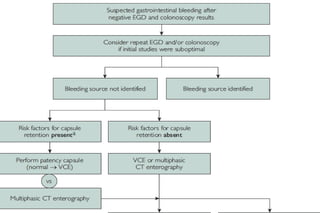
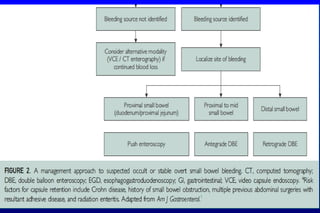
 In contrast, occult or stable overt small bowel bleeding in patients who are
hemodynamically stable can usually be managed in the outpatient setting
by using the proposed management algorithm shown as a guide.
 In this population, if initial EGD/colonoscopy are unremarkable but
suboptimal, repeat EGD vs extended OGD &/or colonoscopy considered.
 If bleeding is not identified on repeat adequate endoscopic evaluation or
the initial endoscopicstudy is deemed to be acceptable, the next best choice
is to perform VCE or multiphasic CT enterography,depending on
contraindications& availability of resources to avoid delays.
 RFs for VC retention should be kept in mind &patency capsule performed.
 Multiphasic CTE avoided in patients with underlying kidney dis but
should be considered if there is concern for a structural SB lesion.
Management of presumed SSB:
 Once a small bowel bleeding source is identified, the location within the SB
should be estimated (proximal vs distal)&a decision made whether to
pursue push or balloon-assisted enteroscopy in either an anterograde or a
retrograde fashion.
 If SBB source is not identified on initial evaluation, performing the
alternate unperformed diagnostic modality (VCE vs CT enterography) if
there is concern for continued bleeding.
 The yield will be significantly higher in patients experiencing overt GIB.
 If the initial small bowel evaluation is unremarkable & the patient remains
hemodynamically stable& not experiencing overt GI bleeding, close follow-
up with laboratory monitoring could be considered.
 Rarely GI bleeding is secondary to a Meckel diverticulum& consideration
should be given to performing a Meckel scan in young adults (age,<30
years) with ongoing evidence of overt GI bleeding.
Conclusion:
 SB bleeding accounts for only 5-10% of cases of GI bleeding & most often
presents as occult bleeding or overt bleeding in a clinically stable patient.
 In patients presenting with melena or hematochezia, EGD &/or
colonoscopy is generally performed first.
 If no identifiable etiology is found on EGD or colonoscopy & clinical
evidence of GI bleeding persists, it is reasonable to perform further
evaluation for SB bleeding with VCE or multiphasic CT enterography.
 Using the approach described, a small SB source is usually identified&can
be treated appropriately.

Git j club sbb22

  • 1.
    Kurdistan Board GEH/GITSurgery J Club 2022 Supervised by Professor Dr. Mohamed Alshekhani.
  • 2.
    Introduction:  GIB isa common clinical problem encountered in inpatient&OP settings.  Although the evaluation of upper & lower GIB is often straightforward, bleeding from the SB may pose a clinical challenge.  The indications, modalities&differential diagnoses of SB bleeding is shown.  Clinicians should be able to identify common causes of SB bleeding, understand the advantages & disadvantages of the modalities used to evaluate SB bleeding& enact a stepwise management approach to the patient with presumed SB bleeding.
  • 3.
    Introduction:  GIB isa common clinical problem encountered in inpatient&OP settings.  Although the evaluation of upper & lower GIB is often straightforward, bleeding from the SB may pose a clinical challenge.  The indications, modalities&differential diagnoses of SB bleeding is shown.  Clinicians should be able to identify common causes of SB bleeding, understand the advantages & disadvantages of the modalities used to evaluate SB bleeding& enact a stepwise management approach to the patient with presumed SB bleeding.  GIB; include upper, lower&SBB.  Upper:bleeding that occurs proximal to the ligament of Treitz classically presents with melena, hematemesis, or, if brisk bleeding, hematochezia.  Lower: a colonic source of bleeding typically presents with hematochezia.  Small: 5-10% of GI bleeding.
  • 4.
    Classification:  Overt GIbleeding: visible either through bright red blood or through by- products of blood breakdown in the emesis or feces.  Occult:+ve FOB test &/or IDA without visual evidence of blood or blood breakdown products.  In occult GIB (no visible blood), it is recommended to first pursue EGD& colonoscopy to determine a potential source of bleeding.  If no source is identified on EGD& colonoscopy&evidence of GI persists through continued ID, +FOB, &/or visible blood loss, it is referred to as obscure GI bleeding.  Obscure GI bleeding has largely been replaced by SBB because advances in endoscopy, VCE&radiographic imaging have allowed for improved identification of SBB that was previously difficult to detect.  Overt (visible) GI bleeding, occult (not visible) GI bleeding& SBB (evidence of ongoing GIB without sourc on after EGD &colonoscopy).
  • 5.
    SBB DD:  Diagnosesto consider in those <40 years include IBD, polyposis syndromes& Meckel diverticulum.  In those>40 years, vascular lesions as angioectasias&NSAIDs-induced ulcers&enteropathy are more common.  Etiologies present in both age groups include Dieulafoy lesions (small submucosal arterial bleeds)& neoplastic lesions.
  • 6.
    Evaluation of presumedSBB:  Begins with the assessment of the hemodynamic stability of the patient.  SBB most often presents as stable overt or occult bleeding, with an unstable presentation being relatively rare.  If brisk SBB is suspected, the patient should be admitted to the hospital with consideration of admission to theICU if HD instability is present.  Anticoagulation, antiplatelet agents& nonsteroidal anti-inflammatory drugs should be held if clinically permitted.  In general, the goal hemoglobin transfusion threshold should be 7 g/dL for most patients& 8 g/dL for those with coronary artery disease (to convert to mmol/L, multiply by 0.6206).
  • 7.
    Occult or stableovert SBB:  With negative EGD and colonoscopy, it is important to first consider repeating EGD or colonoscopy in select cases.  Evidence for this recommendation comes from VCE studies, which have found a clinically significant non small bowel bleeding source in up to 30%  Consideration of repeat endoscopy is especially important in cases of inadequate or suboptimal colonoscopy preparation, short procedure or withdrawal times, poor patient tolerance of the procedure, or inability to visualize the terminal ileum.  In contrast,one important subset of patients to consider early evaluation of the small bowel are patients with left ventricular assist devices, as SBB accounts for up to 30% of GI bleeding episodes in this patient population.
  • 8.
    VCE:  After 8-12hours of data acquisition, sensors are removed and images are reviewed by a trained gastroenterologist, who uses SB passage time to estimate the location of the bleeding source.  In cases of occult or stable overt SB bleeding, VCE emerged as the next recommended test after high-quality EGD and colonoscopy.  In patients with suspected SBB,the detection rates of VCE 53-73%.  No strict contraindications to VCE, but main risk is capsule retention.  Patients considered at highest risk for capsule retention include those with established CD who have capsule retention rates 3-13%,H/O SBB, multiple previous abd operations with resultant adhesive dis,&radiation enteritis.  Without significant risk factors, capsule retention rates are 1-2%.  Most complications of capsule retention are limited, rarely, IO or perf.  MRI is contraindicated in those with a retained capsule device as strong magnetic field could pull the device through the patient’s body.  One option to assess the risk of retention a patency capsule evaluation.
  • 9.
    Patency capsule evaluation: A small radiofrequency identification capsule tag surrounded by barium absorbable material allowing detection either by the radiofrequency identification tag or radiographically.  The patency capsule remains intact for about 80 hs before it dissolves.  56% excreted the patency capsule intact, indicating that they did not have clinically significant obstruction.  All patients who excreted the patency capsule intact went on to undergo successful VCE without retention, highlighting the usefulness of the patency capsule in patient selection
  • 10.
    Multiphase CTE:  Usesboth oral&IV contrast to capture cross-sectional images in arterial, enteric& delayed contrast phases,allows the detailed visualization of the small bowel wall, especially useful for the detection of masses& other structural lesions,a 90-100% detection rate for SB masses, which can be missed on VCE.  Although less invasive than VCE, CT enterography may have lower detection rates when used to evaluate GI bleeding, with detection rates between 28-35%.  May not be an appropriate test in those with acute or chronic kidney disease.
  • 11.
    Enteroscopy:push  Push enteroscopyuses a longer gastroscope (such as a pediatric colonoscope) allows deeper intubation of SB past the ligament of Treitz.  Often used after the identification of a proximal small bowel bleeding source on VCE or as a second-look procedure after a negative EGD  In cases in which a lesion was found after an initial EGD result had been negative, 53% were in a location only accessible by push enteroscopy, highlighting the use of push enteroscopy as a “second-look” procedure rather than repeating an EGD.
  • 12.
    Enteroscopy:Balloon-assisted  A technicallymore complex than push endoscopy but allows deeper intubation of the small bowel,performed in the anterograde or retrograde manner to visualize the proximal two-thirds or distal onethird of the small bowel, respectively.  In general, VCE or multiphasic CT enterography is performed before balloon-assisted enteroscopy to localize the site of bleeding& determine approach (anterograde vs retrograde), as this can increase the diagnostic yield of balloon-assisted enteroscopy.  Although bleeding identification varies by study, by using double balloon enteroscopy the detection rates 53-80%.  Main advantage of double balloon enteroscopy is to perform therapeutic intervention&mark lesions with ink tattoo for future evaluation,rebleeding of vascular lesions as angioectasias after endoscopic intervention is relatively common 34%.
  • 13.
    Enteroscopy:Balloon-assisted  Regardless, endoscopictreatment of vascular lesions has been found to increase hemoglobin levels & decrease the rate of transfusions.  Repeat double balloon enteroscopy procedures are not associated with increased complications,making it safe to repeat if clinically indicated.  It carries a higher rate of adverse events (0.8-1%) than does standard endoscopy, includingacute pancreatitis, perforation&sedation-related adverse events as the procedure takes longer.  Double balloon enteroscopy is often performed in patients with a left ventricular assist device who experience SBB from angioectasias.  No significant difference in the number of red blood cell transfusions/ month or all cause mortality with endoscopic treatment of identified bleeding lesions by balloon enteroscopy compared with conservative therapy with iron replacement& blood transfusion.  Research is needed to determine the best practice in this population.
  • 14.
    Brisk SB bleeding: After stabilization of the patient, the evaluation of brisk small bowel bleeding begins with consideration of CTA), conventional angiogram, inpatient capsule endoscopy, or tagged red blood cell scan.  Computed Tomography Angiography&Conventional Angiography. Computed tomography angiography is a widely available modality that involves the administration of timed intravenous contrast to visualize extravasation of contrast material into the GI lumen.  In brisk GI bleeding, CTA has excellent sensitivity, with a meta-analysis revealing an approximate sensitivity of 89%.  CTA is a diagnostic only modality& if the result is positive, the recommended next step is conventional angio embolization.  If the CTA result is negative,bleeding is likely not brisk enough (<0.2 mL/min) to be found & intervened on by conventional angiography &management of bleeding via the below stable overt pathway is appropri.
  • 15.
    Inpatient VCE:  Theuse of early inpatient VCE is evolving&center dependent, studies to date find promise for this diagnostic modality.  Early use of capsule endoscopy after hospital admission may lead to superior localization of a bleeding source, 64% bleed localization vs 31% in the standard of care arm.  If brisk SBB is discovered, treatment with conventional angiogram or double balloon enteroscopy is an option for therapeutic intervention.
  • 16.
    Tech-labeled RBC scan: Another option to localize brisk GI bleeding,can detect bleeding rates as low as 0.2 mL/min, leading to mildly increased sensitivity vs CTA.  The ocalization of the bleed can be difficult& CTA is likely superior,so often considered first line.  One special consideration is the use of a technetium-99m scan to evaluate for Meckel diverticulum, as it secretes the radiotracer&allows the noninvasive identification of the condition.  CTA exposes the patient to intravenous contrast,so technetium- 99melabeled red blood cell scan may be a better option in a patient population with acute or chronic kidney disease.  If a technetium-99melabeled red blood cell scan is obtained and brisk bleeding is localized,trt with conventional angiogram or double balloon endoscopy is an option for therapeutic intervention.
  • 17.
    Management of presumedSSB:  Begins by determining HD status &appropriate level of care.  Patients with brisk SBB often require ICU &consideration should be given to examinations that provide results within a short time frame, as CTA.  In contrast, occult or stable overt small bowel bleeding in patients who are hemodynamically stable can usually be managed in the outpatient setting by using the proposed management algorithm shown as a guide.  In this population, if initial EGD/colonoscopy are unremarkable but suboptimal, repeat EGD vs extended OGD &/or colonoscopy considered.  If bleeding is not identified on repeat adequate endoscopic evaluation or the initial endoscopicstudy is deemed to be acceptable, the next best choice is to perform VCE or multiphasic CT enterography,depending on contraindications& availability of resources to avoid delays.  RFs for VC retention should be kept in mind &patency capsule performed.  Multiphasic CTE avoided in patients with underlying kidney dis but should be considered if there is concern for a structural SB lesion.
  • 18.
    Management of presumedSSB:  Once a small bowel bleeding source is identified, the location within the SB should be estimated (proximal vs distal)&a decision made whether to pursue push or balloon-assisted enteroscopy in either an anterograde or a retrograde fashion.  If SBB source is not identified on initial evaluation, performing the alternate unperformed diagnostic modality (VCE vs CT enterography) if there is concern for continued bleeding.  The yield will be significantly higher in patients experiencing overt GIB.  If the initial small bowel evaluation is unremarkable & the patient remains hemodynamically stable& not experiencing overt GI bleeding, close follow- up with laboratory monitoring could be considered.  Rarely GI bleeding is secondary to a Meckel diverticulum& consideration should be given to performing a Meckel scan in young adults (age,<30 years) with ongoing evidence of overt GI bleeding.
  • 22.
    Conclusion:  SB bleedingaccounts for only 5-10% of cases of GI bleeding & most often presents as occult bleeding or overt bleeding in a clinically stable patient.  In patients presenting with melena or hematochezia, EGD &/or colonoscopy is generally performed first.  If no identifiable etiology is found on EGD or colonoscopy & clinical evidence of GI bleeding persists, it is reasonable to perform further evaluation for SB bleeding with VCE or multiphasic CT enterography.  Using the approach described, a small SB source is usually identified&can be treated appropriately.