Chapter 8 Approximation Algorithms
Outline Why approximation algorithms? The vertex cover problem The set cover problem TSP
Why Approximation Algorithms ? Many problems of practical significance are NP-complete but are too important to abandon merely because obtaining an optimal solution is intractable.  If a problem is NP-complete, we are unlikely to find a polynomial time algorithm for solving it exactly, but it may still be possible to find  near-optimal solution  in polynomial time. In practice, near-optimality is often good enough.  An algorithm that returns near-optimal solutions is called an  approximation algorithm .
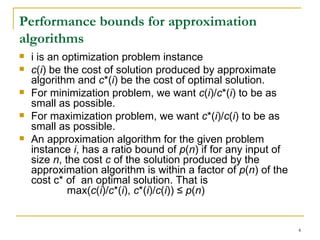
Performance bounds for approximation algorithms i is an optimization problem instance c ( i ) be the cost of solution produced by approximate algorithm and  c *( i ) be the cost of optimal solution.  For minimization problem, we want  c ( i )/ c *( i ) to be as small as possible. For maximization problem, we want  c *( i )/ c ( i ) to be as small as possible. An approximation algorithm for the given problem instance  i , has a ratio bound of  p ( n ) if for any input of size  n , the cost  c  of the solution produced by the approximation algorithm is within a factor of  p ( n ) of the cost c* of  an optimal solution. That is             max( c ( i )/ c *( i ),  c *( i )/ c ( i )) ≤  p ( n )
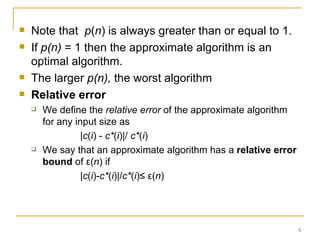
Note that   p ( n ) is always greater than or equal to 1.  If  p(n)  = 1 then the approximate algorithm is an optimal algorithm. The larger  p(n),  the worst algorithm Relative error We define the  relative error  of the approximate algorithm for any input size as |c ( i ) -  c* ( i )|/  c* ( i ) We say that an approximate algorithm has a  relative error bound  of ε( n ) if |c ( i )- c* ( i )|/ c* ( i )≤ ε( n )
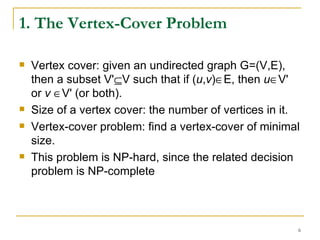
1. The Vertex-Cover Problem Vertex cover: given an undirected graph G=(V,E), then a subset V'  V such that if ( u , v )  E, then  u  V' or  v    V' (or both). Size of a vertex cover: the number of vertices in it. Vertex-cover problem: find a vertex-cover of minimal size. This problem is NP-hard, since the related decision problem is NP-complete
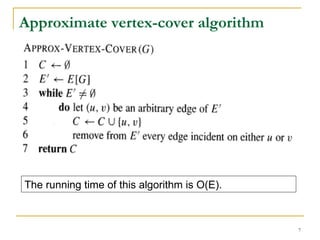
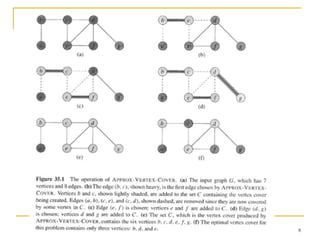
Approximate vertex-cover algorithm The running time of this algorithm is O(E).
 
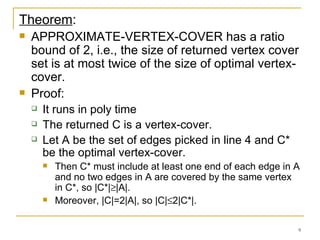
Theorem : APPROXIMATE-VERTEX-COVER has a ratio bound of 2, i.e., the size of returned vertex cover set is at most twice of the size of optimal vertex-cover. Proof: It runs in poly time The returned C is a vertex-cover. Let A be the set of edges picked in line 4 and C* be the optimal vertex-cover. Then C* must include at least one end of each edge in A and no two edges in A are covered by the same vertex in C*, so |C*|  |A|.  Moreover, |C|=2|A|, so |C|  2|C*|.
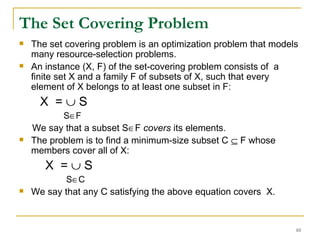
The Set Covering Problem   The set covering problem is an optimization problem that models many resource-selection problems.  An instance (X, F) of the set-covering problem consists of  a finite set X and a family F of subsets of X, such that every element of X belongs to at least one subset in F: X  =    S S  F We say that a subset S  F  covers  its elements.  The problem is to find a minimum-size subset C    F whose members cover all of X: X  =    S S  C We say that any C satisfying the above equation covers  X.
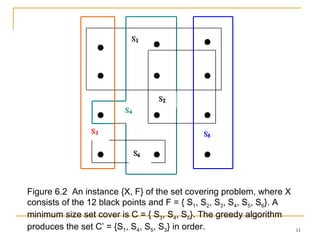
Figure 6.2  An instance {X, F} of the set covering problem, where X consists of the 12 black points and F = { S 1 , S 2 , S 3 , S 4 , S 5 , S 6 }. A minimum size set cover is C = { S 3 , S 4 , S 5 }. The greedy algorithm produces the set C’ = {S 1 , S 4 , S 5 , S 3 } in order.
Applications of Set-covering problem Assume that X is a set of skills that are needed to solve a problem and we have a set of people available to work on it. We wish to form a team, containing as few people as possible, s.t. for every requisite skill in X, there is a member in the team having that skill. Assign emergency stations (fire stations) in a city. Allocate sale branch offices for a company. Schedule for bus drivers.
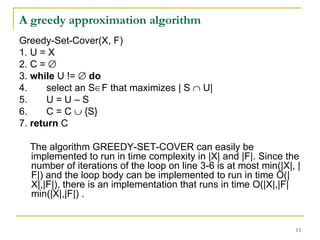
A greedy approximation algorithm Greedy-Set-Cover(X, F) 1. U = X 2. C =   3.  while  U !=     do 4.  select an S  F that maximizes | S    U| 5.  U = U – S 6.  C = C    {S} 7.  return  C The algorithm GREEDY-SET-COVER can easily be implemented to run in time complexity in |X| and |F|. Since the number of iterations of the loop on line 3-6 is at most min(|X|, |F|) and the loop body can be implemented to run in time O(|X|,|F|), there is an implementation that runs in time O(|X|,|F| min(|X|,|F|) .
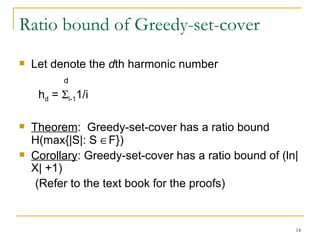
Ratio bound of Greedy-set-cover Let denote the  d th harmonic number d   h d  =   i-1 1/i Theorem :  Greedy-set-cover has a ratio bound H(max{|S|: S   F } ) Corollary : Greedy-set-cover has a ratio bound of (ln|X| +1) (Refer to the text book for the proofs)
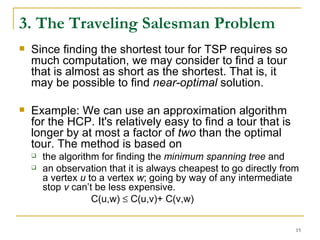
3. The Traveling Salesman Problem Since finding the shortest tour for TSP requires so much computation, we may consider to find a tour that is almost as short as the shortest. That is, it may be possible to find  near-optimal  solution. Example: We can use an approximation algorithm for the HCP. It's relatively easy to find a tour that is longer by at most a factor of  two  than the optimal tour. The method is based on  the algorithm for finding the  minimum spanning tree  and an observation that it is always cheapest to go directly from a vertex  u  to a vertex  w ; going by way of any intermediate stop  v  can’t be less expensive. C(u,w)    C(u,v)+ C(v,w)
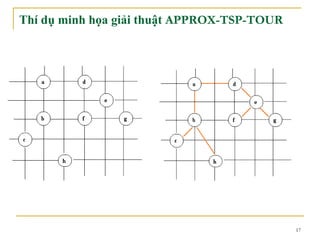
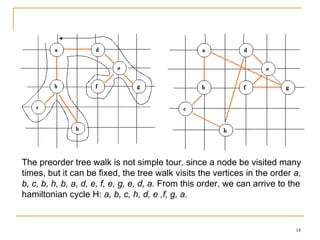
APPROX-TSP-TOUR The algorithm computes a near-optimal tour of an undirected graph G. procedure  APPROX-TSP-TOUR(G, c); begin  select a vertex r    V[G] to be the “root” vertex; grow a minimum spanning tree T for G from root r, using Prim’s algorithm;  apply a preorder tree walk of T and let L be the list of vertices visited in the walk; form the halmintonian cycle H that visits the vertices in the order of L. /* H is the result to return * / end   A  preorder tree walk  recursively visits   every vertex in the tree, listing a vertex when its first encountered, before any of its children are visited.
Thí dụ minh họa giải thuật   APPROX-TSP-TOUR
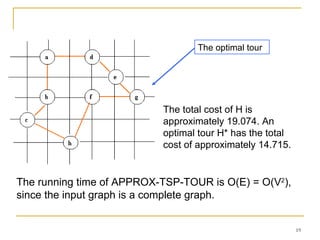
The preorder tree walk is not simple tour, since a node be visited many times, but it can be fixed, the tree walk visits the vertices in the order  a, b, c, b, h, b, a, d, e, f, e, g, e, d, a.  From this order, we can arrive to the hamiltonian cycle H:  a, b, c, h, d, e ,f, g, a.
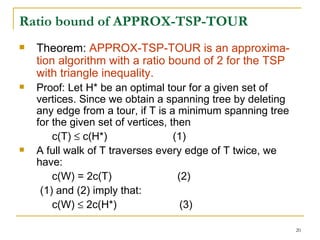
The total cost of H is approximately 19.074. An optimal tour H* has the total cost of approximately 14.715. The running time of APPROX-TSP-TOUR is O(E) = O(V 2 ), since the input graph is a complete graph. The optimal tour
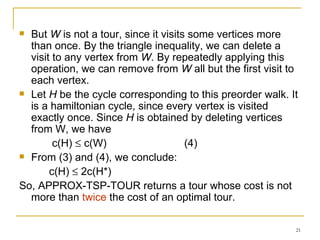
Ratio bound of APPROX-TSP-TOUR Theorem:  APPROX-TSP-TOUR is an approxima-tion algorithm with a ratio bound of 2 for the TSP with triangle inequality. Proof: Let H* be an optimal tour for a given set of vertices. Since we obtain a spanning tree by deleting any edge from a tour, if T is a minimum spanning tree for the given set of vertices, then c(T)    c(H*)  (1) A full walk of T traverses every edge of T twice, we have: c(W) = 2c(T)  (2) (1) and (2) imply that: c(W)    2c(H*)  (3)
But  W  is not a tour, since it visits some vertices more than once. By the triangle inequality, we can delete a visit to any vertex from  W . By repeatedly applying this operation, we can remove from  W  all but the first visit to each vertex. Let  H  be the cycle corresponding to this preorder walk. It is a hamiltonian cycle, since every vertex is visited exactly once. Since  H  is obtained by deleting vertices from W, we have c(H)    c(W)  (4) From (3) and (4), we conclude: c(H)    2c(H*) So, APPROX-TSP-TOUR returns a tour whose cost is not more than  twice  the cost of an optimal tour.
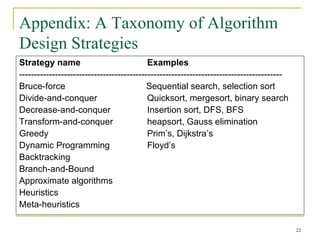
Appendix: A Taxonomy of Algorithm Design Strategies Strategy name   Examples ---------------------------------------------------------------------------------------- Bruce-force  Sequential search, selection sort Divide-and-conquer Quicksort, mergesort, binary search Decrease-and-conquer Insertion sort, DFS, BFS Transform-and-conquer heapsort, Gauss elimination Greedy  Prim’s, Dijkstra’s Dynamic Programming Floyd’s Backtracking Branch-and-Bound Approximate algorithms Heuristics  Meta-heuristics

Giáo trình Phân tích và thiết kế giải thuật - CHAP 8

  • 1.
  • 2.
    Outline Why approximationalgorithms? The vertex cover problem The set cover problem TSP
  • 3.
    Why Approximation Algorithms? Many problems of practical significance are NP-complete but are too important to abandon merely because obtaining an optimal solution is intractable. If a problem is NP-complete, we are unlikely to find a polynomial time algorithm for solving it exactly, but it may still be possible to find near-optimal solution in polynomial time. In practice, near-optimality is often good enough. An algorithm that returns near-optimal solutions is called an approximation algorithm .
  • 4.
    Performance bounds forapproximation algorithms i is an optimization problem instance c ( i ) be the cost of solution produced by approximate algorithm and c *( i ) be the cost of optimal solution. For minimization problem, we want c ( i )/ c *( i ) to be as small as possible. For maximization problem, we want c *( i )/ c ( i ) to be as small as possible. An approximation algorithm for the given problem instance i , has a ratio bound of p ( n ) if for any input of size n , the cost c of the solution produced by the approximation algorithm is within a factor of p ( n ) of the cost c* of  an optimal solution. That is             max( c ( i )/ c *( i ), c *( i )/ c ( i )) ≤ p ( n )
  • 5.
    Note that  p ( n ) is always greater than or equal to 1. If p(n) = 1 then the approximate algorithm is an optimal algorithm. The larger p(n), the worst algorithm Relative error We define the relative error of the approximate algorithm for any input size as |c ( i ) - c* ( i )|/ c* ( i ) We say that an approximate algorithm has a relative error bound of ε( n ) if |c ( i )- c* ( i )|/ c* ( i )≤ ε( n )
  • 6.
    1. The Vertex-CoverProblem Vertex cover: given an undirected graph G=(V,E), then a subset V'  V such that if ( u , v )  E, then u  V' or v  V' (or both). Size of a vertex cover: the number of vertices in it. Vertex-cover problem: find a vertex-cover of minimal size. This problem is NP-hard, since the related decision problem is NP-complete
  • 7.
    Approximate vertex-cover algorithmThe running time of this algorithm is O(E).
  • 8.
  • 9.
    Theorem : APPROXIMATE-VERTEX-COVERhas a ratio bound of 2, i.e., the size of returned vertex cover set is at most twice of the size of optimal vertex-cover. Proof: It runs in poly time The returned C is a vertex-cover. Let A be the set of edges picked in line 4 and C* be the optimal vertex-cover. Then C* must include at least one end of each edge in A and no two edges in A are covered by the same vertex in C*, so |C*|  |A|. Moreover, |C|=2|A|, so |C|  2|C*|.
  • 10.
    The Set CoveringProblem The set covering problem is an optimization problem that models many resource-selection problems. An instance (X, F) of the set-covering problem consists of a finite set X and a family F of subsets of X, such that every element of X belongs to at least one subset in F: X =  S S  F We say that a subset S  F covers its elements. The problem is to find a minimum-size subset C  F whose members cover all of X: X =  S S  C We say that any C satisfying the above equation covers X.
  • 11.
    Figure 6.2 An instance {X, F} of the set covering problem, where X consists of the 12 black points and F = { S 1 , S 2 , S 3 , S 4 , S 5 , S 6 }. A minimum size set cover is C = { S 3 , S 4 , S 5 }. The greedy algorithm produces the set C’ = {S 1 , S 4 , S 5 , S 3 } in order.
  • 12.
    Applications of Set-coveringproblem Assume that X is a set of skills that are needed to solve a problem and we have a set of people available to work on it. We wish to form a team, containing as few people as possible, s.t. for every requisite skill in X, there is a member in the team having that skill. Assign emergency stations (fire stations) in a city. Allocate sale branch offices for a company. Schedule for bus drivers.
  • 13.
    A greedy approximationalgorithm Greedy-Set-Cover(X, F) 1. U = X 2. C =  3. while U !=  do 4. select an S  F that maximizes | S  U| 5. U = U – S 6. C = C  {S} 7. return C The algorithm GREEDY-SET-COVER can easily be implemented to run in time complexity in |X| and |F|. Since the number of iterations of the loop on line 3-6 is at most min(|X|, |F|) and the loop body can be implemented to run in time O(|X|,|F|), there is an implementation that runs in time O(|X|,|F| min(|X|,|F|) .
  • 14.
    Ratio bound ofGreedy-set-cover Let denote the d th harmonic number d h d =  i-1 1/i Theorem : Greedy-set-cover has a ratio bound H(max{|S|: S  F } ) Corollary : Greedy-set-cover has a ratio bound of (ln|X| +1) (Refer to the text book for the proofs)
  • 15.
    3. The TravelingSalesman Problem Since finding the shortest tour for TSP requires so much computation, we may consider to find a tour that is almost as short as the shortest. That is, it may be possible to find near-optimal solution. Example: We can use an approximation algorithm for the HCP. It's relatively easy to find a tour that is longer by at most a factor of two than the optimal tour. The method is based on the algorithm for finding the minimum spanning tree and an observation that it is always cheapest to go directly from a vertex u to a vertex w ; going by way of any intermediate stop v can’t be less expensive. C(u,w)  C(u,v)+ C(v,w)
  • 16.
    APPROX-TSP-TOUR The algorithmcomputes a near-optimal tour of an undirected graph G. procedure APPROX-TSP-TOUR(G, c); begin select a vertex r  V[G] to be the “root” vertex; grow a minimum spanning tree T for G from root r, using Prim’s algorithm; apply a preorder tree walk of T and let L be the list of vertices visited in the walk; form the halmintonian cycle H that visits the vertices in the order of L. /* H is the result to return * / end A preorder tree walk recursively visits every vertex in the tree, listing a vertex when its first encountered, before any of its children are visited.
  • 17.
    Thí dụ minhhọa giải thuật APPROX-TSP-TOUR
  • 18.
    The preorder treewalk is not simple tour, since a node be visited many times, but it can be fixed, the tree walk visits the vertices in the order a, b, c, b, h, b, a, d, e, f, e, g, e, d, a. From this order, we can arrive to the hamiltonian cycle H: a, b, c, h, d, e ,f, g, a.
  • 19.
    The total costof H is approximately 19.074. An optimal tour H* has the total cost of approximately 14.715. The running time of APPROX-TSP-TOUR is O(E) = O(V 2 ), since the input graph is a complete graph. The optimal tour
  • 20.
    Ratio bound ofAPPROX-TSP-TOUR Theorem: APPROX-TSP-TOUR is an approxima-tion algorithm with a ratio bound of 2 for the TSP with triangle inequality. Proof: Let H* be an optimal tour for a given set of vertices. Since we obtain a spanning tree by deleting any edge from a tour, if T is a minimum spanning tree for the given set of vertices, then c(T)  c(H*) (1) A full walk of T traverses every edge of T twice, we have: c(W) = 2c(T) (2) (1) and (2) imply that: c(W)  2c(H*) (3)
  • 21.
    But W is not a tour, since it visits some vertices more than once. By the triangle inequality, we can delete a visit to any vertex from W . By repeatedly applying this operation, we can remove from W all but the first visit to each vertex. Let H be the cycle corresponding to this preorder walk. It is a hamiltonian cycle, since every vertex is visited exactly once. Since H is obtained by deleting vertices from W, we have c(H)  c(W) (4) From (3) and (4), we conclude: c(H)  2c(H*) So, APPROX-TSP-TOUR returns a tour whose cost is not more than twice the cost of an optimal tour.
  • 22.
    Appendix: A Taxonomyof Algorithm Design Strategies Strategy name Examples ---------------------------------------------------------------------------------------- Bruce-force Sequential search, selection sort Divide-and-conquer Quicksort, mergesort, binary search Decrease-and-conquer Insertion sort, DFS, BFS Transform-and-conquer heapsort, Gauss elimination Greedy Prim’s, Dijkstra’s Dynamic Programming Floyd’s Backtracking Branch-and-Bound Approximate algorithms Heuristics Meta-heuristics