Building sustainability
into an EAP course
Averil Bolster & Peter Levrai
16th November, 2017
http://developeap.weebly.com/
Overview
• Hyperlinks throughout the PPT
How we got here
Benefits of using Sustainable Development Goals
(SDGs) in EAP
Key features of Develop EAP
How we got here
Our history & approach to course design
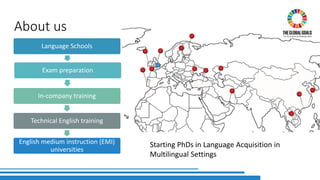
About us
Language Schools
Exam preparation
In-company training
Technical English training
English medium instruction (EMI)
universities
Starting PhDs in Language Acquisition in
Multilingual Settings
Teaching EAP
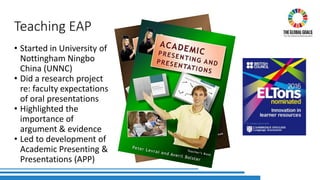
• Started in University of
Nottingham Ningbo
China (UNNC)
• Did a research project
re: faculty expectations
of oral presentations
• Highlighted the
importance of
argument & evidence
• Led to development of
Academic Presenting &
Presentations (APP)
Teaching EAP
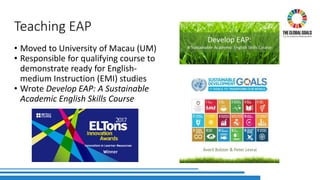
• Moved to University of Macau (UM)
• Responsible for qualifying course to
demonstrate ready for English-
medium Instruction (EMI) studies
• Wrote Develop EAP: A Sustainable
Academic English Skills Course
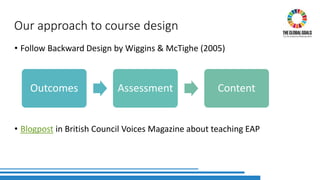
Outcomes Assessment Content
Our approach to course design
• Follow Backward Design by Wiggins & McTighe (2005)
• Blogpost in British Council Voices Magazine about teaching EAP
The aim of Develop EAP
• Everything is geared towards helping students succeed in English-
medium higher education.
• Article about developing the course in the latest edition of the
European Journal of Applied Linguistics and TEFL
Linchpin idea: To help learners to develop “the language and
associated practices that people need in order to undertake study
or work in English medium higher education” (Gillett, 2015, para. 1)
Benefits of using the
SDGs in EAP
What the SDGs are, how we used them & useful resources
Developing a sustainable course
Suitable for
different contexts
& cohorts
Easily adaptable
& usable for a
long time
Accessible &
relevant content
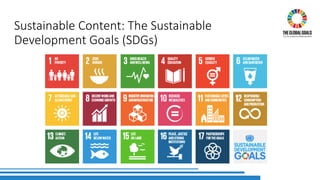
Sustainable Content: The Sustainable
Development Goals (SDGs)
The SDGs in Higher Education
• Fits with quotes from Peter Wells, chief of higher education at UNESCO
‘Professors no longer need to scrabble
around creating artificial problems for
their curricula as the SDGs pose real-life
problems for students to address.’
(Warden, 2017)
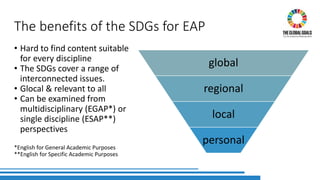
The benefits of the SDGs for EAP
• Hard to find content suitable
for every discipline
• The SDGs cover a range of
interconnected issues.
• Glocal & relevant to all
• Can be examined from
multidisciplinary (EGAP*) or
single discipline (ESAP**)
perspectives
*English for General Academic Purposes
**English for Specific Academic Purposes
global
regional
local
personal
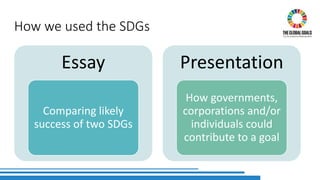
How we used the SDGs
Essay
Comparing likely
success of two SDGs
Presentation
How governments,
corporations and/or
individuals could
contribute to a goal
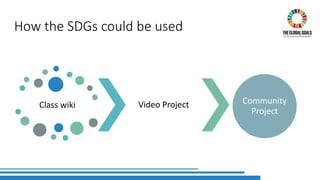
How the SDGs could be used
Class wiki Video Project Community
Project
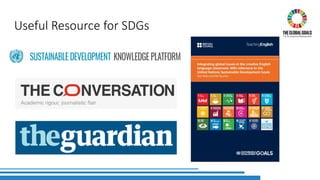
Useful Resource for SDGs
Key features of Develop
EAP
What makes the course a success
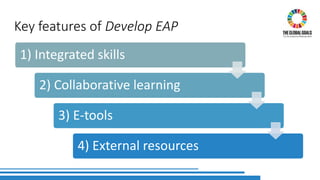
Key features of Develop EAP
1) Integrated skills
2) Collaborative learning
3) E-tools
4) External resources
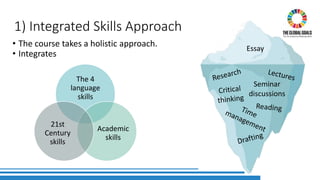
1) Integrated Skills Approach
• The course takes a holistic approach.
• Integrates
Essay
Seminar
discussions
The 4
language
skills
Academic
skills
21st
Century
skills
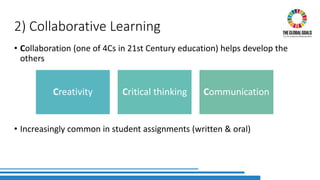
2) Collaborative Learning
• Collaboration (one of 4Cs in 21st Century education) helps develop the
others
• Increasingly common in student assignments (written & oral)
Creativity Critical thinking Communication
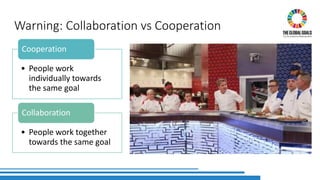
Warning: Collaboration vs Cooperation
• People work
individually towards
the same goal
Cooperation
• People work together
towards the same goal
Collaboration
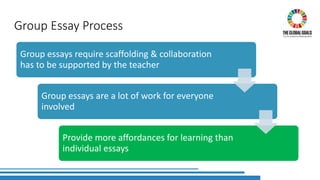
Group Essay Process
Group essays require scaffolding & collaboration
has to be supported by the teacher
Group essays are a lot of work for everyone
involved
Provide more affordances for learning than
individual essays
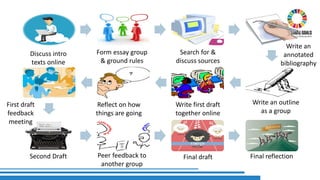
Form essay group
& ground rules
Discuss intro
texts online
Search for &
discuss sources
Write an
annotated
bibliography
Write an outline
as a group
Write first draft
together online
Reflect on how
things are going
First draft
feedback
meeting
Second Draft Final draft Final reflectionPeer feedback to
another group
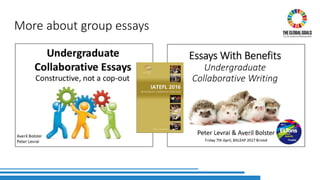
More about group essays
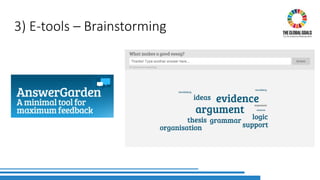
3) E-tools – Brainstorming
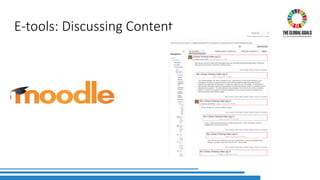
E-tools: Discussing Content
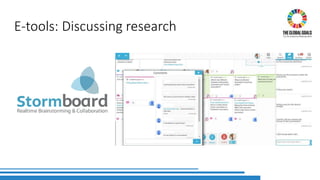
E-tools: Discussing research
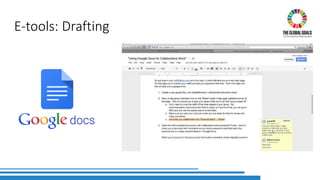
E-tools: Drafting
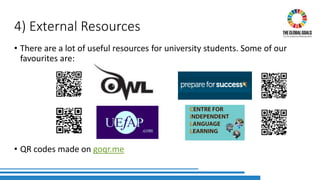
4) External Resources
• There are a lot of useful resources for university students. Some of our
favourites are:
• QR codes made on goqr.me
The future of the course
• We will be calling for universities that want to pilot the course
Open to research
on collaborative
learning
Provide feedback
for further
improvements
References
Bolster, A. & Levrai, P. (2017). Using the Sustainable Development Goals in the EAP Classroom. In Maley, A., &
Peachey, N. (Eds.), Integrating global issues in the creative English language classroom: With reference to the
United Nations Sustainable Development Goals (pp. 195-203). British Council. Retrieved from:
http://www.teachingenglish.org.uk/sites/teacheng/files/PUB_29200_Creativity_UN_SDG_v4S_WEB.pdf
Bolster, A. & Levrai, P. (2017). ‘A Slow (R)evolution: Developing a Sustainable EGAP Course’, European Journal for
Applied Linguistics and TEFL 6-1, 147-166.
Gillett, A. (2015). What is EAP? Retrieved from http://www.uefap.com/bgnd/whatfram.htm
Levrai, P. & Bolster, A. (2017). ‘Undergraduate collaborative essays: constructive not a cop-out’, IATEFL 2016
Birmingham Conference Selections. IATEFL
United Nations. (2016). Sustainable Development Goals: 17 Goals to Transform our World. Retrieved from
http://www.un.org/sustainabledevelopment/sustainable-development-goals/
Warden, R. (2017) SDGs – Universities are moving from what to do to how. Retrieved from
http://www.universityworldnews.com/article.php?story=20170921171919144
Wiggins, G. P., & McTighe, J. (2005). Understanding by design. Upper Saddle River, NJ: Merrill/Prentice Hall.
Thank you
averilbolster@gmail.com
peterlevrai@gmail.com

Building Sustainability into an EAP Course

  • 1.
    Building sustainability into anEAP course Averil Bolster & Peter Levrai 16th November, 2017 http://developeap.weebly.com/
  • 2.
    Overview • Hyperlinks throughoutthe PPT How we got here Benefits of using Sustainable Development Goals (SDGs) in EAP Key features of Develop EAP
  • 3.
    How we gothere Our history & approach to course design
  • 4.
    About us Language Schools Exampreparation In-company training Technical English training English medium instruction (EMI) universities Starting PhDs in Language Acquisition in Multilingual Settings
  • 5.
    Teaching EAP • Startedin University of Nottingham Ningbo China (UNNC) • Did a research project re: faculty expectations of oral presentations • Highlighted the importance of argument & evidence • Led to development of Academic Presenting & Presentations (APP)
  • 6.
    Teaching EAP • Movedto University of Macau (UM) • Responsible for qualifying course to demonstrate ready for English- medium Instruction (EMI) studies • Wrote Develop EAP: A Sustainable Academic English Skills Course
  • 7.
    Outcomes Assessment Content Ourapproach to course design • Follow Backward Design by Wiggins & McTighe (2005) • Blogpost in British Council Voices Magazine about teaching EAP
  • 8.
    The aim ofDevelop EAP • Everything is geared towards helping students succeed in English- medium higher education. • Article about developing the course in the latest edition of the European Journal of Applied Linguistics and TEFL Linchpin idea: To help learners to develop “the language and associated practices that people need in order to undertake study or work in English medium higher education” (Gillett, 2015, para. 1)
  • 9.
    Benefits of usingthe SDGs in EAP What the SDGs are, how we used them & useful resources
  • 10.
    Developing a sustainablecourse Suitable for different contexts & cohorts Easily adaptable & usable for a long time Accessible & relevant content
  • 11.
    Sustainable Content: TheSustainable Development Goals (SDGs)
  • 12.
    The SDGs inHigher Education • Fits with quotes from Peter Wells, chief of higher education at UNESCO ‘Professors no longer need to scrabble around creating artificial problems for their curricula as the SDGs pose real-life problems for students to address.’ (Warden, 2017)
  • 13.
    The benefits ofthe SDGs for EAP • Hard to find content suitable for every discipline • The SDGs cover a range of interconnected issues. • Glocal & relevant to all • Can be examined from multidisciplinary (EGAP*) or single discipline (ESAP**) perspectives *English for General Academic Purposes **English for Specific Academic Purposes global regional local personal
  • 14.
    How we usedthe SDGs Essay Comparing likely success of two SDGs Presentation How governments, corporations and/or individuals could contribute to a goal
  • 15.
    How the SDGscould be used Class wiki Video Project Community Project
  • 16.
  • 17.
    Key features ofDevelop EAP What makes the course a success
  • 18.
    Key features ofDevelop EAP 1) Integrated skills 2) Collaborative learning 3) E-tools 4) External resources
  • 19.
    1) Integrated SkillsApproach • The course takes a holistic approach. • Integrates Essay Seminar discussions The 4 language skills Academic skills 21st Century skills
  • 20.
    2) Collaborative Learning •Collaboration (one of 4Cs in 21st Century education) helps develop the others • Increasingly common in student assignments (written & oral) Creativity Critical thinking Communication
  • 21.
    Warning: Collaboration vsCooperation • People work individually towards the same goal Cooperation • People work together towards the same goal Collaboration
  • 22.
    Group Essay Process Groupessays require scaffolding & collaboration has to be supported by the teacher Group essays are a lot of work for everyone involved Provide more affordances for learning than individual essays
  • 23.
    Form essay group &ground rules Discuss intro texts online Search for & discuss sources Write an annotated bibliography Write an outline as a group Write first draft together online Reflect on how things are going First draft feedback meeting Second Draft Final draft Final reflectionPeer feedback to another group
  • 24.
  • 25.
    3) E-tools –Brainstorming
  • 26.
  • 27.
  • 28.
  • 29.
    4) External Resources •There are a lot of useful resources for university students. Some of our favourites are: • QR codes made on goqr.me
  • 30.
    The future ofthe course • We will be calling for universities that want to pilot the course Open to research on collaborative learning Provide feedback for further improvements
  • 31.
    References Bolster, A. &Levrai, P. (2017). Using the Sustainable Development Goals in the EAP Classroom. In Maley, A., & Peachey, N. (Eds.), Integrating global issues in the creative English language classroom: With reference to the United Nations Sustainable Development Goals (pp. 195-203). British Council. Retrieved from: http://www.teachingenglish.org.uk/sites/teacheng/files/PUB_29200_Creativity_UN_SDG_v4S_WEB.pdf Bolster, A. & Levrai, P. (2017). ‘A Slow (R)evolution: Developing a Sustainable EGAP Course’, European Journal for Applied Linguistics and TEFL 6-1, 147-166. Gillett, A. (2015). What is EAP? Retrieved from http://www.uefap.com/bgnd/whatfram.htm Levrai, P. & Bolster, A. (2017). ‘Undergraduate collaborative essays: constructive not a cop-out’, IATEFL 2016 Birmingham Conference Selections. IATEFL United Nations. (2016). Sustainable Development Goals: 17 Goals to Transform our World. Retrieved from http://www.un.org/sustainabledevelopment/sustainable-development-goals/ Warden, R. (2017) SDGs – Universities are moving from what to do to how. Retrieved from http://www.universityworldnews.com/article.php?story=20170921171919144 Wiggins, G. P., & McTighe, J. (2005). Understanding by design. Upper Saddle River, NJ: Merrill/Prentice Hall.
  • 32.