+

       IB
    PARENT
     NIGHT

             School at St. George Place

             NOVEMBER 2012
+
    IB BASICS

    THE HISTORY OF IB
       1968-IB Diploma Program began at International School of
        Geneva-led to a creation of a diploma for international students

       1980s-Diploma recognized by top universities around the world

       1994-Beginning of Middle Years Programme (MYP)

       1997-Beginning of Primary Years Programme (PYP)
+
    Facts and Figures
       3,482 schools in 144 countries

       1,061,000 students are enrolled in IB programs worldwide

       4 Program Types
           Primary Years Programme (PYP) for students aged 3 to 12
             975 schools
           Middle Years Programme (MYP) for students aged 11 to 16
             989 schools
           Diploma Programme for students aged 16 to 19
             2,367 schools
           Career-related Certificate (IBCC) for students aged 16 to 19

       PYP only schools world wide-557

       PYP only school in North America and Caribbean-337

       1,388 IB World Schools in United States
+
    Benefits of the IB Program
    What makes the program unique?

     Encourages     international-mindedness in students

     Encourages    a positive attitude toward learning by
        engaging students in inquiries and making them
        aware of the process of learning

        Reflects real life by going beyond traditional subject
        learning

     Emphasis    development of whole student through the
        Learner Profile.
+ Research to Support Benefit of the
  Program
    Evaluation of IB Programs in Texas (2010)
        State of Texas Education Research Center at Texas A&M
        Findings:
          Not a significant difference between IB schools and their comparison
           schools in math and reading achievement as measured by TAKS
          Structured classroom observations indicated that favorable
           instructional practices and student behaviors and activities occurred
           more frequently in IB classrooms than in non-IB Texas classrooms.
          Positive outcomes:
            Increased teacher collaboration
            Authentic assessment
            Increased student motivation
            Development of critical thinking skills
            Increased global and cultural awareness


    More info visit:
     http://www.ibo.org/research/policy/programmevalidation/pyp/
+
    Research to Support Benefit of the
    Program
       Handout
           DP best predictor of college performance
               http://www.ibo.org/recognition/resourcesanddocumentlibrary/more
                resources/documents/StudentPerfBrochure1.9.pdf
           Higher graduation rates
           Collaborative planning, training, resources, community
            involvement, leadership
           Graduate destinations 2011
               http://www.ibo.org/recognition/resourcesanddocumentlibrary/more
                resources/documents/GlobalDPDestinationSurveyUS.pdf
+
    Learner Profile

       Over-arching view of the attributes that learners will
        demonstrate

       http://www.ibo.org/programmes/profile/
+
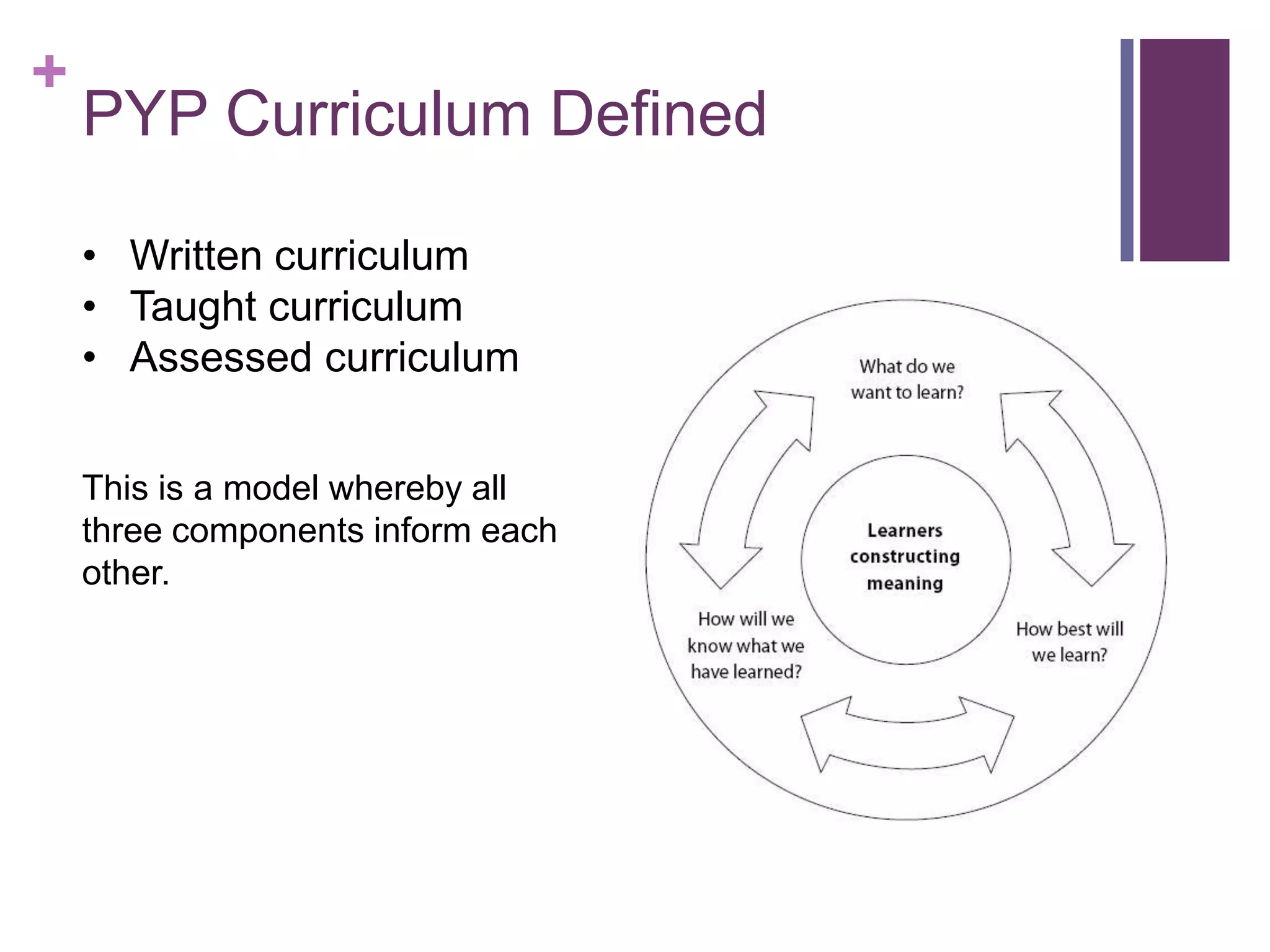
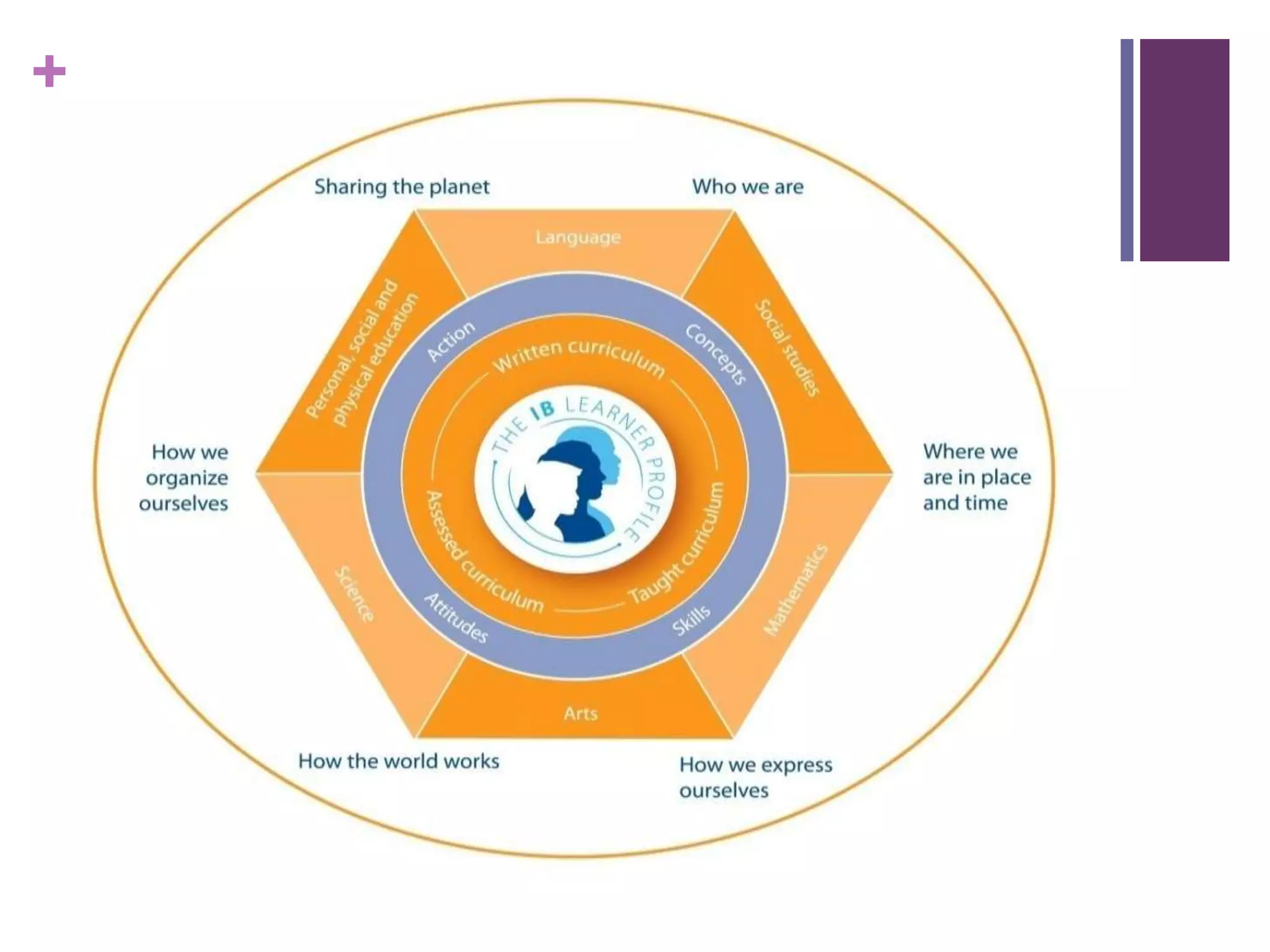
    PYP Curriculum Defined

    • Written curriculum
    • Taught curriculum
    • Assessed curriculum


    This is a model whereby all
    three components inform each
    other.
+
    Essential Elements
     Knowledge-Significant,   relevant content


     Concepts-ideas that have relevance within
     the subject areas but also transcend them


     Skills-capabilities
                      the students need to
     demonstrate to succeed in a
     changing, challenging world
+
    Essential Elements
     Attitudes-Dispositions
                          that are expressions of
     fundamental values, beliefs and feelings
     about learning


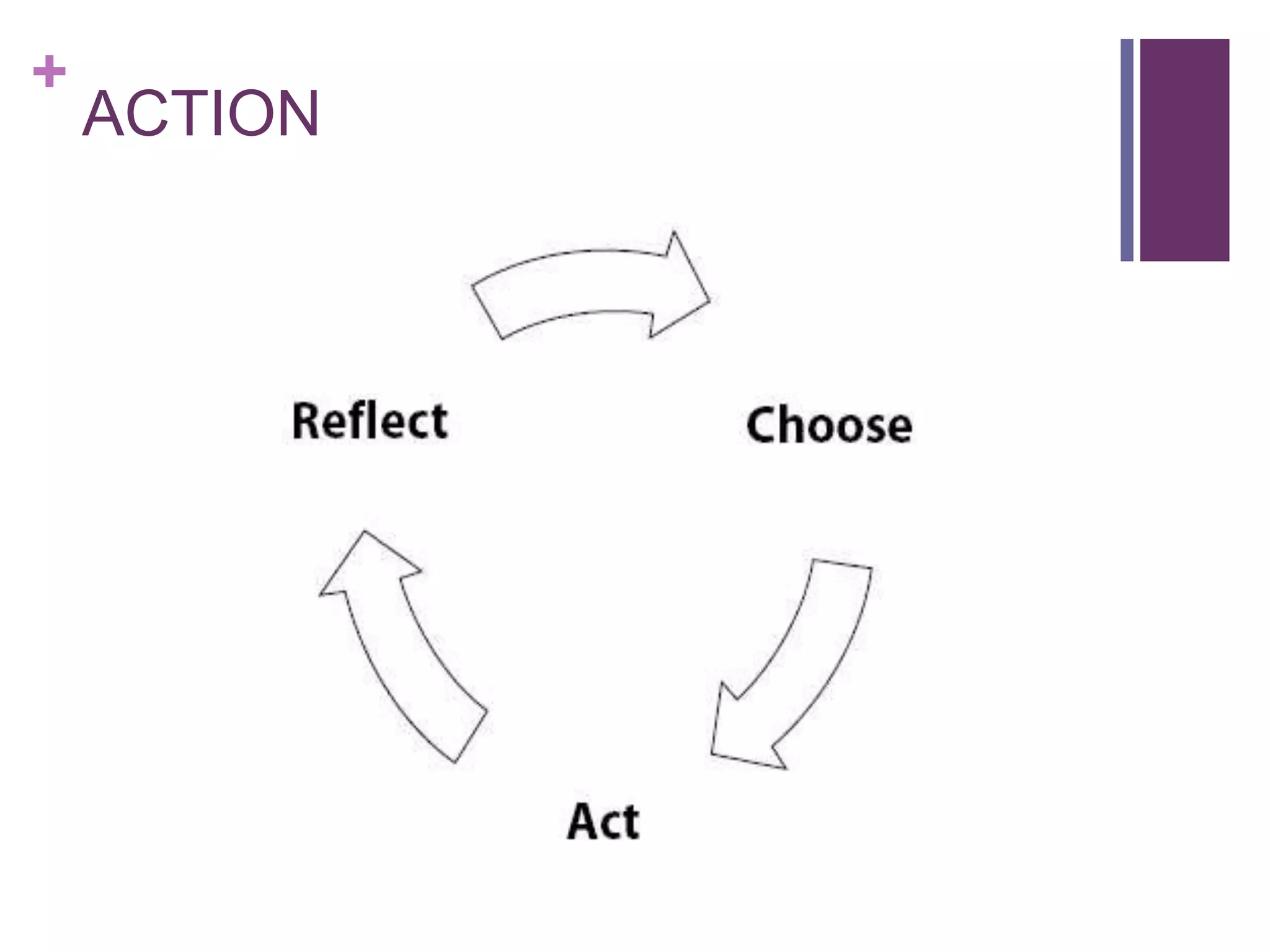
     Action-a manifestation in practice of the
     other essential elements
+
    KNOWLEDGE
       Who we are

        Inquiry into the nature of the self; beliefs and values;
        person, physical, mental, social and spiritual health; human
        relationships including families, friends, communities, and
        cultures; rights and responsibilities; what it means to be
        human.

       Where we are in place and time

        Inquiry into orientation in place and time; personal histories;
        homes and journeys; the discoveries, explorations and
        migrations of humankind; the relationship between and the
        interconnectedness of individuals and civilizations, from local
        and global perspectives.
+
    KNOWLEDGE
       How we express ourselves

        Inquiry into the ways in which we discover and express
        ideas, feelings, nature, culture, beliefs and values; the
        ways in which we reflect on, extend and enjoy our
        creativity; our appreciation of the aesthetic.

       How the world works

        Inquiry into the natural world and its laws, the interaction
        between the natural world (physical and biological) and
        human societies; how humans use their understanding of
        scientific principles; the impact of scientific and
        technological advances on society and on the
        environment.
+
    KNOWLEDGE
       How we organize ourselves

        Inquiry into the interconnectedness of human-made
        systems and communities; the structure and function of
        organizations; societal decision-making; economic
        activities and their impact on humankind and the
        environment.

       Sharing the planet

        Inquiry into rights and responsibilities in the struggle to
        share finite resources with other people and with other
        living things; communities and the relationship within and
        between them; access to equal opportunities; peace and
        conflict resolution
+
    CONCEPTS
       Form - What is it like?
       Function - How does it work?
       Causation - Why is it like it is?
       Change - How is it changing?
       Connection - How is it connected to other things?
       Perspective-What are the points of view?
       Responsibility-What is our responsibility?
       Reflection-How do we know?
+
    SKILLS
       Thinking
        Acquisition of knowledge; comprehension;
        application;
        analysis, synthesis, evaluation, dialectical
        thought, metacognition.


       Social skills
        Accepting responsibility; respecting others;
        cooperating, resolving conflict; group decision-
        making; adopting a variety of group roles.
+
    SKILLS
       Communication skills
        Listening; speaking; reading; writing; viewing;
        presenting; non-verbal communication
       Self – management skills
        Gross motor skills; fine motor skills; spatial
        awareness; organization; time management; safety;
        healthy lifestyle; codes of behaviour; informed
        choices
       Research skills
        Formulating questions; observing; planning;
        collecting data; recording data; organizing data;
        interpreting data; presenting research findings
    .
+
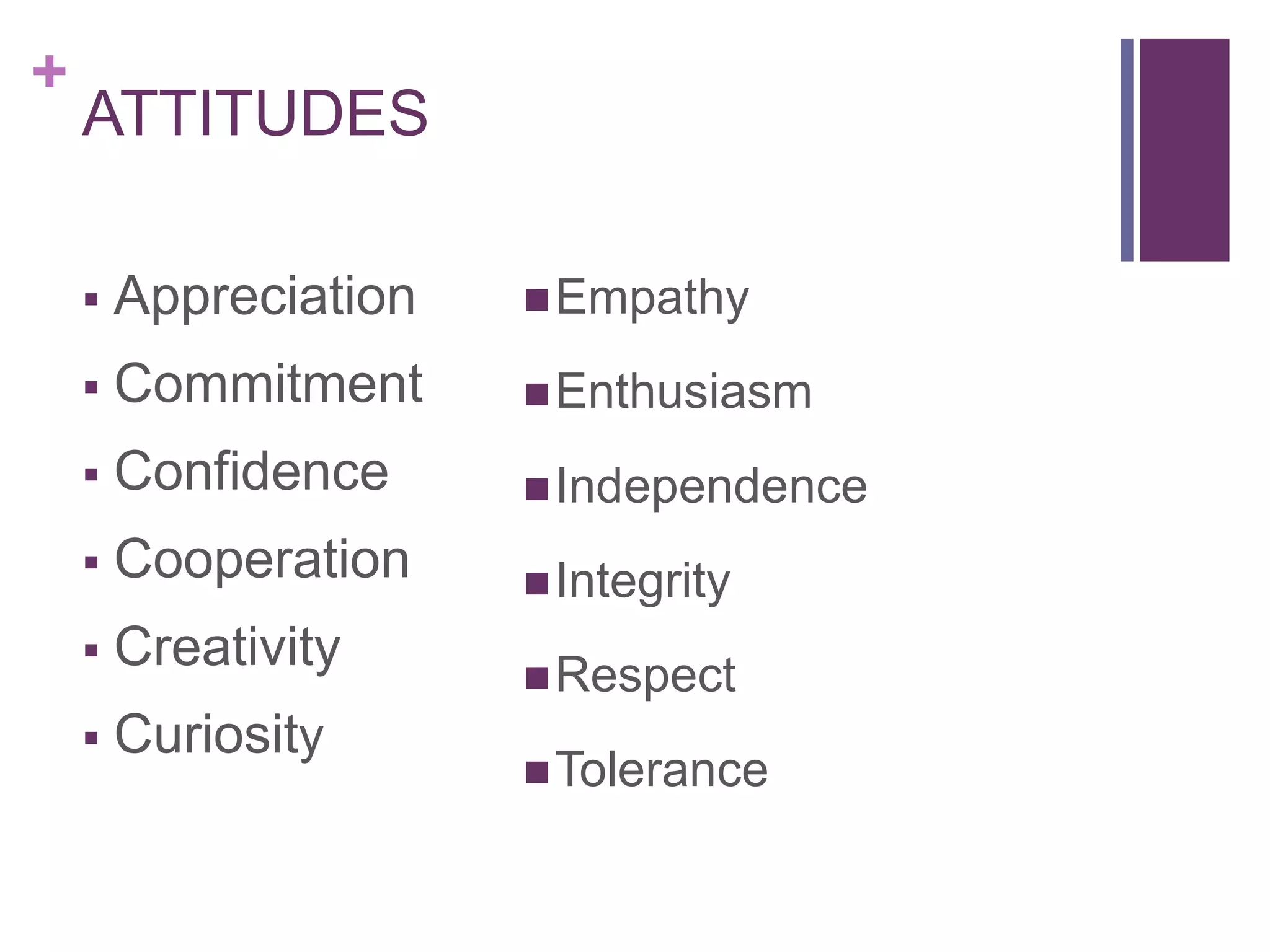
    ATTITUDES

       Appreciation    Empathy

       Commitment      Enthusiasm

       Confidence      Independence

       Cooperation     Integrity
       Creativity      Respect
       Curiosity
                        Tolerance
+
    ACTION
+
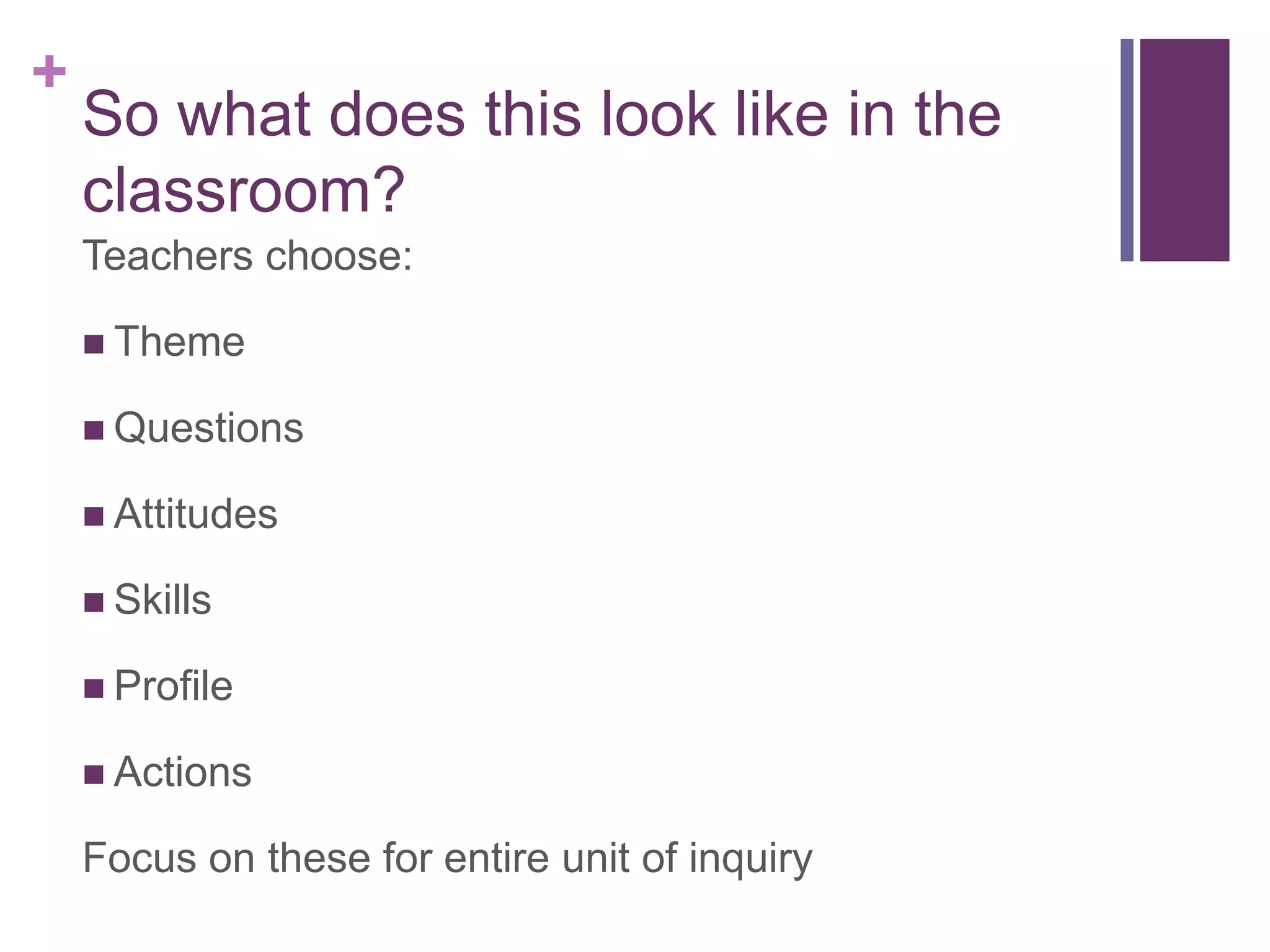
    So what does this look like in the
    classroom?
    Teachers choose:

     Theme

     Questions

     Attitudes

     Skills

     Profile

     Actions

    Focus on these for entire unit of inquiry
+
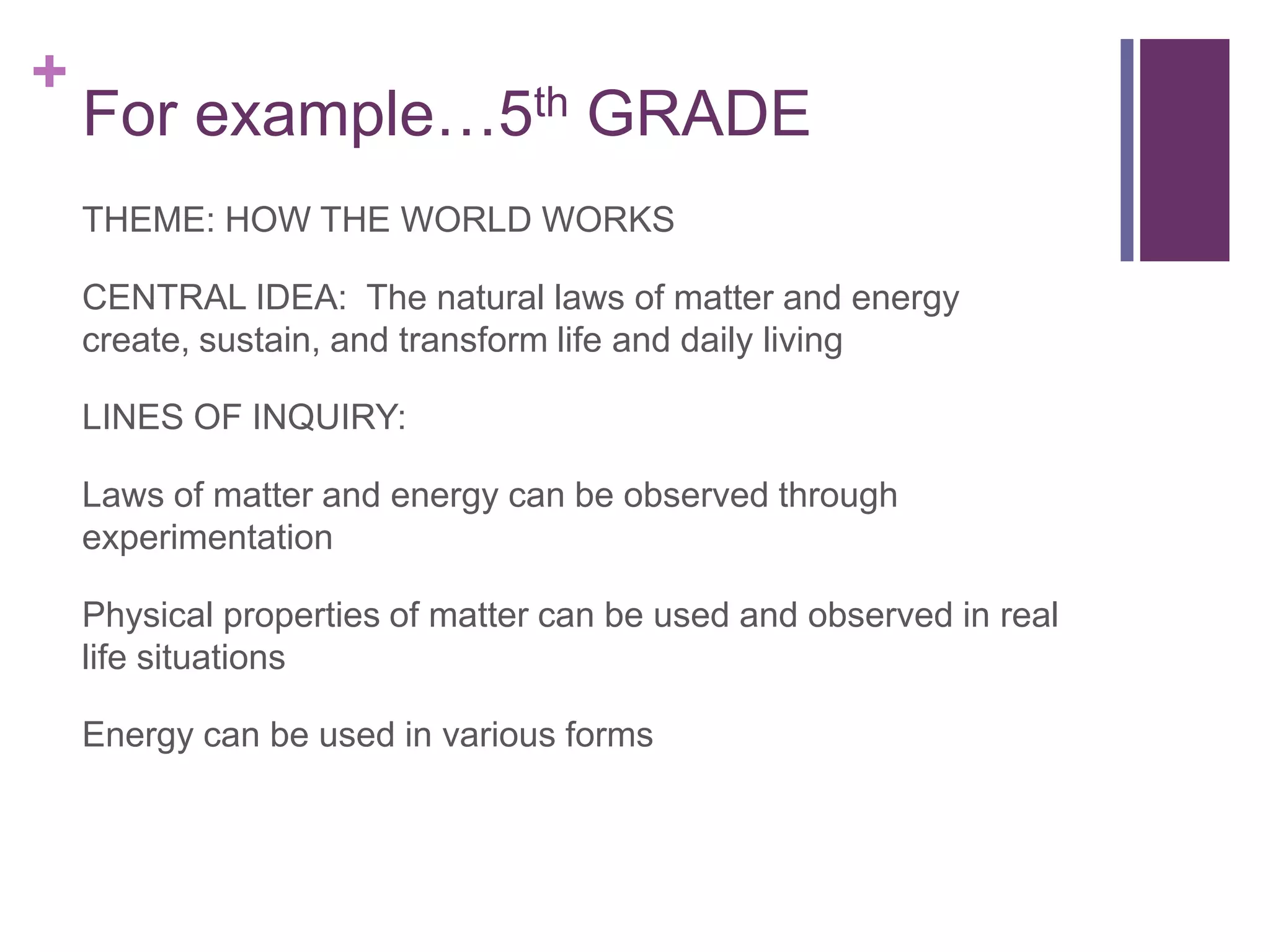
    For example…5th GRADE
    THEME: HOW THE WORLD WORKS

    CENTRAL IDEA: The natural laws of matter and energy
    create, sustain, and transform life and daily living

    LINES OF INQUIRY:

    Laws of matter and energy can be observed through
    experimentation

    Physical properties of matter can be used and observed in real
    life situations

    Energy can be used in various forms
+
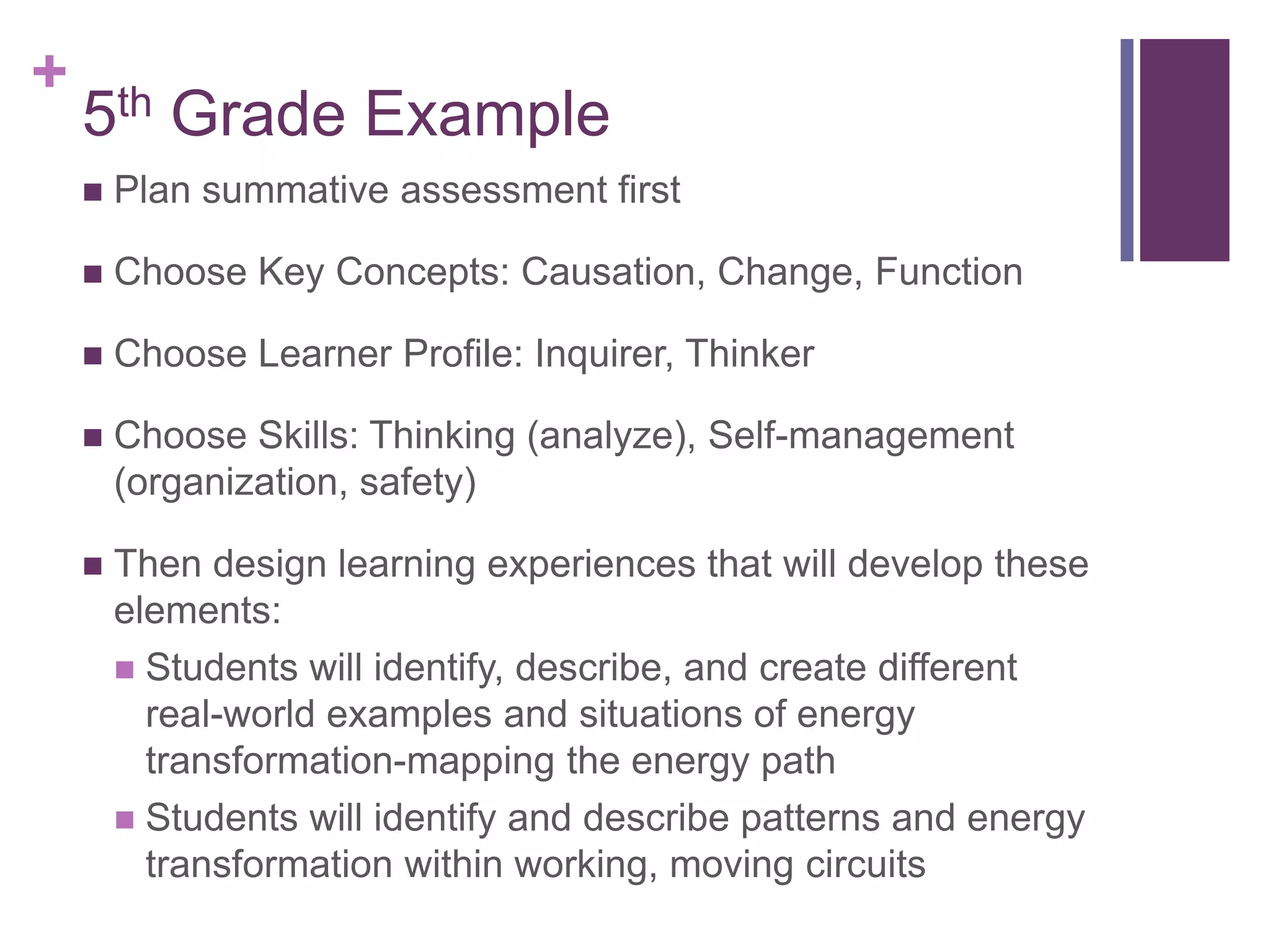
    5th Grade Example
       Plan summative assessment first

       Choose Key Concepts: Causation, Change, Function

       Choose Learner Profile: Inquirer, Thinker

       Choose Skills: Thinking (analyze), Self-management
        (organization, safety)

       Then design learning experiences that will develop these
        elements:
         Students will identify, describe, and create different
          real-world examples and situations of energy
          transformation-mapping the energy path
         Students will identify and describe patterns and energy
          transformation within working, moving circuits
+
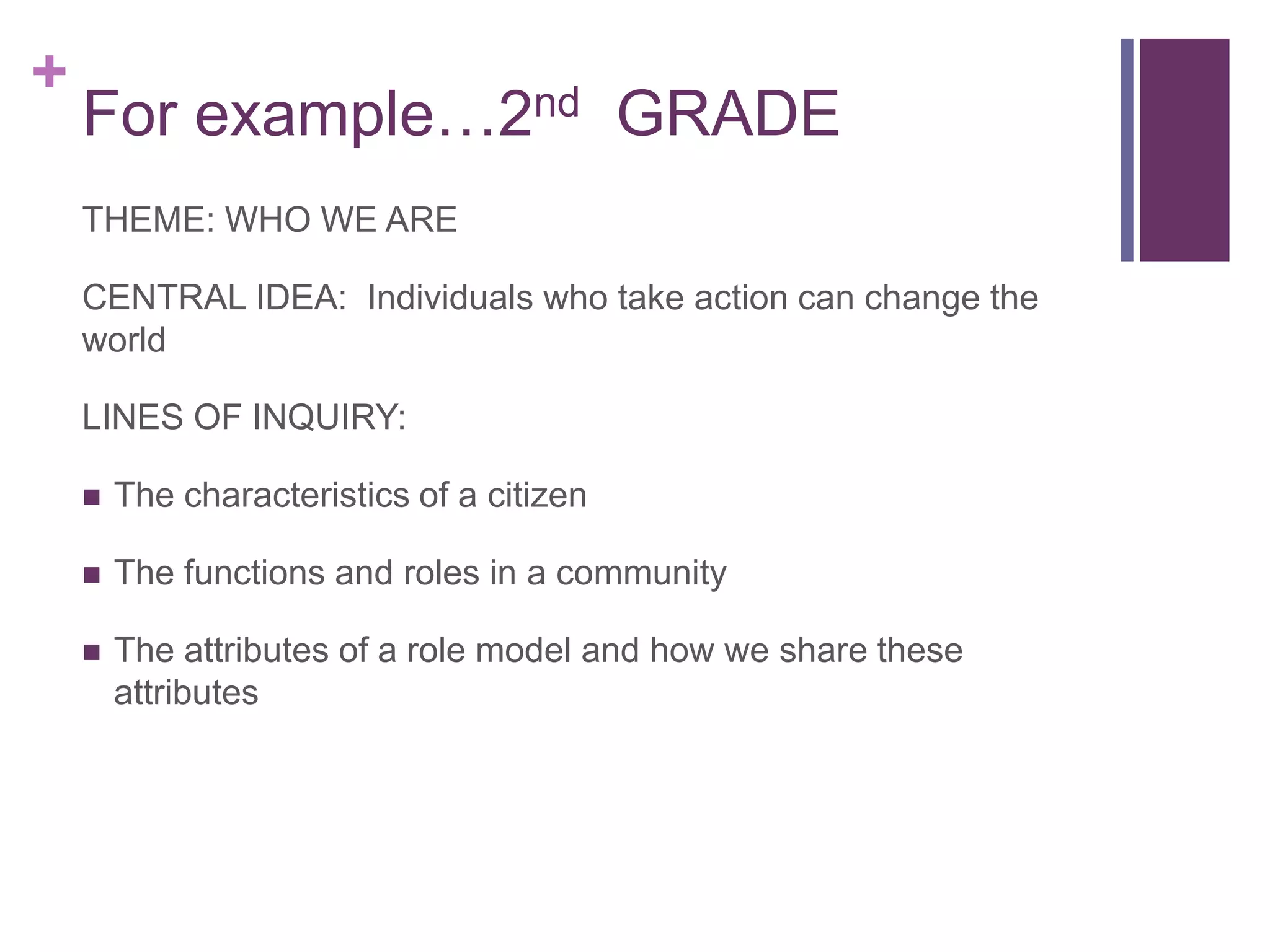
    For example…2nd GRADE
    THEME: WHO WE ARE

    CENTRAL IDEA: Individuals who take action can change the
    world

    LINES OF INQUIRY:

       The characteristics of a citizen

       The functions and roles in a community

       The attributes of a role model and how we share these
        attributes
+
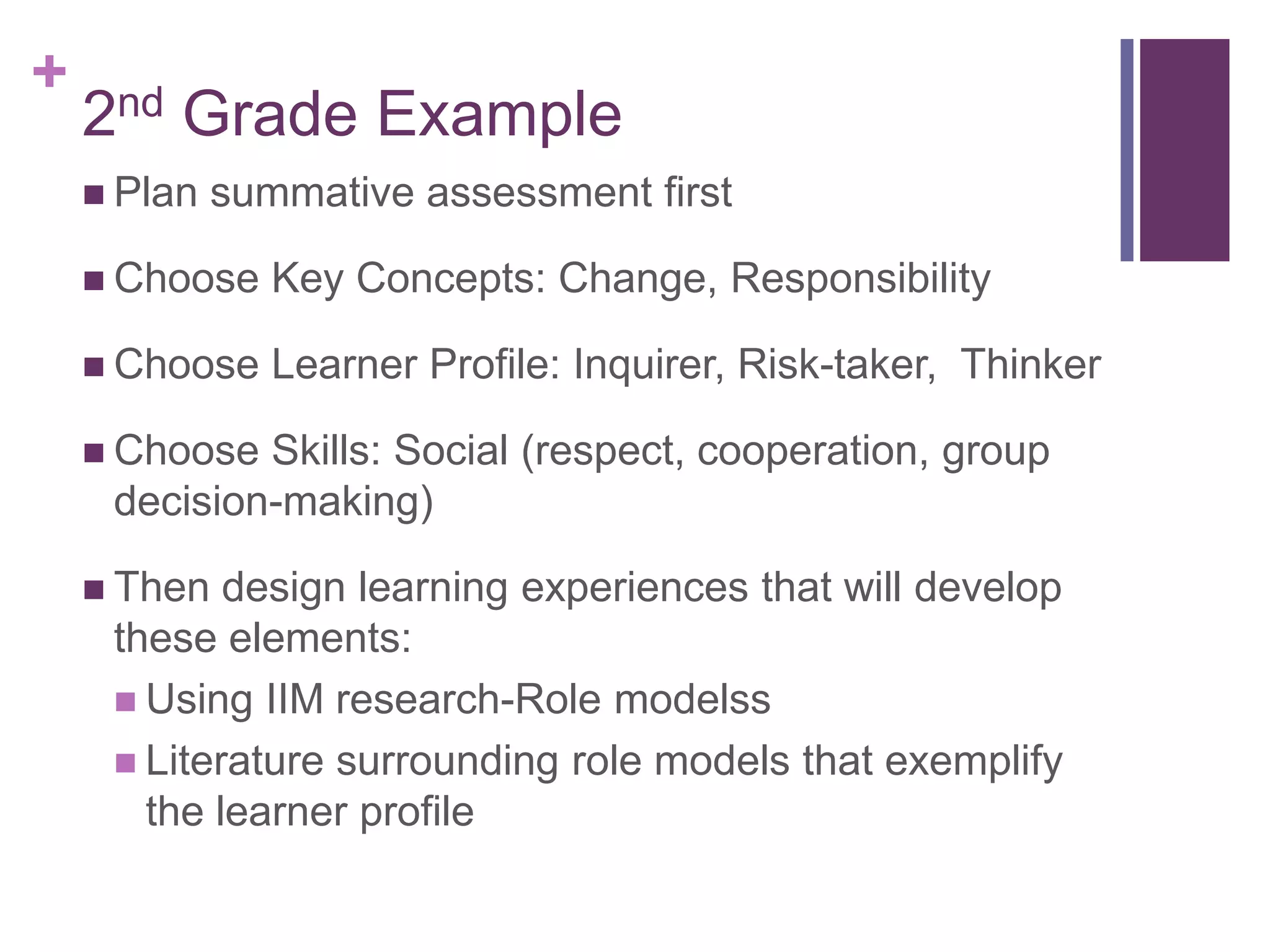
    2nd Grade Example
     Plan   summative assessment first

     Choose    Key Concepts: Change, Responsibility

     Choose    Learner Profile: Inquirer, Risk-taker, Thinker

     Choose Skills: Social (respect, cooperation, group
     decision-making)

     Then  design learning experiences that will develop
     these elements:
      Using IIM research-Role modelss
      Literature surrounding role models that exemplify
       the learner profile
+
    Overview
+
    Where we are in the process


     Goal:   6 Units of Inquiry
     Working  on writing and implementing 2nd Unit
     of Inquiry
     Goal:
          By December Program of Inquiry
     complete
     6 central ideas with lines of inquiry for each
      grade
+
    What can parents do?
     IB   @ Home

     Talk   to children about the Learner Profile

     Encourage     inquiry in their children
+
    ANY QUESTIONS???

       Contact me: Lisa Hernandez
           LHERNA15@houstonisd.org

       IB Website
        www.ibo.org

Ib parent night website[1]

  • 1.
    + IB PARENT NIGHT School at St. George Place NOVEMBER 2012
  • 2.
    + IB BASICS THE HISTORY OF IB  1968-IB Diploma Program began at International School of Geneva-led to a creation of a diploma for international students  1980s-Diploma recognized by top universities around the world  1994-Beginning of Middle Years Programme (MYP)  1997-Beginning of Primary Years Programme (PYP)
  • 3.
    + Facts and Figures  3,482 schools in 144 countries  1,061,000 students are enrolled in IB programs worldwide  4 Program Types  Primary Years Programme (PYP) for students aged 3 to 12  975 schools  Middle Years Programme (MYP) for students aged 11 to 16  989 schools  Diploma Programme for students aged 16 to 19  2,367 schools  Career-related Certificate (IBCC) for students aged 16 to 19  PYP only schools world wide-557  PYP only school in North America and Caribbean-337  1,388 IB World Schools in United States
  • 4.
    + Benefits of the IB Program What makes the program unique?  Encourages international-mindedness in students  Encourages a positive attitude toward learning by engaging students in inquiries and making them aware of the process of learning  Reflects real life by going beyond traditional subject learning  Emphasis development of whole student through the Learner Profile.
  • 5.
    + Research toSupport Benefit of the Program  Evaluation of IB Programs in Texas (2010)  State of Texas Education Research Center at Texas A&M  Findings:  Not a significant difference between IB schools and their comparison schools in math and reading achievement as measured by TAKS  Structured classroom observations indicated that favorable instructional practices and student behaviors and activities occurred more frequently in IB classrooms than in non-IB Texas classrooms.  Positive outcomes:  Increased teacher collaboration  Authentic assessment  Increased student motivation  Development of critical thinking skills  Increased global and cultural awareness  More info visit: http://www.ibo.org/research/policy/programmevalidation/pyp/
  • 6.
    + Research to Support Benefit of the Program  Handout  DP best predictor of college performance  http://www.ibo.org/recognition/resourcesanddocumentlibrary/more resources/documents/StudentPerfBrochure1.9.pdf  Higher graduation rates  Collaborative planning, training, resources, community involvement, leadership  Graduate destinations 2011  http://www.ibo.org/recognition/resourcesanddocumentlibrary/more resources/documents/GlobalDPDestinationSurveyUS.pdf
  • 7.
    + Learner Profile  Over-arching view of the attributes that learners will demonstrate  http://www.ibo.org/programmes/profile/
  • 8.
    + PYP Curriculum Defined • Written curriculum • Taught curriculum • Assessed curriculum This is a model whereby all three components inform each other.
  • 9.
    + Essential Elements  Knowledge-Significant, relevant content  Concepts-ideas that have relevance within the subject areas but also transcend them  Skills-capabilities the students need to demonstrate to succeed in a changing, challenging world
  • 10.
    + Essential Elements  Attitudes-Dispositions that are expressions of fundamental values, beliefs and feelings about learning  Action-a manifestation in practice of the other essential elements
  • 11.
    + KNOWLEDGE  Who we are Inquiry into the nature of the self; beliefs and values; person, physical, mental, social and spiritual health; human relationships including families, friends, communities, and cultures; rights and responsibilities; what it means to be human.  Where we are in place and time Inquiry into orientation in place and time; personal histories; homes and journeys; the discoveries, explorations and migrations of humankind; the relationship between and the interconnectedness of individuals and civilizations, from local and global perspectives.
  • 12.
    + KNOWLEDGE  How we express ourselves Inquiry into the ways in which we discover and express ideas, feelings, nature, culture, beliefs and values; the ways in which we reflect on, extend and enjoy our creativity; our appreciation of the aesthetic.  How the world works Inquiry into the natural world and its laws, the interaction between the natural world (physical and biological) and human societies; how humans use their understanding of scientific principles; the impact of scientific and technological advances on society and on the environment.
  • 13.
    + KNOWLEDGE  How we organize ourselves Inquiry into the interconnectedness of human-made systems and communities; the structure and function of organizations; societal decision-making; economic activities and their impact on humankind and the environment.  Sharing the planet Inquiry into rights and responsibilities in the struggle to share finite resources with other people and with other living things; communities and the relationship within and between them; access to equal opportunities; peace and conflict resolution
  • 14.
    + CONCEPTS  Form - What is it like?  Function - How does it work?  Causation - Why is it like it is?  Change - How is it changing?  Connection - How is it connected to other things?  Perspective-What are the points of view?  Responsibility-What is our responsibility?  Reflection-How do we know?
  • 15.
    + SKILLS  Thinking Acquisition of knowledge; comprehension; application; analysis, synthesis, evaluation, dialectical thought, metacognition.  Social skills Accepting responsibility; respecting others; cooperating, resolving conflict; group decision- making; adopting a variety of group roles.
  • 16.
    + SKILLS  Communication skills Listening; speaking; reading; writing; viewing; presenting; non-verbal communication  Self – management skills Gross motor skills; fine motor skills; spatial awareness; organization; time management; safety; healthy lifestyle; codes of behaviour; informed choices  Research skills Formulating questions; observing; planning; collecting data; recording data; organizing data; interpreting data; presenting research findings .
  • 17.
    + ATTITUDES  Appreciation  Empathy  Commitment  Enthusiasm  Confidence  Independence  Cooperation  Integrity  Creativity  Respect  Curiosity  Tolerance
  • 18.
    + ACTION
  • 19.
    + So what does this look like in the classroom? Teachers choose:  Theme  Questions  Attitudes  Skills  Profile  Actions Focus on these for entire unit of inquiry
  • 20.
    + For example…5th GRADE THEME: HOW THE WORLD WORKS CENTRAL IDEA: The natural laws of matter and energy create, sustain, and transform life and daily living LINES OF INQUIRY: Laws of matter and energy can be observed through experimentation Physical properties of matter can be used and observed in real life situations Energy can be used in various forms
  • 21.
    + 5th Grade Example  Plan summative assessment first  Choose Key Concepts: Causation, Change, Function  Choose Learner Profile: Inquirer, Thinker  Choose Skills: Thinking (analyze), Self-management (organization, safety)  Then design learning experiences that will develop these elements:  Students will identify, describe, and create different real-world examples and situations of energy transformation-mapping the energy path  Students will identify and describe patterns and energy transformation within working, moving circuits
  • 22.
    + For example…2nd GRADE THEME: WHO WE ARE CENTRAL IDEA: Individuals who take action can change the world LINES OF INQUIRY:  The characteristics of a citizen  The functions and roles in a community  The attributes of a role model and how we share these attributes
  • 23.
    + 2nd Grade Example  Plan summative assessment first  Choose Key Concepts: Change, Responsibility  Choose Learner Profile: Inquirer, Risk-taker, Thinker  Choose Skills: Social (respect, cooperation, group decision-making)  Then design learning experiences that will develop these elements:  Using IIM research-Role modelss  Literature surrounding role models that exemplify the learner profile
  • 24.
    + Overview
  • 25.
    + Where we are in the process  Goal: 6 Units of Inquiry  Working on writing and implementing 2nd Unit of Inquiry  Goal: By December Program of Inquiry complete 6 central ideas with lines of inquiry for each grade
  • 26.
    + What can parents do?  IB @ Home  Talk to children about the Learner Profile  Encourage inquiry in their children
  • 27.
    + ANY QUESTIONS???  Contact me: Lisa Hernandez  LHERNA15@houstonisd.org  IB Website www.ibo.org