A four levels framework to understand 
quality practices in active e-Learning 
Diogo Casanova1, António Moreira2, Nilza Costa2 
1 Kingston University London, CHERP, United Kingdom 
2 Universidade de Aveiro, Portugal 
ECER2014
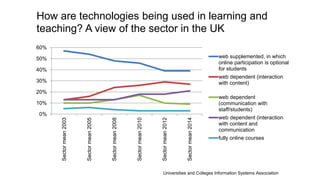
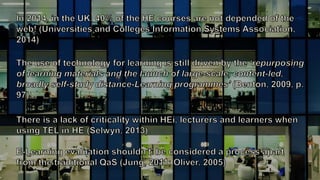
How are technologies being used in learning and 
teaching? A view of the sector in the UK 
60% 
50% 
40% 
30% 
20% 
10% 
0% 
Sector mean 2003 
Sector mean 2005 
Sector mean 2008 
Sector mean 2010 
Sector mean 2012 
Sector mean 2014 
web supplemented, in which 
online participation is optional 
for students 
web dependent (interaction 
with content) 
web dependent 
(communication with 
staff/students) 
web dependent (interaction 
with content and 
communication 
fully online courses 
Universities and Colleges Information Systems Association
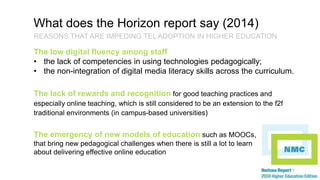
What does the Horizon report say (2014) 
REASONS THAT ARE IMPEDING TEL ADOPTION IN HIGHER EDUCATION 
The low digital fluency among staff 
• the lack of competencies in using technologies pedagogically; 
• the non-integration of digital media literacy skills across the curriculum. 
The lack of rewards and recognition for good teaching practices and 
especially online teaching, which is still considered to be an extension to the f2f 
traditional environments (in campus-based universities) 
The emergency of new models of education such as MOOCs, 
that bring new pedagogical challenges when there is still a lot to learn 
about delivering effective online education
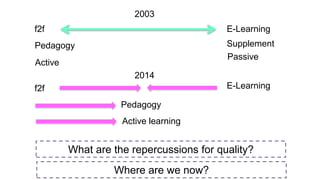
2003 
f2f E-Learning 
2014 
Pedagogy 
Passive 
f2f E-Learning 
Pedagogy 
Active 
Supplement 
Active learning 
What are the repercussions for quality? 
Where are we now?
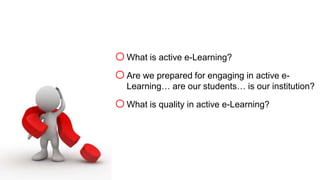
oWhat is active e-Learning? 
oAre we prepared for engaging in active e- 
Learning… are our students… is our institution? 
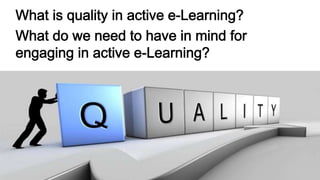
oWhat is quality in active e-Learning?
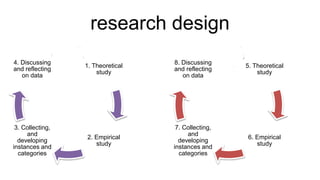
research design 
1. Theoretical 
study 
2. Empirical 
study 
4. Discussing 
and reflecting 
on data 
3. Collecting, 
and 
developing 
instances and 
categories 
5. Theoretical 
study 
6. Empirical 
study 
8. Discussing 
and reflecting 
on data 
7. Collecting, 
and 
developing 
instances and 
categories
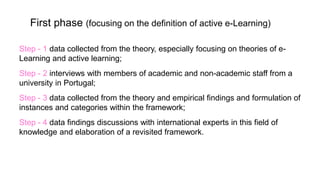
First phase (focusing on the definition of active e-Learning) 
Step - 1 data collected from the theory, especially focusing on theories of e- 
Learning and active learning; 
Step - 2 interviews with members of academic and non-academic staff from a 
university in Portugal; 
Step - 3 data collected from the theory and empirical findings and formulation of 
instances and categories within the framework; 
Step - 4 data findings discussions with international experts in this field of 
knowledge and elaboration of a revisited framework.
Second phase (focusing on identifying QS for active e-Learning) 
Step – 5 data collected within the literature about models that evaluate the quality 
of e-learning which in some extent would be aligned with the first version of the 
framework; 
Step – 6 focus group for understanding the students point a view about quality 
learning in e-Learning, 
Step - 7 data collected from the theory and empirical moments and formulation of 
concepts and categories within the framework; 
Step - 8 data findings discussion both in Portugal and in the UK with international 
experts in e-Learning and e-Learning quality.
Key concepts 
learner-centred 
The learner should be able to act as an active agent in the learning process 
designing its own path of learning and constructing its own conception of 
knowledge (Mayes & Freitas, 2007). 
Should allow a degree of personalisation either by agreeing with learners the 
learning outcomes and assessment or by giving learners different opportunities 
so they can adapt to their own learning styles and needs. 
Examples: 
• Allow learners to choose their own learning resources and materials; 
• Discussing personal experiences and setting individual outcomes/goals; 
• Enforcing learners to become active consumers of online communities.
Key concepts 
relevant use of technology 
Technology must be used when it is relevant and when it brings something 
new or additional to the learning experience. 
This suggests that by using technology the lecturer is either promoting new 
learning opportunities or promoting more effective and more engaging 
teaching. 
Examples: 
• Use technology to promote asynchronous and reflected discussions; 
• Use technologies to promote collaborative writing (Google Docs) or thinking skills 
(Conceptual Maps); 
• Use technologies for interacting with students in classroom (Twitter wall, Audience Response 
Systems) or involving with a different style of learning using multimedia files or simulation 
environments.
Key concepts 
planned and designed 
E-Learning doesn’t match with improvise. Activities need to be aligned with assessment, with 
iLO and with a pedagogical goal. 
Practical use of constructive alignment (Biggs & Tang, 2011) is fundamental because it 
allows learners to become more autonomous and more responsible for their learning. 
Lecturers should choose a particular tool or technology according to the learning activity or 
to each pedagogical goal (Conole, Dyke, Oliver, & Seale, 2004; Laurillard, 2002). 
Examples: 
• Use design tools to plan and to reflect on how you set learning goals and plan activities; 
• Use analytics as a tool to reflect and redesign.
Key concepts 
active and experiential 
The learner has to become involved in the learning process not by hearing or reading 
passively but by appropriating the content delivered. Learners must be involved in 
developing hypothesis, interpreting, manipulating, solving problems and taking 
decisions (Kim & Hannafin, 2011). 
The learner must also be involved in reflecting on its learning and on the learning 
process. 
Examples: 
• Develop project base learning activities (technology can be seen as a medium but also as a 
support for the end product); 
• Promote complex activities which suggest experimentation and having different outcomes; 
• Encourage individual and group reflections at the end of each activity (using blogs, social 
networks or forums).
Key concepts 
flexible 
One of the most suggested reasons for the use of technology in 
learning and especially in HE is the degree of flexibility it allows, not 
just from the learners perspective but also from the lecturer 
perspective. 
Flexibility can be demonstrated according to the time learning 
occurs, the duration learning takes, the learning space or the 
learning resources available (Moore et al., 2011; Oliver & Trigwell, 
2005). 
Examples: 
• Agree with flexible schedules (tasks, assessment) when possible; 
• Encourage flexibility when choosing resources or tools;
Key concepts 
engagement by production and collaboration 
For the use of technology to become engaging it should foster production, collaboration, 
communication and content sharing between lecturers and learners and learners and 
learners (Conole, Crew, Oliver, & Harvey, 2001; Shea, Pickett, & Pelz, 2003). 
Communication needs to be effective and according to best practices (netiquette, frequent, 
relevant). There should be a presence from the lecturer either directly or indirectly 
(mentors/tutors) and communication must be synchronous and asynchronous . 
Feedback must be constructive, timely and involving learners in it (Shea et al., 2003). 
Examples: 
• Nominate students as moderators so they become daily responsible for the online environment 
(fosters responsibility, transferable skills, online presence); 
• Agree with a response time beforehand and give feedback in that timeframe (ideally in a 24h 
timeframe).
Key concepts 
authentic 
Alignment between activities, students expectations and experiential learning 
(Bradwell, 2009; Herrington, Oliver, & Reeves, 2011). A learner motivated 
with real and meaningful activities is crucial especially when there is a lack of 
physical presence from the lecturer. It encourages engagement and self-direction. 
Examples: 
• Design real scenarios similar to what students would have in their future professions; 
• Encourage more project base learning; 
• Involve stakeholders/employers when possible; 
• Encourage students to share their previous experiences; 
• Encourage the use of professional networks (social media).
other relevant concepts that 
informed the framework 
Innovation (materials and resources, learning activities) 
Impact (students learning, transferable skills) 
Satisfaction (students, staff, future employers) 
Sustainability (lifelong learning skills, reusable materials 
and resources)
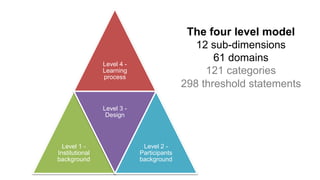
The four level model 
12 sub-dimensions 
61 domains 
121 categories 
298 threshold statements 
Level 4 - 
Learning 
process 
Level 1 - 
Institutional 
background 
Level 3 - 
Design 
Level 2 - 
Participants 
background
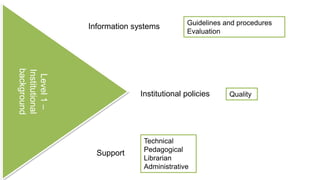
Level 1 – 
Institutional 
background 
Information systems 
Institutional policies 
Support 
Guidelines and procedures 
Evaluation 
Quality 
Technical 
Pedagogical 
Librarian 
Administrative
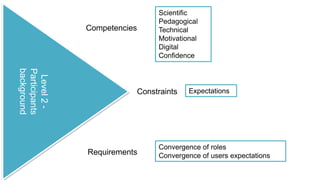
Level 2 - 
Participants 
background 
Competencies 
Scientific 
Pedagogical 
Technical 
Motivational 
Digital 
Confidence 
Constraints 
Expectations 
Requirements 
Convergence of roles 
Convergence of users expectations
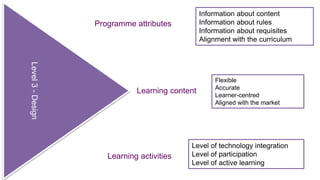
Level 3 - Design 
Programme attributes 
Learning content 
Learning activities 
Information about content 
Information about rules 
Information about requisites 
Alignment with the curriculum 
Flexible 
Accurate 
Learner-centred 
Aligned with the market 
Level of technology integration 
Level of participation 
Level of active learning
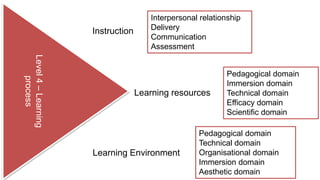
Level 4 – Learning 
process 
Interpersonal relationship 
Delivery 
Communication 
Assessment 
Learning resources 
Instruction 
Pedagogical domain 
Immersion domain 
Technical domain 
Efficacy domain 
Scientific domain 
Learning Environment 
Pedagogical domain 
Technical domain 
Organisational domain 
Immersion domain 
Aesthetic domain
Final considerations and suggestions for discussion 
• Is this module more suitable for quality enhancement or 
quality assurance? What concerns should we have? 
• Can we use this module for assessing emergent e-learning 
trends (MOOCs, OER, PLEs) 
• How and with what debt should we integrate analytics in 
evaluation models (ethics, data protection).

ECER conference presentation

  • 1.
    A four levelsframework to understand quality practices in active e-Learning Diogo Casanova1, António Moreira2, Nilza Costa2 1 Kingston University London, CHERP, United Kingdom 2 Universidade de Aveiro, Portugal ECER2014
  • 4.
    How are technologiesbeing used in learning and teaching? A view of the sector in the UK 60% 50% 40% 30% 20% 10% 0% Sector mean 2003 Sector mean 2005 Sector mean 2008 Sector mean 2010 Sector mean 2012 Sector mean 2014 web supplemented, in which online participation is optional for students web dependent (interaction with content) web dependent (communication with staff/students) web dependent (interaction with content and communication fully online courses Universities and Colleges Information Systems Association
  • 5.
    What does theHorizon report say (2014) REASONS THAT ARE IMPEDING TEL ADOPTION IN HIGHER EDUCATION The low digital fluency among staff • the lack of competencies in using technologies pedagogically; • the non-integration of digital media literacy skills across the curriculum. The lack of rewards and recognition for good teaching practices and especially online teaching, which is still considered to be an extension to the f2f traditional environments (in campus-based universities) The emergency of new models of education such as MOOCs, that bring new pedagogical challenges when there is still a lot to learn about delivering effective online education
  • 6.
    2003 f2f E-Learning 2014 Pedagogy Passive f2f E-Learning Pedagogy Active Supplement Active learning What are the repercussions for quality? Where are we now?
  • 8.
    oWhat is activee-Learning? oAre we prepared for engaging in active e- Learning… are our students… is our institution? oWhat is quality in active e-Learning?
  • 10.
    research design 1.Theoretical study 2. Empirical study 4. Discussing and reflecting on data 3. Collecting, and developing instances and categories 5. Theoretical study 6. Empirical study 8. Discussing and reflecting on data 7. Collecting, and developing instances and categories
  • 11.
    First phase (focusingon the definition of active e-Learning) Step - 1 data collected from the theory, especially focusing on theories of e- Learning and active learning; Step - 2 interviews with members of academic and non-academic staff from a university in Portugal; Step - 3 data collected from the theory and empirical findings and formulation of instances and categories within the framework; Step - 4 data findings discussions with international experts in this field of knowledge and elaboration of a revisited framework.
  • 12.
    Second phase (focusingon identifying QS for active e-Learning) Step – 5 data collected within the literature about models that evaluate the quality of e-learning which in some extent would be aligned with the first version of the framework; Step – 6 focus group for understanding the students point a view about quality learning in e-Learning, Step - 7 data collected from the theory and empirical moments and formulation of concepts and categories within the framework; Step - 8 data findings discussion both in Portugal and in the UK with international experts in e-Learning and e-Learning quality.
  • 14.
    Key concepts learner-centred The learner should be able to act as an active agent in the learning process designing its own path of learning and constructing its own conception of knowledge (Mayes & Freitas, 2007). Should allow a degree of personalisation either by agreeing with learners the learning outcomes and assessment or by giving learners different opportunities so they can adapt to their own learning styles and needs. Examples: • Allow learners to choose their own learning resources and materials; • Discussing personal experiences and setting individual outcomes/goals; • Enforcing learners to become active consumers of online communities.
  • 15.
    Key concepts relevantuse of technology Technology must be used when it is relevant and when it brings something new or additional to the learning experience. This suggests that by using technology the lecturer is either promoting new learning opportunities or promoting more effective and more engaging teaching. Examples: • Use technology to promote asynchronous and reflected discussions; • Use technologies to promote collaborative writing (Google Docs) or thinking skills (Conceptual Maps); • Use technologies for interacting with students in classroom (Twitter wall, Audience Response Systems) or involving with a different style of learning using multimedia files or simulation environments.
  • 16.
    Key concepts plannedand designed E-Learning doesn’t match with improvise. Activities need to be aligned with assessment, with iLO and with a pedagogical goal. Practical use of constructive alignment (Biggs & Tang, 2011) is fundamental because it allows learners to become more autonomous and more responsible for their learning. Lecturers should choose a particular tool or technology according to the learning activity or to each pedagogical goal (Conole, Dyke, Oliver, & Seale, 2004; Laurillard, 2002). Examples: • Use design tools to plan and to reflect on how you set learning goals and plan activities; • Use analytics as a tool to reflect and redesign.
  • 17.
    Key concepts activeand experiential The learner has to become involved in the learning process not by hearing or reading passively but by appropriating the content delivered. Learners must be involved in developing hypothesis, interpreting, manipulating, solving problems and taking decisions (Kim & Hannafin, 2011). The learner must also be involved in reflecting on its learning and on the learning process. Examples: • Develop project base learning activities (technology can be seen as a medium but also as a support for the end product); • Promote complex activities which suggest experimentation and having different outcomes; • Encourage individual and group reflections at the end of each activity (using blogs, social networks or forums).
  • 18.
    Key concepts flexible One of the most suggested reasons for the use of technology in learning and especially in HE is the degree of flexibility it allows, not just from the learners perspective but also from the lecturer perspective. Flexibility can be demonstrated according to the time learning occurs, the duration learning takes, the learning space or the learning resources available (Moore et al., 2011; Oliver & Trigwell, 2005). Examples: • Agree with flexible schedules (tasks, assessment) when possible; • Encourage flexibility when choosing resources or tools;
  • 19.
    Key concepts engagementby production and collaboration For the use of technology to become engaging it should foster production, collaboration, communication and content sharing between lecturers and learners and learners and learners (Conole, Crew, Oliver, & Harvey, 2001; Shea, Pickett, & Pelz, 2003). Communication needs to be effective and according to best practices (netiquette, frequent, relevant). There should be a presence from the lecturer either directly or indirectly (mentors/tutors) and communication must be synchronous and asynchronous . Feedback must be constructive, timely and involving learners in it (Shea et al., 2003). Examples: • Nominate students as moderators so they become daily responsible for the online environment (fosters responsibility, transferable skills, online presence); • Agree with a response time beforehand and give feedback in that timeframe (ideally in a 24h timeframe).
  • 20.
    Key concepts authentic Alignment between activities, students expectations and experiential learning (Bradwell, 2009; Herrington, Oliver, & Reeves, 2011). A learner motivated with real and meaningful activities is crucial especially when there is a lack of physical presence from the lecturer. It encourages engagement and self-direction. Examples: • Design real scenarios similar to what students would have in their future professions; • Encourage more project base learning; • Involve stakeholders/employers when possible; • Encourage students to share their previous experiences; • Encourage the use of professional networks (social media).
  • 21.
    other relevant conceptsthat informed the framework Innovation (materials and resources, learning activities) Impact (students learning, transferable skills) Satisfaction (students, staff, future employers) Sustainability (lifelong learning skills, reusable materials and resources)
  • 23.
    The four levelmodel 12 sub-dimensions 61 domains 121 categories 298 threshold statements Level 4 - Learning process Level 1 - Institutional background Level 3 - Design Level 2 - Participants background
  • 24.
    Level 1 – Institutional background Information systems Institutional policies Support Guidelines and procedures Evaluation Quality Technical Pedagogical Librarian Administrative
  • 25.
    Level 2 - Participants background Competencies Scientific Pedagogical Technical Motivational Digital Confidence Constraints Expectations Requirements Convergence of roles Convergence of users expectations
  • 26.
    Level 3 -Design Programme attributes Learning content Learning activities Information about content Information about rules Information about requisites Alignment with the curriculum Flexible Accurate Learner-centred Aligned with the market Level of technology integration Level of participation Level of active learning
  • 27.
    Level 4 –Learning process Interpersonal relationship Delivery Communication Assessment Learning resources Instruction Pedagogical domain Immersion domain Technical domain Efficacy domain Scientific domain Learning Environment Pedagogical domain Technical domain Organisational domain Immersion domain Aesthetic domain
  • 28.
    Final considerations andsuggestions for discussion • Is this module more suitable for quality enhancement or quality assurance? What concerns should we have? • Can we use this module for assessing emergent e-learning trends (MOOCs, OER, PLEs) • How and with what debt should we integrate analytics in evaluation models (ethics, data protection).