Leveraging Blackboard
Solutions for Program
Assessment
Four Perspectives
Slides are available at
facdev.niu.edu/bbworld17assessment
Answer our
survey
questions in
the app!
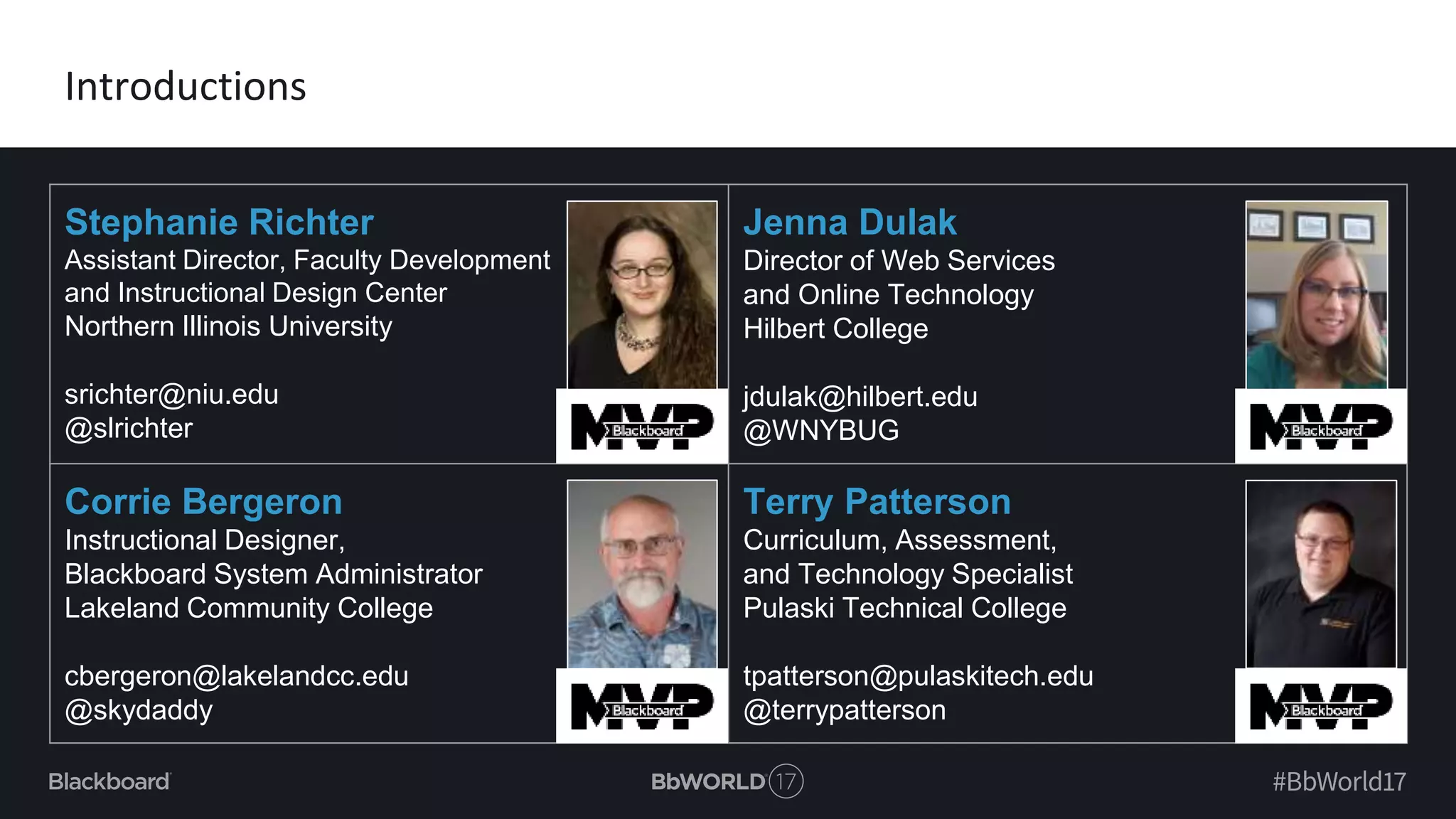
Stephanie Richter
Assistant Director, Faculty Development
and Instructional Design Center
Northern Illinois University
srichter@niu.edu
@slrichter
Jenna Dulak
Director of Web Services
and Online Technology
Hilbert College
jdulak@hilbert.edu
@WNYBUG
Corrie Bergeron
Instructional Designer,
Blackboard System Administrator
Lakeland Community College
cbergeron@lakelandcc.edu
@skydaddy
Terry Patterson
Curriculum, Assessment,
and Technology Specialist
Pulaski Technical College
tpatterson@pulaskitech.edu
@terrypatterson
Introductions
Northern Illinois University
Stephanie Richter
Assistant Director, Faculty Development and
Instructional Design Center
Northern Illinois University Overview
• Somewhat large rural public university
– Founded 1895 as a Normal School
– 750-acre campus in DeKalb, IL
– 19,000 students, 1,100 faculty
– 60 minutes west of Chicago
• Using Blackboard since 2000
– 95% of students, 90% of faculty
– Automated Bb administrative processes
Program Assessment at NIU
Managed by the Office of Accreditation, Assessment, and Evaluation
Overseen by University Assessment Panel and General Education Committee
Highly distributed process - programs define their own assessment methods,
measures, and policies
More programs being held accountable for achievement
data by outside accreditors
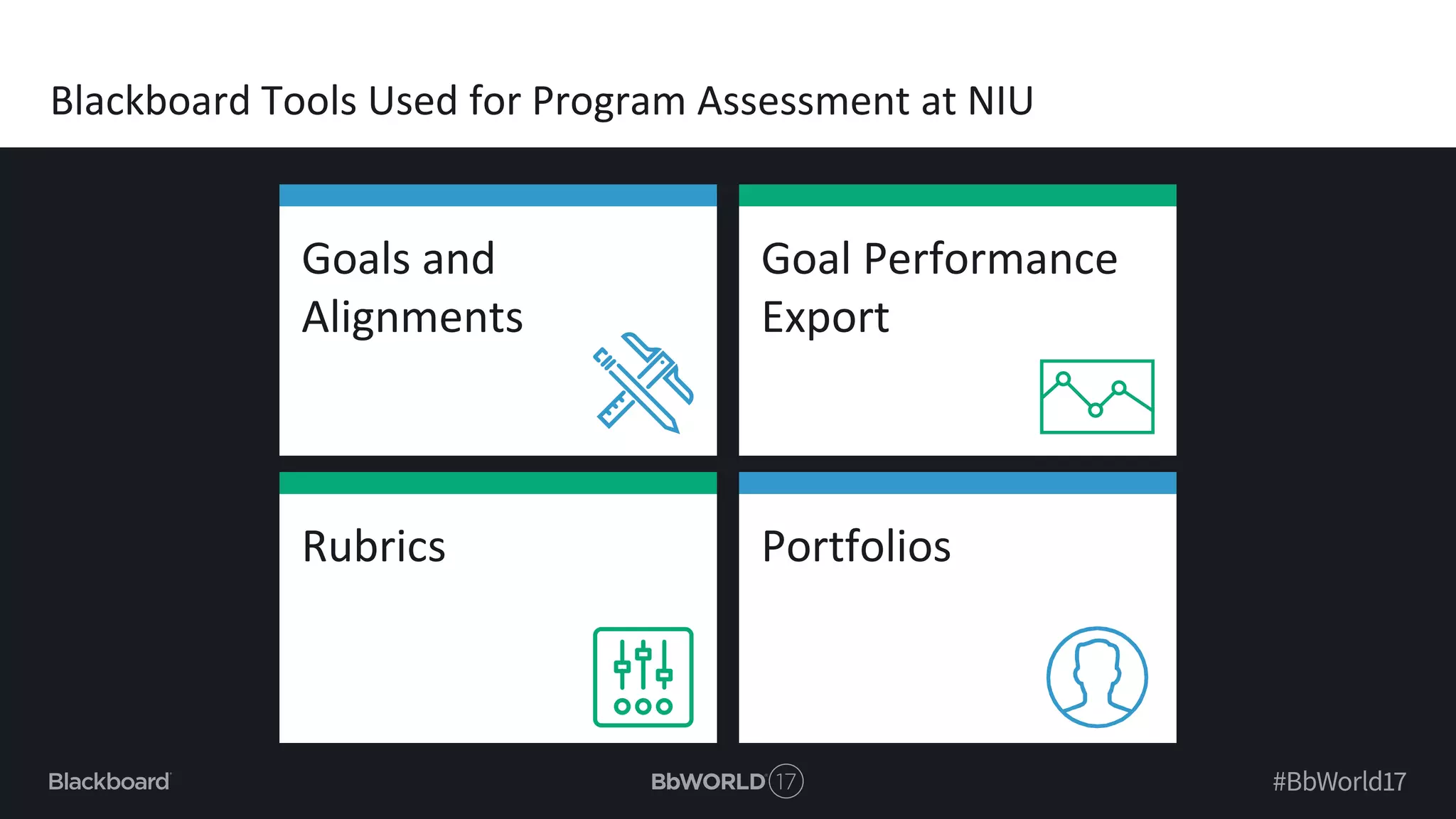
Blackboard Tools Used for Program Assessment at NIU
Goals and
Alignments
Goal Performance
Export
Rubrics Portfolios
Why not Outcomes?
Price - budget crisis in Illinois
Primary vs. secondary assessment strategies
Data collection limited to Assignments
Program Assessment with Goals, Alignments, and Performance Export
Champions in each program given Goal Manager role on staging server
Build Goals using the GUI
Sys Admin exports Goal Set from staging server to Prod
Using free B2 available on Oscelot
Champions and faculty align courses, often starting with past courses
Often requires standardizing assessments and rubrics within the program
Sys Admin uses Goal Performance Export to generate report
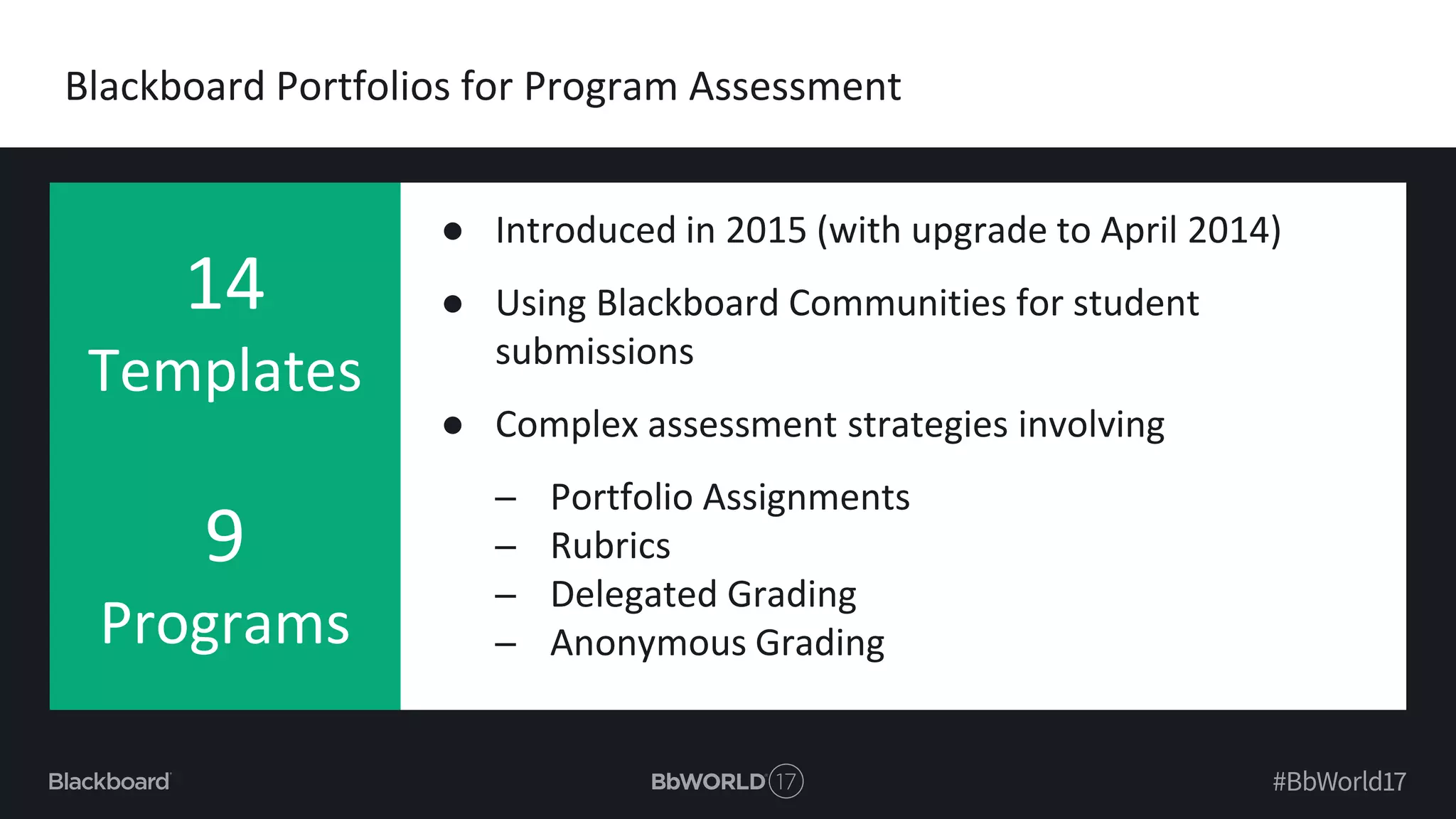
Blackboard Portfolios for Program Assessment
● Introduced in 2015 (with upgrade to April 2014)
● Using Blackboard Communities for student
submissions
● Complex assessment strategies involving
─ Portfolio Assignments
─ Rubrics
─ Delegated Grading
─ Anonymous Grading
14
Templates
9
Programs
General Education Assessment with Rubrics
● Uses standardized rubrics for each baccalaureate outcome (SLOs)
○ Rubrics are “No Points”
● Automated process places rubrics in courses
○ Based on SLO mapping in SIS
○ Essentially a course copy
○ Built into course request process
● DoIT developed a query to extract frequency data from rubrics
Challenges
Goals
• Insufficient staff to
support properly
• Rubrics don’t copy or
export with alignments
*except when copied
with an assessment
Portfolios
• Users struggle with the
“snapshot” concept
• Complex assessment
practices
Rubrics
• “Too many steps”
• Difficult to aggregate
data from No Points
rubrics
• Lack of central
administration for
rubrics
Lesson: You can do a lot with built-in tools!
Hilbert College
Jenna Dulak
Director of Web Services and Online
Technology
Hilbert College Overview
• Small four-year, liberal arts college
– Founded 1957
– 1,100 students
– Suburban Hamburg, NY
– 10 minutes south of Buffalo
• Using Blackboard since 2012
– Migrated from ANGEL
– Migrated to SaaS in summer 2016
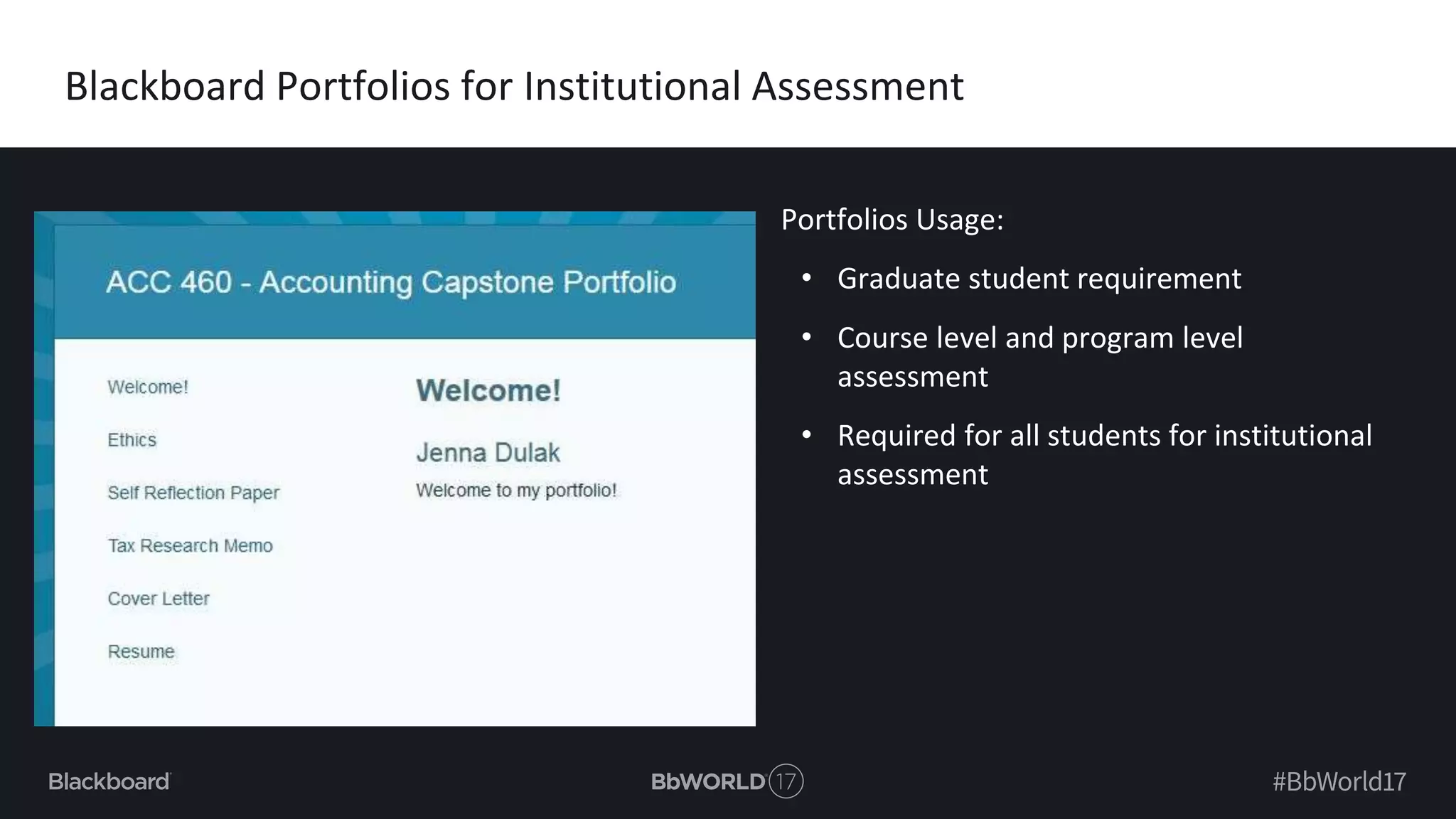
Blackboard Portfolios for Institutional Assessment
Portfolios Usage:
• Graduate student requirement
• Course level and program level
assessment
• Required for all students for institutional
assessment
Graduate Assessment
Required for all grad students
• templates are available for each
program
• students have access to a Bb
organization that has step by step
videos and a portfolio assignment
• students can share their portfolio
beyond graduate school
Course Level and Program Level
Institutional Level Assessment
• Why do institutional
level assessment?
• How do we assess our
blue print?
• Who will participate?
• How will assess the
portfolios?
• Where will they be
collected?
Institutional Level Assessment
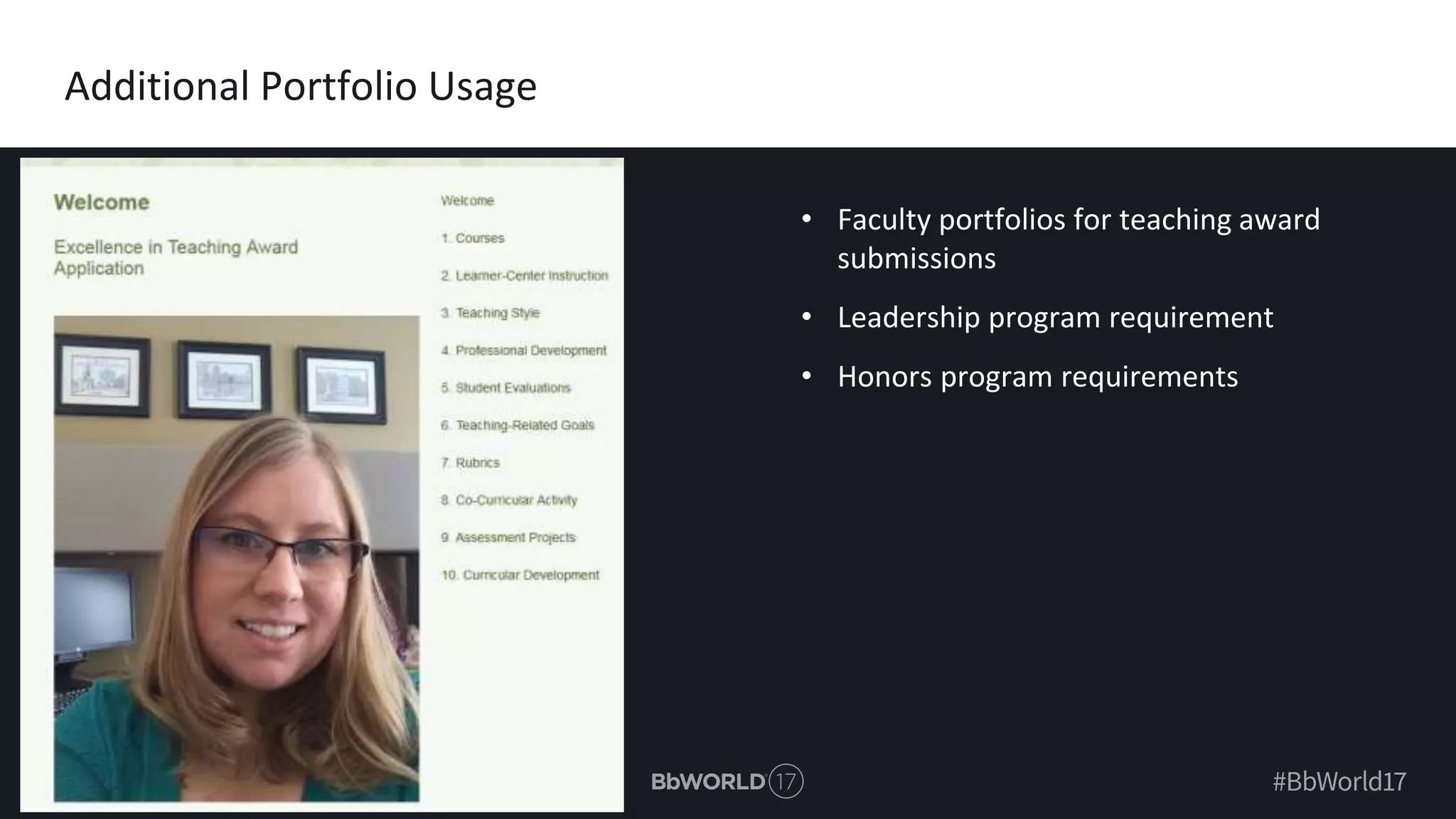
Additional Portfolio Usage
• Faculty portfolios for teaching award
submissions
• Leadership program requirement
• Honors program requirements
Future Ideas
Wish List for Portfolio enhancements:
• Add achievement certificates and badges
• Student self assessment rubrics
• Aggregated portfolio reports
Obstacles:
• Faculte usage (i.e. faculty using Bb
assignment, rubrics, grades, etc.)
• Oversight and ownership
• Template creation privileges
Lakeland Community College
Corrie Bergeron
Instructional Designer & Blackboard System
Administrator
Video presentation available at
facdev.niu.edu/corrie
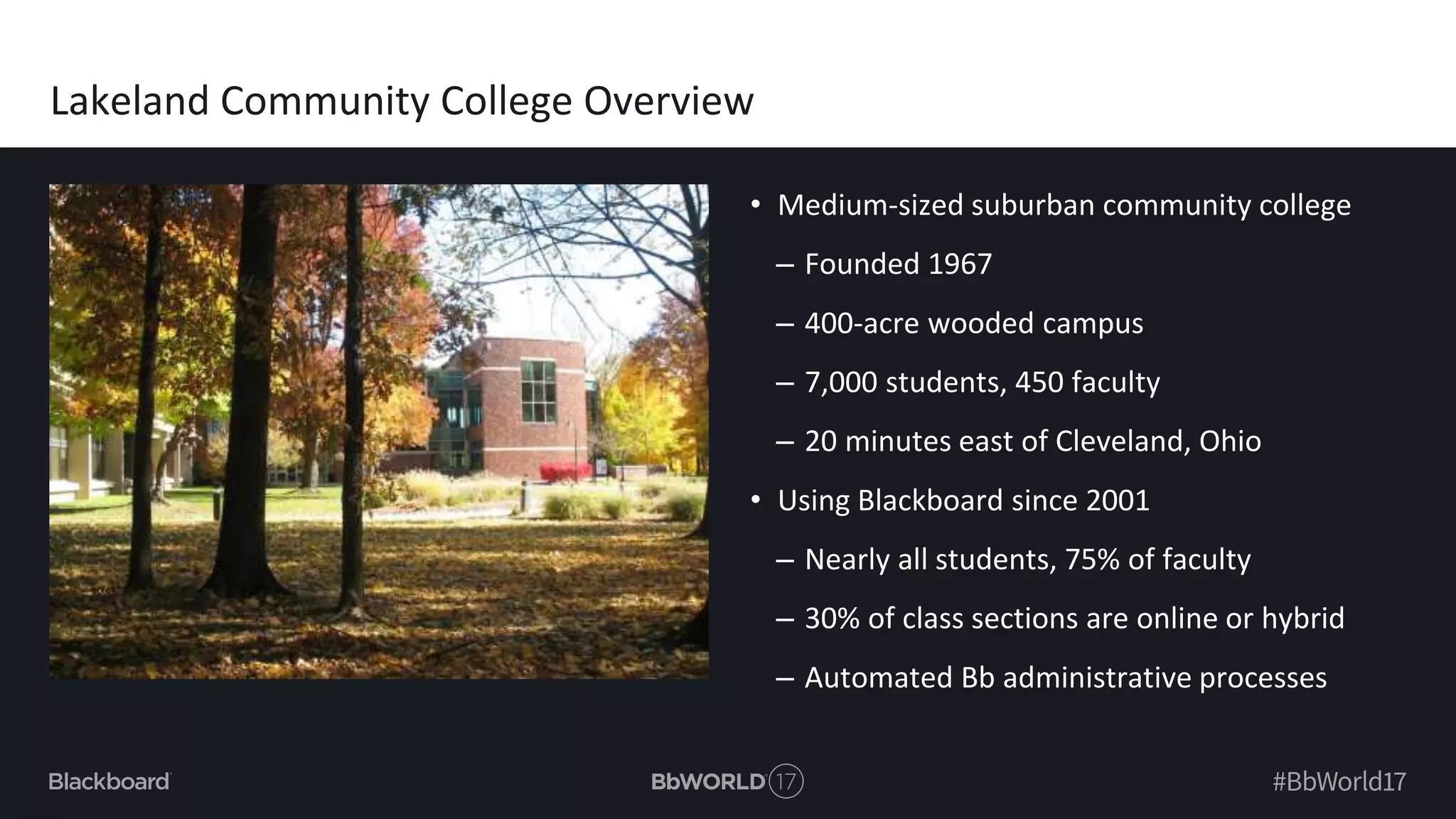
Lakeland Community College Overview
• Medium-sized suburban community college
– Founded 1967
– 400-acre wooded campus
– 7,000 students, 450 faculty
– 20 minutes east of Cleveland, Ohio
• Using Blackboard since 2001
– Nearly all students, 75% of faculty
– 30% of class sections are online or hybrid
– Automated Bb administrative processes
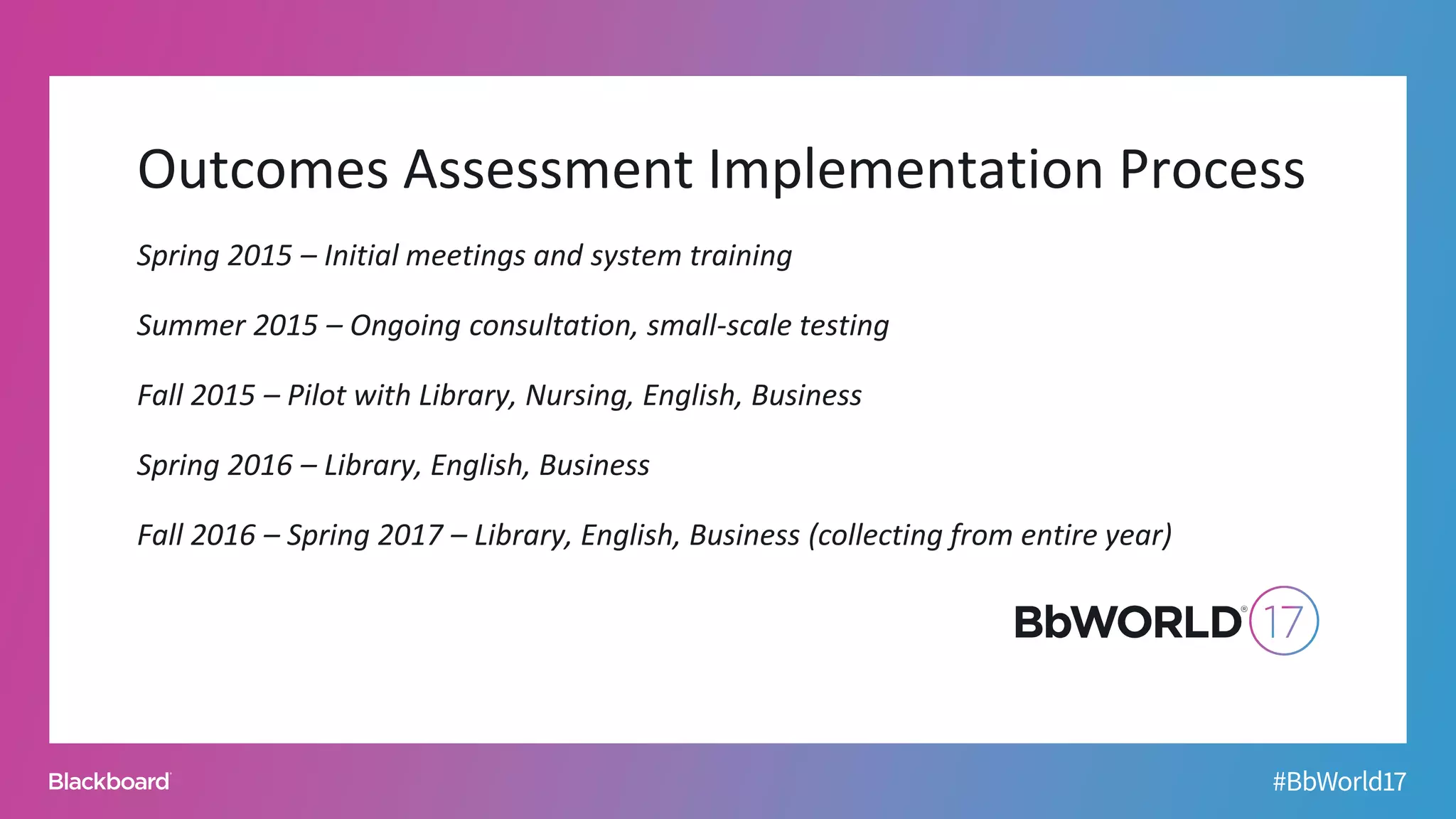
Outcomes Assessment Implementation Process
Spring 2015 – Initial meetings and system training
Summer 2015 – Ongoing consultation, small-scale testing
Fall 2015 – Pilot with Library, Nursing, English, Business
Spring 2016 – Library, English, Business
Fall 2016 – Spring 2017 – Library, English, Business (collecting from entire year)
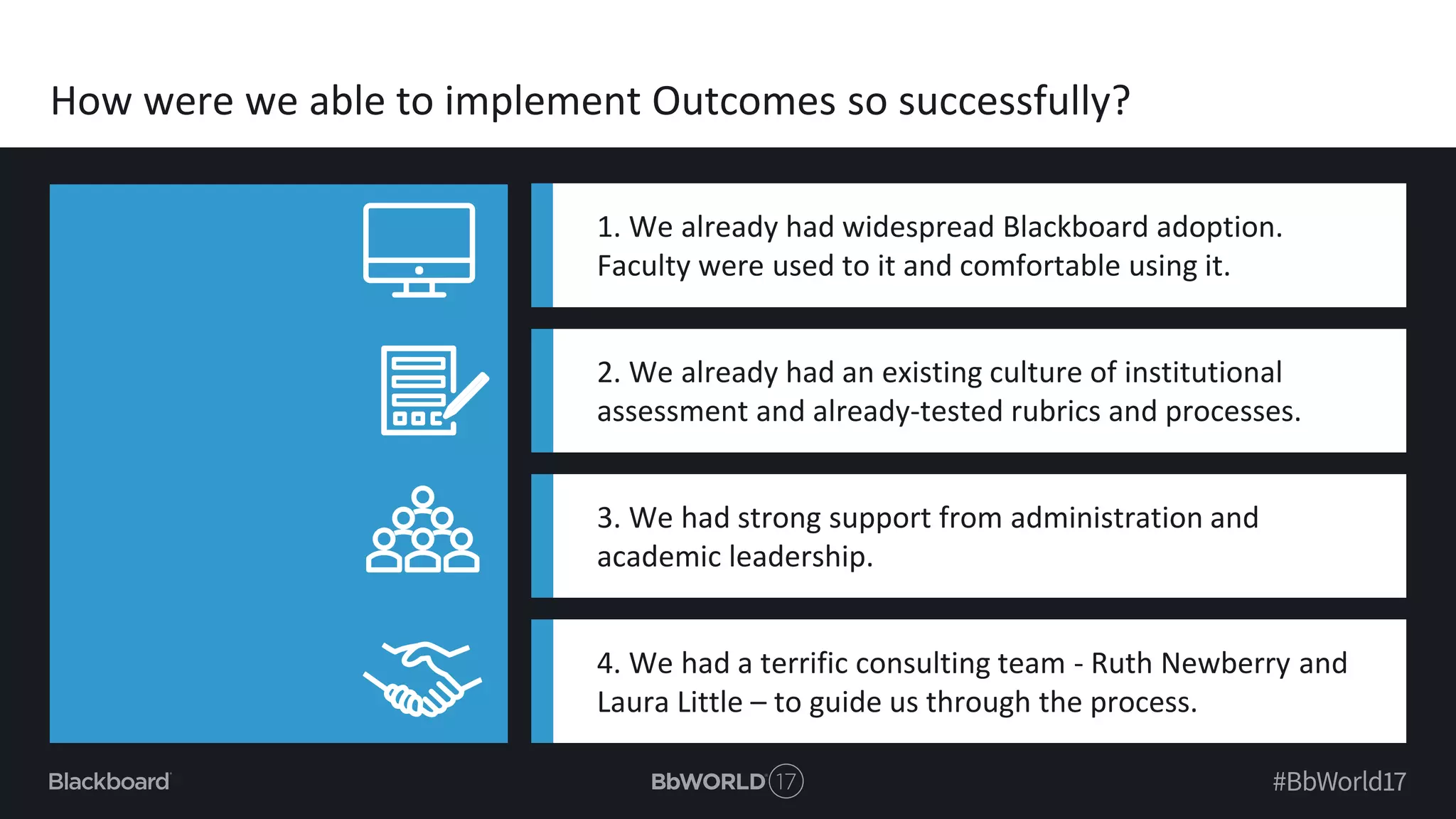
How were we able to implement Outcomes so successfully?
1. We already had widespread Blackboard adoption.
Faculty were used to it and comfortable using it.
2. We already had an existing culture of institutional
assessment and already-tested rubrics and processes.
3. We had strong support from administration and
academic leadership.
4. We had a terrific consulting team - Ruth Newberry and
Laura Little – to guide us through the process.
Things that could be improved
• Adding evaluators is clunky & time-consuming
– Have to search individually
• Editing an existing Evaluation Session is limited
– Cannot change name or rubrics
• Cannot filter students by credit hours
– This is important for all Gen Ed departments
who want to assess only students who are
ready to graduate
– Not an issue for technical programs with a
Capstone course from which they can easily
gather artifacts from graduating students
University of Arkansas
Pulaski Technical College
Terry Patterson
Curriculum, Assessment, and
Technology Specialist
Video available at
blackboardguru.com/bbworld2017
Who We Are…
University of Arkansas – Pulaski
Technical College
- Joined the U of A System
February 2017
- 90+ Programs
- 6,576 Enrollment (Fall 2016)
- Transfer Students
- AA, AS, AAS Degrees
- Technical Certificates
- Certificates of Proficiency
What We Faced…
The UA-PTC Process
• Tedious paper process
–Hours for Instructors
–Hours for Assessment Coordinator
• Some Instructors saw no benefit
based on the amount of work.
Establish student
learning outcomes
Provide learning
opportunities
Assess student
learning
Use the results to
improve instructional
delivery
Assessment By The Numbers
Paper Based Assessment
4 hours – Collecting, Encoding and Compiling
Assessment Data (per instructor)
3 hours – Additional time for a lead instructor to
produce reports
Example
6 instructors
4 different courses
4 x 6 = 24 hours for instructor to compile data
3 x 4 = 12 hours for lead instructor to compile data
Additional 36 hours of time spent pushing papers
Measuring Student Assessment
Rubrics
Used to assess
• Assignments
• Test Essays
• Online Discussions
• Presentations
• Speeches
• Foreign Language
Interviews
Checklists
Used to assess
• Microscope Skills
• Welding Proficiencies
• Video Projects
• Knife Proficiencies
• Automotive Mechanical
Skills
• Processes
Tests / Surveys
Used to assess
• Quantitative Reasoning
• Critical Thinking
• Conceptual Knowledge
• Problem Solving
• Student Perceptions
• Institutional Climate
UA-PTC Rubric Example
Institutional Learning Outcomes
Critical Thinking
Program Learning Outcomes
Currently none because this is a
General Education course.
Course Learning Outcomes
Demonstrate an ability to think
critically and creatively by writing
well-argued, well organized essays
that articulate a solid thesis…
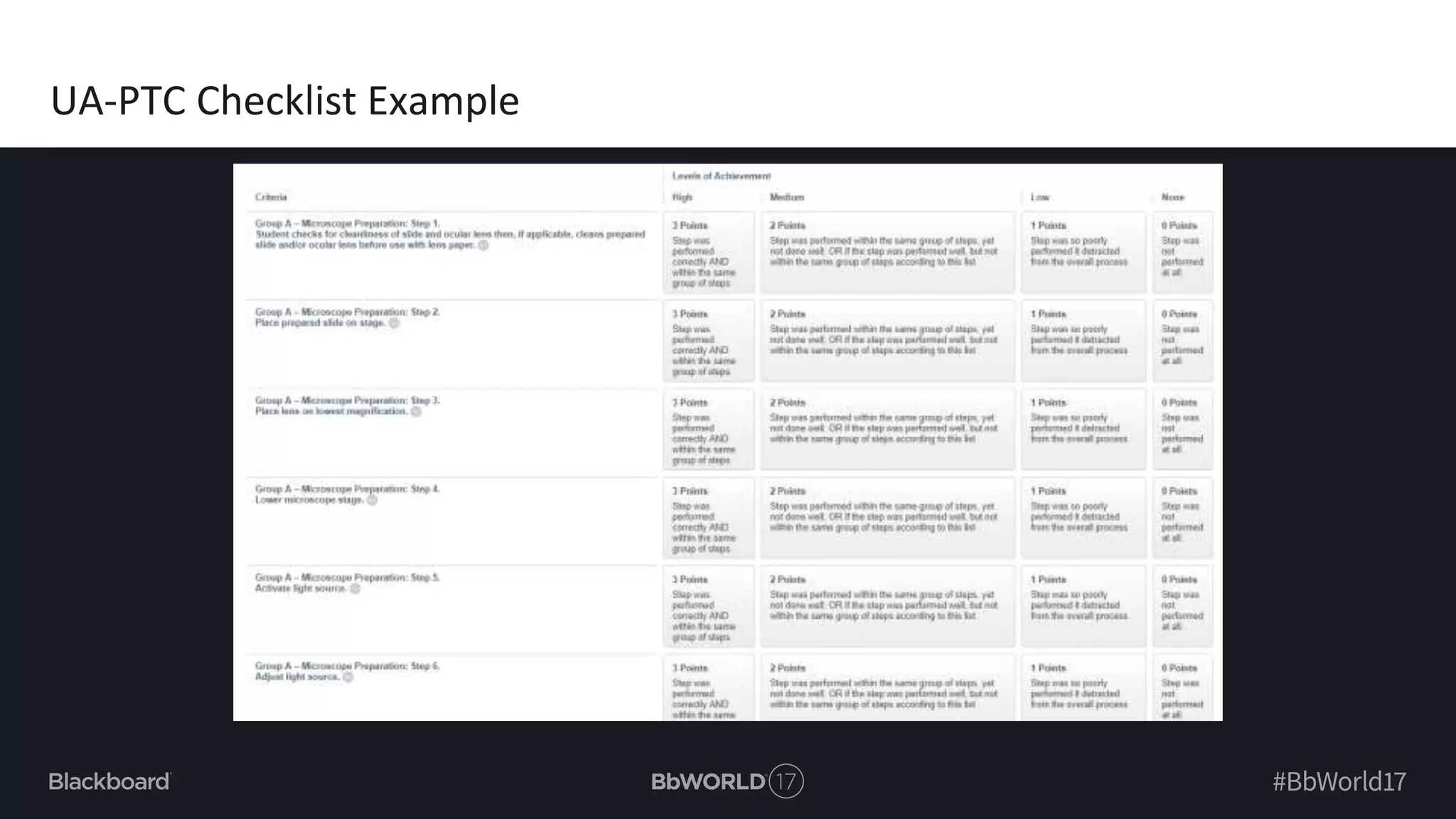
UA-PTC Checklist Example
Institutional Learning Outcomes
Technology Literacy
Program Learning Outcomes
The AP 1 & 2 student will demonstrate
intermediate microscopy skills in order to
locate and identify designated tissues/cell
structures.
Course Learning Outcomes
The student will demonstrate
intermediate microscopy skills in order to
locate and identify designated tissues/cell
structures.
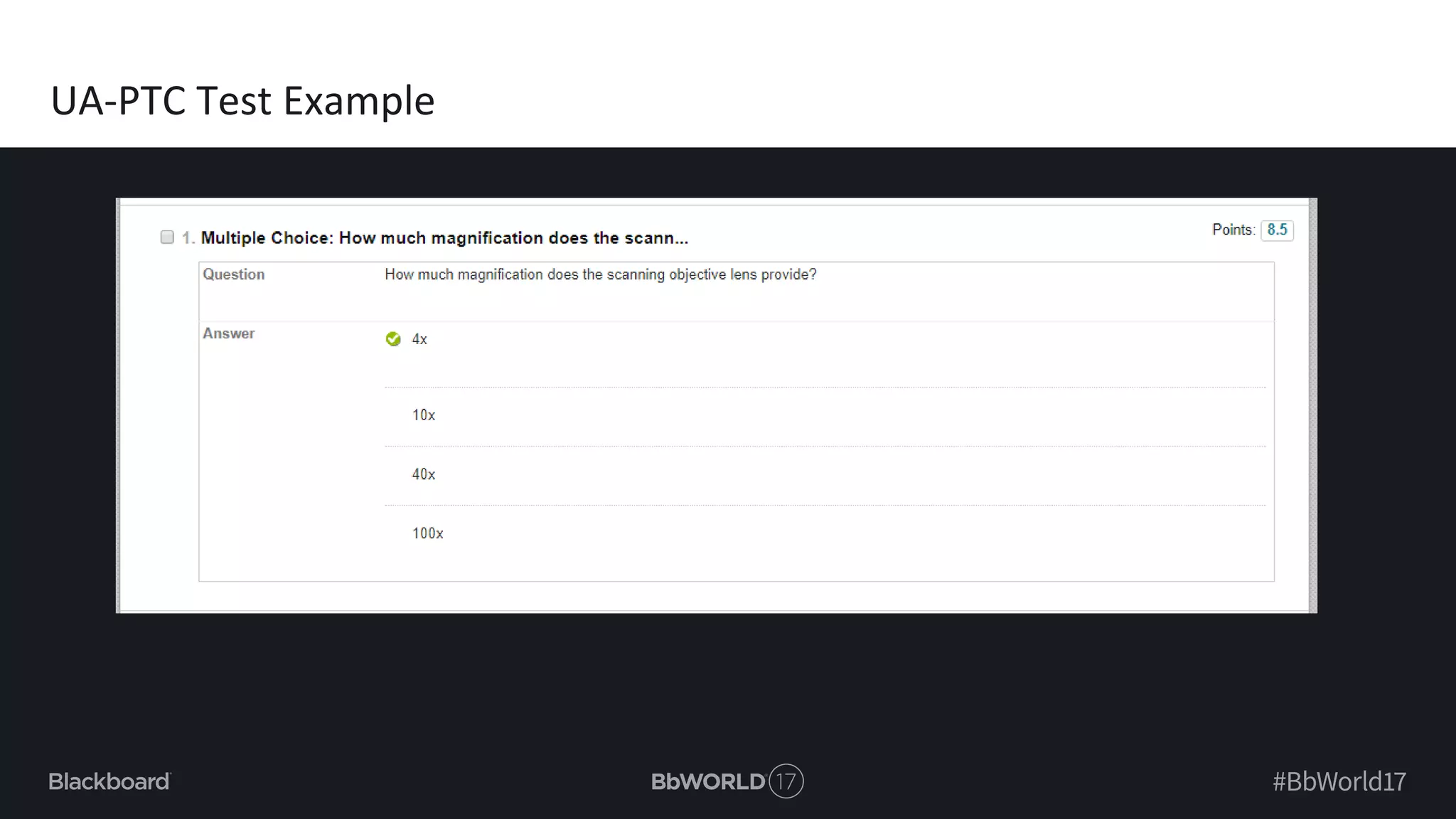
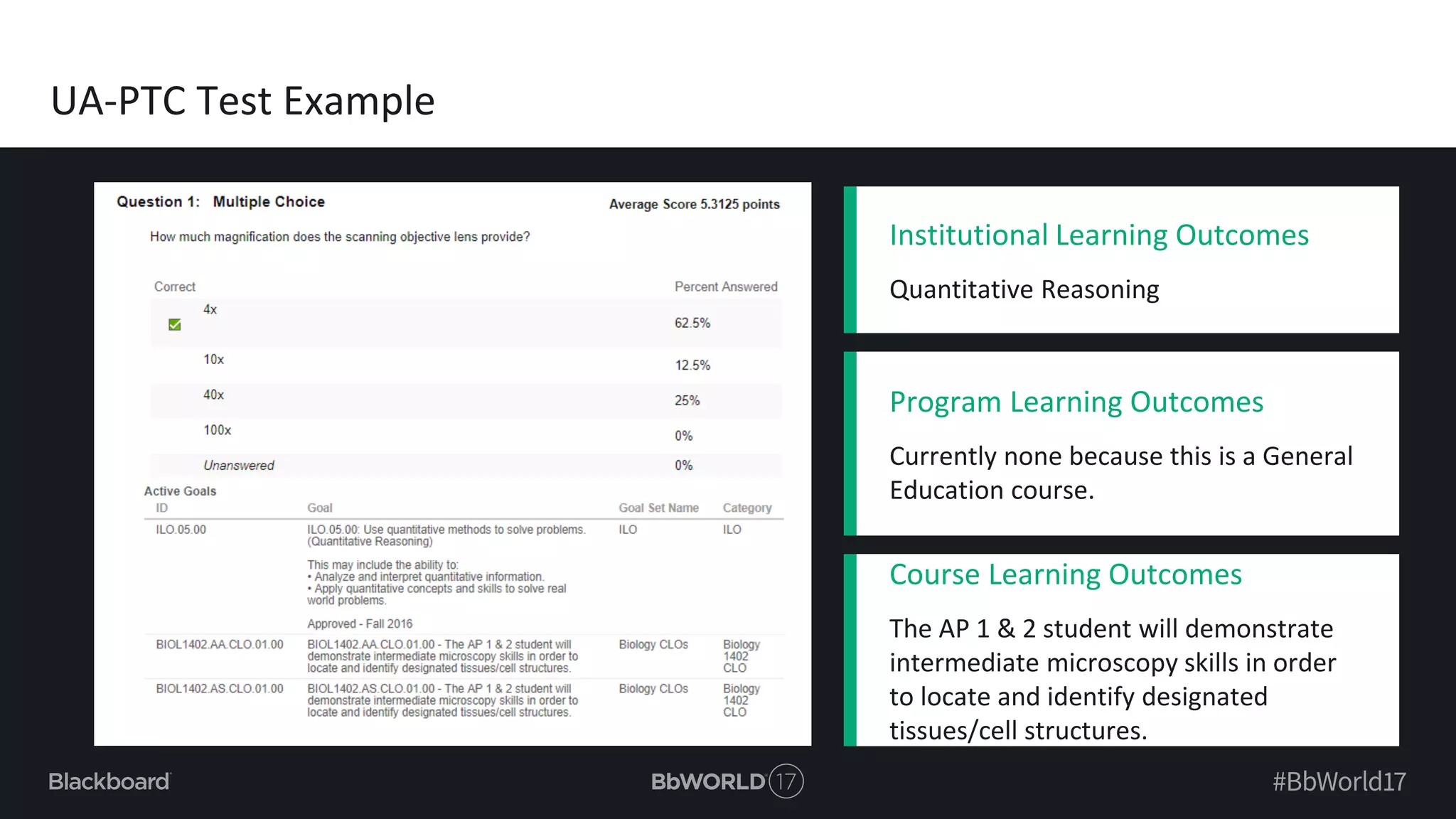
UA-PTC Test Example
UA-PTC Test Example
Institutional Learning Outcomes
Quantitative Reasoning
Program Learning Outcomes
Currently none because this is a General
Education course.
Course Learning Outcomes
The AP 1 & 2 student will demonstrate
intermediate microscopy skills in order
to locate and identify designated
tissues/cell structures.
The EAC Benefits
Data Collection
Collect Rubric / Checklist Data
• Across Sections
• Comparing Course
Deliveries
• Across Multiple Courses
for Program Assessment
Advanced Goals Alignment
Add / Remove Multiple Goal
Alignments
• Rubric Rows
• Test Questions
Advanced Test Statistics
Advanced Item Analysis
• Download Table of Student
Answers
• View Correct and Incorrect
Answers in Table Format
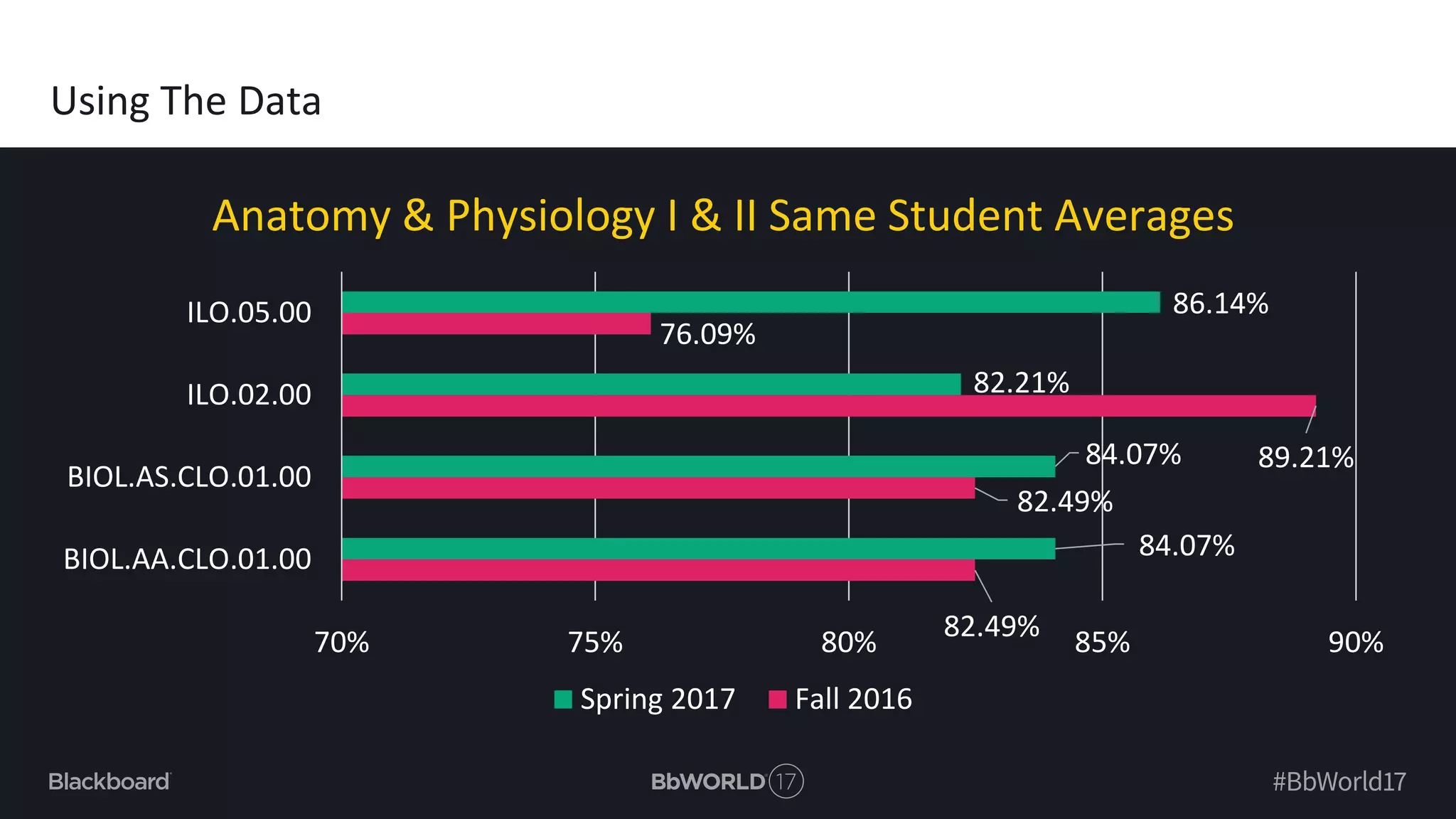
Using The Data
Using The Data
Anatomy & Physiology I & II Same Student Averages
82.49%
82.49%
89.21%
76.09%
84.07%
84.07%
82.21%
86.14%
70% 75% 80% 85% 90%
BIOL.AA.CLO.01.00
BIOL.AS.CLO.01.00
ILO.02.00
ILO.05.00
Spring 2017 Fall 2016
Q & A
Corrie Bergeron (Remote)
Stephanie Richter
Assistant Director, Faculty Development
and Instructional Design Center
Northern Illinois University
srichter@niu.edu
@slrichter
Jenna Dulak
Director of Web Services
and Online Technology
Hilbert College
jdulak@hilbert.edu
@WNYBUG
Corrie Bergeron
Instructional Designer,
Blackboard System Administrator
Lakeland Community College
cbergeron@lakelandcc.edu
@skydaddy
Terry Patterson
Curriculum, Assessment,
and Technology Specialist
Pulaski Technical College
tpatterson@pulaskitech.edu
@terrypatterson
Contact Info
Don’t forget
to rate this
session in the
BbWorld app.
Leveraging Blackboard Solutions for Program Assessment: Four Perspectives

Leveraging Blackboard Solutions for Program Assessment: Four Perspectives

  • 1.
    Leveraging Blackboard Solutions forProgram Assessment Four Perspectives Slides are available at facdev.niu.edu/bbworld17assessment
  • 2.
  • 3.
    Stephanie Richter Assistant Director,Faculty Development and Instructional Design Center Northern Illinois University srichter@niu.edu @slrichter Jenna Dulak Director of Web Services and Online Technology Hilbert College jdulak@hilbert.edu @WNYBUG Corrie Bergeron Instructional Designer, Blackboard System Administrator Lakeland Community College cbergeron@lakelandcc.edu @skydaddy Terry Patterson Curriculum, Assessment, and Technology Specialist Pulaski Technical College tpatterson@pulaskitech.edu @terrypatterson Introductions
  • 4.
    Northern Illinois University StephanieRichter Assistant Director, Faculty Development and Instructional Design Center
  • 5.
    Northern Illinois UniversityOverview • Somewhat large rural public university – Founded 1895 as a Normal School – 750-acre campus in DeKalb, IL – 19,000 students, 1,100 faculty – 60 minutes west of Chicago • Using Blackboard since 2000 – 95% of students, 90% of faculty – Automated Bb administrative processes
  • 6.
    Program Assessment atNIU Managed by the Office of Accreditation, Assessment, and Evaluation Overseen by University Assessment Panel and General Education Committee Highly distributed process - programs define their own assessment methods, measures, and policies More programs being held accountable for achievement data by outside accreditors
  • 7.
    Blackboard Tools Usedfor Program Assessment at NIU Goals and Alignments Goal Performance Export Rubrics Portfolios
  • 8.
    Why not Outcomes? Price- budget crisis in Illinois Primary vs. secondary assessment strategies Data collection limited to Assignments
  • 9.
    Program Assessment withGoals, Alignments, and Performance Export Champions in each program given Goal Manager role on staging server Build Goals using the GUI Sys Admin exports Goal Set from staging server to Prod Using free B2 available on Oscelot Champions and faculty align courses, often starting with past courses Often requires standardizing assessments and rubrics within the program Sys Admin uses Goal Performance Export to generate report
  • 10.
    Blackboard Portfolios forProgram Assessment ● Introduced in 2015 (with upgrade to April 2014) ● Using Blackboard Communities for student submissions ● Complex assessment strategies involving ─ Portfolio Assignments ─ Rubrics ─ Delegated Grading ─ Anonymous Grading 14 Templates 9 Programs
  • 11.
    General Education Assessmentwith Rubrics ● Uses standardized rubrics for each baccalaureate outcome (SLOs) ○ Rubrics are “No Points” ● Automated process places rubrics in courses ○ Based on SLO mapping in SIS ○ Essentially a course copy ○ Built into course request process ● DoIT developed a query to extract frequency data from rubrics
  • 12.
    Challenges Goals • Insufficient staffto support properly • Rubrics don’t copy or export with alignments *except when copied with an assessment Portfolios • Users struggle with the “snapshot” concept • Complex assessment practices Rubrics • “Too many steps” • Difficult to aggregate data from No Points rubrics • Lack of central administration for rubrics
  • 13.
    Lesson: You cando a lot with built-in tools!
  • 14.
    Hilbert College Jenna Dulak Directorof Web Services and Online Technology
  • 15.
    Hilbert College Overview •Small four-year, liberal arts college – Founded 1957 – 1,100 students – Suburban Hamburg, NY – 10 minutes south of Buffalo • Using Blackboard since 2012 – Migrated from ANGEL – Migrated to SaaS in summer 2016
  • 16.
    Blackboard Portfolios forInstitutional Assessment Portfolios Usage: • Graduate student requirement • Course level and program level assessment • Required for all students for institutional assessment
  • 17.
    Graduate Assessment Required forall grad students • templates are available for each program • students have access to a Bb organization that has step by step videos and a portfolio assignment • students can share their portfolio beyond graduate school
  • 18.
    Course Level andProgram Level
  • 19.
    Institutional Level Assessment •Why do institutional level assessment? • How do we assess our blue print? • Who will participate? • How will assess the portfolios? • Where will they be collected?
  • 20.
  • 21.
    Additional Portfolio Usage •Faculty portfolios for teaching award submissions • Leadership program requirement • Honors program requirements
  • 22.
    Future Ideas Wish Listfor Portfolio enhancements: • Add achievement certificates and badges • Student self assessment rubrics • Aggregated portfolio reports Obstacles: • Faculte usage (i.e. faculty using Bb assignment, rubrics, grades, etc.) • Oversight and ownership • Template creation privileges
  • 23.
    Lakeland Community College CorrieBergeron Instructional Designer & Blackboard System Administrator Video presentation available at facdev.niu.edu/corrie
  • 24.
    Lakeland Community CollegeOverview • Medium-sized suburban community college – Founded 1967 – 400-acre wooded campus – 7,000 students, 450 faculty – 20 minutes east of Cleveland, Ohio • Using Blackboard since 2001 – Nearly all students, 75% of faculty – 30% of class sections are online or hybrid – Automated Bb administrative processes
  • 25.
    Outcomes Assessment ImplementationProcess Spring 2015 – Initial meetings and system training Summer 2015 – Ongoing consultation, small-scale testing Fall 2015 – Pilot with Library, Nursing, English, Business Spring 2016 – Library, English, Business Fall 2016 – Spring 2017 – Library, English, Business (collecting from entire year)
  • 26.
    How were weable to implement Outcomes so successfully? 1. We already had widespread Blackboard adoption. Faculty were used to it and comfortable using it. 2. We already had an existing culture of institutional assessment and already-tested rubrics and processes. 3. We had strong support from administration and academic leadership. 4. We had a terrific consulting team - Ruth Newberry and Laura Little – to guide us through the process.
  • 27.
    Things that couldbe improved • Adding evaluators is clunky & time-consuming – Have to search individually • Editing an existing Evaluation Session is limited – Cannot change name or rubrics • Cannot filter students by credit hours – This is important for all Gen Ed departments who want to assess only students who are ready to graduate – Not an issue for technical programs with a Capstone course from which they can easily gather artifacts from graduating students
  • 28.
    University of Arkansas PulaskiTechnical College Terry Patterson Curriculum, Assessment, and Technology Specialist Video available at blackboardguru.com/bbworld2017
  • 29.
    Who We Are… Universityof Arkansas – Pulaski Technical College - Joined the U of A System February 2017 - 90+ Programs - 6,576 Enrollment (Fall 2016) - Transfer Students - AA, AS, AAS Degrees - Technical Certificates - Certificates of Proficiency
  • 30.
  • 31.
    The UA-PTC Process •Tedious paper process –Hours for Instructors –Hours for Assessment Coordinator • Some Instructors saw no benefit based on the amount of work. Establish student learning outcomes Provide learning opportunities Assess student learning Use the results to improve instructional delivery
  • 32.
    Assessment By TheNumbers Paper Based Assessment 4 hours – Collecting, Encoding and Compiling Assessment Data (per instructor) 3 hours – Additional time for a lead instructor to produce reports Example 6 instructors 4 different courses 4 x 6 = 24 hours for instructor to compile data 3 x 4 = 12 hours for lead instructor to compile data Additional 36 hours of time spent pushing papers
  • 33.
    Measuring Student Assessment Rubrics Usedto assess • Assignments • Test Essays • Online Discussions • Presentations • Speeches • Foreign Language Interviews Checklists Used to assess • Microscope Skills • Welding Proficiencies • Video Projects • Knife Proficiencies • Automotive Mechanical Skills • Processes Tests / Surveys Used to assess • Quantitative Reasoning • Critical Thinking • Conceptual Knowledge • Problem Solving • Student Perceptions • Institutional Climate
  • 34.
  • 35.
    UA-PTC Rubric Example InstitutionalLearning Outcomes Critical Thinking Program Learning Outcomes Currently none because this is a General Education course. Course Learning Outcomes Demonstrate an ability to think critically and creatively by writing well-argued, well organized essays that articulate a solid thesis…
  • 36.
  • 37.
    UA-PTC Checklist Example InstitutionalLearning Outcomes Technology Literacy Program Learning Outcomes The AP 1 & 2 student will demonstrate intermediate microscopy skills in order to locate and identify designated tissues/cell structures. Course Learning Outcomes The student will demonstrate intermediate microscopy skills in order to locate and identify designated tissues/cell structures.
  • 38.
  • 39.
    UA-PTC Test Example InstitutionalLearning Outcomes Quantitative Reasoning Program Learning Outcomes Currently none because this is a General Education course. Course Learning Outcomes The AP 1 & 2 student will demonstrate intermediate microscopy skills in order to locate and identify designated tissues/cell structures.
  • 40.
    The EAC Benefits DataCollection Collect Rubric / Checklist Data • Across Sections • Comparing Course Deliveries • Across Multiple Courses for Program Assessment Advanced Goals Alignment Add / Remove Multiple Goal Alignments • Rubric Rows • Test Questions Advanced Test Statistics Advanced Item Analysis • Download Table of Student Answers • View Correct and Incorrect Answers in Table Format
  • 41.
  • 42.
    Using The Data Anatomy& Physiology I & II Same Student Averages 82.49% 82.49% 89.21% 76.09% 84.07% 84.07% 82.21% 86.14% 70% 75% 80% 85% 90% BIOL.AA.CLO.01.00 BIOL.AS.CLO.01.00 ILO.02.00 ILO.05.00 Spring 2017 Fall 2016
  • 43.
  • 44.
  • 45.
    Stephanie Richter Assistant Director,Faculty Development and Instructional Design Center Northern Illinois University srichter@niu.edu @slrichter Jenna Dulak Director of Web Services and Online Technology Hilbert College jdulak@hilbert.edu @WNYBUG Corrie Bergeron Instructional Designer, Blackboard System Administrator Lakeland Community College cbergeron@lakelandcc.edu @skydaddy Terry Patterson Curriculum, Assessment, and Technology Specialist Pulaski Technical College tpatterson@pulaskitech.edu @terrypatterson Contact Info
  • 46.
    Don’t forget to ratethis session in the BbWorld app.