Measuring Digital 
Professional Development 
Analytics for the Use of Web and Social Media Materials 
View the slides at 
facdev.niu.edu/slate14analytics
Presenters 
Stephanie Richter 
Assistant Director 
srichter@niu.edu 
Peter Gowen 
Online Analytics Coordinator 
pgowen@niu.edu
The Need for Web and 
Social Media Analytics
Faculty Development and 
Instructional Design Center
Faculty Development and 
Instructional Design Center 
niu.edu/facdev
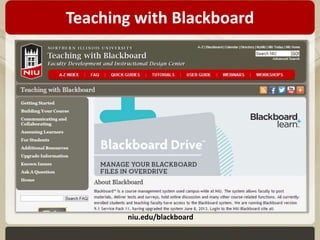
Teaching with Blackboard 
niu.edu/blackboard
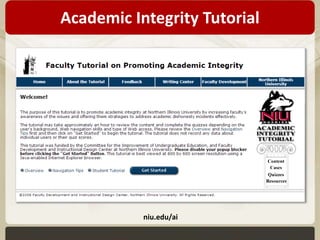
Academic Integrity Tutorial 
niu.edu/ai
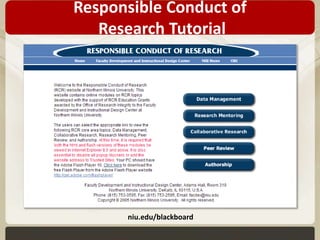
Responsible Conduct of 
Research Tutorial 
niu.edu/blackboard
Social Media 
@facdev 
@NIUBlackboard 
@NIUTeachOnline 
facdev facdev
Faculty Development and 
Instructional Design Center
Web Analytics
Why Web? 
• Programs 
• Services 
• Resources 
* No (or little) “cross-talk”
Analytics 
The use of data, statistical analysis, and 
explanatory and predictive models to gain 
insights and act on complex issues 
Bichsel, 2012, p. 6
On Data 
• Data let you answer questions 
– Are our resources being used? 
– What is being used? 
– How are they being used? 
– Why?* 
*May not be possible, or at least not easy
Why Google Analytics? 
• Measure utilization easily 
• Measure behavior (with some work) 
• Key terms 
– Traffic: Pageviews or Users, per given time span 
– Visits/Sessions: A (default) 30-minute sliding activity 
window 
– Hits/Pageviews: A webpage request from a web 
browser 
– Visitors/Users: A unique ID set by Google per browser
What can GA do? 
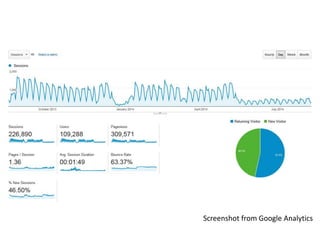
Screenshot from Google Analytics
What can GA do? 
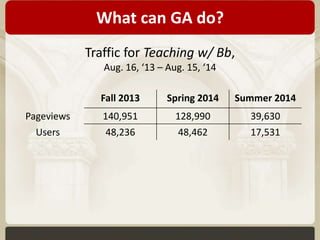
Traffic for Teaching w/ Bb, 
Aug. 16, ‘13 – Aug. 15, ‘14 
Fall 2013 Spring 2014 Summer 2014 
Pageviews 140,951 128,990 39,630 
Users 48,236 48,462 17,531
What can GA do? 
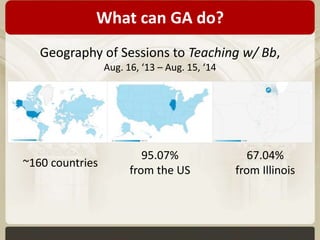
Geography of Sessions to Teaching w/ Bb, 
95.07% 
from the US 
67.04% 
from Illinois 
Aug. 16, ‘13 – Aug. 15, ‘14 
~160 countries
What can GA do? 
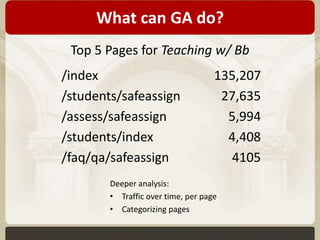
Top 5 Pages for Teaching w/ Bb 
/index 
/students/safeassign 
/assess/safeassign 
/students/index 
/faq/qa/safeassign 
135,207 
27,635 
5,994 
4,408 
4105 
Deeper analysis: 
• Traffic over time, per page 
• Categorizing pages
What can GA do? 
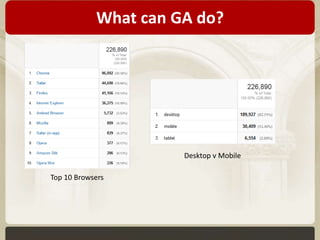
Top 10 Browsers 
Desktop v Mobile
What can GA do? 
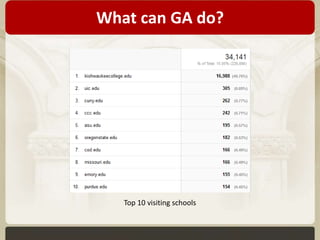
Top 10 visiting schools
Google Analytics Resources 
• Get started with Analytics 
• How To Set Up Google Analytics Account 
Setup 2014 (YouTube tutorial) 
• Setup Checklist (for all/advanced features)
Social Media Analytics
Key Terms 
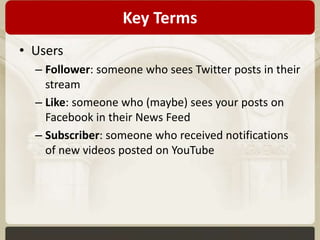
• Users 
– Follower: someone who sees Twitter posts in their 
stream 
– Like: someone who (maybe) sees your posts on 
Facebook in their News Feed 
– Subscriber: someone who received notifications 
of new videos posted on YouTube
Key Terms 
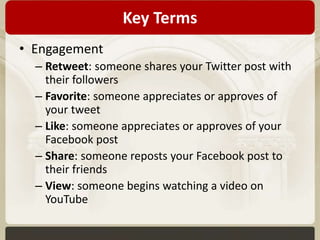
• Engagement 
– Retweet: someone shares your Twitter post with 
their followers 
– Favorite: someone appreciates or approves of 
your tweet 
– Like: someone appreciates or approves of your 
Facebook post 
– Share: someone reposts your Facebook post to 
their friends 
– View: someone begins watching a video on 
YouTube
Social Media Presence 
@facdev 
@NIUBlackboard 
@NIUTeachOnline 
facdev facdev
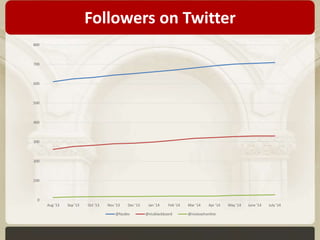
Followers on Twitter 
800 
700 
600 
500 
400 
300 
200 
100 
0 
Aug '13 Sep '13 Oct '13 Nov '13 Dec '13 Jan '14 Feb '14 Mar '14 Apr '14 May '14 June '14 July '14 
@facdev @niublackboard @niuteachonline
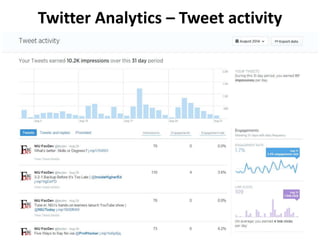
Twitter Analytics – Tweet activity
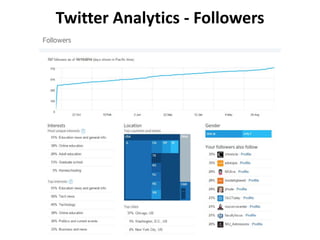
Twitter Analytics - Followers
200 
195 
190 
185 
180 
175 
170 
165 
160 
155 
150 
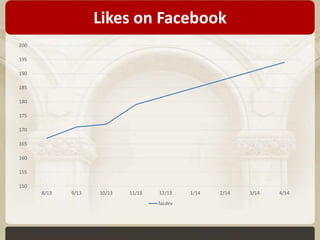
Likes on Facebook 
8/13 9/13 10/13 11/13 12/13 1/14 2/14 3/14 4/14 
facdev
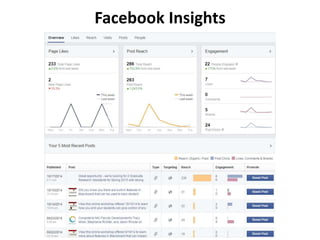
Facebook Insights
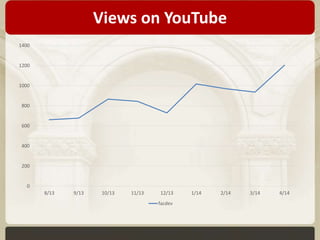
Views on YouTube 
1400 
1200 
1000 
800 
600 
400 
200 
0 
8/13 9/13 10/13 11/13 12/13 1/14 2/14 3/14 4/14 
facdev
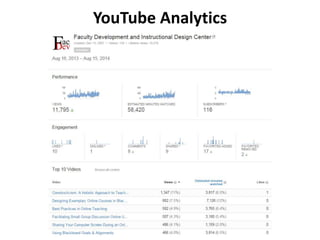
YouTube Analytics
Conclusions
What We Have Learned 
• Online resources are heavily used, at NIU and 
around the world 
• Top pages are a priority for updates 
• Popular topics may need additional workshops 
• Mobile users are a small but growing group 
• Significant site traffic comes from other 
universities and colleges 
• Social media engagement is growing but 
needs further analysis
Next Steps 
• Look at traffic to segments of content instead 
of single pages 
• Identify trends in topics over time 
• Compare trends to consultation trends and 
workshop schedule 
• Investigate user behavior more deeply 
– page visits vs. searches 
– page visits vs. question submission 
– in-page behavior
Questions? 
Stephanie Richter 
srichter@niu.edu 
Peter Gowen 
pgowen@niu.edu 
View the slides at 
facdev.niu.edu/slate14analytics
References 
• Bichsel, J., 2012. Analytics in higher education: 
Benefits, barriers, progress, and 
recommendations. Louisville, CO: EDUCAUSE 
Center for Applied Research. Available from: 
http://net.educause.edu/ir/library/pdf/ERS12 
07/ers1207.pdf [Accessed 21 February 2014].

Measuring Digital Professional Development

  • 1.
    Measuring Digital ProfessionalDevelopment Analytics for the Use of Web and Social Media Materials View the slides at facdev.niu.edu/slate14analytics
  • 2.
    Presenters Stephanie Richter Assistant Director srichter@niu.edu Peter Gowen Online Analytics Coordinator pgowen@niu.edu
  • 3.
    The Need forWeb and Social Media Analytics
  • 4.
    Faculty Development and Instructional Design Center
  • 5.
    Faculty Development and Instructional Design Center niu.edu/facdev
  • 6.
    Teaching with Blackboard niu.edu/blackboard
  • 7.
  • 8.
    Responsible Conduct of Research Tutorial niu.edu/blackboard
  • 9.
    Social Media @facdev @NIUBlackboard @NIUTeachOnline facdev facdev
  • 10.
    Faculty Development and Instructional Design Center
  • 11.
  • 12.
    Why Web? •Programs • Services • Resources * No (or little) “cross-talk”
  • 13.
    Analytics The useof data, statistical analysis, and explanatory and predictive models to gain insights and act on complex issues Bichsel, 2012, p. 6
  • 14.
    On Data •Data let you answer questions – Are our resources being used? – What is being used? – How are they being used? – Why?* *May not be possible, or at least not easy
  • 15.
    Why Google Analytics? • Measure utilization easily • Measure behavior (with some work) • Key terms – Traffic: Pageviews or Users, per given time span – Visits/Sessions: A (default) 30-minute sliding activity window – Hits/Pageviews: A webpage request from a web browser – Visitors/Users: A unique ID set by Google per browser
  • 16.
    What can GAdo? Screenshot from Google Analytics
  • 17.
    What can GAdo? Traffic for Teaching w/ Bb, Aug. 16, ‘13 – Aug. 15, ‘14 Fall 2013 Spring 2014 Summer 2014 Pageviews 140,951 128,990 39,630 Users 48,236 48,462 17,531
  • 18.
    What can GAdo? Geography of Sessions to Teaching w/ Bb, 95.07% from the US 67.04% from Illinois Aug. 16, ‘13 – Aug. 15, ‘14 ~160 countries
  • 19.
    What can GAdo? Top 5 Pages for Teaching w/ Bb /index /students/safeassign /assess/safeassign /students/index /faq/qa/safeassign 135,207 27,635 5,994 4,408 4105 Deeper analysis: • Traffic over time, per page • Categorizing pages
  • 20.
    What can GAdo? Top 10 Browsers Desktop v Mobile
  • 21.
    What can GAdo? Top 10 visiting schools
  • 22.
    Google Analytics Resources • Get started with Analytics • How To Set Up Google Analytics Account Setup 2014 (YouTube tutorial) • Setup Checklist (for all/advanced features)
  • 23.
  • 24.
    Key Terms •Users – Follower: someone who sees Twitter posts in their stream – Like: someone who (maybe) sees your posts on Facebook in their News Feed – Subscriber: someone who received notifications of new videos posted on YouTube
  • 25.
    Key Terms •Engagement – Retweet: someone shares your Twitter post with their followers – Favorite: someone appreciates or approves of your tweet – Like: someone appreciates or approves of your Facebook post – Share: someone reposts your Facebook post to their friends – View: someone begins watching a video on YouTube
  • 26.
    Social Media Presence @facdev @NIUBlackboard @NIUTeachOnline facdev facdev
  • 27.
    Followers on Twitter 800 700 600 500 400 300 200 100 0 Aug '13 Sep '13 Oct '13 Nov '13 Dec '13 Jan '14 Feb '14 Mar '14 Apr '14 May '14 June '14 July '14 @facdev @niublackboard @niuteachonline
  • 28.
    Twitter Analytics –Tweet activity
  • 29.
  • 30.
    200 195 190 185 180 175 170 165 160 155 150 Likes on Facebook 8/13 9/13 10/13 11/13 12/13 1/14 2/14 3/14 4/14 facdev
  • 31.
  • 32.
    Views on YouTube 1400 1200 1000 800 600 400 200 0 8/13 9/13 10/13 11/13 12/13 1/14 2/14 3/14 4/14 facdev
  • 33.
  • 34.
  • 35.
    What We HaveLearned • Online resources are heavily used, at NIU and around the world • Top pages are a priority for updates • Popular topics may need additional workshops • Mobile users are a small but growing group • Significant site traffic comes from other universities and colleges • Social media engagement is growing but needs further analysis
  • 36.
    Next Steps •Look at traffic to segments of content instead of single pages • Identify trends in topics over time • Compare trends to consultation trends and workshop schedule • Investigate user behavior more deeply – page visits vs. searches – page visits vs. question submission – in-page behavior
  • 37.
    Questions? Stephanie Richter srichter@niu.edu Peter Gowen pgowen@niu.edu View the slides at facdev.niu.edu/slate14analytics
  • 38.
    References • Bichsel,J., 2012. Analytics in higher education: Benefits, barriers, progress, and recommendations. Louisville, CO: EDUCAUSE Center for Applied Research. Available from: http://net.educause.edu/ir/library/pdf/ERS12 07/ers1207.pdf [Accessed 21 February 2014].

Editor's Notes

  • #4 Our Center’s services have grown rapidly into the digital arena, which requires new methods of assessing and evaluating use & effectiveness
  • #6 Describe the Center – Offer Programs, Consultations/Mentoring/Observations, and provide resources, including Instructional Guide, tutorials, and Blackboard documentation
  • #7 Describe Blackboard documentation site
  • #10 The department maintains a presence on several social media networks, including 3 accounts on Twitter, one Page on Facebook, and multiple YouTube channels and playlists. These accounts are used to connect with faculty and share tips and news. YouTube is also used to store tutorial videos for streaming.
  • #25 The important distinction here is between analytics on Users and analytics on Engagement (who has viewed, liked, shared, retweeted, etc.). Both are important pieces of analyzing social media
  • #27 The department maintains a presence on several social media networks, including 3 accounts on Twitter, one Page on Facebook, and multiple YouTube channels and playlists. These accounts are used to connect with faculty and share tips and news. YouTube is also used to store tutorial videos for streaming.
  • #28 Slow but steady growth in numbers of followers Need to promote @niuteachonline more to increase the number of followers Need to consider INTERACTIONS (such as retweets, favorites, and clicks) in addition to followers
  • #31 Smaller group of followers on Facebook, but often more engagement than on Twitter (clicks, comments, likes)
  • #33 More sporadic, but generally rising Not very many subscribers, but that is OK Also measure views from embedded player on our website pages (some require log in to track specific campus users)