Tracking dynamic networks in
real time.
R. Cameron Craddock, PhD
Director, Computational Neuroimaging Lab
Nathan S. Kline Institute for Psychiatric Research
Director of Imaging, Center for the Developing Brain
Child Mind Institute
March 8, 2016
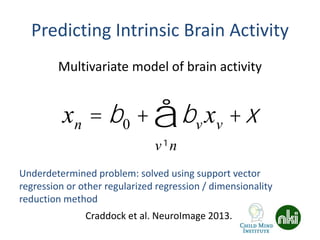
Predicting Intrinsic Brain Activity
Multivariate model of brain activity
xn = b0 + bv
v¹n
å xv +x
Underdetermined problem: solved using support vector
regression or other regularized regression / dimensionality
reduction method
Craddock et al. NeuroImage 2013.
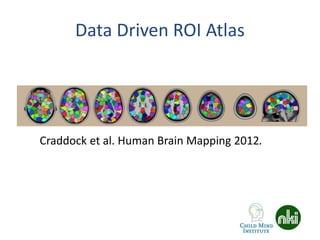
Data Driven ROI Atlas
Craddock et al. Human Brain Mapping 2012.
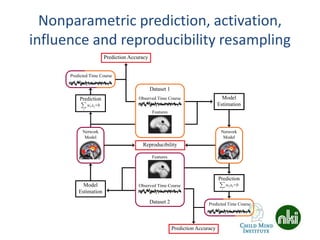
Nonparametric prediction, activation,
influence and reproducibility resampling
Predicted Time Course
Observed Time Course
Features
Dataset 1
Observed Time Course
Features
Dataset 2
Model
Estimation
Model
Estimation
wixi+b
i
Prediction
Prediction Accuracy
Reproducibility
Prediction
wixi+b
i
Predicted Time Course
Prediction Accuracy
Network
Model
Network
Model
B
A
Prediction Accuracy
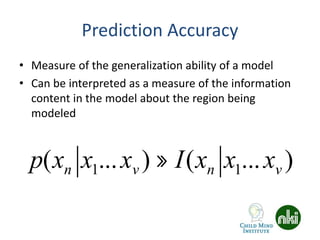
• Measure of the generalization ability of a model
• Can be interpreted as a measure of the information
content in the model about the region being
modeled
p(xn x1...xv ) » I(xn x1...xv )
Reproducibility
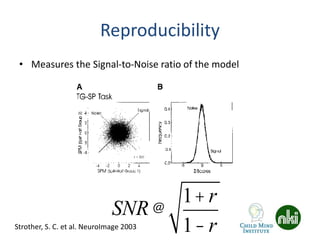
• Measures the Signal-to-Noise ratio of the model
SNR @
1+r
1-rStrother, S. C. et al. NeuroImage 2003
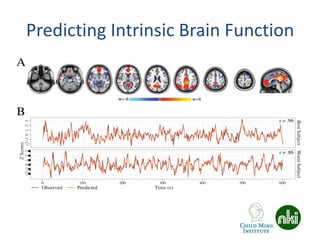
Predicting Intrinsic Brain Function
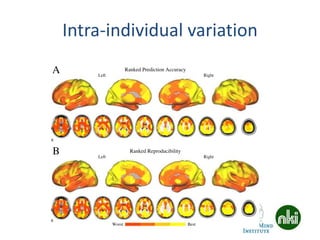
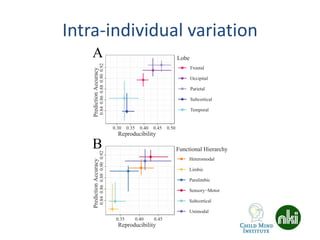
Intra-individual variation
Reproducibility
PredictionAccuracy
0.840.860.880.900.92
0.30 0.35 0.40 0.45 0.50
Lobe
Frontal
Occipital
Parietal
Subcortical
Temporal
A
Reproducibility
PredictionAccuracy
0.840.860.880.900.92
0.35 0.40 0.45
Functional Hierarchy
Heteromodal
Limbic
Paralimbic
Sensory−Motor
Subcortical
Unimodal
B
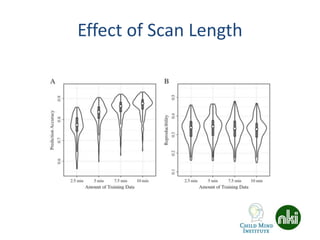
Effect of Scan Length
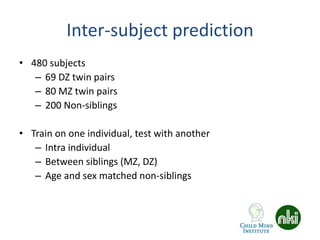
Inter-subject prediction
• 480 subjects
– 69 DZ twin pairs
– 80 MZ twin pairs
– 200 Non-siblings
• Train on one individual, test with another
– Intra individual
– Between siblings (MZ, DZ)
– Age and sex matched non-siblings
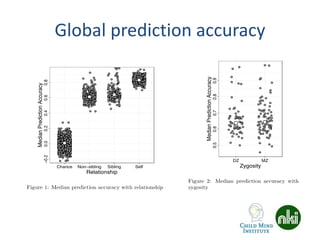
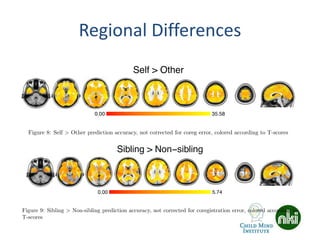
Global prediction accuracy
Regional Differences
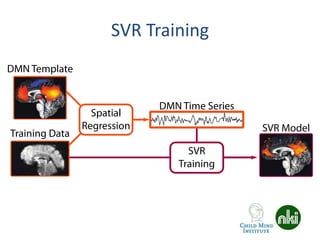
SVR Training
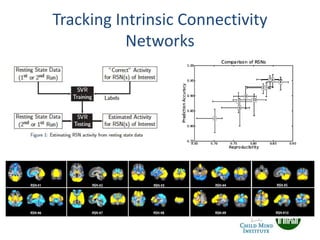
Tracking Intrinsic Connectivity
Networks
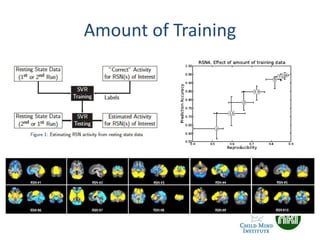
Amount of Training
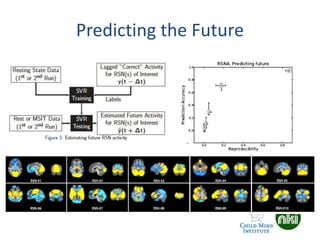
Predicting the Future
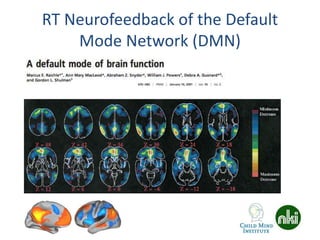
RT Neurofeedback of the Default
Mode Network (DMN)
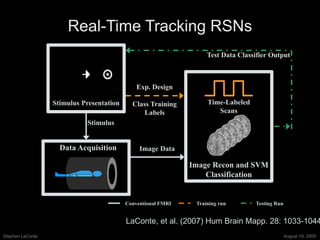
Exp. Design
Class Training
Labels
Training run
Time-Labeled
Scans
Image Recon and SVM
Classification
Image DataData Acquisition
Stimulus Presentation
Stimulus
Conventional FMRI
Test Data Classifier Output
Testing Run
Real-Time Tracking RSNs
LaConte, et al. (2007) Hum Brain Mapp. 28: 1033-1044
Stephen LaConte August 19, 2009
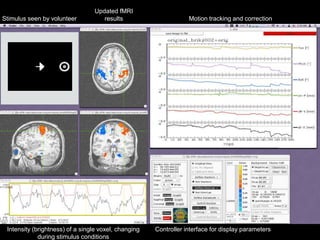
Stimulus seen by volunteer
Updated fMRI
results Motion tracking and correction
Intensity (brightness) of a single voxel, changing
during stimulus conditions
Controller interface for display parameters
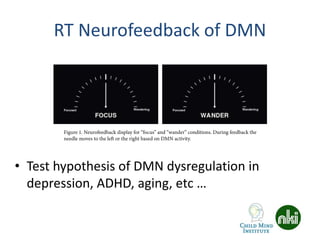
RT Neurofeedback of DMN
• Test hypothesis of DMN dysregulation in
depression, ADHD, aging, etc …
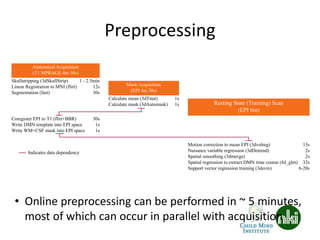
Preprocessing
Skullstripping (3dSkullStrip)
Linear Registration to MNI (flirt)
Segmentation (fast)
Anatomical Acquisition
(T1 MPRAGE 4m 30s)
1 - 2.5min
12s
30s
Coregister EPI to T1 (flirt+BBR)
Write DMN template into EPI space
Write WM+CSF mask into EPI space
30s
1s
1s
Mask Acquisition
(EPI 4m 30s)
Calculate mean (3dTstat)
Calculate mask (3dAutomask)
1s
1s Resting State (Training) Scan
(EPI 6m)
Motion correction to mean EPI (3dvolreg)
Nuisance variable regression (3dDetrend)
Spatial smoothing (3dmerge)
Spatial regression to extract DMN time course (fsl_glm)
Support vector regression training (3dsvm)
13s
2s
2s
32s
6-20s
Indicates data dependency
• Online preprocessing can be performed in ~ 5 minutes,
most of which can occur in parallel with acquisition
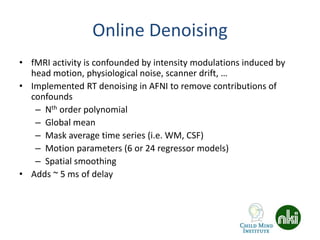
Online Denoising
• fMRI activity is confounded by intensity modulations induced by
head motion, physiological noise, scanner drift, …
• Implemented RT denoising in AFNI to remove contributions of
confounds
– Nth order polynomial
– Global mean
– Mask average time series (i.e. WM, CSF)
– Motion parameters (6 or 24 regressor models)
– Spatial smoothing
• Adds ~ 5 ms of delay
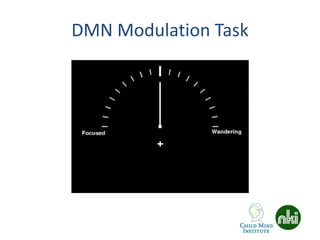
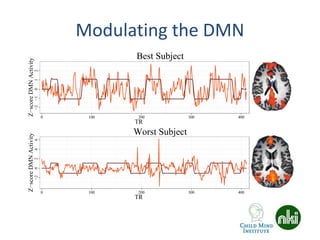
DMN Modulation Task
Modulating the DMN−2−1012
0 100 200 300 400
Best Subject
Worst Subject
TR
Z−scoreDMNActivity
−20246
0 100 200 300 400
TR
Z−scoreDMNActivity
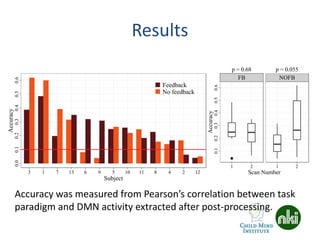
Results
0.00.10.20.30.40.50.6
3 1 7 13 6 9 5 10 11 8 4 2 12
Subject
Accuracy
Feedback
No feedback
FB NOFB
0.10.20.30.40.50.6
1 2 1 2
Scan Number
Accuracy
p = 0.055p = 0.68
Accuracy was measured from Pearson’s correlation between task
paradigm and DMN activity extracted after post-processing.
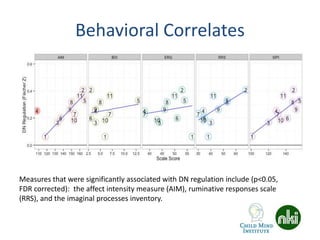
Behavioral Correlates
Measures that were significantly associated with DN regulation include (p<0.05,
FDR corrected): the affect intensity measure (AIM), ruminative responses scale
(RRS), and the imaginal processes inventory.
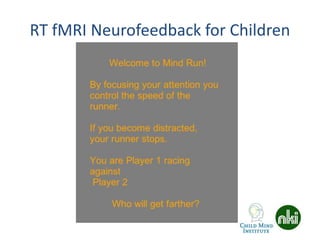
RT fMRI Neurofeedback for Children
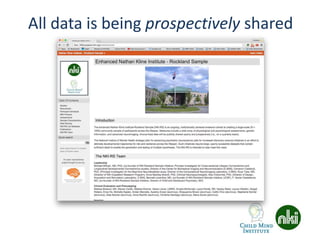
All data is being prospectively shared
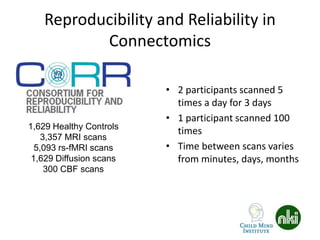
Reproducibility and Reliability in
Connectomics
• 2 participants scanned 5
times a day for 3 days
• 1 participant scanned 100
times
• Time between scans varies
from minutes, days, months
1,629 Healthy Controls
3,357 MRI scans
5,093 rs-fMRI scans
1,629 Diffusion scans
300 CBF scans
Acknowledgments
• CMI/NKI
– Michael Milham, MD, PHD
– Zarrar Shehzad
– Stan Colcombe, PhD
• Virginia Tech Carilion Research Institute
– Stephen LaConte, PhD
– Jonathan Lisinski, MS
• Siemens Medical
– Keith Heberlein, PhD
– Chris Glielmi, PhD
• Research Funded in part by a NARSAD Young Investigator
Award and NIMH R01MH101555
Thank
You!
Tracking Dynamic Networks in Real Time

Tracking Dynamic Networks in Real Time

  • 1.
    Tracking dynamic networksin real time. R. Cameron Craddock, PhD Director, Computational Neuroimaging Lab Nathan S. Kline Institute for Psychiatric Research Director of Imaging, Center for the Developing Brain Child Mind Institute March 8, 2016
  • 2.
    Predicting Intrinsic BrainActivity Multivariate model of brain activity xn = b0 + bv v¹n å xv +x Underdetermined problem: solved using support vector regression or other regularized regression / dimensionality reduction method Craddock et al. NeuroImage 2013.
  • 3.
    Data Driven ROIAtlas Craddock et al. Human Brain Mapping 2012.
  • 4.
    Nonparametric prediction, activation, influenceand reproducibility resampling Predicted Time Course Observed Time Course Features Dataset 1 Observed Time Course Features Dataset 2 Model Estimation Model Estimation wixi+b i Prediction Prediction Accuracy Reproducibility Prediction wixi+b i Predicted Time Course Prediction Accuracy Network Model Network Model B A
  • 5.
    Prediction Accuracy • Measureof the generalization ability of a model • Can be interpreted as a measure of the information content in the model about the region being modeled p(xn x1...xv ) » I(xn x1...xv )
  • 6.
    Reproducibility • Measures theSignal-to-Noise ratio of the model SNR @ 1+r 1-rStrother, S. C. et al. NeuroImage 2003
  • 7.
  • 8.
  • 9.
    Intra-individual variation Reproducibility PredictionAccuracy 0.840.860.880.900.92 0.30 0.350.40 0.45 0.50 Lobe Frontal Occipital Parietal Subcortical Temporal A Reproducibility PredictionAccuracy 0.840.860.880.900.92 0.35 0.40 0.45 Functional Hierarchy Heteromodal Limbic Paralimbic Sensory−Motor Subcortical Unimodal B
  • 10.
  • 11.
    Inter-subject prediction • 480subjects – 69 DZ twin pairs – 80 MZ twin pairs – 200 Non-siblings • Train on one individual, test with another – Intra individual – Between siblings (MZ, DZ) – Age and sex matched non-siblings
  • 12.
  • 13.
  • 14.
  • 15.
  • 16.
  • 17.
  • 18.
    RT Neurofeedback ofthe Default Mode Network (DMN)
  • 19.
    Exp. Design Class Training Labels Trainingrun Time-Labeled Scans Image Recon and SVM Classification Image DataData Acquisition Stimulus Presentation Stimulus Conventional FMRI Test Data Classifier Output Testing Run Real-Time Tracking RSNs LaConte, et al. (2007) Hum Brain Mapp. 28: 1033-1044 Stephen LaConte August 19, 2009
  • 20.
    Stimulus seen byvolunteer Updated fMRI results Motion tracking and correction Intensity (brightness) of a single voxel, changing during stimulus conditions Controller interface for display parameters
  • 21.
    RT Neurofeedback ofDMN • Test hypothesis of DMN dysregulation in depression, ADHD, aging, etc …
  • 22.
    Preprocessing Skullstripping (3dSkullStrip) Linear Registrationto MNI (flirt) Segmentation (fast) Anatomical Acquisition (T1 MPRAGE 4m 30s) 1 - 2.5min 12s 30s Coregister EPI to T1 (flirt+BBR) Write DMN template into EPI space Write WM+CSF mask into EPI space 30s 1s 1s Mask Acquisition (EPI 4m 30s) Calculate mean (3dTstat) Calculate mask (3dAutomask) 1s 1s Resting State (Training) Scan (EPI 6m) Motion correction to mean EPI (3dvolreg) Nuisance variable regression (3dDetrend) Spatial smoothing (3dmerge) Spatial regression to extract DMN time course (fsl_glm) Support vector regression training (3dsvm) 13s 2s 2s 32s 6-20s Indicates data dependency • Online preprocessing can be performed in ~ 5 minutes, most of which can occur in parallel with acquisition
  • 23.
    Online Denoising • fMRIactivity is confounded by intensity modulations induced by head motion, physiological noise, scanner drift, … • Implemented RT denoising in AFNI to remove contributions of confounds – Nth order polynomial – Global mean – Mask average time series (i.e. WM, CSF) – Motion parameters (6 or 24 regressor models) – Spatial smoothing • Adds ~ 5 ms of delay
  • 24.
  • 25.
    Modulating the DMN−2−1012 0100 200 300 400 Best Subject Worst Subject TR Z−scoreDMNActivity −20246 0 100 200 300 400 TR Z−scoreDMNActivity
  • 26.
    Results 0.00.10.20.30.40.50.6 3 1 713 6 9 5 10 11 8 4 2 12 Subject Accuracy Feedback No feedback FB NOFB 0.10.20.30.40.50.6 1 2 1 2 Scan Number Accuracy p = 0.055p = 0.68 Accuracy was measured from Pearson’s correlation between task paradigm and DMN activity extracted after post-processing.
  • 27.
    Behavioral Correlates Measures thatwere significantly associated with DN regulation include (p<0.05, FDR corrected): the affect intensity measure (AIM), ruminative responses scale (RRS), and the imaginal processes inventory.
  • 28.
  • 29.
    All data isbeing prospectively shared
  • 30.
    Reproducibility and Reliabilityin Connectomics • 2 participants scanned 5 times a day for 3 days • 1 participant scanned 100 times • Time between scans varies from minutes, days, months 1,629 Healthy Controls 3,357 MRI scans 5,093 rs-fMRI scans 1,629 Diffusion scans 300 CBF scans
  • 32.
    Acknowledgments • CMI/NKI – MichaelMilham, MD, PHD – Zarrar Shehzad – Stan Colcombe, PhD • Virginia Tech Carilion Research Institute – Stephen LaConte, PhD – Jonathan Lisinski, MS • Siemens Medical – Keith Heberlein, PhD – Chris Glielmi, PhD • Research Funded in part by a NARSAD Young Investigator Award and NIMH R01MH101555 Thank You!