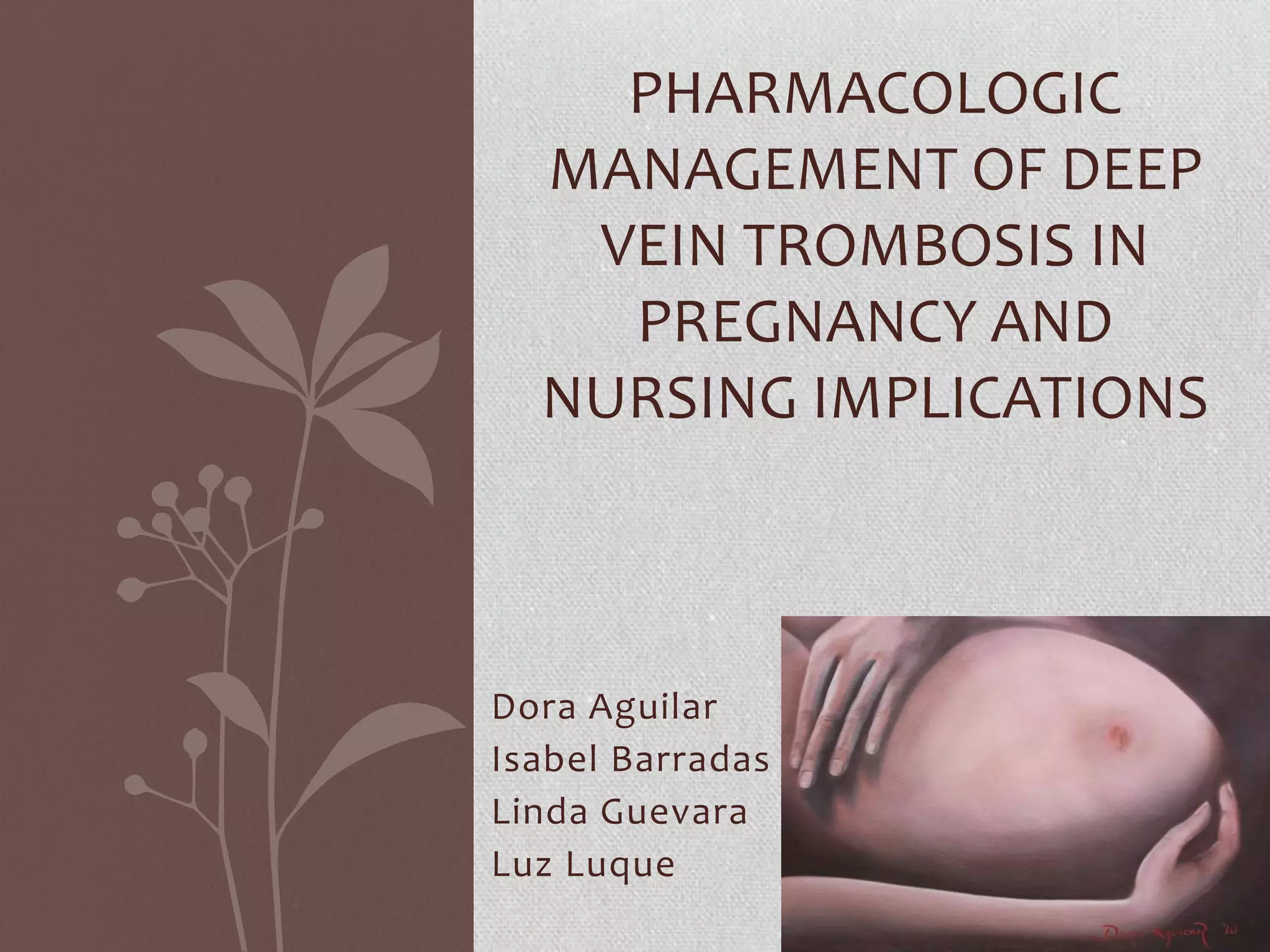

PHARMACOLOGIC
  MANAGEMENT OF DEEP
   VEIN TROMBOSIS IN
    PREGNANCY AND
  NURSING IMPLICATIONS


Dora Aguilar
Isabel Barradas
Linda Guevara
Luz Luque
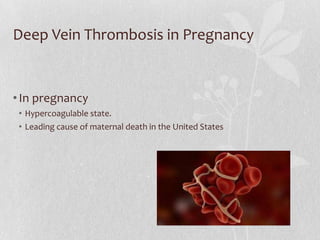
Deep Vein Thrombosis in Pregnancy


• In pregnancy
 • Hypercoagulable state.
 • Leading cause of maternal death in the United States
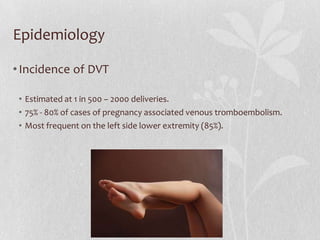
Epidemiology

• Incidence of DVT

 • Estimated at 1 in 500 – 2000 deliveries.
 • 75% - 80% of cases of pregnancy associated venous tromboembolism.
 • Most frequent on the left side lower extremity (85%).
Risk factors
• Physiological pregnancy process
      • Virchow’s triad of hypercoagulation.
                • Hypercoagulable state
                • Vascular damage
                • Venous stasis
• Inherited

• Acquired
      •   Antiphospholipid antibody syndrome
      •   Pregnancy age more than 35
      •   Parity more than 3
      •   Obesity
      •   Inmobilization
      •   Smoking
      •   Medical problems
          • Hypertension, nephrotic syndrome, sever infection
      • Cesarean dellivery
Pathophysiology
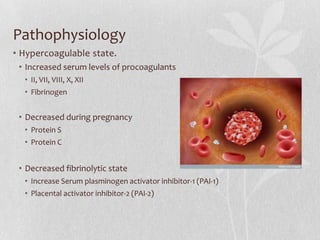
• Hypercoagulable state.
 • Increased serum levels of procoagulants
  • II, VII, VIII, X, XII
  • Fibrinogen


 • Decreased during pregnancy
  • Protein S
  • Protein C


 • Decreased fibrinolytic state
  • Increase Serum plasminogen activator inhibitor-1 (PAI-1)
  • Placental activator inhibitor-2 (PAI-2)
Signs and Symptoms


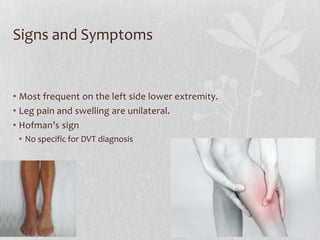
• Most frequent on the left side lower extremity.
• Leg pain and swelling are unilateral.
• Hofman’s sign
 • No specific for DVT diagnosis
Diagnostic


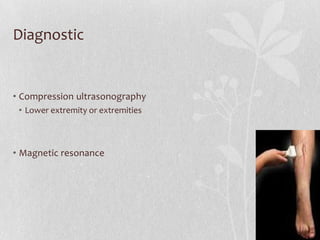
• Compression ultrasonography
 • Lower extremity or extremities


• Magnetic resonance
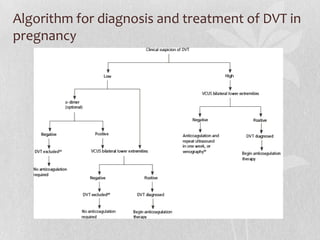
Algorithm for diagnosis and treatment of DVT in
pregnancy
Treatment
• Therapeutic anticoagulation
       All women with acute venous thromboembolism


• Women with high risk of thrombosis
       Mechanical heart valve
       History of thrombosis
       Thrombophilia
Treatment

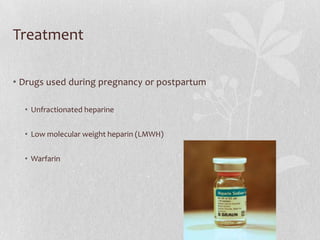
• Drugs used during pregnancy or postpartum

  • Unfractionated heparine


  • Low molecular weight heparin (LMWH)


  • Warfarin
Treatment
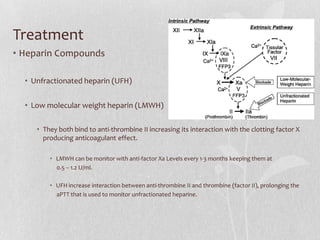
• Heparin Compounds

  • Unfractionated heparin (UFH)


  • Low molecular weight heparin (LMWH)

     • They both bind to anti-thrombine II increasing its interaction with the clotting factor X
       producing anticoagulant effect.

         • LMWH can be monitor with anti-factor Xa Levels every 1-3 months keeping them at
           0.5 – 1.2 U/ml.

         • UFH increase interaction between anti-thrombine II and thrombine (factor II), prolonging the
           aPTT that is used to monitor unfractionated heparine.
Treatment

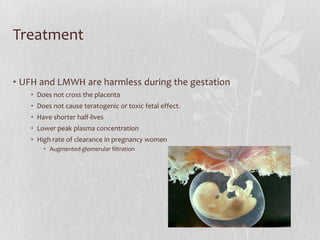
• UFH and LMWH are harmless during the gestation
   • Does not cross the placenta
   • Does not cause teratogenic or toxic fetal effect.
   • Have shorter half-lives
   • Lower peak plasma concentration
   • High rate of clearance in pregnancy women
       • Augmented glomerular filtration
Treatment
Adverse effects UFH and LMWH
  • Osteoporosis
  • Heparin-induced thrombocytopenia
       • Calcium and Vitamin D reduce risk of osteoporosis.

Advantages of LMWH
    •Fewer adverse effects than UFH
            •Fewer bleeding episodes
            •Lower risk of heparin-induced thrombocytopenia
            •Less bone mineral density loss
            •More predictable therapeutic response

•Disadvantages of LMWH
             •More expensive
             •Longer half-life compared with UFH
Treatment
• LMWH must be stopped 24 hours previous regional anesthesia or
  induction of labor.
• LMWH can be change for UFH at 36 weeks of pregnancy and
  instruct to the patient to stop UFH when spontaneous labor starts.
• Anticoagulation will be reassumed after 6 hours of vaginal delivery
  or 6 to 12 hours after cesarean.
• UFH therapeutic dosage is 80 U/kg bolus intravenous
    • 18 U/kg/hour adjusted to aPTT of 60-80 SC
    • 216 U/kg /12 hr
• UFH prophylactic dose is 5,000 U (1st trimester)
                                  7,500 U (2nd trimester)
                                 10,000 U (3rd trimester) SC twice daily.
Treatment

• LMWH therapeutic dosage

  • Enoxaparin 1 mg/kg/12 hrs. SC


• LMWH prophylactic dosage

  • Enoxaparin 40 mg SC daily
Treatment
• Warfarin
  • Inhibits the generation of Vit K-dependent procoagulants factors
         • II, VII, IX, X, protein C and S.


  • Associated with warfarin embriopathy when is used during the 1st semester
       • Nasal bone, hypoplasia, condrodysplasia puntata, congenital heart defects,
         agenesis of corpus callosum.

  • After 12 weeks of gestation, it is related with fetal bleeding and pregnancy loss.

  •   Incidence of congenital abnormalities is 6-10% and fetal demise is 30%.
  •   Mother with mechanical heart valves  after 12 week of gestation.
  •   More used during postpartum
  •   Dosage is 5 -10 mg daily. It must be overlap with heparin for 5 to 7 days until
      get INR.
Treatment
• Allergic patient
   • Danaparoid
      •   Probably does not cross the placent
      •   Has long half-life without a reversible agent
      •   It is not available in the United States since 2002
      •   It is accessible in Canada and Europe


   • Fondaparinux
      • First option in patients with heparin-induced trobocitopenia
      • Binds to antithrombin III to facilitate its binding to factor X to inactivate it and stopping
        the clotting cascade.
      • Released intact and can keep inhibiting more factor X.
      • Its half-life is 17 hrs.
      • Cathegory B (studies in-vitro human show that does not cross placenta significantly
      • Profilaxis dosage is 2.5 mg SC daily
      • Therapeutic dosage is 5-10 mg SC daily
Nursing Implications
• The “gold standard” in DVT is LMWH by SC injections.
   • Reduce risk of a pulmonary embolism
   • Reduce risk of developing another clot in the legs.


 •LMWH:
    •Has potential advantages over UFH during pregnancy.
    •Cause less heparin induced thrombocytopenia.
    •Has the potential for once-daily administration.
    •Lower risk of heparin-induced osteoporosis.


 •Coumarin:
     •Can cross the placenta:
         •Bleeding in the fetus and teratogenicity.
         •Embryopathy (nasal hypoplasia and/or stippled epiphyses).
                    Trauma of delivery can lead to bleeding in the neonate.
Nursing Implications
• Potential fetal complications of maternal anticoagulant therapy:

  • Teratogenicity
  • Bleeding


• UFH and LMWH do not cross the placenta.
  • Inhibit complications.
  • Bleeding at the uteroplacental junction is possible.
Nursing Implications
• Enoxaparin (LovenoxR)
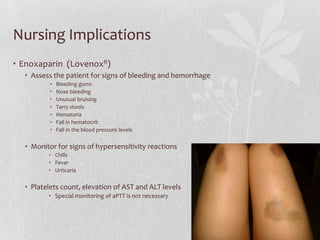
  • Assess the patient for signs of bleeding and hemorrhage
          •   Bleeding gums
          •   Nose bleeding
          •   Unusual bruising
          •   Tarry stools
          •   Hematuria
          •   Fall in hematocrit
          •   Fall in the blood pressure levels

  • Monitor for signs of hypersensitivity reactions
         • Chills
         • Fever
         • Urticaria

  • Platelets count, elevation of AST and ALT levels
         • Special monitoring of aPTT is not necessary
Nursing Implications
• Fondaparinux (ArixtraR)
  • Alternative medication used in acute DVT in pregnancy.
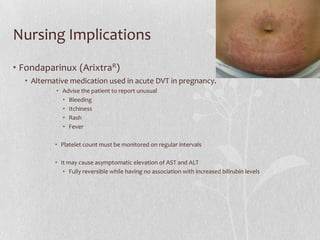
           • Advise the patient to report unusual
             • Bleeding
             • Itchiness
             • Rash
             • Fever

          • Platelet count must be monitored on regular intervals

          • It may cause asymptomatic elevation of AST and ALT
             • Fully reversible while having no association with increased bilirubin levels
Nursing Implications
• Measures recommended:
  •   Staying active as tolerated
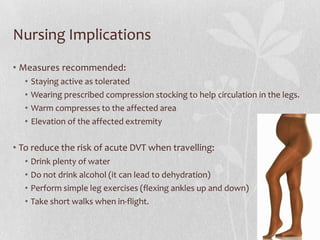
  •   Wearing prescribed compression stocking to help circulation in the legs.
  •   Warm compresses to the affected area
  •   Elevation of the affected extremity

• To reduce the risk of acute DVT when travelling:
  •   Drink plenty of water
  •   Do not drink alcohol (it can lead to dehydration)
  •   Perform simple leg exercises (flexing ankles up and down)
  •   Take short walks when in-flight.
Nursing Implications

• American College of Chest Physicians (Bates et al. ACCP, 2012)
  recommends:

  • LMWH for the prevention and treatment of VTE in pregnant women instead of
    unfractionated heparin (Grade 1B).


  • For pregnant women with acute VTE, the anticoagulants will be continued for at
    least 6 weeks postpartum.
         • For a minimum duration of therapy of 3 months, compared with shorter durations of treatment
           (Grade 2C).
Nursing Implications

 • Women with criteria for antiphospholipid antibody syndrome (APLA) with three
   or more pregnancy losses give:
    • Antepartum administration of prophylactic or intermediate-dose unfractionated heparin
      of prophylactic LMWH combined with low-dose aspirin (75-100mg/dl) over no treatment
      (Grade 1B).


 • For women with inherited thrombophilia and history of pregnancy complications:
    • Eliminating antithrombotic prophylaxis (Grade 2C).


 • For women with two or more miscarriages but without APLA or thrombophilia:
    • Antithrombotic prophylaxis (Grade 1B).
THANK YOU

Dvt in pregnancy

  • 1.
    PHARMACOLOGIC MANAGEMENTOF DEEP VEIN TROMBOSIS IN PREGNANCY AND NURSING IMPLICATIONS Dora Aguilar Isabel Barradas Linda Guevara Luz Luque
  • 2.
    Deep Vein Thrombosisin Pregnancy • In pregnancy • Hypercoagulable state. • Leading cause of maternal death in the United States
  • 3.
    Epidemiology • Incidence ofDVT • Estimated at 1 in 500 – 2000 deliveries. • 75% - 80% of cases of pregnancy associated venous tromboembolism. • Most frequent on the left side lower extremity (85%).
  • 4.
    Risk factors • Physiologicalpregnancy process • Virchow’s triad of hypercoagulation. • Hypercoagulable state • Vascular damage • Venous stasis • Inherited • Acquired • Antiphospholipid antibody syndrome • Pregnancy age more than 35 • Parity more than 3 • Obesity • Inmobilization • Smoking • Medical problems • Hypertension, nephrotic syndrome, sever infection • Cesarean dellivery
  • 5.
    Pathophysiology • Hypercoagulable state. • Increased serum levels of procoagulants • II, VII, VIII, X, XII • Fibrinogen • Decreased during pregnancy • Protein S • Protein C • Decreased fibrinolytic state • Increase Serum plasminogen activator inhibitor-1 (PAI-1) • Placental activator inhibitor-2 (PAI-2)
  • 6.
    Signs and Symptoms •Most frequent on the left side lower extremity. • Leg pain and swelling are unilateral. • Hofman’s sign • No specific for DVT diagnosis
  • 7.
    Diagnostic • Compression ultrasonography • Lower extremity or extremities • Magnetic resonance
  • 8.
    Algorithm for diagnosisand treatment of DVT in pregnancy
  • 9.
    Treatment • Therapeutic anticoagulation All women with acute venous thromboembolism • Women with high risk of thrombosis Mechanical heart valve History of thrombosis Thrombophilia
  • 10.
    Treatment • Drugs usedduring pregnancy or postpartum • Unfractionated heparine • Low molecular weight heparin (LMWH) • Warfarin
  • 11.
    Treatment • Heparin Compounds • Unfractionated heparin (UFH) • Low molecular weight heparin (LMWH) • They both bind to anti-thrombine II increasing its interaction with the clotting factor X producing anticoagulant effect. • LMWH can be monitor with anti-factor Xa Levels every 1-3 months keeping them at 0.5 – 1.2 U/ml. • UFH increase interaction between anti-thrombine II and thrombine (factor II), prolonging the aPTT that is used to monitor unfractionated heparine.
  • 12.
    Treatment • UFH andLMWH are harmless during the gestation • Does not cross the placenta • Does not cause teratogenic or toxic fetal effect. • Have shorter half-lives • Lower peak plasma concentration • High rate of clearance in pregnancy women • Augmented glomerular filtration
  • 13.
    Treatment Adverse effects UFHand LMWH • Osteoporosis • Heparin-induced thrombocytopenia • Calcium and Vitamin D reduce risk of osteoporosis. Advantages of LMWH •Fewer adverse effects than UFH •Fewer bleeding episodes •Lower risk of heparin-induced thrombocytopenia •Less bone mineral density loss •More predictable therapeutic response •Disadvantages of LMWH •More expensive •Longer half-life compared with UFH
  • 14.
    Treatment • LMWH mustbe stopped 24 hours previous regional anesthesia or induction of labor. • LMWH can be change for UFH at 36 weeks of pregnancy and instruct to the patient to stop UFH when spontaneous labor starts. • Anticoagulation will be reassumed after 6 hours of vaginal delivery or 6 to 12 hours after cesarean. • UFH therapeutic dosage is 80 U/kg bolus intravenous • 18 U/kg/hour adjusted to aPTT of 60-80 SC • 216 U/kg /12 hr • UFH prophylactic dose is 5,000 U (1st trimester) 7,500 U (2nd trimester) 10,000 U (3rd trimester) SC twice daily.
  • 15.
    Treatment • LMWH therapeuticdosage • Enoxaparin 1 mg/kg/12 hrs. SC • LMWH prophylactic dosage • Enoxaparin 40 mg SC daily
  • 16.
    Treatment • Warfarin • Inhibits the generation of Vit K-dependent procoagulants factors • II, VII, IX, X, protein C and S. • Associated with warfarin embriopathy when is used during the 1st semester • Nasal bone, hypoplasia, condrodysplasia puntata, congenital heart defects, agenesis of corpus callosum. • After 12 weeks of gestation, it is related with fetal bleeding and pregnancy loss. • Incidence of congenital abnormalities is 6-10% and fetal demise is 30%. • Mother with mechanical heart valves  after 12 week of gestation. • More used during postpartum • Dosage is 5 -10 mg daily. It must be overlap with heparin for 5 to 7 days until get INR.
  • 17.
    Treatment • Allergic patient • Danaparoid • Probably does not cross the placent • Has long half-life without a reversible agent • It is not available in the United States since 2002 • It is accessible in Canada and Europe • Fondaparinux • First option in patients with heparin-induced trobocitopenia • Binds to antithrombin III to facilitate its binding to factor X to inactivate it and stopping the clotting cascade. • Released intact and can keep inhibiting more factor X. • Its half-life is 17 hrs. • Cathegory B (studies in-vitro human show that does not cross placenta significantly • Profilaxis dosage is 2.5 mg SC daily • Therapeutic dosage is 5-10 mg SC daily
  • 18.
    Nursing Implications • The“gold standard” in DVT is LMWH by SC injections. • Reduce risk of a pulmonary embolism • Reduce risk of developing another clot in the legs. •LMWH: •Has potential advantages over UFH during pregnancy. •Cause less heparin induced thrombocytopenia. •Has the potential for once-daily administration. •Lower risk of heparin-induced osteoporosis. •Coumarin: •Can cross the placenta: •Bleeding in the fetus and teratogenicity. •Embryopathy (nasal hypoplasia and/or stippled epiphyses). Trauma of delivery can lead to bleeding in the neonate.
  • 19.
    Nursing Implications • Potentialfetal complications of maternal anticoagulant therapy: • Teratogenicity • Bleeding • UFH and LMWH do not cross the placenta. • Inhibit complications. • Bleeding at the uteroplacental junction is possible.
  • 20.
    Nursing Implications • Enoxaparin(LovenoxR) • Assess the patient for signs of bleeding and hemorrhage • Bleeding gums • Nose bleeding • Unusual bruising • Tarry stools • Hematuria • Fall in hematocrit • Fall in the blood pressure levels • Monitor for signs of hypersensitivity reactions • Chills • Fever • Urticaria • Platelets count, elevation of AST and ALT levels • Special monitoring of aPTT is not necessary
  • 21.
    Nursing Implications • Fondaparinux(ArixtraR) • Alternative medication used in acute DVT in pregnancy. • Advise the patient to report unusual • Bleeding • Itchiness • Rash • Fever • Platelet count must be monitored on regular intervals • It may cause asymptomatic elevation of AST and ALT • Fully reversible while having no association with increased bilirubin levels
  • 22.
    Nursing Implications • Measuresrecommended: • Staying active as tolerated • Wearing prescribed compression stocking to help circulation in the legs. • Warm compresses to the affected area • Elevation of the affected extremity • To reduce the risk of acute DVT when travelling: • Drink plenty of water • Do not drink alcohol (it can lead to dehydration) • Perform simple leg exercises (flexing ankles up and down) • Take short walks when in-flight.
  • 23.
    Nursing Implications • AmericanCollege of Chest Physicians (Bates et al. ACCP, 2012) recommends: • LMWH for the prevention and treatment of VTE in pregnant women instead of unfractionated heparin (Grade 1B). • For pregnant women with acute VTE, the anticoagulants will be continued for at least 6 weeks postpartum. • For a minimum duration of therapy of 3 months, compared with shorter durations of treatment (Grade 2C).
  • 24.
    Nursing Implications •Women with criteria for antiphospholipid antibody syndrome (APLA) with three or more pregnancy losses give: • Antepartum administration of prophylactic or intermediate-dose unfractionated heparin of prophylactic LMWH combined with low-dose aspirin (75-100mg/dl) over no treatment (Grade 1B). • For women with inherited thrombophilia and history of pregnancy complications: • Eliminating antithrombotic prophylaxis (Grade 2C). • For women with two or more miscarriages but without APLA or thrombophilia: • Antithrombotic prophylaxis (Grade 1B).
  • 25.