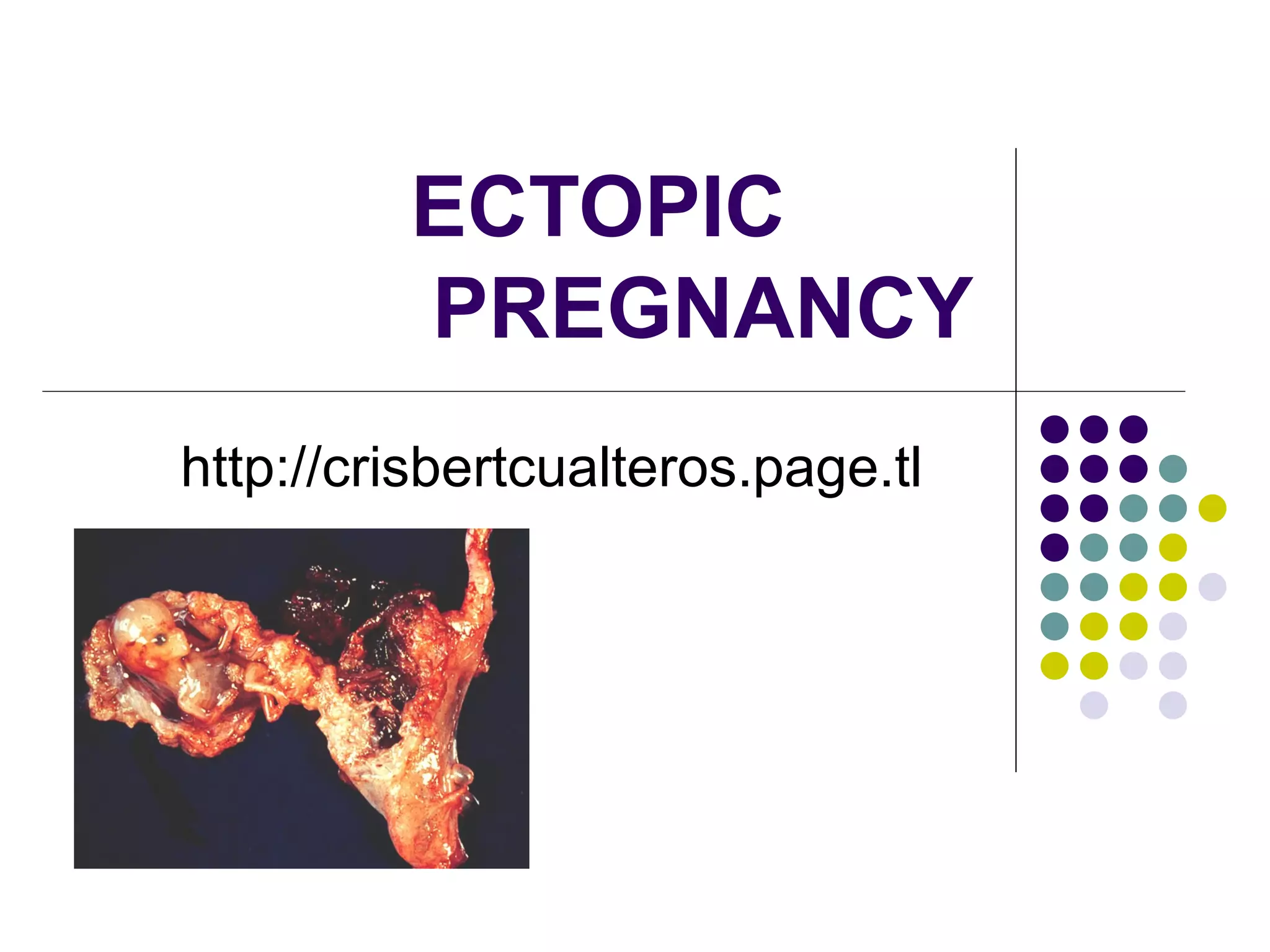
ECTOPIC  PREGNANCY http://crisbertcualteros.page.tl
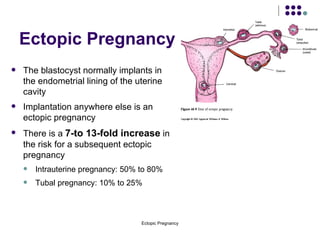
Ectopic Pregnancy The blastocyst normally implants in the endometrial lining of the uterine cavity Implantation anywhere else is an ectopic pregnancy There is a  7-to 13-fold increase  in the risk for a subsequent ectopic pregnancy Intrauterine pregnancy: 50% to 80%  Tubal pregnancy: 10% to 25%
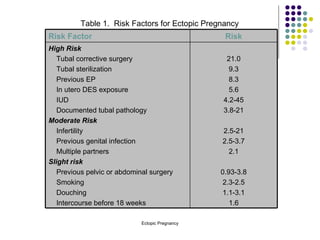
Table 1.  Risk Factors for Ectopic Pregnancy 21.0 9.3 8.3 5.6 4.2-45 3.8-21 2.5-21 2.5-3.7 2.1 0.93-3.8 2.3-2.5 1.1-3.1 1.6 High Risk Tubal corrective surgery Tubal sterilization Previous EP In utero DES exposure IUD Documented tubal pathology Moderate Risk Infertility Previous genital infection Multiple partners Slight risk Previous pelvic or abdominal surgery Smoking Douching Intercourse before 18 weeks  Risk Risk Factor
Increasing ectopic pregnancy rates Prevalence of sexually transmitted tubal infection and damage Ascertainment through earlier diagnosis of some EP otherwise destined to resorb spontaneously Popularity of contraception that predisposes failures to be ectopic
Increasing ectopic pregnancy rates Use of tubal sterilization techniques that increase the likelihood of EP Use of assisted reproductive techniques Use of tubal surgery, including salpingotomy for tubal pregnancy and tuboplasty for infertility
History Classic triad of symptoms Pain ,  amenorrhea ,  vaginal bleeding Seen in only about 50% of patients Most typical in patients in whom EP has ruptured Abdominal pain – most frequent complaint With rupture, the patient may experience transient relief of pain since stretching of the serosa ceases Shoulder and back pain  – hemoperitoneal irritation of the diaphragm; may indicate intraabdominal hemorrhage
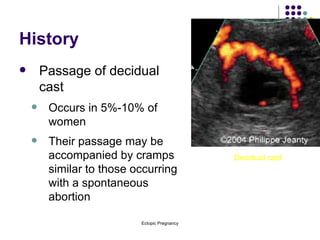
History Passage of decidual cast Occurs in 5%-10% of women Their passage may be accompanied by cramps similar to those occurring with a spontaneous abortion Decidual cast
Physical Examination Measurement of vital signs With rupture and intraabdominal hemorrhage, the patient develops tachycardia followed by hypotension
Physical Examination Examination of the abdomen and pelvis Abdomen may be nontender or tender, with or without rebound Uterus may be enlarged, with findings similar to a normal pregnancy Cervical motion tenderness may or may not be present Bulging of the posterior cul-de-sac Adnexal mass palpable in up to 50% of cases
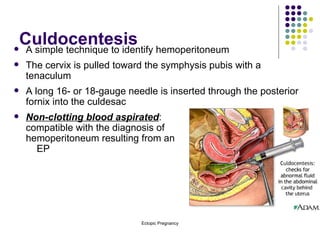
Culdocentesis A simple technique to identify hemoperitoneum The cervix is pulled toward the symphysis pubis with a tenaculum A long 16- or 18-gauge needle is inserted through the posterior fornix into the culdesac Non-clotting blood aspirated :  compatible with the diagnosis of  hemoperitoneum resulting from an  EP
Laboratory tests Hemogram Even after substantive hemorrhage, hemoglobin and hematocrit readings may at first show only a slight reduction Hence after an acute hemorrhage, a decrease in hemoglobin or hematocrit level over several hours is a more valuable index of blood loss than the initial reading
Laboratory tests hCG assays EP cannot be diagnosed by a positive pregnancy test alone hCG assays positive in over 99% of EPs Sensitive to levels of chorionic gonadotropin of 10-20 mIU/ml The hCG pattern that is most predictive of EP is one that has reached a plateau (doubling time of more than 7 days)
Laboratory tests Serum progesterone levels A single progesterone measurement can be used to establish that there is a normally developing pregnancy with high reliability A value exceeding 25 ng/mL excludes EP with 97.5% sensitivity Values below 5 ng/mL occur only in 0.3% of normal pregnancies – suggests a dead fetus or EP
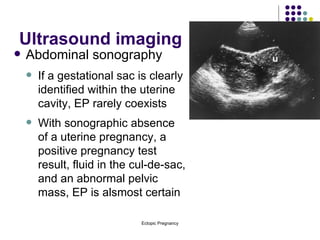
Ultrasound imaging Abdominal sonography If a gestational sac is clearly identified within the uterine cavity, EP rarely coexists With sonographic absence of a uterine pregnancy, a positive pregnancy test result, fluid in the cul-de-sac, and an abnormal pelvic mass, EP is alsmost certain
Ultrasound imaging Vaginal sonography The imaging of choice in early pregnancy A tubal pregnancy may be missed when the mass is small or obscured by bowel Reported sensitivity for diagnosing EP varies widely from 20% to 80%
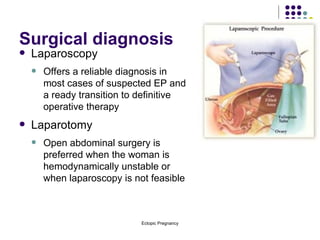
Surgical diagnosis Laparoscopy Offers a reliable diagnosis in most cases of suspected EP and a ready transition to definitive operative therapy Laparotomy Open abdominal surgery is preferred when the woman is hemodynamically unstable or when laparoscopy is not feasible
Histologic characteristics Evidence of chronic salpingitis and salpingitis isthmica nodosa (SIN) Arias-Stella reaction
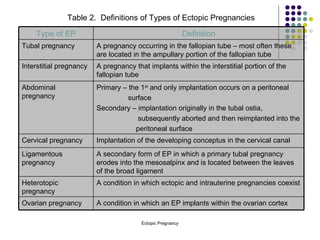
Table 2.  Definitions of Types of Ectopic Pregnancies A condition in which an EP implants within the ovarian cortex Ovarian pregnancy A condition in which ectopic and intrauterine pregnancies coexist  Heterotopic pregnancy A secondary form of EP in which a primary tubal pregnancy erodes into the mesosalpinx and is located between the leaves of the broad ligament Ligamentous pregnancy Implantation of the developing conceptus in the cervical canal Cervical pregnancy Primary – the 1 st  and only implantation occurs on a peritoneal  surface Secondary – implantation originally in the tubal ostia,  subsequently aborted and then reimplanted into the  peritoneal surface Abdominal pregnancy A pregnancy that implants within the interstitial portion of the fallopian tube Interstitial pregnancy A pregnancy occurring in the fallopian tube – most often these are located in the ampullary portion of the fallopian tube Tubal pregnancy Definition Type of EP
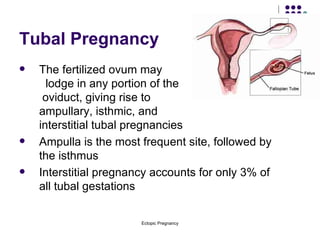
Tubal Pregnancy The fertilized ovum may  lodge in any portion of the  oviduct, giving rise to  ampullary, isthmic, and  interstitial tubal pregnancies Ampulla is the most frequent site, followed by the isthmus Interstitial pregnancy accounts for only 3% of all tubal gestations
Tubal Pregnancy Treatment Anti-D immunoglobulin D-negative women with an ectopic pregnancy who are not sensitized to D-antigen should be given anti-D immunoglobulin
Tubal Pregnancy Treatment Surgical Management Laparoscopy is preferred over laparotomy unless the patient is unstable Tubal surgery for EP is considered conservative when there is tubal salvage (salpingostomy, salpingotomy, fimbrial expression of the EP) Radical surgery is defined by salpingectomy
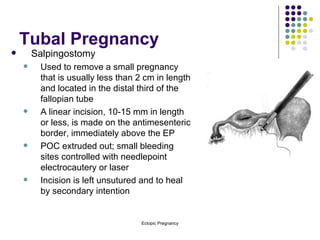
Tubal Pregnancy Salpingostomy Used to remove a small pregnancy that is usually less than 2 cm in length and located in the distal third of the fallopian tube A linear incision, 10-15 mm in length or less, is made on the antimesenteric border, immediately above the EP POC extruded out; small bleeding sites controlled with needlepoint electrocautery or laser Incision is left unsutured and to heal by secondary intention
Tubal Pregnancy Salpingotomy Essentially the same as salpingostomy except that the incision is closed with 7-0 Vicryl or similar suture
Tubal Pregnancy Salpingectomy May be performed through an operative laparoscope and may be used for both ruptured and unruptured EP When removing the oviduct, it is advisable to excise a wedge of the outer third (or less) of the interstitial portion of the tube (cornual resection) To minimize the rare recurrence of pregnancy in the tubal stump
Tubal Pregnancy Segmental resection and anastomosis Resection of the ectopic mass and tubal reanastomosis is sometimes used for an unruptured isthmic pregnancy because salpingostomy may cause scarring and subsequent narrowing of the small isthmic lumen
Tubal Pregnancy Medical Management Systemic MTX MTX acts as a folic acid antagonist and is highly effective against rapidly proliferating trophoblasts Active intraabdominal bleeding is contraindicated May not be used if the EP is > 4 cm Success is greatest if the AOG is < 6 weeks, the tubal mass is not > 3.5 cm in diameter, the fetus is dead, and the B-hCG <15,000 mIU/mL
Cervical Pregnancy 1 in 2,400 to 1 in 50,000 pregnancies (US) Conditions that predispose: Previous therapeutic abortion Asherman’s syndrome Previous CS DES exposure Leiomyomas IVF
Cervical Pregnancy Diagnostic Criteria The uterus is smaller than the surrounding distended cervix The internal os is not dilated Curettage of the endometrial cavity is non-productive of placental tissue The external os opens earlier than in spontaneous abortion
Cervical Pregnancy Preoperative preparation should include blood typing and cross-matching, IV access, and detailed informed consent which include the possibility of hysterectomy in the event of hemorrhage Non-surgical management:  intraamniotic and systemic MTX administration
Ovarian Pregnancy Criteria for diagnosis (Spiegelberg’s Criteria) The fallopian tube on the affected side must be intact The fetal sac must occupy the position of the ovary The ovary must be connected to the uterus by the ovarian ligament Ovarian tissue must be located in the sac wall
Ovarian Pregnancy 0.5% to 1% of all ectopic pregnancies Most common type of non-tubal pregnancy Misdiagnosis common because it is confused with a ruptured corpus luteum in up to 75% of cases Ovarian cystectomy is the preferred treatment  Treatment with MTX and prostaglandin injection has also been reported
Abdominal pregnancy Classified as primary and secondary Secondary abdominal pregnancies are by far the most common and result from tubal abortion or rupture or, less often, from subsequent implantation within the abdomen after uterine rupture 1 in 372 to 1 in 9,714 live births Incidence of congenital anomalies:  20%-40%
Abdominal pregnancy Clinical presentation In the 1 st  and early second trimester, the symptoms may be the same as a tubal EP In advanced pregnancy: Painful fetal movement Fetal movements high in the abdomen or sudden cessation of movements Persistent abnormal fetal lies, abdominal tenderness, displaced cervix, fetal superficiality No uterine contractions after oxytocin infusion
Abdominal pregnancy Criteria for diagnosis – Studdiford’s Criteria Presence of normal tubes and ovaries with no evidence of recent or past pregnancy No evidence of uteroplacental fistula The presence of a pregnancy related exclusively to the peritoneal surface and early enough to eliminate the possibility of secondary implantation after primary tubal abortion
Abdominal pregnancy Surgical intervention  Placenta can be removed if its vascular supply can be identified and ligated; otherwise it is left behind, packing is done which is removed after 24 to 48 hours MTX treatment appears to be contraindicated because of the high rate of complications due to rapid tissue necrosis
Interstitial pregnancy Represent about 1% of EPs Patients tend to present later in gestation than those with tubal pregnancies Often associated with uterine rupture – represent a large proportion of fatalities from EP Treatment:  cornual resection by laparotomy
Interligamentous pregnancy Rare form of EP; 1 in 300 EPs Usually results from trophoblastic penetration of a tubal pregnancy through the serosa and into the mesosalpinx, with secondary implantation between the leaves of the broad ligament Can also occur if a uterine fistula develops between the endometrial cavity and retroperitoneal space
Heterotopic pregnancy Occurs when there are coexisting intrauterine and ectopic pregnancies 1 in 100 to 1 in 30,000 pregnancies Higher in patients who undergo ovulation induction Treatment is operative
Please visit: http://crisbertcualteros.page.tl

Ectopic Pregnancy

  • 1.
    ECTOPIC PREGNANCYhttp://crisbertcualteros.page.tl
  • 2.
    Ectopic Pregnancy Theblastocyst normally implants in the endometrial lining of the uterine cavity Implantation anywhere else is an ectopic pregnancy There is a 7-to 13-fold increase in the risk for a subsequent ectopic pregnancy Intrauterine pregnancy: 50% to 80% Tubal pregnancy: 10% to 25%
  • 3.
    Table 1. Risk Factors for Ectopic Pregnancy 21.0 9.3 8.3 5.6 4.2-45 3.8-21 2.5-21 2.5-3.7 2.1 0.93-3.8 2.3-2.5 1.1-3.1 1.6 High Risk Tubal corrective surgery Tubal sterilization Previous EP In utero DES exposure IUD Documented tubal pathology Moderate Risk Infertility Previous genital infection Multiple partners Slight risk Previous pelvic or abdominal surgery Smoking Douching Intercourse before 18 weeks Risk Risk Factor
  • 4.
    Increasing ectopic pregnancyrates Prevalence of sexually transmitted tubal infection and damage Ascertainment through earlier diagnosis of some EP otherwise destined to resorb spontaneously Popularity of contraception that predisposes failures to be ectopic
  • 5.
    Increasing ectopic pregnancyrates Use of tubal sterilization techniques that increase the likelihood of EP Use of assisted reproductive techniques Use of tubal surgery, including salpingotomy for tubal pregnancy and tuboplasty for infertility
  • 6.
    History Classic triadof symptoms Pain , amenorrhea , vaginal bleeding Seen in only about 50% of patients Most typical in patients in whom EP has ruptured Abdominal pain – most frequent complaint With rupture, the patient may experience transient relief of pain since stretching of the serosa ceases Shoulder and back pain – hemoperitoneal irritation of the diaphragm; may indicate intraabdominal hemorrhage
  • 7.
    History Passage ofdecidual cast Occurs in 5%-10% of women Their passage may be accompanied by cramps similar to those occurring with a spontaneous abortion Decidual cast
  • 8.
    Physical Examination Measurementof vital signs With rupture and intraabdominal hemorrhage, the patient develops tachycardia followed by hypotension
  • 9.
    Physical Examination Examinationof the abdomen and pelvis Abdomen may be nontender or tender, with or without rebound Uterus may be enlarged, with findings similar to a normal pregnancy Cervical motion tenderness may or may not be present Bulging of the posterior cul-de-sac Adnexal mass palpable in up to 50% of cases
  • 10.
    Culdocentesis A simpletechnique to identify hemoperitoneum The cervix is pulled toward the symphysis pubis with a tenaculum A long 16- or 18-gauge needle is inserted through the posterior fornix into the culdesac Non-clotting blood aspirated : compatible with the diagnosis of hemoperitoneum resulting from an EP
  • 11.
    Laboratory tests HemogramEven after substantive hemorrhage, hemoglobin and hematocrit readings may at first show only a slight reduction Hence after an acute hemorrhage, a decrease in hemoglobin or hematocrit level over several hours is a more valuable index of blood loss than the initial reading
  • 12.
    Laboratory tests hCGassays EP cannot be diagnosed by a positive pregnancy test alone hCG assays positive in over 99% of EPs Sensitive to levels of chorionic gonadotropin of 10-20 mIU/ml The hCG pattern that is most predictive of EP is one that has reached a plateau (doubling time of more than 7 days)
  • 13.
    Laboratory tests Serumprogesterone levels A single progesterone measurement can be used to establish that there is a normally developing pregnancy with high reliability A value exceeding 25 ng/mL excludes EP with 97.5% sensitivity Values below 5 ng/mL occur only in 0.3% of normal pregnancies – suggests a dead fetus or EP
  • 14.
    Ultrasound imaging Abdominalsonography If a gestational sac is clearly identified within the uterine cavity, EP rarely coexists With sonographic absence of a uterine pregnancy, a positive pregnancy test result, fluid in the cul-de-sac, and an abnormal pelvic mass, EP is alsmost certain
  • 15.
    Ultrasound imaging Vaginalsonography The imaging of choice in early pregnancy A tubal pregnancy may be missed when the mass is small or obscured by bowel Reported sensitivity for diagnosing EP varies widely from 20% to 80%
  • 16.
    Surgical diagnosis LaparoscopyOffers a reliable diagnosis in most cases of suspected EP and a ready transition to definitive operative therapy Laparotomy Open abdominal surgery is preferred when the woman is hemodynamically unstable or when laparoscopy is not feasible
  • 17.
    Histologic characteristics Evidenceof chronic salpingitis and salpingitis isthmica nodosa (SIN) Arias-Stella reaction
  • 18.
    Table 2. Definitions of Types of Ectopic Pregnancies A condition in which an EP implants within the ovarian cortex Ovarian pregnancy A condition in which ectopic and intrauterine pregnancies coexist Heterotopic pregnancy A secondary form of EP in which a primary tubal pregnancy erodes into the mesosalpinx and is located between the leaves of the broad ligament Ligamentous pregnancy Implantation of the developing conceptus in the cervical canal Cervical pregnancy Primary – the 1 st and only implantation occurs on a peritoneal surface Secondary – implantation originally in the tubal ostia, subsequently aborted and then reimplanted into the peritoneal surface Abdominal pregnancy A pregnancy that implants within the interstitial portion of the fallopian tube Interstitial pregnancy A pregnancy occurring in the fallopian tube – most often these are located in the ampullary portion of the fallopian tube Tubal pregnancy Definition Type of EP
  • 19.
    Tubal Pregnancy Thefertilized ovum may lodge in any portion of the oviduct, giving rise to ampullary, isthmic, and interstitial tubal pregnancies Ampulla is the most frequent site, followed by the isthmus Interstitial pregnancy accounts for only 3% of all tubal gestations
  • 20.
    Tubal Pregnancy TreatmentAnti-D immunoglobulin D-negative women with an ectopic pregnancy who are not sensitized to D-antigen should be given anti-D immunoglobulin
  • 21.
    Tubal Pregnancy TreatmentSurgical Management Laparoscopy is preferred over laparotomy unless the patient is unstable Tubal surgery for EP is considered conservative when there is tubal salvage (salpingostomy, salpingotomy, fimbrial expression of the EP) Radical surgery is defined by salpingectomy
  • 22.
    Tubal Pregnancy SalpingostomyUsed to remove a small pregnancy that is usually less than 2 cm in length and located in the distal third of the fallopian tube A linear incision, 10-15 mm in length or less, is made on the antimesenteric border, immediately above the EP POC extruded out; small bleeding sites controlled with needlepoint electrocautery or laser Incision is left unsutured and to heal by secondary intention
  • 23.
    Tubal Pregnancy SalpingotomyEssentially the same as salpingostomy except that the incision is closed with 7-0 Vicryl or similar suture
  • 24.
    Tubal Pregnancy SalpingectomyMay be performed through an operative laparoscope and may be used for both ruptured and unruptured EP When removing the oviduct, it is advisable to excise a wedge of the outer third (or less) of the interstitial portion of the tube (cornual resection) To minimize the rare recurrence of pregnancy in the tubal stump
  • 25.
    Tubal Pregnancy Segmentalresection and anastomosis Resection of the ectopic mass and tubal reanastomosis is sometimes used for an unruptured isthmic pregnancy because salpingostomy may cause scarring and subsequent narrowing of the small isthmic lumen
  • 26.
    Tubal Pregnancy MedicalManagement Systemic MTX MTX acts as a folic acid antagonist and is highly effective against rapidly proliferating trophoblasts Active intraabdominal bleeding is contraindicated May not be used if the EP is > 4 cm Success is greatest if the AOG is < 6 weeks, the tubal mass is not > 3.5 cm in diameter, the fetus is dead, and the B-hCG <15,000 mIU/mL
  • 27.
    Cervical Pregnancy 1in 2,400 to 1 in 50,000 pregnancies (US) Conditions that predispose: Previous therapeutic abortion Asherman’s syndrome Previous CS DES exposure Leiomyomas IVF
  • 28.
    Cervical Pregnancy DiagnosticCriteria The uterus is smaller than the surrounding distended cervix The internal os is not dilated Curettage of the endometrial cavity is non-productive of placental tissue The external os opens earlier than in spontaneous abortion
  • 29.
    Cervical Pregnancy Preoperativepreparation should include blood typing and cross-matching, IV access, and detailed informed consent which include the possibility of hysterectomy in the event of hemorrhage Non-surgical management: intraamniotic and systemic MTX administration
  • 30.
    Ovarian Pregnancy Criteriafor diagnosis (Spiegelberg’s Criteria) The fallopian tube on the affected side must be intact The fetal sac must occupy the position of the ovary The ovary must be connected to the uterus by the ovarian ligament Ovarian tissue must be located in the sac wall
  • 31.
    Ovarian Pregnancy 0.5%to 1% of all ectopic pregnancies Most common type of non-tubal pregnancy Misdiagnosis common because it is confused with a ruptured corpus luteum in up to 75% of cases Ovarian cystectomy is the preferred treatment Treatment with MTX and prostaglandin injection has also been reported
  • 32.
    Abdominal pregnancy Classifiedas primary and secondary Secondary abdominal pregnancies are by far the most common and result from tubal abortion or rupture or, less often, from subsequent implantation within the abdomen after uterine rupture 1 in 372 to 1 in 9,714 live births Incidence of congenital anomalies: 20%-40%
  • 33.
    Abdominal pregnancy Clinicalpresentation In the 1 st and early second trimester, the symptoms may be the same as a tubal EP In advanced pregnancy: Painful fetal movement Fetal movements high in the abdomen or sudden cessation of movements Persistent abnormal fetal lies, abdominal tenderness, displaced cervix, fetal superficiality No uterine contractions after oxytocin infusion
  • 34.
    Abdominal pregnancy Criteriafor diagnosis – Studdiford’s Criteria Presence of normal tubes and ovaries with no evidence of recent or past pregnancy No evidence of uteroplacental fistula The presence of a pregnancy related exclusively to the peritoneal surface and early enough to eliminate the possibility of secondary implantation after primary tubal abortion
  • 35.
    Abdominal pregnancy Surgicalintervention Placenta can be removed if its vascular supply can be identified and ligated; otherwise it is left behind, packing is done which is removed after 24 to 48 hours MTX treatment appears to be contraindicated because of the high rate of complications due to rapid tissue necrosis
  • 36.
    Interstitial pregnancy Representabout 1% of EPs Patients tend to present later in gestation than those with tubal pregnancies Often associated with uterine rupture – represent a large proportion of fatalities from EP Treatment: cornual resection by laparotomy
  • 37.
    Interligamentous pregnancy Rareform of EP; 1 in 300 EPs Usually results from trophoblastic penetration of a tubal pregnancy through the serosa and into the mesosalpinx, with secondary implantation between the leaves of the broad ligament Can also occur if a uterine fistula develops between the endometrial cavity and retroperitoneal space
  • 38.
    Heterotopic pregnancy Occurswhen there are coexisting intrauterine and ectopic pregnancies 1 in 100 to 1 in 30,000 pregnancies Higher in patients who undergo ovulation induction Treatment is operative
  • 39.