Presented By:
Md. Mamun Mia ID. 142-23-148
Geotextiles were originally intended to be an alternative to granular soil filters.
The original, and still sometimes used, term for geotextiles is filter fabrics. Work
originally began in the 1950s
Geotextiles are generally used for four applications i.e. separation, filtration,
drainage & reinforcements. The wide use of geotextiles is under the structure
of road due to which life of road increases. Geotextile is also used for
preservation of riverbanks, coastal protection, dams, water canals etc. geotextile
is also used under the structure of railway tracks as a shock absorber in order to
improve the life of railway tracks
History
•Geotech segment comprises of technical textile products used in Geotechnical
applications pertaining to soil, rock, earth etc.
•This class of product is loosely called Geotextiles.
•However Geotextiles particularly refers to permeable fabric or synthetic material, woven
or non-woven, which can be used with geotechnical engineering material.
Geotech:
Used:
Geotextiles are permeable fabrics which used in association
have the ability to separate, filter, reinforce, protect, or drain.
Typically made from polypropylene or polyester.
Forms: Woven (resembling mail bag sacking),
Needle punched (resembling felt) or heat bonded
(resembling ironed felt).
Used and Form:
1 . Mechanical properties:
a) Tensile strength
b) Bursting strength
c) Drap ability
d) Compatibility
e) Flexibility
f) Tearing strength
g) Frictional resistance
h) Tenacity
Required Properties of geo-textiles:
2. Physical properties:
a) Specific gravity
b) Weight
c) Thickness
d) Stiffness
e) Density
3. Hydraulic properties
4. Degradation properties:
5. Endurance properties:
Required Properties of geo-textiles:
:
1. Separation:
Geotextiles will prevent two soil layers of different particle sizes from
mixing with each other.
2. Drainage:
Geotextiles will efficiently collect superfluous water from structures, such
as rainwater or surplus water, from the soil and discharge it.
3. Filtration:
Geotextiles are an ideal interface for reverse filtration in the soil adjacent
to the geotextile.
4. Reinforcement:
Heavy geotextiles can be used to reinforce earth structures by means of
fill materials
5. Protection:
Geotextiles are an ideal protection from erosion of earth embankments by
wave action.
5 main functions of geotextiles
Raw materials of geo-textile
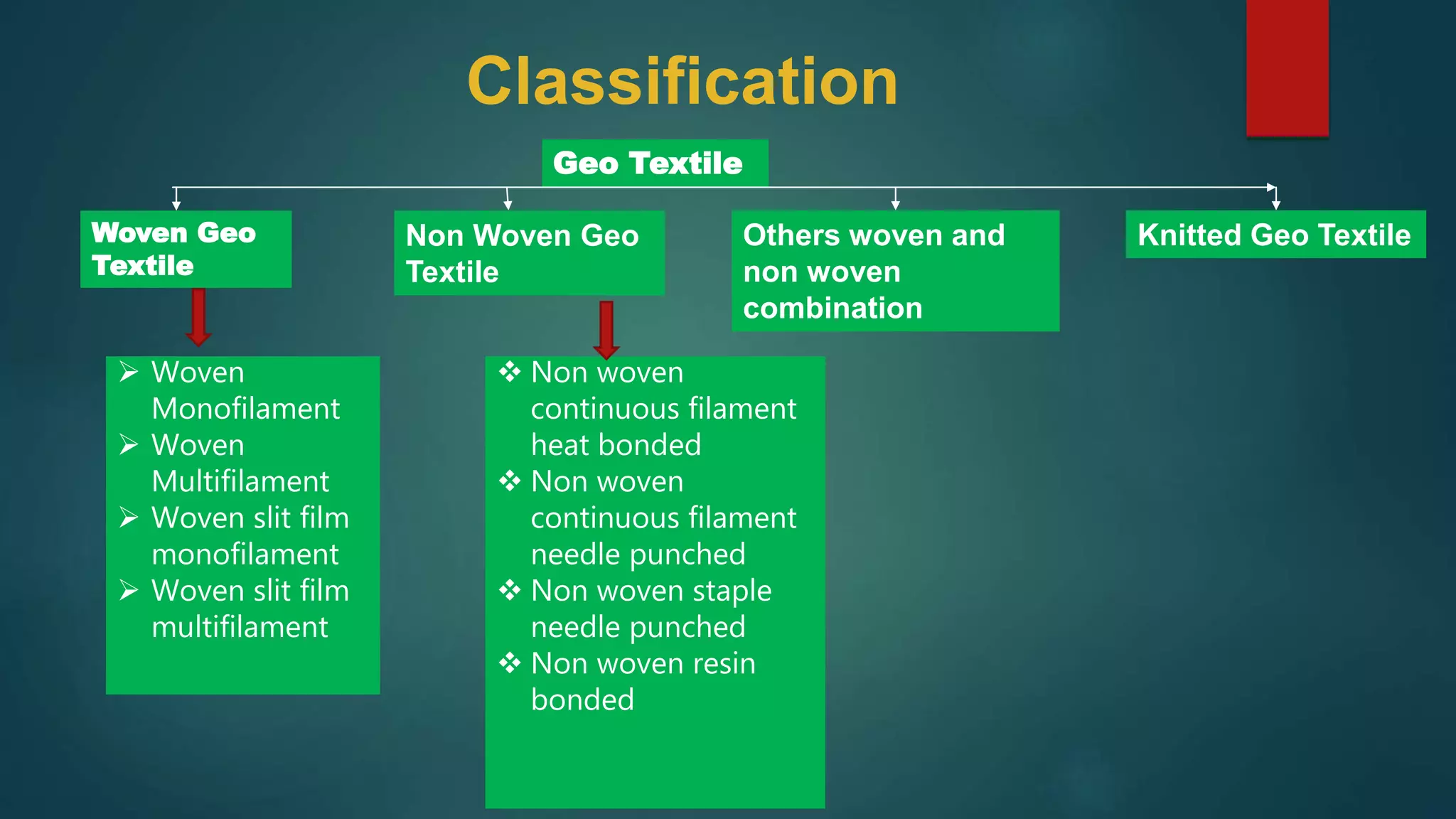
Classification
Geo Textile
Woven Geo
Textile
Non Woven Geo
Textile
Others woven and
non woven
combination
Knitted Geo Textile
 Woven
Monofilament
 Woven
Multifilament
 Woven slit film
monofilament
 Woven slit film
multifilament
 Non woven
continuous filament
heat bonded
 Non woven
continuous filament
needle punched
 Non woven staple
needle punched
 Non woven resin
bonded
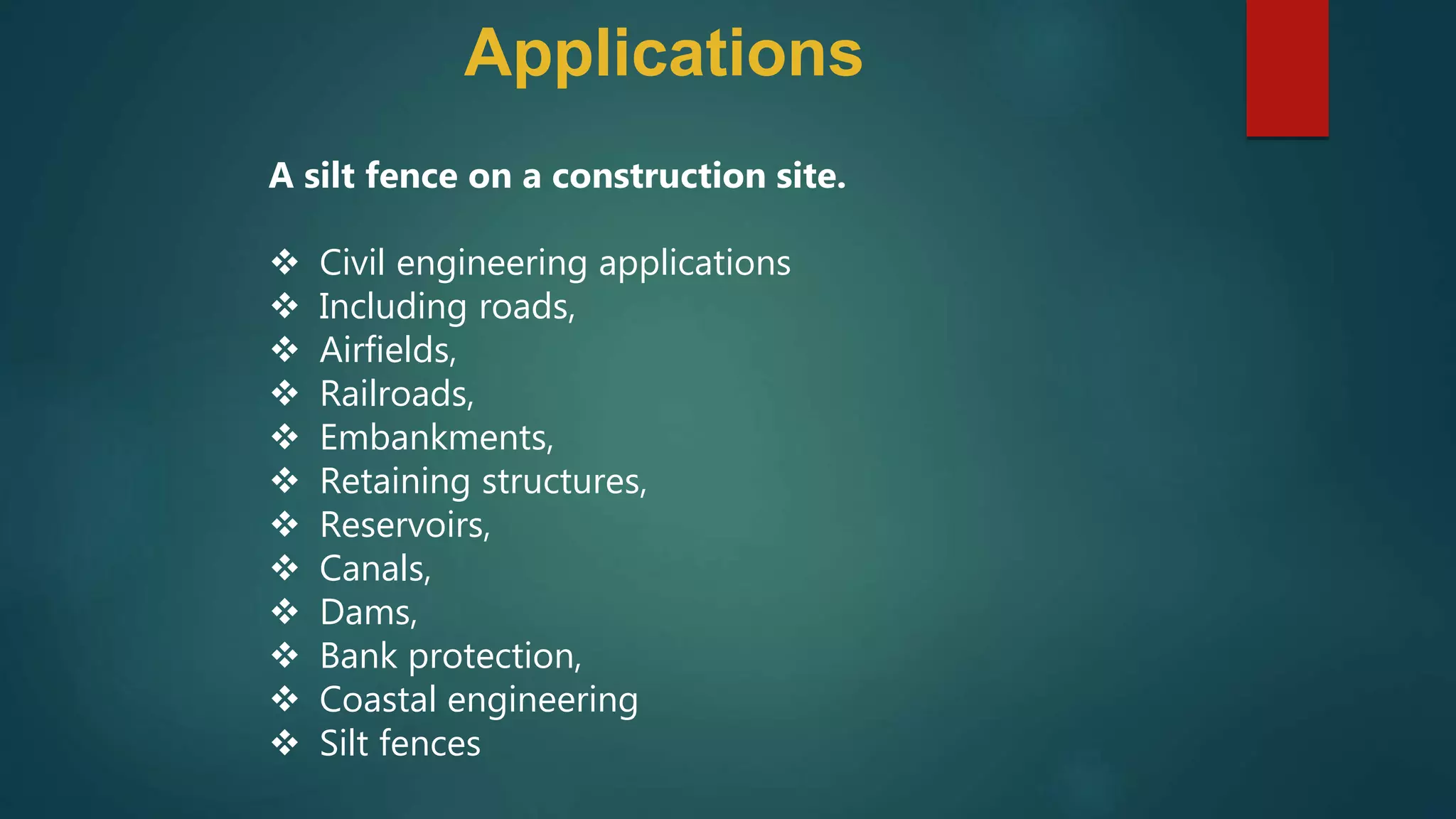
A silt fence on a construction site.
 Civil engineering applications
 Including roads,
 Airfields,
 Railroads,
 Embankments,
 Retaining structures,
 Reservoirs,
 Canals,
 Dams,
 Bank protection,
 Coastal engineering
 Silt fences
Applications
- Serves as a barrier and filtration
- Stabilization of soil
- Consistent
- Cost-effective
- Longevity of structure
Benefits of Geotextile Filter Fabrics:
1. Application in Jamuna River bank administration for
Bangabandhu Bridge.
2. Dhaka - Sylhet Highway:
3. Aricha Highway.
4. All types of land filling.
5. DND Dam (embankment).
6. Gomti Dam (embankment).
7. Tista Barrage.
8. Teknaf Coastal works.
9. Airport.
10.All types of Bridge construction.
Geo-textile in Bangladesh
Prospect of Geo textile in Bangladesh is very much for
following reasons:
1. Lot of scope for application of Geo-textile in
Bangladesh.
2. Production of Geo-textile in Bangladesh.
a. Jute Geo-textile.
b. Synthetic Geo-textile
Prospect in Bangladesh
Geo Textile

Geo Textile

  • 1.
    Presented By: Md. MamunMia ID. 142-23-148
  • 2.
    Geotextiles were originallyintended to be an alternative to granular soil filters. The original, and still sometimes used, term for geotextiles is filter fabrics. Work originally began in the 1950s Geotextiles are generally used for four applications i.e. separation, filtration, drainage & reinforcements. The wide use of geotextiles is under the structure of road due to which life of road increases. Geotextile is also used for preservation of riverbanks, coastal protection, dams, water canals etc. geotextile is also used under the structure of railway tracks as a shock absorber in order to improve the life of railway tracks History
  • 3.
    •Geotech segment comprisesof technical textile products used in Geotechnical applications pertaining to soil, rock, earth etc. •This class of product is loosely called Geotextiles. •However Geotextiles particularly refers to permeable fabric or synthetic material, woven or non-woven, which can be used with geotechnical engineering material. Geotech:
  • 4.
    Used: Geotextiles are permeablefabrics which used in association have the ability to separate, filter, reinforce, protect, or drain. Typically made from polypropylene or polyester. Forms: Woven (resembling mail bag sacking), Needle punched (resembling felt) or heat bonded (resembling ironed felt). Used and Form:
  • 5.
    1 . Mechanicalproperties: a) Tensile strength b) Bursting strength c) Drap ability d) Compatibility e) Flexibility f) Tearing strength g) Frictional resistance h) Tenacity Required Properties of geo-textiles:
  • 6.
    2. Physical properties: a)Specific gravity b) Weight c) Thickness d) Stiffness e) Density 3. Hydraulic properties 4. Degradation properties: 5. Endurance properties: Required Properties of geo-textiles:
  • 7.
    : 1. Separation: Geotextiles willprevent two soil layers of different particle sizes from mixing with each other. 2. Drainage: Geotextiles will efficiently collect superfluous water from structures, such as rainwater or surplus water, from the soil and discharge it. 3. Filtration: Geotextiles are an ideal interface for reverse filtration in the soil adjacent to the geotextile. 4. Reinforcement: Heavy geotextiles can be used to reinforce earth structures by means of fill materials 5. Protection: Geotextiles are an ideal protection from erosion of earth embankments by wave action. 5 main functions of geotextiles
  • 8.
    Raw materials ofgeo-textile
  • 9.
    Classification Geo Textile Woven Geo Textile NonWoven Geo Textile Others woven and non woven combination Knitted Geo Textile  Woven Monofilament  Woven Multifilament  Woven slit film monofilament  Woven slit film multifilament  Non woven continuous filament heat bonded  Non woven continuous filament needle punched  Non woven staple needle punched  Non woven resin bonded
  • 10.
    A silt fenceon a construction site.  Civil engineering applications  Including roads,  Airfields,  Railroads,  Embankments,  Retaining structures,  Reservoirs,  Canals,  Dams,  Bank protection,  Coastal engineering  Silt fences Applications
  • 11.
    - Serves asa barrier and filtration - Stabilization of soil - Consistent - Cost-effective - Longevity of structure Benefits of Geotextile Filter Fabrics:
  • 12.
    1. Application inJamuna River bank administration for Bangabandhu Bridge. 2. Dhaka - Sylhet Highway: 3. Aricha Highway. 4. All types of land filling. 5. DND Dam (embankment). 6. Gomti Dam (embankment). 7. Tista Barrage. 8. Teknaf Coastal works. 9. Airport. 10.All types of Bridge construction. Geo-textile in Bangladesh
  • 13.
    Prospect of Geotextile in Bangladesh is very much for following reasons: 1. Lot of scope for application of Geo-textile in Bangladesh. 2. Production of Geo-textile in Bangladesh. a. Jute Geo-textile. b. Synthetic Geo-textile Prospect in Bangladesh