PRESENTED BY : RAVIKIRAN KATTOLI
 In all countries, the construction industry is rapidly
developing based on the invention of different materials
and products in engineering fields.
 Engineers have attempted various types of materials in
order to make the task more efficient reducing time,
cost, improving durability, quality and performance of
structures during their lifetime.
 Concrete is weak in tension and strong in compression.
 Even though reinforcement is provided in tension zone
microcracks are developed in the tension and
compression zone.
 The propogation of these cracks can be
arrested by using fibre reinforcement in
concrete.
 The fibres are very small which are
distributed over the whole area of concrete.
 Because of this we can not only arrest crack
formation but also we can increase flexural,
shear ,torsion, strength, freezing and thawing
resistance.
 It is a Small piece of reinforcing material
possessing certain characteristic properties.
 It Can be circular or flat.
 Parameter used to describe fiber – “Aspect
ratio”.
 Aspect ratio is ratio of its length to its
diameter.
 Typical aspect ratio for fibers ranges from 30
to 150
 Fiber reinforced concrete (FRC) is concrete
containing fibrous material which increases
its structural integrity.
 It contains short discrete fibers that are
uniformly distributed and randomly
oriented.
 Fibers include steel fibers, glass fibers,
synthetic fibers and natural fibers
 Fibers have been used for concrete reinforcement
since prehistoric times.
 In the early age, straw and mortar were used for
producing mud bricks, and horsehair was used for
their reinforcement.
 As the fiber technology developed, cement was
reinforced by asbestos fibers in the early twentieth
century.
 Later, the use of asbestos for concrete reinforcement
was discouraged due to the detection of health risks.
 New materials like steel, glass, and synthetic fibers
replaced asbestos for reinforcement.
 Active research is still in progress on this important
technology.
2.1 STEEL FIBER REINFORCED CONCRETE
Steel fiber-reinforced concrete is basically cheaper and easier
to use.
Steel fiber-reinforced concrete uses thin steel wires
mixed in with the cement.
 This imparts the concrete with greater structural strength and
reduces cracking
 Steel fiber is often used in conjunction with rebar or one of
the other fiber types.
 Glass fiber-reinforced concrete uses fiberglass
 The glass fiber helps insulate the concrete in addition to
making it stronger.
 Glass fiber also helps prevent the concrete from
cracking over time due to mechanical or thermal stress.
 In addition, the glass fiber does not interfere with radio
signals like the steel fiber reinforcement does.
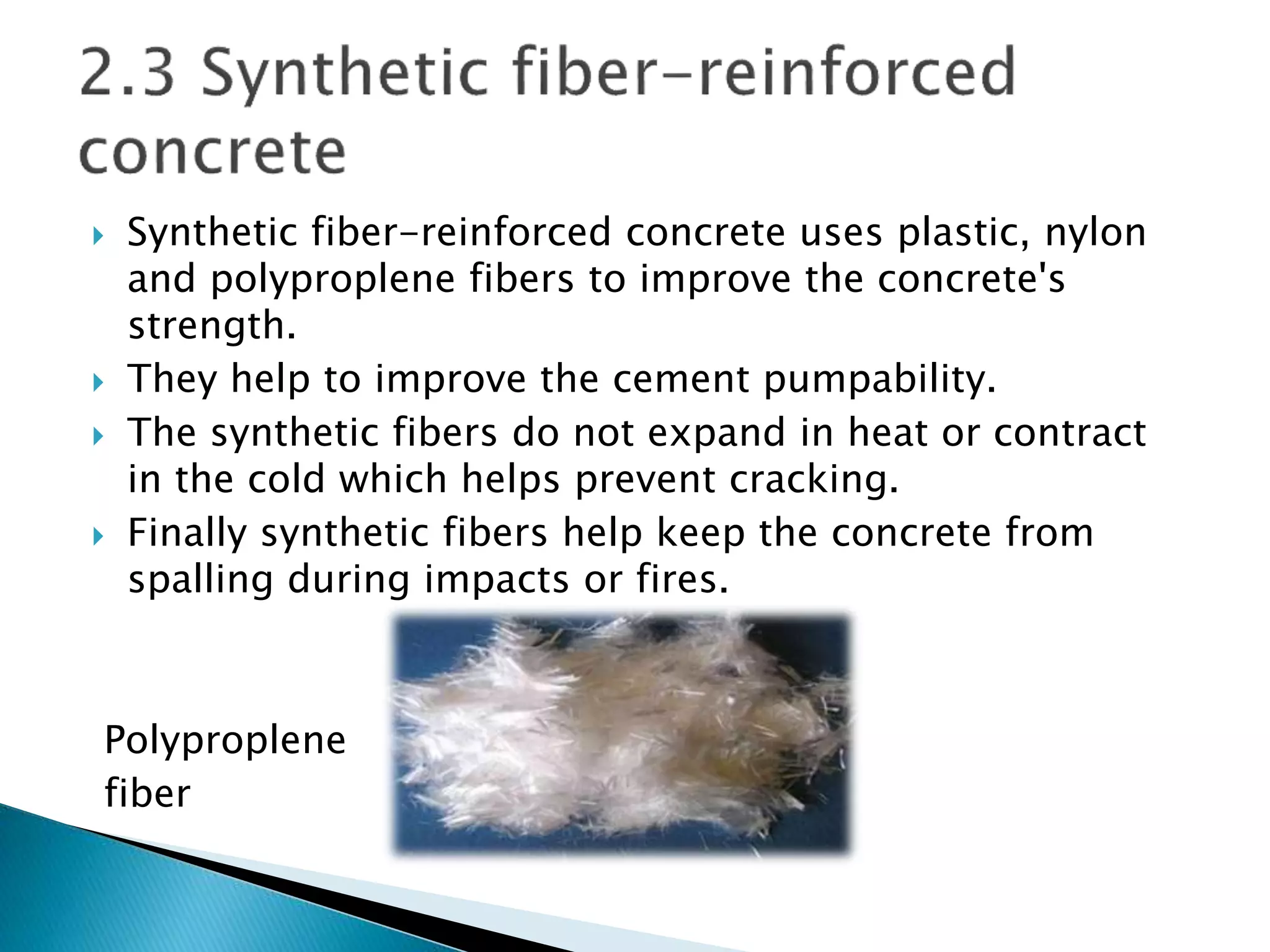
 Synthetic fiber-reinforced concrete uses plastic, nylon
and polyproplene fibers to improve the concrete's
strength.
 They help to improve the cement pumpability.
 The synthetic fibers do not expand in heat or contract
in the cold which helps prevent cracking.
 Finally synthetic fibers help keep the concrete from
spalling during impacts or fires.
Polyproplene
fiber
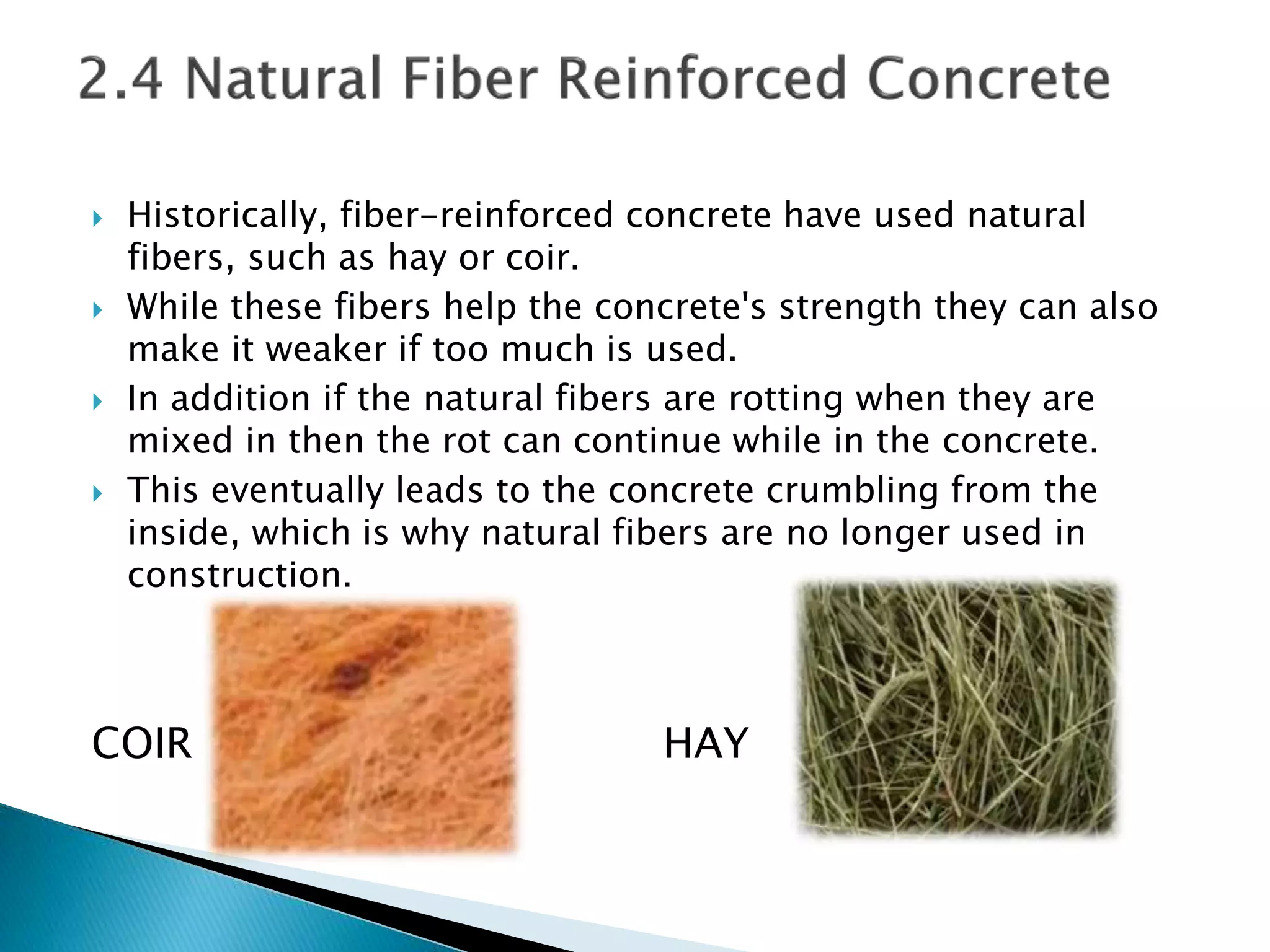
 Historically, fiber-reinforced concrete have used natural
fibers, such as hay or coir.
 While these fibers help the concrete's strength they can also
make it weaker if too much is used.
 In addition if the natural fibers are rotting when they are
mixed in then the rot can continue while in the concrete.
 This eventually leads to the concrete crumbling from the
inside, which is why natural fibers are no longer used in
construction.
COIR HAY
3.1. Volume of fibres:
 low volume fraction (less then 1%):
 Used in slabs and pavement that have large exposed surface
leading to shrinkage cracking
 Moderate volume fraction(between 1 and 2%):
 Used in construction method such as shotcrete
 High volume fraction (greater then 2%):
 Used in making high performance FRC
 Aspect Ratio is the ratio of length of the Fibre
to the diameter of its cross - section.
 Aspect Ratio = Length(L) / Diameter(D)
 Aligned in the direction of load
 Aligned in the direction perpendicular to load
 Randomly distribution of fibers
 Fibre should be significantly stiffer than matrix.
 Low modulus of fibres imparts more energy
absorption while high modulus of fibres imparts
strength and stiffness.
 Low modulus fibres e.g. nylon, polypropylene
 High modulus of elasticity e.g. steel, glass and carbon
fibres.
 Usage of steel fibres , higher aspect ratio and
non-uniform distribution of fibres will reduce
workability
 Prolonged external vibration fails to compact
the concrete
 These properties can be improved by
increasing water/cement ratio or by using
water reducing admixtures
 Restricted to 10mm
 Friction between fibres and between fibres
and aggregates controls orientation and
distribution.
3.7. Mixing:
 Mixing of FRC needs careful precautions to
avoid segregation
 Increase in aspect ratio, volume percentage
and size of coarse aggregate will increase the
difficulties.
 Addition of 4% of fibres report 2.5 times
more increase in flexural strength.
 Presence of 3% of fibres develop 2.5 times
more splitting tensile strength.
 Compressive strength- Improves(0-15 %).
 Toughness is about 20-40 times that of plain
concrete.
 Impact strength is 5 to 10 times of plain
concrete and improves wear and tear.
 Main role of fibres is to bridge the cracks that
develop in concrete and increase the ductility
of concrete elements.
 Improvement on Post-Cracking behaviour of
concrete
 Imparts more resistance to Impact load
 Lowers the permeability of concrete matrix
and thus reduce the bleeding of water
 Increase in specific gravity of the concrete.
This means that the concrete will be heavier
than normal concrete in case of some fibres
 Higher cost because of its control issues
(production issues) as well as the cost of raw
material is high.
 Corrosion of steel fibres
Highway pavements
Hydraulic structures
Precast applications
 More than 400 tones of Shakti man Steel Fibers have been
used recently in the construction of a road overlay for a project
at Mathura (UP).
 The efficient utilisation of fibrous concrete involves
improved static and dynamic properties like tensile
strength, energy absorbing characteristics, Impact
strength and fatigue strength.
 The efficient utilisation of fibrous concrete involves
improved static and dynamic properties like tensile
strength, energy absorbing characteristics, Impact
strength and fatigue strength.
 At elevated temperature, SFRC have more strength
both in compression and tension.
 Properties of Concrete- Nevilla.
 Concrete Technology- MsShetty.
 ‘Fibre Reinforced Concrete’-N. Banthia
 ‘Synthetic Fibre Reinforcement for Concrete’- D.
Ludirdja, J.F. Young, 1993.
 ‘Synthetic Fibres- Anne Laning, 1992.
 ‘Glass Fibre reinforced Concrete (GFRC)’ - By
Wallace Neal, 1978.
 ‘Tensile behavior of Glass Fibre reinforced
Concrete’- J.A.O.Barros, J.A.Figueiras, C.V.D.Veen

Fibre reinforced concrete

  • 1.
    PRESENTED BY :RAVIKIRAN KATTOLI
  • 2.
     In allcountries, the construction industry is rapidly developing based on the invention of different materials and products in engineering fields.  Engineers have attempted various types of materials in order to make the task more efficient reducing time, cost, improving durability, quality and performance of structures during their lifetime.  Concrete is weak in tension and strong in compression.  Even though reinforcement is provided in tension zone microcracks are developed in the tension and compression zone.
  • 3.
     The propogationof these cracks can be arrested by using fibre reinforcement in concrete.  The fibres are very small which are distributed over the whole area of concrete.  Because of this we can not only arrest crack formation but also we can increase flexural, shear ,torsion, strength, freezing and thawing resistance.
  • 4.
     It isa Small piece of reinforcing material possessing certain characteristic properties.  It Can be circular or flat.  Parameter used to describe fiber – “Aspect ratio”.  Aspect ratio is ratio of its length to its diameter.  Typical aspect ratio for fibers ranges from 30 to 150
  • 5.
     Fiber reinforcedconcrete (FRC) is concrete containing fibrous material which increases its structural integrity.  It contains short discrete fibers that are uniformly distributed and randomly oriented.  Fibers include steel fibers, glass fibers, synthetic fibers and natural fibers
  • 6.
     Fibers havebeen used for concrete reinforcement since prehistoric times.  In the early age, straw and mortar were used for producing mud bricks, and horsehair was used for their reinforcement.  As the fiber technology developed, cement was reinforced by asbestos fibers in the early twentieth century.  Later, the use of asbestos for concrete reinforcement was discouraged due to the detection of health risks.  New materials like steel, glass, and synthetic fibers replaced asbestos for reinforcement.  Active research is still in progress on this important technology.
  • 7.
    2.1 STEEL FIBERREINFORCED CONCRETE Steel fiber-reinforced concrete is basically cheaper and easier to use. Steel fiber-reinforced concrete uses thin steel wires mixed in with the cement.
  • 8.
     This impartsthe concrete with greater structural strength and reduces cracking  Steel fiber is often used in conjunction with rebar or one of the other fiber types.
  • 9.
     Glass fiber-reinforcedconcrete uses fiberglass  The glass fiber helps insulate the concrete in addition to making it stronger.  Glass fiber also helps prevent the concrete from cracking over time due to mechanical or thermal stress.  In addition, the glass fiber does not interfere with radio signals like the steel fiber reinforcement does.
  • 10.
     Synthetic fiber-reinforcedconcrete uses plastic, nylon and polyproplene fibers to improve the concrete's strength.  They help to improve the cement pumpability.  The synthetic fibers do not expand in heat or contract in the cold which helps prevent cracking.  Finally synthetic fibers help keep the concrete from spalling during impacts or fires. Polyproplene fiber
  • 11.
     Historically, fiber-reinforcedconcrete have used natural fibers, such as hay or coir.  While these fibers help the concrete's strength they can also make it weaker if too much is used.  In addition if the natural fibers are rotting when they are mixed in then the rot can continue while in the concrete.  This eventually leads to the concrete crumbling from the inside, which is why natural fibers are no longer used in construction. COIR HAY
  • 12.
    3.1. Volume offibres:  low volume fraction (less then 1%):  Used in slabs and pavement that have large exposed surface leading to shrinkage cracking  Moderate volume fraction(between 1 and 2%):  Used in construction method such as shotcrete  High volume fraction (greater then 2%):  Used in making high performance FRC
  • 13.
     Aspect Ratiois the ratio of length of the Fibre to the diameter of its cross - section.  Aspect Ratio = Length(L) / Diameter(D)
  • 14.
     Aligned inthe direction of load  Aligned in the direction perpendicular to load  Randomly distribution of fibers
  • 15.
     Fibre shouldbe significantly stiffer than matrix.  Low modulus of fibres imparts more energy absorption while high modulus of fibres imparts strength and stiffness.  Low modulus fibres e.g. nylon, polypropylene  High modulus of elasticity e.g. steel, glass and carbon fibres.
  • 16.
     Usage ofsteel fibres , higher aspect ratio and non-uniform distribution of fibres will reduce workability  Prolonged external vibration fails to compact the concrete  These properties can be improved by increasing water/cement ratio or by using water reducing admixtures
  • 17.
     Restricted to10mm  Friction between fibres and between fibres and aggregates controls orientation and distribution. 3.7. Mixing:  Mixing of FRC needs careful precautions to avoid segregation  Increase in aspect ratio, volume percentage and size of coarse aggregate will increase the difficulties.
  • 18.
     Addition of4% of fibres report 2.5 times more increase in flexural strength.  Presence of 3% of fibres develop 2.5 times more splitting tensile strength.  Compressive strength- Improves(0-15 %).  Toughness is about 20-40 times that of plain concrete.  Impact strength is 5 to 10 times of plain concrete and improves wear and tear.
  • 19.
     Main roleof fibres is to bridge the cracks that develop in concrete and increase the ductility of concrete elements.  Improvement on Post-Cracking behaviour of concrete  Imparts more resistance to Impact load  Lowers the permeability of concrete matrix and thus reduce the bleeding of water
  • 20.
     Increase inspecific gravity of the concrete. This means that the concrete will be heavier than normal concrete in case of some fibres  Higher cost because of its control issues (production issues) as well as the cost of raw material is high.  Corrosion of steel fibres
  • 22.
  • 23.
  • 24.
  • 25.
     More than400 tones of Shakti man Steel Fibers have been used recently in the construction of a road overlay for a project at Mathura (UP).
  • 26.
     The efficientutilisation of fibrous concrete involves improved static and dynamic properties like tensile strength, energy absorbing characteristics, Impact strength and fatigue strength.  The efficient utilisation of fibrous concrete involves improved static and dynamic properties like tensile strength, energy absorbing characteristics, Impact strength and fatigue strength.  At elevated temperature, SFRC have more strength both in compression and tension.
  • 27.
     Properties ofConcrete- Nevilla.  Concrete Technology- MsShetty.  ‘Fibre Reinforced Concrete’-N. Banthia  ‘Synthetic Fibre Reinforcement for Concrete’- D. Ludirdja, J.F. Young, 1993.  ‘Synthetic Fibres- Anne Laning, 1992.  ‘Glass Fibre reinforced Concrete (GFRC)’ - By Wallace Neal, 1978.  ‘Tensile behavior of Glass Fibre reinforced Concrete’- J.A.O.Barros, J.A.Figueiras, C.V.D.Veen