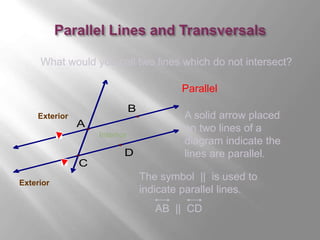
What would you call two lines which do not intersect? 
A 
B 
D 
C 
Parallel 
A solid arrow placed 
on two lines of a 
diagram indicate the 
lines are parallel. 
The symbol || is used to 
indicate parallel lines. 
AB || CD 
Interior 
Exterior 
Exterior
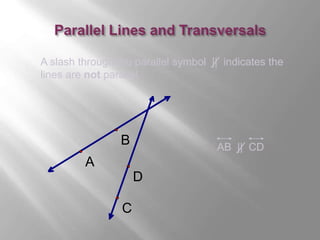
A slash through the parallel symbol || indicates the 
lines are not parallel. 
A 
D 
B 
C 
AB || CD
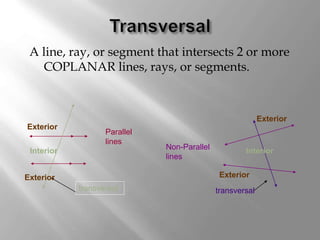
A line, ray, or segment that intersects 2 or more 
COPLANAR lines, rays, or segments. 
Parallel 
lines 
transversal 
Non-Parallel 
lines 
transversal 
Exterior 
Interior 
Exterior 
Interior 
Exterior 
Exterior
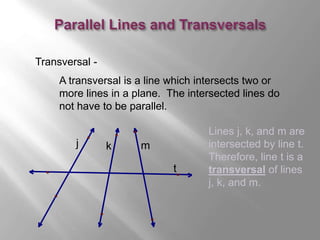
A transversal is a line which intersects two or 
more lines in a plane. The intersected lines do 
not have to be parallel. 
t 
Transversal - 
j k m 
Lines j, k, and m are 
intersected by line t. 
Therefore, line t is a 
transversal of lines 
j, k, and m.
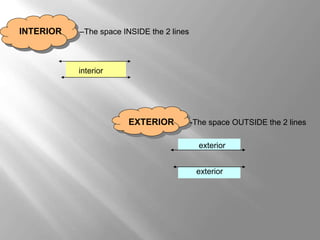
INTERIOR –The space INSIDE the 2 lines 
interior 
EXTERIOR -The space OUTSIDE the 2 lines 
exterior 
exterior
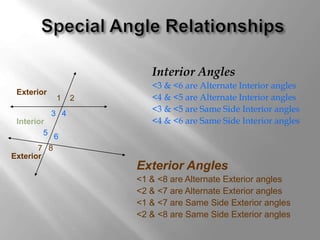
Interior Angles 
<3 & <6 are Alternate Interior angles 
<4 & <5 are Alternate Interior angles 
<3 & <5 are Same Side Interior angles 
<4 & <6 are Same Side Interior angles 
1 
4 
2 
3 
6 
Exterior 
5 
7 8 
Exterior Angles 
<1 & <8 are Alternate Exterior angles 
<2 & <7 are Alternate Exterior angles 
<1 & <7 are Same Side Exterior angles 
<2 & <8 are Same Side Exterior angles 
Interior 
Exterior
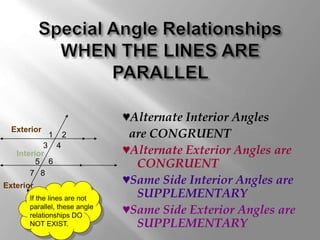
♥Alternate Interior Angles 
are CONGRUENT 
♥Alternate Exterior Angles are 
CONGRUENT 
♥Same Side Interior Angles are 
SUPPLEMENTARY 
♥Same Side Exterior Angles are 
SUPPLEMENTARY 
1 
4 
2 
3 
Exterior 
Interior 
5 6 
7 8 
Exterior 
If the lines are not 
parallel, these angle 
relationships DO 
NOT EXIST.
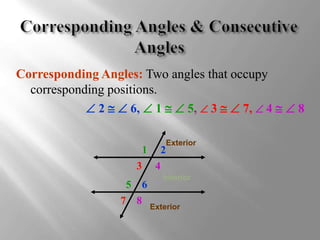
Corresponding Angles: Two angles that occupy 
corresponding positions. 
 2   6,  1   5,  3   7,  4   8 
Exterior 
1 2 
3 4 
5 6 
7 8 
Interior 
Exterior
Corresponding Angles 
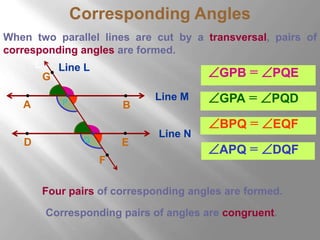
When two parallel lines are cut by a transversal, pairs of 
corresponding angles are formed. 
GPB = PQE 
GPA = PQD 
BPQ = EQF 
APQ = DQF 
Line M 
A B 
Line N 
D E 
Four pairs of corresponding angles are formed. 
Corresponding pairs of angles are congruent. 
L 
P 
Q 
G 
F 
Line L
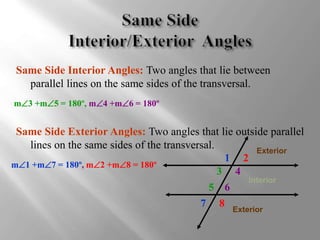
Same Side Interior Angles: Two angles that lie between 
parallel lines on the same sides of the transversal. 
m3 +m5 = 180º, m4 +m6 = 180º 
Same Side Exterior Angles: Two angles that lie outside parallel 
lines on the same sides of the transversal. 
m1 +m7 = 180º, m2 +m8 = 180º 
1 2 
3 4 
5 6 
7 8 
Exterior 
Interior 
Exterior
Interior Angles 
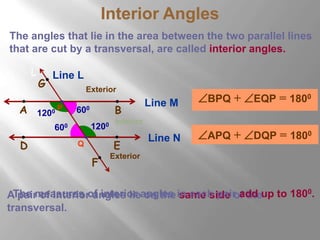
The angles that lie in the area between the two parallel lines 
that are cut by a transversal, are called interior angles. 
Line M 
L 
Line L 
P 
G 
Exterior 
A B 
Line N 
600 
1200 600 
Q 
1200 
Interior 
D E 
F 
BPQ + EQP = 1800 
APQ + DQP = 1800 
Exterior 
The measures of interior angles in each pair add up to 1800. 
A pair of interior angles lie on the same side of the 
transversal.
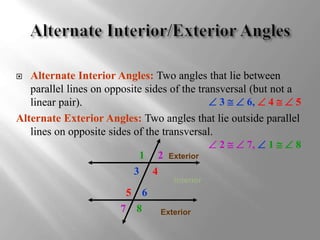
 Alternate Interior Angles: Two angles that lie between 
parallel lines on opposite sides of the transversal (but not a 
linear pair). 
 3   6,  4   5 
Alternate Exterior Angles: Two angles that lie outside parallel 
lines on opposite sides of the transversal. 
 2   7,  1   8 
1 2 
3 4 
5 6 
7 8 
Exterior 
Interior 
Exterior
Alternate Interior Angles 
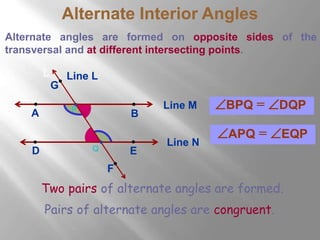
Alternate angles are formed on opposite sides of the 
transversal and at different intersecting points. 
Line M 
L 
P 
G 
A B 
Line N 
Q 
D E 
F 
Line L 
BPQ = DQP 
APQ = EQP 
Two pairs of alternate angles are formed. 
Pairs of alternate angles are congruent.
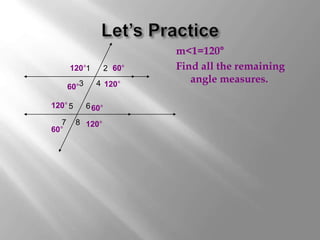
m<1=120° 
Find all the remaining 
angle measures. 
1 
4 
2 
3 
5 6 
7 8 
60° 
60° 
60° 
60° 
120° 
120° 
120° 
120°
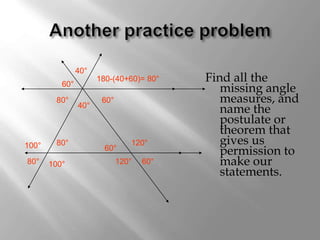
Find all the 
missing angle 
measures, and 
name the 
postulate or 
theorem that 
gives us 
permission to 
make our 
statements. 
40° 
120° 
60° 
120° 
60° 
40° 
60° 
60° 
180-(40+60)= 80° 
80° 
80° 
100° 
80° 
100°
All rights belong to their respective owners. 
Copyright Disclaimer Under Section 107 of the Copyright Act 1976, allowance is 
made for "fair use" for purposes such as criticism, comment, news reporting, 
TEACHING, scholarship, and research. 
Fair use is a use permitted by copyright statute that might otherwise be infringing. 
Non-profit, EDUCATIONAL or personal use tips the balance in favor of fair use.

Geometry unit 3.1.3.3

  • 2.
    What would youcall two lines which do not intersect? A B D C Parallel A solid arrow placed on two lines of a diagram indicate the lines are parallel. The symbol || is used to indicate parallel lines. AB || CD Interior Exterior Exterior
  • 3.
    A slash throughthe parallel symbol || indicates the lines are not parallel. A D B C AB || CD
  • 4.
    A line, ray,or segment that intersects 2 or more COPLANAR lines, rays, or segments. Parallel lines transversal Non-Parallel lines transversal Exterior Interior Exterior Interior Exterior Exterior
  • 5.
    A transversal isa line which intersects two or more lines in a plane. The intersected lines do not have to be parallel. t Transversal - j k m Lines j, k, and m are intersected by line t. Therefore, line t is a transversal of lines j, k, and m.
  • 6.
    INTERIOR –The spaceINSIDE the 2 lines interior EXTERIOR -The space OUTSIDE the 2 lines exterior exterior
  • 7.
    Interior Angles <3& <6 are Alternate Interior angles <4 & <5 are Alternate Interior angles <3 & <5 are Same Side Interior angles <4 & <6 are Same Side Interior angles 1 4 2 3 6 Exterior 5 7 8 Exterior Angles <1 & <8 are Alternate Exterior angles <2 & <7 are Alternate Exterior angles <1 & <7 are Same Side Exterior angles <2 & <8 are Same Side Exterior angles Interior Exterior
  • 8.
    ♥Alternate Interior Angles are CONGRUENT ♥Alternate Exterior Angles are CONGRUENT ♥Same Side Interior Angles are SUPPLEMENTARY ♥Same Side Exterior Angles are SUPPLEMENTARY 1 4 2 3 Exterior Interior 5 6 7 8 Exterior If the lines are not parallel, these angle relationships DO NOT EXIST.
  • 9.
    Corresponding Angles: Twoangles that occupy corresponding positions.  2   6,  1   5,  3   7,  4   8 Exterior 1 2 3 4 5 6 7 8 Interior Exterior
  • 10.
    Corresponding Angles Whentwo parallel lines are cut by a transversal, pairs of corresponding angles are formed. GPB = PQE GPA = PQD BPQ = EQF APQ = DQF Line M A B Line N D E Four pairs of corresponding angles are formed. Corresponding pairs of angles are congruent. L P Q G F Line L
  • 11.
    Same Side InteriorAngles: Two angles that lie between parallel lines on the same sides of the transversal. m3 +m5 = 180º, m4 +m6 = 180º Same Side Exterior Angles: Two angles that lie outside parallel lines on the same sides of the transversal. m1 +m7 = 180º, m2 +m8 = 180º 1 2 3 4 5 6 7 8 Exterior Interior Exterior
  • 12.
    Interior Angles Theangles that lie in the area between the two parallel lines that are cut by a transversal, are called interior angles. Line M L Line L P G Exterior A B Line N 600 1200 600 Q 1200 Interior D E F BPQ + EQP = 1800 APQ + DQP = 1800 Exterior The measures of interior angles in each pair add up to 1800. A pair of interior angles lie on the same side of the transversal.
  • 13.
     Alternate InteriorAngles: Two angles that lie between parallel lines on opposite sides of the transversal (but not a linear pair).  3   6,  4   5 Alternate Exterior Angles: Two angles that lie outside parallel lines on opposite sides of the transversal.  2   7,  1   8 1 2 3 4 5 6 7 8 Exterior Interior Exterior
  • 14.
    Alternate Interior Angles Alternate angles are formed on opposite sides of the transversal and at different intersecting points. Line M L P G A B Line N Q D E F Line L BPQ = DQP APQ = EQP Two pairs of alternate angles are formed. Pairs of alternate angles are congruent.
  • 15.
    m<1=120° Find allthe remaining angle measures. 1 4 2 3 5 6 7 8 60° 60° 60° 60° 120° 120° 120° 120°
  • 16.
    Find all the missing angle measures, and name the postulate or theorem that gives us permission to make our statements. 40° 120° 60° 120° 60° 40° 60° 60° 180-(40+60)= 80° 80° 80° 100° 80° 100°
  • 17.
    All rights belongto their respective owners. Copyright Disclaimer Under Section 107 of the Copyright Act 1976, allowance is made for "fair use" for purposes such as criticism, comment, news reporting, TEACHING, scholarship, and research. Fair use is a use permitted by copyright statute that might otherwise be infringing. Non-profit, EDUCATIONAL or personal use tips the balance in favor of fair use.