
Geometry in My World


      By Megan T


                       1
Isosceles Right
   Triangle
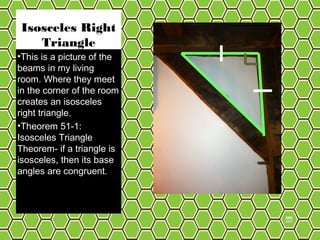
•This is a picture of the
beams in my living
room. Where they meet
in the corner of the room
creates an isosceles
right triangle.
•Theorem 51-1:
Isosceles Triangle
Theorem- if a triangle is
isosceles, then its base
angles are congruent.


                            2
Line of
    Symmetry
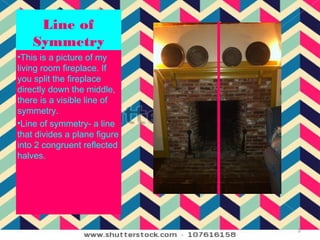
•This is a picture of my
living room fireplace. If
you split the fireplace
directly down the middle,
there is a visible line of
symmetry.
•Line of symmetry- a line
that divides a plane figure
into 2 congruent reflected
halves.


                              3
Rectangular
   Prism
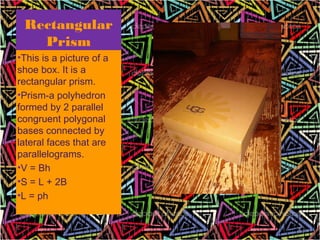
•This is a picture of a
shoe box. It is a
rectangular prism.
•Prism-a polyhedron
formed by 2 parallel
congruent polygonal
bases connected by
lateral faces that are
parallelograms.
•V = Bh
•S = L + 2B
•L = ph


                          4
Parallel Lines
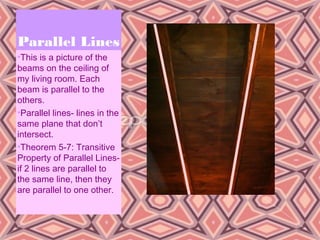
•This is a picture of the
beams on the ceiling of
my living room. Each
beam is parallel to the
others.
•Parallel lines- lines in the
same plane that don’t
intersect.
•Theorem 5-7: Transitive
Property of Parallel Lines-
if 2 lines are parallel to
the same line, then they
are parallel to one other.


                                5
Cylinder
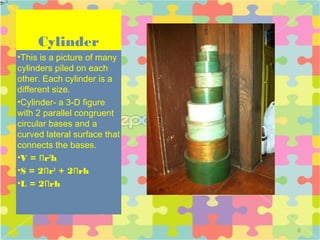
•This is a picture of many
cylinders piled on each
other. Each cylinder is a
different size.
•Cylinder- a 3-D figure
with 2 parallel congruent
circular bases and a
curved lateral surface that
connects the bases.
•V = Πr2h
•S = 2Πr2 + 2Πrh
•L = 2Πrh


                              6
Vertical
      Angles
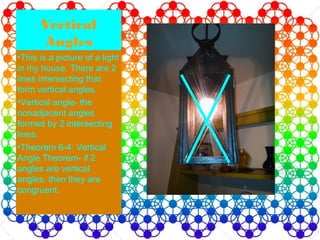
•This is a picture of a light
in my house. There are 2
lines intersecting that
form vertical angles.
•Vertical angle- the
nonadjacent angles
formed by 2 intersecting
lines.
•Theorem 6-4: Vertical
Angle Theorem- if 2
angles are vertical
angles, then they are
congruent.


                                7
Supplementry
   Angles
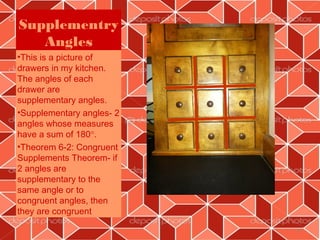
•This is a picture of
drawers in my kitchen.
The angles of each
drawer are
supplementary angles.
•Supplementary angles- 2
angles whose measures
have a sum of 180°.
•Theorem 6-2: Congruent
Supplements Theorem- if
2 angles are
supplementary to the
same angle or to
congruent angles, then
they are congruent

                           8
Sphere
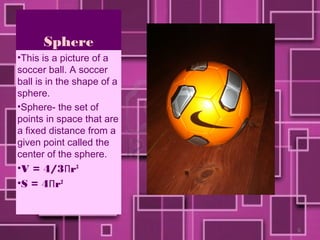
•This is a picture of a
soccer ball. A soccer
ball is in the shape of a
sphere.
•Sphere- the set of
points in space that are
a fixed distance from a
given point called the
center of the sphere.
•V = 4/3Πr3
•S = 4Πr2


                            9
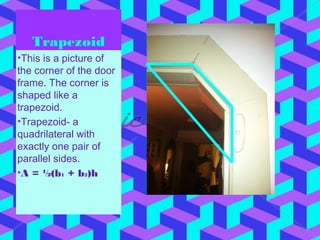
Trapezoid
•This is a picture of
the corner of the door
frame. The corner is
shaped like a
trapezoid.
•Trapezoid- a
quadrilateral with
exactly one pair of
parallel sides.
•A = ½(b1 + b2)h


                         10
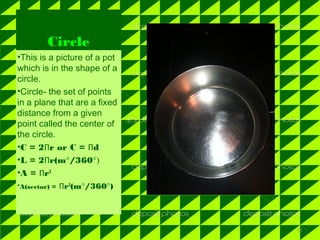
Circle
•This is a picture of a pot
which is in the shape of a
circle.
•Circle- the set of points
in a plane that are a fixed
distance from a given
point called the center of
the circle.
•C = 2Πr or C = Πd
•L = 2Πr(m°/360°)
•A = Πr2
•A(sector) = Πr2(m°/360°)


                              11
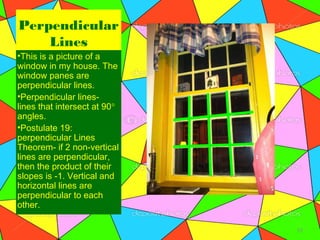
Perpendicular
    Lines
•This is a picture of a
window in my house. The
window panes are
perpendicular lines.
•Perpendicular lines-
lines that intersect at 90°
angles.
•Postulate 19:
perpendicular Lines
Theorem- if 2 non-vertical
lines are perpendicular,
then the product of their
slopes is -1. Vertical and
horizontal lines are
perpendicular to each
other.

                              12
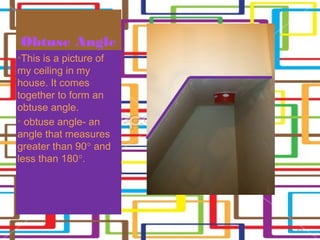
Obtuse Angle
•This is a picture of
my ceiling in my
house. It comes
together to form an
obtuse angle.
• obtuse angle- an
angle that measures
greater than 90° and
less than 180°.


                        13
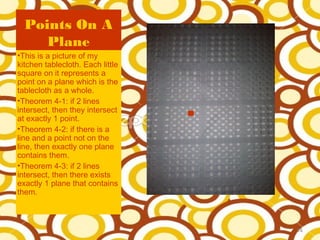
Points On A
     Plane
•This is a picture of my
kitchen tablecloth. Each little
square on it represents a
point on a plane which is the
tablecloth as a whole.
•Theorem 4-1: if 2 lines
intersect, then they intersect
at exactly 1 point.
•Theorem 4-2: if there is a
line and a point not on the
line, then exactly one plane
contains them.
•Theorem 4-3: if 2 lines
intersect, then there exists
exactly 1 plane that contains
them.


                                  14
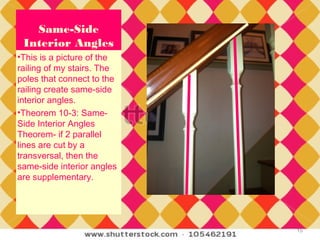
Same-Side
 Interior Angles
•This is a picture of the
railing of my stairs. The
poles that connect to the
railing create same-side
interior angles.
•Theorem 10-3: Same-
Side Interior Angles
Theorem- if 2 parallel
lines are cut by a
transversal, then the
same-side interior angles
are supplementary.


                            15
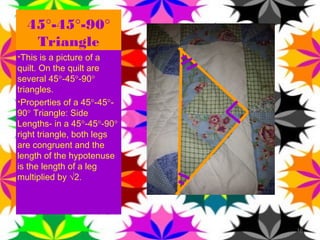
45°-45°-90°
   Triangle
•This is a picture of a
quilt. On the quilt are
several 45°-45°-90°
triangles.
•Properties of a 45°-45°-
90° Triangle: Side
Lengths- in a 45°-45°-90°
right triangle, both legs
are congruent and the
length of the hypotenuse
is the length of a leg
multiplied by √2.


                            16
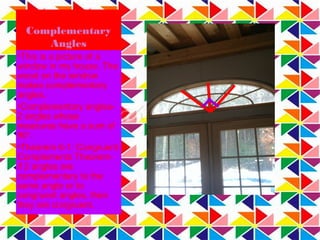
Complementary
     Angles
•This is a picture of a
window in my house. The
wood on the window
makes complementary
angles.
•Complementary angles-
2 angles whose
measures have a sum of
90°.
•Theorem 6-1: Congruent
Complements Theorem-
if 2 angles are
complementary to the
same angle or to
congruent angles, then
they are congruent.

                          17
Concave
     Polygon
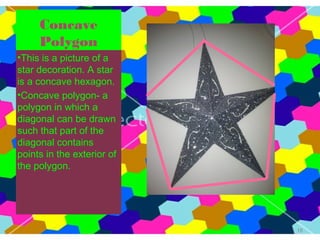
•This is a picture of a
star decoration. A star
is a concave hexagon.
•Concave polygon- a
polygon in which a
diagonal can be drawn
such that part of the
diagonal contains
points in the exterior of
the polygon.


                            18
30°-60°-90°
   Triangle
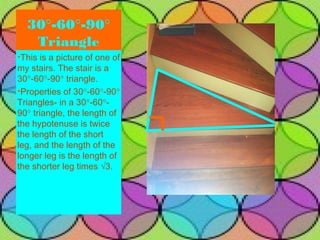
•This is a picture of one of
my stairs. The stair is a
30°-60°-90° triangle.
•Properties of 30°-60°-90°
Triangles- in a 30°-60°-
90° triangle, the length of
the hypotenuse is twice
the length of the short
leg, and the length of the
longer leg is the length of
the shorter leg times √3.


                               19
Skew Lines
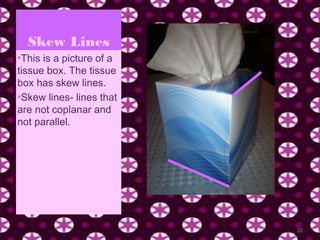
•This is a picture of a
tissue box. The tissue
box has skew lines.
•Skew lines- lines that
are not coplanar and
not parallel.


                          20
Cone
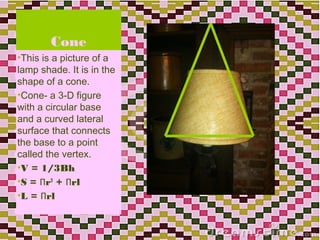
•This is a picture of a
lamp shade. It is in the
shape of a cone.
•Cone- a 3-D figure
with a circular base
and a curved lateral
surface that connects
the base to a point
called the vertex.
•V = 1/3Bh
•S = Πr2 + Πrl
•L = Πrl


                           21

Geometry in My World (MT)

  • 1.
    Geometry in MyWorld By Megan T 1
  • 2.
    Isosceles Right Triangle •This is a picture of the beams in my living room. Where they meet in the corner of the room creates an isosceles right triangle. •Theorem 51-1: Isosceles Triangle Theorem- if a triangle is isosceles, then its base angles are congruent. 2
  • 3.
    Line of Symmetry •This is a picture of my living room fireplace. If you split the fireplace directly down the middle, there is a visible line of symmetry. •Line of symmetry- a line that divides a plane figure into 2 congruent reflected halves. 3
  • 4.
    Rectangular Prism •This is a picture of a shoe box. It is a rectangular prism. •Prism-a polyhedron formed by 2 parallel congruent polygonal bases connected by lateral faces that are parallelograms. •V = Bh •S = L + 2B •L = ph 4
  • 5.
    Parallel Lines •This isa picture of the beams on the ceiling of my living room. Each beam is parallel to the others. •Parallel lines- lines in the same plane that don’t intersect. •Theorem 5-7: Transitive Property of Parallel Lines- if 2 lines are parallel to the same line, then they are parallel to one other. 5
  • 6.
    Cylinder •This is apicture of many cylinders piled on each other. Each cylinder is a different size. •Cylinder- a 3-D figure with 2 parallel congruent circular bases and a curved lateral surface that connects the bases. •V = Πr2h •S = 2Πr2 + 2Πrh •L = 2Πrh 6
  • 7.
    Vertical Angles •This is a picture of a light in my house. There are 2 lines intersecting that form vertical angles. •Vertical angle- the nonadjacent angles formed by 2 intersecting lines. •Theorem 6-4: Vertical Angle Theorem- if 2 angles are vertical angles, then they are congruent. 7
  • 8.
    Supplementry Angles •This is a picture of drawers in my kitchen. The angles of each drawer are supplementary angles. •Supplementary angles- 2 angles whose measures have a sum of 180°. •Theorem 6-2: Congruent Supplements Theorem- if 2 angles are supplementary to the same angle or to congruent angles, then they are congruent 8
  • 9.
    Sphere •This is apicture of a soccer ball. A soccer ball is in the shape of a sphere. •Sphere- the set of points in space that are a fixed distance from a given point called the center of the sphere. •V = 4/3Πr3 •S = 4Πr2 9
  • 10.
    Trapezoid •This is apicture of the corner of the door frame. The corner is shaped like a trapezoid. •Trapezoid- a quadrilateral with exactly one pair of parallel sides. •A = ½(b1 + b2)h 10
  • 11.
    Circle •This is apicture of a pot which is in the shape of a circle. •Circle- the set of points in a plane that are a fixed distance from a given point called the center of the circle. •C = 2Πr or C = Πd •L = 2Πr(m°/360°) •A = Πr2 •A(sector) = Πr2(m°/360°) 11
  • 12.
    Perpendicular Lines •This is a picture of a window in my house. The window panes are perpendicular lines. •Perpendicular lines- lines that intersect at 90° angles. •Postulate 19: perpendicular Lines Theorem- if 2 non-vertical lines are perpendicular, then the product of their slopes is -1. Vertical and horizontal lines are perpendicular to each other. 12
  • 13.
    Obtuse Angle •This isa picture of my ceiling in my house. It comes together to form an obtuse angle. • obtuse angle- an angle that measures greater than 90° and less than 180°. 13
  • 14.
    Points On A Plane •This is a picture of my kitchen tablecloth. Each little square on it represents a point on a plane which is the tablecloth as a whole. •Theorem 4-1: if 2 lines intersect, then they intersect at exactly 1 point. •Theorem 4-2: if there is a line and a point not on the line, then exactly one plane contains them. •Theorem 4-3: if 2 lines intersect, then there exists exactly 1 plane that contains them. 14
  • 15.
    Same-Side Interior Angles •Thisis a picture of the railing of my stairs. The poles that connect to the railing create same-side interior angles. •Theorem 10-3: Same- Side Interior Angles Theorem- if 2 parallel lines are cut by a transversal, then the same-side interior angles are supplementary. 15
  • 16.
    45°-45°-90° Triangle •This is a picture of a quilt. On the quilt are several 45°-45°-90° triangles. •Properties of a 45°-45°- 90° Triangle: Side Lengths- in a 45°-45°-90° right triangle, both legs are congruent and the length of the hypotenuse is the length of a leg multiplied by √2. 16
  • 17.
    Complementary Angles •This is a picture of a window in my house. The wood on the window makes complementary angles. •Complementary angles- 2 angles whose measures have a sum of 90°. •Theorem 6-1: Congruent Complements Theorem- if 2 angles are complementary to the same angle or to congruent angles, then they are congruent. 17
  • 18.
    Concave Polygon •This is a picture of a star decoration. A star is a concave hexagon. •Concave polygon- a polygon in which a diagonal can be drawn such that part of the diagonal contains points in the exterior of the polygon. 18
  • 19.
    30°-60°-90° Triangle •This is a picture of one of my stairs. The stair is a 30°-60°-90° triangle. •Properties of 30°-60°-90° Triangles- in a 30°-60°- 90° triangle, the length of the hypotenuse is twice the length of the short leg, and the length of the longer leg is the length of the shorter leg times √3. 19
  • 20.
    Skew Lines •This isa picture of a tissue box. The tissue box has skew lines. •Skew lines- lines that are not coplanar and not parallel. 20
  • 21.
    Cone •This is apicture of a lamp shade. It is in the shape of a cone. •Cone- a 3-D figure with a circular base and a curved lateral surface that connects the base to a point called the vertex. •V = 1/3Bh •S = Πr2 + Πrl •L = Πrl 21