Activity
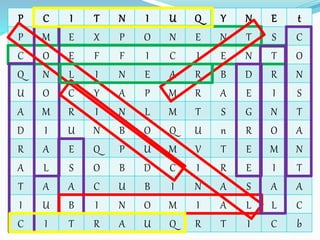
Word Hunt
Math 7
P C I T N I U Q Y N E t
P M E X P O N E N T S C
C O E F F I C I E N T O
Q N L I N E A R B D R N
U O C Y A P M R A E I S
A M R I N L M T S G N T
D I U N B O Q U n R O A
R A E Q P U M V T E M N
A L S O B D C I R E I T
T A A C U B I N A S A A
I U B I N O M I A L L C
C I T R A U Q R T I C b
DEFINITION OF TERMS:
Term
Term is a constant, a variable or a
product of constant and variable.
EXAMPLE: 3x2, 3 is called the numeral coefficient
and x2 is called the literal coefficient. In the term
– x has the numerical coefficient which is – 1 and a
literal coefficient which is x.
Numerical coefficient is the constant/number.
Literal coefficient is the variable including its
exponent.
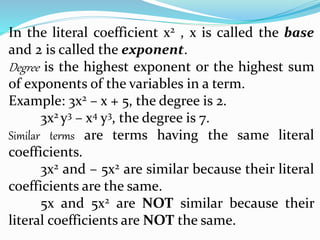
In the literal coefficient x2 , x is called the base
and 2 is called the exponent.
Degree is the highest exponent or the highest sum
of exponents of the variables in a term.
Example: 3x2 – x + 5, the degree is 2.
3x2 y3 – x4 y3, the degree is 7.
Similar terms are terms having the same literal
coefficients.
3x2 and – 5x2 are similar because their literal
coefficients are the same.
5x and 5x2 are NOT similar because their
literal coefficients are NOT the same.
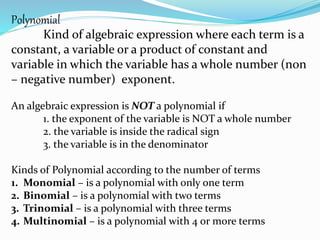
Polynomial
Kind of algebraic expression where each term is a
constant, a variable or a product of constant and
variable in which the variable has a whole number (non
– negative number) exponent.
An algebraic expression is NOT a polynomial if
1. the exponent of the variable is NOT a whole number
2. the variable is inside the radical sign
3. the variable is in the denominator
Kinds of Polynomial according to the number of terms
1. Monomial – is a polynomial with only one term
2. Binomial – is a polynomial with two terms
3. Trinomial – is a polynomial with three terms
4. Multinomial – is a polynomial with 4 or more terms
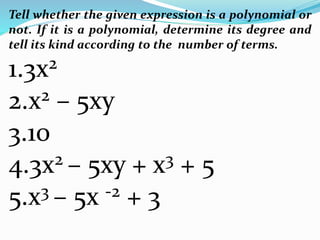
Tell whether the given expression is a polynomial or
not. If it is a polynomial, determine its degree and
tell its kind according to the number of terms.
1.3x2
2.x2 – 5xy
3.10
4.3x2 – 5xy + x3 + 5
5.x3 – 5x -2 + 3
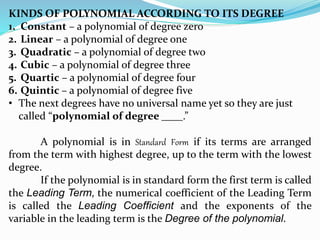
KINDS OF POLYNOMIAL ACCORDING TO ITS DEGREE
1. Constant – a polynomial of degree zero
2. Linear – a polynomial of degree one
3. Quadratic – a polynomial of degree two
4. Cubic – a polynomial of degree three
5. Quartic – a polynomial of degree four
6. Quintic – a polynomial of degree five
• The next degrees have no universal name yet so they are just
called “polynomial of degree ____.”
A polynomial is in Standard Form if its terms are arranged
from the term with highest degree, up to the term with the lowest
degree.
If the polynomial is in standard form the first term is called
the Leading Term, the numerical coefficient of the Leading Term
is called the Leading Coefficient and the exponents of the
variable in the leading term is the Degree of the polynomial.
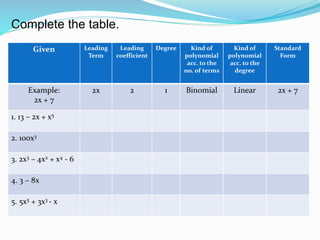
Given Leading
Term
Leading
coefficient
Degree Kind of
polynomial
acc. to the
no. of terms
Kind of
polynomial
acc. to the
degree
Standard
Form
Example:
2x + 7
2x 2 1 Binomial Linear 2x + 7
1. 13 – 2x + x5
2. 100x3
3. 2x3 – 4x2 + x4 - 6
4. 3 – 8x
5. 5x5 + 3x3 - x
Complete the table.

Polynomials Mathematics Grade 7

  • 1.
  • 2.
    P C IT N I U Q Y N E t P M E X P O N E N T S C C O E F F I C I E N T O Q N L I N E A R B D R N U O C Y A P M R A E I S A M R I N L M T S G N T D I U N B O Q U n R O A R A E Q P U M V T E M N A L S O B D C I R E I T T A A C U B I N A S A A I U B I N O M I A L L C C I T R A U Q R T I C b
  • 3.
    DEFINITION OF TERMS: Term Termis a constant, a variable or a product of constant and variable. EXAMPLE: 3x2, 3 is called the numeral coefficient and x2 is called the literal coefficient. In the term – x has the numerical coefficient which is – 1 and a literal coefficient which is x. Numerical coefficient is the constant/number. Literal coefficient is the variable including its exponent.
  • 4.
    In the literalcoefficient x2 , x is called the base and 2 is called the exponent. Degree is the highest exponent or the highest sum of exponents of the variables in a term. Example: 3x2 – x + 5, the degree is 2. 3x2 y3 – x4 y3, the degree is 7. Similar terms are terms having the same literal coefficients. 3x2 and – 5x2 are similar because their literal coefficients are the same. 5x and 5x2 are NOT similar because their literal coefficients are NOT the same.
  • 5.
    Polynomial Kind of algebraicexpression where each term is a constant, a variable or a product of constant and variable in which the variable has a whole number (non – negative number) exponent. An algebraic expression is NOT a polynomial if 1. the exponent of the variable is NOT a whole number 2. the variable is inside the radical sign 3. the variable is in the denominator Kinds of Polynomial according to the number of terms 1. Monomial – is a polynomial with only one term 2. Binomial – is a polynomial with two terms 3. Trinomial – is a polynomial with three terms 4. Multinomial – is a polynomial with 4 or more terms
  • 6.
    Tell whether thegiven expression is a polynomial or not. If it is a polynomial, determine its degree and tell its kind according to the number of terms. 1.3x2 2.x2 – 5xy 3.10 4.3x2 – 5xy + x3 + 5 5.x3 – 5x -2 + 3
  • 7.
    KINDS OF POLYNOMIALACCORDING TO ITS DEGREE 1. Constant – a polynomial of degree zero 2. Linear – a polynomial of degree one 3. Quadratic – a polynomial of degree two 4. Cubic – a polynomial of degree three 5. Quartic – a polynomial of degree four 6. Quintic – a polynomial of degree five • The next degrees have no universal name yet so they are just called “polynomial of degree ____.” A polynomial is in Standard Form if its terms are arranged from the term with highest degree, up to the term with the lowest degree. If the polynomial is in standard form the first term is called the Leading Term, the numerical coefficient of the Leading Term is called the Leading Coefficient and the exponents of the variable in the leading term is the Degree of the polynomial.
  • 8.
    Given Leading Term Leading coefficient Degree Kindof polynomial acc. to the no. of terms Kind of polynomial acc. to the degree Standard Form Example: 2x + 7 2x 2 1 Binomial Linear 2x + 7 1. 13 – 2x + x5 2. 100x3 3. 2x3 – 4x2 + x4 - 6 4. 3 – 8x 5. 5x5 + 3x3 - x Complete the table.