1.4 Angles & their Measures

           p. 26
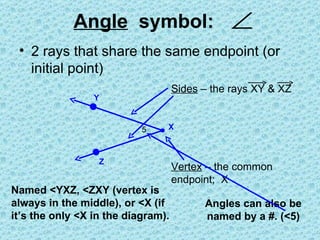
Angle symbol:                     ∠
 • 2 rays that share the same endpoint (or
   initial point)
                                    Sides – the rays XY & XZ
                 Y


                           5    X


                     Z
                                    Vertex – the common
                                    endpoint; X
Named <YXZ, <ZXY (vertex is
always in the middle), or <X (if          Angles can also be
it’s the only <X in the diagram).         named by a #. (<5)
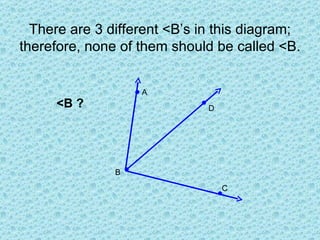
There are 3 different <B’s in this diagram;
therefore, none of them should be called <B.


                   A
     <B ?                     D


               B

                                  C
Angle Measurement
• m<A means the         • Angles with the
  “measure of <A”         same measure are
• Measure angles with     congruent angles.
  a protractor.         • If m<A = m<B,
• Units of angle           then <A ≅ <B.
  measurement are
  degrees (o).
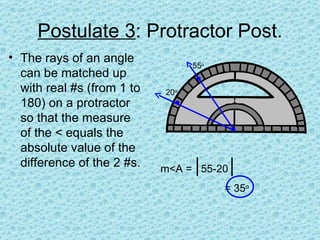
Postulate 3: Protractor Post.
• The rays of an angle
                                  55o
  can be matched up
  with real #s (from 1 to   20o
  180) on a protractor
  so that the measure
  of the < equals the
  absolute value of the
  difference of the 2 #s.   m<A = 55-20
                                        = 35o
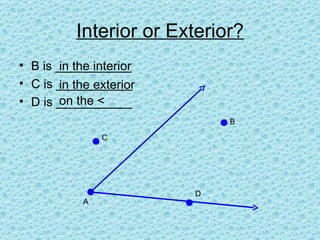
Interior or Exterior?
• B is ___________
        in the interior
• C is ___________
        in the exterior
        on the <
• D is ___________
                              B

                C


                          D
            A
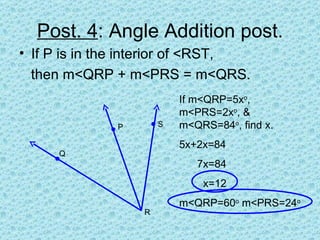
Post. 4: Angle Addition post.
• If P is in the interior of <RST,
  then m<QRP + m<PRS = m<QRS.
                          If m<QRP=5xo,
                          m<PRS=2xo, &
              P       S   m<QRS=84o, find x.
                          5x+2x=84
     Q
                             7x=84
                              x=12
                          m<QRP=60o m<PRS=24o
                  R
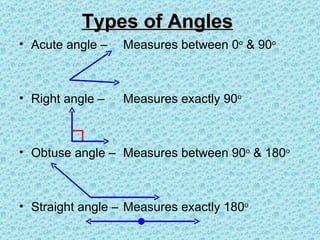
Types of Angles
• Acute angle –   Measures between 0o & 90o


• Right angle –   Measures exactly 90o


• Obtuse angle – Measures between 90o & 180o


• Straight angle – Measures exactly 180o
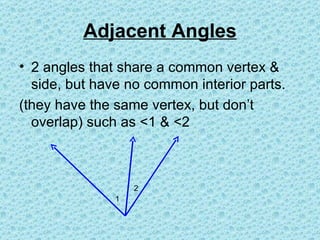
Adjacent Angles
• 2 angles that share a common vertex &
  side, but have no common interior parts.
(they have the same vertex, but don’t
  overlap) such as <1 & <2


                   2
               1
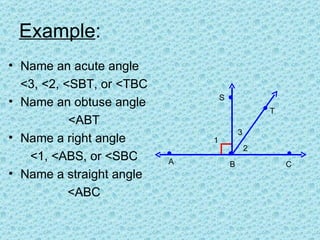
Example:
• Name an acute angle
  <3, <2, <SBT, or <TBC
                                  S
• Name an obtuse angle
                                                  T
           <ABT
                                          3
• Name a right angle          1
                                              2
   <1, <ABS, or <SBC      A           B               C
• Name a straight angle
           <ABC
Assignment

1.4 angles __their_measures

  • 1.
    1.4 Angles &their Measures p. 26
  • 2.
    Angle symbol: ∠ • 2 rays that share the same endpoint (or initial point) Sides – the rays XY & XZ Y 5 X Z Vertex – the common endpoint; X Named <YXZ, <ZXY (vertex is always in the middle), or <X (if Angles can also be it’s the only <X in the diagram). named by a #. (<5)
  • 3.
    There are 3different <B’s in this diagram; therefore, none of them should be called <B. A <B ? D B C
  • 4.
    Angle Measurement • m<Ameans the • Angles with the “measure of <A” same measure are • Measure angles with congruent angles. a protractor. • If m<A = m<B, • Units of angle then <A ≅ <B. measurement are degrees (o).
  • 5.
    Postulate 3: ProtractorPost. • The rays of an angle 55o can be matched up with real #s (from 1 to 20o 180) on a protractor so that the measure of the < equals the absolute value of the difference of the 2 #s. m<A = 55-20 = 35o
  • 6.
    Interior or Exterior? •B is ___________ in the interior • C is ___________ in the exterior on the < • D is ___________ B C D A
  • 7.
    Post. 4: AngleAddition post. • If P is in the interior of <RST, then m<QRP + m<PRS = m<QRS. If m<QRP=5xo, m<PRS=2xo, & P S m<QRS=84o, find x. 5x+2x=84 Q 7x=84 x=12 m<QRP=60o m<PRS=24o R
  • 8.
    Types of Angles •Acute angle – Measures between 0o & 90o • Right angle – Measures exactly 90o • Obtuse angle – Measures between 90o & 180o • Straight angle – Measures exactly 180o
  • 9.
    Adjacent Angles • 2angles that share a common vertex & side, but have no common interior parts. (they have the same vertex, but don’t overlap) such as <1 & <2 2 1
  • 10.
    Example: • Name anacute angle <3, <2, <SBT, or <TBC S • Name an obtuse angle T <ABT 3 • Name a right angle 1 2 <1, <ABS, or <SBC A B C • Name a straight angle <ABC
  • 11.