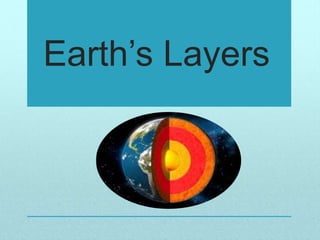
Earth’s Layers
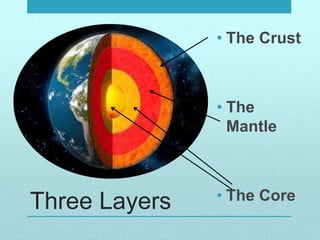
Three Layers
• The Crust
• The
Mantle
• The Core
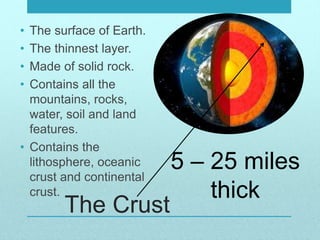
The Crust
• The surface of Earth.
• The thinnest layer.
• Made of solid rock.
• Contains all the
mountains, rocks,
water, soil and land
features.
• Contains the
lithosphere, oceanic
crust and continental
crust.
5 – 25 miles
thick
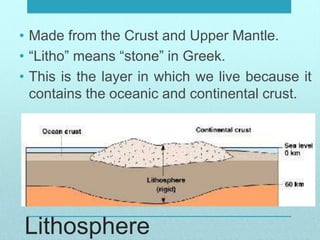
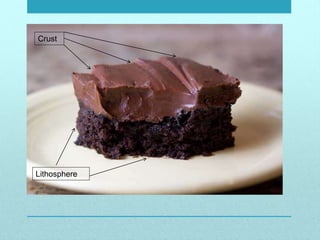
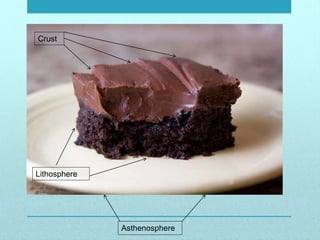
Lithosphere
• Made from the Crust and Upper Mantle.
• “Litho” means “stone” in Greek.
• This is the layer in which we live because it
contains the oceanic and continental crust.
Crust
Lithosphere
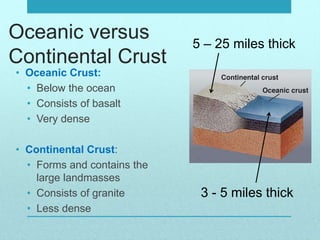
Oceanic versus
Continental Crust
• Oceanic Crust:
• Below the ocean
• Consists of basalt
• Very dense
• Continental Crust:
• Forms and contains the
large landmasses
• Consists of granite
• Less dense
5 – 25 miles thick
3 - 5 miles thick
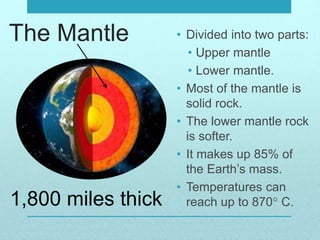
The Mantle • Divided into two parts:
• Upper mantle
• Lower mantle.
• Most of the mantle is
solid rock.
• The lower mantle rock
is softer.
• It makes up 85% of
the Earth’s mass.
• Temperatures can
reach up to 870 C.
1,800 miles thick
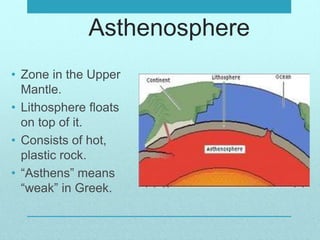
Asthenosphere
• Zone in the Upper
Mantle.
• Lithosphere floats
on top of it.
• Consists of hot,
plastic rock.
• “Asthens” means
“weak” in Greek.
Crust
Lithosphere
Asthenosphere
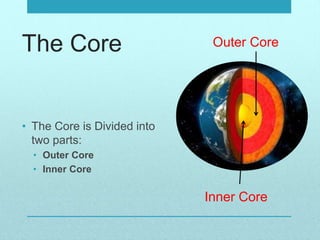
The Core
• The Core is Divided into
two parts:
• Outer Core
• Inner Core
Inner Core
Outer Core
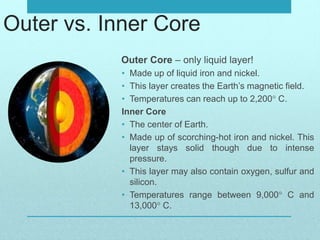
Outer vs. Inner Core
Outer Core – only liquid layer!
• Made up of liquid iron and nickel.
• This layer creates the Earth’s magnetic field.
• Temperatures can reach up to 2,200 C.
Inner Core
• The center of Earth.
• Made up of scorching-hot iron and nickel. This
layer stays solid though due to intense
pressure.
• This layer may also contain oxygen, sulfur and
silicon.
• Temperatures range between 9,000 C and
13,000 C.
Evidence
How do Scientists know about the interior of the
Earth?
Two forms of evidence:
• Direct evidence from rock samples
• Indirect evidence from seismic waves
Theory of Plate
Tectonics
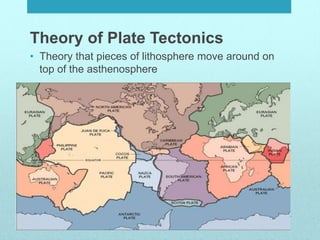
Theory of Plate Tectonics
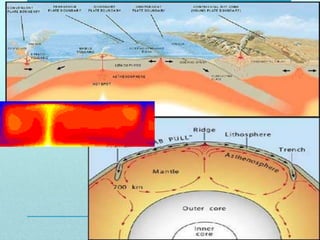
• Theory that pieces of lithosphere move around on
top of the asthenosphere
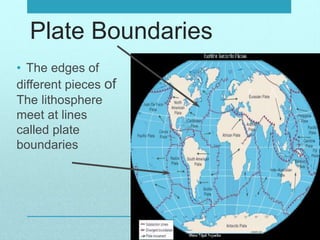
Plate Boundaries
• The edges of
different pieces of
The lithosphere
meet at lines
called plate
boundaries
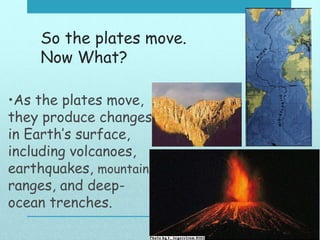
So the plates move.
Now What?
•As the plates move,
they produce changes
in Earth’s surface,
including volcanoes,
earthquakes, mountain
ranges, and deep-
ocean trenches.
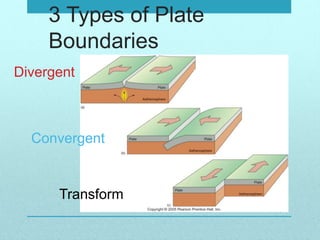
3 Types of Plate
Boundaries
Divergent
Convergent
Transform
Divergent
Transform
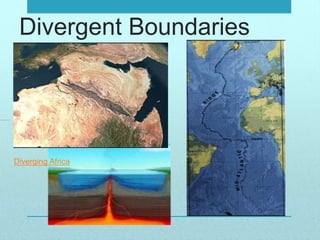
Divergent boundary - two plates
move apart
• Magma rises and creates new
crust or seafloor
Causes: mid-
ocean ridges, rift
valleys, new crust
, volcanoes
Divergent Boundaries
© All Rights Reserved.
Diverging Africa
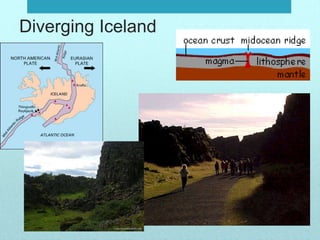
Diverging Iceland
• Convergent - when two tectonic
plates push into one another.
Convergent Boundaries
• Continental vs. Continental
• Continental vs. Oceanic
• Oceanic vs. Oceanic
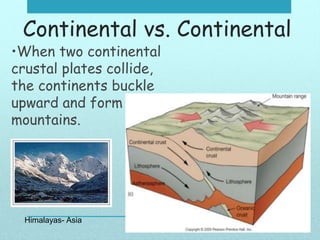
Continental vs. Continental
•When two continental
crustal plates collide,
the continents buckle
upward and form
mountains.
Himalayas- Asia
Himalayas- Asia
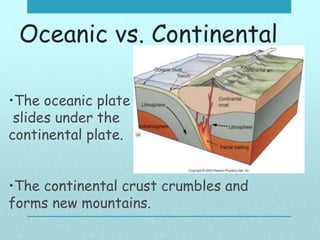
Oceanic vs. Continental
•The oceanic plate
slides under the
continental plate.
•The continental crust crumbles and
forms new mountains.
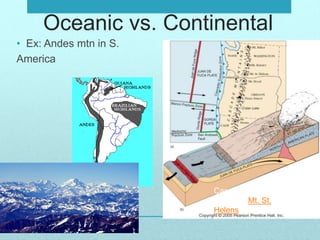
Oceanic vs. Continental
• Ex: Andes mtn in S.
America
Cascade Mtns. in N.
America- Mt. St.
Helens
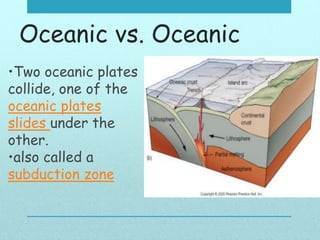
Oceanic vs. Oceanic
•Two oceanic plates
collide, one of the
oceanic plates
slides under the
other.
•also called a
subduction zone
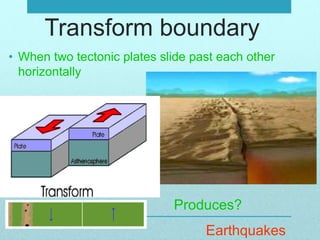
Transform boundary
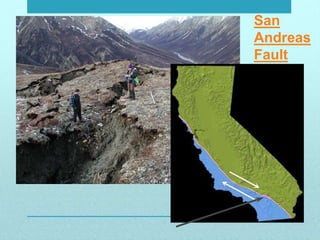
• When two tectonic plates slide past each other
horizontally
Produces?
Earthquakes
San
Andreas
Fault
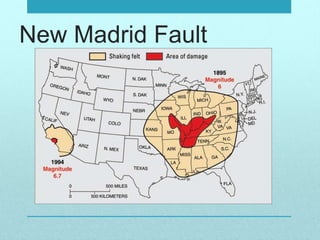
New Madrid Fault
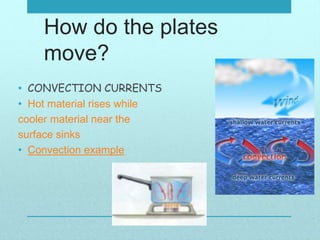
How do the plates
move?
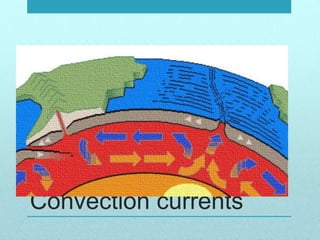
• CONVECTION CURRENTS
• Hot material rises while
cooler material near the
surface sinks
• Convection example
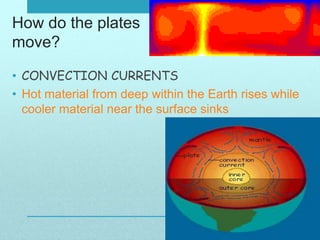
How do the plates
move?
• CONVECTION CURRENTS
• Hot material from deep within the Earth rises while
cooler material near the surface sinks
Convection currents
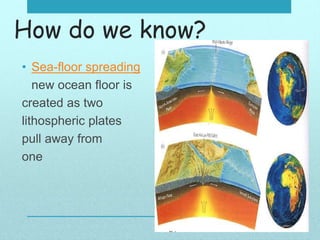
How do we know?
• Sea-floor spreading
new ocean floor is
created as two
lithospheric plates
pull away from
one another.

Geology powerpoint earth layers

  • 1.
  • 2.
    Three Layers • TheCrust • The Mantle • The Core
  • 3.
    The Crust • Thesurface of Earth. • The thinnest layer. • Made of solid rock. • Contains all the mountains, rocks, water, soil and land features. • Contains the lithosphere, oceanic crust and continental crust. 5 – 25 miles thick
  • 4.
    Lithosphere • Made fromthe Crust and Upper Mantle. • “Litho” means “stone” in Greek. • This is the layer in which we live because it contains the oceanic and continental crust.
  • 5.
  • 6.
    Oceanic versus Continental Crust •Oceanic Crust: • Below the ocean • Consists of basalt • Very dense • Continental Crust: • Forms and contains the large landmasses • Consists of granite • Less dense 5 – 25 miles thick 3 - 5 miles thick
  • 7.
    The Mantle •Divided into two parts: • Upper mantle • Lower mantle. • Most of the mantle is solid rock. • The lower mantle rock is softer. • It makes up 85% of the Earth’s mass. • Temperatures can reach up to 870 C. 1,800 miles thick
  • 8.
    Asthenosphere • Zone inthe Upper Mantle. • Lithosphere floats on top of it. • Consists of hot, plastic rock. • “Asthens” means “weak” in Greek.
  • 9.
  • 10.
    The Core • TheCore is Divided into two parts: • Outer Core • Inner Core Inner Core Outer Core
  • 11.
    Outer vs. InnerCore Outer Core – only liquid layer! • Made up of liquid iron and nickel. • This layer creates the Earth’s magnetic field. • Temperatures can reach up to 2,200 C. Inner Core • The center of Earth. • Made up of scorching-hot iron and nickel. This layer stays solid though due to intense pressure. • This layer may also contain oxygen, sulfur and silicon. • Temperatures range between 9,000 C and 13,000 C.
  • 12.
    Evidence How do Scientistsknow about the interior of the Earth? Two forms of evidence: • Direct evidence from rock samples • Indirect evidence from seismic waves
  • 13.
    Theory of Plate Tectonics Theoryof Plate Tectonics • Theory that pieces of lithosphere move around on top of the asthenosphere
  • 14.
    Plate Boundaries • Theedges of different pieces of The lithosphere meet at lines called plate boundaries
  • 15.
    So the platesmove. Now What? •As the plates move, they produce changes in Earth’s surface, including volcanoes, earthquakes, mountain ranges, and deep- ocean trenches.
  • 16.
    3 Types ofPlate Boundaries Divergent Convergent Transform Divergent Transform
  • 17.
    Divergent boundary -two plates move apart • Magma rises and creates new crust or seafloor Causes: mid- ocean ridges, rift valleys, new crust , volcanoes
  • 18.
    Divergent Boundaries © AllRights Reserved. Diverging Africa
  • 19.
  • 20.
    • Convergent -when two tectonic plates push into one another.
  • 21.
    Convergent Boundaries • Continentalvs. Continental • Continental vs. Oceanic • Oceanic vs. Oceanic
  • 22.
    Continental vs. Continental •Whentwo continental crustal plates collide, the continents buckle upward and form mountains. Himalayas- Asia
  • 23.
  • 24.
    Oceanic vs. Continental •Theoceanic plate slides under the continental plate. •The continental crust crumbles and forms new mountains.
  • 25.
    Oceanic vs. Continental •Ex: Andes mtn in S. America Cascade Mtns. in N. America- Mt. St. Helens
  • 26.
    Oceanic vs. Oceanic •Twooceanic plates collide, one of the oceanic plates slides under the other. •also called a subduction zone
  • 27.
    Transform boundary • Whentwo tectonic plates slide past each other horizontally Produces? Earthquakes
  • 28.
  • 29.
  • 30.
    How do theplates move? • CONVECTION CURRENTS • Hot material rises while cooler material near the surface sinks • Convection example
  • 31.
    How do theplates move? • CONVECTION CURRENTS • Hot material from deep within the Earth rises while cooler material near the surface sinks
  • 33.
  • 34.
    How do weknow? • Sea-floor spreading new ocean floor is created as two lithospheric plates pull away from one another.