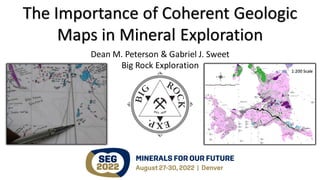
The Importance of Coherent Geologic
Maps in Mineral Exploration
Dean M. Peterson & Gabriel J. Sweet
Big Rock Exploration 1:200 Scale
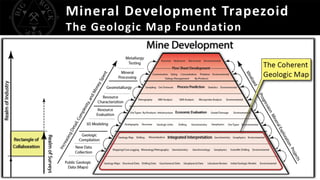
Mineral Development Trapezoid
The Geologic Map Foundation
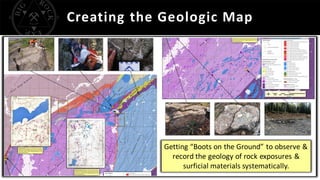
Creating the Geologic Map
Getting “Boots on the Ground” to observe &
record the geology of rock exposures &
surficial materials systematically.
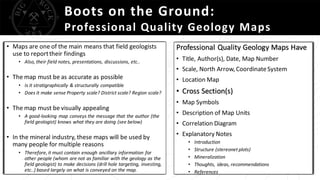
Boots on the Ground:
Professional Quality Geology Maps
• Maps are one of the main means that field geologists
use to reporttheir findings
• Also, their field notes, presentations, discussions, etc..
• The map must be as accurate as possible
• Is it stratigraphically & structurally compatible
• Does it make sense Property scale? District scale? Region scale?
• The map must be visually appealing
• A good-looking map conveys the message that the author (the
field geologist) knows what they are doing (see below)
• In the mineral industry, these maps will be used by
many people for multiple reasons
• Therefore, it must contain enough ancillary information for
other people (whom are not as familiar with the geology as the
field geologist) to make decisions (drill hole targeting, investing,
etc..) based largely on what is conveyed on the map.
Professional Quality Geology Maps Have
• Title, Author(s), Date, Map Number
• Scale, North Arrow,CoordinateSystem
• Location Map
• Cross Section(s)
• Map Symbols
• Description of Map Units
• Correlation Diagram
• Explanatory Notes
• Introduction
• Structure (stereonet plots)
• Mineralization
• Thoughts, ideas, recommendations
• References
The Geologic Map
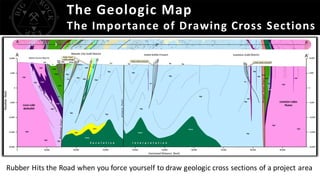
The Importance of Drawing Cross Sections
Rubber Hits the Road when you force yourself to draw geologic cross sections of a project area
The Digital Geologic Map
A Geographic Information System is a computer-based tool designed to capture, store,
manage, analyze, manipulate and visualize spatial or geographic information, usually in
map form. The true power of GIS lies in the ability to perform spatial analysis.
It is a tool for managing data, including points, lines, polygons, and imagery
• about where features are (coordinate data)
• what they are like (attribute data)
The ability to perform geological Spatial Analysis is why Coherent Geologic Maps must
be created by mineral industry geologists. Such maps derive their power from:
• Seamlesscompilation of multi-scale input data (ie. geology maps, geochemical data, geophysical data)
into a standardizedformat
• Understandable androbustattribute tables
• Integration with other information from government agencies/geologic surveys
The Unseen Data (OBSERVATIONS)
Behind Digital Geologic Maps
1) Lithology-based map units (for example: quartz-sericite-pyrite schist)
2) Locations of exposed rock (outcrop lithology, structure, textures, mineralogy, etc..)
3) Lines on the geology map (contacts, faults, shear zones, etc., rocks on each side of the line!!)
4) Orientation of the rocks (bedding, foliation, folding, lineation, etc..)
5) Mineral assemblages (mineral occurrences, alteration mineralogy, etc..)
6) Textures of the rocks (brecciated, faulted, sheared, altered, veined, etc..)
7) Mineral resources (calculated resources, mines, quarries, test pits, prospects, etc..)
8) Drill hole data in 3D (continuous lithology, assays, density, etc..)
9) Geochemical data (rocks, cores, till, soils, seeps, lake & stream sediment, etc..)
10) Geophysical data (magnetics, density, susceptibility, conductivity, resistivity, etc..)
If assembled correctly these unseen data behind geology maps can be used to create any
number of new Derivative Maps in Exploration Programs.
Derivative Map Generation
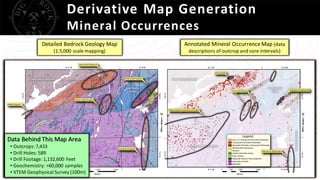
Mineral Occurrences
Data Behind This Map Area
• Outcrops:7,433
• Drill Holes: 589
• Drill Footage: 1,132,600 Feet
• Geochemistry: >60,000 samples
• VTEM Geophysical Survey (100m)
Detailed Bedrock Geology Map
(1:5,000 scale mapping)
Annotated Mineral OccurrenceMap (data
descriptions of outcrop and core intervals)
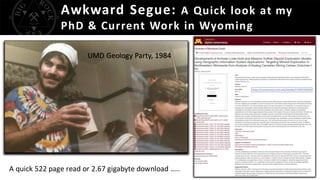
Awkward Segue: A Quick look at my
PhD & Current Work in Wyoming
UMD Geology Party, 1984
A quick 522 page read or 2.67 gigabyte download …..
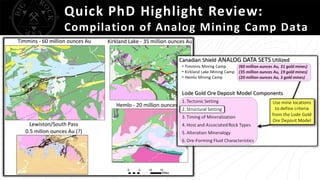
Quick PhD Highlight Review:
Compilation of Analog Mining Camp Data
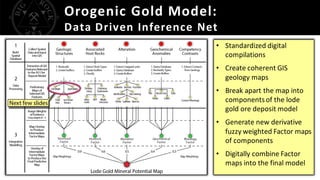
Orogenic Gold Model:
Data Driven Inference Net
• Standardized digital
compilations
• Create coherent GIS
geology maps
• Break apart the map into
componentsof the lode
gold ore deposit model
• Generate new derivative
fuzzy weighted Factor maps
of components
• Digitally combine Factor
maps into the final model
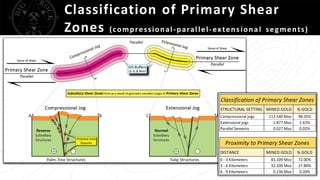
Classification of Primary Shear
Zones (compressional-parallel-extensional segments)
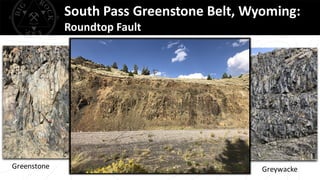
South Pass Greenstone Belt, Wyoming:
Roundtop Fault
Greenstone Greywacke
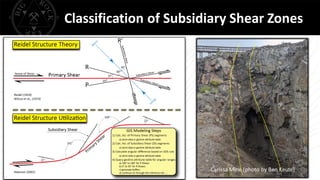
Classification of Subsidiary Shear Zones
Carissa Mine (photo by Ben Keute)
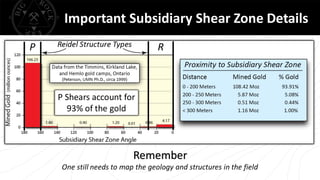
Important Subsidiary Shear Zone Details
Remember
One still needs to map the geology and structures in the field
P Shears account for
93% of the gold
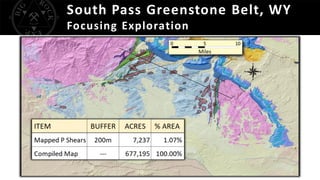
South Pass Greenstone Belt, WY
Focusing Exploration
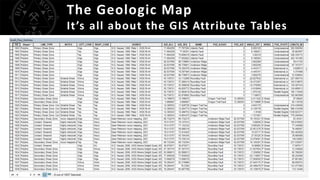
The Geologic Map
It’s all about the GIS Attribute Tables
A Concluding Geologic Tenet
“The distribution of outcrop is neither random or
representative”
Geologists out field mapping must search for insights on rocks that
perhaps are not exposed.
THANK YOU!
QUESTIONS?

SEG_2022_Presentation_16633576222324.pdf

  • 1.
    The Importance ofCoherent Geologic Maps in Mineral Exploration Dean M. Peterson & Gabriel J. Sweet Big Rock Exploration 1:200 Scale
  • 2.
    Mineral Development Trapezoid TheGeologic Map Foundation
  • 3.
    Creating the GeologicMap Getting “Boots on the Ground” to observe & record the geology of rock exposures & surficial materials systematically.
  • 4.
    Boots on theGround: Professional Quality Geology Maps • Maps are one of the main means that field geologists use to reporttheir findings • Also, their field notes, presentations, discussions, etc.. • The map must be as accurate as possible • Is it stratigraphically & structurally compatible • Does it make sense Property scale? District scale? Region scale? • The map must be visually appealing • A good-looking map conveys the message that the author (the field geologist) knows what they are doing (see below) • In the mineral industry, these maps will be used by many people for multiple reasons • Therefore, it must contain enough ancillary information for other people (whom are not as familiar with the geology as the field geologist) to make decisions (drill hole targeting, investing, etc..) based largely on what is conveyed on the map. Professional Quality Geology Maps Have • Title, Author(s), Date, Map Number • Scale, North Arrow,CoordinateSystem • Location Map • Cross Section(s) • Map Symbols • Description of Map Units • Correlation Diagram • Explanatory Notes • Introduction • Structure (stereonet plots) • Mineralization • Thoughts, ideas, recommendations • References
  • 5.
    The Geologic Map TheImportance of Drawing Cross Sections Rubber Hits the Road when you force yourself to draw geologic cross sections of a project area
  • 6.
    The Digital GeologicMap A Geographic Information System is a computer-based tool designed to capture, store, manage, analyze, manipulate and visualize spatial or geographic information, usually in map form. The true power of GIS lies in the ability to perform spatial analysis. It is a tool for managing data, including points, lines, polygons, and imagery • about where features are (coordinate data) • what they are like (attribute data) The ability to perform geological Spatial Analysis is why Coherent Geologic Maps must be created by mineral industry geologists. Such maps derive their power from: • Seamlesscompilation of multi-scale input data (ie. geology maps, geochemical data, geophysical data) into a standardizedformat • Understandable androbustattribute tables • Integration with other information from government agencies/geologic surveys
  • 7.
    The Unseen Data(OBSERVATIONS) Behind Digital Geologic Maps 1) Lithology-based map units (for example: quartz-sericite-pyrite schist) 2) Locations of exposed rock (outcrop lithology, structure, textures, mineralogy, etc..) 3) Lines on the geology map (contacts, faults, shear zones, etc., rocks on each side of the line!!) 4) Orientation of the rocks (bedding, foliation, folding, lineation, etc..) 5) Mineral assemblages (mineral occurrences, alteration mineralogy, etc..) 6) Textures of the rocks (brecciated, faulted, sheared, altered, veined, etc..) 7) Mineral resources (calculated resources, mines, quarries, test pits, prospects, etc..) 8) Drill hole data in 3D (continuous lithology, assays, density, etc..) 9) Geochemical data (rocks, cores, till, soils, seeps, lake & stream sediment, etc..) 10) Geophysical data (magnetics, density, susceptibility, conductivity, resistivity, etc..) If assembled correctly these unseen data behind geology maps can be used to create any number of new Derivative Maps in Exploration Programs.
  • 8.
    Derivative Map Generation MineralOccurrences Data Behind This Map Area • Outcrops:7,433 • Drill Holes: 589 • Drill Footage: 1,132,600 Feet • Geochemistry: >60,000 samples • VTEM Geophysical Survey (100m) Detailed Bedrock Geology Map (1:5,000 scale mapping) Annotated Mineral OccurrenceMap (data descriptions of outcrop and core intervals)
  • 9.
    Awkward Segue: AQuick look at my PhD & Current Work in Wyoming UMD Geology Party, 1984 A quick 522 page read or 2.67 gigabyte download …..
  • 10.
    Quick PhD HighlightReview: Compilation of Analog Mining Camp Data
  • 11.
    Orogenic Gold Model: DataDriven Inference Net • Standardized digital compilations • Create coherent GIS geology maps • Break apart the map into componentsof the lode gold ore deposit model • Generate new derivative fuzzy weighted Factor maps of components • Digitally combine Factor maps into the final model
  • 12.
    Classification of PrimaryShear Zones (compressional-parallel-extensional segments)
  • 13.
    South Pass GreenstoneBelt, Wyoming: Roundtop Fault Greenstone Greywacke
  • 14.
    Classification of SubsidiaryShear Zones Carissa Mine (photo by Ben Keute)
  • 15.
    Important Subsidiary ShearZone Details Remember One still needs to map the geology and structures in the field P Shears account for 93% of the gold
  • 16.
    South Pass GreenstoneBelt, WY Focusing Exploration
  • 17.
    The Geologic Map It’sall about the GIS Attribute Tables
  • 18.
    A Concluding GeologicTenet “The distribution of outcrop is neither random or representative” Geologists out field mapping must search for insights on rocks that perhaps are not exposed.
  • 19.