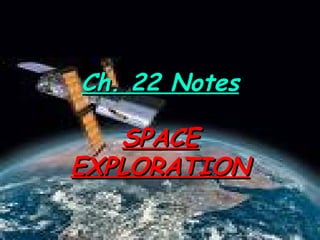
Ch. 22 Notes SPACE EXPLORATION
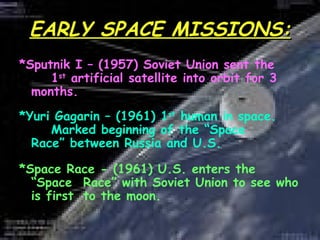
EARLY SPACE MISSIONS: *Sputnik I – (1957) Soviet Union sent the  1 st  artificial satellite into orbit for 3 months. *Yuri Gagarin – (1961) 1 st  human in space.  Marked beginning of the “Space  Race” between Russia and U.S. *Space Race - (1961) U.S. enters the “Space  Race” with Soviet Union to see who is first  to the moon.
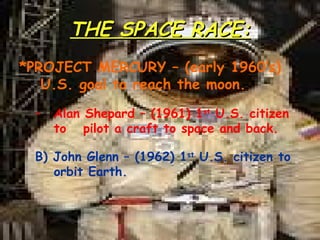
THE SPACE RACE: *PROJECT MERCURY – (early 1960’s) U.S. goal to reach the moon.   Alan Shepard – (1961) 1 st  U.S. citizen to  pilot a craft to space and back. B) John Glenn – (1962) 1 st  U.S. citizen to orbit Earth.
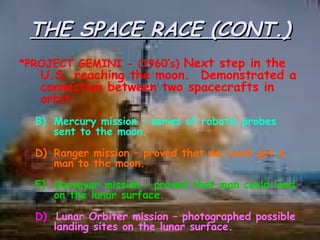
THE SPACE RACE (CONT.) *PROJECT GEMINI - (1960’s)  Next step in the U.S. reaching the moon.  Demonstrated a connection between two spacecrafts in orbit. Mercury mission – series of robotic probes sent to the moon. Ranger mission – proved that we could get a man to the moon. Surveyor mission – proved that man could land on the lunar surface. D)   Lunar Orbiter mission – photographed possible landing sites on the lunar surface.
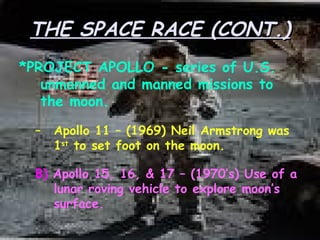
THE SPACE RACE (CONT.) *PROJECT APOLLO - series of U.S. unmanned and manned missions to the moon. Apollo 11 – (1969) Neil Armstrong was 1 st  to set foot on the moon. B)   Apollo 15, 16, & 17 – (1970’s) Use of a lunar roving vehicle to explore moon’s surface.
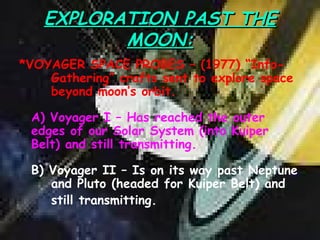
EXPLORATION PAST THE MOON: *VOYAGER SPACE PROBES – (1977) “Info- Gathering” crafts sent to explore space  beyond moon’s orbit. A) Voyager I – Has reached the outer  edges of our Solar System (into Kuiper  Belt) and still transmitting. B) Voyager II – Is on its way past Neptune  and Pluto (headed for Kuiper Belt) and  still transmitting.
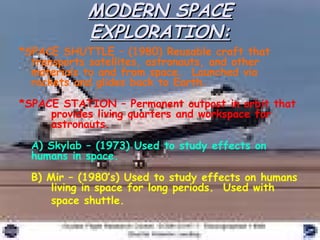
MODERN SPACE EXPLORATION: *SPACE SHUTTLE – (1980) Reusable craft that  transports satellites, astronauts, and other  materials to and from space.  Launched via  rockets and glides back to Earth. *SPACE STATION – Permanent outpost in orbit that  provides living quarters and workspace for  astronauts. A) Skylab – (1973) Used to study effects on  humans in space. B) Mir – (1980’s) Used to study effects on humans  living in space for long periods.  Used with  space shuttle.
MODERN SPACE EXPLORATION (CONT.) *HUBBLE SPACE TELESCOPE – (early  1990’s) sent into space to transmit  info and photos back to Earth. *INTERNATIONAL SPACE STATION –  (1997) More than a dozen nations  cooperated to send an outpost into  orbit.  Used with space shuttle to  study docking missions and for lab  experiments.
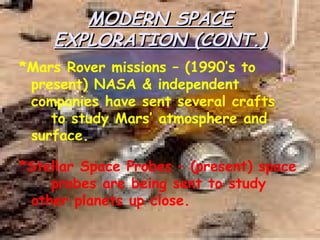
MODERN SPACE EXPLORATION (CONT.) *Mars Rover missions – (1990’s to  present) NASA & independent  companies have sent several crafts  to study Mars’ atmosphere and  surface. *Stellar Space Probes – (present) space  probes are being sent to study  other planets up close.
FUTURE SPACE EXPLORATION *Lunar Studies – NASA is looking once again at the moon. A) Sees the moon as a possible docking and  refueling site for deep space missions  to Mars and beyond. B) May also be a site for a future space  station or colonization by humans. C) May eventually be used as a stepping stone to travel outside our solar system.

Ch. 22 space exploration pp notes 6th grade

  • 1.
    Ch. 22 NotesSPACE EXPLORATION
  • 2.
    EARLY SPACE MISSIONS:*Sputnik I – (1957) Soviet Union sent the 1 st artificial satellite into orbit for 3 months. *Yuri Gagarin – (1961) 1 st human in space. Marked beginning of the “Space Race” between Russia and U.S. *Space Race - (1961) U.S. enters the “Space Race” with Soviet Union to see who is first to the moon.
  • 3.
    THE SPACE RACE:*PROJECT MERCURY – (early 1960’s) U.S. goal to reach the moon. Alan Shepard – (1961) 1 st U.S. citizen to pilot a craft to space and back. B) John Glenn – (1962) 1 st U.S. citizen to orbit Earth.
  • 4.
    THE SPACE RACE(CONT.) *PROJECT GEMINI - (1960’s) Next step in the U.S. reaching the moon. Demonstrated a connection between two spacecrafts in orbit. Mercury mission – series of robotic probes sent to the moon. Ranger mission – proved that we could get a man to the moon. Surveyor mission – proved that man could land on the lunar surface. D) Lunar Orbiter mission – photographed possible landing sites on the lunar surface.
  • 5.
    THE SPACE RACE(CONT.) *PROJECT APOLLO - series of U.S. unmanned and manned missions to the moon. Apollo 11 – (1969) Neil Armstrong was 1 st to set foot on the moon. B) Apollo 15, 16, & 17 – (1970’s) Use of a lunar roving vehicle to explore moon’s surface.
  • 6.
    EXPLORATION PAST THEMOON: *VOYAGER SPACE PROBES – (1977) “Info- Gathering” crafts sent to explore space beyond moon’s orbit. A) Voyager I – Has reached the outer edges of our Solar System (into Kuiper Belt) and still transmitting. B) Voyager II – Is on its way past Neptune and Pluto (headed for Kuiper Belt) and still transmitting.
  • 7.
    MODERN SPACE EXPLORATION:*SPACE SHUTTLE – (1980) Reusable craft that transports satellites, astronauts, and other materials to and from space. Launched via rockets and glides back to Earth. *SPACE STATION – Permanent outpost in orbit that provides living quarters and workspace for astronauts. A) Skylab – (1973) Used to study effects on humans in space. B) Mir – (1980’s) Used to study effects on humans living in space for long periods. Used with space shuttle.
  • 8.
    MODERN SPACE EXPLORATION(CONT.) *HUBBLE SPACE TELESCOPE – (early 1990’s) sent into space to transmit info and photos back to Earth. *INTERNATIONAL SPACE STATION – (1997) More than a dozen nations cooperated to send an outpost into orbit. Used with space shuttle to study docking missions and for lab experiments.
  • 9.
    MODERN SPACE EXPLORATION(CONT.) *Mars Rover missions – (1990’s to present) NASA & independent companies have sent several crafts to study Mars’ atmosphere and surface. *Stellar Space Probes – (present) space probes are being sent to study other planets up close.
  • 10.
    FUTURE SPACE EXPLORATION*Lunar Studies – NASA is looking once again at the moon. A) Sees the moon as a possible docking and refueling site for deep space missions to Mars and beyond. B) May also be a site for a future space station or colonization by humans. C) May eventually be used as a stepping stone to travel outside our solar system.