Geography Essay Writing Tips
1. Read
Read the essay question
carefully.
Make sure you read all
options and all of each
question.
The stress of the situation
can cause you to misread a
question, ensure you make
the right choices.
2. Think
Think carefully about what
the essay is asking you.
Think about the content it is
asking you for.
Think about what the
command term requires you
to do.
Underline and highlight
important terms.
3. Plan
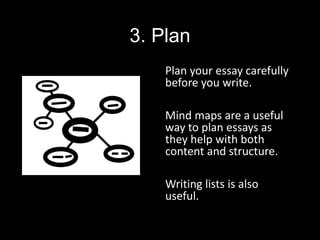
Plan your essay carefully
before you write.
Mind maps are a useful
way to plan essays as
they help with both
content and structure.
Writing lists is also
useful.
4. Write
Start to write your essay
Use a framework to give
your essay structure and
IPEELS.
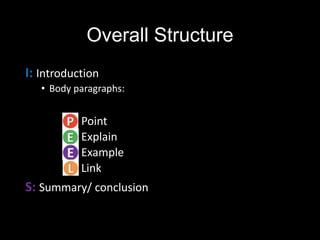
Overall Structure
I: Introduction
• Body paragraphs:
• Point
• Explain
• Example
• Link
S: Summary/ conclusion
Introduction:
Write a specific opening statement. Make sure this is not too
generalized (avoid “In the world today ……!).
Define the key terms and break down the command term to
ensure you have the correct focus
Paraphrase the question to ensure direct focus on what you
are specifically being asked
Show deeper understanding of what the question requires by
explaining several key ideas you will expand upon in your
response
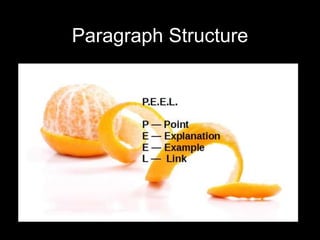
Paragraph Structure
Point
Your first sentence must state your point.
It introduces the topic you’re about to discuss and
tells the reader what the paragraph is going to be
about.
This is sometimes called a topic sentence.
Explanation
This is where you show your understanding by
explaining in more detail about your opening point.
You should use relevant terminology and ideas that
reiterate and expand upon your point.
Example
Support your point with relevant evidence and
examples.
Evidence can include facts, statistics, or details of a
case study.
Link
The last sentence should reinforce your original point
or link your writing to the specific question you are
addressing.
The link sentence can also provide a transition to the
next topic or paragraph.
Summary/ Conclusion:
Make sure your conclusion relates directly to the specific
question you are addressing.
Keep your conclusion clear and concise.
Don’t introduce anything new, this is the time to conclude
which ideas already discussed are the most important.
A strong conclusion brings everything together and reinforces
the points made in the essay.
.
5. Review/ Edit
Proofread your answers
as much as you can to
correct any spelling
mistakes and add
any extra comments you
think are worth
mentioning.
General Essay Tips
Time
Be conscious of the time you
have. Allocate sufficient time
to complete the essay.
Make sure to use several
minutes to plan before you
start to write.
Once you have assigned a
time limit for each question,
you MUST move on once you
hit it or you won’t be able to
give the next question your
full attention.
Use an Appropriate Style
Ensure you write in an
appropriate style.
Use relevant terminology.
Make sure you stay focused
on the specific question being
asked.
Don’t use personal pronouns.
Use Relevant Case Studies
It is important that you
use relevant contemporary
case studies and examples
to illustrate the points that
you make.
Including specific details
demonstrates a greater
level of understanding
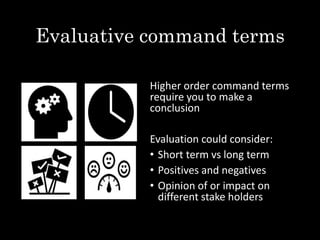
Evaluative command terms
Higher order command terms
require you to make a
conclusion
Evaluation could consider:
• Short term vs long term
• Positives and negatives
• Opinion of or impact on
different stake holders
Practice
Most of your essays will
be hand written so make
sure you practice writing.
Think about possible
essay topics and have a
practice writing
responses that may come
up.
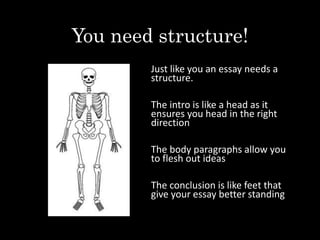
You need structure!
Just like you an essay needs a
structure.
The intro is like a head as it
ensures you head in the right
direction
The body paragraphs allow you
to flesh out ideas
The conclusion is like feet that
give your essay better standing

Geography Essay Writing Tips

  • 1.
  • 2.
    1. Read Read theessay question carefully. Make sure you read all options and all of each question. The stress of the situation can cause you to misread a question, ensure you make the right choices.
  • 3.
    2. Think Think carefullyabout what the essay is asking you. Think about the content it is asking you for. Think about what the command term requires you to do. Underline and highlight important terms.
  • 4.
    3. Plan Plan youressay carefully before you write. Mind maps are a useful way to plan essays as they help with both content and structure. Writing lists is also useful.
  • 5.
    4. Write Start towrite your essay Use a framework to give your essay structure and IPEELS.
  • 6.
    Overall Structure I: Introduction •Body paragraphs: • Point • Explain • Example • Link S: Summary/ conclusion
  • 7.
    Introduction: Write a specificopening statement. Make sure this is not too generalized (avoid “In the world today ……!). Define the key terms and break down the command term to ensure you have the correct focus Paraphrase the question to ensure direct focus on what you are specifically being asked Show deeper understanding of what the question requires by explaining several key ideas you will expand upon in your response
  • 8.
  • 9.
    Point Your first sentencemust state your point. It introduces the topic you’re about to discuss and tells the reader what the paragraph is going to be about. This is sometimes called a topic sentence.
  • 10.
    Explanation This is whereyou show your understanding by explaining in more detail about your opening point. You should use relevant terminology and ideas that reiterate and expand upon your point.
  • 11.
    Example Support your pointwith relevant evidence and examples. Evidence can include facts, statistics, or details of a case study.
  • 12.
    Link The last sentenceshould reinforce your original point or link your writing to the specific question you are addressing. The link sentence can also provide a transition to the next topic or paragraph.
  • 13.
    Summary/ Conclusion: Make sureyour conclusion relates directly to the specific question you are addressing. Keep your conclusion clear and concise. Don’t introduce anything new, this is the time to conclude which ideas already discussed are the most important. A strong conclusion brings everything together and reinforces the points made in the essay. .
  • 14.
    5. Review/ Edit Proofreadyour answers as much as you can to correct any spelling mistakes and add any extra comments you think are worth mentioning.
  • 15.
  • 16.
    Time Be conscious ofthe time you have. Allocate sufficient time to complete the essay. Make sure to use several minutes to plan before you start to write. Once you have assigned a time limit for each question, you MUST move on once you hit it or you won’t be able to give the next question your full attention.
  • 17.
    Use an AppropriateStyle Ensure you write in an appropriate style. Use relevant terminology. Make sure you stay focused on the specific question being asked. Don’t use personal pronouns.
  • 18.
    Use Relevant CaseStudies It is important that you use relevant contemporary case studies and examples to illustrate the points that you make. Including specific details demonstrates a greater level of understanding
  • 19.
    Evaluative command terms Higherorder command terms require you to make a conclusion Evaluation could consider: • Short term vs long term • Positives and negatives • Opinion of or impact on different stake holders
  • 20.
    Practice Most of youressays will be hand written so make sure you practice writing. Think about possible essay topics and have a practice writing responses that may come up.
  • 21.
    You need structure! Justlike you an essay needs a structure. The intro is like a head as it ensures you head in the right direction The body paragraphs allow you to flesh out ideas The conclusion is like feet that give your essay better standing