ADVICE ON
ACADEMICWRITING
ISFD N° 41
Subject:Written Expression IV
Professor: Stella Saubidet
Student: Mariana Giménez Foth
Date: May 25th, 2020
INDEX
General Advice on Essay-Writing __________________________________ 3
Understanding EssayTopics ______________________________________ 4
Organizing an Essay _____________________________________________ 5
Techniques for note-taking and planning ____________________________ 6
UsingThesis Statements _________________________________________ 7
Introductions ___________________________________________________ 8
How to write an interesting, effective introduction _____________________ 9
Conclusions ___________________________________________________ 10
How to write an interesting, effective conclusion _____________________ 11
Paragraphs ____________________________________________________ 12
How to develop ideas in a paragraph _______________________________ 13,14
How to make ideas flow in a paragraph _____________________________ 15
Critical ReadingTowards Critical Writing __________________________16
Some PracticalTips ___________________________________________17
Revising and Editing __________________________________________ 18
Start Large, End Small ________________________________________ 19,20
Bibliography __________________________________________________ 21
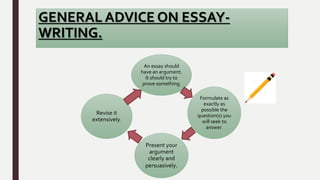
GENERAL ADVICE ON ESSAY-
WRITING.
An essay should
have an argument.
It should try to
prove something.
Formulate as
exactly as
possible the
question(s) you
will seek to
answer.
Present your
argument
clearly and
persuasively.
Revise it
extensively.
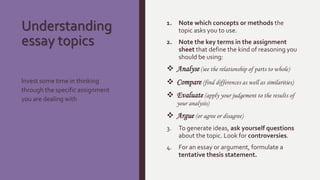
Understanding
essay topics
1. Note which concepts or methods the
topic asks you to use.
2. Note the key terms in the assignment
sheet that define the kind of reasoning you
should be using:
 Analyse (see the relationship of parts to whole)
 Compare (find differences as well as similarities)
 Evaluate (apply your judgement to the results of
your analysis)
 Argue (or agree or disagree)
3. To generate ideas, ask yourself questions
about the topic. Look for controversies.
4. For an essay or argument, formulate a
tentative thesis statement.
Invest some time in thinking
through the specific assignment
you are dealing with
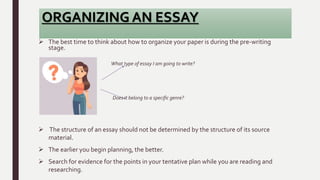
ORGANIZING AN ESSAY
 The best time to think about how to organize your paper is during the pre-writing
stage.
What type of essay I am going to write?
Does it belong to a specific genre?
 The structure of an essay should not be determined by the structure of its source
material.
 The earlier you begin planning, the better.
 Search for evidence for the points in your tentative plan while you are reading and
researching.
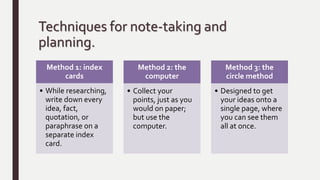
Techniques for note-taking and
planning.
Method 1: index
cards
• While researching,
write down every
idea, fact,
quotation, or
paraphrase on a
separate index
card.
Method 2: the
computer
• Collect your
points, just as you
would on paper;
but use the
computer.
Method 3: the
circle method
• Designed to get
your ideas onto a
single page, where
you can see them
all at once.
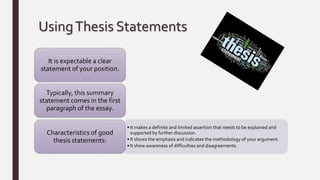
UsingThesis Statements
It is expectable a clear
statement of your position.
Typically, this summary
statement comes in the first
paragraph of the essay.
• It makes a definite and limited assertion that needs to be explained and
supported by further discussion.
• It shows the emphasis and indicates the methodology of your argument.
• It show awareness of difficulties and disagreements.
Characteristics of good
thesis statements:
Introductions
• identify your topic
• provide essential context
• indicate your particular focus in
the essay
• engage your readers’ interest.
A good
introduction
should:
How to write an interesting, effective
introduction.
Find a startling statistic that illustrates the seriousness of the problem you will address.
Quote an expert.
Mention a common misperception that your thesis will argue against.
Give some background information necessary for understanding the essay.
Use a brief narrative or anecdote that exemplifies your reason for choosing the topic.
In a science paper,explain key scientific concepts and refer to relevant literature.
In a more technical paper, define a term that is possibly unfamiliar to your audience but is central to
understanding the essay.
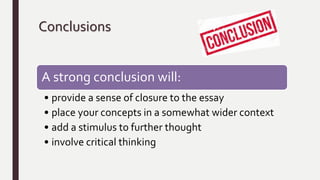
Conclusions
A strong conclusion will:
• provide a sense of closure to the essay
• place your concepts in a somewhat wider context
• add a stimulus to further thought
• involve critical thinking
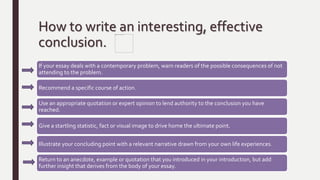
How to write an interesting, effective
conclusion.
If your essay deals with a contemporary problem, warn readers of the possible consequences of not
attending to the problem.
Recommend a specific course of action.
Use an appropriate quotation or expert opinion to lend authority to the conclusion you have
reached.
Give a startling statistic, fact or visual image to drive home the ultimate point.
Illustrate your concluding point with a relevant narrative drawn from your own life experiences.
Return to an anecdote, example or quotation that you introduced in your introduction, but add
further insight that derives from the body of your essay.
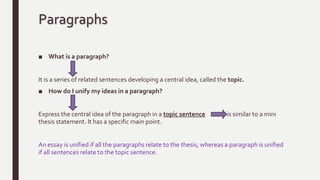
Paragraphs
■ What is a paragraph?
It is a series of related sentences developing a central idea, called the topic.
■ How do I unify my ideas in a paragraph?
Express the central idea of the paragraph in a topic sentence it is similar to a mini
thesis statement. It has a specific main point.
An essay is unified if all the paragraphs relate to the thesis, whereas a paragraph is unified
if all sentences relate to the topic sentence.
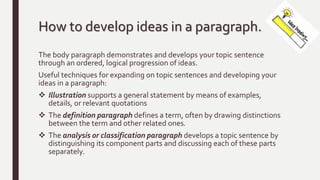
How to develop ideas in a paragraph.
The body paragraph demonstrates and develops your topic sentence
through an ordered, logical progression of ideas.
Useful techniques for expanding on topic sentences and developing your
ideas in a paragraph:
 Illustration supports a general statement by means of examples,
details, or relevant quotations
 The definition paragraph defines a term, often by drawing distinctions
between the term and other related ones.
 The analysis or classification paragraph develops a topic sentence by
distinguishing its component parts and discussing each of these parts
separately.
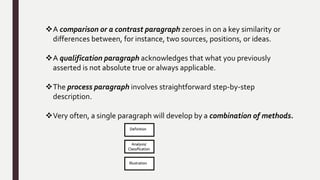
A comparison or a contrast paragraph zeroes in on a key similarity or
differences between, for instance, two sources, positions, or ideas.
A qualification paragraph acknowledges that what you previously
asserted is not absolute true or always applicable.
The process paragraph involves straightforward step-by-step
description.
Very often, a single paragraph will develop by a combination of methods.
Definition
Analysis/
Classification
Illustration
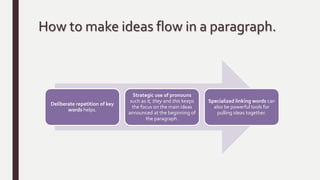
How to make ideas flow in a paragraph.
Deliberate repetition of key
words helps.
Strategic use of pronouns
such as it, they and this keeps
the focus on the main ideas
announced at the beginning of
the paragraph.
Specialized linking words can
also be powerful tools for
pulling ideas together.
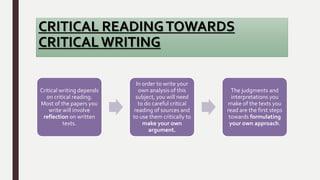
CRITICAL READINGTOWARDS
CRITICAL WRITING
Critical writing depends
on critical reading.
Most of the papers you
write will involve
reflection on written
texts.
In order to write your
own analysis of this
subject, you will need
to do careful critical
reading of sources and
to use them critically to
make your own
argument.
The judgments and
interpretations you
make of the texts you
read are the first steps
towards formulating
your own approach.
Some PracticalTips.
• Begin by skimming research materials, especially
introductions and conclusions, in order to strategically
choose where to focus your critical efforts.
• When highlighting a text or taking notes from it, teach
yourself to highlight argument.
• When you quote directly from a source, use the quotation
critically.
• Critical reading skills are also critical listening skills.
• Try to remain aware of how the portion of a text you might
use fits into the whole argument from which it is taken.
REVISING AND EDITING
It gives you the chance to:
• Preview your work on behalf of the eventual reader.
• Check details.
• Transform a mediocre first draft into an excellent
final paper.
Start Large, End Small
1. First check whether you have fulfilled the intention of the assignment.
o Have you performed the kind of thinking asked? (e.g., analyse, argue, compare)
o Have you written the genre of document called? (e.g., book review, personal response,
research report)
o Have you used concepts and methods of reasoning discussed in the course?
o Have you given adequate evidence for your argument or interpretation?
2. Then look at overall organization.
o Does your introduction make clear where the rest of the paper is headed?
o Is each section in the right place to fulfil your purpose?
o Have you drawn connections between the sections?
o Would a person reading your conclusion know what question you had asked and how you
had arrived at your answer?
3. Now polish and edit your style by moving to smaller matters such as word choice,
sentence structure, grammar, punctuation, and spelling.
o Read passages aloud to see if you have achieved the emphasis you want.
o Be sure to use spell check.
o Don’t depend on a thesaurus.
o Don’t depend on a grammar checker.
Bibliography
 Website
Advice on AcademicWriting. Retrieved from University ofToronto. Last visited: May 25th,
2020.Available at: https://advice.writing.utoronto.ca/

Academic writing we4

  • 1.
    ADVICE ON ACADEMICWRITING ISFD N°41 Subject:Written Expression IV Professor: Stella Saubidet Student: Mariana Giménez Foth Date: May 25th, 2020
  • 2.
    INDEX General Advice onEssay-Writing __________________________________ 3 Understanding EssayTopics ______________________________________ 4 Organizing an Essay _____________________________________________ 5 Techniques for note-taking and planning ____________________________ 6 UsingThesis Statements _________________________________________ 7 Introductions ___________________________________________________ 8 How to write an interesting, effective introduction _____________________ 9 Conclusions ___________________________________________________ 10 How to write an interesting, effective conclusion _____________________ 11 Paragraphs ____________________________________________________ 12 How to develop ideas in a paragraph _______________________________ 13,14 How to make ideas flow in a paragraph _____________________________ 15 Critical ReadingTowards Critical Writing __________________________16 Some PracticalTips ___________________________________________17 Revising and Editing __________________________________________ 18 Start Large, End Small ________________________________________ 19,20 Bibliography __________________________________________________ 21
  • 3.
    GENERAL ADVICE ONESSAY- WRITING. An essay should have an argument. It should try to prove something. Formulate as exactly as possible the question(s) you will seek to answer. Present your argument clearly and persuasively. Revise it extensively.
  • 4.
    Understanding essay topics 1. Notewhich concepts or methods the topic asks you to use. 2. Note the key terms in the assignment sheet that define the kind of reasoning you should be using:  Analyse (see the relationship of parts to whole)  Compare (find differences as well as similarities)  Evaluate (apply your judgement to the results of your analysis)  Argue (or agree or disagree) 3. To generate ideas, ask yourself questions about the topic. Look for controversies. 4. For an essay or argument, formulate a tentative thesis statement. Invest some time in thinking through the specific assignment you are dealing with
  • 5.
    ORGANIZING AN ESSAY The best time to think about how to organize your paper is during the pre-writing stage. What type of essay I am going to write? Does it belong to a specific genre?  The structure of an essay should not be determined by the structure of its source material.  The earlier you begin planning, the better.  Search for evidence for the points in your tentative plan while you are reading and researching.
  • 6.
    Techniques for note-takingand planning. Method 1: index cards • While researching, write down every idea, fact, quotation, or paraphrase on a separate index card. Method 2: the computer • Collect your points, just as you would on paper; but use the computer. Method 3: the circle method • Designed to get your ideas onto a single page, where you can see them all at once.
  • 7.
    UsingThesis Statements It isexpectable a clear statement of your position. Typically, this summary statement comes in the first paragraph of the essay. • It makes a definite and limited assertion that needs to be explained and supported by further discussion. • It shows the emphasis and indicates the methodology of your argument. • It show awareness of difficulties and disagreements. Characteristics of good thesis statements:
  • 8.
    Introductions • identify yourtopic • provide essential context • indicate your particular focus in the essay • engage your readers’ interest. A good introduction should:
  • 9.
    How to writean interesting, effective introduction. Find a startling statistic that illustrates the seriousness of the problem you will address. Quote an expert. Mention a common misperception that your thesis will argue against. Give some background information necessary for understanding the essay. Use a brief narrative or anecdote that exemplifies your reason for choosing the topic. In a science paper,explain key scientific concepts and refer to relevant literature. In a more technical paper, define a term that is possibly unfamiliar to your audience but is central to understanding the essay.
  • 10.
    Conclusions A strong conclusionwill: • provide a sense of closure to the essay • place your concepts in a somewhat wider context • add a stimulus to further thought • involve critical thinking
  • 11.
    How to writean interesting, effective conclusion. If your essay deals with a contemporary problem, warn readers of the possible consequences of not attending to the problem. Recommend a specific course of action. Use an appropriate quotation or expert opinion to lend authority to the conclusion you have reached. Give a startling statistic, fact or visual image to drive home the ultimate point. Illustrate your concluding point with a relevant narrative drawn from your own life experiences. Return to an anecdote, example or quotation that you introduced in your introduction, but add further insight that derives from the body of your essay.
  • 12.
    Paragraphs ■ What isa paragraph? It is a series of related sentences developing a central idea, called the topic. ■ How do I unify my ideas in a paragraph? Express the central idea of the paragraph in a topic sentence it is similar to a mini thesis statement. It has a specific main point. An essay is unified if all the paragraphs relate to the thesis, whereas a paragraph is unified if all sentences relate to the topic sentence.
  • 13.
    How to developideas in a paragraph. The body paragraph demonstrates and develops your topic sentence through an ordered, logical progression of ideas. Useful techniques for expanding on topic sentences and developing your ideas in a paragraph:  Illustration supports a general statement by means of examples, details, or relevant quotations  The definition paragraph defines a term, often by drawing distinctions between the term and other related ones.  The analysis or classification paragraph develops a topic sentence by distinguishing its component parts and discussing each of these parts separately.
  • 14.
    A comparison ora contrast paragraph zeroes in on a key similarity or differences between, for instance, two sources, positions, or ideas. A qualification paragraph acknowledges that what you previously asserted is not absolute true or always applicable. The process paragraph involves straightforward step-by-step description. Very often, a single paragraph will develop by a combination of methods. Definition Analysis/ Classification Illustration
  • 15.
    How to makeideas flow in a paragraph. Deliberate repetition of key words helps. Strategic use of pronouns such as it, they and this keeps the focus on the main ideas announced at the beginning of the paragraph. Specialized linking words can also be powerful tools for pulling ideas together.
  • 16.
    CRITICAL READINGTOWARDS CRITICAL WRITING Criticalwriting depends on critical reading. Most of the papers you write will involve reflection on written texts. In order to write your own analysis of this subject, you will need to do careful critical reading of sources and to use them critically to make your own argument. The judgments and interpretations you make of the texts you read are the first steps towards formulating your own approach.
  • 17.
    Some PracticalTips. • Beginby skimming research materials, especially introductions and conclusions, in order to strategically choose where to focus your critical efforts. • When highlighting a text or taking notes from it, teach yourself to highlight argument. • When you quote directly from a source, use the quotation critically. • Critical reading skills are also critical listening skills. • Try to remain aware of how the portion of a text you might use fits into the whole argument from which it is taken.
  • 18.
    REVISING AND EDITING Itgives you the chance to: • Preview your work on behalf of the eventual reader. • Check details. • Transform a mediocre first draft into an excellent final paper.
  • 19.
    Start Large, EndSmall 1. First check whether you have fulfilled the intention of the assignment. o Have you performed the kind of thinking asked? (e.g., analyse, argue, compare) o Have you written the genre of document called? (e.g., book review, personal response, research report) o Have you used concepts and methods of reasoning discussed in the course? o Have you given adequate evidence for your argument or interpretation? 2. Then look at overall organization. o Does your introduction make clear where the rest of the paper is headed?
  • 20.
    o Is eachsection in the right place to fulfil your purpose? o Have you drawn connections between the sections? o Would a person reading your conclusion know what question you had asked and how you had arrived at your answer? 3. Now polish and edit your style by moving to smaller matters such as word choice, sentence structure, grammar, punctuation, and spelling. o Read passages aloud to see if you have achieved the emphasis you want. o Be sure to use spell check. o Don’t depend on a thesaurus. o Don’t depend on a grammar checker.
  • 21.
    Bibliography  Website Advice onAcademicWriting. Retrieved from University ofToronto. Last visited: May 25th, 2020.Available at: https://advice.writing.utoronto.ca/