The Southern United States
Outline Notes
Mr. Zunic
Vocabulary
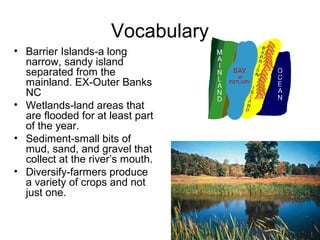
• Barrier Islands-a long
narrow, sandy island
separated from the
mainland. EX-Outer Banks
NC
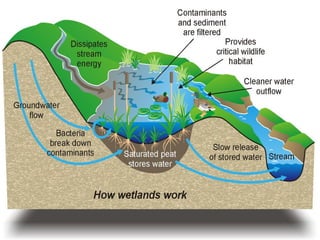
• Wetlands-land areas that
are flooded for at least part
of the year.
• Sediment-small bits of
mud, sand, and gravel that
collect at the river’s mouth.
• Diversify-farmers produce
a variety of crops and not
just one.
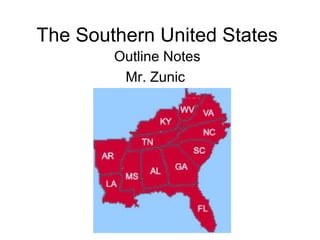
12 States that make up the South
• Louisiana
• Texas
• Arkansas
• Tennessee
• Mississippi
• Alabama
• Kentucky
• Georgia
• Florida
• South Carolina
• North Carolina
• Virginia
Landforms
• What is the major
landform region in the
South? What are two
geographic features
included in this
landform?
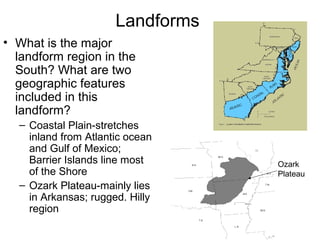
– Coastal Plain-stretches
inland from Atlantic ocean
and Gulf of Mexico;
Barrier Islands line most
of the Shore
– Ozark Plateau-mainly lies
in Arkansas; rugged. Hilly
region
Ozark
Plateau
Landforms Contd
• Where are some of the
largest wetlands
areas?
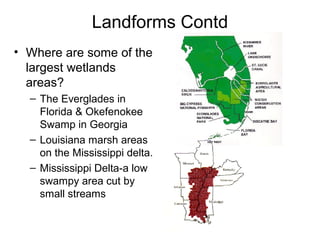
– The Everglades in
Florida & Okefenokee
Swamp in Georgia
– Louisiana marsh areas
on the Mississippi delta.
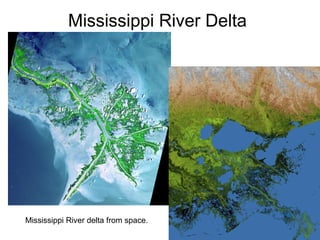
– Mississippi Delta-a low
swampy area cut by
small streams
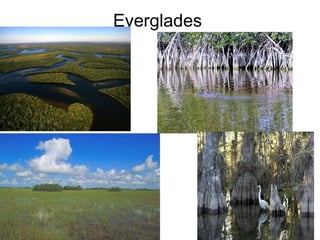
Everglades
Mississippi River Delta
Mississippi River delta from space.
Landforms Contd
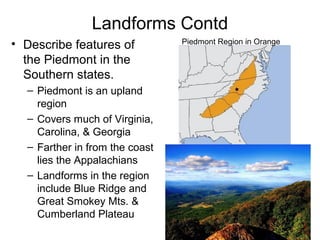
• Describe features of
the Piedmont in the
Southern states.
– Piedmont is an upland
region
– Covers much of Virginia,
Carolina, & Georgia
– Farther in from the coast
lies the Appalachians
– Landforms in the region
include Blue Ridge and
Great Smokey Mts. &
Cumberland Plateau
Piedmont Region in Orange
Landforms Contd
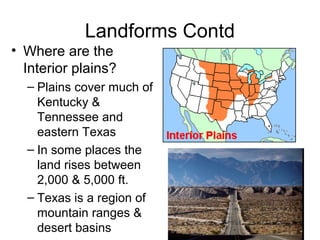
• Where are the
Interior plains?
– Plains cover much of
Kentucky &
Tennessee and
eastern Texas
– In some places the
land rises between
2,000 & 5,000 ft.
– Texas is a region of
mountain ranges &
desert basins
Climate
• What type of climate dominates
the South.
–Humid Subtropical-winters are mild;
summers are long, hot, and humid
–Appalachians and Ozarks
experience cooler temperatures
–Texas ranges from humid
subtropical to desert
Climate Contd
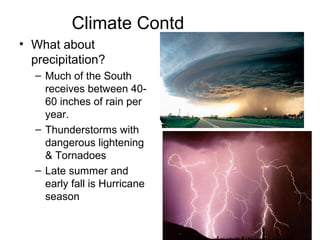
• What about
precipitation?
– Much of the South
receives between 40-
60 inches of rain per
year.
– Thunderstorms with
dangerous lightening
& Tornadoes
– Late summer and
early fall is Hurricane
season
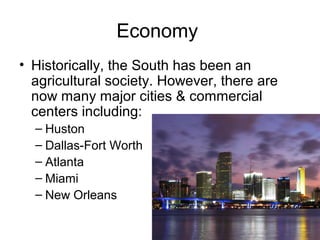
Economy
• Historically, the South has been an
agricultural society. However, there are
now many major cities & commercial
centers including:
– Huston
– Dallas-Fort Worth
– Atlanta
– Miami
– New Orleans
Agriculture
• No longer the South’s major
economic activity.
• Region has been a major
producer of cotton, tobacco, and
citrus fruits
• Recently, farmers have tried to
diversify-producing a variety of
crops, not just one.
Resources
• Coastal waters of Gulf of Mexico and
Atlantic are rich in ocean life.
• Louisiana & Texas are leading in fishing
(oysters, shrimp, etc…)
• Mineral resources include coal, sulfur, salt,
phosphates, oil, and natural gas
• Florida has the largest phosphate mining
industry
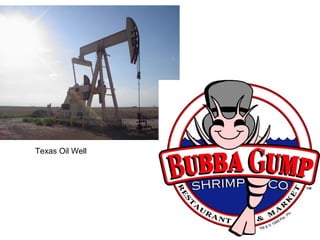
• Louisiana & Texas have oil.
Texas Oil Well
Industry
• Textile industries operate in the Piedmont
regions of Georgia, Carolinas, & Virginia
• Gulf coast and lower Mississippi have
huge oil refineries.
• Some cities have computer, software, and
publishing companies
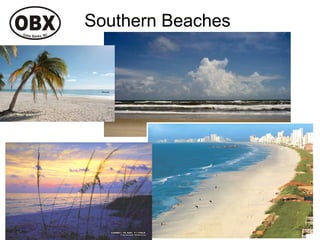
• Warm weather and beautiful beaches
draw many vacationers
• Many southern cities have important links
to central & south America such as Miami.
Southern Beaches

The southern united states

  • 1.
    The Southern UnitedStates Outline Notes Mr. Zunic
  • 2.
    Vocabulary • Barrier Islands-along narrow, sandy island separated from the mainland. EX-Outer Banks NC • Wetlands-land areas that are flooded for at least part of the year. • Sediment-small bits of mud, sand, and gravel that collect at the river’s mouth. • Diversify-farmers produce a variety of crops and not just one.
  • 4.
    12 States thatmake up the South • Louisiana • Texas • Arkansas • Tennessee • Mississippi • Alabama • Kentucky • Georgia • Florida • South Carolina • North Carolina • Virginia
  • 5.
    Landforms • What isthe major landform region in the South? What are two geographic features included in this landform? – Coastal Plain-stretches inland from Atlantic ocean and Gulf of Mexico; Barrier Islands line most of the Shore – Ozark Plateau-mainly lies in Arkansas; rugged. Hilly region Ozark Plateau
  • 6.
    Landforms Contd • Whereare some of the largest wetlands areas? – The Everglades in Florida & Okefenokee Swamp in Georgia – Louisiana marsh areas on the Mississippi delta. – Mississippi Delta-a low swampy area cut by small streams
  • 7.
  • 8.
    Mississippi River Delta MississippiRiver delta from space.
  • 9.
    Landforms Contd • Describefeatures of the Piedmont in the Southern states. – Piedmont is an upland region – Covers much of Virginia, Carolina, & Georgia – Farther in from the coast lies the Appalachians – Landforms in the region include Blue Ridge and Great Smokey Mts. & Cumberland Plateau Piedmont Region in Orange
  • 10.
    Landforms Contd • Whereare the Interior plains? – Plains cover much of Kentucky & Tennessee and eastern Texas – In some places the land rises between 2,000 & 5,000 ft. – Texas is a region of mountain ranges & desert basins
  • 11.
    Climate • What typeof climate dominates the South. –Humid Subtropical-winters are mild; summers are long, hot, and humid –Appalachians and Ozarks experience cooler temperatures –Texas ranges from humid subtropical to desert
  • 12.
    Climate Contd • Whatabout precipitation? – Much of the South receives between 40- 60 inches of rain per year. – Thunderstorms with dangerous lightening & Tornadoes – Late summer and early fall is Hurricane season
  • 13.
    Economy • Historically, theSouth has been an agricultural society. However, there are now many major cities & commercial centers including: – Huston – Dallas-Fort Worth – Atlanta – Miami – New Orleans
  • 14.
    Agriculture • No longerthe South’s major economic activity. • Region has been a major producer of cotton, tobacco, and citrus fruits • Recently, farmers have tried to diversify-producing a variety of crops, not just one.
  • 15.
    Resources • Coastal watersof Gulf of Mexico and Atlantic are rich in ocean life. • Louisiana & Texas are leading in fishing (oysters, shrimp, etc…) • Mineral resources include coal, sulfur, salt, phosphates, oil, and natural gas • Florida has the largest phosphate mining industry • Louisiana & Texas have oil.
  • 16.
  • 17.
    Industry • Textile industriesoperate in the Piedmont regions of Georgia, Carolinas, & Virginia • Gulf coast and lower Mississippi have huge oil refineries. • Some cities have computer, software, and publishing companies • Warm weather and beautiful beaches draw many vacationers • Many southern cities have important links to central & south America such as Miami.
  • 18.