Status of Genomic Selection in Forages
Margaret Worthington (CIAT) and Chris Jones (ILRI)
Workshop on Implementing Genomic Selection in CGIAR Breeding
Programs, Montpellier, 10-12 December 2015
Current Status at CIAT
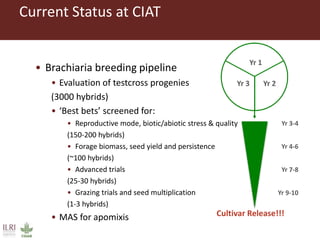
• Brachiaria breeding pipeline
• Evaluation of testcross progenies
(3000 hybrids)
• ‘Best bets’ screened for:
• Reproductive mode, biotic/abiotic stress & quality
(150-200 hybrids)
• Forage biomass, seed yield and persistence
(~100 hybrids)
• Advanced trials
(25-30 hybrids)
• Grazing trials and seed multiplication
(1-3 hybrids)
• MAS for apomixis Cultivar Release!!!
Yr 3-4
Yr 4-6
Yr 7-8
Yr 9-10
Opportunities for Genomic Selection
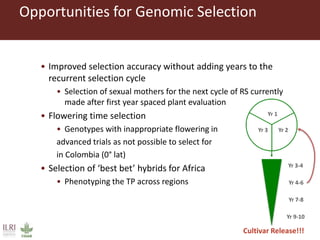
• Improved selection accuracy without adding years to the
recurrent selection cycle
• Selection of sexual mothers for the next cycle of RS currently
made after first year spaced plant evaluation
• Flowering time selection
• Genotypes with inappropriate flowering in
advanced trials as not possible to select for
in Colombia (0° lat)
• Selection of ‘best bet’ hybrids for Africa
• Phenotyping the TP across regions
Cultivar Release!!!
Yr 3-4
Yr 4-6
Yr 7-8
Yr 9-10
Current Status and Prospects for Genomic
Selection at ILRI
• Forage genebank
• 19,210 accessions (grasses, legumes & fodder trees)
• E.g. Napier grass (the most widely grown cut & carry forage)
• Extensively phenotyped over a number of years
• Morphology, forage biomass, drought tolerance, nutritive
value, smut and stunt resistance (KALRO)
• Clonally propagated crop
• Gene discovery proposal (RNAseq, GBS and AM)
• E.g. Lablab (fast growing, high yielding dual purpose crop
with wide adaptability and a large amount of variation)
• Phentotyped for crop residue (yield and quality) and tradeoff
with grain yield
New Tools and Challenges
• Tools:
• First saturated genetic maps of Brachiaria spp. by GBS
• Markers for apomixis and aluminum resistance
• Diploid B.ruziziensis reference genome (with TGAC)
• 2015/2016 funding for MatePairs, PacBio reads & annotation
• Pearl millet reference genome for Napier grass
• Challenges:
• Investment in high quality plant phenotyping
• Rapid standardized GBS protocols or a SNP platform
• Statistical models for heterozygous polyploids
• links to RTB crops
The presentation has a Creative Commons licence. You are free to re-use or distribute this work, provided credit is given to ILRI.
better lives through livestock
ilri.org

Status of genomic selection in forages

  • 1.
    Status of GenomicSelection in Forages Margaret Worthington (CIAT) and Chris Jones (ILRI) Workshop on Implementing Genomic Selection in CGIAR Breeding Programs, Montpellier, 10-12 December 2015
  • 2.
    Current Status atCIAT • Brachiaria breeding pipeline • Evaluation of testcross progenies (3000 hybrids) • ‘Best bets’ screened for: • Reproductive mode, biotic/abiotic stress & quality (150-200 hybrids) • Forage biomass, seed yield and persistence (~100 hybrids) • Advanced trials (25-30 hybrids) • Grazing trials and seed multiplication (1-3 hybrids) • MAS for apomixis Cultivar Release!!! Yr 3-4 Yr 4-6 Yr 7-8 Yr 9-10
  • 3.
    Opportunities for GenomicSelection • Improved selection accuracy without adding years to the recurrent selection cycle • Selection of sexual mothers for the next cycle of RS currently made after first year spaced plant evaluation • Flowering time selection • Genotypes with inappropriate flowering in advanced trials as not possible to select for in Colombia (0° lat) • Selection of ‘best bet’ hybrids for Africa • Phenotyping the TP across regions Cultivar Release!!! Yr 3-4 Yr 4-6 Yr 7-8 Yr 9-10
  • 4.
    Current Status andProspects for Genomic Selection at ILRI • Forage genebank • 19,210 accessions (grasses, legumes & fodder trees) • E.g. Napier grass (the most widely grown cut & carry forage) • Extensively phenotyped over a number of years • Morphology, forage biomass, drought tolerance, nutritive value, smut and stunt resistance (KALRO) • Clonally propagated crop • Gene discovery proposal (RNAseq, GBS and AM) • E.g. Lablab (fast growing, high yielding dual purpose crop with wide adaptability and a large amount of variation) • Phentotyped for crop residue (yield and quality) and tradeoff with grain yield
  • 5.
    New Tools andChallenges • Tools: • First saturated genetic maps of Brachiaria spp. by GBS • Markers for apomixis and aluminum resistance • Diploid B.ruziziensis reference genome (with TGAC) • 2015/2016 funding for MatePairs, PacBio reads & annotation • Pearl millet reference genome for Napier grass • Challenges: • Investment in high quality plant phenotyping • Rapid standardized GBS protocols or a SNP platform • Statistical models for heterozygous polyploids • links to RTB crops
  • 6.
    The presentation hasa Creative Commons licence. You are free to re-use or distribute this work, provided credit is given to ILRI. better lives through livestock ilri.org

Editor's Notes

  • #2 There MUST be a CGIAR logo or a CRP logo. You can copy and paste the logo you need from the final slide of this presentation. Then you can delete that final slide   To replace a photo above, copy and paste this link in your browser: http://www.flickr.com/photos/ilri/sets/72157632057087650/detail/   Find a photo you like and the right size, copy and paste it in the block above.