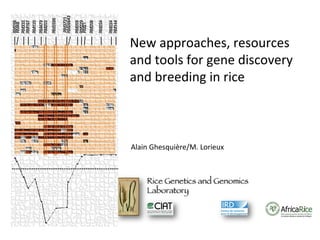
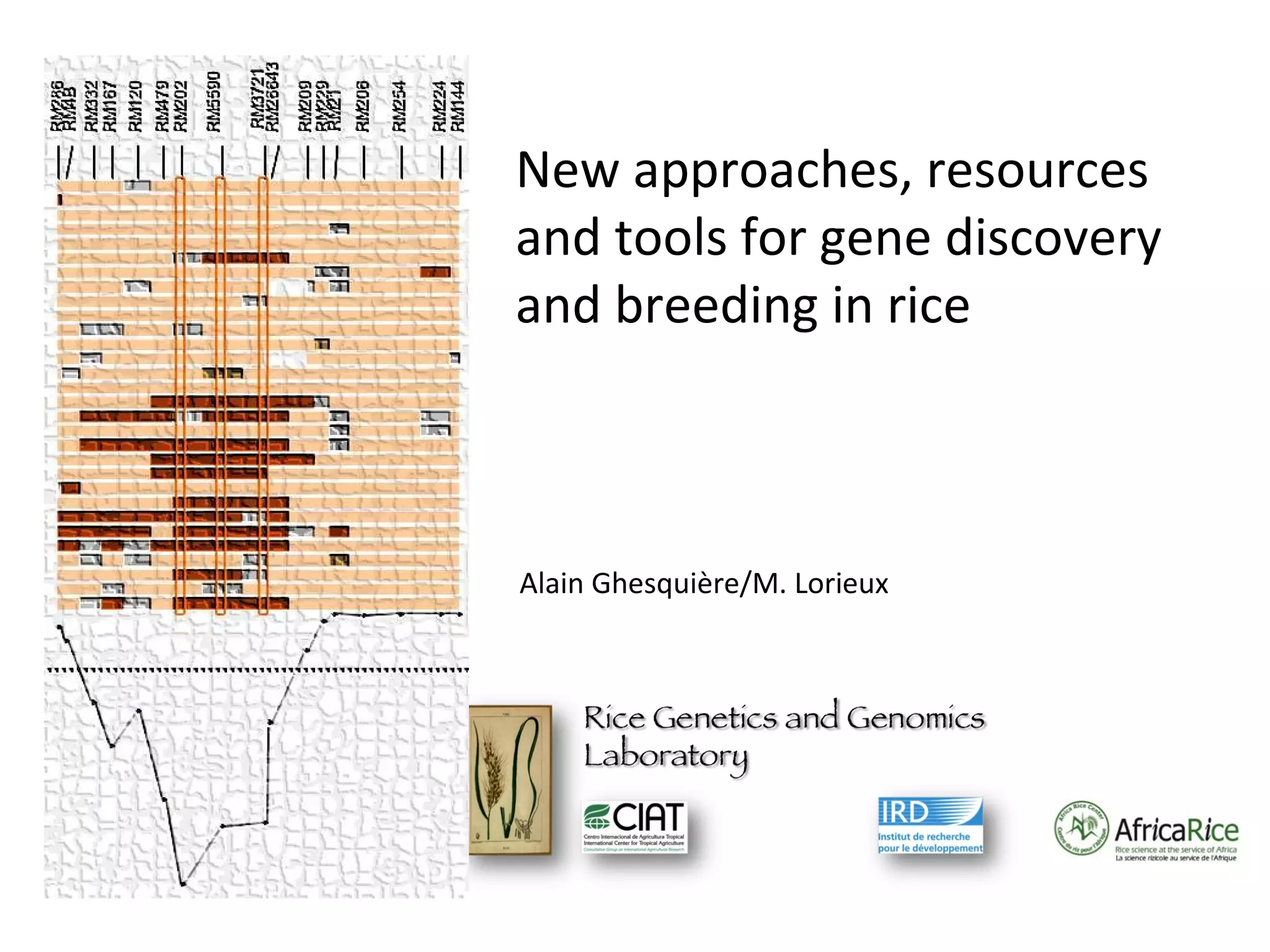
New approaches, resources
and tools for gene discovery
and breeding in rice

Alain Ghesquière/M. Lorieux
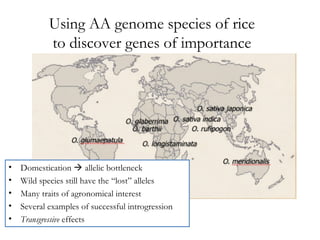
Using AA genome species of rice
to discover genes of importance

•
•
•
•
•

Domestication  allelic bottleneck
Wild species still have the “lost” alleles
Many traits of agronomical interest
Several examples of successful introgression
Transgressive effects
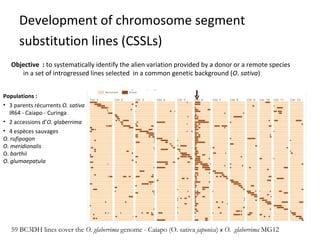
Development of chromosome segment
substitution lines (CSSLs)
Objective : to systematically identify the alien variation provided by a donor or a remote species
in a set of introgressed lines selected in a common genetic background (O. sativa)
Populations :
• 3 parents récurrents O. sativa
IR64 - Caiapo - Curinga
• 2 accessions d’O. glaberrima
• 4 espèces sauvages
O. rufipogon
O. meridionalis
O. barthii
O. glumaepatula

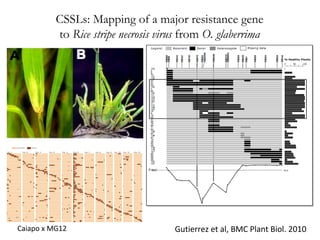
59 BC3DH lines cover the O. glaberrima genome - Caiapo (O. sativa japonica) x O. glaberrima MG12
CSSLs: Mapping of a major resistance gene
to Rice stripe necrosis virus from O. glaberrima

Caiapo x MG12

Gutierrez et al, BMC Plant Biol. 2010
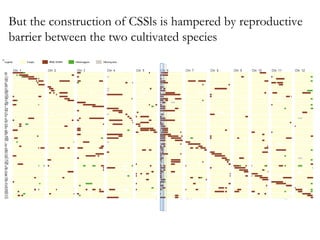
But the construction of CSSls is hampered by reproductive
barrier between the two cultivated species
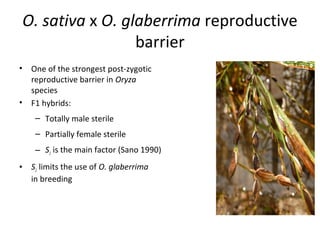
O. sativa x O. glaberrima reproductive
barrier
•

•

One of the strongest post-zygotic
reproductive barrier in Oryza
species
F1 hybrids:
– Totally male sterile
– Partially female sterile
– S1 is the main factor (Sano 1990)

•

S1 limits the use of O. glaberrima
in breeding
RMC6_22046
RM19359
E1920

RMC6_22028

RMC6_21989

RMC6_21942

RMC6_21851

C6_216837

C6_21824

C6_21804

C6_21778

C6_21774

RM19357

RMC6_21678

E0506

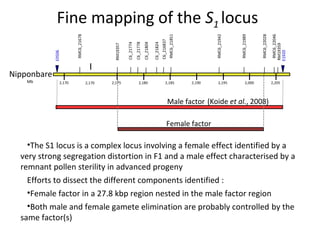
Fine mapping of the S1 locus
Nipponbare
Mb

2,170

2,170

2,175

2,180

2,185

2,190

2,195

2,000

2,205

Male factor (Koide et al., 2008)
Female factor

•The S1 locus is a complex locus involving a female effect identified by a
very strong segregation distortion in F1 and a male effect characterised by a
remnant pollen sterility in advanced progeny
Efforts to dissect the different components identified :
•Female factor in a 27.8 kbp region nested in the male factor region
•Both male and female gamete elimination are probably controlled by the
same factor(s)
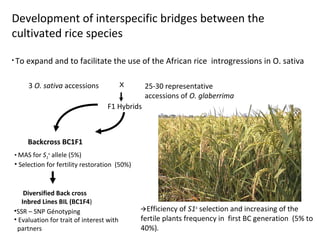
Development of interspecific bridges between the
cultivated rice species
• To

expand and to facilitate the use of the African rice introgressions in O. sativa
X

3 O. sativa accessions

25-30 representative
accessions of O. glaberrima

F1 Hybrids

Backcross BC1F1
• MAS for S1s allele (5%)

• Selection for fertility restoration (50%)

Diversified Back cross
Inbred Lines BIL (BC1F4)
•SSR – SNP Génotyping
• Evaluation for trait of interest with
partners

Efficiency of

S1s selection and increasing of the
fertile plants frequency in first BC generation (5% to
40%).
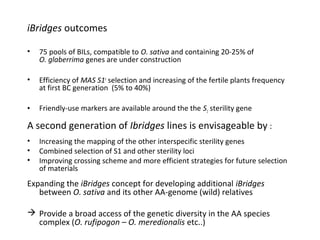
iBridges outcomes
•

75 pools of BILs, compatible to O. sativa and containing 20-25% of
O. glaberrima genes are under construction

•

Efficiency of MAS S1s selection and increasing of the fertile plants frequency
at first BC generation (5% to 40%)

•

Friendly-use markers are available around the the S1 sterility gene

A second generation of Ibridges lines is envisageable by :
•
•
•

Increasing the mapping of the other interspecific sterility genes
Combined selection of S1 and other sterility loci
Improving crossing scheme and more efficient strategies for future selection
of materials

Expanding the iBridges concept for developing additional iBridges
between O. sativa and its other AA-genome (wild) relatives
 Provide a broad access of the genetic diversity in the AA species
complex (O. rufipogon – O. meredionalis etc..)
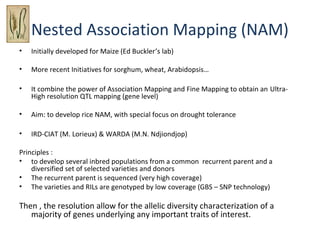
Nested Association Mapping (NAM)
•

Initially developed for Maize (Ed Buckler’s lab)

•

More recent Initiatives for sorghum, wheat, Arabidopsis…

•

It combine the power of Association Mapping and Fine Mapping to obtain an UltraHigh resolution QTL mapping (gene level)

•

Aim: to develop rice NAM, with special focus on drought tolerance

•

IRD-CIAT (M. Lorieux) & WARDA (M.N. Ndjiondjop)

Principles :
• to develop several inbred populations from a common recurrent parent and a
diversified set of selected varieties and donors
• The recurrent parent is sequenced (very high coverage)
• The varieties and RILs are genotyped by low coverage (GBS – SNP technology)

Then , the resolution allow for the allelic diversity characterization of a
majority of genes underlying any important traits of interest.
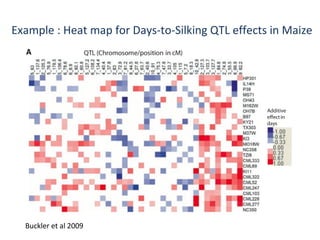
Example : Heat map for Days-to-Silking QTL effects in Maize

Buckler et al 2009
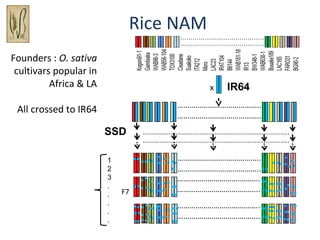
Rice NAM
Founders : O. sativa 
cultivars popular in
Africa & LA

x

All crossed to IR64
SSD
1
2
3
.
.
.
.
.

F7

IR64
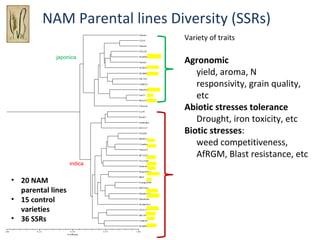
NAM Parental lines Diversity (SSRs)
Nerica5
CG14

Variety of traits

Nerica4
ITA150

japonica

WAB56-104
Nerica3
WAB181-1
WAB96-3
IAC165
FARO11
Moroberekan
Lac23
IRAT104
Chocoto
Co39
Rock5
Gambiaka
IET3137
ITA306
BG90-2
Cisadane
Nerica19
IR13240
Tox3100

indica

Suakoko
Kogoni91-1

• 20 NAM
parental lines
• 15 control
varieties
• 36 SSRs

IR64
Foniap2000
BW348-1
Bouake189
Djoukeme
WAB638-1
ITA212
B6144
FARO31
WAB96-1-1

0.00

0.25

0.50

Coefficient

0.75

1.00

Agronomic
yield, aroma, N
responsivity, grain quality,
etc
Abiotic stresses tolerance
Drought, iron toxicity, etc
Biotic stresses:
weed competitiveness,
AfRGM, Blast resistance, etc
Current status & perspectives
• CIAT: 2,000 lines, 10 combinations, F7 harvested
• AfricaRice: 2,000 lines, 10 combinations, F7 harvested
• Seed exchange on going
• Genotyping:
• Low resolution WGS / imputation
(IRIGIN project)
• Genotyping By Sequencing
(w S. Dellaporta, Yale Uty)
• Phenotyping:
• GRiSP Phenotyping Network
• Tools for data analysis:
MapDisto

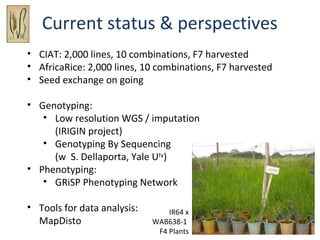
IR64 x
WAB638-1
F4 Plants

Th1_New approaches, resources and tools for gene discovery

  • 1.
    New approaches, resources andtools for gene discovery and breeding in rice Alain Ghesquière/M. Lorieux
  • 2.
    Using AA genomespecies of rice to discover genes of importance • • • • • Domestication  allelic bottleneck Wild species still have the “lost” alleles Many traits of agronomical interest Several examples of successful introgression Transgressive effects
  • 3.
    Development of chromosomesegment substitution lines (CSSLs) Objective : to systematically identify the alien variation provided by a donor or a remote species in a set of introgressed lines selected in a common genetic background (O. sativa) Populations : • 3 parents récurrents O. sativa IR64 - Caiapo - Curinga • 2 accessions d’O. glaberrima • 4 espèces sauvages O. rufipogon O. meridionalis O. barthii O. glumaepatula 59 BC3DH lines cover the O. glaberrima genome - Caiapo (O. sativa japonica) x O. glaberrima MG12
  • 4.
    CSSLs: Mapping ofa major resistance gene to Rice stripe necrosis virus from O. glaberrima Caiapo x MG12 Gutierrez et al, BMC Plant Biol. 2010
  • 5.
    But the constructionof CSSls is hampered by reproductive barrier between the two cultivated species
  • 6.
    O. sativa xO. glaberrima reproductive barrier • • One of the strongest post-zygotic reproductive barrier in Oryza species F1 hybrids: – Totally male sterile – Partially female sterile – S1 is the main factor (Sano 1990) • S1 limits the use of O. glaberrima in breeding
  • 7.
    RMC6_22046 RM19359 E1920 RMC6_22028 RMC6_21989 RMC6_21942 RMC6_21851 C6_216837 C6_21824 C6_21804 C6_21778 C6_21774 RM19357 RMC6_21678 E0506 Fine mapping ofthe S1 locus Nipponbare Mb 2,170 2,170 2,175 2,180 2,185 2,190 2,195 2,000 2,205 Male factor (Koide et al., 2008) Female factor •The S1 locus is a complex locus involving a female effect identified by a very strong segregation distortion in F1 and a male effect characterised by a remnant pollen sterility in advanced progeny Efforts to dissect the different components identified : •Female factor in a 27.8 kbp region nested in the male factor region •Both male and female gamete elimination are probably controlled by the same factor(s)
  • 8.
    Development of interspecificbridges between the cultivated rice species • To expand and to facilitate the use of the African rice introgressions in O. sativa X 3 O. sativa accessions 25-30 representative accessions of O. glaberrima F1 Hybrids Backcross BC1F1 • MAS for S1s allele (5%) • Selection for fertility restoration (50%) Diversified Back cross Inbred Lines BIL (BC1F4) •SSR – SNP Génotyping • Evaluation for trait of interest with partners Efficiency of S1s selection and increasing of the fertile plants frequency in first BC generation (5% to 40%).
  • 9.
    iBridges outcomes • 75 poolsof BILs, compatible to O. sativa and containing 20-25% of O. glaberrima genes are under construction • Efficiency of MAS S1s selection and increasing of the fertile plants frequency at first BC generation (5% to 40%) • Friendly-use markers are available around the the S1 sterility gene A second generation of Ibridges lines is envisageable by : • • • Increasing the mapping of the other interspecific sterility genes Combined selection of S1 and other sterility loci Improving crossing scheme and more efficient strategies for future selection of materials Expanding the iBridges concept for developing additional iBridges between O. sativa and its other AA-genome (wild) relatives  Provide a broad access of the genetic diversity in the AA species complex (O. rufipogon – O. meredionalis etc..)
  • 10.
    Nested Association Mapping(NAM) • Initially developed for Maize (Ed Buckler’s lab) • More recent Initiatives for sorghum, wheat, Arabidopsis… • It combine the power of Association Mapping and Fine Mapping to obtain an UltraHigh resolution QTL mapping (gene level) • Aim: to develop rice NAM, with special focus on drought tolerance • IRD-CIAT (M. Lorieux) & WARDA (M.N. Ndjiondjop) Principles : • to develop several inbred populations from a common recurrent parent and a diversified set of selected varieties and donors • The recurrent parent is sequenced (very high coverage) • The varieties and RILs are genotyped by low coverage (GBS – SNP technology) Then , the resolution allow for the allelic diversity characterization of a majority of genes underlying any important traits of interest.
  • 11.
    Example : Heatmap for Days-to-Silking QTL effects in Maize Buckler et al 2009
  • 12.
    Rice NAM Founders :O. sativa  cultivars popular in Africa & LA x All crossed to IR64 SSD 1 2 3 . . . . . F7 IR64
  • 13.
    NAM Parental linesDiversity (SSRs) Nerica5 CG14 Variety of traits Nerica4 ITA150 japonica WAB56-104 Nerica3 WAB181-1 WAB96-3 IAC165 FARO11 Moroberekan Lac23 IRAT104 Chocoto Co39 Rock5 Gambiaka IET3137 ITA306 BG90-2 Cisadane Nerica19 IR13240 Tox3100 indica Suakoko Kogoni91-1 • 20 NAM parental lines • 15 control varieties • 36 SSRs IR64 Foniap2000 BW348-1 Bouake189 Djoukeme WAB638-1 ITA212 B6144 FARO31 WAB96-1-1 0.00 0.25 0.50 Coefficient 0.75 1.00 Agronomic yield, aroma, N responsivity, grain quality, etc Abiotic stresses tolerance Drought, iron toxicity, etc Biotic stresses: weed competitiveness, AfRGM, Blast resistance, etc
  • 14.
    Current status &perspectives • CIAT: 2,000 lines, 10 combinations, F7 harvested • AfricaRice: 2,000 lines, 10 combinations, F7 harvested • Seed exchange on going • Genotyping: • Low resolution WGS / imputation (IRIGIN project) • Genotyping By Sequencing (w S. Dellaporta, Yale Uty) • Phenotyping: • GRiSP Phenotyping Network • Tools for data analysis: MapDisto IR64 x WAB638-1 F4 Plants

Editor's Notes

  • #2 {"8":"Place dans l’expose ?\nSupprimer tableau\nSimplifier encore\n","3":"(Alain)\nAlléger le texte\nreprendre la figure de 13\nEliminer la référence a Kit\n"}