Genetic Programming in automated test code
generation for a multi-threaded microprocessor.
Neow Way Yuh
MSc. Machine Learning and Data Mining.
Supervised by Dr. Kerstin Eder and
Mr. Peter Hedinger
Introduction
• The complexity of modern microprocessors makes
verification difficult.
• Recent research on Coverage-Directed test Generation
(CDG) uses machine learning approaches.
• Genetic Programming (GP) is one of the machine
learning methods used in CDG.
• Initial experiments with GP in multi-threaded
microprocessor verification show potential.
• Presentation starts with introduction to GP and a case
study with the XMOS multi-threaded microprocessor.
• GP is based on the natural evolution process.
• Darwin Theorem: Natural selection promotes favourable
heritable traits in successive generations.
• In GP, each individual in a population is given a quantitative
measurement to reflect the quality of an individual relative to
the environment.
Fundamentals of Genetic
Programming (GP)‫‏‬
GP in test code generation
• Selection algorithm samples two individuals from the population based on their
fitness values (e.g. Higher fitness value individuals get sampled more often).
• The parents are merged using genetic operators to produce new individuals.
• An external simulator is used to evaluate the fitness of the new individuals.
• GP implementation in Coverage-Directed test Generation requires less expert
knowledge compared to other methods (e.g. Bayesian Network).
Case study: XMOS multi-
threaded microprocessor
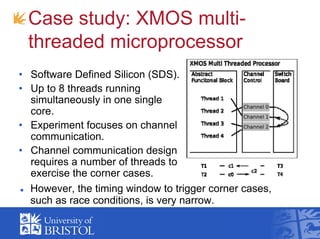
• Software Defined Silicon (SDS).
• Up to 8 threads running
simultaneously in one single
core.
• Experiment focuses on channel
communication.
• Channel communication design
requires a number of threads to
exercise the corner cases.
However, the timing window to trigger corner cases,
such as race conditions, is very narrow.
Implemented CDG loop
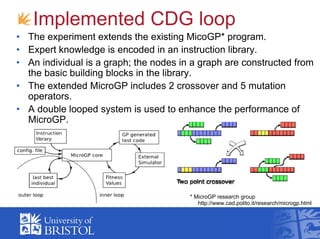
• The experiment extends the existing MicoGP* program.
• Expert knowledge is encoded in an instruction library.
• An individual is a graph; the nodes in a graph are constructed from
the basic building blocks in the library.
• The extended MicroGP includes 2 crossover and 5 mutation
operators.
• A double looped system is used to enhance the performance of
MicroGP.
* MicroGP research group
http://www.cad.polito.it/research/microgp.html
Encoding multi-threaded test
code in GP
• A test program can be represented by a graph; a node in a graph maps to a
channel operation and a branch represents the content of a new thread.
Feedback measurements
• Improves basic coverage measurements such as line
coverage and branch coverage.
• Minimises simulation cycles.
• Minimises the main graph to encourage more threads in
test code.
• Balances the distribution of operations among the
threads.
• Increases operation on channel IO.
• All feedback measurements are optimised together with
different priority.
Experiment Results
• Test code generated by MicroGP method is significantly better
than human engineer and randomly generated sequences.
• Actual line coverage improved to 94% and up to 50% cycle
reduction.
12 345 678 901 234 567 890 123 456 789
65
70
75
80
Line Coverage
Random Seed
Percentage(%)
12 345 678 901 234 567 890 123 456 789
0
5000
10000
15000
20000
25000
30000
35000
Simulation Cycle
Human
Random
MicroGP
Random Seed
UnitCycle
Thank you.
Questions ?

Genetic Programming in Automated Test Code Generation

  • 1.
    Genetic Programming inautomated test code generation for a multi-threaded microprocessor. Neow Way Yuh MSc. Machine Learning and Data Mining. Supervised by Dr. Kerstin Eder and Mr. Peter Hedinger
  • 2.
    Introduction • The complexityof modern microprocessors makes verification difficult. • Recent research on Coverage-Directed test Generation (CDG) uses machine learning approaches. • Genetic Programming (GP) is one of the machine learning methods used in CDG. • Initial experiments with GP in multi-threaded microprocessor verification show potential. • Presentation starts with introduction to GP and a case study with the XMOS multi-threaded microprocessor.
  • 3.
    • GP isbased on the natural evolution process. • Darwin Theorem: Natural selection promotes favourable heritable traits in successive generations. • In GP, each individual in a population is given a quantitative measurement to reflect the quality of an individual relative to the environment. Fundamentals of Genetic Programming (GP)‫‏‬
  • 4.
    GP in testcode generation • Selection algorithm samples two individuals from the population based on their fitness values (e.g. Higher fitness value individuals get sampled more often). • The parents are merged using genetic operators to produce new individuals. • An external simulator is used to evaluate the fitness of the new individuals. • GP implementation in Coverage-Directed test Generation requires less expert knowledge compared to other methods (e.g. Bayesian Network).
  • 5.
    Case study: XMOSmulti- threaded microprocessor • Software Defined Silicon (SDS). • Up to 8 threads running simultaneously in one single core. • Experiment focuses on channel communication. • Channel communication design requires a number of threads to exercise the corner cases. However, the timing window to trigger corner cases, such as race conditions, is very narrow.
  • 6.
    Implemented CDG loop •The experiment extends the existing MicoGP* program. • Expert knowledge is encoded in an instruction library. • An individual is a graph; the nodes in a graph are constructed from the basic building blocks in the library. • The extended MicroGP includes 2 crossover and 5 mutation operators. • A double looped system is used to enhance the performance of MicroGP. * MicroGP research group http://www.cad.polito.it/research/microgp.html
  • 7.
    Encoding multi-threaded test codein GP • A test program can be represented by a graph; a node in a graph maps to a channel operation and a branch represents the content of a new thread.
  • 8.
    Feedback measurements • Improvesbasic coverage measurements such as line coverage and branch coverage. • Minimises simulation cycles. • Minimises the main graph to encourage more threads in test code. • Balances the distribution of operations among the threads. • Increases operation on channel IO. • All feedback measurements are optimised together with different priority.
  • 9.
    Experiment Results • Testcode generated by MicroGP method is significantly better than human engineer and randomly generated sequences. • Actual line coverage improved to 94% and up to 50% cycle reduction. 12 345 678 901 234 567 890 123 456 789 65 70 75 80 Line Coverage Random Seed Percentage(%) 12 345 678 901 234 567 890 123 456 789 0 5000 10000 15000 20000 25000 30000 35000 Simulation Cycle Human Random MicroGP Random Seed UnitCycle
  • 10.