GENETIC ENGINEERING
FOR CROP IMPROVEMENT
BY:
T.NIVETHITHA,
III-BIOTECHNOLOGY.
Plant Transformation with the
Ti-Plasmid of A.tumefaciens
 Agrobacterium tumefaciens are gram-negative
organisms responsible for transfer of target
DNA(T-DNA). These phytopathogens, transforms
plant cells (trasngenic plants), which genetic
transformation leads to the formation of Crown
gall tumors.
 As it helps in the transformation of plants,
Agrobacterium spp. are known as Natural Genetic
engineers.
 The involvement of Agrobacterium spp. was
discovered by Smith and Townsend in 1907.
Ti-Plasmid
 Ti-plasmid carries about approximately 10-
30kbp of T-DNA.
 The virulent strains of A.tumifaciens harbor
large plasmids of about 140-235 kbp,
known as Ti-Plasmids.
 It consists of vir region, origin of
replication, region enabling conjugative
transfer, o-cat region for catabolism of
opines and most importantly T-DNA.
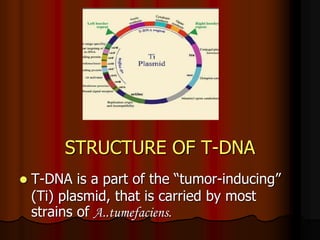
STRUCTURE OF T-DNA
 T-DNA is a part of the “tumor-inducing”
(Ti) plasmid, that is carried by most
strains of A..tumefaciens.
T-DNA is defined by its left and right
borders and includes genes for the
biosynthesis of auxin,cytokinin and opine.
Process Involved:
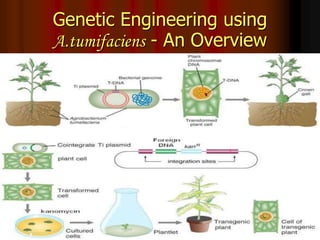
 The initial step in the infection is the attachment
of A.tumefaciens to a plant cell at the site of an
open wound, often at the crown(base), which
produces a network of cellulose fibrils that bind
the bacterium tightly to the plant cell surface.
 These bacteria respond to certain plant phenolic
componds, acetosyringone and
hydroxyacetosyringone, excreted by wounded
plants. These small molecules act to induce the
virulence (vir) genes located on 35kb region of
Ti-plasmid.
 After Ti-plasmid carrying A.tumifaciens attaches to
a host plant, the vir genes are induced and
becomes integrated into the chromosomal DNA.
 The T-DNA also contains iaaM and iaaH genes.
 The iaaM codes for the enzyme tryptophan 2-
monooxygenase which converts tryptophan to
indole 3-acetamide hydrolase, which coverts it to
indoleacetic acid.
 The T-DNA also carries ‘tmr’ gene(ipt), that
encodes isopentenyltransferase responsible for
the synthesis of cytokinin isopentenyladenine.
 The opines are synthesized within the crown gall
and then secreted, which can be used as a
carbon source, and sometimes as nitrogen
source by A.tumifaciens.
 The binary cloning vector system and
cointegrate cloning vector system are being
used in this transfer technique.
 Finally, the transformed cells are being tested by
Kanamycin treatment, and if they grew the
transformation is confirmed and those
transgenic plants or crops are cultivated in a
large scale.
Genetic Engineering using
A.tumifaciens - An Overview
Physical Methods of Transferring
Genes to Plants
MICROPROJECTILE BOMBARDMENT-
(Biolistics) Used with a wide range of
plants and tissues; easy and
inexpensive.
VIRAL VECTORS- Not an effective way
to deliver DNA to plant cells.
DIRECT GENE TRANSFER INTO PLANT
PROTOPLASTS- Can be used only
with the plant cell protoplasts that
can be regenerated into viable plants.
ELECTROPORATION- Generally limited to
plant cell protoplasts that can be
regenerated into viable plants.
LIPOSOME FUSION- Can be used only with
plant cell protoplasts that can be
regenerated into viable plants.
MICROINJECTION- Has limited usefulness
because only one cell can be injected at a
time; requires the services of a highly
skilled individual.
APPLICATIONS:
 Crop Improvement
 Genetically Engineered Traits: The Big Six
1. Herbicide resistance
2. Insect resistance
3. Virus resistance
4. Altered oil content
5. Delayed fuit ripening
6. Pollen control
 Biotech Revolution: Cold and Drought
Tolerance and Weather-gard genes
1. Genetically Engineered foods
2. Soybeans
3. Corn
4. Cotton
5. Other crops
Reference:
 Molecular Biotechnology: Principles and
Applications of Recombinant DNA – R.
Glick, J. Pasternak, L. Patten.
Genetic engineering for crop improvement

Genetic engineering for crop improvement

  • 1.
    GENETIC ENGINEERING FOR CROPIMPROVEMENT BY: T.NIVETHITHA, III-BIOTECHNOLOGY.
  • 2.
    Plant Transformation withthe Ti-Plasmid of A.tumefaciens  Agrobacterium tumefaciens are gram-negative organisms responsible for transfer of target DNA(T-DNA). These phytopathogens, transforms plant cells (trasngenic plants), which genetic transformation leads to the formation of Crown gall tumors.  As it helps in the transformation of plants, Agrobacterium spp. are known as Natural Genetic engineers.  The involvement of Agrobacterium spp. was discovered by Smith and Townsend in 1907.
  • 3.
    Ti-Plasmid  Ti-plasmid carriesabout approximately 10- 30kbp of T-DNA.  The virulent strains of A.tumifaciens harbor large plasmids of about 140-235 kbp, known as Ti-Plasmids.  It consists of vir region, origin of replication, region enabling conjugative transfer, o-cat region for catabolism of opines and most importantly T-DNA.
  • 4.
    STRUCTURE OF T-DNA T-DNA is a part of the “tumor-inducing” (Ti) plasmid, that is carried by most strains of A..tumefaciens.
  • 5.
    T-DNA is definedby its left and right borders and includes genes for the biosynthesis of auxin,cytokinin and opine.
  • 6.
    Process Involved:  Theinitial step in the infection is the attachment of A.tumefaciens to a plant cell at the site of an open wound, often at the crown(base), which produces a network of cellulose fibrils that bind the bacterium tightly to the plant cell surface.  These bacteria respond to certain plant phenolic componds, acetosyringone and hydroxyacetosyringone, excreted by wounded plants. These small molecules act to induce the virulence (vir) genes located on 35kb region of Ti-plasmid.  After Ti-plasmid carrying A.tumifaciens attaches to a host plant, the vir genes are induced and becomes integrated into the chromosomal DNA.  The T-DNA also contains iaaM and iaaH genes.
  • 7.
     The iaaMcodes for the enzyme tryptophan 2- monooxygenase which converts tryptophan to indole 3-acetamide hydrolase, which coverts it to indoleacetic acid.
  • 8.
     The T-DNAalso carries ‘tmr’ gene(ipt), that encodes isopentenyltransferase responsible for the synthesis of cytokinin isopentenyladenine.  The opines are synthesized within the crown gall and then secreted, which can be used as a carbon source, and sometimes as nitrogen source by A.tumifaciens.  The binary cloning vector system and cointegrate cloning vector system are being used in this transfer technique.  Finally, the transformed cells are being tested by Kanamycin treatment, and if they grew the transformation is confirmed and those transgenic plants or crops are cultivated in a large scale.
  • 9.
  • 10.
    Physical Methods ofTransferring Genes to Plants MICROPROJECTILE BOMBARDMENT- (Biolistics) Used with a wide range of plants and tissues; easy and inexpensive. VIRAL VECTORS- Not an effective way to deliver DNA to plant cells. DIRECT GENE TRANSFER INTO PLANT PROTOPLASTS- Can be used only with the plant cell protoplasts that can be regenerated into viable plants.
  • 11.
    ELECTROPORATION- Generally limitedto plant cell protoplasts that can be regenerated into viable plants. LIPOSOME FUSION- Can be used only with plant cell protoplasts that can be regenerated into viable plants. MICROINJECTION- Has limited usefulness because only one cell can be injected at a time; requires the services of a highly skilled individual.
  • 12.
    APPLICATIONS:  Crop Improvement Genetically Engineered Traits: The Big Six 1. Herbicide resistance 2. Insect resistance 3. Virus resistance 4. Altered oil content 5. Delayed fuit ripening 6. Pollen control
  • 13.
     Biotech Revolution:Cold and Drought Tolerance and Weather-gard genes 1. Genetically Engineered foods 2. Soybeans 3. Corn 4. Cotton 5. Other crops
  • 14.
    Reference:  Molecular Biotechnology:Principles and Applications of Recombinant DNA – R. Glick, J. Pasternak, L. Patten.