COMPLEMENT SYSTEM
MNEMONICS
Ms. A. INDUMATHI
&
M.V.MALA
PG & RESEARCH DEPARTMENT OF BIOTECHNOLOGY
Bon Secours College for Women, Thanjavur
IMMUNOLOGY
❑ INTRODUCTION
❑ COMPLEMENT COMPONENT
Classical Alternative Mannose Binding Lectin
Pathway Pathway Pathway
❑ BIOLOGIC EFFECTS
❑ REGULATION
❑ CONCLUSION
COMPLEMENT COMPONENTS
• Complement was discoverd by Jules Bordet as a heat-
labile component of normal plasma that causes the
Opsonisation and killing of bacteria.
• Group of 20 plasma proteins and essential part in the
innate immunity.
• Word “Complement” enhances or complements our
immunity
• 11 protein are mostly involved name as B, C1-C9 and D.
Catalyze a series of enzymatic reactions
Products of complement system
ENZYMES CASCADE the activations of one protein
to another protein with enzyme help
• Attracts macrophagess and neutrophils and also actives
mast cell.
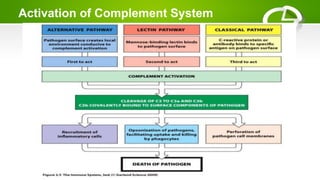
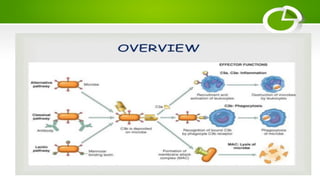
Activation of Complement System
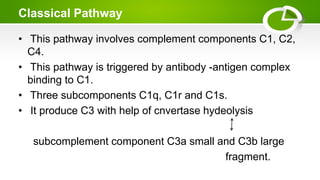
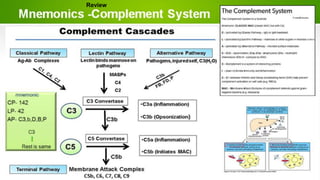
Classical Pathway
• This pathway involves complement components C1, C2,
C4.
• This pathway is triggered by antibody -antigen complex
binding to C1.
• Three subcomponents C1q, C1r and C1s.
• It produce C3 with help of cnvertase hydeolysis
subcomplement component C3a small and C3b large
fragment.
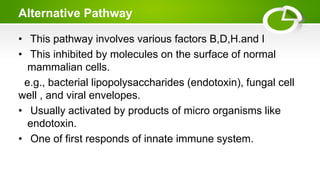
Alternative Pathway
• This pathway involves various factors B,D,H.and I
• This inhibited by molecules on the surface of normal
mammalian cells.
e.g., bacterial lipopolysaccharides (endotoxin), fungal cell
well , and viral envelopes.
• Usually activated by products of micro organisms like
endotoxin.
• One of first responds of innate immune system.
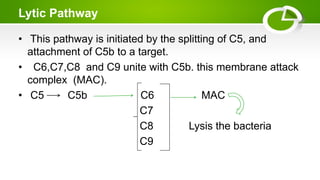
Lytic Pathway
• This pathway is initiated by the splitting of C5, and
attachment of C5b to a target.
• C6,C7,C8 and C9 unite with C5b. this membrane attack
complex (MAC).
• C5 C5b C6 MAC
C7
C8 Lysis the bacteria
C9
Review
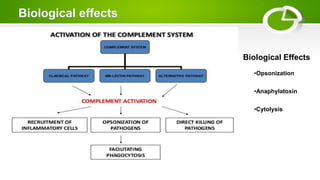
Biological Effects
•Opsonization
•Anaphylatoxin
•Cytolysis
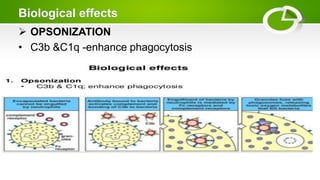
➢ OPSONIZATION
• C3b &C1q -enhance phagocytosis
➢ Anaphylatoxin
( C3a,C4a,C5a )
• Smaller complement fragments
➢ Cytolysis (MAC)
• Disrupt the mambrane and entry H2O and electrolyte into
the cell.
➢ Enhancement of antibody production
• Binding of C3b its receptors on the surface of activated
B cells enhanced antibody production.
ROLE OF COMPLEMENT IN DISEASE
▪ This inflammation Response
▪ Fungal infection
▪ Bacterial infection
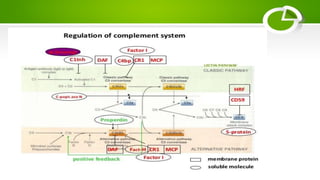
REGULATION
C1 Inhibitor
• Important regulator of classic pathway
Factor H
• Regulate alternative pathway
Properdin
• Protects C3b and stabilizes C3 convertase
Complement receptor
Complement protein
CONCLUSION
• The complement system is a group of serum protein,
which participate in innate as well as adaptive immune
response.
• The complement system is characteristically activated by
antigen antibody interaction.
• It is help antibacterial cells and molecules of the immune
system.
THANK YOU
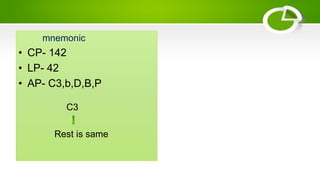
mnemonic
• CP- 142
• LP- 42
• AP- C3,b,D,B,P
C3
Rest is same

Complement pathway (mnemonic)

  • 1.
    COMPLEMENT SYSTEM MNEMONICS Ms. A.INDUMATHI & M.V.MALA PG & RESEARCH DEPARTMENT OF BIOTECHNOLOGY Bon Secours College for Women, Thanjavur IMMUNOLOGY
  • 2.
    ❑ INTRODUCTION ❑ COMPLEMENTCOMPONENT Classical Alternative Mannose Binding Lectin Pathway Pathway Pathway ❑ BIOLOGIC EFFECTS ❑ REGULATION ❑ CONCLUSION
  • 3.
    COMPLEMENT COMPONENTS • Complementwas discoverd by Jules Bordet as a heat- labile component of normal plasma that causes the Opsonisation and killing of bacteria. • Group of 20 plasma proteins and essential part in the innate immunity. • Word “Complement” enhances or complements our immunity • 11 protein are mostly involved name as B, C1-C9 and D.
  • 4.
    Catalyze a seriesof enzymatic reactions Products of complement system ENZYMES CASCADE the activations of one protein to another protein with enzyme help • Attracts macrophagess and neutrophils and also actives mast cell.
  • 5.
  • 6.
    Classical Pathway • Thispathway involves complement components C1, C2, C4. • This pathway is triggered by antibody -antigen complex binding to C1. • Three subcomponents C1q, C1r and C1s. • It produce C3 with help of cnvertase hydeolysis subcomplement component C3a small and C3b large fragment.
  • 7.
    Alternative Pathway • Thispathway involves various factors B,D,H.and I • This inhibited by molecules on the surface of normal mammalian cells. e.g., bacterial lipopolysaccharides (endotoxin), fungal cell well , and viral envelopes. • Usually activated by products of micro organisms like endotoxin. • One of first responds of innate immune system.
  • 8.
    Lytic Pathway • Thispathway is initiated by the splitting of C5, and attachment of C5b to a target. • C6,C7,C8 and C9 unite with C5b. this membrane attack complex (MAC). • C5 C5b C6 MAC C7 C8 Lysis the bacteria C9
  • 9.
  • 10.
  • 11.
    ➢ OPSONIZATION • C3b&C1q -enhance phagocytosis
  • 12.
    ➢ Anaphylatoxin ( C3a,C4a,C5a) • Smaller complement fragments ➢ Cytolysis (MAC) • Disrupt the mambrane and entry H2O and electrolyte into the cell.
  • 13.
    ➢ Enhancement ofantibody production • Binding of C3b its receptors on the surface of activated B cells enhanced antibody production. ROLE OF COMPLEMENT IN DISEASE ▪ This inflammation Response ▪ Fungal infection ▪ Bacterial infection
  • 15.
    REGULATION C1 Inhibitor • Importantregulator of classic pathway Factor H • Regulate alternative pathway Properdin • Protects C3b and stabilizes C3 convertase Complement receptor Complement protein
  • 18.
    CONCLUSION • The complementsystem is a group of serum protein, which participate in innate as well as adaptive immune response. • The complement system is characteristically activated by antigen antibody interaction. • It is help antibacterial cells and molecules of the immune system.
  • 19.
  • 20.
    mnemonic • CP- 142 •LP- 42 • AP- C3,b,D,B,P C3 Rest is same