Aim: to introduce DNA technology techniques
and its applications

 Objectives:
  To describe DNA extraction

  To explain and demonstrate DNA cloning

  To explain the process of PCR and its uses.

  To explain DNA fingerprinting and its uses
The structure of nucleic acids
There are two types of nucleic acids:
  1. Deoxyribonucleic acid (DNA)
  2. Ribonucleic acid (RNA)


    Both are polymers made up of sub-units called
                   nucleotides
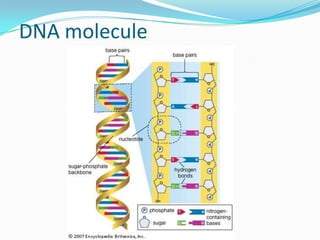
Each nucleotide is made up of
           three parts:
 A Phosphate group
 A pentose sugar (either ribose or deoxyribose)
 A base which contains nitrogen
DNA molecule
RNA molecule
DNA extraction
centrifuge
   Break down                         Precipitate
   the cell wall                      the DNA
   and                                using
   membranes                          ethanol
  Add some
  buffered detergent
  to break down the                                 Centrifuge to
  cell membranes                                    isolate the
                                                    DNA


video
                                    Dissolve
                                     DNA
Gene cloning
Restriction enzymes
 Restriction enzymes are enzymes that cut DNA into
  small fragments. This allows individual genes to be
  isolated.
 Restrictions enzymes recognize and cleave at specific
  DNA sequences. E.g. EcoRI
Vectors
 Vector - A DNA molecule that carries the foreign DNA
 fragment into a host cell

Several types of vectors are used including:

• Plasmids
• Bateriophages (i.e. the DNA of the bacteriophage genome)
• Viruses
Plasmids vectors
Essential features of a plasmid
vector:

•   A origin of replication

•   A selectable marker that allows
    cells that carry the plasmid to be
    distinguished from cells that do
    not. This is usually an antibiotic
    resistance gene.

•   One or more unique restriction
    enzyme sites into which DNA
    can be ligated.
Hosts
 Host cells include:
 E. coli
 Other types of bacterium
 Yeast
Basic steps in genetic engineering
1. Isolate the gene
2. Insert it in a host using a vector
3. Produce as many copies of the host as
   possible
4. Separate and purify the product of the gene
Step 1: Isolating the gene
  •   The action of a restriction enzyme
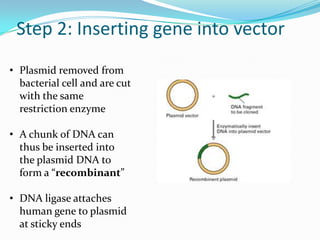
Step 2: Inserting gene into vector
• Plasmid removed from
  bacterial cell and are cut
  with the same
  restriction enzyme

• A chunk of DNA can
  thus be inserted into
  the plasmid DNA to
  form a “recombinant”

• DNA ligase attaches
  human gene to plasmid
  at sticky ends
Step 3: inserting vector into host
 The recombinant
  plasmids are then
  mixed with bacteria.

 Vector plasmid taken
  up by treated
  bacterium

 This insertion is called
  transformation
Step 4: Multiplication of the host cells by
    cloning

•   In these conditions,
    the bacteria multiply
    rapidly, making
    many copies of the
    human gene.
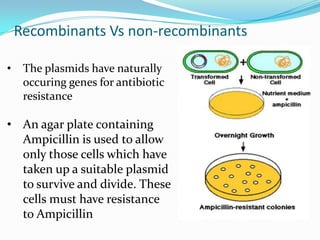
Recombinants Vs non-recombinants

•    The plasmids have naturally
     occuring genes for antibiotic
     resistance

• An agar plate containing
  Ampicillin is used to allow
  only those cells which have
  taken up a suitable plasmid
  to survive and divide. These
  cells must have resistance
  to Ampicillin
Video
What is PCR?
• PCR involves the targeted amplification of a
  specific DNA sequence.

• Using PCR the amount of a chosen DNA
  fragment can be increased 10-10 fold in 2-3
  hours
Performing a PCR reaction
A PCR reaction contains:

1. A small amount of DNA fragment to be amplified.
2. The primers which act as signals to the DNA
   polymerase enzyme to start copying.
3. The different types of nucleotide containing the
   bases adenine, guanine, cytosine and thymine.
4. Taq DNA polymerase
Reaction


  PCR tube   Thermocycler
Performing a PCR reaction
 Strands of sample DNA
  separated by heating to
  95oC

 Mixture cooled to 55oC
  to allow primers to bind.

 Mixture heated to 70oC
  for replication
  (optimum temp of DNA
  polymerase)

                              Animation
                              Video
PCR Amplification
Exponential Amplification of template DNA
DNA fingerpriting

 DNA profiling allows individuals to be unambiguously
 identified. It relies on differences between the genomes of
 different individuals.

 The DNA of every human being is 99.9% the same. It
 is the 0.1% that makes all the difference
Short Tandem Repeats (STR)
 An STR is a sequence of 2-5 bp (e.g. TCAT) repeated from 1-
  50 times.

 STRs occur at many sites in the genome of humans and
  other animals.

 The number of copies of the repeat in a particular STR
  varies enormously between different individuals. It is the
  number of times that these blocks of STRs are repeated
  that produces the variation in individuals.
Obtaining a DNA profile
 The DNA is extracted from the sample and cut into
 millions of small fragments using resctriction
 enzymes, aimed at a specific base pair sequence, called
 a restriction site.
DNA fragments are separated using
               electrophoresis.
 The DNA samples to be
 analysed are each added to a
 well.

 The fragments are then
 subjected to an electric
 field

 The smaller fragments
 move faster, the larger ones
 move slower
 The DNA fragments are transfered to a nylon membrane by a
  process called Southern blotting.
 Radioactive probes are used to attach to specific parts of the
  fragments.
 The nylon sheet with DNA fragments attached is placed under
  X-ray film.
                                     Patterns of bands on DNA profile
This produces a visible
pattern of light and dark
bands (where the radioactive
probe is present) rather like a
bar-code. Everyone’s bar-
code is different
Animation
DNA fingerprinting in Forensics
 DNA fingerprints can be used as biological evidence


 Strands of DNA can be found on hair, blood or semen


 Useful in solving crimes like murder and rape


 DNA Fingerprinting has exonorated people who were
 falsely convicted
DNA profiling in forensic science
 DNA from a victim (e.g. in a blood
  spot) may be left on the clothing of
  an attacker.

 Or attacker may leave their DNA on a
  crime victim (e.g. in blood, hair or
  semen). In this case the DNA profile
  from the attacker is compared to that
  of suspects.

 A large database of DNA profiles of
  known offenders has been
  assembled.
In paternity testing
For each STR a child inherits one
allele (band on gel) from the mother,
one from the father.

 In the example shown on the right,
 which shown the inheritance of a
 single STR, who is the father of the
 child?
Detection of pathogens by PCR
 Infections by certain pathogens can be detected by
  PCR using primers that recognise the pathogen
  genome.
 E.g. rabies can be diagnosed by amplifying rival
  nucleic acid present in viruses in saliva.

 • PCR is also valuable in the
   diagnosis of HIV – it can
   detect infection very soon after
   exposure and also newborn
   babies

Genetic engineering

  • 2.
    Aim: to introduceDNA technology techniques and its applications Objectives:  To describe DNA extraction  To explain and demonstrate DNA cloning  To explain the process of PCR and its uses.  To explain DNA fingerprinting and its uses
  • 3.
    The structure ofnucleic acids There are two types of nucleic acids: 1. Deoxyribonucleic acid (DNA) 2. Ribonucleic acid (RNA) Both are polymers made up of sub-units called nucleotides
  • 4.
    Each nucleotide ismade up of three parts:  A Phosphate group  A pentose sugar (either ribose or deoxyribose)  A base which contains nitrogen
  • 5.
  • 6.
  • 7.
  • 8.
    centrifuge Break down Precipitate the cell wall the DNA and using membranes ethanol Add some buffered detergent to break down the Centrifuge to cell membranes isolate the DNA video Dissolve DNA
  • 9.
  • 10.
    Restriction enzymes  Restrictionenzymes are enzymes that cut DNA into small fragments. This allows individual genes to be isolated.  Restrictions enzymes recognize and cleave at specific DNA sequences. E.g. EcoRI
  • 11.
    Vectors  Vector -A DNA molecule that carries the foreign DNA fragment into a host cell Several types of vectors are used including: • Plasmids • Bateriophages (i.e. the DNA of the bacteriophage genome) • Viruses
  • 12.
    Plasmids vectors Essential featuresof a plasmid vector: • A origin of replication • A selectable marker that allows cells that carry the plasmid to be distinguished from cells that do not. This is usually an antibiotic resistance gene. • One or more unique restriction enzyme sites into which DNA can be ligated.
  • 13.
    Hosts  Host cellsinclude:  E. coli  Other types of bacterium  Yeast
  • 14.
    Basic steps ingenetic engineering 1. Isolate the gene 2. Insert it in a host using a vector 3. Produce as many copies of the host as possible 4. Separate and purify the product of the gene
  • 15.
    Step 1: Isolatingthe gene • The action of a restriction enzyme
  • 16.
    Step 2: Insertinggene into vector • Plasmid removed from bacterial cell and are cut with the same restriction enzyme • A chunk of DNA can thus be inserted into the plasmid DNA to form a “recombinant” • DNA ligase attaches human gene to plasmid at sticky ends
  • 17.
    Step 3: insertingvector into host  The recombinant plasmids are then mixed with bacteria.  Vector plasmid taken up by treated bacterium  This insertion is called transformation
  • 18.
    Step 4: Multiplicationof the host cells by cloning • In these conditions, the bacteria multiply rapidly, making many copies of the human gene.
  • 19.
    Recombinants Vs non-recombinants • The plasmids have naturally occuring genes for antibiotic resistance • An agar plate containing Ampicillin is used to allow only those cells which have taken up a suitable plasmid to survive and divide. These cells must have resistance to Ampicillin
  • 20.
  • 21.
    What is PCR? •PCR involves the targeted amplification of a specific DNA sequence. • Using PCR the amount of a chosen DNA fragment can be increased 10-10 fold in 2-3 hours
  • 23.
    Performing a PCRreaction A PCR reaction contains: 1. A small amount of DNA fragment to be amplified. 2. The primers which act as signals to the DNA polymerase enzyme to start copying. 3. The different types of nucleotide containing the bases adenine, guanine, cytosine and thymine. 4. Taq DNA polymerase
  • 24.
    Reaction PCRtube Thermocycler
  • 25.
    Performing a PCRreaction  Strands of sample DNA separated by heating to 95oC  Mixture cooled to 55oC to allow primers to bind.  Mixture heated to 70oC for replication (optimum temp of DNA polymerase) Animation Video
  • 26.
  • 27.
    DNA fingerpriting  DNAprofiling allows individuals to be unambiguously identified. It relies on differences between the genomes of different individuals.  The DNA of every human being is 99.9% the same. It is the 0.1% that makes all the difference
  • 28.
    Short Tandem Repeats(STR)  An STR is a sequence of 2-5 bp (e.g. TCAT) repeated from 1- 50 times.  STRs occur at many sites in the genome of humans and other animals.  The number of copies of the repeat in a particular STR varies enormously between different individuals. It is the number of times that these blocks of STRs are repeated that produces the variation in individuals.
  • 29.
    Obtaining a DNAprofile  The DNA is extracted from the sample and cut into millions of small fragments using resctriction enzymes, aimed at a specific base pair sequence, called a restriction site.
  • 30.
    DNA fragments areseparated using electrophoresis.  The DNA samples to be analysed are each added to a well.  The fragments are then subjected to an electric field  The smaller fragments move faster, the larger ones move slower
  • 31.
     The DNAfragments are transfered to a nylon membrane by a process called Southern blotting.  Radioactive probes are used to attach to specific parts of the fragments.  The nylon sheet with DNA fragments attached is placed under X-ray film. Patterns of bands on DNA profile
  • 32.
    This produces avisible pattern of light and dark bands (where the radioactive probe is present) rather like a bar-code. Everyone’s bar- code is different
  • 33.
  • 34.
    DNA fingerprinting inForensics  DNA fingerprints can be used as biological evidence  Strands of DNA can be found on hair, blood or semen  Useful in solving crimes like murder and rape  DNA Fingerprinting has exonorated people who were falsely convicted
  • 35.
    DNA profiling inforensic science  DNA from a victim (e.g. in a blood spot) may be left on the clothing of an attacker.  Or attacker may leave their DNA on a crime victim (e.g. in blood, hair or semen). In this case the DNA profile from the attacker is compared to that of suspects.  A large database of DNA profiles of known offenders has been assembled.
  • 36.
    In paternity testing Foreach STR a child inherits one allele (band on gel) from the mother, one from the father.  In the example shown on the right, which shown the inheritance of a single STR, who is the father of the child?
  • 37.
    Detection of pathogensby PCR  Infections by certain pathogens can be detected by PCR using primers that recognise the pathogen genome.  E.g. rabies can be diagnosed by amplifying rival nucleic acid present in viruses in saliva. • PCR is also valuable in the diagnosis of HIV – it can detect infection very soon after exposure and also newborn babies