Genetic
Algorithm
Mehbuba Tabannur ( 011132034 )
Meshu Debnath ( 011132058 )
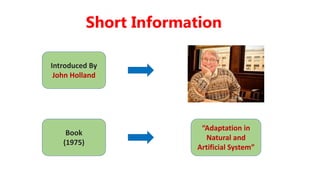
Short Information
Introduced By
John Holland
Book
(1975)
“Adaptation in
Natural and
Artificial System”
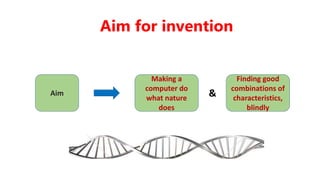
Aim
Making a
computer do
what nature
does
Finding good
combinations of
characteristics,
blindly
&
Aim for invention
A Genetic Algorithm is,
-a search procedure
-based on the mechanics of
-natural selection and
-genetics.
What is Genetic
Algorithm?
 Initialization
 Evaluation
 Selection
 Crossover
 Mutation
Basic Process
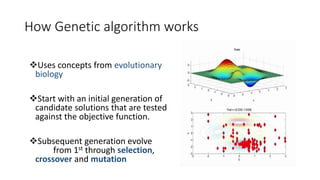
How Genetic algorithm works
Uses concepts from evolutionary
biology
Start with an initial generation of
candidate solutions that are tested
against the objective function.
Subsequent generation evolve
from 1st through selection,
crossover and mutation
How Genetic algorithm works
Selection
o Retain the best performing bit string from one generation to the next. Favor these for
reproduction.
o parent1 = [ 1 0 1 0 0 1 1 0 0 0 ]
o parent1 = [ 1 0 0 1 0 0 1 0 1 0 ]
Crossover
o parent1 = [ 1 0 1 0 0 1 1 0 0 0 ]
o parent2 = [ 1 0 0 1 0 0 1 0 1 0 ]
o child = [ 1 0 0 1 0 0 1 0 1 0 ]
Mutation
o parent2 = [ 1 0 1 0 0 1 1 0 0 0 ]
o child = [ 0 1 0 1 0 1 0 0 0 1 ]
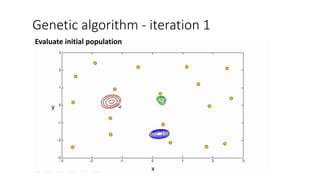
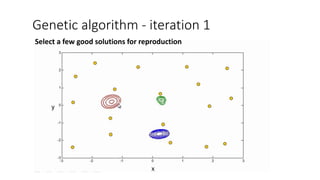
Genetic algorithm - iteration 1
Evaluate initial population
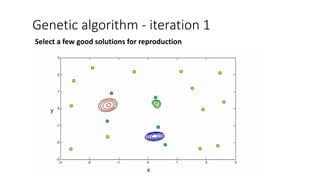
Genetic algorithm - iteration 1
Select a few good solutions for reproduction
Genetic algorithm - iteration 1
Select a few good solutions for reproduction
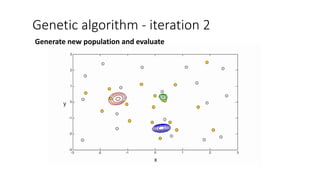
Genetic algorithm - iteration 2
Generate new population and evaluate
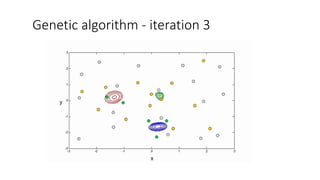
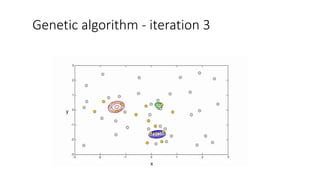
Genetic algorithm - iteration 3
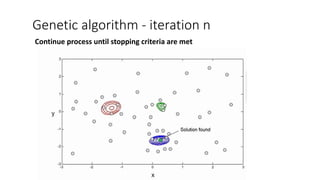
Genetic algorithm - iteration n
Continue process until stopping criteria are met
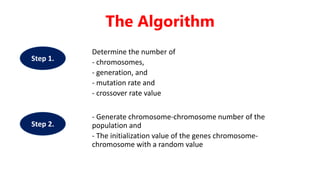
Determine the number of
- chromosomes,
- generation, and
- mutation rate and
- crossover rate value
- Generate chromosome-chromosome number of the
population and
- The initialization value of the genes chromosome-
chromosome with a random value
The Algorithm
Step 1.
Step 2.
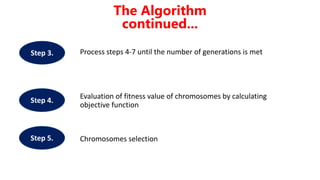
Process steps 4-7 until the number of generations is met
Evaluation of fitness value of chromosomes by calculating
objective function
Chromosomes selection
The Algorithm
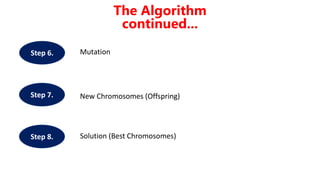
continued...
Step 3.
Step 4.
Step 5.
Mutation
New Chromosomes (Offspring)
Solution (Best Chromosomes)
The Algorithm
continued...
Step 6.
Step 7.
Step 8.
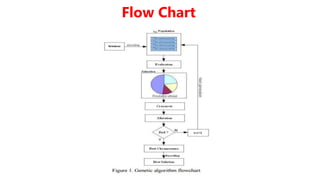
Flow Chart
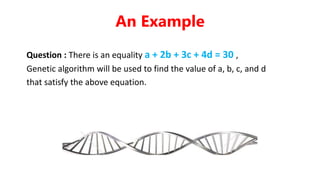
Question : There is an equality a + 2b + 3c + 4d = 30 ,
Genetic algorithm will be used to find the value of a, b, c, and d
that satisfy the above equation.
An Example
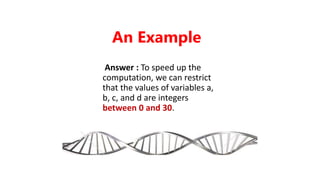
Answer : To speed up the
computation, we can restrict
that the values of variables a,
b, c, and d are integers
between 0 and 30.
An Example
We define,
The number of chromosomes in population are 6
and The random value of gene are a, b, c, d for 6 chromosomes
Chromosome[1] = [a;b;c;d] = [12;05;23;08]
Chromosome[2] = [a;b;c;d] = [02;21;18;03]
Chromosome[3] = [a;b;c;d] = [10;04;13;14]
Chromosome[4] = [a;b;c;d] = [20;01;10;06]
Chromosome[5] = [a;b;c;d] = [01;04;13;19]
Chromosome[6] = [a;b;c;d] = [20;05;17;01]
Step 1 : Initialization
We compute the objective function value for each chromosome produced in initialization
step:
F_obj[1] = Abs(( 12 + 2*5 + 3*23 + 4*8 ) - 30) = Abs((12 + 10 + 69 + 32 ) - 30) = Abs(123 -
30) = 93
F_obj[2] = Abs((02 + 2*21 + 3*18 + 4*3) - 30) = Abs((2 + 42 + 54 + 12) - 30) = Abs(110 - 30)
= 80
F_obj[3] = Abs((10 + 2*4 + 3*13 + 4*14) - 30) = Abs((10 + 8 + 39 + 56) - 30) = Abs(113 - 30)
= 83
F_obj[4] = Abs((20 + 2*1 + 3*10 + 4*6) - 30) = Abs((20 + 2 + 30 + 24) - 30) a b c d = Abs(76 -
30) = 46
F_obj[5] = Abs((1 + 2*4 + 3*13 + 4*19) - 30) = Abs((1 + 8 + 39 + 76) - 30) = Abs(124 - 30) =
94
F_obj[6] = Abs((20 + 2*5 + 3*17 + 4*1) - 30) = Abs((20 + 10 + 51 + 4) - 30) = Abs(85 - 30) =
55
Step 2 : Evaluation
The fittest chromosomes have higher probability to be selected for the next generation. To
compute fitness probability we must compute the fitness of each chromosome. To avoid
divide by zero problem, the value of F_obj is added by 1.
Fitness[1] = 1 / (1+F_obj[1]) = 1 / 94 = 0.0106
Fitness[2] = 1 / (1+F_obj[2]) = 1 / 81 = 0.0123
Fitness[3] = 1 / (1+F_obj[3]) = 1 / 84 = 0.0119
Fitness[4] = 1 / (1+F_obj[4]) = 1 / 47 = 0.0213
Fitness[5] = 1 / (1+F_obj[5]) = 1 / 95 = 0.0105
Fitness[6] = 1 / (1+F_obj[6]) = 1 / 56 = 0.0179
Total = 0.0106 + 0.0123 + 0.0119 + 0.0213 + 0.0105 + 0.0179
= 0.0845
Step 3 : Selection
The probability for each chromosomes is formulated by:
P[i] = Fitness[i] / Total
P[1] = 0.0106 / 0.0845 = 0.1254
P[2] = 0.0123 / 0.0845 = 0.1456
P[3] = 0.0119 / 0.0845 = 0.1408
P[4] = 0.0213 / 0.0845 = 0.2521
P[5] = 0.0105 / 0.0845 = 0.1243
P[6] = 0.0179 / 0.0845 = 0.2118
Step 3 continued...
Here, Chromosome 4 that has the highest fitness.
So, The cumulative probability values are:
C[1] = 0.1254
C[2] = 0.1254 + 0.1456 = 0.2710
C[3] = 0.1254 + 0.1456 + 0.1408 = 0.4118
C[4] = 0.1254 + 0.1456 + 0.1408 + 0.2521 = 0.6639
C[5] = 0.1254 + 0.1456 + 0.1408 + 0.2521 + 0.1243 = 0.7882
C[6] = 0.1254 + 0.1456 + 0.1408 + 0.2521 + 0.1243 + 0.2118 = 1.0
Step 3 continued...
The process is to generate random number R in the range 0-1 as follows :
R[1] = 0.201
R[2] = 0.284
R[3] = 0.099
R[4] = 0.822
R[5] = 0.398
R[6] = 0.501
Step 3 continued...
If random number P [2] > R [1] > P [1]
Then we have to select Chromosome [2] as a chromosome in the new
population for next generation:
NewChromosome[1] = Chromosome[2]
NewChromosome[2] = Chromosome[3]
NewChromosome[3] = Chromosome[1]
NewChromosome[4] = Chromosome[6]
NewChromosome[5] = Chromosome[3]
NewChromosome[6] = Chromosome[4]
Step 3 continued...
Pseudo-code for the crossover process is as follows :
Begin
k← 0;
while(k< population ) do
R[k] ← random(0-1);
if (R[k] < ρc ) then
select Chromosome[k] as parent;
end;
k = k + 1;
end;
end;
Step 4 : Crossover
k=random generated value for Chromosome
if (k < 0.25)
The process will be as follows :
R[1] = 0.191
R[2] = 0.259
R[3] = 0.760
R[4] = 0.006
R[5] = 0.159
R[6] = 0.340
Step 4 continued...
For random number R,
Chromosome [1], Chromosome [4] and Chromosome [5] will be selected for
crossover.
Chromosome[1] >< Chromosome[4]
Chromosome[4] >< Chromosome[5]
Chromosome[5] >< Chromosome[1]
Step 4 continued...
For first, second and third crossover,
Chromosome[1] = Chromosome[1] >< Chromosome[4]
= [02;21;18;03] >< [20;05;17;01] = [02;05;17;01]
Chromosome[4] = Chromosome[4] >< Chromosome[5]
= [20;05;17;01] >< [10;04;13;14] = [20;04;13;14]
Chromosome[5] = Chromosome[5] >< Chromosome[1]
= [10;04;13;14] >< [02;21;18;03] = [10;04;18;03]
Step 4 continued...
Thus Chromosome population after experiencing a crossover process:
Chromosome[1] = [02;05;17;01]
Chromosome[2] = [10;04;13;14]
Chromosome[3] = [12;05;23;08]
Chromosome[4] = [20;04;13;14]
Chromosome[5] = [10;04;18;03]
Chromosome[6] = [20;01;10;06]
Step 4 continued...
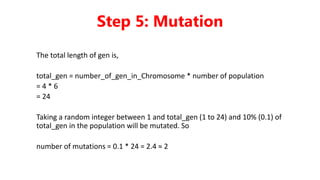
The total length of gen is,
total_gen = number_of_gen_in_Chromosome * number of population
= 4 * 6
= 24
Taking a random integer between 1 and total_gen (1 to 24) and 10% (0.1) of
total_gen in the population will be mutated. So
number of mutations = 0.1 * 24 = 2.4 ≈ 2
Step 5: Mutation
Suppose, generated random number are 2 and 5 then Chromosome
composition after mutation are:
Chromosome[1] = [02;05;17;01]
Chromosome[2] = [10;04;13;14]
Chromosome[3] = [12;05;23;02]
Chromosome[4] = [20;04;13;14]
Chromosome[5] = [10;05;18;03]
Chromosome[6] = [20;01;10;06]
Step 5 continued...
Evaluating the objective function after one generation,
Chromosome[1] = [02;05;17;01]
F_obj[1] = Abs(( 02 + 2*05 + 3*17 + 4*01 ) - 30)
= Abs((2 + 10 + 51 + 4 ) - 30)
= Abs(67 - 30) = 37
Chromosome[2] = [10;04;13;14]
F_obj[2] = Abs(( 10 + 2*04 + 3*13 + 4*14 ) - 30)
= Abs((10 + 8 + 33 + 56 ) - 30)
= Abs(107 - 30) = 77
Chromosome[3] = [12;05;23;02]
F_obj[3] = Abs(( 12 + 2*05 + 3*23 + 4*02 ) - 30)
= Abs((12 + 10 + 69 + 8 ) - 30)
= Abs(87 - 30) = 47
Step 5 continued...
Chromosome[4] = [20;04;13;14]
F_obj[4] = Abs(( 20 + 2*04 + 3*13 + 4*14 ) - 30)
= Abs((20 + 8 + 39 + 56 ) - 30)
= Abs(123 - 30) = 93
Chromosome[5] = [10;05;18;03]
F_obj[5] = Abs(( 10 + 2*05 + 3*18 + 4*03 ) - 30)
= Abs((10 + 10 + 54 + 12 ) - 30)
= Abs(86 - 30) = 56
Chromosome[6] = [20;01;10;06]
F_obj[6] = Abs(( 20 + 2*01 + 3*10 + 4*06 ) - 30)
= Abs((20 + 2 + 30 + 24 ) - 30)
= Abs(76 - 30) = 46
Step 5 continued...
After running 50 generations,
Chromosome = [07; 05; 03; 01]
That means : a = 7,
b = 5,
c = 3,
d = 1
So the equation = a + 2b + 3c + 4d = 30
7 + (2 * 5) + (3 * 3) + (4 * 1) = 30
The value of variable a, b, c and d generated by genetic algorithm can satisfy that
equality.
Step 5 continued...
 To search different combinations of materials.
 To design the perfect combination of stronger, lighter and overall,
better final product.
 To design computer algorithms.
 To schedule tasks and
 To solve other optimization problems easily.
Uses
• https://arxiv.org/ftp/arxiv/papers/1308/
• http://www.ai-junkie.com/ga/intro/
• https://en.wikipedia.org/wiki/Genetic_algorithm
• http://www.slideshare.net/circles808/demonstration1-g-as?qid=adbab8ac-a1c1-4ed8-
92b7-1e17e5525316&v=&b=&from_search=8
References
Any Questions

Genetic algorithm

  • 1.
  • 2.
    Mehbuba Tabannur (011132034 ) Meshu Debnath ( 011132058 )
  • 3.
    Short Information Introduced By JohnHolland Book (1975) “Adaptation in Natural and Artificial System”
  • 4.
    Aim Making a computer do whatnature does Finding good combinations of characteristics, blindly & Aim for invention
  • 5.
    A Genetic Algorithmis, -a search procedure -based on the mechanics of -natural selection and -genetics. What is Genetic Algorithm?
  • 6.
     Initialization  Evaluation Selection  Crossover  Mutation Basic Process
  • 7.
    How Genetic algorithmworks Uses concepts from evolutionary biology Start with an initial generation of candidate solutions that are tested against the objective function. Subsequent generation evolve from 1st through selection, crossover and mutation
  • 8.
    How Genetic algorithmworks Selection o Retain the best performing bit string from one generation to the next. Favor these for reproduction. o parent1 = [ 1 0 1 0 0 1 1 0 0 0 ] o parent1 = [ 1 0 0 1 0 0 1 0 1 0 ] Crossover o parent1 = [ 1 0 1 0 0 1 1 0 0 0 ] o parent2 = [ 1 0 0 1 0 0 1 0 1 0 ] o child = [ 1 0 0 1 0 0 1 0 1 0 ] Mutation o parent2 = [ 1 0 1 0 0 1 1 0 0 0 ] o child = [ 0 1 0 1 0 1 0 0 0 1 ]
  • 9.
    Genetic algorithm -iteration 1 Evaluate initial population
  • 10.
    Genetic algorithm -iteration 1 Select a few good solutions for reproduction
  • 11.
    Genetic algorithm -iteration 1 Select a few good solutions for reproduction
  • 12.
    Genetic algorithm -iteration 2 Generate new population and evaluate
  • 13.
  • 14.
  • 15.
    Genetic algorithm -iteration n Continue process until stopping criteria are met
  • 16.
    Determine the numberof - chromosomes, - generation, and - mutation rate and - crossover rate value - Generate chromosome-chromosome number of the population and - The initialization value of the genes chromosome- chromosome with a random value The Algorithm Step 1. Step 2.
  • 17.
    Process steps 4-7until the number of generations is met Evaluation of fitness value of chromosomes by calculating objective function Chromosomes selection The Algorithm continued... Step 3. Step 4. Step 5.
  • 18.
    Mutation New Chromosomes (Offspring) Solution(Best Chromosomes) The Algorithm continued... Step 6. Step 7. Step 8.
  • 19.
  • 20.
    Question : Thereis an equality a + 2b + 3c + 4d = 30 , Genetic algorithm will be used to find the value of a, b, c, and d that satisfy the above equation. An Example
  • 21.
    Answer : Tospeed up the computation, we can restrict that the values of variables a, b, c, and d are integers between 0 and 30. An Example
  • 22.
    We define, The numberof chromosomes in population are 6 and The random value of gene are a, b, c, d for 6 chromosomes Chromosome[1] = [a;b;c;d] = [12;05;23;08] Chromosome[2] = [a;b;c;d] = [02;21;18;03] Chromosome[3] = [a;b;c;d] = [10;04;13;14] Chromosome[4] = [a;b;c;d] = [20;01;10;06] Chromosome[5] = [a;b;c;d] = [01;04;13;19] Chromosome[6] = [a;b;c;d] = [20;05;17;01] Step 1 : Initialization
  • 23.
    We compute theobjective function value for each chromosome produced in initialization step: F_obj[1] = Abs(( 12 + 2*5 + 3*23 + 4*8 ) - 30) = Abs((12 + 10 + 69 + 32 ) - 30) = Abs(123 - 30) = 93 F_obj[2] = Abs((02 + 2*21 + 3*18 + 4*3) - 30) = Abs((2 + 42 + 54 + 12) - 30) = Abs(110 - 30) = 80 F_obj[3] = Abs((10 + 2*4 + 3*13 + 4*14) - 30) = Abs((10 + 8 + 39 + 56) - 30) = Abs(113 - 30) = 83 F_obj[4] = Abs((20 + 2*1 + 3*10 + 4*6) - 30) = Abs((20 + 2 + 30 + 24) - 30) a b c d = Abs(76 - 30) = 46 F_obj[5] = Abs((1 + 2*4 + 3*13 + 4*19) - 30) = Abs((1 + 8 + 39 + 76) - 30) = Abs(124 - 30) = 94 F_obj[6] = Abs((20 + 2*5 + 3*17 + 4*1) - 30) = Abs((20 + 10 + 51 + 4) - 30) = Abs(85 - 30) = 55 Step 2 : Evaluation
  • 24.
    The fittest chromosomeshave higher probability to be selected for the next generation. To compute fitness probability we must compute the fitness of each chromosome. To avoid divide by zero problem, the value of F_obj is added by 1. Fitness[1] = 1 / (1+F_obj[1]) = 1 / 94 = 0.0106 Fitness[2] = 1 / (1+F_obj[2]) = 1 / 81 = 0.0123 Fitness[3] = 1 / (1+F_obj[3]) = 1 / 84 = 0.0119 Fitness[4] = 1 / (1+F_obj[4]) = 1 / 47 = 0.0213 Fitness[5] = 1 / (1+F_obj[5]) = 1 / 95 = 0.0105 Fitness[6] = 1 / (1+F_obj[6]) = 1 / 56 = 0.0179 Total = 0.0106 + 0.0123 + 0.0119 + 0.0213 + 0.0105 + 0.0179 = 0.0845 Step 3 : Selection
  • 25.
    The probability foreach chromosomes is formulated by: P[i] = Fitness[i] / Total P[1] = 0.0106 / 0.0845 = 0.1254 P[2] = 0.0123 / 0.0845 = 0.1456 P[3] = 0.0119 / 0.0845 = 0.1408 P[4] = 0.0213 / 0.0845 = 0.2521 P[5] = 0.0105 / 0.0845 = 0.1243 P[6] = 0.0179 / 0.0845 = 0.2118 Step 3 continued...
  • 26.
    Here, Chromosome 4that has the highest fitness. So, The cumulative probability values are: C[1] = 0.1254 C[2] = 0.1254 + 0.1456 = 0.2710 C[3] = 0.1254 + 0.1456 + 0.1408 = 0.4118 C[4] = 0.1254 + 0.1456 + 0.1408 + 0.2521 = 0.6639 C[5] = 0.1254 + 0.1456 + 0.1408 + 0.2521 + 0.1243 = 0.7882 C[6] = 0.1254 + 0.1456 + 0.1408 + 0.2521 + 0.1243 + 0.2118 = 1.0 Step 3 continued...
  • 27.
    The process isto generate random number R in the range 0-1 as follows : R[1] = 0.201 R[2] = 0.284 R[3] = 0.099 R[4] = 0.822 R[5] = 0.398 R[6] = 0.501 Step 3 continued...
  • 28.
    If random numberP [2] > R [1] > P [1] Then we have to select Chromosome [2] as a chromosome in the new population for next generation: NewChromosome[1] = Chromosome[2] NewChromosome[2] = Chromosome[3] NewChromosome[3] = Chromosome[1] NewChromosome[4] = Chromosome[6] NewChromosome[5] = Chromosome[3] NewChromosome[6] = Chromosome[4] Step 3 continued...
  • 29.
    Pseudo-code for thecrossover process is as follows : Begin k← 0; while(k< population ) do R[k] ← random(0-1); if (R[k] < ρc ) then select Chromosome[k] as parent; end; k = k + 1; end; end; Step 4 : Crossover
  • 30.
    k=random generated valuefor Chromosome if (k < 0.25) The process will be as follows : R[1] = 0.191 R[2] = 0.259 R[3] = 0.760 R[4] = 0.006 R[5] = 0.159 R[6] = 0.340 Step 4 continued...
  • 31.
    For random numberR, Chromosome [1], Chromosome [4] and Chromosome [5] will be selected for crossover. Chromosome[1] >< Chromosome[4] Chromosome[4] >< Chromosome[5] Chromosome[5] >< Chromosome[1] Step 4 continued...
  • 32.
    For first, secondand third crossover, Chromosome[1] = Chromosome[1] >< Chromosome[4] = [02;21;18;03] >< [20;05;17;01] = [02;05;17;01] Chromosome[4] = Chromosome[4] >< Chromosome[5] = [20;05;17;01] >< [10;04;13;14] = [20;04;13;14] Chromosome[5] = Chromosome[5] >< Chromosome[1] = [10;04;13;14] >< [02;21;18;03] = [10;04;18;03] Step 4 continued...
  • 33.
    Thus Chromosome populationafter experiencing a crossover process: Chromosome[1] = [02;05;17;01] Chromosome[2] = [10;04;13;14] Chromosome[3] = [12;05;23;08] Chromosome[4] = [20;04;13;14] Chromosome[5] = [10;04;18;03] Chromosome[6] = [20;01;10;06] Step 4 continued...
  • 34.
    The total lengthof gen is, total_gen = number_of_gen_in_Chromosome * number of population = 4 * 6 = 24 Taking a random integer between 1 and total_gen (1 to 24) and 10% (0.1) of total_gen in the population will be mutated. So number of mutations = 0.1 * 24 = 2.4 ≈ 2 Step 5: Mutation
  • 35.
    Suppose, generated randomnumber are 2 and 5 then Chromosome composition after mutation are: Chromosome[1] = [02;05;17;01] Chromosome[2] = [10;04;13;14] Chromosome[3] = [12;05;23;02] Chromosome[4] = [20;04;13;14] Chromosome[5] = [10;05;18;03] Chromosome[6] = [20;01;10;06] Step 5 continued...
  • 36.
    Evaluating the objectivefunction after one generation, Chromosome[1] = [02;05;17;01] F_obj[1] = Abs(( 02 + 2*05 + 3*17 + 4*01 ) - 30) = Abs((2 + 10 + 51 + 4 ) - 30) = Abs(67 - 30) = 37 Chromosome[2] = [10;04;13;14] F_obj[2] = Abs(( 10 + 2*04 + 3*13 + 4*14 ) - 30) = Abs((10 + 8 + 33 + 56 ) - 30) = Abs(107 - 30) = 77 Chromosome[3] = [12;05;23;02] F_obj[3] = Abs(( 12 + 2*05 + 3*23 + 4*02 ) - 30) = Abs((12 + 10 + 69 + 8 ) - 30) = Abs(87 - 30) = 47 Step 5 continued...
  • 37.
    Chromosome[4] = [20;04;13;14] F_obj[4]= Abs(( 20 + 2*04 + 3*13 + 4*14 ) - 30) = Abs((20 + 8 + 39 + 56 ) - 30) = Abs(123 - 30) = 93 Chromosome[5] = [10;05;18;03] F_obj[5] = Abs(( 10 + 2*05 + 3*18 + 4*03 ) - 30) = Abs((10 + 10 + 54 + 12 ) - 30) = Abs(86 - 30) = 56 Chromosome[6] = [20;01;10;06] F_obj[6] = Abs(( 20 + 2*01 + 3*10 + 4*06 ) - 30) = Abs((20 + 2 + 30 + 24 ) - 30) = Abs(76 - 30) = 46 Step 5 continued...
  • 38.
    After running 50generations, Chromosome = [07; 05; 03; 01] That means : a = 7, b = 5, c = 3, d = 1 So the equation = a + 2b + 3c + 4d = 30 7 + (2 * 5) + (3 * 3) + (4 * 1) = 30 The value of variable a, b, c and d generated by genetic algorithm can satisfy that equality. Step 5 continued...
  • 39.
     To searchdifferent combinations of materials.  To design the perfect combination of stronger, lighter and overall, better final product.  To design computer algorithms.  To schedule tasks and  To solve other optimization problems easily. Uses
  • 40.
    • https://arxiv.org/ftp/arxiv/papers/1308/ • http://www.ai-junkie.com/ga/intro/ •https://en.wikipedia.org/wiki/Genetic_algorithm • http://www.slideshare.net/circles808/demonstration1-g-as?qid=adbab8ac-a1c1-4ed8- 92b7-1e17e5525316&v=&b=&from_search=8 References
  • 41.