Genetic algorithm Darwin's theory of evolution.pptx
Genetic algorithm developed by Goldberg (1960’s) was inspired by Darwin's theory of evolution which states that the survival of an organism is affected by rule "the strongest species that survives".
Definition
• Genetic algorithmdeveloped by Goldberg (1960’s) was inspired by Darwin's theory
of evolution which states that the survival of an organism is affected by rule "the
strongest species that survives".
• Genetic algorithms (GAS) are numerical optimization algorithms inspired by both
natural selection and natural genetics. They are being used to help solve practical
problems on a daily basis.
• A genetic algorithm (or GA) is a search technique used in computing to find true or
approximate’ solutions to optimization and search problems.
3.
• A solutiongenerated by genetic algorithm is called a chromosome, while collection of
chromosomes is referred as a population.
• A chromosome is composed from genes and its value can be either numerical, binary, symbols or
characters.
• These chromosomes will undergo a process called fitness function to measure the suitability of
solution generated by GA with problem.
• Some chromosomes in population will mate through process called crossover thus producing new
chromosomes named offspring.
• In a generation, a few chromosomes will also mutation in their gene.
• The number of chromosomes which will undergo crossover and mutation is controlled by crossover
rate and mutation rate value.
4.
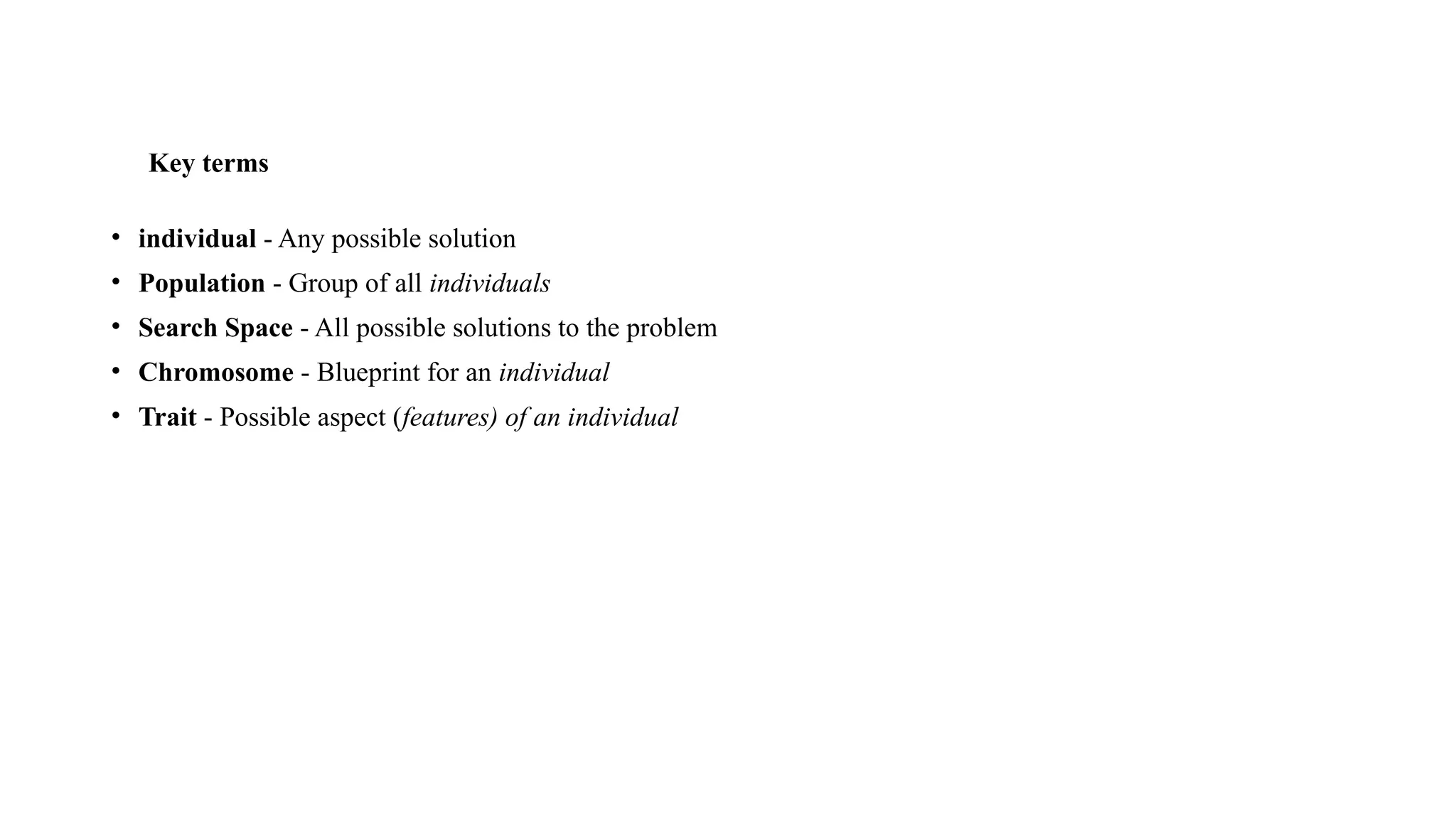
Key terms
• individual- Any possible solution
• Population - Group of all individuals
• Search Space - All possible solutions to the problem
• Chromosome - Blueprint for an individual
• Trait - Possible aspect (features) of an individual
5.
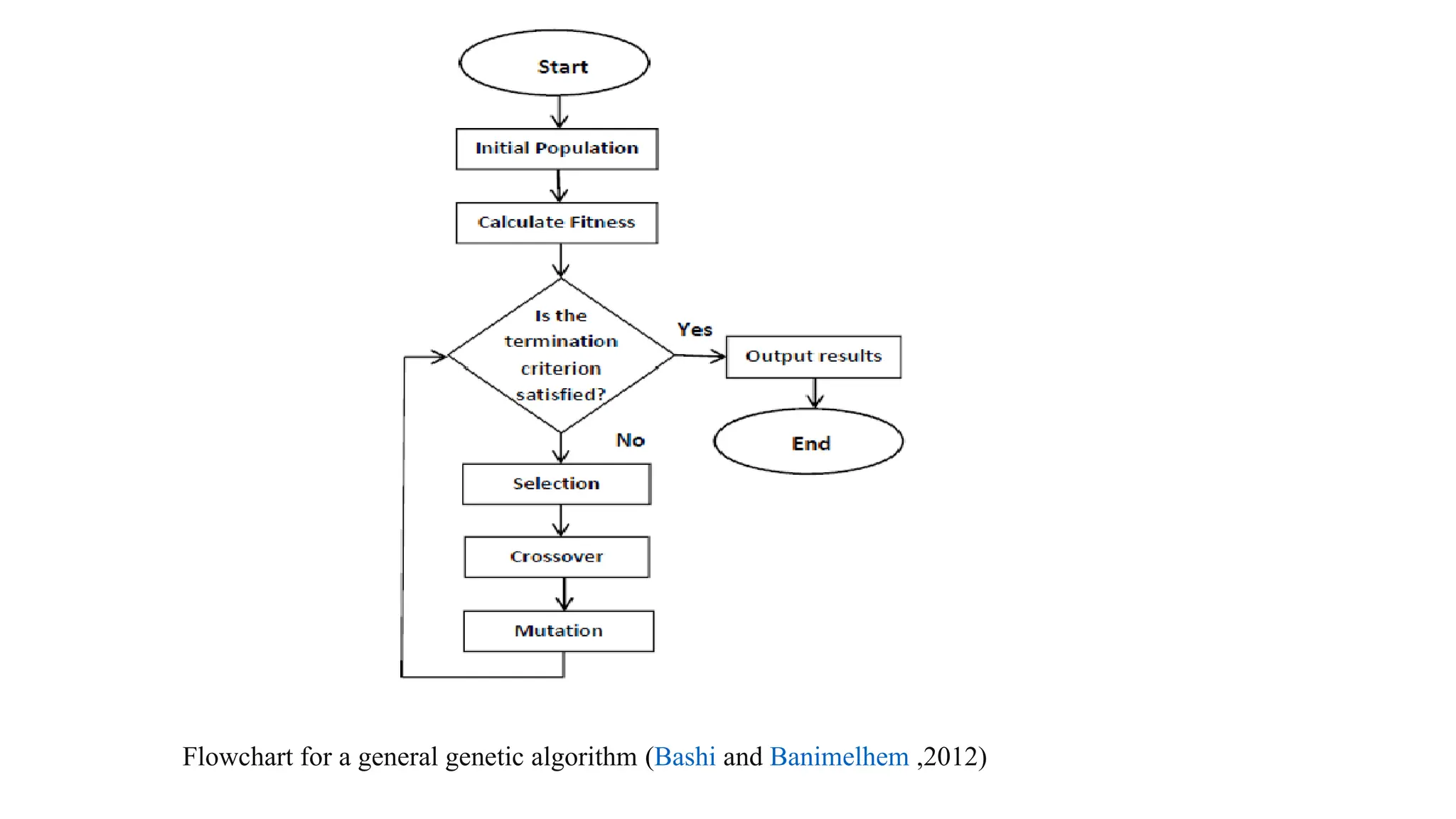
Flowchart for ageneral genetic algorithm (Bashi and Banimelhem ,2012)
6.
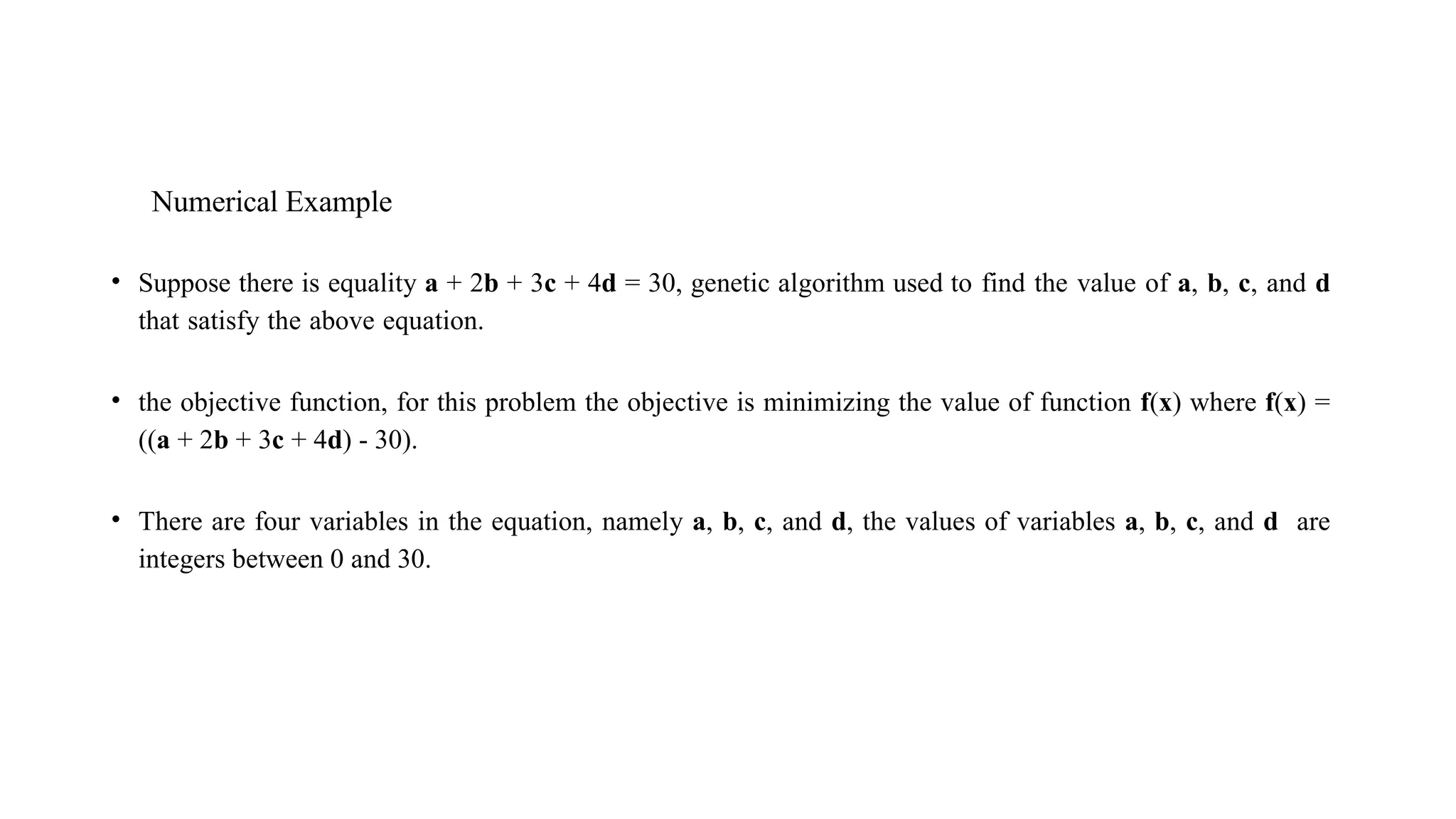
Numerical Example
• Supposethere is equality a + 2b + 3c + 4d = 30, genetic algorithm used to find the value of a, b, c, and d
that satisfy the above equation.
• the objective function, for this problem the objective is minimizing the value of function f(x) where f(x) =
((a + 2b + 3c + 4d) - 30).
• There are four variables in the equation, namely a, b, c, and d, the values of variables a, b, c, and d are
integers between 0 and 30.
7.
Step 1. Initialization
•thenumber of chromosomes in population are 6,
•then we generate random value of gene a, b, c, d for 6 chromosomes.
•Chromosome[1] = [a;b;c;d] = [12;05;23;08]
•Chromosome[2] = [a;b;c;d] = [02;21;18;03]
•Chromosome[3] = [a;b;c;d] = [10;04;13;14]
•Chromosome[4] = [a;b;c;d] = [20;01;10;06]
•Chromosome[5] = [a;b;c;d] = [01;04;13;19]
•Chromosome[6] = [a;b;c;d] = [20;05;17;01]
Step 3. Selection
•The fittest chromosomes have higher probability to be selected for the next generation.
• To avoid divide by zero problem, the value of F_obj is added by 1
. . Fitness[1] = 1 / (1+F_obj[1]) = 1 / 94
• = 0.0106
• Fitness[2] = 1 / (1+F_obj[2] = 1 / 81
• = 0.0123
• Fitness[3] = 1 / (1+F_obj[3]) = 1 / 84
• = 0.0119
• Fitness[4] = 1 / (1+F_obj[4]) = 1 / 47
• = 0.0213
• Fitness[5] = 1 / (1+F_obj[5]) = 1 / 95
• = 0.0105
• Fitness[6] = 1 / (1+F_obj[6]) = 1 / 56
• = 0.0179
•Total = 0.0106 + 0.0123 + 0.0119 + 0.0213 + 0.0105 + 0.0179
• = 0.0845
10.
Step 3. Selection
•Theprobability for each chromosome is formulated by: P[i] = Fitness[i] / Total
•P[1] = 0.0106 / 0.0845 = 0.1254
•P[2] = 0.0123 / 0.0845 = 0.1456
•P[3] = 0.0119 / 0.0845 = 0.1408
•P[4] = 0.0213 / 0.0845 = 0.2521
•P[5] = 0.0105 / 0.0845 = 0.1243
•P[6] = 0.0179 / 0.0845 = 0.2118
•Chromosome 4 that has the highest fitness
11.
Step 3. Selection
•Forthe selection process we use roulette wheel, for that we should compute the cumulative
probability values:
•C[1] = 0.1254
•C[2] = 0.1254 + 0.1456 = 0.2710
•C[3] = 0.1254 + 0.1456 + 0.1408 = 0.4118
•C[4] = 0.1254 + 0.1456 + 0.1408 + 0.2521 = 0.6639
•C[5] = 0.1254 + 0.1456 + 0.1408 + 0.2521 + 0.1243 = 0.7882
•C[6] = 0.1254 + 0.1456 + 0.1408 + 0.2521 + 0.1243 + 0.2118 = 1.0
12.
roulette-wheel
•Having calculated thecumulative probability of selection process using roulette-wheel can be done. The
process is to generate random number R in the range 0-1 as follows.
•R[1] = 0.201
•R[2] = 0.284
•R[3] = 0.099
•R[4] = 0.822
•R[5] = 0.398
•R[6] = 0.501
13.
Step 4. crossover
•Ifrandom number R[1] is greater than C[1] and smaller than C[2] then select
Chromosome[2] as a chromosome in the new population for next generation:
•NewChromosome[1] = Chromosome[2]
•NewChromosome[2] = Chromosome[3]
•NewChromosome[3] = Chromosome[1]
•NewChromosome[4] = Chromosome[6]
•NewChromosome[5] = Chromosome[3]
• NewChromosome[6] = Chromosome[4]
•Chromosomes in the population thus became:
•Chromosome[1] = [02;21;18;03]
•Chromosome[2] = [10;04;13;14]
•Chromosome[3] = [12;05;23;08]
•Chromosome[4] = [20;05;17;01]
•Chromosome[5] = [10;04;13;14]
•Chromosome[6] = [20;01;10;06]
14.
Step 4. crossover
•Inthis example, we use one-cut point, i.e. randomly select a position in the parent chromosome then
exchanging sub-chromosome.
•Parent chromosome which will mate is randomly selected and the number of mate Chromosomes is
controlled using crossover_rate (ρc) parameters.
•Pseudo-code for the crossover process is as follows:
begin
• k← 0; while(k<population) do R[k] = random(0-1);
if(R[k]<ρc) then
• select Chromosome[k] as parent;
end;
• k = k + 1;
end;
end;
15.
Step 4. crossover
•Supposewe set that the crossover rate is 25%, then Chromosome number k will be selected for crossover if
random generated value for Chromosome k below 0.25. The process is as follows: First we generate a random
number R as the number of populations.
•R[1] = 0.191
•R[2] = 0.259
•R[3] = 0.760
•R[4] = 0.006
•R[5] = 0.159
•R[6] = 0.340
For random number R above, parents are Chromosome [1], Chromosome [4] and
•Chromosome[5] will be selected for crossover.
• Chromosome[1] >< Chromosome[4]
•Chromosome[4] >< Chromosome[5]
•Chromosome[5] >< Chromosome[1]
16.
Step 4. crossover
•Afterchromosome selection, the next process is determining the position of the crossover point. This is done
by generating random numbers between 1 to (length of Chromosome – 1). In this case, generated random
numbers should be between 1 and 3. After we get the crossover point, parents Chromosome will be cut
at crossover point and its gens will be interchanged. For example we generated 3 random number and we get:
•C[1] = 1
•C[2] = 1
•C[3] = 2
17.
Step 4. crossover
•Thenfor first crossover, second crossover and third crossover, parent’s gens will be cut at
•gen number 1, gen number 1 and gen number 3 respectively, e.g.
•Chromosome[1] = Chromosome[1] >< Chromosome[4]
• = [02;21;18;03] >< [20;05;17;01]
• = [02;05;17;01]
•Chromosome[4] = Chromosome[4] >< Chromosome[5]
• = [20;05;17;01] >< [10;04;13;14]
• = [20;04;13;14]
•Chromosome[5] = Chromosome[5] >< Chromosome[1]
• = [10;04;13;14] >< [02;21;18;03]
• = [10;04;18;03]
•
•Thus, Chromosome population after experiencing a crossover process:
•Chromosome[1] = [02;05;17;01] Chromosome[2] = [10;04;13;14]
Chromosome[3] = [12;05;23;08] Chromosome[4] = [20;04;13;14]
Chromosome[5] = [10;04;18;03] Chromosome[6] = [20;01;10;06]
•
18.
Step 5. Mutation
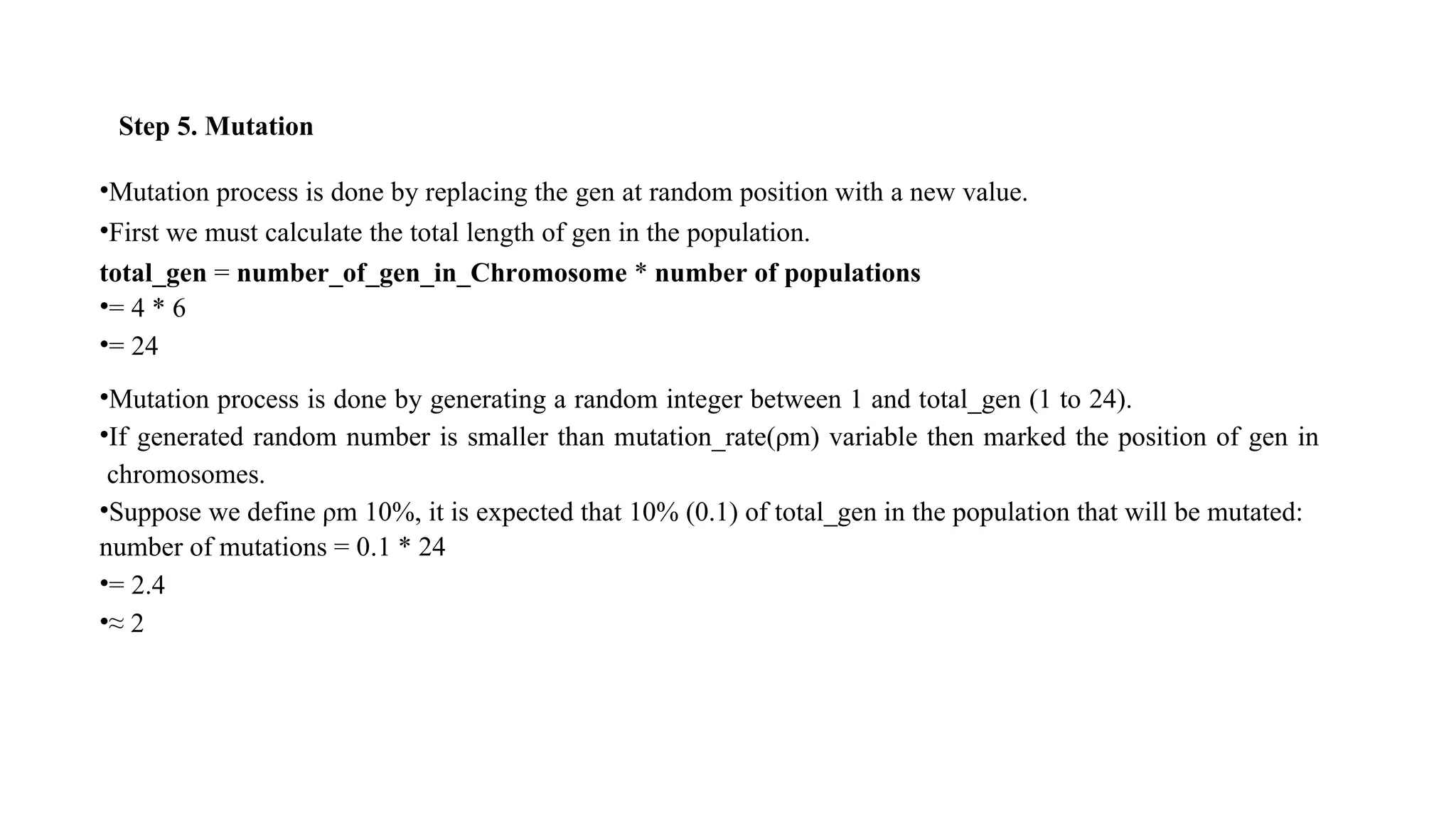
•Mutationprocess is done by replacing the gen at random position with a new value.
•First we must calculate the total length of gen in the population.
total_gen = number_of_gen_in_Chromosome * number of populations
•= 4 * 6
•= 24
•Mutation process is done by generating a random integer between 1 and total_gen (1 to 24).
•If generated random number is smaller than mutation_rate(ρm) variable then marked the position of gen in
chromosomes.
•Suppose we define ρm 10%, it is expected that 10% (0.1) of total_gen in the population that will be mutated:
number of mutations = 0.1 * 24
•= 2.4
•≈ 2
19.
Step 5. Mutation
•Supposegeneration of random number yield 12 and 18 then the chromosome which have mutation are
Chromosome number 3 gen number 4 and Chromosome 5 gen number 2.
•The value of mutated gene at mutation point is replaced by random number between 0-30.
•Suppose generated random number are 2 and 5 then Chromosome composition after mutation are:
•Chromosome[1] = [02;05;17;01]
•Chromosome[2] = [10;04;13;14]
•Chromosome[3] = [12;05;23;02]
•Chromosome[4] = [20;04;13;14]
•Chromosome[5] = [10;05;18;03]
•Chromosome[6] = [20;01;10;06]
Step 5. Mutation
•Fromthe evaluation of new Chromosome, we can see that the objective function is decreasing, this means
that we have better Chromosome or solution compared with previous Chromosome generation. New
Chromosomes for next iteration are:
•Chromosome[1] = [02;05;17;01]
• Chromosome[2] = [10;04;13;14]
•Chromosome[3] = [12;05;23;02]
•Chromosome[4] = [20;04;13;14]
•Chromosome[5] = [10;05;18;03]
•Chromosome[6] = [20;01;10;06]
•These new Chromosomes will undergo the same process as the previous generation of Chromosomes such as
evaluation, selection, crossover and mutation and at the end it produces new generation of Chromosome for
the next iteration.
22.
Step 5. Mutation
•Thisprocess will be repeated until a predetermined number of generations. For this example, after running
50 generations, best chromosome is obtained:
•Chromosome = [07; 05; 03; 01]
•This means that: a = 7, b = 5, c = 3, d = 1
•If we use the number in the problem equation:
•a + 2b + 3c + 4d = 30
•7 + (2 * 5) + (3 * 3) + (4 * 1) = 30
•We can see that the value of variable a, b, c and d generated by genetic algorithm can satisfy that equality.
23.
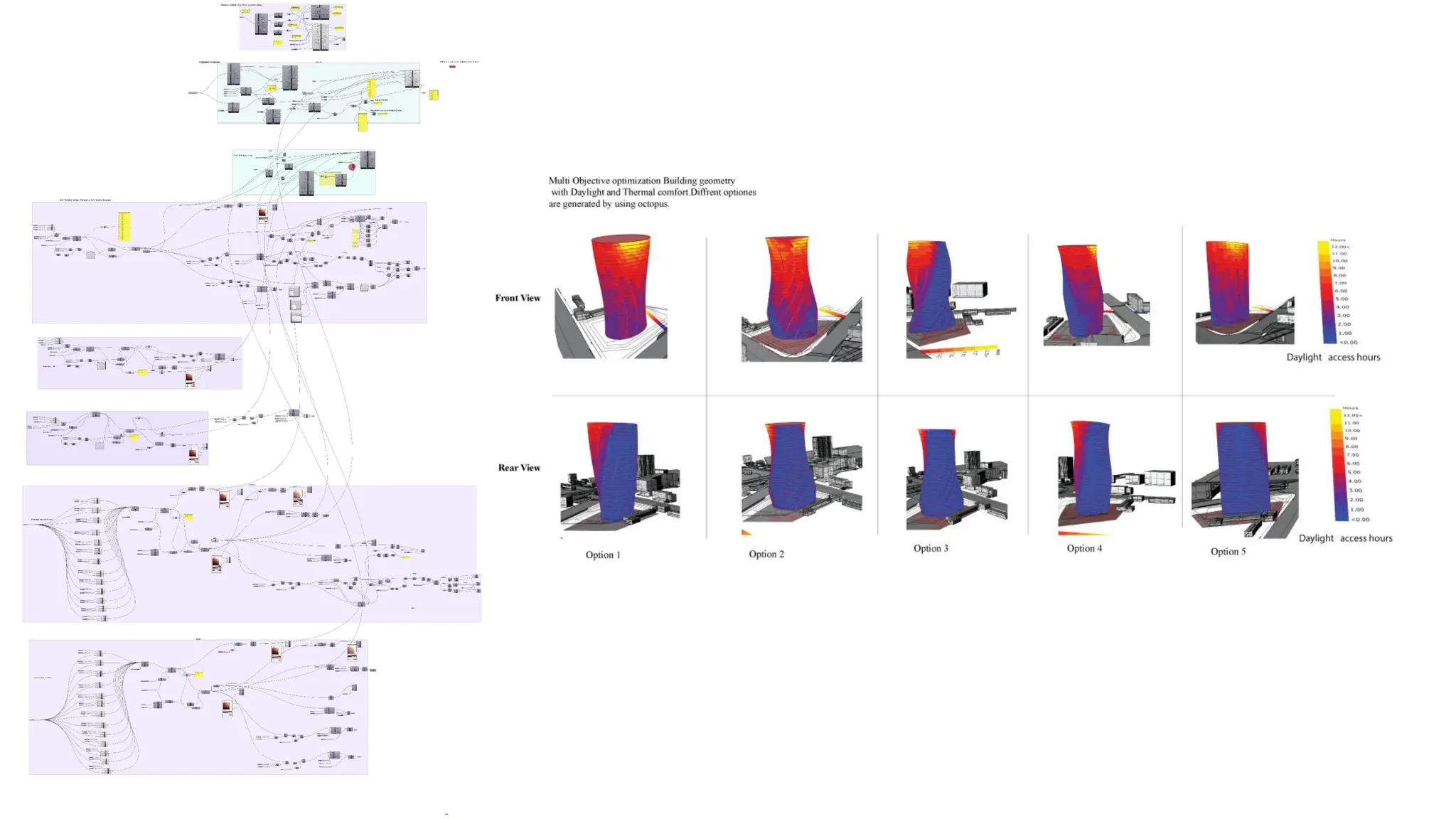
Design of energyEfficient Buildings
•The genetic algorithm allows a designer to select from a range of buildings, all of which have a predicted
energy performance within, say, five percent of the achievable minimum, the design which best suits his/her
other requirements.
•It relieves the designer of the need to work through the consequences of choosing individual features and of
checking their compatibility with the rest of the building system.
•The energy performance of a building is determined by its response as a complete system to the external
environment and the internal environmental demands of the occupants.
•The system response, in turn, depends upon the combination of individual attributes that have been assembled
to produce the building.
24.
In the workof Migowsky [MIG95], and subsequent extensions, EXCALIBUR is combined with a genetic
algorithm to try and generate high-quality designs with architectural appeal.
The population, P, is manipulated as follows:
•1. create initial, random, population of attributes
•2. reduce physical attributes to model parameters
•3. calculate annual energy use of heating and cooling systems,
•4. use GA to create new designs by recombination and mutation using as the selection factor;
•5. repeat from 2 until termination criterion is met; and then
•6. filter designs considering architectural appeal.
25.
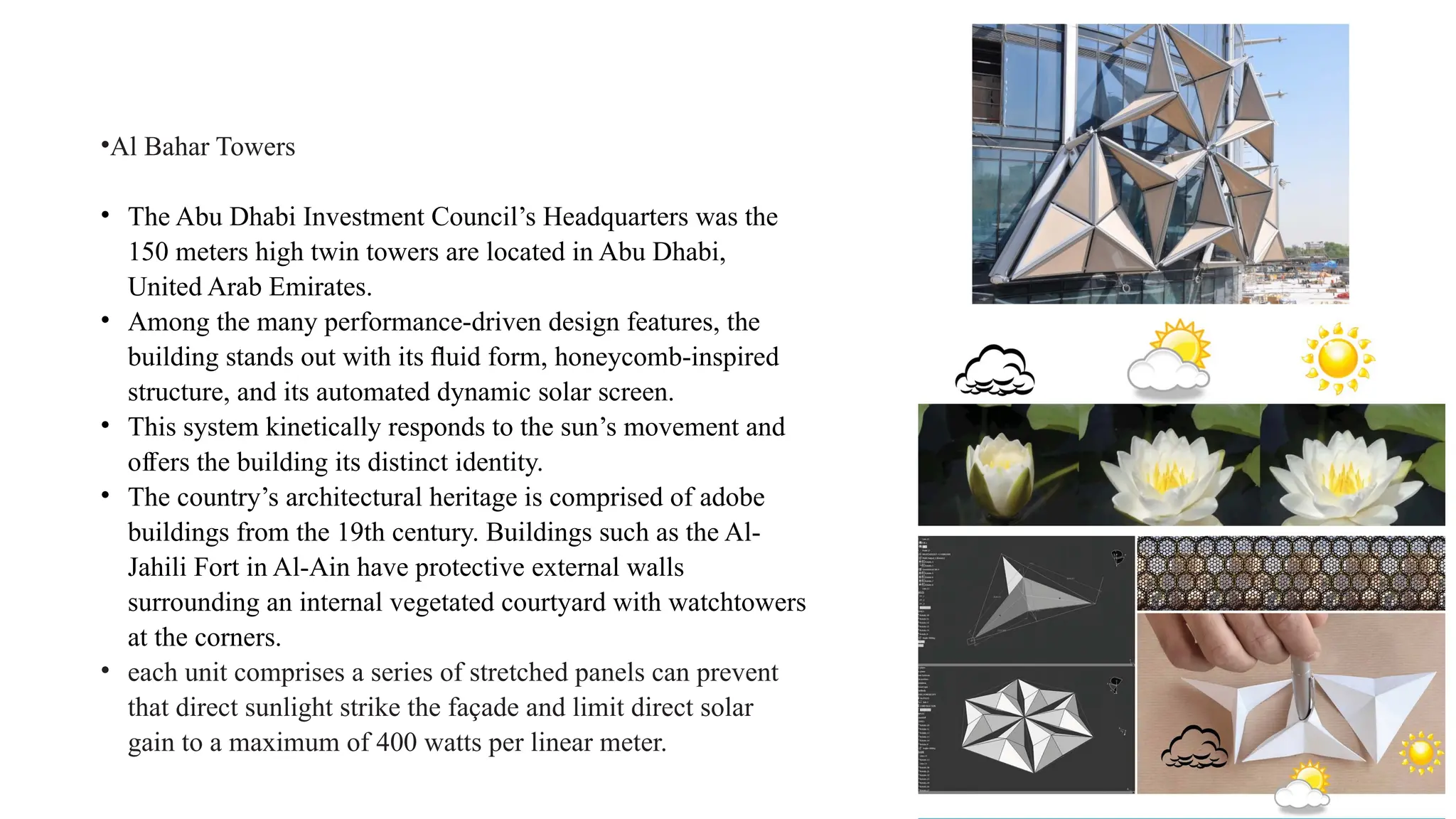
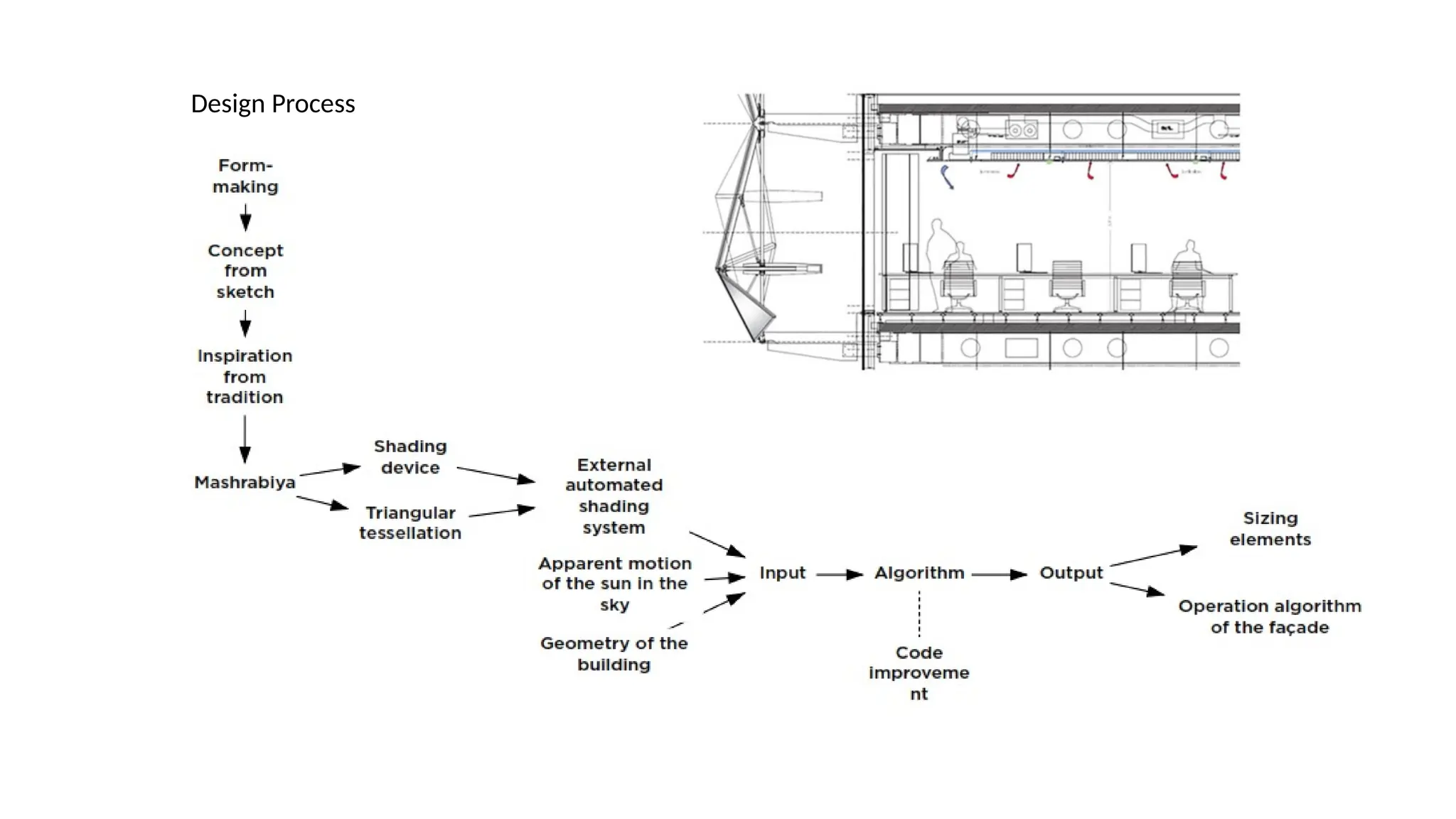
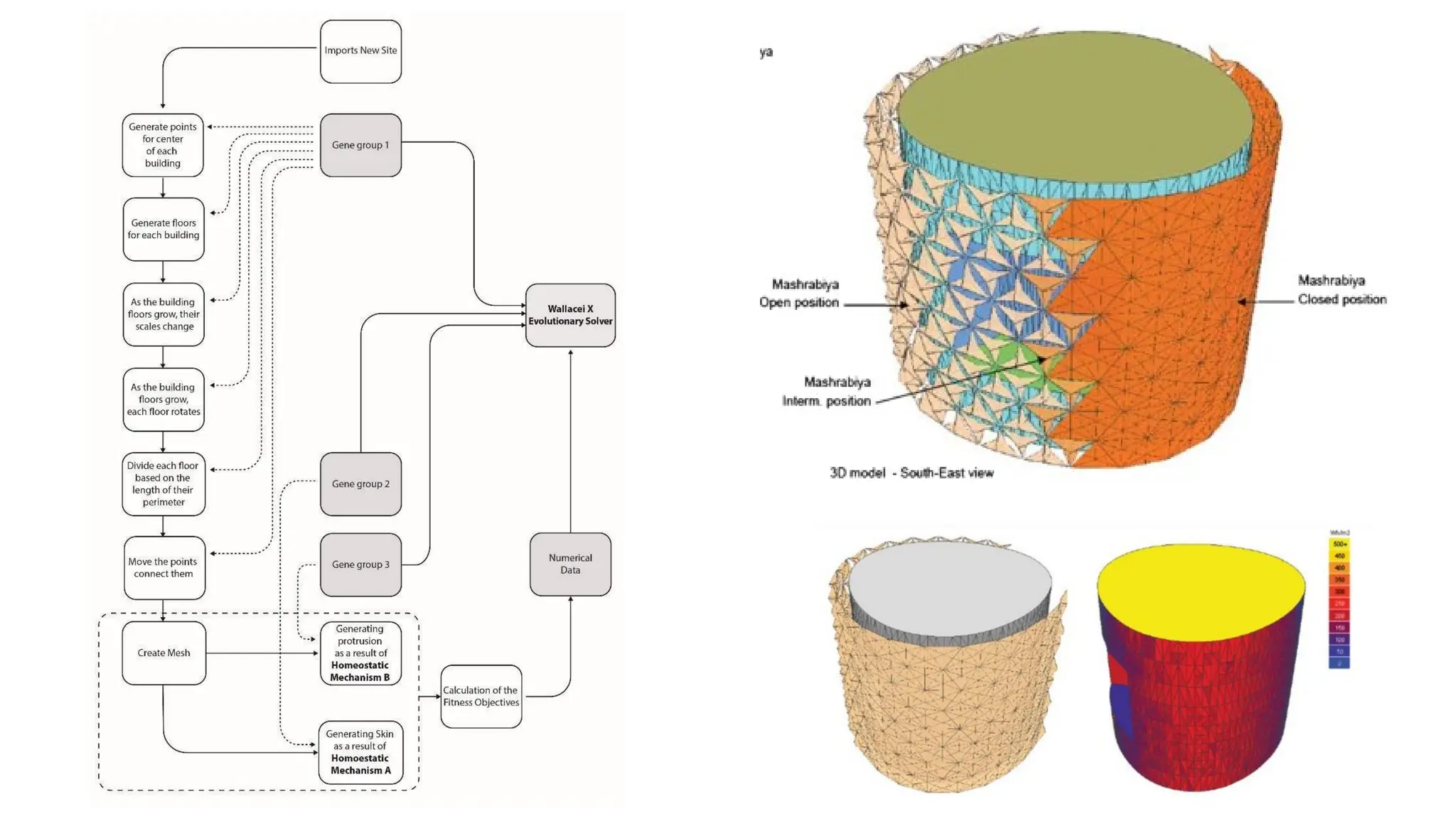
•Al Bahar Towers
•The Abu Dhabi Investment Council’s Headquarters was the
150 meters high twin towers are located in Abu Dhabi,
United Arab Emirates.
• Among the many performance-driven design features, the
building stands out with its fluid form, honeycomb-inspired
structure, and its automated dynamic solar screen.
• This system kinetically responds to the sun’s movement and
o ers the building its distinct identity.
ff
• The country’s architectural heritage is comprised of adobe
buildings from the 19th century. Buildings such as the Al-
Jahili Fort in Al-Ain have protective external walls
surrounding an internal vegetated courtyard with watchtowers
at the corners.
• each unit comprises a series of stretched panels can prevent
that direct sunlight strike the façade and limit direct solar
gain to a maximum of 400 watts per linear meter.
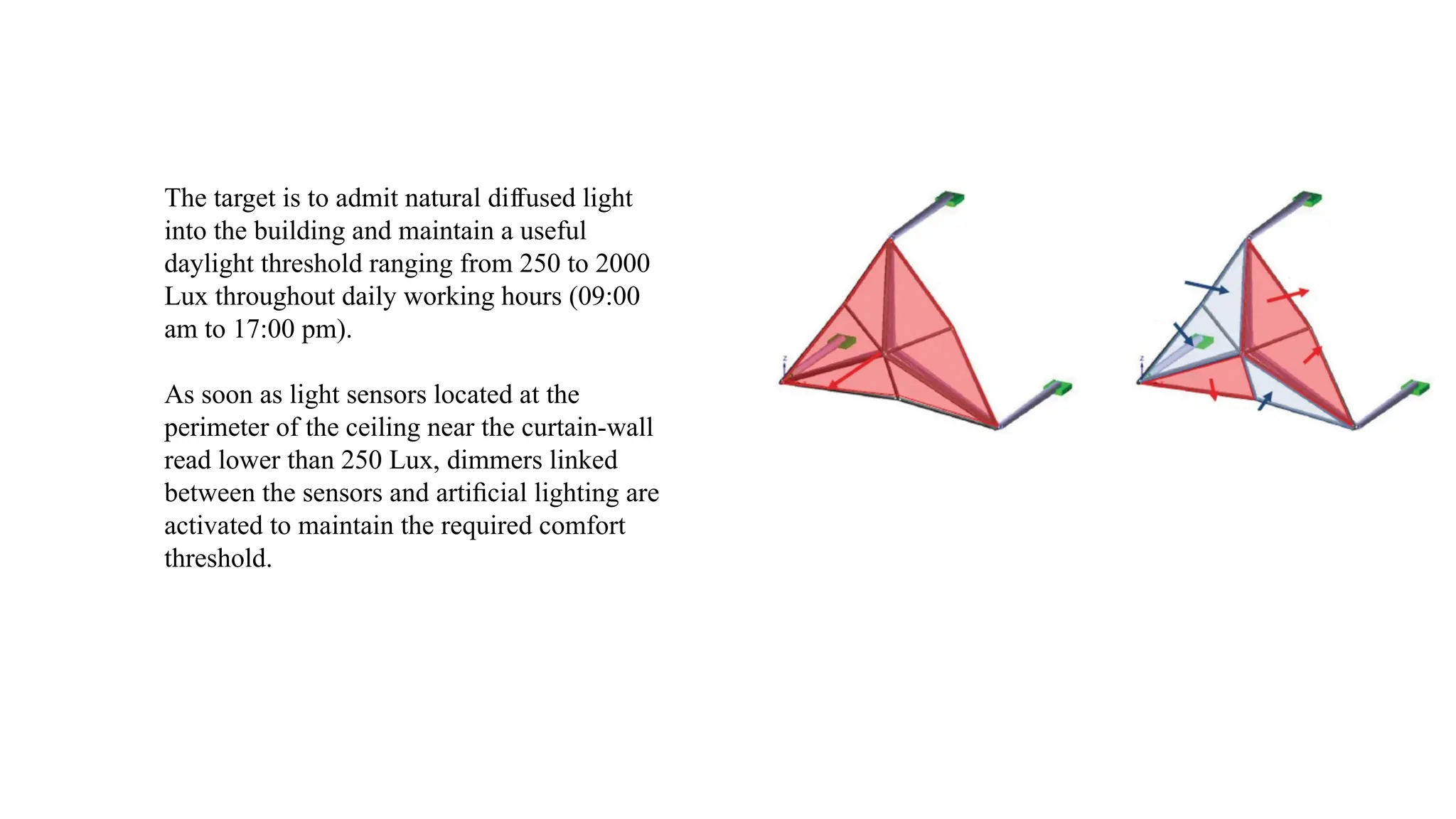
The target isto admit natural di used light
ff
into the building and maintain a useful
daylight threshold ranging from 250 to 2000
Lux throughout daily working hours (09:00
am to 17:00 pm).
As soon as light sensors located at the
perimeter of the ceiling near the curtain-wall
read lower than 250 Lux, dimmers linked
between the sensors and artificial lighting are
activated to maintain the required comfort
threshold.


![Step 1. Initialization
•the number of chromosomes in population are 6,
•then we generate random value of gene a, b, c, d for 6 chromosomes.
•Chromosome[1] = [a;b;c;d] = [12;05;23;08]
•Chromosome[2] = [a;b;c;d] = [02;21;18;03]
•Chromosome[3] = [a;b;c;d] = [10;04;13;14]
•Chromosome[4] = [a;b;c;d] = [20;01;10;06]
•Chromosome[5] = [a;b;c;d] = [01;04;13;19]
•Chromosome[6] = [a;b;c;d] = [20;05;17;01]](https://image.slidesharecdn.com/geneticalgorithmconstruction-250927204050-2d1b525b/75/Genetic-algorithm-Darwin-s-theory-of-evolution-pptx-7-2048.jpg)
![Step 2. Evaluation
compute the objective function value for each chromosome produced in initialization step:
•F_obj[1] = Abs(( 12 + 2*05 + 3*23 + 4*08 ) - 30)
• = Abs((12 + 10 + 69 + 32 ) - 30)
• = 93
•F_obj[2] = Abs((02 + 2*21 + 3*18 + 4*03) - 30)
• = Abs((02 + 42 + 54 + 12) - 30)
• = 80
•F_obj[3] = Abs((10 + 2*04 + 3*13 + 4*14) - 30)
• = Abs((10 + 08 + 39 + 56) - 30)
• = 83
•F_obj[4] = Abs((20 + 2*01 + 3*10 + 4*06) - 30)
• = Abs((20 + 02 + 30 + 24) - 30)
• = 46
•F_obj[5] = Abs((01 + 2*04 + 3*13 + 4*19) - 30)
• = Abs((01 + 08 + 39 + 76) - 30)
• = 94
•F_obj[6] = Abs((20 + 2*05 + 3*17 + 4*01) - 30)
• = Abs((20 + 10 + 51 + 04) - 30)
• = 55](https://image.slidesharecdn.com/geneticalgorithmconstruction-250927204050-2d1b525b/75/Genetic-algorithm-Darwin-s-theory-of-evolution-pptx-8-2048.jpg)
![Step 3. Selection
• The fittest chromosomes have higher probability to be selected for the next generation.
• To avoid divide by zero problem, the value of F_obj is added by 1
. . Fitness[1] = 1 / (1+F_obj[1]) = 1 / 94
• = 0.0106
• Fitness[2] = 1 / (1+F_obj[2] = 1 / 81
• = 0.0123
• Fitness[3] = 1 / (1+F_obj[3]) = 1 / 84
• = 0.0119
• Fitness[4] = 1 / (1+F_obj[4]) = 1 / 47
• = 0.0213
• Fitness[5] = 1 / (1+F_obj[5]) = 1 / 95
• = 0.0105
• Fitness[6] = 1 / (1+F_obj[6]) = 1 / 56
• = 0.0179
•Total = 0.0106 + 0.0123 + 0.0119 + 0.0213 + 0.0105 + 0.0179
• = 0.0845](https://image.slidesharecdn.com/geneticalgorithmconstruction-250927204050-2d1b525b/75/Genetic-algorithm-Darwin-s-theory-of-evolution-pptx-9-2048.jpg)
![Step 3. Selection
•The probability for each chromosome is formulated by: P[i] = Fitness[i] / Total
•P[1] = 0.0106 / 0.0845 = 0.1254
•P[2] = 0.0123 / 0.0845 = 0.1456
•P[3] = 0.0119 / 0.0845 = 0.1408
•P[4] = 0.0213 / 0.0845 = 0.2521
•P[5] = 0.0105 / 0.0845 = 0.1243
•P[6] = 0.0179 / 0.0845 = 0.2118
•Chromosome 4 that has the highest fitness](https://image.slidesharecdn.com/geneticalgorithmconstruction-250927204050-2d1b525b/75/Genetic-algorithm-Darwin-s-theory-of-evolution-pptx-10-2048.jpg)
![Step 3. Selection
•For the selection process we use roulette wheel, for that we should compute the cumulative
probability values:
•C[1] = 0.1254
•C[2] = 0.1254 + 0.1456 = 0.2710
•C[3] = 0.1254 + 0.1456 + 0.1408 = 0.4118
•C[4] = 0.1254 + 0.1456 + 0.1408 + 0.2521 = 0.6639
•C[5] = 0.1254 + 0.1456 + 0.1408 + 0.2521 + 0.1243 = 0.7882
•C[6] = 0.1254 + 0.1456 + 0.1408 + 0.2521 + 0.1243 + 0.2118 = 1.0](https://image.slidesharecdn.com/geneticalgorithmconstruction-250927204050-2d1b525b/75/Genetic-algorithm-Darwin-s-theory-of-evolution-pptx-11-2048.jpg)
![roulette-wheel
•Having calculated the cumulative probability of selection process using roulette-wheel can be done. The
process is to generate random number R in the range 0-1 as follows.
•R[1] = 0.201
•R[2] = 0.284
•R[3] = 0.099
•R[4] = 0.822
•R[5] = 0.398
•R[6] = 0.501](https://image.slidesharecdn.com/geneticalgorithmconstruction-250927204050-2d1b525b/75/Genetic-algorithm-Darwin-s-theory-of-evolution-pptx-12-2048.jpg)
![Step 4. crossover
•If random number R[1] is greater than C[1] and smaller than C[2] then select
Chromosome[2] as a chromosome in the new population for next generation:
•NewChromosome[1] = Chromosome[2]
•NewChromosome[2] = Chromosome[3]
•NewChromosome[3] = Chromosome[1]
•NewChromosome[4] = Chromosome[6]
•NewChromosome[5] = Chromosome[3]
• NewChromosome[6] = Chromosome[4]
•Chromosomes in the population thus became:
•Chromosome[1] = [02;21;18;03]
•Chromosome[2] = [10;04;13;14]
•Chromosome[3] = [12;05;23;08]
•Chromosome[4] = [20;05;17;01]
•Chromosome[5] = [10;04;13;14]
•Chromosome[6] = [20;01;10;06]](https://image.slidesharecdn.com/geneticalgorithmconstruction-250927204050-2d1b525b/75/Genetic-algorithm-Darwin-s-theory-of-evolution-pptx-13-2048.jpg)
![Step 4. crossover
•In this example, we use one-cut point, i.e. randomly select a position in the parent chromosome then
exchanging sub-chromosome.
•Parent chromosome which will mate is randomly selected and the number of mate Chromosomes is
controlled using crossover_rate (ρc) parameters.
•Pseudo-code for the crossover process is as follows:
begin
• k← 0; while(k<population) do R[k] = random(0-1);
if(R[k]<ρc) then
• select Chromosome[k] as parent;
end;
• k = k + 1;
end;
end;](https://image.slidesharecdn.com/geneticalgorithmconstruction-250927204050-2d1b525b/75/Genetic-algorithm-Darwin-s-theory-of-evolution-pptx-14-2048.jpg)
![Step 4. crossover
•Suppose we set that the crossover rate is 25%, then Chromosome number k will be selected for crossover if
random generated value for Chromosome k below 0.25. The process is as follows: First we generate a random
number R as the number of populations.
•R[1] = 0.191
•R[2] = 0.259
•R[3] = 0.760
•R[4] = 0.006
•R[5] = 0.159
•R[6] = 0.340
For random number R above, parents are Chromosome [1], Chromosome [4] and
•Chromosome[5] will be selected for crossover.
• Chromosome[1] >< Chromosome[4]
•Chromosome[4] >< Chromosome[5]
•Chromosome[5] >< Chromosome[1]](https://image.slidesharecdn.com/geneticalgorithmconstruction-250927204050-2d1b525b/75/Genetic-algorithm-Darwin-s-theory-of-evolution-pptx-15-2048.jpg)
![Step 4. crossover
•After chromosome selection, the next process is determining the position of the crossover point. This is done
by generating random numbers between 1 to (length of Chromosome – 1). In this case, generated random
numbers should be between 1 and 3. After we get the crossover point, parents Chromosome will be cut
at crossover point and its gens will be interchanged. For example we generated 3 random number and we get:
•C[1] = 1
•C[2] = 1
•C[3] = 2](https://image.slidesharecdn.com/geneticalgorithmconstruction-250927204050-2d1b525b/75/Genetic-algorithm-Darwin-s-theory-of-evolution-pptx-16-2048.jpg)
![Step 4. crossover
•Then for first crossover, second crossover and third crossover, parent’s gens will be cut at
•gen number 1, gen number 1 and gen number 3 respectively, e.g.
•Chromosome[1] = Chromosome[1] >< Chromosome[4]
• = [02;21;18;03] >< [20;05;17;01]
• = [02;05;17;01]
•Chromosome[4] = Chromosome[4] >< Chromosome[5]
• = [20;05;17;01] >< [10;04;13;14]
• = [20;04;13;14]
•Chromosome[5] = Chromosome[5] >< Chromosome[1]
• = [10;04;13;14] >< [02;21;18;03]
• = [10;04;18;03]
•
•Thus, Chromosome population after experiencing a crossover process:
•Chromosome[1] = [02;05;17;01] Chromosome[2] = [10;04;13;14]
Chromosome[3] = [12;05;23;08] Chromosome[4] = [20;04;13;14]
Chromosome[5] = [10;04;18;03] Chromosome[6] = [20;01;10;06]
•](https://image.slidesharecdn.com/geneticalgorithmconstruction-250927204050-2d1b525b/75/Genetic-algorithm-Darwin-s-theory-of-evolution-pptx-17-2048.jpg)
![Step 5. Mutation
•Suppose generation of random number yield 12 and 18 then the chromosome which have mutation are
Chromosome number 3 gen number 4 and Chromosome 5 gen number 2.
•The value of mutated gene at mutation point is replaced by random number between 0-30.
•Suppose generated random number are 2 and 5 then Chromosome composition after mutation are:
•Chromosome[1] = [02;05;17;01]
•Chromosome[2] = [10;04;13;14]
•Chromosome[3] = [12;05;23;02]
•Chromosome[4] = [20;04;13;14]
•Chromosome[5] = [10;05;18;03]
•Chromosome[6] = [20;01;10;06]](https://image.slidesharecdn.com/geneticalgorithmconstruction-250927204050-2d1b525b/75/Genetic-algorithm-Darwin-s-theory-of-evolution-pptx-19-2048.jpg)
![Step 5. Mutation
evaluate the objective function after one generation:
chromosome[1] = [02;05;17;01]
•F_obj[1] = Abs(( 02 + 2*05 + 3*17 + 4*01 ) - 30) = 37
Chromosome[2] = [10;04;13;14]
•F_obj[2] = Abs(( 10 + 2*04 + 3*13 + 4*14 ) - 30) = 77
Chromosome[3] = [12;05;23;02]
•F_obj[3] = Abs(( 12 + 2*05 + 3*23 + 4*02 ) - 30) = 47
Chromosome[4] = [20;04;13;14]
•F_obj[4] = Abs(( 20 + 2*04 + 3*13 + 4*14 ) - 30) = 93
Chromosome[5] = [10;05;18;03]
F_obj[5] = Abs(( 10 + 2*05 + 3*18 + 4*03 ) - 30) = 56
Chromosome[6] = [20;01;10;06]
•F_obj[6] = Abs(( 20 + 2*01 + 3*10 + 4*06 ) - 30) = 46](https://image.slidesharecdn.com/geneticalgorithmconstruction-250927204050-2d1b525b/75/Genetic-algorithm-Darwin-s-theory-of-evolution-pptx-20-2048.jpg)
![Step 5. Mutation
•From the evaluation of new Chromosome, we can see that the objective function is decreasing, this means
that we have better Chromosome or solution compared with previous Chromosome generation. New
Chromosomes for next iteration are:
•Chromosome[1] = [02;05;17;01]
• Chromosome[2] = [10;04;13;14]
•Chromosome[3] = [12;05;23;02]
•Chromosome[4] = [20;04;13;14]
•Chromosome[5] = [10;05;18;03]
•Chromosome[6] = [20;01;10;06]
•These new Chromosomes will undergo the same process as the previous generation of Chromosomes such as
evaluation, selection, crossover and mutation and at the end it produces new generation of Chromosome for
the next iteration.](https://image.slidesharecdn.com/geneticalgorithmconstruction-250927204050-2d1b525b/75/Genetic-algorithm-Darwin-s-theory-of-evolution-pptx-21-2048.jpg)
![Step 5. Mutation
•This process will be repeated until a predetermined number of generations. For this example, after running
50 generations, best chromosome is obtained:
•Chromosome = [07; 05; 03; 01]
•This means that: a = 7, b = 5, c = 3, d = 1
•If we use the number in the problem equation:
•a + 2b + 3c + 4d = 30
•7 + (2 * 5) + (3 * 3) + (4 * 1) = 30
•We can see that the value of variable a, b, c and d generated by genetic algorithm can satisfy that equality.](https://image.slidesharecdn.com/geneticalgorithmconstruction-250927204050-2d1b525b/75/Genetic-algorithm-Darwin-s-theory-of-evolution-pptx-22-2048.jpg)
![In the work of Migowsky [MIG95], and subsequent extensions, EXCALIBUR is combined with a genetic
algorithm to try and generate high-quality designs with architectural appeal.
The population, P, is manipulated as follows:
•1. create initial, random, population of attributes
•2. reduce physical attributes to model parameters
•3. calculate annual energy use of heating and cooling systems,
•4. use GA to create new designs by recombination and mutation using as the selection factor;
•5. repeat from 2 until termination criterion is met; and then
•6. filter designs considering architectural appeal.](https://image.slidesharecdn.com/geneticalgorithmconstruction-250927204050-2d1b525b/75/Genetic-algorithm-Darwin-s-theory-of-evolution-pptx-24-2048.jpg)