Generative Modeling with
Convolutional Neural Networks
Denis Dus
Lead Data Scientist at InData Labs
What we will discuss
1. Discriminative vs Generative modeling
2. Convolutional Neural Networks
3. How to train a neural network to fool a discriminative deep
learning model?
4. How to train a neural network to produce photorealistic
images?
5. What difficulties can we face and how to avoid them?
6. How could GAN framework be used to solve real problems?
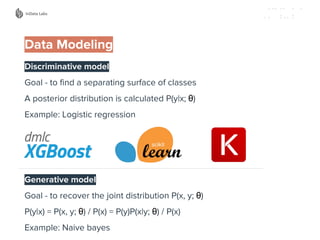
Data Modeling
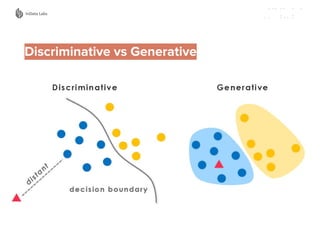
Discriminative model
Goal - to find a separating surface of classes
A posterior distribution is calculated P(y|x; θ)
Example: Logistic regression
Generative model
Goal - to recover the joint distribution P(x, y; θ)
P(y|x) = P(x, y; θ) / P(x) = P(y)P(x|y; θ) / P(x)
Example: Naive bayes
Discriminative vs Generative
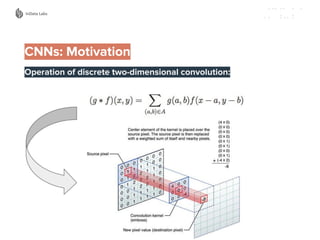
CNNs: Motivation
Operation of discrete two-dimensional convolution:
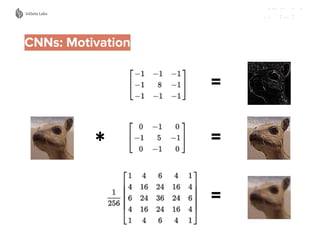
CNNs: Motivation
CNNs: Motivation
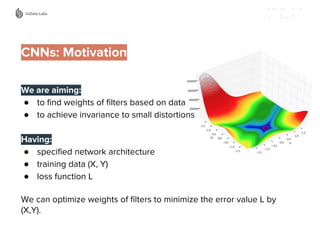
We are aiming:
● to find weights of filters based on data
● to achieve invariance to small distortions
Having:
● specified network architecture
● training data (X, Y)
● loss function L
We can optimize weights of filters to minimize the error value L by
(X,Y).
CNNs: Pooling
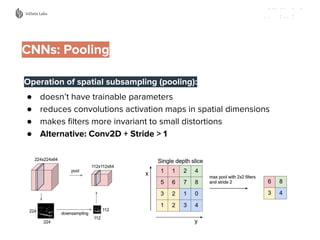
Operation of spatial subsampling (pooling):
● doesn’t have trainable parameters
● reduces convolutions activation maps in spatial dimensions
● makes filters more invariant to small distortions
● Alternative: Conv2D + Stride > 1
CNNs: Architectures
1. Typical architecture of Convolutional Neural Networks
2. Variations
3. Tendencies
A. Fully Convolutional Networks
B. Reduction of the number of parameters and computational
complexity
INPUT→[[CONV→ReLU] * N→POOL?] * M→[FC→ReLU] * K→FC
ResNet / Inception / …
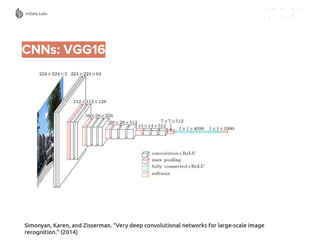
CNNs: VGG16
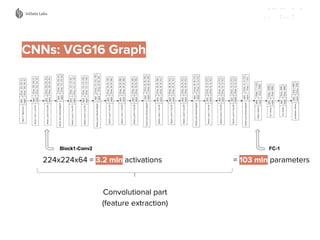
CNNs: VGG16 Graph
224x224x64 ≈ 3.2 mln activations ≈ 103 mln parameters
Convolutional part
(feature extraction)
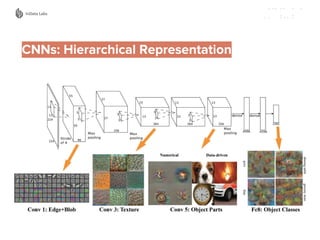
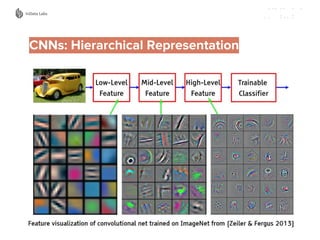
CNNs: Hierarchical Representation
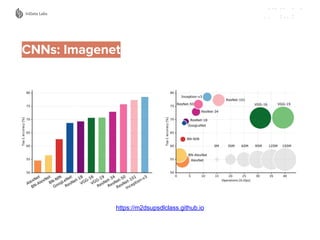
CNNs: Imagenet
https://m2dsupsdlclass.github.io
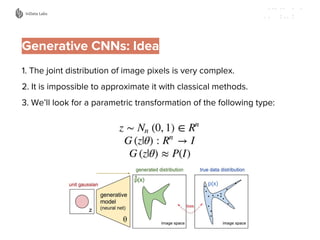
Generative CNNs: Idea
1. The joint distribution of image pixels is very complex.
2. It is impossible to approximate it with classical methods.
3. We’ll look for a parametric transformation of the following type:
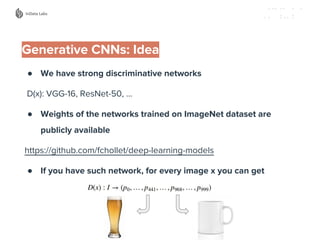
Generative CNNs: Idea
● We have strong discriminative networks
D(x): VGG-16, ResNet-50, …
● Weights of the networks trained on ImageNet dataset are
publicly available
https://github.com/fchollet/deep-learning-models
● If you have such network, for every image x you can get
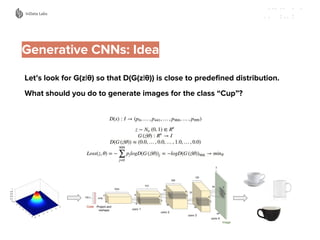
Generative CNNs: Idea
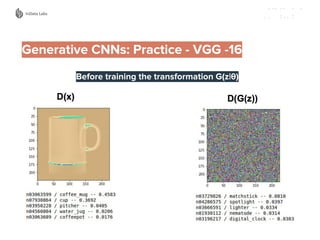
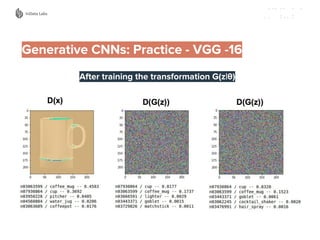
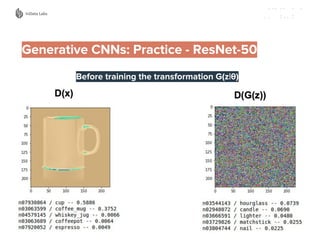
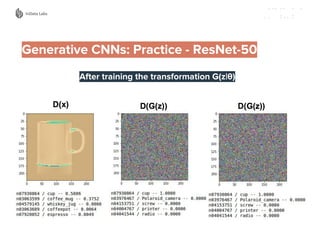
Let’s look for G(z|θ) so that D(G(z|θ)) is close to predefined distribution.
What should you do to generate images for the class “Cup”?
Generative CNNs: Practice - VGG -16
Before training the transformation G(z|θ)
Generative CNNs: Practice - VGG -16
After training the transformation G(z|θ)
Generative CNNs: Practice - ResNet-50
Before training the transformation G(z|θ)
Generative CNNs: Practice - ResNet-50
After training the transformation G(z|θ)
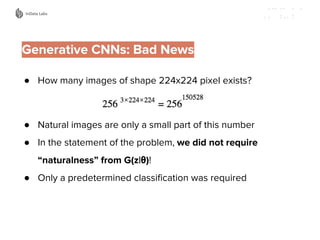
Generative CNNs: Bad News
● How many images of shape 224x224 pixel exists?
● Natural images are only a small part of this number
● In the statement of the problem, we did not require
“naturalness” from G(z|θ)!
● Only a predetermined classification was required
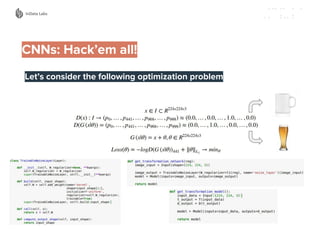
CNNs: Hack’em all!
Let’s consider the following optimization problem
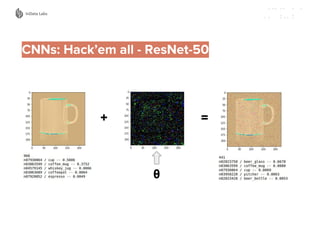
CNNs: Hack’em all - ResNet-50
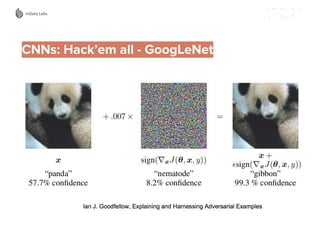
CNNs: Hack’em all - GoogLeNet
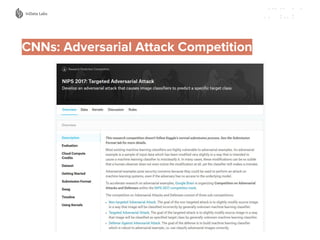
CNNs: Adversarial Attack Competition
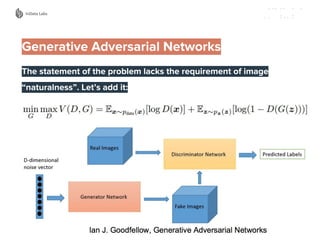
Generative Adversarial Networks
The statement of the problem lacks the requirement of image
“naturalness”. Let’s add it:
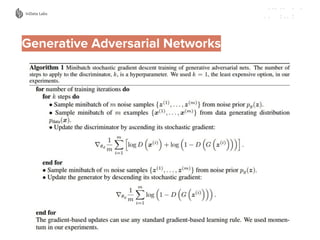
Generative Adversarial Networks
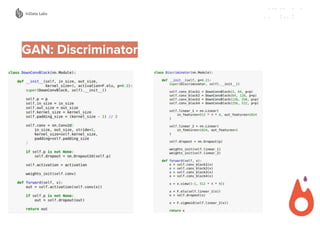
GAN: Discriminator
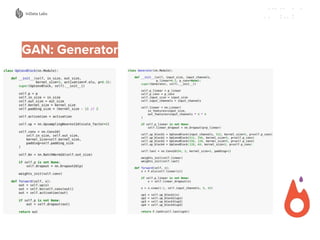
GAN: Generator
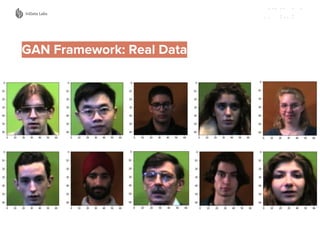
GAN Framework: Real Data
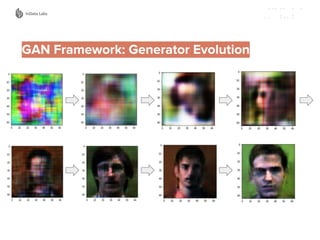
GAN Framework: Generator Evolution
GAN: Difficulties
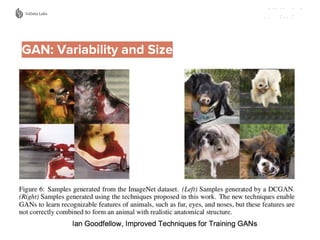
1. Generation of large-sized images (more than 128x128 pixels)
2. The variability of real-world images
3. There is no guarantee that the game converges to an
equilibrium state
4. It is difficult to keep D(x) and G(z) “on the same quality level”
5. Initially, D(x) has a very simple problem (in comparison with G(z))
6. Quality assessment of G(z)
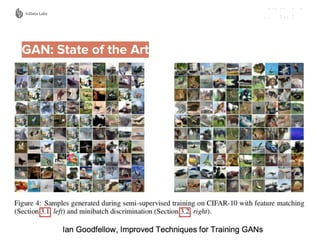
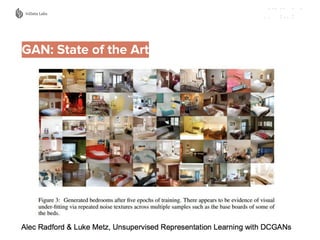
GAN: State of the Art
GAN: Variability and Size
GAN: Designing the D(x)
1. Normalize the input images in [-1.0, 1.0]
2. Should have less parameters than G(x)
3. Use Dropout/Spatial Dropout
4. 2x2 MaxPooling→Convolution2D + Stride = 2
5. ReLU→LeakyReLU/ELU (SELU?)
6. Adaptive L2 regularization
7. Label Smoothing
8. Instance Noise
9. Balancing of the min-max the game
https://github.com/soumith/ganhacks
Ian Goodfellow, Improved Techniques of Training GANs
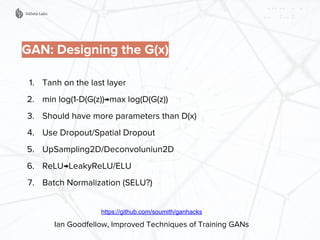
GAN: Designing the G(x)
1. Tanh on the last layer
2. min log(1-D(G(z))→max log(D(G(z))
3. Should have more parameters than D(x)
4. Use Dropout/Spatial Dropout
5. UpSampling2D/Deconvoluniun2D
6. ReLU→LeakyReLU/ELU
7. Batch Normalization (SELU?)
https://github.com/soumith/ganhacks
Ian Goodfellow, Improved Techniques of Training GANs
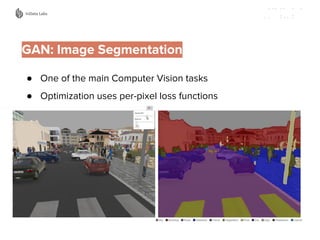
GAN: Image Segmentation
● One of the main Computer Vision tasks
● Optimization uses per-pixel loss functions
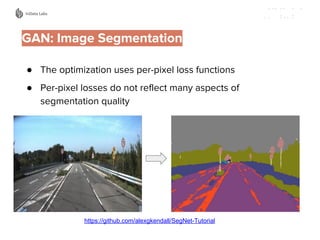
GAN: Image Segmentation
● The optimization uses per-pixel loss functions
● Per-pixel losses do not reflect many aspects of
segmentation quality
https://github.com/alexgkendall/SegNet-Tutorial
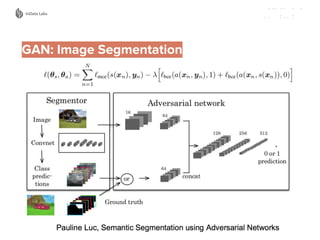
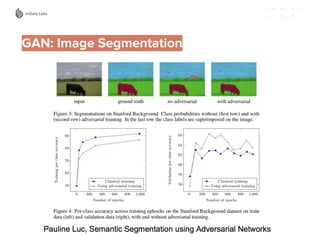
GAN: Image Segmentation
Many other interesting things
1. Types of GAN: Conditional Gan, Stacked GAN, Cycle GAN, …
2. Alternative models: VAE, Pix2Pix, ...
3. Other areas of application: generation of text/audio/video
4. Other practical tasks: Image Super-Resolution, ...
Summary
1. Convolutional neural networks perfectly cope with the CV
tasks
2. But there is a serious problem with “Adversarial Examples”
3. GAN - is a very interesting idea at the intersection of areas
of mathematics
4. GAN is not only fun, but also useful
5. Future improvements in this area are expected
Thank you!
Denis Dus
Lead Data Scientist
d_dus@indatalabs.com
facebook: dzianis.dus
www.indatalabs.com @indatalabs @indatalabs

Generative modeling with Convolutional Neural Networks

  • 1.
    Generative Modeling with ConvolutionalNeural Networks Denis Dus Lead Data Scientist at InData Labs
  • 2.
    What we willdiscuss 1. Discriminative vs Generative modeling 2. Convolutional Neural Networks 3. How to train a neural network to fool a discriminative deep learning model? 4. How to train a neural network to produce photorealistic images? 5. What difficulties can we face and how to avoid them? 6. How could GAN framework be used to solve real problems?
  • 3.
    Data Modeling Discriminative model Goal- to find a separating surface of classes A posterior distribution is calculated P(y|x; θ) Example: Logistic regression Generative model Goal - to recover the joint distribution P(x, y; θ) P(y|x) = P(x, y; θ) / P(x) = P(y)P(x|y; θ) / P(x) Example: Naive bayes
  • 4.
  • 5.
    CNNs: Motivation Operation ofdiscrete two-dimensional convolution:
  • 6.
  • 7.
    CNNs: Motivation We areaiming: ● to find weights of filters based on data ● to achieve invariance to small distortions Having: ● specified network architecture ● training data (X, Y) ● loss function L We can optimize weights of filters to minimize the error value L by (X,Y).
  • 8.
    CNNs: Pooling Operation ofspatial subsampling (pooling): ● doesn’t have trainable parameters ● reduces convolutions activation maps in spatial dimensions ● makes filters more invariant to small distortions ● Alternative: Conv2D + Stride > 1
  • 9.
    CNNs: Architectures 1. Typicalarchitecture of Convolutional Neural Networks 2. Variations 3. Tendencies A. Fully Convolutional Networks B. Reduction of the number of parameters and computational complexity INPUT→[[CONV→ReLU] * N→POOL?] * M→[FC→ReLU] * K→FC ResNet / Inception / …
  • 10.
  • 11.
    CNNs: VGG16 Graph 224x224x64≈ 3.2 mln activations ≈ 103 mln parameters Convolutional part (feature extraction)
  • 12.
  • 13.
  • 14.
  • 15.
    Generative CNNs: Idea 1.The joint distribution of image pixels is very complex. 2. It is impossible to approximate it with classical methods. 3. We’ll look for a parametric transformation of the following type:
  • 16.
    Generative CNNs: Idea ●We have strong discriminative networks D(x): VGG-16, ResNet-50, … ● Weights of the networks trained on ImageNet dataset are publicly available https://github.com/fchollet/deep-learning-models ● If you have such network, for every image x you can get
  • 17.
    Generative CNNs: Idea Let’slook for G(z|θ) so that D(G(z|θ)) is close to predefined distribution. What should you do to generate images for the class “Cup”?
  • 18.
    Generative CNNs: Practice- VGG -16 Before training the transformation G(z|θ)
  • 19.
    Generative CNNs: Practice- VGG -16 After training the transformation G(z|θ)
  • 20.
    Generative CNNs: Practice- ResNet-50 Before training the transformation G(z|θ)
  • 21.
    Generative CNNs: Practice- ResNet-50 After training the transformation G(z|θ)
  • 22.
    Generative CNNs: BadNews ● How many images of shape 224x224 pixel exists? ● Natural images are only a small part of this number ● In the statement of the problem, we did not require “naturalness” from G(z|θ)! ● Only a predetermined classification was required
  • 23.
    CNNs: Hack’em all! Let’sconsider the following optimization problem
  • 24.
  • 25.
  • 26.
  • 27.
    Generative Adversarial Networks Thestatement of the problem lacks the requirement of image “naturalness”. Let’s add it:
  • 28.
  • 29.
  • 30.
  • 31.
  • 32.
  • 33.
    GAN: Difficulties 1. Generationof large-sized images (more than 128x128 pixels) 2. The variability of real-world images 3. There is no guarantee that the game converges to an equilibrium state 4. It is difficult to keep D(x) and G(z) “on the same quality level” 5. Initially, D(x) has a very simple problem (in comparison with G(z)) 6. Quality assessment of G(z)
  • 34.
  • 35.
  • 36.
  • 37.
    GAN: Designing theD(x) 1. Normalize the input images in [-1.0, 1.0] 2. Should have less parameters than G(x) 3. Use Dropout/Spatial Dropout 4. 2x2 MaxPooling→Convolution2D + Stride = 2 5. ReLU→LeakyReLU/ELU (SELU?) 6. Adaptive L2 regularization 7. Label Smoothing 8. Instance Noise 9. Balancing of the min-max the game https://github.com/soumith/ganhacks Ian Goodfellow, Improved Techniques of Training GANs
  • 38.
    GAN: Designing theG(x) 1. Tanh on the last layer 2. min log(1-D(G(z))→max log(D(G(z)) 3. Should have more parameters than D(x) 4. Use Dropout/Spatial Dropout 5. UpSampling2D/Deconvoluniun2D 6. ReLU→LeakyReLU/ELU 7. Batch Normalization (SELU?) https://github.com/soumith/ganhacks Ian Goodfellow, Improved Techniques of Training GANs
  • 39.
    GAN: Image Segmentation ●One of the main Computer Vision tasks ● Optimization uses per-pixel loss functions
  • 40.
    GAN: Image Segmentation ●The optimization uses per-pixel loss functions ● Per-pixel losses do not reflect many aspects of segmentation quality https://github.com/alexgkendall/SegNet-Tutorial
  • 41.
  • 42.
  • 43.
    Many other interestingthings 1. Types of GAN: Conditional Gan, Stacked GAN, Cycle GAN, … 2. Alternative models: VAE, Pix2Pix, ... 3. Other areas of application: generation of text/audio/video 4. Other practical tasks: Image Super-Resolution, ...
  • 44.
    Summary 1. Convolutional neuralnetworks perfectly cope with the CV tasks 2. But there is a serious problem with “Adversarial Examples” 3. GAN - is a very interesting idea at the intersection of areas of mathematics 4. GAN is not only fun, but also useful 5. Future improvements in this area are expected
  • 45.
    Thank you! Denis Dus LeadData Scientist d_dus@indatalabs.com facebook: dzianis.dus www.indatalabs.com @indatalabs @indatalabs