KHUSHI SAINI
170305110015
BTECH .AGRICULTURALENGINEERING DEPT
.
4TH YEAR SEMINAR PRESENTATION
SUBMITTED TO :- ENG. DIVEYSH VAGHALA
INTRODUCTION
WHAT IS SURPLUS BIOMASS?
BIOMASS CONVERTED TO
ENERGY
ENERGY GENERATION MODES
DIRECT COMBUSTI0N
THERMAL GASIFICATION
FAST PYROLYSIS
SOCIAL BENEFITS OF SURPLUS
BIOMASS POWER GENERATION
Electricity is a type of energy that can build up in one place or flow
from one place to another.
Biomass is one of the prospective sources of renewable energy to
produce electricity in different countries in the world.
Electricity is most often generated at a power plant by
electromechanical generators, primarily driven by heat engines fueled
by combustion or nuclear fission but also by other means such as the
kinetic energy of flowing water and wind. Other energy sources include
solar photovoltaic , geothermal power and biomass energy.
SURPLUS an amount of something left over when
requirements have met, an excess of production or
supply.
Biomass remains as surplus of which maximum comes
from the forestry sector with over 68% in forms of twigs,
dry branches, roots and wood chips etc.
Wheat, Corn, Sugarcane and fast-growing tree crops such
as willow and poplar that are purposefully grown for the
biomass industry.
BIOMASS CONVERTED TO ENERGY
When the plants are cut or die, wood chips, straw and other plant matter is derived
to biogas plant. When biomass is burnt, it release energy in the form of heat.
The biomass plants burn wood or other forms of waste to generate steam. The
energy from of waste to generate steam. The energy from the steam is directed
via pipes to run turbines.
The steam rises up to run turbines that produce electricity or generate heat for
homes and industries.
In most countries, biomass plants have been built in the countryside to provide
electricity to the local population. There are waste to energy plants that burn trash
to produce electricity and power millions of homes.
DIRECT
COMBUSTION
THERMAL
GASIFICATION
FAST
PYROLYSIS
Direct combustion of biomass for electricity production is common in the forestry and timber
industries. It has been estimated that 53% of the raw timber delivered to sawmills ends up as
biomass in the form of woodchips, bark and sawdust. Direct combustion systems feed a
biomass feedstock into combustor or furnace, where the biomass is burned with excess air to
heat water in a boiler to create steam. Steam from the boiler is then expanded through a steam
turbine , which spins to runs a generator and produces electricity.
In general, all biomass systems require fuel storage space and some type of fuel handling
equipment and controls. An automated control system conveys the fuel from the outside storage
area using some combination of cranes, stackers, reclaimers, front-end loaders, belts, augers,
and pneumatic transport. Manual equipment, like front loaders, can be used to transfer biomass
from the piles to the bunkers, but this method will incur significant cost in labor and equipment
operations and maintenance
Wood chip-fired electric power systems typically use one dry ton per megawatt-hour of
electricity production. This approximation is typical of wet wood systems and is useful for
a first approximation of fuel use and storage requirements but the actual value will vary
with system efficiency. For comparison, this is equivalent to 20% HHV efficiency with 17
MMBtu/ton wood.
Most wood chips produced from green lumber will have a moisture content of 40% to
55%, wet basis, which means that a ton of green fuel will contain 800 to 1,100 pounds of
water. This water will reduce the recoverable energy content of the material, and reduce
the efficiency of the boiler, as the water must be evaporated in the first stages of
combustion.
The two principal types of chip-fired direct combustion systems:-
1. FIXED – BED SYSTEM
2. FLUIDIZED – BED SYSTEM
IN A DIRECT COMBUSTION SYSTEM PROCESSED BIOMASS IS THE BOILER FUEL
THAT PRODUCED STEAM TO OPERATE A STEAM TURBINE AND GENERATOR TO
MAKE ELECTRICITY.
KEY COMPONENTS OF DIRECT
COMBUSTION
 Fuel storage and handling equipment
 Combustor/ furnace
 Boiler
 Pumps
 Fans
 Steams turbine
 Generator
 Condenser
 Cooling tower
 Exhaust/ emission control
 System control
ADVANTAGES
 Mature technology
 Low running cost
 Simple biomass pretreatment
DISADVANTAGES
 Low efficiency at small scale
 Single biomass fuel
 Large investment
APPLICATION
 Large scale power generation
THERMAL GASIFICATION
Gasification- Takes place by heating the biomass
with limited oxygen/Air (deficient O2 and Air) to
produce low heating value gas or by reacting it with
steam & Oxygen at high pressure & temperature to
produce medium heating value gas like H2 , CO2 ,
CH2 , N2.
Biomass gasified first and then fuel gas burned with
coal in boiler.
How Gasification is Used for Power Generation
Biomass gasification is a process that
converts agricultural and industry solid
waste into a clean source of electricity by
unlocking the energy in these materials.
Using advanced thermal conversion
technology that involves heat, and finely
controlled oxygen supply, the biomass
waste is transformed into H2, CO2, CH2
and other inert gasses producing electricity
and heat without combustion or high carbon
emissions commonly associated with more
traditional sources of power.
The term biomass refers to a wide range of
materials, including agricultural byproducts
such as corn husks, wood chips, lumber and
timber yard wastes which is known as
surplus biomass .
biomass gasification systems are similar to combustion systems, except that the quantity of air is limited,
and thus produce a clean fuel gas with a usable heating value in contrast to combustion, in which the off
gas does not have a usable heating value. Clean fuel gas provides the ability to power many different kinds
of gas-based prime movers, such as internal combustion engines, Sterling engines, thermo electric
generators, solid oxide fuel cells, and micro-turbines
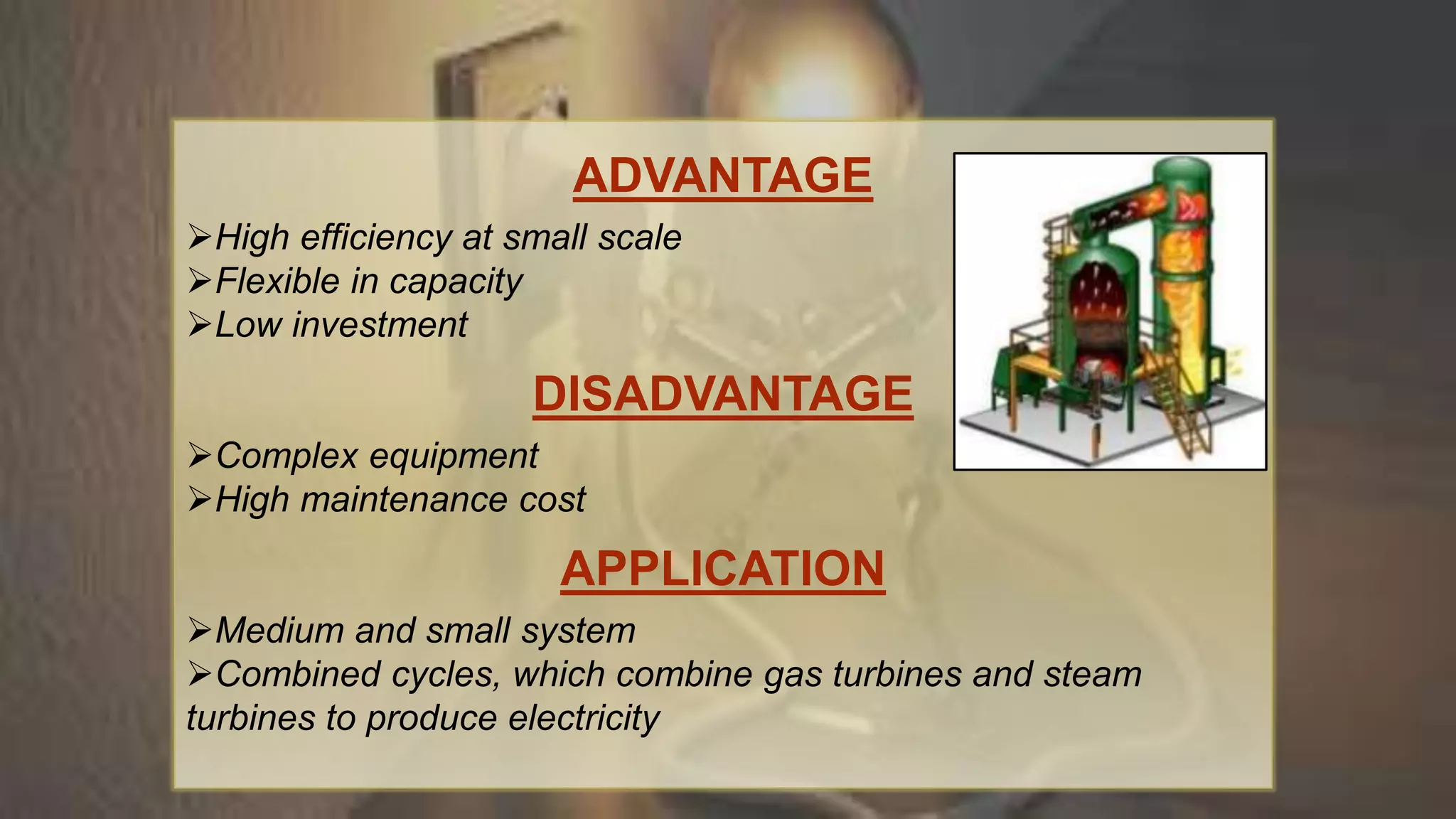
ADVANTAGE
High efficiency at small scale
Flexible in capacity
Low investment
DISADVANTAGE
Complex equipment
High maintenance cost
APPLICATION
Medium and small system
Combined cycles, which combine gas turbines and steam
turbines to produce electricity
FAST PYROLYSIS
FAST PYROLYSIS
Biomass pyrolysis is the thermal decomposition
of biomass .
Fast pyrolysis is a process in which organic
materials are rapidly heated in the range of 500°c
to 900°c in absence if oxygen or with steam. It
produces solid, liquid and gases.
The pyrolysis process can be use all type of
organic material including plastic and rubber.
The biomass pyrolysis process consists of both
simultaneous and successive reactions when
organic material is heated in a non-reactive
atmosphere.
The products of biomass pyrolysis include
biochar, bio-oil and gases including methane,
hydrogen, carbon monoxide, and carbon dioxide.
The main product of pyrolysis is fuel oil and the process is optimized to convert
the maximum amount of carbon compound into oil.
Pyrolysis fuel oil has been successfully used with small gas turbines (1 mw) and
with heavy fuel oil engines (diesel engines) for the production of energy.
There is an increasing interest in pyrolysis because the fuel oil can be stored and
transported, and does not need to be used at the same site as it is produced
Advantages of Biomass Pyrolysis
Pyrolysis can be performed at relatively small scale and at remote
locations.
Pyrolysis offers a flexible and attractive way of converting organic
matter into energy products.
A wide range of biomass feedstock can be used in pyrolysis
processes.
The bio-char produced can be used on the farm as an excellent
soil amender as it is highly absorbent and therefore increases the
soil’s ability to retain water, nutrients and agricultural chemicals,
preventing water contamination and soil erosion.
Biomass pyrolysis has been garnering much attention due to its
high efficiency and good environmental performance characteristics.
 It also provides an opportunity for the processing of agricultural
residues, wood wastes and municipal solid waste into clean energy.
SOCIAL BENEFITS OF SURPLUS BIOMASS
POWER GENERATION
Biomass power generates electricity that is :-
Reliable
Domestically produced
Economically competitive
Environmentally sustainable
Since biomass energy uses domestically produced fuels,
biomass power :-
Greatly reduces our dependence on foreign energy sources.
Increase our national security
Provides greater fuel diversity
https://www.bioenergyconsult.com/biomass-pyrolysis/
https://www.slideshare.net/iqbal_abbas93/biomass-fuelled-power-plants
https://www.slideshare.net/guest067b99/india-biomass-power-sector
https://www.wbdg.org/resources/biomass-electricity-generation
https://www.researchgate.net/publication/281781431_Gasification_Technology_for_Electricity_Gen
eration_in_Rural_Area#:~:text=The%20biomass%20gasification%20for%20electricity,a%20generator
%20for%20electricity%20generation
https://www.bioenergyconsult.com/biomass-pyrolysis/
https://www.irena.org/documentdownloads/publications/re_technologies_cost_analysis-biomass.pdf
VIDEO LINK
https://youtu.be/40ztd8uoU9Q
References
Generation of electricity

Generation of electricity

  • 2.
    KHUSHI SAINI 170305110015 BTECH .AGRICULTURALENGINEERINGDEPT . 4TH YEAR SEMINAR PRESENTATION SUBMITTED TO :- ENG. DIVEYSH VAGHALA
  • 4.
    INTRODUCTION WHAT IS SURPLUSBIOMASS? BIOMASS CONVERTED TO ENERGY ENERGY GENERATION MODES DIRECT COMBUSTI0N THERMAL GASIFICATION FAST PYROLYSIS SOCIAL BENEFITS OF SURPLUS BIOMASS POWER GENERATION
  • 5.
    Electricity is atype of energy that can build up in one place or flow from one place to another. Biomass is one of the prospective sources of renewable energy to produce electricity in different countries in the world. Electricity is most often generated at a power plant by electromechanical generators, primarily driven by heat engines fueled by combustion or nuclear fission but also by other means such as the kinetic energy of flowing water and wind. Other energy sources include solar photovoltaic , geothermal power and biomass energy.
  • 6.
    SURPLUS an amountof something left over when requirements have met, an excess of production or supply. Biomass remains as surplus of which maximum comes from the forestry sector with over 68% in forms of twigs, dry branches, roots and wood chips etc. Wheat, Corn, Sugarcane and fast-growing tree crops such as willow and poplar that are purposefully grown for the biomass industry.
  • 8.
    BIOMASS CONVERTED TOENERGY When the plants are cut or die, wood chips, straw and other plant matter is derived to biogas plant. When biomass is burnt, it release energy in the form of heat. The biomass plants burn wood or other forms of waste to generate steam. The energy from of waste to generate steam. The energy from the steam is directed via pipes to run turbines. The steam rises up to run turbines that produce electricity or generate heat for homes and industries. In most countries, biomass plants have been built in the countryside to provide electricity to the local population. There are waste to energy plants that burn trash to produce electricity and power millions of homes.
  • 10.
  • 11.
    Direct combustion ofbiomass for electricity production is common in the forestry and timber industries. It has been estimated that 53% of the raw timber delivered to sawmills ends up as biomass in the form of woodchips, bark and sawdust. Direct combustion systems feed a biomass feedstock into combustor or furnace, where the biomass is burned with excess air to heat water in a boiler to create steam. Steam from the boiler is then expanded through a steam turbine , which spins to runs a generator and produces electricity. In general, all biomass systems require fuel storage space and some type of fuel handling equipment and controls. An automated control system conveys the fuel from the outside storage area using some combination of cranes, stackers, reclaimers, front-end loaders, belts, augers, and pneumatic transport. Manual equipment, like front loaders, can be used to transfer biomass from the piles to the bunkers, but this method will incur significant cost in labor and equipment operations and maintenance
  • 12.
    Wood chip-fired electricpower systems typically use one dry ton per megawatt-hour of electricity production. This approximation is typical of wet wood systems and is useful for a first approximation of fuel use and storage requirements but the actual value will vary with system efficiency. For comparison, this is equivalent to 20% HHV efficiency with 17 MMBtu/ton wood. Most wood chips produced from green lumber will have a moisture content of 40% to 55%, wet basis, which means that a ton of green fuel will contain 800 to 1,100 pounds of water. This water will reduce the recoverable energy content of the material, and reduce the efficiency of the boiler, as the water must be evaporated in the first stages of combustion. The two principal types of chip-fired direct combustion systems:- 1. FIXED – BED SYSTEM 2. FLUIDIZED – BED SYSTEM
  • 13.
    IN A DIRECTCOMBUSTION SYSTEM PROCESSED BIOMASS IS THE BOILER FUEL THAT PRODUCED STEAM TO OPERATE A STEAM TURBINE AND GENERATOR TO MAKE ELECTRICITY.
  • 15.
    KEY COMPONENTS OFDIRECT COMBUSTION  Fuel storage and handling equipment  Combustor/ furnace  Boiler  Pumps  Fans  Steams turbine  Generator  Condenser  Cooling tower  Exhaust/ emission control  System control
  • 16.
    ADVANTAGES  Mature technology Low running cost  Simple biomass pretreatment DISADVANTAGES  Low efficiency at small scale  Single biomass fuel  Large investment APPLICATION  Large scale power generation
  • 17.
  • 18.
    THERMAL GASIFICATION Gasification- Takesplace by heating the biomass with limited oxygen/Air (deficient O2 and Air) to produce low heating value gas or by reacting it with steam & Oxygen at high pressure & temperature to produce medium heating value gas like H2 , CO2 , CH2 , N2. Biomass gasified first and then fuel gas burned with coal in boiler.
  • 19.
    How Gasification isUsed for Power Generation Biomass gasification is a process that converts agricultural and industry solid waste into a clean source of electricity by unlocking the energy in these materials. Using advanced thermal conversion technology that involves heat, and finely controlled oxygen supply, the biomass waste is transformed into H2, CO2, CH2 and other inert gasses producing electricity and heat without combustion or high carbon emissions commonly associated with more traditional sources of power. The term biomass refers to a wide range of materials, including agricultural byproducts such as corn husks, wood chips, lumber and timber yard wastes which is known as surplus biomass .
  • 20.
    biomass gasification systemsare similar to combustion systems, except that the quantity of air is limited, and thus produce a clean fuel gas with a usable heating value in contrast to combustion, in which the off gas does not have a usable heating value. Clean fuel gas provides the ability to power many different kinds of gas-based prime movers, such as internal combustion engines, Sterling engines, thermo electric generators, solid oxide fuel cells, and micro-turbines
  • 21.
    ADVANTAGE High efficiency atsmall scale Flexible in capacity Low investment DISADVANTAGE Complex equipment High maintenance cost APPLICATION Medium and small system Combined cycles, which combine gas turbines and steam turbines to produce electricity
  • 22.
  • 23.
    FAST PYROLYSIS Biomass pyrolysisis the thermal decomposition of biomass . Fast pyrolysis is a process in which organic materials are rapidly heated in the range of 500°c to 900°c in absence if oxygen or with steam. It produces solid, liquid and gases. The pyrolysis process can be use all type of organic material including plastic and rubber. The biomass pyrolysis process consists of both simultaneous and successive reactions when organic material is heated in a non-reactive atmosphere. The products of biomass pyrolysis include biochar, bio-oil and gases including methane, hydrogen, carbon monoxide, and carbon dioxide.
  • 24.
    The main productof pyrolysis is fuel oil and the process is optimized to convert the maximum amount of carbon compound into oil. Pyrolysis fuel oil has been successfully used with small gas turbines (1 mw) and with heavy fuel oil engines (diesel engines) for the production of energy. There is an increasing interest in pyrolysis because the fuel oil can be stored and transported, and does not need to be used at the same site as it is produced
  • 25.
    Advantages of BiomassPyrolysis Pyrolysis can be performed at relatively small scale and at remote locations. Pyrolysis offers a flexible and attractive way of converting organic matter into energy products. A wide range of biomass feedstock can be used in pyrolysis processes. The bio-char produced can be used on the farm as an excellent soil amender as it is highly absorbent and therefore increases the soil’s ability to retain water, nutrients and agricultural chemicals, preventing water contamination and soil erosion. Biomass pyrolysis has been garnering much attention due to its high efficiency and good environmental performance characteristics.  It also provides an opportunity for the processing of agricultural residues, wood wastes and municipal solid waste into clean energy.
  • 26.
    SOCIAL BENEFITS OFSURPLUS BIOMASS POWER GENERATION Biomass power generates electricity that is :- Reliable Domestically produced Economically competitive Environmentally sustainable Since biomass energy uses domestically produced fuels, biomass power :- Greatly reduces our dependence on foreign energy sources. Increase our national security Provides greater fuel diversity
  • 28.